1
Chapter 9&14
Biological and Chemical
Conversion Technologies
Biological conversion of MSW
 With the exception of plastic, rubber and leather components,
the organic fraction of MSW (OFMSW) is composed of
proteins, lipids, carbohydrates, cellulose, lignin and ash.
 The two common biological processes used to transform
these organic materials into gaseous, liquid and solid
conversion products are;
 Aerobic Composting
 Anaerobic Digestion (AD)
2
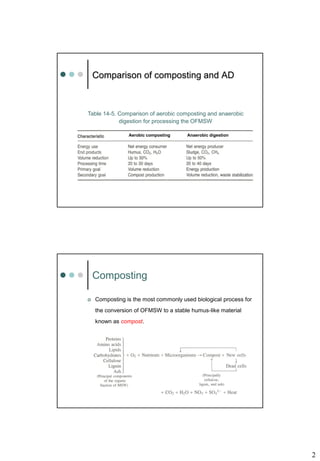
Comparison of composting and AD
Table 14-5. Comparison of aerobic composting and anaerobic
digestion for processing the OFMSW
Aerobic composting Anaerobic digestion
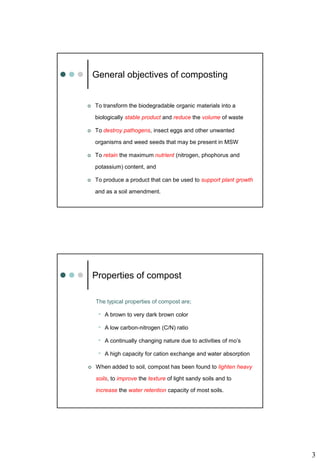
Composting
 Composting is the most commonly used biological process for
the conversion of OFMSW to a stable humus-like material
known as compost.
3
 To transform the biodegradable organic materials into a
biologically stable product and reduce the volume of waste
 To destroy pathogens, insect eggs and other unwanted
organisms and weed seeds that may be present in MSW
 To retain the maximum nutrient (nitrogen, phophorus and
potassium) content, and
 To produce a product that can be used to support plant growth
and as a soil amendment.
General objectives of composting
The typical properties of compost are;
• A brown to very dark brown color
• A low carbon-nitrogen (C/N) ratio
• A continually changing nature due to activities of mo’s
• A high capacity for cation exchange and water absorption
 When added to soil, compost has been found to lighten heavy
soils, to improve the texture of light sandy soils and to
increase the water retention capacity of most soils.
Properties of compost
4
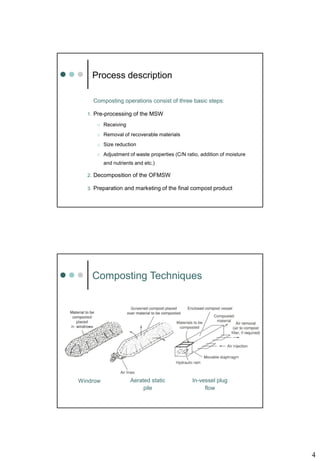
Process description
Composting operations consist of three basic steps:
1. Pre-processing of the MSW
o Receiving
o Removal of recoverable materials
o Size reduction
o Adjustment of waste properties (C/N ratio, addition of moisture
and nutrients and etc.)
2. Decomposition of the OFMSW
3. Preparation and marketing of the final compost product
Composting Techniques
Windrow Aerated static
pile
In-vessel plug
flow
5
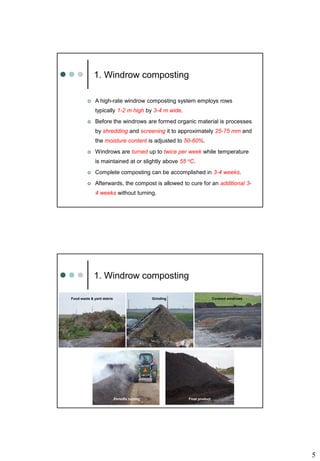
1. Windrow composting
 A high-rate windrow composting system employs rows
typically 1-2 m high by 3-4 m wide.
 Before the windrows are formed organic material is processes
by shredding and screening it to approximately 25-75 mm and
the moisture content is adjusted to 50-60%.
 Windrows are turned up to twice per week while temperature
is maintained at or slightly above 55 oC.
 Complete composting can be accomplished in 3-4 weeks.
 Afterwards, the compost is allowed to cure for an additional 3-
4 weeks without turning.
Food waste & yard debris Grinding Covered windrows
Final product
1. Windrow composting
Periodic turning
6
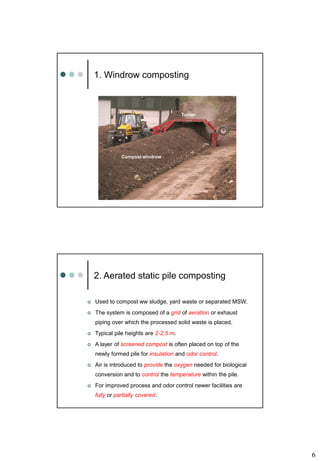
1. Windrow composting
Turner
Compost windrow
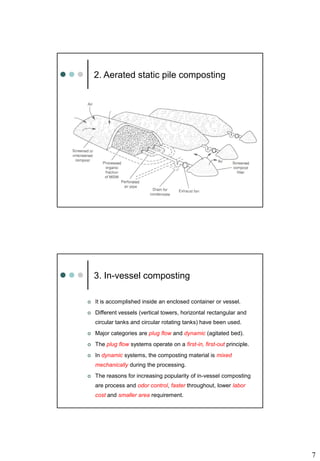
2. Aerated static pile composting
 Used to compost ww sludge, yard waste or separated MSW.
 The system is composed of a grid of aeration or exhaust
piping over which the processed solid waste is placed.
 Typical pile heights are 2-2,5 m.
 A layer of screened compost is often placed on top of the
newly formed pile for insulation and odor control.
 Air is introduced to provide the oxygen needed for biological
conversion and to control the temperature within the pile.
 For improved process and odor control newer facilities are
fully or partially covered.
7
2. Aerated static pile composting
3. In-vessel composting
 It is accomplished inside an enclosed container or vessel.
 Different vessels (vertical towers, horizontal rectangular and
circular tanks and circular rotating tanks) have been used.
 Major categories are plug flow and dynamic (agitated bed).
 The plug flow systems operate on a first-in, first-out principle.
 In dynamic systems, the composting material is mixed
mechanically during the processing.
 The reasons for increasing popularity of in-vessel composting
are process and odor control, faster throughout, lower labor
cost and smaller area requirement.
8
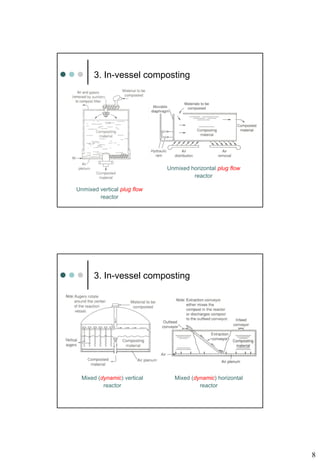
Unmixed vertical plug flow
reactor
Unmixed horizontal plug flow
reactor
3. In-vessel composting
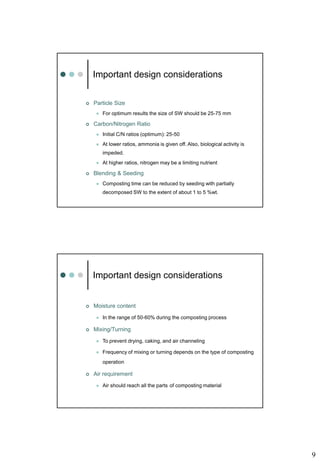
Mixed (dynamic) vertical
reactor
Mixed (dynamic) horizontal
reactor
3. In-vessel composting
9
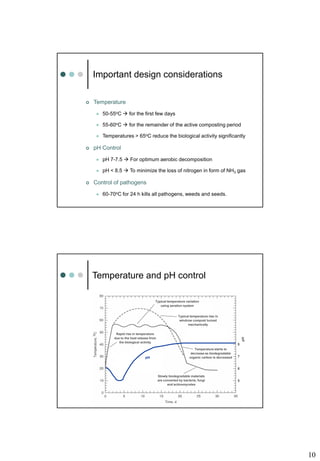
Important design considerations
 Particle Size
 For optimum results the size of SW should be 25-75 mm
 Carbon/Nitrogen Ratio
 Initial C/N ratios (optimum): 25-50
 At lower ratios, ammonia is given off. Also, biological activity is
impeded.
 At higher ratios, nitrogen may be a limiting nutrient
 Blending & Seeding
 Composting time can be reduced by seeding with partially
decomposed SW to the extent of about 1 to 5 %wt.
Important design considerations
 Moisture content
 In the range of 50-60% during the composting process
 Mixing/Turning
 To prevent drying, caking, and air channeling
 Frequency of mixing or turning depends on the type of composting
operation
 Air requirement
 Air should reach all the parts of composting material
10
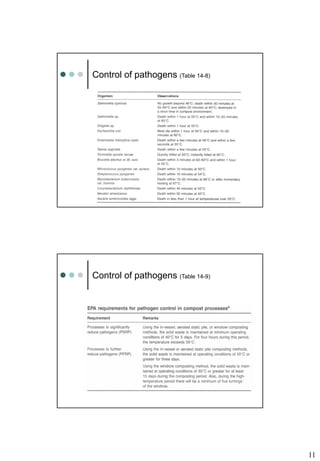
 Temperature
 50-55oC  for the first few days
 55-60oC  for the remainder of the active composting period
 Temperatures > 65oC reduce the biological activity significantly
 pH Control
 pH 7-7.5  For optimum aerobic decomposition
 pH < 8.5  To minimize the loss of nitrogen in form of NH3 gas
 Control of pathogens
 60-70oC for 24 h kills all pathogens, weeds and seeds.
Important design considerations
Temperature and pH control
5
6
7
8
pH
Rapid rise in temperature
due to the heat release from
the biological activity
Slowly biodegradable materials
are converted by bacteria, fungi
and actinomycetes
Temperature starts to
decrease as biodegradable
organic carbon is decreased
Typical temperature rise in
windrow compost turned
mechanically
Typical temperature variation
using aeration system
pH
11
Control of pathogens (Table 14-8)
Control of pathogens (Table 14-9)
12
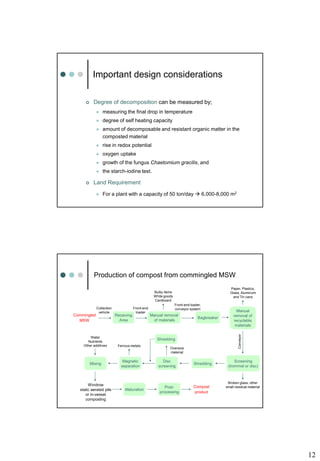
 Degree of decomposition can be measured by;
 measuring the final drop in temperature
 degree of self heating capacity
 amount of decomposable and resistant organic matter in the
composted material
 rise in redox potential
 oxygen uptake
 growth of the fungus Chaetomium gracilis, and
 the starch-iodine test.
 Land Requirement
 For a plant with a capacity of 50 ton/day  6,000-8,000 m2
Important design considerations
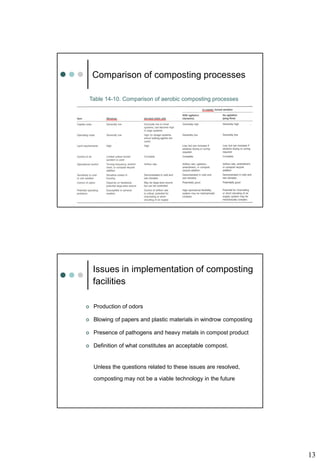
Receiving
Area
Front-end loader,
conveyor system
Bagbreaker
Commingled
MSW
Manual removal
of materials
Front-end
loader
Collection
vehicle Manual
removal of
recyclable
materials
Screening
(trommel or disc)
Conveyor
Shredding
Disc
screening
Shredding
Magnetic
separation
Bulky items
White goods
Cardboard
Paper, Plastics,
Glass, Aluminum
and Tin cans
Broken glass, other
small residual material
Oversize
material
Mixing
Water
Nutrients
Other additives Ferrous metals
Windrow
static aerated pile
or in-vessel
composting
Maturation
Post-
processing
Compost
product
Production of compost from commingled MSW
13
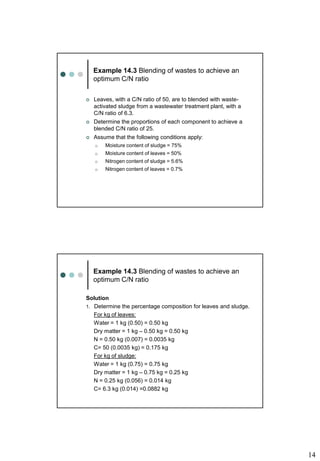
Comparison of composting processes
Table 14-10. Comparison of aerobic composting processes
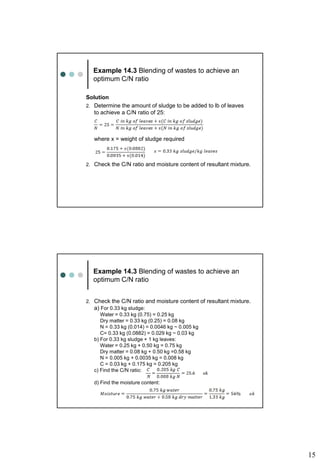
 Production of odors
 Blowing of papers and plastic materials in windrow composting
 Presence of pathogens and heavy metals in compost product
 Definition of what constitutes an acceptable compost.
Unless the questions related to these issues are resolved,
composting may not be a viable technology in the future
Issues in implementation of composting
facilities
14
Example 14.3 Blending of wastes to achieve an
optimum C/N ratio
 Leaves, with a C/N ratio of 50, are to blended with waste-
activated sludge from a wastewater treatment plant, with a
C/N ratio of 6.3.
 Determine the proportions of each component to achieve a
blended C/N ratio of 25.
 Assume that the following conditions apply:
o Moisture content of sludge = 75%
o Moisture content of leaves = 50%
o Nitrogen content of sludge = 5.6%
o Nitrogen content of leaves = 0.7%
Example 14.3 Blending of wastes to achieve an
optimum C/N ratio
Solution
1. Determine the percentage composition for leaves and sludge.
For kg of leaves:
Water = 1 kg (0.50) = 0.50 kg
Dry matter = 1 kg – 0.50 kg = 0.50 kg
N = 0.50 kg (0.007) = 0.0035 kg
C= 50 (0.0035 kg) = 0.175 kg
For kg of sludge:
Water = 1 kg (0.75) = 0.75 kg
Dry matter = 1 kg – 0.75 kg = 0.25 kg
N = 0.25 kg (0.056) = 0.014 kg
C= 6.3 kg (0.014) =0.0882 kg
15
Example 14.3 Blending of wastes to achieve an
optimum C/N ratio
Solution
2. Determine the amount of sludge to be added to lb of leaves
to achieve a C/N ratio of 25:
where x = weight of sludge required
2. Check the C/N ratio and moisture content of resultant mixture.
Example 14.3 Blending of wastes to achieve an
optimum C/N ratio
2. Check the C/N ratio and moisture content of resultant mixture.
a) For 0.33 kg sludge:
Water = 0.33 kg (0.75) = 0.25 kg
Dry matter = 0.33 kg (0.25) = 0.08 kg
N = 0.33 kg (0.014) = 0.0046 kg ~ 0.005 kg
C= 0.33 kg (0.0882) = 0.029 kg ~ 0.03 kg
b) For 0.33 kg sludge + 1 kg leaves:
Water = 0.25 kg + 0.50 kg = 0.75 kg
Dry matter = 0.08 kg + 0.50 kg =0.58 kg
N = 0.005 kg + 0.0035 kg = 0.008 kg
C = 0.03 kg + 0.175 kg = 0.205 kg
c) Find the C/N ratio:
d) Find the moisture content:
16
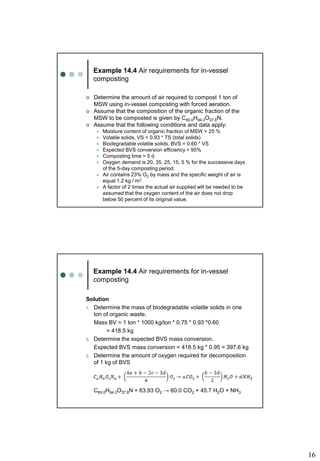
Example 14.4 Air requirements for in-vessel
composting
 Determine the amount of air required to compost 1 ton of
MSW using in-vessel composting with forced aeration.
 Assume that the composition of the organic fraction of the
MSW to be composted is given by C60.0H94.3O37.8N.
 Assume that the following conditions and data apply:
 Moisture content of organic fraction of MSW = 25 %
 Volatile solids, VS = 0.93 * TS (total solids)
 Biodegradable volatile solids, BVS = 0.60 * VS
 Expected BVS conversion efficiency = 95%
 Composting time = 5 d
 Oxygen demand is 20, 35, 25, 15, 5 % for the successive days
of the 5-day composting period.
 Air contains 23% O2 by mass and the specific weight of air is
equal 1.2 kg / m3.
 A factor of 2 times the actual air supplied will be needed to be
assumed that the oxygen content of the air does not drop
below 50 percent of its original value.
Example 14.4 Air requirements for in-vessel
composting
Solution
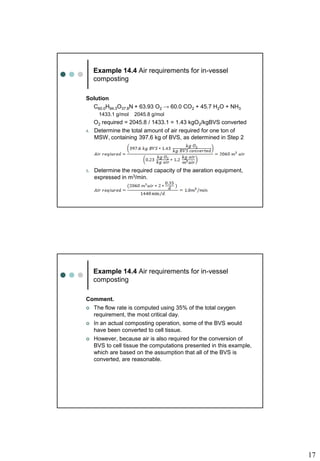
1. Determine the mass of biodegradable volatile solids in one
ton of organic waste.
Mass BV = 1 ton * 1000 kg/ton * 0.75 * 0.93 *0.60
= 418.5 kg
2. Determine the expected BVS mass conversion.
Expected BVS mass conversion = 418.5 kg * 0.95 = 397.6 kg
3. Determine the amount of oxygen required for decomposition
of 1 kg of BVS
C60.0H94.3O37.8N + 63.93 O2 → 60.0 CO2 + 45.7 H2O + NH3
17
Example 14.4 Air requirements for in-vessel
composting
Solution
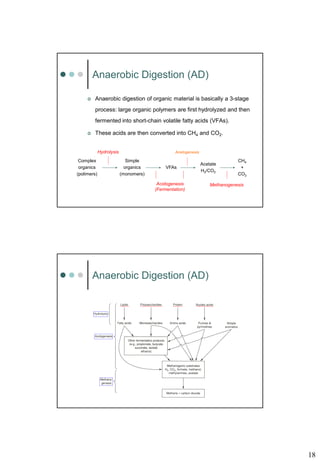
C60.0H94.3O37.8N + 63.93 O2 → 60.0 CO2 + 45.7 H2O + NH3
1433.1 g/mol 2045.8 g/mol
O2 required = 2045.8 / 1433.1 = 1.43 kgO2/kgBVS converted
4. Determine the total amount of air required for one ton of
MSW, containing 397.6 kg of BVS, as determined in Step 2
5. Determine the required capacity of the aeration equipment,
expressed in m3/min.
Example 14.4 Air requirements for in-vessel
composting
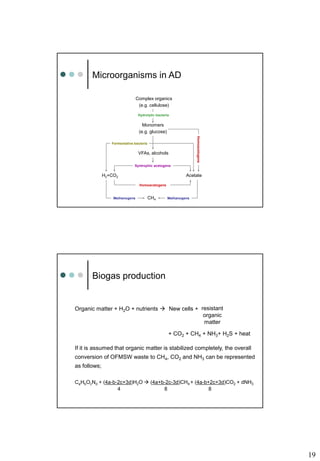
Comment.
 The flow rate is computed using 35% of the total oxygen
requirement, the most critical day.
 In an actual composting operation, some of the BVS would
have been converted to cell tissue.
 However, because air is also required for the conversion of
BVS to cell tissue the computations presented in this example,
which are based on the assumption that all of the BVS is
converted, are reasonable.
18
Anaerobic Digestion (AD)
 Anaerobic digestion of organic material is basically a 3-stage
process: large organic polymers are first hydrolyzed and then
fermented into short-chain volatile fatty acids (VFAs).
 These acids are then converted into CH4 and CO2.
Complex
organics
(polimers)
Simple
organics
(monomers)
VFAs
Acetate
H2/CO2
CH4
+
CO2
Hydrolysis
Acidogenesis
(Fermentation)
Acetogenesis
Methanogenesis
Anaerobic Digestion (AD)
19
Microorganisms in AD
Complex organics
(e.g. cellulose)
Monomers
(e.g. glucose)
VFAs, alcohols
CH4
Hydrolytic bacteria
H2+CO2 Acetate
Homoacetogens
Syntrophic acetogens
Methanogens Methanogens
Homoacetogens
Fermentative bacteria
Biogas production
Organic matter + H2O + nutrients 
+ CO2 + CH4 + NH3+ H2S + heat
resistant
organic
matter
New cells +
If it is assumed that organic matter is stabilized completely, the overall
conversion of OFMSW waste to CH4, CO2 and NH3 can be represented
as follows;
CaHbOcNd + (4a-b-2c+3d)H2O  (4a+b-2c-3d)CH4 + (4a-b+2c+3d)CO2 + dNH3
4 8 8
20
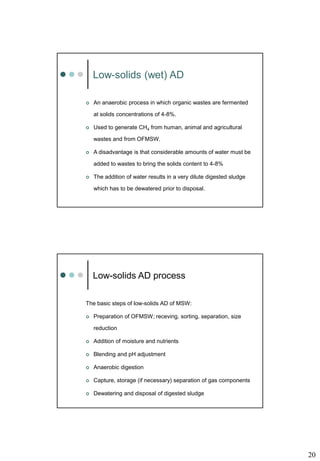
 An anaerobic process in which organic wastes are fermented
at solids concentrations of 4-8%.
 Used to generate CH4 from human, animal and agricultural
wastes and from OFMSW.
 A disadvantage is that considerable amounts of water must be
added to wastes to bring the solids content to 4-8%
 The addition of water results in a very dilute digested sludge
which has to be dewatered prior to disposal.
Low-solids (wet) AD
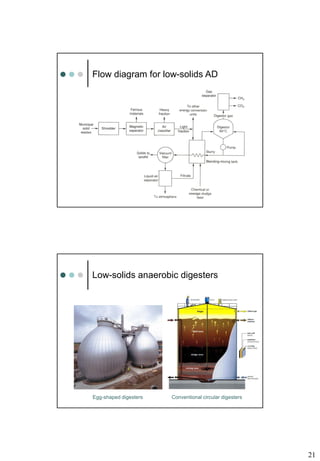
The basic steps of low-solids AD of MSW:
 Preparation of OFMSW; receving, sorting, separation, size
reduction
 Addition of moisture and nutrients
 Blending and pH adjustment
 Anaerobic digestion
 Capture, storage (if necessary) separation of gas components
 Dewatering and disposal of digested sludge
Low-solids AD process
21
Flow diagram for low-solids AD
Low-solids anaerobic digesters
Egg-shaped digesters Conventional circular digesters
22
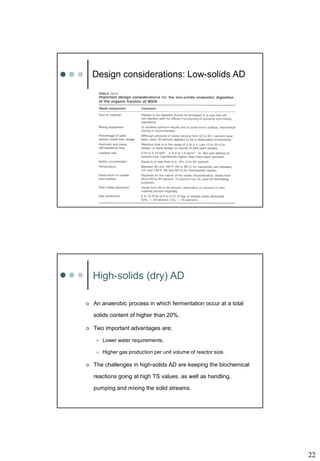
Design considerations: Low-solids AD
 An anaerobic process in which fermentation occur at a total
solids content of higher than 20%.
 Two important advantages are;
 Lower water requirements,
 Higher gas production per unit volume of reactor size.
 The challenges in high-solids AD are keeping the biochemical
reactions going at high TS values, as well as handling,
pumping and mixing the solid streams.
High-solids (dry) AD
23
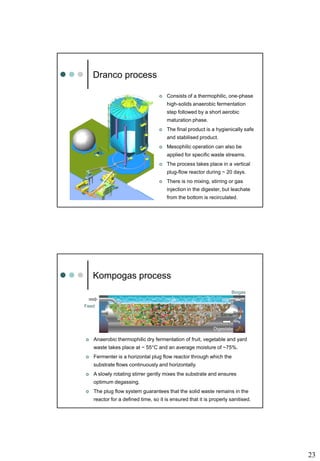
Dranco process
 Consists of a thermophilic, one-phase
high-solids anaerobic fermentation
step followed by a short aerobic
maturation phase.
 The final product is a hygienically safe
and stabilised product.
 Mesophilic operation can also be
applied for specific waste streams.
 The process takes place in a vertical
plug-flow reactor during ~ 20 days.
 There is no mixing, stirring or gas
injection in the digester, but leachate
from the bottom is recirculated.
Kompogas process
 Anaerobic thermophilic dry fermentation of fruit, vegetable and yard
waste takes place at ~ 55°C and an average moisture of ~75%.
 Fermenter is a horizontal plug flow reactor through which the
substrate flows continuously and horizontally.
 A slowly rotating stirrer gently mixes the substrate and ensures
optimum degassing.
 The plug flow system guarantees that the solid waste remains in the
reactor for a defined time, so it is ensured that it is properly sanitised.
Feed
Digestate
Stirrer
Biogas
24
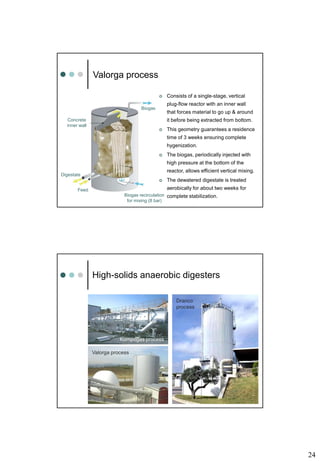
Valorga process
Biogas recirculation
for mixing (8 bar)
Biogas
Concrete
inner wall
Feed
Digestate
 Consists of a single-stage, vertical
plug-flow reactor with an inner wall
that forces material to go up & around
it before being extracted from bottom.
 This geometry guarantees a residence
time of 3 weeks ensuring complete
hygenization.
 The biogas, periodically injected with
high pressure at the bottom of the
reactor, allows efficient vertical mixing.
 The dewatered digestate is treated
aerobically for about two weeks for
complete stabilization.
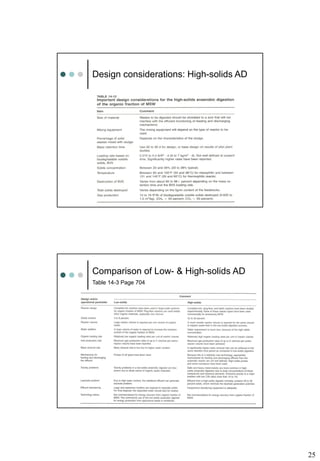
High-solids anaerobic digesters
Kompogas process
Dranco
process
Valorga process
25
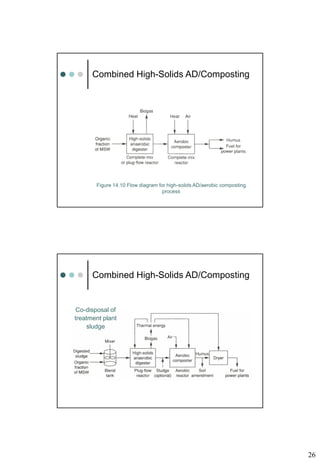
Design considerations: High-solids AD
Comparison of Low- & High-solids AD
Table 14-3 Page 704
26
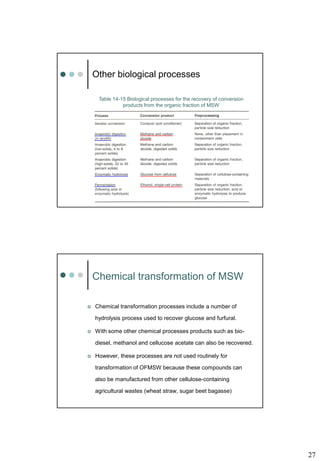
Combined High-Solids AD/Composting
Figure 14.10 Flow diagram for high-solids AD/aerobic composting
process
Co-disposal of
treatment plant
sludge
Combined High-Solids AD/Composting
27
Other biological processes
Table 14-15 Biological processes for the recovery of conversion
products from the organic fraction of MSW
Chemical transformation of MSW
 Chemical transformation processes include a number of
hydrolysis process used to recover glucose and furfural.
 With some other chemical processes products such as bio-
diesel, methanol and cellucose acetate can also be recovered.
 However, these processes are not used routinely for
transformation of OFMSW because these compounds can
also be manufactured from other cellulose-containing
agricultural wastes (wheat straw, sugar beet bagasse)
28
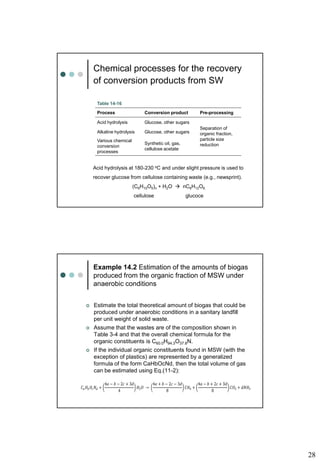
Chemical processes for the recovery
of conversion products from SW
Table 14-16
Process Conversion product Pre-processing
Acid hydrolysis Glucose, other sugars
Separation of
organic fraction,
particle size
reduction
Alkaline hydrolysis Glucose, other sugars
Various chemical
conversion
processes
Synthetic oil, gas,
cellulose acetate
Acid hydrolysis at 180-230 oC and under slight pressure is used to
recover glucose from cellulose containing waste (e.g., newsprint).
(C6H10O5)n + H2O  nC6H12O6
cellulose glucoce
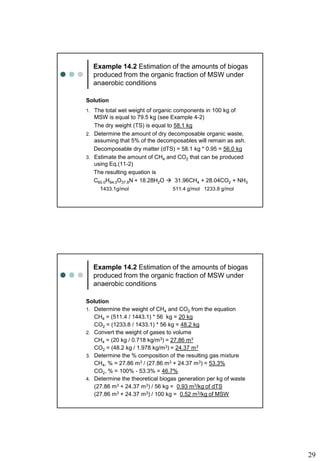
Example 14.2 Estimation of the amounts of biogas
produced from the organic fraction of MSW under
anaerobic conditions
 Estimate the total theoretical amount of biogas that could be
produced under anaerobic conditions in a sanitary landfill
per unit weight of solid waste.
 Assume that the wastes are of the composition shown in
Table 3-4 and that the overall chemical formula for the
organic constituents is C60.0H94.3O37.8N.
 If the individual organic constituents found in MSW (with the
exception of plastics) are represented by a generalized
formula of the form CaHbOcNd, then the total volume of gas
can be estimated using Eq.(11-2):
𝐶𝑎𝐻𝑏𝑂𝑐𝑁𝑑 +
4𝑎 − 𝑏 − 2𝑐 + 3𝑑
4
𝐻2𝑂 →
4𝑎 + 𝑏 − 2𝑐 − 3𝑑
8
𝐶𝐻4 +
4𝑎 − 𝑏 + 2𝑐 + 3𝑑
8
𝐶𝑂2 + 𝑑𝑁𝐻3
29
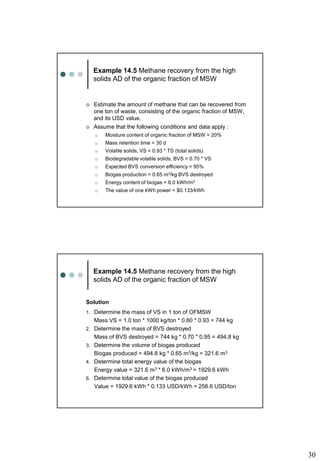
Example 14.2 Estimation of the amounts of biogas
produced from the organic fraction of MSW under
anaerobic conditions
Solution
1. The total wet weight of organic components in 100 kg of
MSW is equal to 79.5 kg (see Example 4-2)
The dry weight (TS) is equal to 58.1 kg
2. Determine the amount of dry decomposable organic waste,
assuming that 5% of the decomposables will remain as ash.
Decomposable dry matter (dTS) = 58.1 kg * 0.95 = 56.0 kg
3. Estimate the amount of CH4 and CO2 that can be produced
using Eq.(11-2)
The resulting equation is
C60.0H94.3O37.8N + 18.28H2O  31.96CH4 + 28.04CO2 + NH3
1433.1g/mol 511.4 g/mol 1233.8 g/mol
Example 14.2 Estimation of the amounts of biogas
produced from the organic fraction of MSW under
anaerobic conditions
Solution
1. Determine the weight of CH4 and CO2 from the equation
CH4 = (511.4 / 1443.1) * 56 kg = 20 kg
CO2 = (1233.8 / 1433.1) * 56 kg = 48.2 kg
2. Convert the weight of gases to volume
CH4 = (20 kg / 0.718 kg/m3) = 27.86 m3
CO2 = (48.2 kg / 1.978 kg/m3) = 24.37 m3
3. Determine the % composition of the resulting gas mixture
CH4, % = 27.86 m3 / (27.86 m3 + 24.37 m3) = 53.3%
CO2, % = 100% - 53.3% = 46.7%
4. Determine the theoretical biogas generation per kg of waste
(27.86 m3 + 24.37 m3) / 56 kg = 0.93 m3/kg of dTS
(27.86 m3 + 24.37 m3) / 100 kg = 0.52 m3/kg of MSW
30
Example 14.5 Methane recovery from the high
solids AD of the organic fraction of MSW
 Estimate the amount of methane that can be recovered from
one ton of waste, consisting of the organic fraction of MSW,
and its USD value.
 Assume that the following conditions and data apply :
o Moisture content of organic fraction of MSW = 20%
o Mass retention time = 30 d
o Volatile solids, VS = 0.93 * TS (total solids)
o Biodegradable volatile solids, BVS = 0.70 * VS
o Expected BVS conversion efficiency = 95%
o Biogas production = 0.65 m3/kg BVS destroyed
o Energy content of biogas = 6.0 kWh/m3
o The value of one kWh power = $0.133/kWh
Example 14.5 Methane recovery from the high
solids AD of the organic fraction of MSW
Solution
1. Determine the mass of VS in 1 ton of OFMSW
Mass VS = 1.0 ton * 1000 kg/ton * 0.80 * 0.93 = 744 kg
2. Determine the mass of BVS destroyed
Mass of BVS destroyed = 744 kg * 0.70 * 0.95 = 494.8 kg
3. Determine the volume of biogas produced
Biogas produced = 494.8 kg * 0.65 m3/kg = 321.6 m3
4. Determine total energy value of the biogas
Energy value = 321.6 m3 * 6.0 kWh/m3 = 1929.6 kWh
6. Determine total value of the biogas produced
Value = 1929.6 kWh * 0.133 USD/kWh = 256.6 USD/ton

6_biological conversion_6.pdf of solid waste

  • 1.
    1 Chapter 9&14 Biological andChemical Conversion Technologies Biological conversion of MSW  With the exception of plastic, rubber and leather components, the organic fraction of MSW (OFMSW) is composed of proteins, lipids, carbohydrates, cellulose, lignin and ash.  The two common biological processes used to transform these organic materials into gaseous, liquid and solid conversion products are;  Aerobic Composting  Anaerobic Digestion (AD)
  • 2.
    2 Comparison of compostingand AD Table 14-5. Comparison of aerobic composting and anaerobic digestion for processing the OFMSW Aerobic composting Anaerobic digestion Composting  Composting is the most commonly used biological process for the conversion of OFMSW to a stable humus-like material known as compost.
  • 3.
    3  To transformthe biodegradable organic materials into a biologically stable product and reduce the volume of waste  To destroy pathogens, insect eggs and other unwanted organisms and weed seeds that may be present in MSW  To retain the maximum nutrient (nitrogen, phophorus and potassium) content, and  To produce a product that can be used to support plant growth and as a soil amendment. General objectives of composting The typical properties of compost are; • A brown to very dark brown color • A low carbon-nitrogen (C/N) ratio • A continually changing nature due to activities of mo’s • A high capacity for cation exchange and water absorption  When added to soil, compost has been found to lighten heavy soils, to improve the texture of light sandy soils and to increase the water retention capacity of most soils. Properties of compost
  • 4.
    4 Process description Composting operationsconsist of three basic steps: 1. Pre-processing of the MSW o Receiving o Removal of recoverable materials o Size reduction o Adjustment of waste properties (C/N ratio, addition of moisture and nutrients and etc.) 2. Decomposition of the OFMSW 3. Preparation and marketing of the final compost product Composting Techniques Windrow Aerated static pile In-vessel plug flow
  • 5.
    5 1. Windrow composting A high-rate windrow composting system employs rows typically 1-2 m high by 3-4 m wide.  Before the windrows are formed organic material is processes by shredding and screening it to approximately 25-75 mm and the moisture content is adjusted to 50-60%.  Windrows are turned up to twice per week while temperature is maintained at or slightly above 55 oC.  Complete composting can be accomplished in 3-4 weeks.  Afterwards, the compost is allowed to cure for an additional 3- 4 weeks without turning. Food waste & yard debris Grinding Covered windrows Final product 1. Windrow composting Periodic turning
  • 6.
    6 1. Windrow composting Turner Compostwindrow 2. Aerated static pile composting  Used to compost ww sludge, yard waste or separated MSW.  The system is composed of a grid of aeration or exhaust piping over which the processed solid waste is placed.  Typical pile heights are 2-2,5 m.  A layer of screened compost is often placed on top of the newly formed pile for insulation and odor control.  Air is introduced to provide the oxygen needed for biological conversion and to control the temperature within the pile.  For improved process and odor control newer facilities are fully or partially covered.
  • 7.
    7 2. Aerated staticpile composting 3. In-vessel composting  It is accomplished inside an enclosed container or vessel.  Different vessels (vertical towers, horizontal rectangular and circular tanks and circular rotating tanks) have been used.  Major categories are plug flow and dynamic (agitated bed).  The plug flow systems operate on a first-in, first-out principle.  In dynamic systems, the composting material is mixed mechanically during the processing.  The reasons for increasing popularity of in-vessel composting are process and odor control, faster throughout, lower labor cost and smaller area requirement.
  • 8.
    8 Unmixed vertical plugflow reactor Unmixed horizontal plug flow reactor 3. In-vessel composting Mixed (dynamic) vertical reactor Mixed (dynamic) horizontal reactor 3. In-vessel composting
  • 9.
    9 Important design considerations Particle Size  For optimum results the size of SW should be 25-75 mm  Carbon/Nitrogen Ratio  Initial C/N ratios (optimum): 25-50  At lower ratios, ammonia is given off. Also, biological activity is impeded.  At higher ratios, nitrogen may be a limiting nutrient  Blending & Seeding  Composting time can be reduced by seeding with partially decomposed SW to the extent of about 1 to 5 %wt. Important design considerations  Moisture content  In the range of 50-60% during the composting process  Mixing/Turning  To prevent drying, caking, and air channeling  Frequency of mixing or turning depends on the type of composting operation  Air requirement  Air should reach all the parts of composting material
  • 10.
    10  Temperature  50-55oC for the first few days  55-60oC  for the remainder of the active composting period  Temperatures > 65oC reduce the biological activity significantly  pH Control  pH 7-7.5  For optimum aerobic decomposition  pH < 8.5  To minimize the loss of nitrogen in form of NH3 gas  Control of pathogens  60-70oC for 24 h kills all pathogens, weeds and seeds. Important design considerations Temperature and pH control 5 6 7 8 pH Rapid rise in temperature due to the heat release from the biological activity Slowly biodegradable materials are converted by bacteria, fungi and actinomycetes Temperature starts to decrease as biodegradable organic carbon is decreased Typical temperature rise in windrow compost turned mechanically Typical temperature variation using aeration system pH
  • 11.
    11 Control of pathogens(Table 14-8) Control of pathogens (Table 14-9)
  • 12.
    12  Degree ofdecomposition can be measured by;  measuring the final drop in temperature  degree of self heating capacity  amount of decomposable and resistant organic matter in the composted material  rise in redox potential  oxygen uptake  growth of the fungus Chaetomium gracilis, and  the starch-iodine test.  Land Requirement  For a plant with a capacity of 50 ton/day  6,000-8,000 m2 Important design considerations Receiving Area Front-end loader, conveyor system Bagbreaker Commingled MSW Manual removal of materials Front-end loader Collection vehicle Manual removal of recyclable materials Screening (trommel or disc) Conveyor Shredding Disc screening Shredding Magnetic separation Bulky items White goods Cardboard Paper, Plastics, Glass, Aluminum and Tin cans Broken glass, other small residual material Oversize material Mixing Water Nutrients Other additives Ferrous metals Windrow static aerated pile or in-vessel composting Maturation Post- processing Compost product Production of compost from commingled MSW
  • 13.
    13 Comparison of compostingprocesses Table 14-10. Comparison of aerobic composting processes  Production of odors  Blowing of papers and plastic materials in windrow composting  Presence of pathogens and heavy metals in compost product  Definition of what constitutes an acceptable compost. Unless the questions related to these issues are resolved, composting may not be a viable technology in the future Issues in implementation of composting facilities
  • 14.
    14 Example 14.3 Blendingof wastes to achieve an optimum C/N ratio  Leaves, with a C/N ratio of 50, are to blended with waste- activated sludge from a wastewater treatment plant, with a C/N ratio of 6.3.  Determine the proportions of each component to achieve a blended C/N ratio of 25.  Assume that the following conditions apply: o Moisture content of sludge = 75% o Moisture content of leaves = 50% o Nitrogen content of sludge = 5.6% o Nitrogen content of leaves = 0.7% Example 14.3 Blending of wastes to achieve an optimum C/N ratio Solution 1. Determine the percentage composition for leaves and sludge. For kg of leaves: Water = 1 kg (0.50) = 0.50 kg Dry matter = 1 kg – 0.50 kg = 0.50 kg N = 0.50 kg (0.007) = 0.0035 kg C= 50 (0.0035 kg) = 0.175 kg For kg of sludge: Water = 1 kg (0.75) = 0.75 kg Dry matter = 1 kg – 0.75 kg = 0.25 kg N = 0.25 kg (0.056) = 0.014 kg C= 6.3 kg (0.014) =0.0882 kg
  • 15.
    15 Example 14.3 Blendingof wastes to achieve an optimum C/N ratio Solution 2. Determine the amount of sludge to be added to lb of leaves to achieve a C/N ratio of 25: where x = weight of sludge required 2. Check the C/N ratio and moisture content of resultant mixture. Example 14.3 Blending of wastes to achieve an optimum C/N ratio 2. Check the C/N ratio and moisture content of resultant mixture. a) For 0.33 kg sludge: Water = 0.33 kg (0.75) = 0.25 kg Dry matter = 0.33 kg (0.25) = 0.08 kg N = 0.33 kg (0.014) = 0.0046 kg ~ 0.005 kg C= 0.33 kg (0.0882) = 0.029 kg ~ 0.03 kg b) For 0.33 kg sludge + 1 kg leaves: Water = 0.25 kg + 0.50 kg = 0.75 kg Dry matter = 0.08 kg + 0.50 kg =0.58 kg N = 0.005 kg + 0.0035 kg = 0.008 kg C = 0.03 kg + 0.175 kg = 0.205 kg c) Find the C/N ratio: d) Find the moisture content:
  • 16.
    16 Example 14.4 Airrequirements for in-vessel composting  Determine the amount of air required to compost 1 ton of MSW using in-vessel composting with forced aeration.  Assume that the composition of the organic fraction of the MSW to be composted is given by C60.0H94.3O37.8N.  Assume that the following conditions and data apply:  Moisture content of organic fraction of MSW = 25 %  Volatile solids, VS = 0.93 * TS (total solids)  Biodegradable volatile solids, BVS = 0.60 * VS  Expected BVS conversion efficiency = 95%  Composting time = 5 d  Oxygen demand is 20, 35, 25, 15, 5 % for the successive days of the 5-day composting period.  Air contains 23% O2 by mass and the specific weight of air is equal 1.2 kg / m3.  A factor of 2 times the actual air supplied will be needed to be assumed that the oxygen content of the air does not drop below 50 percent of its original value. Example 14.4 Air requirements for in-vessel composting Solution 1. Determine the mass of biodegradable volatile solids in one ton of organic waste. Mass BV = 1 ton * 1000 kg/ton * 0.75 * 0.93 *0.60 = 418.5 kg 2. Determine the expected BVS mass conversion. Expected BVS mass conversion = 418.5 kg * 0.95 = 397.6 kg 3. Determine the amount of oxygen required for decomposition of 1 kg of BVS C60.0H94.3O37.8N + 63.93 O2 → 60.0 CO2 + 45.7 H2O + NH3
  • 17.
    17 Example 14.4 Airrequirements for in-vessel composting Solution C60.0H94.3O37.8N + 63.93 O2 → 60.0 CO2 + 45.7 H2O + NH3 1433.1 g/mol 2045.8 g/mol O2 required = 2045.8 / 1433.1 = 1.43 kgO2/kgBVS converted 4. Determine the total amount of air required for one ton of MSW, containing 397.6 kg of BVS, as determined in Step 2 5. Determine the required capacity of the aeration equipment, expressed in m3/min. Example 14.4 Air requirements for in-vessel composting Comment.  The flow rate is computed using 35% of the total oxygen requirement, the most critical day.  In an actual composting operation, some of the BVS would have been converted to cell tissue.  However, because air is also required for the conversion of BVS to cell tissue the computations presented in this example, which are based on the assumption that all of the BVS is converted, are reasonable.
  • 18.
    18 Anaerobic Digestion (AD) Anaerobic digestion of organic material is basically a 3-stage process: large organic polymers are first hydrolyzed and then fermented into short-chain volatile fatty acids (VFAs).  These acids are then converted into CH4 and CO2. Complex organics (polimers) Simple organics (monomers) VFAs Acetate H2/CO2 CH4 + CO2 Hydrolysis Acidogenesis (Fermentation) Acetogenesis Methanogenesis Anaerobic Digestion (AD)
  • 19.
    19 Microorganisms in AD Complexorganics (e.g. cellulose) Monomers (e.g. glucose) VFAs, alcohols CH4 Hydrolytic bacteria H2+CO2 Acetate Homoacetogens Syntrophic acetogens Methanogens Methanogens Homoacetogens Fermentative bacteria Biogas production Organic matter + H2O + nutrients  + CO2 + CH4 + NH3+ H2S + heat resistant organic matter New cells + If it is assumed that organic matter is stabilized completely, the overall conversion of OFMSW waste to CH4, CO2 and NH3 can be represented as follows; CaHbOcNd + (4a-b-2c+3d)H2O  (4a+b-2c-3d)CH4 + (4a-b+2c+3d)CO2 + dNH3 4 8 8
  • 20.
    20  An anaerobicprocess in which organic wastes are fermented at solids concentrations of 4-8%.  Used to generate CH4 from human, animal and agricultural wastes and from OFMSW.  A disadvantage is that considerable amounts of water must be added to wastes to bring the solids content to 4-8%  The addition of water results in a very dilute digested sludge which has to be dewatered prior to disposal. Low-solids (wet) AD The basic steps of low-solids AD of MSW:  Preparation of OFMSW; receving, sorting, separation, size reduction  Addition of moisture and nutrients  Blending and pH adjustment  Anaerobic digestion  Capture, storage (if necessary) separation of gas components  Dewatering and disposal of digested sludge Low-solids AD process
  • 21.
    21 Flow diagram forlow-solids AD Low-solids anaerobic digesters Egg-shaped digesters Conventional circular digesters
  • 22.
    22 Design considerations: Low-solidsAD  An anaerobic process in which fermentation occur at a total solids content of higher than 20%.  Two important advantages are;  Lower water requirements,  Higher gas production per unit volume of reactor size.  The challenges in high-solids AD are keeping the biochemical reactions going at high TS values, as well as handling, pumping and mixing the solid streams. High-solids (dry) AD
  • 23.
    23 Dranco process  Consistsof a thermophilic, one-phase high-solids anaerobic fermentation step followed by a short aerobic maturation phase.  The final product is a hygienically safe and stabilised product.  Mesophilic operation can also be applied for specific waste streams.  The process takes place in a vertical plug-flow reactor during ~ 20 days.  There is no mixing, stirring or gas injection in the digester, but leachate from the bottom is recirculated. Kompogas process  Anaerobic thermophilic dry fermentation of fruit, vegetable and yard waste takes place at ~ 55°C and an average moisture of ~75%.  Fermenter is a horizontal plug flow reactor through which the substrate flows continuously and horizontally.  A slowly rotating stirrer gently mixes the substrate and ensures optimum degassing.  The plug flow system guarantees that the solid waste remains in the reactor for a defined time, so it is ensured that it is properly sanitised. Feed Digestate Stirrer Biogas
  • 24.
    24 Valorga process Biogas recirculation formixing (8 bar) Biogas Concrete inner wall Feed Digestate  Consists of a single-stage, vertical plug-flow reactor with an inner wall that forces material to go up & around it before being extracted from bottom.  This geometry guarantees a residence time of 3 weeks ensuring complete hygenization.  The biogas, periodically injected with high pressure at the bottom of the reactor, allows efficient vertical mixing.  The dewatered digestate is treated aerobically for about two weeks for complete stabilization. High-solids anaerobic digesters Kompogas process Dranco process Valorga process
  • 25.
    25 Design considerations: High-solidsAD Comparison of Low- & High-solids AD Table 14-3 Page 704
  • 26.
    26 Combined High-Solids AD/Composting Figure14.10 Flow diagram for high-solids AD/aerobic composting process Co-disposal of treatment plant sludge Combined High-Solids AD/Composting
  • 27.
    27 Other biological processes Table14-15 Biological processes for the recovery of conversion products from the organic fraction of MSW Chemical transformation of MSW  Chemical transformation processes include a number of hydrolysis process used to recover glucose and furfural.  With some other chemical processes products such as bio- diesel, methanol and cellucose acetate can also be recovered.  However, these processes are not used routinely for transformation of OFMSW because these compounds can also be manufactured from other cellulose-containing agricultural wastes (wheat straw, sugar beet bagasse)
  • 28.
    28 Chemical processes forthe recovery of conversion products from SW Table 14-16 Process Conversion product Pre-processing Acid hydrolysis Glucose, other sugars Separation of organic fraction, particle size reduction Alkaline hydrolysis Glucose, other sugars Various chemical conversion processes Synthetic oil, gas, cellulose acetate Acid hydrolysis at 180-230 oC and under slight pressure is used to recover glucose from cellulose containing waste (e.g., newsprint). (C6H10O5)n + H2O  nC6H12O6 cellulose glucoce Example 14.2 Estimation of the amounts of biogas produced from the organic fraction of MSW under anaerobic conditions  Estimate the total theoretical amount of biogas that could be produced under anaerobic conditions in a sanitary landfill per unit weight of solid waste.  Assume that the wastes are of the composition shown in Table 3-4 and that the overall chemical formula for the organic constituents is C60.0H94.3O37.8N.  If the individual organic constituents found in MSW (with the exception of plastics) are represented by a generalized formula of the form CaHbOcNd, then the total volume of gas can be estimated using Eq.(11-2): 𝐶𝑎𝐻𝑏𝑂𝑐𝑁𝑑 + 4𝑎 − 𝑏 − 2𝑐 + 3𝑑 4 𝐻2𝑂 → 4𝑎 + 𝑏 − 2𝑐 − 3𝑑 8 𝐶𝐻4 + 4𝑎 − 𝑏 + 2𝑐 + 3𝑑 8 𝐶𝑂2 + 𝑑𝑁𝐻3
  • 29.
    29 Example 14.2 Estimationof the amounts of biogas produced from the organic fraction of MSW under anaerobic conditions Solution 1. The total wet weight of organic components in 100 kg of MSW is equal to 79.5 kg (see Example 4-2) The dry weight (TS) is equal to 58.1 kg 2. Determine the amount of dry decomposable organic waste, assuming that 5% of the decomposables will remain as ash. Decomposable dry matter (dTS) = 58.1 kg * 0.95 = 56.0 kg 3. Estimate the amount of CH4 and CO2 that can be produced using Eq.(11-2) The resulting equation is C60.0H94.3O37.8N + 18.28H2O  31.96CH4 + 28.04CO2 + NH3 1433.1g/mol 511.4 g/mol 1233.8 g/mol Example 14.2 Estimation of the amounts of biogas produced from the organic fraction of MSW under anaerobic conditions Solution 1. Determine the weight of CH4 and CO2 from the equation CH4 = (511.4 / 1443.1) * 56 kg = 20 kg CO2 = (1233.8 / 1433.1) * 56 kg = 48.2 kg 2. Convert the weight of gases to volume CH4 = (20 kg / 0.718 kg/m3) = 27.86 m3 CO2 = (48.2 kg / 1.978 kg/m3) = 24.37 m3 3. Determine the % composition of the resulting gas mixture CH4, % = 27.86 m3 / (27.86 m3 + 24.37 m3) = 53.3% CO2, % = 100% - 53.3% = 46.7% 4. Determine the theoretical biogas generation per kg of waste (27.86 m3 + 24.37 m3) / 56 kg = 0.93 m3/kg of dTS (27.86 m3 + 24.37 m3) / 100 kg = 0.52 m3/kg of MSW
  • 30.
    30 Example 14.5 Methanerecovery from the high solids AD of the organic fraction of MSW  Estimate the amount of methane that can be recovered from one ton of waste, consisting of the organic fraction of MSW, and its USD value.  Assume that the following conditions and data apply : o Moisture content of organic fraction of MSW = 20% o Mass retention time = 30 d o Volatile solids, VS = 0.93 * TS (total solids) o Biodegradable volatile solids, BVS = 0.70 * VS o Expected BVS conversion efficiency = 95% o Biogas production = 0.65 m3/kg BVS destroyed o Energy content of biogas = 6.0 kWh/m3 o The value of one kWh power = $0.133/kWh Example 14.5 Methane recovery from the high solids AD of the organic fraction of MSW Solution 1. Determine the mass of VS in 1 ton of OFMSW Mass VS = 1.0 ton * 1000 kg/ton * 0.80 * 0.93 = 744 kg 2. Determine the mass of BVS destroyed Mass of BVS destroyed = 744 kg * 0.70 * 0.95 = 494.8 kg 3. Determine the volume of biogas produced Biogas produced = 494.8 kg * 0.65 m3/kg = 321.6 m3 4. Determine total energy value of the biogas Energy value = 321.6 m3 * 6.0 kWh/m3 = 1929.6 kWh 6. Determine total value of the biogas produced Value = 1929.6 kWh * 0.133 USD/kWh = 256.6 USD/ton