Trilaminar germ disc
By
DrManah Chandra Changmai MBBS MS
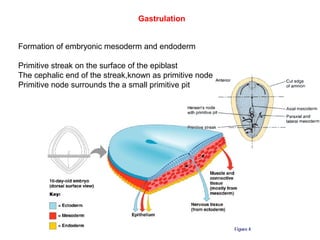
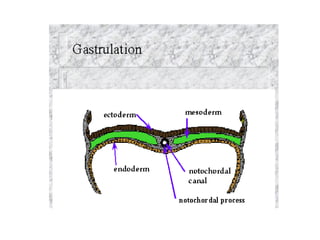
Gastrulation
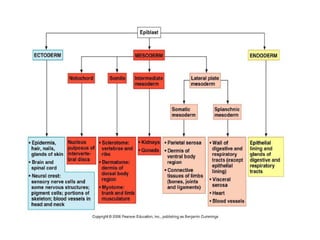
Formation of embryonic mesoderm and endoderm
Primitive streak on the surface of the epiblast
The cephalic end of the streak,known as primitive node
Primitive node surrounds the a small primitive pit
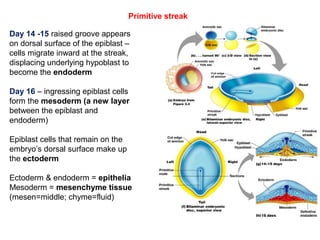
Day 14 -15 raised groove appears
on dorsal surface of the epiblast –
cells migrate inward at the streak,
displacing underlying hypoblast to
become the endoderm
Day 16 – ingressing epiblast cells
form the mesoderm (a new layer
between the epiblast and
endoderm)
Epiblast cells that remain on the
embryo’s dorsal surface make up
the ectoderm
Ectoderm & endoderm = epithelia
Mesoderm = mesenchyme tissue
(mesen=middle; chyme=fluid)
Primitive streak
Cells invaginating the primitive pit Move straight
forward in cephalic direction upto prochordal plate.
Form a tube like process known as notochordal or
head process.
By the 18th
day,floor of the
notochordal process fuses with
underlying endoderm
Lumen of the notochordal
process disappears completely
Notocordal process forms a
narrow plate of cells
Notochordal cells proliferate
and forms solid cord,known as
definitive notochord.
Formation of notochord
Formation of cloacal membrane
Cloacal membrane is formed caudal to primitive streak,
consists of tightly adherent ectoderm and endoderm.
At 16th
day a diverticulum is formed at the posterior wall
of yolk sac which extends into connecting
stalk.
This diverticulum is called allantoenteric diverticulum or
allantois.
In humans it remains rudimentary.
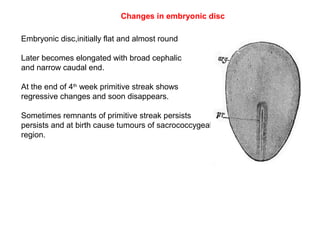
Embryonic disc,initially flat and almost round
Later becomes elongated with broad cephalic
and narrow caudal end.
At the end of 4th
week primitive streak shows
regressive changes and soon disappears.
Sometimes remnants of primitive streak persists
persists and at birth cause tumours of sacrococcygeal
region.
Changes in embryonic disc
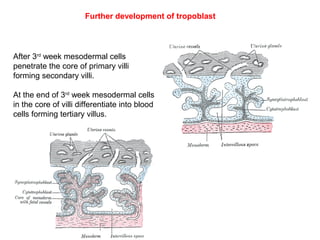
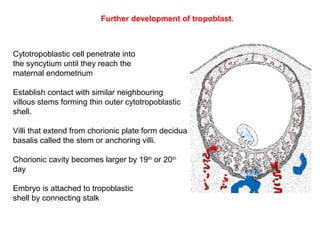
Further development of tropoblast
After 3rd
week mesodermal cells
penetrate the core of primary villi
forming secondary villi.
At the end of 3rd
week mesodermal cells
in the core of villi differentiate into blood
cells forming tertiary villus.
Tertiary villi
Cytotropoblastic cell penetrate into
the syncytium until they reach the
maternal endometrium
Establish contact with similar neighbouring
villous stems forming thin outer cytotropoblastic
shell.
Villi that extend from chorionic plate form decidua
basalis called the stem or anchoring villi.
Chorionic cavity becomes larger by 19th
or 20th
day
Embryo is attached to tropoblastic
shell by connecting stalk
Further development of tropoblast.
The end

Trilaminar germ disc

  • 1.
    Trilaminar germ disc By DrManahChandra Changmai MBBS MS
  • 2.
    Gastrulation Formation of embryonicmesoderm and endoderm Primitive streak on the surface of the epiblast The cephalic end of the streak,known as primitive node Primitive node surrounds the a small primitive pit
  • 4.
    Day 14 -15raised groove appears on dorsal surface of the epiblast – cells migrate inward at the streak, displacing underlying hypoblast to become the endoderm Day 16 – ingressing epiblast cells form the mesoderm (a new layer between the epiblast and endoderm) Epiblast cells that remain on the embryo’s dorsal surface make up the ectoderm Ectoderm & endoderm = epithelia Mesoderm = mesenchyme tissue (mesen=middle; chyme=fluid) Primitive streak
  • 6.
    Cells invaginating theprimitive pit Move straight forward in cephalic direction upto prochordal plate. Form a tube like process known as notochordal or head process. By the 18th day,floor of the notochordal process fuses with underlying endoderm Lumen of the notochordal process disappears completely Notocordal process forms a narrow plate of cells Notochordal cells proliferate and forms solid cord,known as definitive notochord. Formation of notochord
  • 9.
    Formation of cloacalmembrane Cloacal membrane is formed caudal to primitive streak, consists of tightly adherent ectoderm and endoderm. At 16th day a diverticulum is formed at the posterior wall of yolk sac which extends into connecting stalk. This diverticulum is called allantoenteric diverticulum or allantois. In humans it remains rudimentary.
  • 11.
    Embryonic disc,initially flatand almost round Later becomes elongated with broad cephalic and narrow caudal end. At the end of 4th week primitive streak shows regressive changes and soon disappears. Sometimes remnants of primitive streak persists persists and at birth cause tumours of sacrococcygeal region. Changes in embryonic disc
  • 12.
    Further development oftropoblast After 3rd week mesodermal cells penetrate the core of primary villi forming secondary villi. At the end of 3rd week mesodermal cells in the core of villi differentiate into blood cells forming tertiary villus.
  • 13.
  • 14.
    Cytotropoblastic cell penetrateinto the syncytium until they reach the maternal endometrium Establish contact with similar neighbouring villous stems forming thin outer cytotropoblastic shell. Villi that extend from chorionic plate form decidua basalis called the stem or anchoring villi. Chorionic cavity becomes larger by 19th or 20th day Embryo is attached to tropoblastic shell by connecting stalk Further development of tropoblast.
  • 18.