




Birla Vishvakarma
Mahavidyalaya
Production engineering department
140080125009 Harsh Parekh
140080125010 Viraj Javia
140080125011 Chintan Joshi
140080125012 Meet Kansara
Guided by: Dr. Manish Mehta
Topics
 Basic concept
 Types of convection
 Boundary layer
 Turbulent flow
 Laminar flow
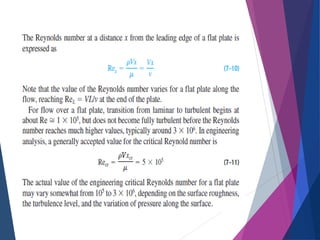
 Reynolds number
 Nusselt number
 Prandl number
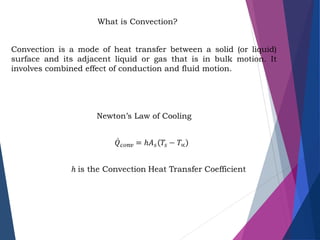
What is Convection?
Convection is a mode of heat transfer between a solid (or liquid)
surface and its adjacent liquid or gas that is in bulk motion. It
involves combined effect of conduction and fluid motion.
Newton’s Law of Cooling
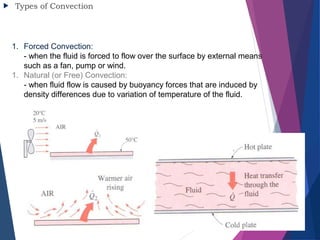
 Types of Convection
1. Forced Convection:
- when the fluid is forced to flow over the surface by external means
such as a fan, pump or wind.
1. Natural (or Free) Convection:
- when fluid flow is caused by buoyancy forces that are induced by
density differences due to variation of temperature of the fluid.
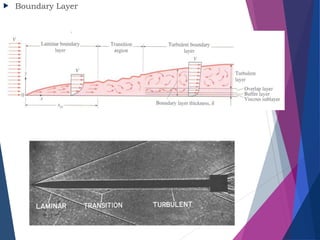
 Boundary Layer
Dimensional analysis
 Dimension analysis can be used to:
 Derive an equation .
 Check whether an equation is dimensionally correct.
However, dimensionally correct doesn’t necessarily mean
the equation is correct
 Find out dimension or units of derived quantities.
 There are physical quantities which
are dimensionless:
 Numerical value
 Ratio between the same quantity
angle
 Some of the known constants like ln
, log etc.
Turbulent And laminar flow
 Laminar flow:
 Where the fluid moves slowly in layers in a pipe,
without much
 mixing among the layers.
 Turbulent flow
 Opposite of laminar, where considerable mixing
occurs,
 velocities are high.
Reynolds Number:
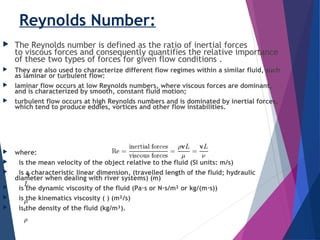
 The Reynolds number is defined as the ratio of inertial forces
to viscous forces and consequently quantifies the relative importance
of these two types of forces for given flow conditions .
 They are also used to characterize different flow regimes within a similar fluid, such
as laminar or turbulent flow:
 laminar flow occurs at low Reynolds numbers, where viscous forces are dominant,
and is characterized by smooth, constant fluid motion;
 turbulent flow occurs at high Reynolds numbers and is dominated by inertial forces,
which tend to produce eddies, vortices and other flow instabilities.
 where:
  is the mean velocity of the object relative to the fluid (SI units: m/s)
  is a characteristic linear dimension, (travelled length of the fluid; hydraulic
diameter when dealing with river systems) (m)
  is the dynamic viscosity of the fluid (Pa·s or N·s/m² or kg/(m·s))
  is the kinematics viscosity ( ) (m²/s)
  is the density of the fluid (kg/m³).
Nusselt Number:
 In heat transfer at a boundary (surface) within a fluid, the Nusselt
number (Nu) is the ratio of convective to conductive heat transfer
across (normal to) the boundary.
 A Nusselt number close to one, namely convection and conduction of
similar magnitude, is characteristic of "slug flow" or laminar flow. A
larger Nusselt number corresponds to more active convection,
with turbulent flow typically in the 100–1000 range.
 Prandtl Number
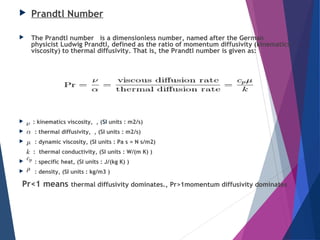
 The Prandtl number   is a dimensionless number, named after the German
physicist Ludwig Prandtl, defined as the ratio of momentum diffusivity (kinematics
viscosity) to thermal diffusivity. That is, the Prandtl number is given as:
  : kinematics viscosity,  , (SI units : m2/s)
  : thermal diffusivity,  , (SI units : m2/s)
  : dynamic viscosity, (SI units : Pa s = N s/m2)
:  thermal conductivity, (SI units : W/(m K) )
  : specific heat, (SI units : J/(kg K) )
  : density, (SI units : kg/m3 )
 Pr<1 means thermal diffusivity dominates., Pr>1momentum diffusivity dominates
Dependence Of transition and
laminar flow
 The transition from laminar to
turbulent flow depends on the
surface geometry, surface
roughness, upstream velocity,
surface temperature, and the type
of fluid, among other things, and is
best characterized by the Reynolds
number
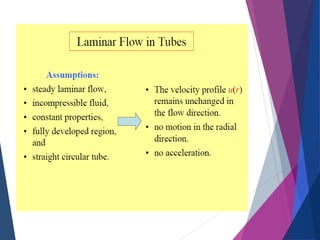
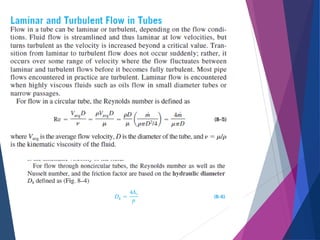
 Laminar and Turbulent Flow In Tubes
 Flow in a tube can be laminar or turbulent, depending
on the flow conditions.
 Fluid flow is streamlined and thus laminar at low
velocities, but turns turbulent as the velocity is
increased beyond a critical value.
 Transition from laminar to turbulent flow does not
occur suddenly; rather, it occurs over some range of
velocity where the flow fluctuates between laminar and
turbulent flows before it becomes fully turbulent.
 Most pipe flows encountered in practice are turbulent.
 Laminar flow is encountered when highly viscous fluids
such as oils flow in small diameter tubes or narrow
passages.
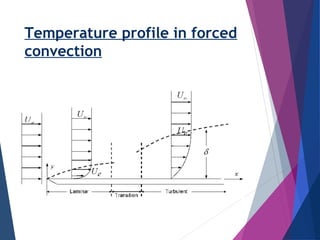
Temperature profile in forced
convection
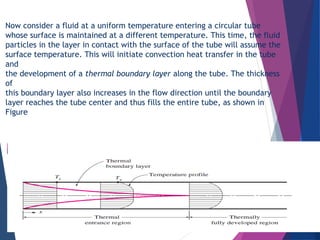
Now consider a fluid at a uniform temperature entering a circular tube
whose surface is maintained at a different temperature. This time, the fluid
particles in the layer in contact with the surface of the tube will assume the
surface temperature. This will initiate convection heat transfer in the tube
and
the development of a thermal boundary layer along the tube. The thickness
of
this boundary layer also increases in the flow direction until the boundary
layer reaches the tube center and thus fills the entire tube, as shown in
Figure
Laminar And
Turbulent
Flow over
Flat plates
PARALLEL FLOW OVER FLAT
PLATES
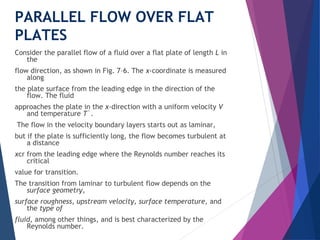
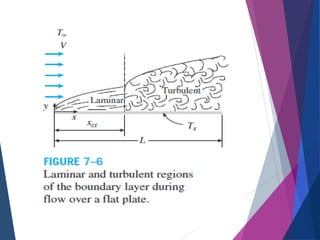
Consider the parallel flow of a fluid over a flat plate of length L in
the
flow direction, as shown in Fig. 7–6. The x-coordinate is measured
along
the plate surface from the leading edge in the direction of the
flow. The fluid
approaches the plate in the x-direction with a uniform velocity V
and temperature T`.
The flow in the velocity boundary layers starts out as laminar,
but if the plate is sufficiently long, the flow becomes turbulent at
a distance
xcr from the leading edge where the Reynolds number reaches its
critical
value for transition.
The transition from laminar to turbulent flow depends on the
surface geometry,
surface roughness, upstream velocity, surface temperature, and
the type of
fluid, among other things, and is best characterized by the
Reynolds number.
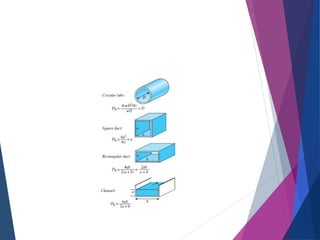
Forced
Convection In
Laminar And
Turbulent Flow
In Pipes
Turbulent flow over cylinders
Characteristic length Lc=diameter of the cylinder D
The co-relation used is: Nu=hD/k=C(Re)^n (Pr)^0.33
The constants C and n depends upon flow Reynolds
number.
Further,all properties are evaluated at mean film
temperature.
Turbulent flow over spheres
Characteristic length Lc=diameter D of sphere
For flow of gases over sphere Nu=0.37(Re)^0.6
For 25<Re<10^5
For flow of liquids over sphere
Nu=[0.97+0.68(Re)^0.5](Pr)^0.33 for 1<Re<2000
Generalized equation for flow over sphere can also be given as
Nu=2+[0.4(Re)^0.5+0.06(Re)^0.67] (Pr)^0.4(µ/µs)^0.25
Where µs=dynamic viscosity
-

Etht grp 11(140080125009,10,11,12)

  • 1.
    Birla Vishvakarma Mahavidyalaya Production engineeringdepartment 140080125009 Harsh Parekh 140080125010 Viraj Javia 140080125011 Chintan Joshi 140080125012 Meet Kansara Guided by: Dr. Manish Mehta
  • 2.
    Topics  Basic concept Types of convection  Boundary layer  Turbulent flow  Laminar flow  Reynolds number  Nusselt number  Prandl number
  • 3.
    What is Convection? Convectionis a mode of heat transfer between a solid (or liquid) surface and its adjacent liquid or gas that is in bulk motion. It involves combined effect of conduction and fluid motion. Newton’s Law of Cooling
  • 4.
     Types ofConvection 1. Forced Convection: - when the fluid is forced to flow over the surface by external means such as a fan, pump or wind. 1. Natural (or Free) Convection: - when fluid flow is caused by buoyancy forces that are induced by density differences due to variation of temperature of the fluid.
  • 5.
  • 6.
    Dimensional analysis  Dimensionanalysis can be used to:  Derive an equation .  Check whether an equation is dimensionally correct. However, dimensionally correct doesn’t necessarily mean the equation is correct  Find out dimension or units of derived quantities.
  • 7.
     There arephysical quantities which are dimensionless:  Numerical value  Ratio between the same quantity angle  Some of the known constants like ln , log etc.
  • 8.
    Turbulent And laminarflow  Laminar flow:  Where the fluid moves slowly in layers in a pipe, without much  mixing among the layers.  Turbulent flow  Opposite of laminar, where considerable mixing occurs,  velocities are high.
  • 9.
    Reynolds Number:  TheReynolds number is defined as the ratio of inertial forces to viscous forces and consequently quantifies the relative importance of these two types of forces for given flow conditions .  They are also used to characterize different flow regimes within a similar fluid, such as laminar or turbulent flow:  laminar flow occurs at low Reynolds numbers, where viscous forces are dominant, and is characterized by smooth, constant fluid motion;  turbulent flow occurs at high Reynolds numbers and is dominated by inertial forces, which tend to produce eddies, vortices and other flow instabilities.  where:   is the mean velocity of the object relative to the fluid (SI units: m/s)   is a characteristic linear dimension, (travelled length of the fluid; hydraulic diameter when dealing with river systems) (m)   is the dynamic viscosity of the fluid (Pa·s or N·s/m² or kg/(m·s))   is the kinematics viscosity ( ) (m²/s)   is the density of the fluid (kg/m³).
  • 10.
    Nusselt Number:  In heattransfer at a boundary (surface) within a fluid, the Nusselt number (Nu) is the ratio of convective to conductive heat transfer across (normal to) the boundary.  A Nusselt number close to one, namely convection and conduction of similar magnitude, is characteristic of "slug flow" or laminar flow. A larger Nusselt number corresponds to more active convection, with turbulent flow typically in the 100–1000 range.
  • 11.
     Prandtl Number The Prandtl number   is a dimensionless number, named after the German physicist Ludwig Prandtl, defined as the ratio of momentum diffusivity (kinematics viscosity) to thermal diffusivity. That is, the Prandtl number is given as:   : kinematics viscosity,  , (SI units : m2/s)   : thermal diffusivity,  , (SI units : m2/s)   : dynamic viscosity, (SI units : Pa s = N s/m2) :  thermal conductivity, (SI units : W/(m K) )   : specific heat, (SI units : J/(kg K) )   : density, (SI units : kg/m3 )  Pr<1 means thermal diffusivity dominates., Pr>1momentum diffusivity dominates
  • 12.
    Dependence Of transitionand laminar flow  The transition from laminar to turbulent flow depends on the surface geometry, surface roughness, upstream velocity, surface temperature, and the type of fluid, among other things, and is best characterized by the Reynolds number
  • 13.
     Laminar andTurbulent Flow In Tubes  Flow in a tube can be laminar or turbulent, depending on the flow conditions.  Fluid flow is streamlined and thus laminar at low velocities, but turns turbulent as the velocity is increased beyond a critical value.  Transition from laminar to turbulent flow does not occur suddenly; rather, it occurs over some range of velocity where the flow fluctuates between laminar and turbulent flows before it becomes fully turbulent.  Most pipe flows encountered in practice are turbulent.  Laminar flow is encountered when highly viscous fluids such as oils flow in small diameter tubes or narrow passages.
  • 14.
    Temperature profile inforced convection
  • 15.
    Now consider afluid at a uniform temperature entering a circular tube whose surface is maintained at a different temperature. This time, the fluid particles in the layer in contact with the surface of the tube will assume the surface temperature. This will initiate convection heat transfer in the tube and the development of a thermal boundary layer along the tube. The thickness of this boundary layer also increases in the flow direction until the boundary layer reaches the tube center and thus fills the entire tube, as shown in Figure
  • 16.
  • 17.
    PARALLEL FLOW OVERFLAT PLATES Consider the parallel flow of a fluid over a flat plate of length L in the flow direction, as shown in Fig. 7–6. The x-coordinate is measured along the plate surface from the leading edge in the direction of the flow. The fluid approaches the plate in the x-direction with a uniform velocity V and temperature T`. The flow in the velocity boundary layers starts out as laminar, but if the plate is sufficiently long, the flow becomes turbulent at a distance xcr from the leading edge where the Reynolds number reaches its critical value for transition. The transition from laminar to turbulent flow depends on the surface geometry, surface roughness, upstream velocity, surface temperature, and the type of fluid, among other things, and is best characterized by the Reynolds number.
  • 21.
  • 24.
    Turbulent flow overcylinders Characteristic length Lc=diameter of the cylinder D The co-relation used is: Nu=hD/k=C(Re)^n (Pr)^0.33 The constants C and n depends upon flow Reynolds number. Further,all properties are evaluated at mean film temperature.
  • 25.
    Turbulent flow overspheres Characteristic length Lc=diameter D of sphere For flow of gases over sphere Nu=0.37(Re)^0.6 For 25<Re<10^5 For flow of liquids over sphere Nu=[0.97+0.68(Re)^0.5](Pr)^0.33 for 1<Re<2000 Generalized equation for flow over sphere can also be given as Nu=2+[0.4(Re)^0.5+0.06(Re)^0.67] (Pr)^0.4(µ/µs)^0.25 Where µs=dynamic viscosity
  • 26.