Fluid Dynamics
Dr. Janhabi Meher
Boundary Layer
Theory
Real fluid-
viscosity
Velocity
gradient
Shear stress
Boundary
layer
development
No-slip
condition
THICKNESS OF BOUNDARY LAYER
• Nominal thickness (δ):v=0.99 V
• The thickness of the boundary layer is arbitrarily defined as
that distance from the boundary surface in which the
velocity reaches 99% of the velocity of the main stream.
• Displacement thickness(δ*):
• The distance by which the boundary surface would have to
be displaced outwards so that the total actual discharge
would be same as that of an ideal (or frictionless) fluid past
the displaced boundary.
• The distance by which the external streamlines are shifted
or displaced outwards owing to the formation of the
boundary layer.
Reduced discharge with boundary layer Q=AV
Original discharge with out boundary layerQ1=A1V =π*R1^2
A1-A=A2=π*R2^2=> displacement thickness=R2-R1
• Mass=density*volume=ρ*A*V*t
• Momentum=Mass*velocity=
ρ*A*V*t*V=ρAV^2*t
• Momentum flux=M1-M2/t=
ρAV^2*t/t=ρAV^2= ρ(πr^2)V^2
• Energy=1/2*mass*velocity^2=
½*ρ*A*V*t*V^2=1/2*ρAV^3*t
• Energy flux=E1-E2/t=1/2*ρAV^3*t/t=
½*ρAV^3
THICKNESS OF BOUNDARY LAYER
• Momentum thickness(θ):
• The distance from the actual boundary surface such
that the momentum flux corresponding to the main
stream velocity V through this distance θ is equal to
the deficiency or loss in momentum due to the
boundary layer formation.
• Energy thickness(δE):
• The distance from the actual boundary surface such
that the energy flux corresponding to the main stream
velocity V through this distance Δe is equal to the
deficiency or loss of energy due to the boundary layer
formation.
BOUNDARY LAYER CHARACTERISTICS
• The various factors which influence the thickness of the
boundary layer forming along a flat smooth plate are noted
below.
• The boundary layer thickness increases as the distance
from the leading edge increases.
• The boundary layer thickness decreases with the increase
in the velocity of flow of the approaching stream of fluid.
• Greater is the kinematic viscosity of the fluid greater is the
boundary layer thickness.
• The boundary layer thickness is considerably affected by
the pressure gradient (∂p/∂x) in the direction of flow.
BOUNDARY LAYER CHARACTERISTICS
• In the case of a flat plate placed in a
stream of uniform velocity V, the pressure
may also be assumed to be uniform i.e.,
(∂p/∂x) = 0.
• However, if the pressure gradient is
negative as in the case of a converging
flow, the resulting pressure force acts in
the direction of flow and it accelerates the
retarded fluid in the boundary layer. As
such the boundary layer growth is
retarded in the presence of negative
pressure gradient.
• On the other hand if the pressure gradient
is positive as in the case of divergent flow
the fluid in the boundary layer is further
decelerated and hence assists in
thickening of the boundary layer. In the
later case back flow and boundary layer
separation may be caused.
BOUNDARY LAYER CHARACTERISTICS
• Laminar boundary layer: parabolic velocity distribution
• Turbulent boundary layer: logarithmic velocity
distribution
• Laminar sub-layer: linear velocity distribution
• The value of Rex at which the boundary layer may
change from laminar to turbulent varies from 3 × 10^5
to 6 ×10^5.
• However, change of boundary layer from laminar to
turbulent is affected by several factors such as
disturbance in the approaching flow, roughness of the
plate, plate curvature, pressure gradient and intensity
and scale of turbulence.
• 1st flow=Re=2000 (laminar flow at leading edge of
smooth plate)
• 2nd flow=Re=10000 (turbulent flow at leading edge of
smooth plate)
• The boundary layer thickness of 1st flow would be more
as compared to that of the 2nd flow.
• 1st flow=Re=2000 (laminar flow at leading edge of
smooth plate)
• 2nd flow=Re=2000 (turbulent flow at leading edge of
rough plate)
• The boundary layer thickness of 1st flow would be more
as compared to that of the 2nd flow.
BOUNDARY LAYER EQUATIONS
• The equations of
continuity and motion
for the steady flow of
an incompressible, in-
viscid fluid in two
dimensions without
body forces are
Prandtl’s Boundary Layer Equations
• Now if a viscous fluid is
considered then the equation
of continuity will be
unchanged, but in the
equations of motion additional
terms will be introduced due
to viscous stresses.
• The only viscous stress τ that
need be considered is that
acting in the direction parallel
to the plate.
• The second equation of
motion is unchanged by the
argument that the shear stress
is acting in the x direction only.
Navier–Stokes equations
• The Prandtl’s boundary layer equations can also be
derived directly from the Navier–Stokes equations of
motion which are in fact the basic equations of motion
for the flow of viscous fluids.
• The analysis involving the use of Navier–Stokes
equations is more accurate and complete, since in this
all the viscous stresses are included. However, for
deriving the Prandtl’s boundary layer equations from
the Navier- Stokes equations of motion the order of
magnitude of each of the terms of these equations is
determined and the terms of smaller order of
magnitude are neglected.
Euler’s equations
• Since outside the boundary layer the fluid may be
treated as inviscid (or non-viscous), the Euler’s
equations of motion may be applied.
• In the region outside the boundary layer v = 0
and u = V the free stream or ambient velocity of
the approaching stream.
• Integration of the above equation leads to the
Bernoulli’s equation at any section.
Von Karman’s Momentum Integral
Equation of Boundary Layer
• Expresses the relation that
must exist between the overall
rate of flux of momentum
across a section of the
boundary layer, the shear
stress at the boundary surface
and the pressure gradient in
the direction of flow.
• Forms the basis for
approximate methods of
solving boundary layer
problems.
• It is applied to both laminar as
well as turbulent boundary
layers.
Von Karman’s Momentum Integral
Equation of Boundary Layer
• The net rate of mass flow across DF and AE ,
out of AEFD
• The rate of transport of momentum in the x
direction across DF minus the rate of transport
of momentum in the x direction across AE is
• The rate of transport of momentum in the x
direction across EF out of AEFD is
Von Karman’s Momentum Integral
Equation of Boundary Layer
• Thus equating the net increase in the rate of
transport of momentum to the sum of the
forces acting in the x direction, we have
• Dividing both the sides of the above equation
by δx and taking the limit δx → 0, we get
Laminar Boundary Layer
• Blasius’s exact analytical solution of the boundary
layer thickness
• Blasius’s exact analytical solution of the shear stress
can be obtained as
• The total horizontal force FD (or skin friction drag)
acting on one side of the plate on which laminar
boundary layer is developed can be obtained as
in which B is the width of the plate and L is the length of the
plate.
Laminar Boundary Layer
• The average drag coefficient Cf may be
obtained as
• Further from the exact analytical solution of
the boundary layer equations by Blasius the
expressions for the displacement thickness
and the momentum thickness may be
obtained as
Laminar Boundary Layer
• If it is assumed that the velocity distribution across a
section of the boundary layer is linear with y up to
the edge of the boundary layer, then
• Further local drag coefficient cf may be obtained as
• Skin friction drag FD on one side of the plate having
laminar boundary layer is obtained as
where B and L are the width and the length of the
plate respectively.
Laminar Boundary Layer
• The average drag coefficient Cf may be
obtained as
• The momentum thickness is given by
• The displacement thickness is given by
Turbulent Boundary Layer
• If it is assumed that the velocity distribution
across a section of the boundary layer is
exponential with y up to the edge of the
boundary layer, then
• Further local drag coefficient cf may be
obtained as
• The average drag coefficient Cf may be
obtained as
LAMINAR SUBLAYER
• If the plate is very smooth, even in the zone of
turbulent boundary layer, there exists a very thin
layer immediately adjacent to the boundary, in
which the flow is laminar. This thin layer is
commonly known as laminar sublayer, and its
thickness is represented by δ’.
• Nikuradse’s experimental studies have shown that
in which V* is known as shear or friction velocity.
Boundary Layer on Rough Surface
• For a rough plate if k is the average height of
roughness projections on the surface of the plate and δ
is the thickness of the boundary layer, then the relative
roughness (k/δ) is a significant parameter indicating
the behaviour of the boundary surface.
• For k remaining constant, (k/δ) decreases along the
plate because δ increases in the downstream direction.
• As a result the front portion of the plate will behave
differently from its rear portion as far as the influence
of roughness on drag is concerned.
Boundary Layer on Rough Surface
• The limits between three regimes of a surface
are determined by the value of a
dimensionless roughness parameter.
in which ks is equivalent sand grain roughness defined as
that value of the roughness which would offer the same
resistance to the flow past the plate as that due to the
actual roughness on the surface of the plate.
Boundary Layer on Rough Surface
• In the completely rough regime the local drag
coefficient cf and the average drag coefficient
Cf are given by the following expressions.
Separation of Boundary Layer
• With the pressure increasing in the
direction of flow i.e., with positive (or
adverse) pressure gradient, the
boundary layer thickens rapidly.
• The adverse pressure gradient plus
the boundary shear decreases the
momentum in the boundary layer
and if they both act over a sufficient
distance they cause the fluid in the
boundary layer to come to rest i.e.,
the retarded fluid particles, cannot,
in general penetrate too far into the
region of increased pressure owing to
their small kinetic energy.
• Thus, the boundary layer is deflected
sideways from the boundary,
separates from it and moves into the
main stream. This phenomenon is
called separation.
Methods of Controlling Boundary
Layer
• The flow in a divergent passage or diffuser
is another example in which the
separation of the flow may be caused due
to adverse pressure gradient prevailing
there unless the angle of divergence is
very small.
• Since the separation of the boundary layer
gives rise to additional resistance to flow,
attempts should be made to avoid
separation by some means.
• The separation may be avoided by
adopting suitable method of controlling
the boundary layer such as motion of solid
boundary, acceleration of fluid in
boundary layer, suction of fluid from
boundary layer.
• Also by developing such boundary shapes
for which the separation will be as small
as possible, i.e. by streamlining the body
shapes is another method to avoid
separation.
Effect of Turbulence on Boundary
Layer
• Separation occurs with both laminar and turbulent boundary
layers, but laminar boundary layer is more susceptible to
earlier separation than turbulent boundary layer.
• This is so because in a laminar boundary layer the increase of
velocity with distance from the boundary surface is less rapid,
and the adverse pressure gradient can more rapidly halt the
slow moving fluid close to the boundary surface.
• On the other hand in a turbulent boundary layer the velocity
distribution is much more uniform than in a laminar boundary
layer because of intense lateral mixing.
• As a result relatively higher velocity prevails within a turbulent
boundary layer, which reduces tendency of separation.
Laminar Flow
• In a steady uniform laminar
flow the pressure gradient in
the direction of flow is equal
to the shear stress gradient in
the normal direction.
• Further for steady uniform
flow, since acceleration is
absent, it is apparent that the
pressure gradient (∂p/∂x) is
independent of y and the
shear stress gradient (∂τ/∂y) is
independent of x.
STEADY LAMINAR FLOW IN CIRCULAR
PIPES—HAGEN POISEUILLE
LAW
• The summation of all
forces in the x-direction
must be equal to zero.
STEADY LAMINAR FLOW IN CIRCULAR
PIPES—HAGEN POISEUILLE
LAW
• The shear stress τ varies
linearly along the radius
of the pipe. At the
centre of the pipe since
r = 0, the shear stress τ
is zero and at the pipe
wall, since r = R the
shear stress is
maximum denoted as τ0.
Laminar flow through annulus
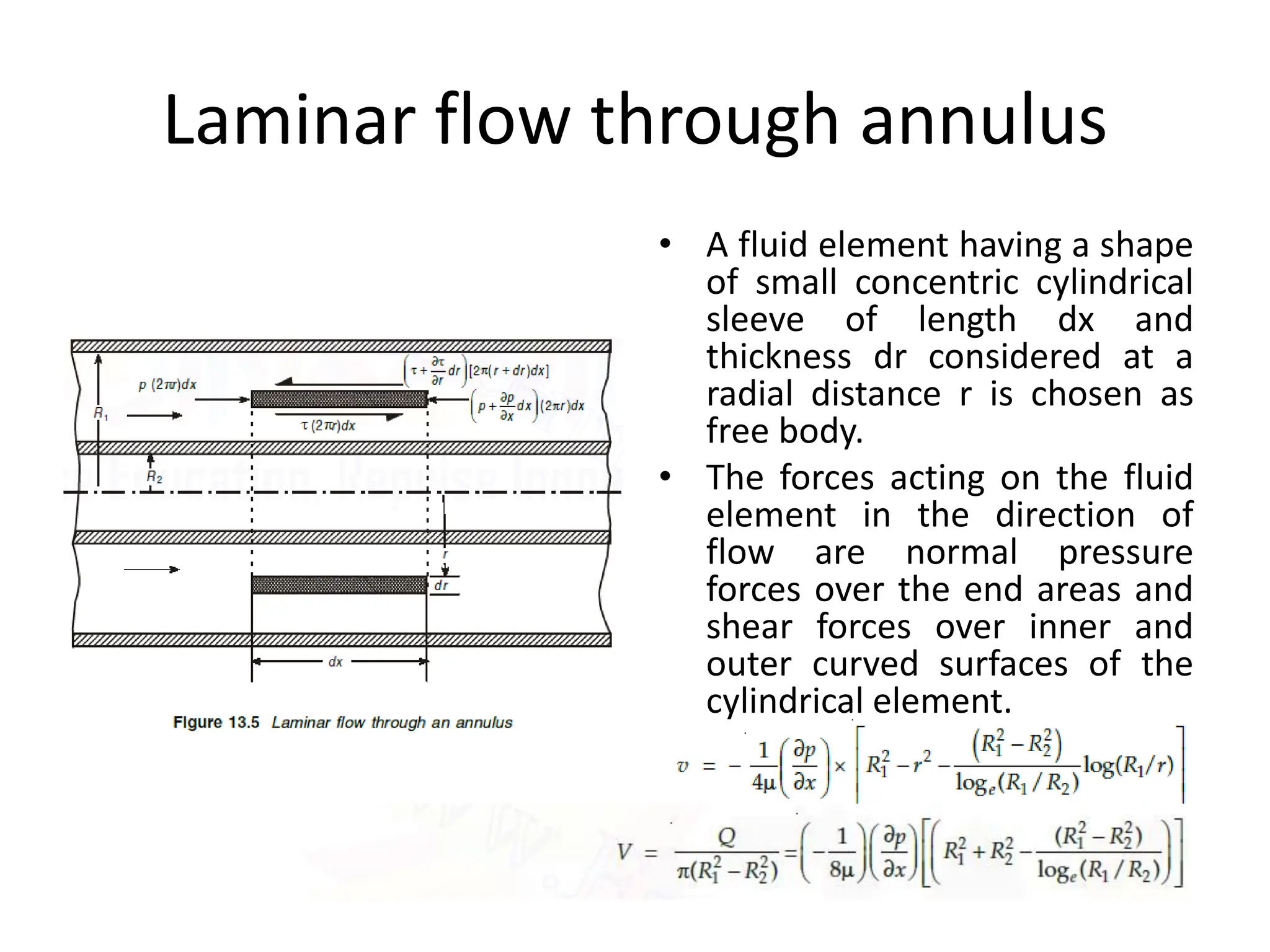
• A fluid element having a shape
of small concentric cylindrical
sleeve of length dx and
thickness dr considered at a
radial distance r is chosen as
free body.
• The forces acting on the fluid
element in the direction of
flow are normal pressure
forces over the end areas and
shear forces over inner and
outer curved surfaces of the
cylindrical element.
Laminar flow between parallel flat
plates-both plates at rest
Laminar flow between parallel plates-
both plates at rest
The shear stress varies linearly with the
distance from the boundary. It has the same
maximum value at either boundary (i.e., at y =
0 or y = B) and decreases linearly with the
distance from the boundary, with the result
that it is equal to zero at the centre line
between the two plates i.e., at y = B/2.
Laminar flow between parallel flat
plates- one plate moving and other at
rest
This linear velocity distribution case is known
as simple Couette flow or simple shear flow.
Laminar flow between parallel flat
plates- one plate moving and other at
rest
• The shear stress varies
linearly with the
distance from the
boundary.
Turbulent Flow
• The velocity distribution in
turbulent flow is relatively
uniform and the velocity profile
of turbulent flow is much flatter
than the corresponding laminar
flow parabola for the same mean
velocity. It becomes even flatter
with increasing Reynolds number.
• In the case of turbulent flow the
velocity fluctuations influence the
mean motion in such a way that
an additional shear (or frictional)
resistance to flow is caused. This
shear stress produced in
turbulent flow is in addition to
the viscous shear stress and it is
termed as turbulent shear stress.
Turbulent Flow
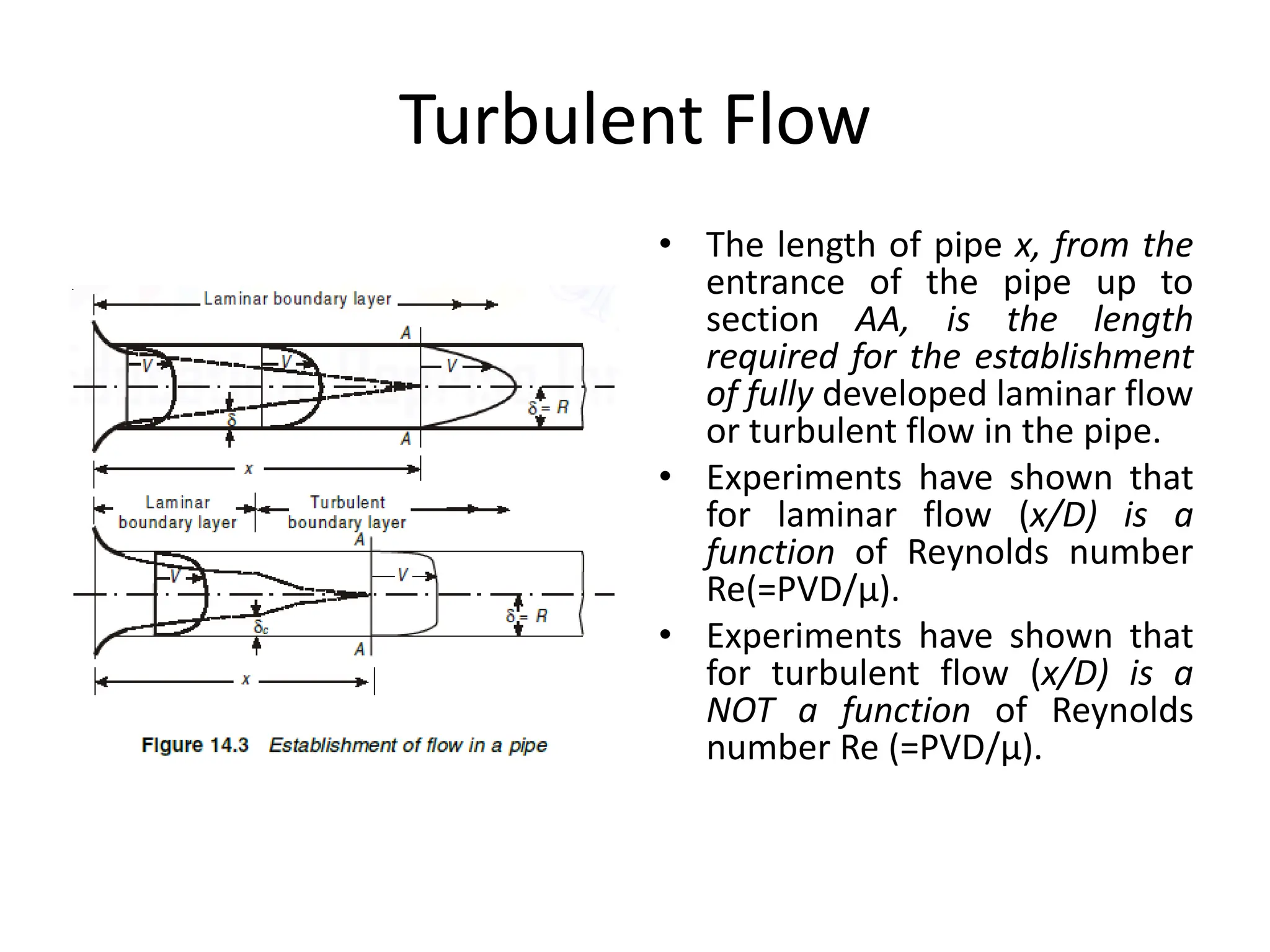
• The length of pipe x, from the
entrance of the pipe up to
section AA, is the length
required for the establishment
of fully developed laminar flow
or turbulent flow in the pipe.
• Experiments have shown that
for laminar flow (x/D) is a
function of Reynolds number
Re(=ΡVD/µ).
• Experiments have shown that
for turbulent flow (x/D) is a
NOT a function of Reynolds
number Re (=ΡVD/µ).
Turbulent Flow
• For laminar flow in a pipe, laminar boundary layer will be developed for
the entire length of the pipe and at a section thickness of the boundary
layer will become equal to the radius of pipe. The length of pipe x, from
the entrance of the pipe up to that section, is therefore the length required
for the establishment of fully developed laminar flow in the pipe.
• If the flow in a pipe is turbulent, for a small distance from the entrance
section, laminar boundary layer will be formed, which will change to
turbulent boundary layer before the thickness of the boundary layer
becomes equal to the radius of the pipe. However, in some cases, if the
pipe is rough and the intensity of turbulence of the incoming flow is
high, from the entrance section itself turbulent boundary layer may be
formed.
• Since a turbulent flow has logarithmic velocity distribution, it is much
more uniform and hence the length of pipe x, required for the
establishment of fully developed turbulent flow in a pipe is relatively less.
Fluid Flow Around Submerged
Objects–Drag and Lift
• The force exerted by the fluid on the moving
body may in general be inclined to the
direction of motion, and hence it has a
component in the direction of motion as well
as one perpendicular to the direction of
motion.
• The component of this force in the direction
of motion is called the drag FD, and the
component perpendicular to the direction of
motion is called the lift FL.
• However, for a symmetrical body, such as
sphere or a cylinder, facing the flow
symmetrically, there is no lift and thus the
total force exerted by the fluid is equal to the
drag on the body.
• Further, it is known from the principles of
hydrodynamics that for a symmetrical body
moving through an ideal fluid (i.e., having no
viscosity) at a uniform velocity, the pressure
distribution around the body is symmetrical
and hence the resultant force acting on the
body is zero.
Fluid Flow Around Submerged
Objects–Drag and Lift
• The sum of the components of the
shear forces in the direction of flow
of fluid is called the friction drag FDf.
• Similarly the sum of the components
of the pressure forces in the direction
of the fluid motion is called the
pressure drag FDp.
• The total drag FD acting on the body
is therefore equal to the sum of the
friction drag and the pressure drag.
• The lift on the body is given by the
summation of the component of the
shear and the pressure forces acting
over the entire surface of the body in
the direction perpendicular to the
direction of the fluid motion.
Fluid Flow Around Submerged
Objects–Drag and Lift
• For a body moving through a fluid of mass density ρ, at a uniform
velocity V, the mathematical expressions for the calculation of the
drag and the lift may also be written as follows:
• In the above expressions CD and CL are known as the drag and the
lift coefficients respectively, both of which are dimensionless.
• The area A is a characteristic area, which is usually taken as either
the largest projected area of the immersed body; or the projected
area of the immersed body on a plane perpendicular to the
direction of flow of fluid.
• The term (ρV^2/2) is the dynamic pressure of the flowing fluid.
Types of Drags due to Viscosity
Real fluid-
viscosity
Boundary layer
development
and No-slip
condition
Velocity
gradient
Shear stress
Surface drag
due to friction
Pressure drag due to
deformation of fluid
particles
Deformation drag = surface drag +
pressure drag (at low Reynolds number)
Separation
of flow
Form drag due to
development of
wake
Deformation drag=surface drag + form
drag(at high Reynolds number)
Types of Drags
• The relative magnitude of the two
components of the total drag viz.,
friction drag and pressure drag/form
drag, depends on the shape and the
position of the immersed body, and
the flow and the fluid characteristics.
• Thus if a thin flat plate is held
immersed in a fluid, parallel to the
direction of flow the pressure drag
practically equal to zero. As such in
this case the total drag is equal to the
friction drag.
• On the other hand, if the same plate
is held perpendicular to the flow, the
friction drag is practically equal to
zero and the total drag is due to the
pressure difference between the
upstream and downstream sides of
the plate.
Types of Drags
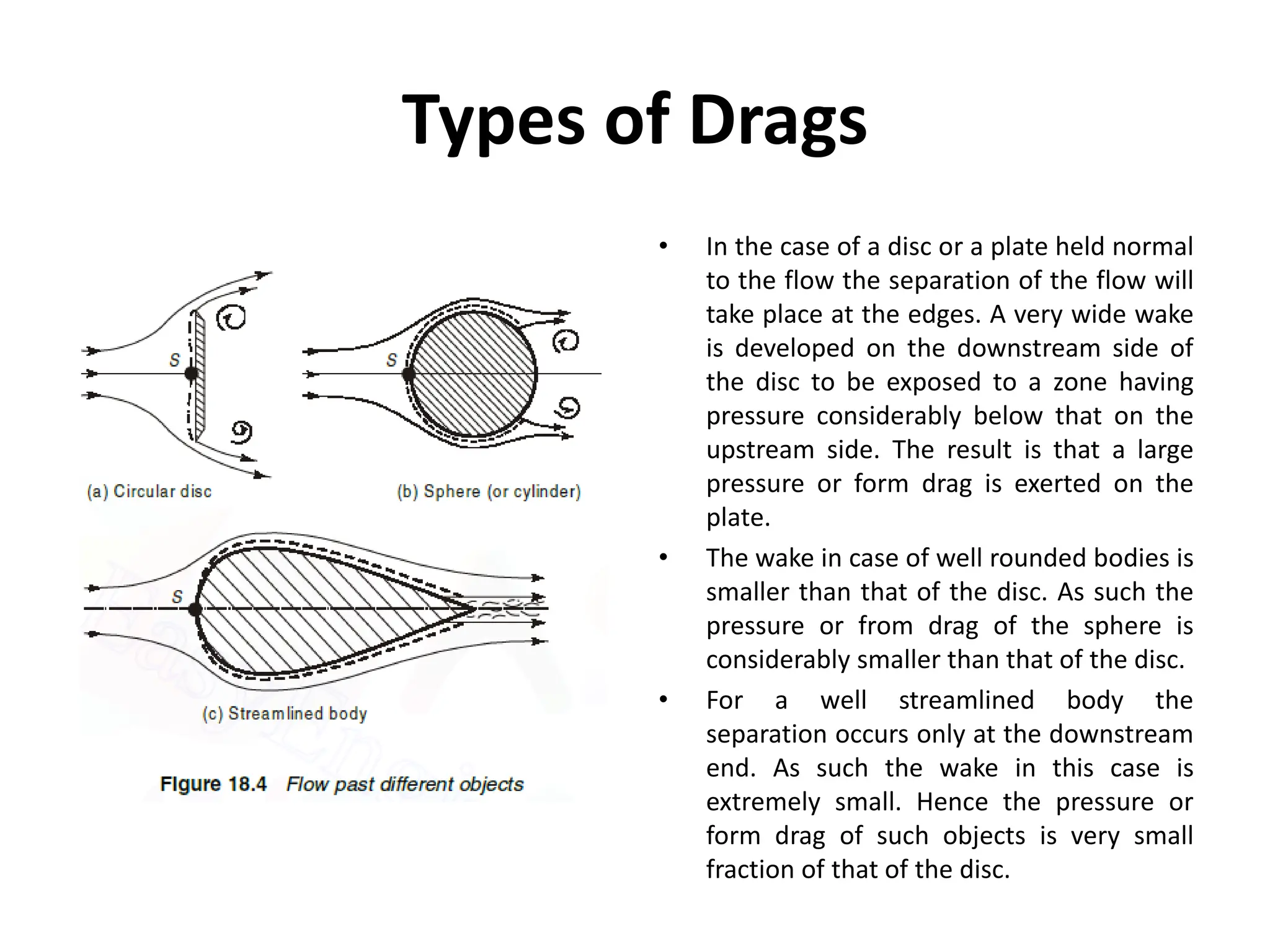
• In the case of a disc or a plate held normal
to the flow the separation of the flow will
take place at the edges. A very wide wake
is developed on the downstream side of
the disc to be exposed to a zone having
pressure considerably below that on the
upstream side. The result is that a large
pressure or form drag is exerted on the
plate.
• The wake in case of well rounded bodies is
smaller than that of the disc. As such the
pressure or from drag of the sphere is
considerably smaller than that of the disc.
• For a well streamlined body the
separation occurs only at the downstream
end. As such the wake in this case is
extremely small. Hence the pressure or
form drag of such objects is very small
fraction of that of the disc.
Types of Drags
Form drag of well
stream-lined bodies <
Form drag of well
rounded bodies < Form
drag of objects having
sharp edges
Surface drag of well
stream-lined bodies >
Surface drag of well
rounded bodies >
Surface drag of objects
having sharp edges
Total drag of well
stream-lined bodies <
Total drag of well
rounded bodies < Total
drag of objects having
sharp edges
DRAG ON A FLAT PLATE
• In the case of a flat plate
the drag coefficient CD is a
function of Re only at low
and moderate values of Re.
• However, as the value of Re
exceeds 10^3, CD assumes a
constant value of about 2.0.
• A reduction in the value of
CD however occurs if the
ratio of the length L of the
plate to its width B is not
very large. The value of CD
decreases as the length of
the plate is reduced.
DRAG ON A FLAT PLATE
• For a thin flat plate held perpendicular to the flow, for different
values of the ratio of length to breadth (L/B) of the plate, the values
of CD , although remains independent of Reynolds number for Re >
1000, it varies markedly with the (L/B) ratio of the plate.
• The limiting value of CD is equal to about 2.0 for an infinitely long
flat plate held perpendicular to the flow which is two dimensional
in character.
• However, because of the flow in the case of a circular disc held
perpendicular to the flow being three-dimensional in character the
limiting value of CD is only about 1.1.
DRAG ON AN AIRFOIL
• The coefficient of drag CD in the case of an airfoil
will necessarily depend on Re and its shape.
• Further in the case of an airfoil, a sudden drop
in the value of CD, cannot be expected, as
because of the streamlining of the body, the
separation occurs only at the extreme rear of
the body, resulting in a small wake and
consequently small pressure drag.
• However, in the case of a sphere or a cylinder
when the boundary layer changes from laminar
to turbulent, due to which the wake size alters
significantly to vary the contribution of the
pressure drag to the total drag, a sudden drop in
the value of CD can be expected.
• The pressure distribution around an airfoil,
based upon the actual measurement and the
theoretical irrotational flow analysis shows that
the two pressure distributions agree very well
except at the rear end, where the separation
may occur.
DRAG ON A SPHERE
• The pressure difference is equal to
zero on account of symmetrical
pressure distribution for an ideal fluid
flowing past a sphere.
• It therefore means that there is no
form drag. Furthermore, since there
is no viscosity, there is neither
deformation drag nor friction drag.
• For the flow of real fluid of an infinite
extent, past a sphere at Reynolds
numbers as low as 0.2, according to
G.G. Stokes the total drag FD = 3πµVD.
• Out of this total drag two-thirds is
contributed by surface drag and one-
third by the pressure drag (developed
on account of deformation of fluid
particles), that is surface drag=2/3(FD
)= 2πµVD and pressure drag due to
deformation =1/3(FD )= πµVD.
DRAG ON A SPHERE
• With the increase in the Reynolds
number the separation of the
boundary layer however begins from
the downstream stagnation point and
the points of separation move further
forward towards upstream direction
as Re increases.
• On account of the shifting of the
separation points considerably
towards the upstream side, a very
wide wake is formed on the rear of
the sphere, which results in a large
contribution of the pressure or (form)
drag (about 95%) in the total drag as
compared with a relatively small
magnitude of skin friction drag
(about 5%).
• Because of this, in the range of
Reynolds number from 10^3 to 10^5,
CD becomes more or less
independent of Reynolds number.
However, in this range of Re, CD,
increases slightly from 0.4 to 0.5 only.
DRAG ON A SPHERE
• Since up to Re < 3 × 10^5 the boundary layer may be
considered to be laminar, the pressure distribution around
the sphere on the upstream side up to the points of
separation is almost the same as obtained by ideal fluid
theory. However, beyond the points of separation, the
pressure distribution is altogether different from that
obtained by the ideal fluid theory.
• With a further increase in the Reynolds number, at Re ≥ 3
×10^5, the boundary layer becomes turbulent which can
travel further downstream without separation. As such in
this case the points of separation shift considerably to the
downstream side. Due to this shift in the points of
separation the size of the wake on the rear of the sphere is
reduced and the value of CD drops sharply from 0.5 to 0.2.
Effect of Turbulence on Drag
Coefficient
• It is thus seen that when the boundary layer changes from laminar to turbulent
the drag coefficient is greatly reduced. The transition of the boundary layer from
laminar to turbulent takes place at critical Reynolds number which however
decreases with the increase in the turbulence of the oncoming fluid and the
increase in the surface roughness. Moreover, by increasing the surface roughness
the point of transition of the boundary layer from laminar to turbulent is shifted
towards the upstream side. This early transition of the boundary layer from
laminar to turbulent on the boundary surface would result in shifting the points of
separation to the downstream side which in turn would result in the reduction of
the size of the wake and hence the reduction of the drag and the drag coefficient.
• With turbulent boundary layer and Re equal to 4.35 × 10^5 also the pressure
distribution around the sphere on the upstream side and more or less up to the
points of separation is almost the same as obtained by ideal fluid theory. Beyond
the points of separation the pressure distribution is considerably changed.
However, on account of the boundary layer being turbulent in this case the size of
the wake is reduced and the pressure in the wake is slightly positive.
DRAG ON A CIRCULAR DISC
• For the circular disc there is reduction in CD
only at low Reynolds numbersdue to viscous
effects, and the position of separation points
are towards the downstream side of the disc.
• For the circular disc there is no reduction in CD,
because, except at low Reynolds numbers, CD is
independent of viscous effects, and the
position of separation points is fixed at the
sharp edges of the disc.
DRAG ON A CYLINDER
• For an infinitely long cylinder of radius R, lying with its axis perpendicular
to the direction of flow in a uniform stream of fluid of infinite extent
having velocity of flow V, also if it is assumed that the fluid flowing past
the cylinder is ideal i.e., non-viscous, then the flow pattern will be
symmetrical.
• Because in this case the pressure distribution around the cylinder is
symmetrical about the mid-section. Consequently the drag on the cylinder
is zero.
• The values of the velocity components at any point on the surface of the
cylinder may be expressed as Vr = 0; and Vθ = 2V sin θ.
• It thus follows that the resultant velocity v at any point on the surface of
the cylinder is along the tangent to the cylinder and it is given by v = 2V sin
θ.
DRAG ON A CYLINDER
• However, due to the viscosity
possessed by the real fluid flowing
past a cylinder the actual pressure
distribution around the cylinder is
considerably modified.
• As long as the boundary layer is
laminar the points of separation are
located on the upstream half portion
of the cylinder, but when the
boundary layer becomes turbulent,
the points of separation shift farther
downstream towards the rear of the
cylinder.
• Furthermore, the pressure
distribution diagrams around a
cylinder are similar to those around a
sphere. But the flow pattern behind a
cylinder is altogether different from
that behind a sphere.
DRAG ON A CYLINDER
• For the case of flow past a
cylinder at very low
values of Reynolds
number (say Re < 0.5),
Lamb has obtained that
the drag coefficient CD of
a cylinder is also
approximately inversely
proportional to Re.
• Evidently at such low
values of Re surface drag
accounts for a large part
of the total drag.
DRAG ON A CYLINDER
• As the Reynolds number increases the flow pattern with respect to an axis
perpendicular to the direction of flow becomes unsymmetrical. It is on
account of the fact that in the wake developed just behind the cylinder, a
more or less orderly series of vortices (which alternate in position about
the centre line) are developed.
• At Re ranging from about 2 to 30, very weak vortices are formed on the
downstream of the cylinder. It is, therefore, the initial stage for the
development of the wake. In the wake region there exists a flow in the
opposite direction along the axis of the wake, but in the outer portion the
flow is in the general direction of motion.
• At Re ranging from about 40 to 70 the wake as well as the pair of vortices
become quite distinct.
• With a further increase in the value of Re the vortices become more and
more elongated in the direction of flow, and at Re equal to about 90 these
vortices become symmetrical, they leave the cylinder and slowly move in
the downstream direction.
Karman Vortex Trails
• Experiments have shown that when the
Reynolds number exceeds about 30, the
two vortices formed at the points of
separation elongate to such an extent that
they become unstable and are washed
down. Since Von Karman was first to study
and analyze the stability of these regular
vortex trails behind a cylinder, these trails
of vortices are commonly known as
“Karman vortex trails” (or Karman vortex
street).
• The two possible vortex configurations in
the Karman vortex trails as suggested by
Karman are as shown in Fig. 18.9.
However, a theoretical analysis of the
stability of vortices of these two
configurations revealed that the
symmetrical configuration of vortex pair
shown in Fig. 18.9 (a) is not at all stable.
• Therefore it may be concluded that as the
fluid flows past a cylinder, an alternate
shedding of the vortices occurs, because
this is the only stable type of pattern
which may be developed for the Karman
vortex trails.
In fact such vortices are always shed when any
two dimensional bluff body is held in a stream
and the flow separates. Thus same is the case
with long flat plates held normal to the
direction of flow of stream of fluid for which
however the Reynolds number is greater than
103.
DRAG ON A CYLINDER
• As the Reynolds number increases the contribution of the pressure drag in
the total drag increases from about one third of the total at small
Reynolds numbers to about half of the total drag as the Reynolds number
increases and vortices begin to form.
• The contribution of the pressure drag in the total drag further increases to
about three quarters of the total at Re equal to about 200, when the
Karman vortex street is well established.
• At high values of Re the variation of CD with Re for a cylinder follows a
pattern similar to that for a sphere. The drag coefficient for a cylinder
reaches a minimum value of about 0.95 at Re = 2000 and then there is
slight rise to 1.2 for Re = 3 × 10^4 due to the increasing turbulence in the
wake and also the widening of the wake as the separation points gradually
advance upstream.
DRAG ON A CYLINDER
At Re = 2 × 10^5 the boundary layer which was
up to now laminar, becomes turbulent before
separation and therefore there is a drop in the
value of CD from 1.20 to about 0.3.
However, with a further increase in Re where
CD is practically independent of Re due to
relatively small viscous effects, the value of CD
increases gradually from 0.3 to about 0.7 over
the approximate range of 5 × 10^5 < Re < 3 ×
10^6.
Effect of Free Surface on Drag
• The gravity forces become predominant when the object is
lying at the interface (or common surface) between the two
fluids of different densities. In such cases for the
geometrically similar bodies the drag coefficient will
depend on both Re and Fr.
• In the case of ships moving on the water surface, the total
drag in the case of a ship is the sum of skin friction drag,
pressure (or form) drag, and the drag due to surface waves.
• The difference between the total drag and the skin friction
drag is commonly known as residual drag. Since the
formation of surface waves is associated with gravitational
action, the residual drag is essentially a function of Froude
number, which may, however, be determined by ship
model studies.
EFFECT OF COMPRESSIBILITY ON
DRAG
• The elastic forces become significant when the velocity of
flow approaches the velocity of sound in that fluid, and the
drag coefficient becomes a function of Mach number Ma.
• With the increase in the value of Mach number the
compressibility of fluid has significant influence on the flow
characteristics as well as the drag.
• In a compressible flow additional forces are transmitted
through the fluid by the shock waves produced.
• The shock waves are essentially the elastic waves (or
pressure waves) spherical in form, which travel at the
velocity of sound, and these are produced in the vicinity of
the object immersed in a compressible fluid flowing past
the object .
EFFECT OF COMPRESSIBILITY ON
DRAG
• Such shock waves with conical
wave front are observed to
extend backwards from the
leading edge of the objects in
the case of supersonic flows
past immersed object.
• An abrupt change of pressure
always occurs across such a
shock wave which produces
the drag.
• In addition the drag also
results from the energy
dissipated in the shock waves
as well as the skin friction and
the flow separation effects.
EFFECT OF SHAPE OF THE OBJECT ON
DRAG
• At high values of Mach number,
the drag is practically
independent of Reynolds number
whereas at low values of Mach
number, Reynolds number is the
significant parameter.
• It may be noted from these
curves that the numerical values
of CD drop steadily when the nose
of the body becomes successively
more pointed, the rear of the
body remaining unchanged in all
cases.
• This is so because in supersonic
flow a sharp pointed nose creates
a narrow shock wave front which
tends to minimize the drag.
EFFECT OF SHAPE OF THE OBJECT ON
DRAG
• From the above discussion it is observed that for
minimum drag in supersonic flow the body should have
a sharp forward edge, or conical nose, and the shape of
the rear end is of secondary importance.
• This requirement is, however, the reverse of that for
subsonic flows, for which as stated earlier the drag is
the least for a streamlined body well tapered at the
rear and rounded at the front.
• Thus a body well streamlined for subsonic flows may
be poorly shaped for supersonic flows and vice versa.
DEVELOPMENT OF LIFT ON
IMMERSED BODIES
• When the body is symmetrical
with respect to its axis and so
located that its axis is parallel to
the direction of motion, then the
resultant force exerted by the
fluid on the body is in the
direction of motion, and in such a
case the lift is zero.
• However, if the axis of symmetry
of the body makes an angle with
the direction of motion, the
resultant force acting on the body
will have a lift component.
• A lift is exerted on a cylinder lying
in a uniform flow when a
circulation is superimposed on
the uniform flow field.
DEVELOPMENT OF LIFT ON A
CYLINDER
• The velocity v of the composite flow on the
surface of the cylinder is v = 2V sin θ + Γ/2π R.
• The position of the stagnation points S1 and S2 on
the surface of the cylinder,, may be determined
by considering v = 0 and solving for sin θ which
gives sin θ = –Γ/4π RV.
• The negative sign in the above expression for sin
θ indicates that angle θ is equal to – θ or (180 +
θ),since in both these cases sin θ is negative.
DEVELOPMENT OF LIFT ON A
CYLINDER
• The lift dFL acting on an elementary
surface area of the cylinder (LRd θ) is
given by dFL = – (LRd θ) p sin θ in
which L is the length of the cylinder.
• The negative sign has been
introduced because the pressure
force is always directed towards the
surface, and hence for sin θ being
positive its component is negative
being in the vertical downward
direction.
• The total lift FL exerted on the cylinder
is obtained as FL = ρVLΓ. This equation
is commonly known as Kutta-
Joukowski equation.
• The lift coefficient CL may be
expressed as CL = Γ/RV where A is the
projected area which is equal to 2RL.
• The lift coefficient may also be
expressed as CL =2 π vc/V.
The phenomenon of the lift produced by
circulation around a circular cross-section
placed in a uniform stream of fluid, was first
investigated experimentally by a German
physicist H.G. Magnus in 1852. As such it is
commonly known as Magnus effect.
DEVELOPMENT OF LIFT ON A
CYLINDER
• From this plot it can be seen that to
produce a given lift coefficient the actual
velocity required is greater than twice that
required theoretically.
• Furthermore, as the peripheral velocity vc
increases to about four times the velocity
of flow of fluid V, the lift coefficient CL
approaches a maximum value of about
9.0 as compared with the theoretical
maximum value of about 12.6.
• In addition to this, the drag coefficient CD
also varies with velocity ratio (vc/V) from
about 1.0 for small velocity ratios to about
5 at a velocity ratio equal to 4.
• For (vc/V) ≈1.0 the value of the drag
coefficient CD is minimum and afterwards
it increases steeply with an increase in the
value of (vc/V).
If the cylinder is relatively short i.e., it has length to
diameter ratio (L/D) < 10 then there is considerable
effect of flow around its ends which appreciably
reduces the lift coefficient. For example, when the
ratio (L/D) = 5, the lift coefficient CL is about half of
that for a longer cylinder having ratio (L/D) >10.
DEVELOPMENT OF LIFT ON AN
AIRFOIL
• Symmetry of an airfoil is
generally characterized by the
chord length c and the angle
of attack α.
• For a symmetrical airfoil the
chord line coincides with its
axis of symmetry.
• The overall length of an airfoil
(in the direction perpendicular
to the cross-section) is termed
as its span.
• The ratio of span L and chord
length c of an airfoil (i.e., L/c)
is known as aspect ratio.
DEVELOPMENT OF LIFT ON AN
AIRFOIL
• Joukowski showed that the pattern of
flow round a circular cylinder could
be used to deduce the flow pattern
around a body of any other shape by
a mathematical process called
‘conformal transformation.’
• As such it may be noted that Kutta-
Joukowski equation, though
developed for a cylinder of circular
cross-section, is found to hold good
for a cylinder having a cross-section
of any shape provided there is
circulation around it.
• From the theoretical analysis it has
been found that by properly
adjusting the circulation it is possible
to obtain the flow pattern such that
the streamline at the trailing end of
the airfoil is tangential to it.
DEVELOPMENT OF LIFT ON AN
AIRFOIL
• The circulation Γ required to do
this has been found analytically
as Γ=π c V sinα, where c is chord
length, V is uniform velocity of
flow and α is the angle of attack.
• So the lift FL on the airfoil of span
L becomes FL = ρVLΓ= ρVL (π c V
sinα)= π c LρV^2 sinα.
• The lift coefficient CL may be
expressed as CL = 2π sinα, where
A is the area of the projection of
the airfoil on a plane
perpendicular to its cross-section,
which in the case of an airfoil of
span L and chord length c is equal
to (cL).
DEVELOPMENT OF CIRCULATION
AROUND AN AIRFOIL
• When a uniform stream of real fluid flows past an airfoil, then initially the
flow pattern is same as that for an ideal fluid flowing past an airfoil i.e., an
irrotational flow pattern develops.
• When the boundary layer separates from the lower surface at the trailing
edge and on the upper surface a flow is induced from the stagnation point
towards the trailing edge. This flow is in the opposite direction to that of
the ideal fluid which results in the formation of an eddy called starting
vortex on the upper surface in the region of the trailing edge.
• When the starting vortex leaves the airfoil, it generates an equal and
opposite circulation round the airfoil. In this way, the net circulation round
the curve A remains zero.
• Now in order to counterbalance the counter clockwise circulations of the
starting vortex, a clockwise circulation of the same strength must be set
up around the airfoil, so that the sum of the circulation around the curve A
is zero in accordance with Thomson’s theorem. The clockwise circulation
around the airfoil is usually known as boundary circulation.
DEVELOPMENT OF LIFT ON AN
AIRFOIL
• A constant circulation around the airfoil results in
setting up of a constant lift on the airfoil.
• Furthermore due to the viscosity, for a real fluid
the actual lift exerted on an airfoil is somewhat
less than that obtained by Kutta—Joukowski
equation.
• The drag and lift of an airfoil may also be
expressed as
in which the area A is represented by the product
of the length or span L and the chord length c of
the airfoil.
DEVELOPMENT OF LIFT ON AN
AIRFOIL
• The actual flow pattern developed for the
flow of real fluid past an airfoil is very
much similar to that for an irrotational
flow for small values of angle α’.
• With increase in the value of angle α’ to
about 10° the lift coefficient attains a
maximum value and for α’ > 10° there is
decrease in the value of lift coefficient.
• The reduction in the lift coefficient with
increase in the angle of attack beyond the
stalling angle is due to the separation of
flow at some point on the upper side of
the airfoil.
• The condition in which the flow separates
from practically the whole of the upper
surface of the airfoil is known as stall.
• The drag coefficient of an airfoil varies
little with the angle α’ and it is only at the
higher values of the angle α’, since the
flow separates, the drag coefficient is
Effect of Fluid Compressibility on the
Lift on an Airfoil
• In subsonic compressible flow the effect of fluid
compressibility is to cause an increase in the coefficient of
lift CL at a given angle of attack α.
• In subsonic compressible flow past thin symmetrical airfoil
of infinite span and small angle of attack, the lift coefficient
is increased by a factor (1–Ma^2)^(–1/2).
• When the free stream velocity is increased from a subsonic
to supersonic range, due to the formation of shock waves,
there is a decrease in the value of CL with the increase in
the value of Ma.
• For supersonic flow past thin symmetrical airfoils of
infinites span and small angle of attack the lift coefficient is
decreased by a factor (Ma^2-1)^(–1/2).
INDUCED DRAG ON AN AIRFOIL OF
FINITE LENGTH
• If an airfoil of a finite span or length L
is placed in a fluid stream, then the
flow of fluid also takes place along
the two ends, on account of which
both the drag will be increased, as
induced drag is exerted which is in
addition to the normal drag exerted
on an airfoil of infinite span.
• The induced drag FDi may also be
expressed as
where CDi is the coefficient of
induced drag.
• By assuming an elliptical distribution
of lift on an airfoil of finite span,
Prandtl has obtained the following
approximate expression for the
coefficient of induced drag as
where (L/c) is the aspect ratio of the
airfoil.
The flow around the ends of a short cylinder
also causes an induced drag in addition to the
normal drag. The induced drag for a short
cylinder is caused in the same manner as in
the case of an airfoil of finite length.
POLAR DIAGRAM FOR LIFT AND DRAG
OF AN AIRFOIL
• The plots indicating the variation of
the coefficients with the angle of
attack α or angle α’ may be shown by
a single curve known as the polar
diagram, which was developed by
Prandtl.
• In this diagram the lift coefficient CL is
plotted against the drag coefficient
CD.
• The horizontal intercept between the
two curves will represent the drag
coefficient CD0 for flow around an
airfoil of infinite length.
• Since the induced angle of attack αi is
usually small, the lift coefficient is
same for airfoils of finite and infinite
span.
Dimensional Analysis
• Dimensional analysis helps in determining a systematic
arrangement of the variables in the physical relationship and
combining dimensional variables to form non-dimensional
parameters.
• In the study of fluid mechanics the dimensional analysis has been
found to be useful in both analytical and experimental
investigations. Some of the uses of dimensional analysis are
 Testing the dimensional homogeneity of any equation of fluid
motion.
 Deriving equations expressed in terms of non-dimensional
parameters to show the relative significance of each parameter.
 Planning model tests and presenting experimental results in a
systematic manner in terms of non-dimensional parameters; thus
making it possible to analyze the complex fluid flow phenomenon.
DIMENSIONAL HOMOGENEITY
• Fourier’s principle of dimensional homogeneity states
that an equation which expresses a physical
phenomenon of fluid flow must be algebraically correct
and dimensionally homogeneous.
• A dimensionally homogeneous equation has the
unique characteristic of being independent of the units
chosen for measurement.
• A dimensionally homogeneous equation has the
advantage that it is always possible to reduce a
dimensionally homogeneous equation to a non-
dimensional form.
Rayleigh Method
(used when the number of variables is less)
• The following two methods of dimensional analysis are generally
used:
 Rayleigh Method: In this method a functional relationship of some
variables is expressed in the form of an exponential equation which
must be dimensionally homogeneous.
Thus if X is some function of variables X1, X2, X3…Xn ; the functional
equation can be written as
which may be expressed as
in which C is a dimensionless constant which may be determined
either from the physical characteristics of the problem or from
experimental measurements.
The exponents a, b, c…,…n are then evaluated on the basis that the
equation is dimensionally homogeneous. The dimensionless
parameters are then formed by grouping together the variables
with like powers.
Buckingham π-Method
(used when the number of variables is more)
• Buckingham π-Method: The Buckingham’s π-theorem
states that if there are n dimensional variables involved in a
phenomenon, which can be completely described by m
fundamental quantities or dimensions, and are related by a
dimensionally homogeneous equation, then the
relationship among the n quantities can always be
expressed in terms of exactly (n – m) dimensionless and
independent π terms.
Mathematically, if any variable Q1 depends on the
independent variables, Q2, Q3, Q4………Qn; the functional
equation may be written as
which can be transformed to where C is a
dimensionless constant.
Buckingham π-Method
In accordance with the π-theorem, a non-dimensional
equation can thus be obtained as
wherein each dimensionless π-term is formed by combining m
variables out of the total n variables with one of the
remaining (n – m) variables.
Thus the different π-terms may be established as
in which each individual equation is dimensionless and the
exponents a, b, c, d……m etc., are determined by considering
dimensional homogeneity for each equation so that each π-
term is dimensionless.
Buckingham π-Method
The final general equation for the phenomenon
may then be obtained by expressing any one of
the π-terms as a function of the others as
These m variables which appear repeatedly in
each of the π-terms, are consequently called
repeating variables and are chosen from among
the variables such that they together involve all
the m fundamental quantities (or dimensions)
and they themselves do not form a dimensionless
parameter.
Repeating Variables
• The repeating variables should be such that
None of them is dimensionless.
No two variables have the same dimensions.
They themselves do not form a dimensionless
parameter.
All the m fundamental dimensions are included
collectively in them.
Moreover, as far as possible the dependent variable
should not be taken as a repeating variable as
otherwise it will not be possible to obtain an explicit
relationship.
Dimensional Matrix Approach
for Repeating Variables
• In some cases the Buckingham’s π theorem does not hold good for
determining the number of the dimensionless groups in a complete set of
variables.
• As such in order to obtain the number of dimensionless groups into which
a complete set of variables may be grouped, another method based on
dimensional matrix approach may be adopted which is as follows:
 List all the variables involved in the phenomenon and prepare a
dimensional matrix of the variables, which is nothing but display of the
exponents of the dimensions of the variables by a tabular arrangement.
 Find the rank of the dimensional matrix. The rank of a matrix is said to be
r, if it contains a nonzero determinant of order r and if all determinants of
order greater than r that the matrix contains are equal to zero.
 The number of dimensionless groups of π-terms is equal to (n–r), that is,
total number of variables n minus the rank of the dimensional matrix r.
SUPERFLUOUS AND OMITTED
VARIABLES
• Often variables may be included that really do
not have any effect on the phenomenon. Such
variables are known as superfluous variables.
• The inclusion of these variables will result in the
appearance of too many terms in the final
equation, thereby making the whole analysis
unnecessarily complicated.
• These superfluous variables can be eliminated
from the analysis only on the basis of the results
obtained from the experimental investigation of
the problems.
SUPERFLUOUS AND OMITTED
VARIABLES
• A set of experiments can now be carried out to determine if a variable
really affects the phenomenon.
• For this purpose the other π-terms must be kept constant while the π-
term containing that variable is varied.
• A plot of one of the π-term against the π-term containing that variable
prepared from the experimental observations may then indicate no
variation of the π-term containing that variable showing thereby that the
variable is irrelevant to this problem.
• If, on the contrary, any of the pertinent variable that may actually
influence the phenomenon, is omitted at the beginning, the analysis may
lead to an incomplete, or even erroneous conclusions.
• This will however be indicated by the final experimental plot of π-terms
which will show a scatter of the points which is not due to experimental
error. In such cases a search must then be made for the omitted variable, a
new dimensional analysis made and a revised plotting carried out.
SUPERFLUOUS AND OMITTED
VARIABLES
• A common mistake may be on account of the omission of
certain variables that have a practically constant value.
These variables are sometimes essential because they
combine with other active variables to form dimensionless
parameters.
• It is thus evident that the method of dimensional analysis
does not give any clue as to the correctness of the selection
of the relevant variables of a particular phenomenon.
• The method of dimensional analysis merely tells how the
variables should be grouped so that from the experimental
investigation it may be decided which of the variables are
important ones. This is however, the main limitation of the
dimensional analysis.
USE OF DIMENSIONAL ANALYSIS
Dimensional analysis is
extremely useful in reducing
the number of variables in a
problem by formulating the
variables involved in any
problem into non-dimensional
parameters.
The reduction of the number of
variables in a problem provides
a systematic scheme for
planning laboratory tests and
also permits the presentation of
experimental results in a more
concise and useful form.
USE OF DIMENSIONAL ANALYSIS
• Suppose it has been found by the
dimensional analysis that some of the
variables influencing any phenomenon,
are interconnected by say four non-
dimensional groups π1, π2, π3, and π4
such that π1 = f (π2, π3, π4).
• An experimental investigation will provide
certain data which may be presented as a
set of groups of π1 against π2 with a
number of curves for different values of
π4 and each graph being for a certain
value of π3.
• In this way the effect of every group is
presented separately. There will of course
be many sets of graphs if the number of
relevant non-dimensional π groups is
large.
• If one group, say π4 is irrelevant, then all
the curves for different values of π4 in
each graph will coincide leaving only π1,
π2 and π3 as relevant groups.
DIMENSIONAL ANALYSIS OF DRAG
AND LIFT
DIMENSIONAL ANALYSIS OF DRAG
AND LIFT
Usually it is not possible to
predict the total drag on a
body merely by analytical
methods. As such in almost all
the cases the general practice
is to determine the total drag
on a body experimentally.
The planning of the
experiments and the analysis
of the results obtained from
the experiments may
conveniently be carried out in
terms of the dimensional
analysis of the problem.
EXPERIMENTAL INVESTIGATION
• For the purpose of finding out , in advance, how the structure
or the machine would behave when it is actually constructed
the engineers have to resort to experimental investigation.
• Experiments to check performance of the structure or the
machine are also necessitated in the case of the problems
which cannot be solved completely simply by theoretical
analysis.
• On the basis of the final results obtained from the model tests
the design of the prototype may be modified and also it may
be possible to predict the behavior of the prototype.
• However, the model test results can be utilized to obtain in
advance the useful information about the performance of the
prototype only if there exists a complete similarity between
the model and prototype.
Geometric Similarity
• There are in general three types of similarities to be established for
complete similarity to exist between the model and its prototype.
These are:
 Geometric Similarity
 Kinematic Similarity
 Dynamic Similarity.
• Geometric Similarity:
 Geometric similarity exists between the model and the prototype if
the ratios of corresponding length dimensions in the model and the
prototype are equal. Such a ratio is defined as scale ratio e.g. length
scale ratio, area scale ratio and volume scale ratio etc.
 It will thus be observed that if the model and the prototype are
geometrically similar, by mere change of scale they can be
superimposed.
Kinematic Similarity
• Kinematic Similarity:
 Kinematic similarity exists between the model and the prototype if
the paths of the homologous moving particles are geometrically
similar, and if the ratios of the velocities as well as acceleration of
the homologous particles are equal. Such a ratio is defined as scale
ratio e.g. time scale ratio, velocity scale ratio, acceleration scale
ratio and discharge scale ratio etc.
 Kinematic similarity can be attained if flownets for the model and
the prototype are geometrically similar, which in turn means that by
mere change of scale the two can be superimposed.
• Dynamic Similarity:
 Dynamic similarity exists between the model and the prototype
which are geometrically and kinematically similar if the ratio of all
the forces acting at homologous points in the two flow systems of
the model and the prototype are equal.
Dynamic Similarity
 For complete dynamic
similarity to exist between the
model and its prototype, the
ratio of inertia forces of the
two systems must be equal to
the ratio of the resultant
forces. Thus the following
relation between the forces
acting on model and prototype
develops:
 In addition to the above noted condition
for complete dynamic similarity, the ratio
of the inertia forces of the two systems
must also be equal to the ratio of
individual component forces i.e., the
following relationships will be developed:
Complete Similarity or
Complete Similitude
• It may thus be mentioned that when the two systems are
geometrically, kinematically and dynamically similar, then
they are said to be completely similar or complete
similitude exists between the two systems.
• However, as stated earlier dynamic similarity implies
geometric and kinematic similarities and hence if two
systems are dynamically similar, they may be said to be
completely similar.
• Moreover, for complete similitude to exist between the two
systems viz., model and prototype, the dimensionless
numbers or π terms, formed out of the complete set of
variables involved in that phenomenon, must be equal.
FORCE RATIOS–DIMENSIONLESS
NUMBERS
• Inertia Force Ratio:
• Inertia-Viscous Force Ratio:
This non-dimensional ratio (ρVL/μ) or
(VL/υ) is called ‘Reynolds number’ (Re or
NR).
• Inertia-Gravity Force Ratio:
The square root of this ratio is known as
‘Froude number’ (Fr or NF).
• Inertia-Pressure Force Ratio:
The square root of this ratio is known as
‘Euler’s number’ (Eu or NE).
• Inertia-Elasticity Force Ratio:
The square root of this ratio is known as
‘Mach number’ (Ma or NM).
• Inertia-Surface Tension Force Ratio:
The square root of this ratio is known as
‘Weber number’ (We or NW).
SIMILARITY LAWS
• The results obtained from the model tests may be
transferred to the prototype by the use of model laws
which may be developed from the principles of dynamic
similarity..
• In the derivation of these model laws, it has been assumed
that for equal values of the dimensionless parameters the
corresponding flow pattern in model and its prototype are
similar.
 Reynolds Model Law: For the flows where in addition to
inertia, viscous force is the only other predominant force,
the similarity of flow in the model and its prototype can be
established if the Reynolds number is same for both the
systems.
SIMILARITY LAWS
 Froude Model Law: When the force of gravity can be considered to
be the only predominant force which controls the motion in
addition to the force of inertia, the similarity of the flow in any two
such systems can be established if the Froude number for both the
systems is the same.
 Euler Model Law. In a fluid system where supplied pressures are
the controlling forces in addition to the inertia force and the other
forces are either entirely absent or are insignificant, the dynamic
similarity is obtained by equating the Euler number for both the
model and its prototype.
SIMILARITY LAWS
 Mach Model Law. If in any phenomenon only the forces
resulting from elastic compression are significant in
addition to inertia and all other forces may be neglected,
then the dynamic similarity between the model and its
prototype may be achieved by equating the Mach number
for both the systems.
 Weber Model Law. When surface tension effects
predominate in addition to inertia force the pertinent
similitude law is obtained by equating the Weber number
for the model and its prototype.
TYPES OF MODELS
• In general hydraulic models can be classified under two broad categories:
 Undistorted Models:
 An undistorted model is that which is geometrically similar to its
prototype, that is, the scale ratios for corresponding linear dimensions of
the model and its prototype are same.
 Since the basic condition of perfect similitude is satisfied, prediction in the
case of such models is relatively easy and many of the results obtained
from the model tests can be transferred directly to the prototype.
 Distorted Models:
 Distorted models are those in which one or more terms of the model are
not identical with their counterparts in the prototype.
 Since the basic condition of perfect similitude is not satisfied, the results
obtained with the help of a distorted model are liable to distortion and
have more qualitative value only.
 A distorted model may have either geometrical distortion, or material
distortion, or distortion of hydraulic quantities or a combination of these.
TYPES OF MODELS
 The following are some of the reasons for adopting distorted models:
 To maintain accuracy in vertical measurements.
 To maintain turbulent flow.
 To obtain suitable bed material and its adequate movement.
 To obtain suitable roughness condition.
 To accommodate the available facilities such as space, money, water supply and
time.
 The merits of distorted models may be summed up as follows:
 The vertical exaggeration results in steeper water surface slopes and magnification
of wave heights in models, which can therefore be measured easily and accurately.
 Due to exaggerated slopes, the Reynolds numbers of a model is considerably
increased and the surface resistance is lowered. This assists in simulation of the
flow conditions in the model and the prototype.
 In case of distorted models sufficient tractive force can be developed to produce
adequate bed movement with a reasonably small model.
 Model size can be sufficiently reduced by its distortion, thereby its operation is
simplified and also cost is lowered considerably.
TYPES OF MODELS
 Besides the advantages accruing from distortion as indicated above, there are
certain limitations of distorted models, which are as listed below:
 The magnitude and distribution of velocities are incorrectly reproduced because
vertical exaggeration causes distortion of lateral distribution of velocity and kinetic
energy.
 The pressures may not be correctly reproduced in magnitude and direction.
 Some of the flow details may not be correctly reproduced because distortion
increases longitudinal slopes of model streams thus tending to upset flow regime
at a point where artificial model roughness is required to restore it.
 Slopes of river bends, earth cuts and dikes are often so steep that they cannot be
moulded satisfactorily in sand or other erodible material.
 A model wave may differ in type and possibly in action from that of the prototype.
 There is an unfavourable psychological effect on the observer.
 Although distorted models have a number of limitations, yet if judicious
allowances are made in the interpretation of the results obtained from such
models, useful information can be obtained, which is not possible otherwise.
SCALE EFFECT IN MODELS
• If complete similitude does not exist between a model and its prototype
there will be some discrepancy between the results obtained from the
model tests and those which will be indicated by the prototype after its
construction. This discrepancy or disturbing influence is called scale effect.
• In the case of certain problems if several forces have predominance, the
complete similitude will be ensured only if all the pertinent model laws
are simultaneously satisfied. However, as indicated below, it is quite
difficult to satisfy all the model laws involved in the phenomenon and
hence in such cases complete similarity cannot be achieved.
• Under such circumstances the variables which may be considered to have
secondary influence on the phenomenon are neglected, so that the
number of the model laws to be satisfied is reduced. But by neglecting
these variables some discrepancy or scale effect would be developed
between the results obtained from the model tests and those of the
prototype.
SCALE EFFECT IN MODELS
• The scale effect may also be developed in cases where the forces
which have practically no effect on the behavior of the prototype,
significantly affected the behavior of its model.
• Often it may not be possible to correctly simulate all the conditions
(e.g., roughness) in the model, as that of the prototype. This may
also result in developing scale effect if any of these conditions has a
pronounced effect on the phenomenon.
• In order to detect the presence of such disturbing influences the
proposed work may be tried in models with different scales and the
resulting scale effects judged from the comparative results so
obtained.
• Besides this the observations collected on models constructed to
different scales will also provide an empirical relationship between
scale effect and size of model, which may be utilized to correct the
results of the model tests.

Fluid Dynamics detailed ppt for Civil Eg

  • 1.
  • 2.
    Boundary Layer Theory Real fluid- viscosity Velocity gradient Shearstress Boundary layer development No-slip condition
  • 3.
    THICKNESS OF BOUNDARYLAYER • Nominal thickness (δ):v=0.99 V • The thickness of the boundary layer is arbitrarily defined as that distance from the boundary surface in which the velocity reaches 99% of the velocity of the main stream. • Displacement thickness(δ*): • The distance by which the boundary surface would have to be displaced outwards so that the total actual discharge would be same as that of an ideal (or frictionless) fluid past the displaced boundary. • The distance by which the external streamlines are shifted or displaced outwards owing to the formation of the boundary layer.
  • 4.
    Reduced discharge withboundary layer Q=AV Original discharge with out boundary layerQ1=A1V =π*R1^2 A1-A=A2=π*R2^2=> displacement thickness=R2-R1
  • 5.
    • Mass=density*volume=ρ*A*V*t • Momentum=Mass*velocity= ρ*A*V*t*V=ρAV^2*t •Momentum flux=M1-M2/t= ρAV^2*t/t=ρAV^2= ρ(πr^2)V^2 • Energy=1/2*mass*velocity^2= ½*ρ*A*V*t*V^2=1/2*ρAV^3*t • Energy flux=E1-E2/t=1/2*ρAV^3*t/t= ½*ρAV^3
  • 6.
    THICKNESS OF BOUNDARYLAYER • Momentum thickness(θ): • The distance from the actual boundary surface such that the momentum flux corresponding to the main stream velocity V through this distance θ is equal to the deficiency or loss in momentum due to the boundary layer formation. • Energy thickness(δE): • The distance from the actual boundary surface such that the energy flux corresponding to the main stream velocity V through this distance Δe is equal to the deficiency or loss of energy due to the boundary layer formation.
  • 7.
    BOUNDARY LAYER CHARACTERISTICS •The various factors which influence the thickness of the boundary layer forming along a flat smooth plate are noted below. • The boundary layer thickness increases as the distance from the leading edge increases. • The boundary layer thickness decreases with the increase in the velocity of flow of the approaching stream of fluid. • Greater is the kinematic viscosity of the fluid greater is the boundary layer thickness. • The boundary layer thickness is considerably affected by the pressure gradient (∂p/∂x) in the direction of flow.
  • 8.
    BOUNDARY LAYER CHARACTERISTICS •In the case of a flat plate placed in a stream of uniform velocity V, the pressure may also be assumed to be uniform i.e., (∂p/∂x) = 0. • However, if the pressure gradient is negative as in the case of a converging flow, the resulting pressure force acts in the direction of flow and it accelerates the retarded fluid in the boundary layer. As such the boundary layer growth is retarded in the presence of negative pressure gradient. • On the other hand if the pressure gradient is positive as in the case of divergent flow the fluid in the boundary layer is further decelerated and hence assists in thickening of the boundary layer. In the later case back flow and boundary layer separation may be caused.
  • 9.
    BOUNDARY LAYER CHARACTERISTICS •Laminar boundary layer: parabolic velocity distribution • Turbulent boundary layer: logarithmic velocity distribution • Laminar sub-layer: linear velocity distribution • The value of Rex at which the boundary layer may change from laminar to turbulent varies from 3 × 10^5 to 6 ×10^5. • However, change of boundary layer from laminar to turbulent is affected by several factors such as disturbance in the approaching flow, roughness of the plate, plate curvature, pressure gradient and intensity and scale of turbulence.
  • 10.
    • 1st flow=Re=2000(laminar flow at leading edge of smooth plate) • 2nd flow=Re=10000 (turbulent flow at leading edge of smooth plate) • The boundary layer thickness of 1st flow would be more as compared to that of the 2nd flow. • 1st flow=Re=2000 (laminar flow at leading edge of smooth plate) • 2nd flow=Re=2000 (turbulent flow at leading edge of rough plate) • The boundary layer thickness of 1st flow would be more as compared to that of the 2nd flow.
  • 11.
    BOUNDARY LAYER EQUATIONS •The equations of continuity and motion for the steady flow of an incompressible, in- viscid fluid in two dimensions without body forces are
  • 12.
    Prandtl’s Boundary LayerEquations • Now if a viscous fluid is considered then the equation of continuity will be unchanged, but in the equations of motion additional terms will be introduced due to viscous stresses. • The only viscous stress τ that need be considered is that acting in the direction parallel to the plate. • The second equation of motion is unchanged by the argument that the shear stress is acting in the x direction only.
  • 13.
    Navier–Stokes equations • ThePrandtl’s boundary layer equations can also be derived directly from the Navier–Stokes equations of motion which are in fact the basic equations of motion for the flow of viscous fluids. • The analysis involving the use of Navier–Stokes equations is more accurate and complete, since in this all the viscous stresses are included. However, for deriving the Prandtl’s boundary layer equations from the Navier- Stokes equations of motion the order of magnitude of each of the terms of these equations is determined and the terms of smaller order of magnitude are neglected.
  • 14.
    Euler’s equations • Sinceoutside the boundary layer the fluid may be treated as inviscid (or non-viscous), the Euler’s equations of motion may be applied. • In the region outside the boundary layer v = 0 and u = V the free stream or ambient velocity of the approaching stream. • Integration of the above equation leads to the Bernoulli’s equation at any section.
  • 15.
    Von Karman’s MomentumIntegral Equation of Boundary Layer • Expresses the relation that must exist between the overall rate of flux of momentum across a section of the boundary layer, the shear stress at the boundary surface and the pressure gradient in the direction of flow. • Forms the basis for approximate methods of solving boundary layer problems. • It is applied to both laminar as well as turbulent boundary layers.
  • 16.
    Von Karman’s MomentumIntegral Equation of Boundary Layer • The net rate of mass flow across DF and AE , out of AEFD • The rate of transport of momentum in the x direction across DF minus the rate of transport of momentum in the x direction across AE is • The rate of transport of momentum in the x direction across EF out of AEFD is
  • 17.
    Von Karman’s MomentumIntegral Equation of Boundary Layer • Thus equating the net increase in the rate of transport of momentum to the sum of the forces acting in the x direction, we have • Dividing both the sides of the above equation by δx and taking the limit δx → 0, we get
  • 18.
    Laminar Boundary Layer •Blasius’s exact analytical solution of the boundary layer thickness • Blasius’s exact analytical solution of the shear stress can be obtained as • The total horizontal force FD (or skin friction drag) acting on one side of the plate on which laminar boundary layer is developed can be obtained as in which B is the width of the plate and L is the length of the plate.
  • 19.
    Laminar Boundary Layer •The average drag coefficient Cf may be obtained as • Further from the exact analytical solution of the boundary layer equations by Blasius the expressions for the displacement thickness and the momentum thickness may be obtained as
  • 20.
    Laminar Boundary Layer •If it is assumed that the velocity distribution across a section of the boundary layer is linear with y up to the edge of the boundary layer, then • Further local drag coefficient cf may be obtained as • Skin friction drag FD on one side of the plate having laminar boundary layer is obtained as where B and L are the width and the length of the plate respectively.
  • 21.
    Laminar Boundary Layer •The average drag coefficient Cf may be obtained as • The momentum thickness is given by • The displacement thickness is given by
  • 22.
    Turbulent Boundary Layer •If it is assumed that the velocity distribution across a section of the boundary layer is exponential with y up to the edge of the boundary layer, then • Further local drag coefficient cf may be obtained as • The average drag coefficient Cf may be obtained as
  • 23.
    LAMINAR SUBLAYER • Ifthe plate is very smooth, even in the zone of turbulent boundary layer, there exists a very thin layer immediately adjacent to the boundary, in which the flow is laminar. This thin layer is commonly known as laminar sublayer, and its thickness is represented by δ’. • Nikuradse’s experimental studies have shown that in which V* is known as shear or friction velocity.
  • 24.
    Boundary Layer onRough Surface • For a rough plate if k is the average height of roughness projections on the surface of the plate and δ is the thickness of the boundary layer, then the relative roughness (k/δ) is a significant parameter indicating the behaviour of the boundary surface. • For k remaining constant, (k/δ) decreases along the plate because δ increases in the downstream direction. • As a result the front portion of the plate will behave differently from its rear portion as far as the influence of roughness on drag is concerned.
  • 25.
    Boundary Layer onRough Surface • The limits between three regimes of a surface are determined by the value of a dimensionless roughness parameter. in which ks is equivalent sand grain roughness defined as that value of the roughness which would offer the same resistance to the flow past the plate as that due to the actual roughness on the surface of the plate.
  • 26.
    Boundary Layer onRough Surface • In the completely rough regime the local drag coefficient cf and the average drag coefficient Cf are given by the following expressions.
  • 27.
    Separation of BoundaryLayer • With the pressure increasing in the direction of flow i.e., with positive (or adverse) pressure gradient, the boundary layer thickens rapidly. • The adverse pressure gradient plus the boundary shear decreases the momentum in the boundary layer and if they both act over a sufficient distance they cause the fluid in the boundary layer to come to rest i.e., the retarded fluid particles, cannot, in general penetrate too far into the region of increased pressure owing to their small kinetic energy. • Thus, the boundary layer is deflected sideways from the boundary, separates from it and moves into the main stream. This phenomenon is called separation.
  • 28.
    Methods of ControllingBoundary Layer • The flow in a divergent passage or diffuser is another example in which the separation of the flow may be caused due to adverse pressure gradient prevailing there unless the angle of divergence is very small. • Since the separation of the boundary layer gives rise to additional resistance to flow, attempts should be made to avoid separation by some means. • The separation may be avoided by adopting suitable method of controlling the boundary layer such as motion of solid boundary, acceleration of fluid in boundary layer, suction of fluid from boundary layer. • Also by developing such boundary shapes for which the separation will be as small as possible, i.e. by streamlining the body shapes is another method to avoid separation.
  • 29.
    Effect of Turbulenceon Boundary Layer • Separation occurs with both laminar and turbulent boundary layers, but laminar boundary layer is more susceptible to earlier separation than turbulent boundary layer. • This is so because in a laminar boundary layer the increase of velocity with distance from the boundary surface is less rapid, and the adverse pressure gradient can more rapidly halt the slow moving fluid close to the boundary surface. • On the other hand in a turbulent boundary layer the velocity distribution is much more uniform than in a laminar boundary layer because of intense lateral mixing. • As a result relatively higher velocity prevails within a turbulent boundary layer, which reduces tendency of separation.
  • 30.
    Laminar Flow • Ina steady uniform laminar flow the pressure gradient in the direction of flow is equal to the shear stress gradient in the normal direction. • Further for steady uniform flow, since acceleration is absent, it is apparent that the pressure gradient (∂p/∂x) is independent of y and the shear stress gradient (∂τ/∂y) is independent of x.
  • 31.
    STEADY LAMINAR FLOWIN CIRCULAR PIPES—HAGEN POISEUILLE LAW • The summation of all forces in the x-direction must be equal to zero.
  • 32.
    STEADY LAMINAR FLOWIN CIRCULAR PIPES—HAGEN POISEUILLE LAW • The shear stress τ varies linearly along the radius of the pipe. At the centre of the pipe since r = 0, the shear stress τ is zero and at the pipe wall, since r = R the shear stress is maximum denoted as τ0.
  • 33.
    Laminar flow throughannulus • A fluid element having a shape of small concentric cylindrical sleeve of length dx and thickness dr considered at a radial distance r is chosen as free body. • The forces acting on the fluid element in the direction of flow are normal pressure forces over the end areas and shear forces over inner and outer curved surfaces of the cylindrical element.
  • 34.
    Laminar flow betweenparallel flat plates-both plates at rest
  • 35.
    Laminar flow betweenparallel plates- both plates at rest The shear stress varies linearly with the distance from the boundary. It has the same maximum value at either boundary (i.e., at y = 0 or y = B) and decreases linearly with the distance from the boundary, with the result that it is equal to zero at the centre line between the two plates i.e., at y = B/2.
  • 36.
    Laminar flow betweenparallel flat plates- one plate moving and other at rest This linear velocity distribution case is known as simple Couette flow or simple shear flow.
  • 37.
    Laminar flow betweenparallel flat plates- one plate moving and other at rest • The shear stress varies linearly with the distance from the boundary.
  • 38.
    Turbulent Flow • Thevelocity distribution in turbulent flow is relatively uniform and the velocity profile of turbulent flow is much flatter than the corresponding laminar flow parabola for the same mean velocity. It becomes even flatter with increasing Reynolds number. • In the case of turbulent flow the velocity fluctuations influence the mean motion in such a way that an additional shear (or frictional) resistance to flow is caused. This shear stress produced in turbulent flow is in addition to the viscous shear stress and it is termed as turbulent shear stress.
  • 39.
    Turbulent Flow • Thelength of pipe x, from the entrance of the pipe up to section AA, is the length required for the establishment of fully developed laminar flow or turbulent flow in the pipe. • Experiments have shown that for laminar flow (x/D) is a function of Reynolds number Re(=ΡVD/µ). • Experiments have shown that for turbulent flow (x/D) is a NOT a function of Reynolds number Re (=ΡVD/µ).
  • 40.
    Turbulent Flow • Forlaminar flow in a pipe, laminar boundary layer will be developed for the entire length of the pipe and at a section thickness of the boundary layer will become equal to the radius of pipe. The length of pipe x, from the entrance of the pipe up to that section, is therefore the length required for the establishment of fully developed laminar flow in the pipe. • If the flow in a pipe is turbulent, for a small distance from the entrance section, laminar boundary layer will be formed, which will change to turbulent boundary layer before the thickness of the boundary layer becomes equal to the radius of the pipe. However, in some cases, if the pipe is rough and the intensity of turbulence of the incoming flow is high, from the entrance section itself turbulent boundary layer may be formed. • Since a turbulent flow has logarithmic velocity distribution, it is much more uniform and hence the length of pipe x, required for the establishment of fully developed turbulent flow in a pipe is relatively less.
  • 41.
    Fluid Flow AroundSubmerged Objects–Drag and Lift • The force exerted by the fluid on the moving body may in general be inclined to the direction of motion, and hence it has a component in the direction of motion as well as one perpendicular to the direction of motion. • The component of this force in the direction of motion is called the drag FD, and the component perpendicular to the direction of motion is called the lift FL. • However, for a symmetrical body, such as sphere or a cylinder, facing the flow symmetrically, there is no lift and thus the total force exerted by the fluid is equal to the drag on the body. • Further, it is known from the principles of hydrodynamics that for a symmetrical body moving through an ideal fluid (i.e., having no viscosity) at a uniform velocity, the pressure distribution around the body is symmetrical and hence the resultant force acting on the body is zero.
  • 42.
    Fluid Flow AroundSubmerged Objects–Drag and Lift • The sum of the components of the shear forces in the direction of flow of fluid is called the friction drag FDf. • Similarly the sum of the components of the pressure forces in the direction of the fluid motion is called the pressure drag FDp. • The total drag FD acting on the body is therefore equal to the sum of the friction drag and the pressure drag. • The lift on the body is given by the summation of the component of the shear and the pressure forces acting over the entire surface of the body in the direction perpendicular to the direction of the fluid motion.
  • 43.
    Fluid Flow AroundSubmerged Objects–Drag and Lift • For a body moving through a fluid of mass density ρ, at a uniform velocity V, the mathematical expressions for the calculation of the drag and the lift may also be written as follows: • In the above expressions CD and CL are known as the drag and the lift coefficients respectively, both of which are dimensionless. • The area A is a characteristic area, which is usually taken as either the largest projected area of the immersed body; or the projected area of the immersed body on a plane perpendicular to the direction of flow of fluid. • The term (ρV^2/2) is the dynamic pressure of the flowing fluid.
  • 44.
    Types of Dragsdue to Viscosity Real fluid- viscosity Boundary layer development and No-slip condition Velocity gradient Shear stress Surface drag due to friction Pressure drag due to deformation of fluid particles Deformation drag = surface drag + pressure drag (at low Reynolds number) Separation of flow Form drag due to development of wake Deformation drag=surface drag + form drag(at high Reynolds number)
  • 45.
    Types of Drags •The relative magnitude of the two components of the total drag viz., friction drag and pressure drag/form drag, depends on the shape and the position of the immersed body, and the flow and the fluid characteristics. • Thus if a thin flat plate is held immersed in a fluid, parallel to the direction of flow the pressure drag practically equal to zero. As such in this case the total drag is equal to the friction drag. • On the other hand, if the same plate is held perpendicular to the flow, the friction drag is practically equal to zero and the total drag is due to the pressure difference between the upstream and downstream sides of the plate.
  • 46.
    Types of Drags •In the case of a disc or a plate held normal to the flow the separation of the flow will take place at the edges. A very wide wake is developed on the downstream side of the disc to be exposed to a zone having pressure considerably below that on the upstream side. The result is that a large pressure or form drag is exerted on the plate. • The wake in case of well rounded bodies is smaller than that of the disc. As such the pressure or from drag of the sphere is considerably smaller than that of the disc. • For a well streamlined body the separation occurs only at the downstream end. As such the wake in this case is extremely small. Hence the pressure or form drag of such objects is very small fraction of that of the disc.
  • 47.
    Types of Drags Formdrag of well stream-lined bodies < Form drag of well rounded bodies < Form drag of objects having sharp edges Surface drag of well stream-lined bodies > Surface drag of well rounded bodies > Surface drag of objects having sharp edges Total drag of well stream-lined bodies < Total drag of well rounded bodies < Total drag of objects having sharp edges
  • 48.
    DRAG ON AFLAT PLATE • In the case of a flat plate the drag coefficient CD is a function of Re only at low and moderate values of Re. • However, as the value of Re exceeds 10^3, CD assumes a constant value of about 2.0. • A reduction in the value of CD however occurs if the ratio of the length L of the plate to its width B is not very large. The value of CD decreases as the length of the plate is reduced.
  • 49.
    DRAG ON AFLAT PLATE • For a thin flat plate held perpendicular to the flow, for different values of the ratio of length to breadth (L/B) of the plate, the values of CD , although remains independent of Reynolds number for Re > 1000, it varies markedly with the (L/B) ratio of the plate. • The limiting value of CD is equal to about 2.0 for an infinitely long flat plate held perpendicular to the flow which is two dimensional in character. • However, because of the flow in the case of a circular disc held perpendicular to the flow being three-dimensional in character the limiting value of CD is only about 1.1.
  • 50.
    DRAG ON ANAIRFOIL • The coefficient of drag CD in the case of an airfoil will necessarily depend on Re and its shape. • Further in the case of an airfoil, a sudden drop in the value of CD, cannot be expected, as because of the streamlining of the body, the separation occurs only at the extreme rear of the body, resulting in a small wake and consequently small pressure drag. • However, in the case of a sphere or a cylinder when the boundary layer changes from laminar to turbulent, due to which the wake size alters significantly to vary the contribution of the pressure drag to the total drag, a sudden drop in the value of CD can be expected. • The pressure distribution around an airfoil, based upon the actual measurement and the theoretical irrotational flow analysis shows that the two pressure distributions agree very well except at the rear end, where the separation may occur.
  • 51.
    DRAG ON ASPHERE • The pressure difference is equal to zero on account of symmetrical pressure distribution for an ideal fluid flowing past a sphere. • It therefore means that there is no form drag. Furthermore, since there is no viscosity, there is neither deformation drag nor friction drag. • For the flow of real fluid of an infinite extent, past a sphere at Reynolds numbers as low as 0.2, according to G.G. Stokes the total drag FD = 3πµVD. • Out of this total drag two-thirds is contributed by surface drag and one- third by the pressure drag (developed on account of deformation of fluid particles), that is surface drag=2/3(FD )= 2πµVD and pressure drag due to deformation =1/3(FD )= πµVD.
  • 52.
    DRAG ON ASPHERE • With the increase in the Reynolds number the separation of the boundary layer however begins from the downstream stagnation point and the points of separation move further forward towards upstream direction as Re increases. • On account of the shifting of the separation points considerably towards the upstream side, a very wide wake is formed on the rear of the sphere, which results in a large contribution of the pressure or (form) drag (about 95%) in the total drag as compared with a relatively small magnitude of skin friction drag (about 5%). • Because of this, in the range of Reynolds number from 10^3 to 10^5, CD becomes more or less independent of Reynolds number. However, in this range of Re, CD, increases slightly from 0.4 to 0.5 only.
  • 53.
    DRAG ON ASPHERE • Since up to Re < 3 × 10^5 the boundary layer may be considered to be laminar, the pressure distribution around the sphere on the upstream side up to the points of separation is almost the same as obtained by ideal fluid theory. However, beyond the points of separation, the pressure distribution is altogether different from that obtained by the ideal fluid theory. • With a further increase in the Reynolds number, at Re ≥ 3 ×10^5, the boundary layer becomes turbulent which can travel further downstream without separation. As such in this case the points of separation shift considerably to the downstream side. Due to this shift in the points of separation the size of the wake on the rear of the sphere is reduced and the value of CD drops sharply from 0.5 to 0.2.
  • 54.
    Effect of Turbulenceon Drag Coefficient • It is thus seen that when the boundary layer changes from laminar to turbulent the drag coefficient is greatly reduced. The transition of the boundary layer from laminar to turbulent takes place at critical Reynolds number which however decreases with the increase in the turbulence of the oncoming fluid and the increase in the surface roughness. Moreover, by increasing the surface roughness the point of transition of the boundary layer from laminar to turbulent is shifted towards the upstream side. This early transition of the boundary layer from laminar to turbulent on the boundary surface would result in shifting the points of separation to the downstream side which in turn would result in the reduction of the size of the wake and hence the reduction of the drag and the drag coefficient. • With turbulent boundary layer and Re equal to 4.35 × 10^5 also the pressure distribution around the sphere on the upstream side and more or less up to the points of separation is almost the same as obtained by ideal fluid theory. Beyond the points of separation the pressure distribution is considerably changed. However, on account of the boundary layer being turbulent in this case the size of the wake is reduced and the pressure in the wake is slightly positive.
  • 55.
    DRAG ON ACIRCULAR DISC • For the circular disc there is reduction in CD only at low Reynolds numbersdue to viscous effects, and the position of separation points are towards the downstream side of the disc. • For the circular disc there is no reduction in CD, because, except at low Reynolds numbers, CD is independent of viscous effects, and the position of separation points is fixed at the sharp edges of the disc.
  • 56.
    DRAG ON ACYLINDER • For an infinitely long cylinder of radius R, lying with its axis perpendicular to the direction of flow in a uniform stream of fluid of infinite extent having velocity of flow V, also if it is assumed that the fluid flowing past the cylinder is ideal i.e., non-viscous, then the flow pattern will be symmetrical. • Because in this case the pressure distribution around the cylinder is symmetrical about the mid-section. Consequently the drag on the cylinder is zero. • The values of the velocity components at any point on the surface of the cylinder may be expressed as Vr = 0; and Vθ = 2V sin θ. • It thus follows that the resultant velocity v at any point on the surface of the cylinder is along the tangent to the cylinder and it is given by v = 2V sin θ.
  • 57.
    DRAG ON ACYLINDER • However, due to the viscosity possessed by the real fluid flowing past a cylinder the actual pressure distribution around the cylinder is considerably modified. • As long as the boundary layer is laminar the points of separation are located on the upstream half portion of the cylinder, but when the boundary layer becomes turbulent, the points of separation shift farther downstream towards the rear of the cylinder. • Furthermore, the pressure distribution diagrams around a cylinder are similar to those around a sphere. But the flow pattern behind a cylinder is altogether different from that behind a sphere.
  • 58.
    DRAG ON ACYLINDER • For the case of flow past a cylinder at very low values of Reynolds number (say Re < 0.5), Lamb has obtained that the drag coefficient CD of a cylinder is also approximately inversely proportional to Re. • Evidently at such low values of Re surface drag accounts for a large part of the total drag.
  • 59.
    DRAG ON ACYLINDER • As the Reynolds number increases the flow pattern with respect to an axis perpendicular to the direction of flow becomes unsymmetrical. It is on account of the fact that in the wake developed just behind the cylinder, a more or less orderly series of vortices (which alternate in position about the centre line) are developed. • At Re ranging from about 2 to 30, very weak vortices are formed on the downstream of the cylinder. It is, therefore, the initial stage for the development of the wake. In the wake region there exists a flow in the opposite direction along the axis of the wake, but in the outer portion the flow is in the general direction of motion. • At Re ranging from about 40 to 70 the wake as well as the pair of vortices become quite distinct. • With a further increase in the value of Re the vortices become more and more elongated in the direction of flow, and at Re equal to about 90 these vortices become symmetrical, they leave the cylinder and slowly move in the downstream direction.
  • 60.
    Karman Vortex Trails •Experiments have shown that when the Reynolds number exceeds about 30, the two vortices formed at the points of separation elongate to such an extent that they become unstable and are washed down. Since Von Karman was first to study and analyze the stability of these regular vortex trails behind a cylinder, these trails of vortices are commonly known as “Karman vortex trails” (or Karman vortex street). • The two possible vortex configurations in the Karman vortex trails as suggested by Karman are as shown in Fig. 18.9. However, a theoretical analysis of the stability of vortices of these two configurations revealed that the symmetrical configuration of vortex pair shown in Fig. 18.9 (a) is not at all stable. • Therefore it may be concluded that as the fluid flows past a cylinder, an alternate shedding of the vortices occurs, because this is the only stable type of pattern which may be developed for the Karman vortex trails. In fact such vortices are always shed when any two dimensional bluff body is held in a stream and the flow separates. Thus same is the case with long flat plates held normal to the direction of flow of stream of fluid for which however the Reynolds number is greater than 103.
  • 61.
    DRAG ON ACYLINDER • As the Reynolds number increases the contribution of the pressure drag in the total drag increases from about one third of the total at small Reynolds numbers to about half of the total drag as the Reynolds number increases and vortices begin to form. • The contribution of the pressure drag in the total drag further increases to about three quarters of the total at Re equal to about 200, when the Karman vortex street is well established. • At high values of Re the variation of CD with Re for a cylinder follows a pattern similar to that for a sphere. The drag coefficient for a cylinder reaches a minimum value of about 0.95 at Re = 2000 and then there is slight rise to 1.2 for Re = 3 × 10^4 due to the increasing turbulence in the wake and also the widening of the wake as the separation points gradually advance upstream.
  • 62.
    DRAG ON ACYLINDER At Re = 2 × 10^5 the boundary layer which was up to now laminar, becomes turbulent before separation and therefore there is a drop in the value of CD from 1.20 to about 0.3. However, with a further increase in Re where CD is practically independent of Re due to relatively small viscous effects, the value of CD increases gradually from 0.3 to about 0.7 over the approximate range of 5 × 10^5 < Re < 3 × 10^6.
  • 63.
    Effect of FreeSurface on Drag • The gravity forces become predominant when the object is lying at the interface (or common surface) between the two fluids of different densities. In such cases for the geometrically similar bodies the drag coefficient will depend on both Re and Fr. • In the case of ships moving on the water surface, the total drag in the case of a ship is the sum of skin friction drag, pressure (or form) drag, and the drag due to surface waves. • The difference between the total drag and the skin friction drag is commonly known as residual drag. Since the formation of surface waves is associated with gravitational action, the residual drag is essentially a function of Froude number, which may, however, be determined by ship model studies.
  • 64.
    EFFECT OF COMPRESSIBILITYON DRAG • The elastic forces become significant when the velocity of flow approaches the velocity of sound in that fluid, and the drag coefficient becomes a function of Mach number Ma. • With the increase in the value of Mach number the compressibility of fluid has significant influence on the flow characteristics as well as the drag. • In a compressible flow additional forces are transmitted through the fluid by the shock waves produced. • The shock waves are essentially the elastic waves (or pressure waves) spherical in form, which travel at the velocity of sound, and these are produced in the vicinity of the object immersed in a compressible fluid flowing past the object .
  • 65.
    EFFECT OF COMPRESSIBILITYON DRAG • Such shock waves with conical wave front are observed to extend backwards from the leading edge of the objects in the case of supersonic flows past immersed object. • An abrupt change of pressure always occurs across such a shock wave which produces the drag. • In addition the drag also results from the energy dissipated in the shock waves as well as the skin friction and the flow separation effects.
  • 66.
    EFFECT OF SHAPEOF THE OBJECT ON DRAG • At high values of Mach number, the drag is practically independent of Reynolds number whereas at low values of Mach number, Reynolds number is the significant parameter. • It may be noted from these curves that the numerical values of CD drop steadily when the nose of the body becomes successively more pointed, the rear of the body remaining unchanged in all cases. • This is so because in supersonic flow a sharp pointed nose creates a narrow shock wave front which tends to minimize the drag.
  • 67.
    EFFECT OF SHAPEOF THE OBJECT ON DRAG • From the above discussion it is observed that for minimum drag in supersonic flow the body should have a sharp forward edge, or conical nose, and the shape of the rear end is of secondary importance. • This requirement is, however, the reverse of that for subsonic flows, for which as stated earlier the drag is the least for a streamlined body well tapered at the rear and rounded at the front. • Thus a body well streamlined for subsonic flows may be poorly shaped for supersonic flows and vice versa.
  • 68.
    DEVELOPMENT OF LIFTON IMMERSED BODIES • When the body is symmetrical with respect to its axis and so located that its axis is parallel to the direction of motion, then the resultant force exerted by the fluid on the body is in the direction of motion, and in such a case the lift is zero. • However, if the axis of symmetry of the body makes an angle with the direction of motion, the resultant force acting on the body will have a lift component. • A lift is exerted on a cylinder lying in a uniform flow when a circulation is superimposed on the uniform flow field.
  • 69.
    DEVELOPMENT OF LIFTON A CYLINDER • The velocity v of the composite flow on the surface of the cylinder is v = 2V sin θ + Γ/2π R. • The position of the stagnation points S1 and S2 on the surface of the cylinder,, may be determined by considering v = 0 and solving for sin θ which gives sin θ = –Γ/4π RV. • The negative sign in the above expression for sin θ indicates that angle θ is equal to – θ or (180 + θ),since in both these cases sin θ is negative.
  • 70.
    DEVELOPMENT OF LIFTON A CYLINDER • The lift dFL acting on an elementary surface area of the cylinder (LRd θ) is given by dFL = – (LRd θ) p sin θ in which L is the length of the cylinder. • The negative sign has been introduced because the pressure force is always directed towards the surface, and hence for sin θ being positive its component is negative being in the vertical downward direction. • The total lift FL exerted on the cylinder is obtained as FL = ρVLΓ. This equation is commonly known as Kutta- Joukowski equation. • The lift coefficient CL may be expressed as CL = Γ/RV where A is the projected area which is equal to 2RL. • The lift coefficient may also be expressed as CL =2 π vc/V. The phenomenon of the lift produced by circulation around a circular cross-section placed in a uniform stream of fluid, was first investigated experimentally by a German physicist H.G. Magnus in 1852. As such it is commonly known as Magnus effect.
  • 71.
    DEVELOPMENT OF LIFTON A CYLINDER • From this plot it can be seen that to produce a given lift coefficient the actual velocity required is greater than twice that required theoretically. • Furthermore, as the peripheral velocity vc increases to about four times the velocity of flow of fluid V, the lift coefficient CL approaches a maximum value of about 9.0 as compared with the theoretical maximum value of about 12.6. • In addition to this, the drag coefficient CD also varies with velocity ratio (vc/V) from about 1.0 for small velocity ratios to about 5 at a velocity ratio equal to 4. • For (vc/V) ≈1.0 the value of the drag coefficient CD is minimum and afterwards it increases steeply with an increase in the value of (vc/V). If the cylinder is relatively short i.e., it has length to diameter ratio (L/D) < 10 then there is considerable effect of flow around its ends which appreciably reduces the lift coefficient. For example, when the ratio (L/D) = 5, the lift coefficient CL is about half of that for a longer cylinder having ratio (L/D) >10.
  • 72.
    DEVELOPMENT OF LIFTON AN AIRFOIL • Symmetry of an airfoil is generally characterized by the chord length c and the angle of attack α. • For a symmetrical airfoil the chord line coincides with its axis of symmetry. • The overall length of an airfoil (in the direction perpendicular to the cross-section) is termed as its span. • The ratio of span L and chord length c of an airfoil (i.e., L/c) is known as aspect ratio.
  • 73.
    DEVELOPMENT OF LIFTON AN AIRFOIL • Joukowski showed that the pattern of flow round a circular cylinder could be used to deduce the flow pattern around a body of any other shape by a mathematical process called ‘conformal transformation.’ • As such it may be noted that Kutta- Joukowski equation, though developed for a cylinder of circular cross-section, is found to hold good for a cylinder having a cross-section of any shape provided there is circulation around it. • From the theoretical analysis it has been found that by properly adjusting the circulation it is possible to obtain the flow pattern such that the streamline at the trailing end of the airfoil is tangential to it.
  • 74.
    DEVELOPMENT OF LIFTON AN AIRFOIL • The circulation Γ required to do this has been found analytically as Γ=π c V sinα, where c is chord length, V is uniform velocity of flow and α is the angle of attack. • So the lift FL on the airfoil of span L becomes FL = ρVLΓ= ρVL (π c V sinα)= π c LρV^2 sinα. • The lift coefficient CL may be expressed as CL = 2π sinα, where A is the area of the projection of the airfoil on a plane perpendicular to its cross-section, which in the case of an airfoil of span L and chord length c is equal to (cL).
  • 75.
    DEVELOPMENT OF CIRCULATION AROUNDAN AIRFOIL • When a uniform stream of real fluid flows past an airfoil, then initially the flow pattern is same as that for an ideal fluid flowing past an airfoil i.e., an irrotational flow pattern develops. • When the boundary layer separates from the lower surface at the trailing edge and on the upper surface a flow is induced from the stagnation point towards the trailing edge. This flow is in the opposite direction to that of the ideal fluid which results in the formation of an eddy called starting vortex on the upper surface in the region of the trailing edge. • When the starting vortex leaves the airfoil, it generates an equal and opposite circulation round the airfoil. In this way, the net circulation round the curve A remains zero. • Now in order to counterbalance the counter clockwise circulations of the starting vortex, a clockwise circulation of the same strength must be set up around the airfoil, so that the sum of the circulation around the curve A is zero in accordance with Thomson’s theorem. The clockwise circulation around the airfoil is usually known as boundary circulation.
  • 76.
    DEVELOPMENT OF LIFTON AN AIRFOIL • A constant circulation around the airfoil results in setting up of a constant lift on the airfoil. • Furthermore due to the viscosity, for a real fluid the actual lift exerted on an airfoil is somewhat less than that obtained by Kutta—Joukowski equation. • The drag and lift of an airfoil may also be expressed as in which the area A is represented by the product of the length or span L and the chord length c of the airfoil.
  • 77.
    DEVELOPMENT OF LIFTON AN AIRFOIL • The actual flow pattern developed for the flow of real fluid past an airfoil is very much similar to that for an irrotational flow for small values of angle α’. • With increase in the value of angle α’ to about 10° the lift coefficient attains a maximum value and for α’ > 10° there is decrease in the value of lift coefficient. • The reduction in the lift coefficient with increase in the angle of attack beyond the stalling angle is due to the separation of flow at some point on the upper side of the airfoil. • The condition in which the flow separates from practically the whole of the upper surface of the airfoil is known as stall. • The drag coefficient of an airfoil varies little with the angle α’ and it is only at the higher values of the angle α’, since the flow separates, the drag coefficient is
  • 78.
    Effect of FluidCompressibility on the Lift on an Airfoil • In subsonic compressible flow the effect of fluid compressibility is to cause an increase in the coefficient of lift CL at a given angle of attack α. • In subsonic compressible flow past thin symmetrical airfoil of infinite span and small angle of attack, the lift coefficient is increased by a factor (1–Ma^2)^(–1/2). • When the free stream velocity is increased from a subsonic to supersonic range, due to the formation of shock waves, there is a decrease in the value of CL with the increase in the value of Ma. • For supersonic flow past thin symmetrical airfoils of infinites span and small angle of attack the lift coefficient is decreased by a factor (Ma^2-1)^(–1/2).
  • 79.
    INDUCED DRAG ONAN AIRFOIL OF FINITE LENGTH • If an airfoil of a finite span or length L is placed in a fluid stream, then the flow of fluid also takes place along the two ends, on account of which both the drag will be increased, as induced drag is exerted which is in addition to the normal drag exerted on an airfoil of infinite span. • The induced drag FDi may also be expressed as where CDi is the coefficient of induced drag. • By assuming an elliptical distribution of lift on an airfoil of finite span, Prandtl has obtained the following approximate expression for the coefficient of induced drag as where (L/c) is the aspect ratio of the airfoil. The flow around the ends of a short cylinder also causes an induced drag in addition to the normal drag. The induced drag for a short cylinder is caused in the same manner as in the case of an airfoil of finite length.
  • 80.
    POLAR DIAGRAM FORLIFT AND DRAG OF AN AIRFOIL • The plots indicating the variation of the coefficients with the angle of attack α or angle α’ may be shown by a single curve known as the polar diagram, which was developed by Prandtl. • In this diagram the lift coefficient CL is plotted against the drag coefficient CD. • The horizontal intercept between the two curves will represent the drag coefficient CD0 for flow around an airfoil of infinite length. • Since the induced angle of attack αi is usually small, the lift coefficient is same for airfoils of finite and infinite span.
  • 81.
    Dimensional Analysis • Dimensionalanalysis helps in determining a systematic arrangement of the variables in the physical relationship and combining dimensional variables to form non-dimensional parameters. • In the study of fluid mechanics the dimensional analysis has been found to be useful in both analytical and experimental investigations. Some of the uses of dimensional analysis are  Testing the dimensional homogeneity of any equation of fluid motion.  Deriving equations expressed in terms of non-dimensional parameters to show the relative significance of each parameter.  Planning model tests and presenting experimental results in a systematic manner in terms of non-dimensional parameters; thus making it possible to analyze the complex fluid flow phenomenon.
  • 82.
    DIMENSIONAL HOMOGENEITY • Fourier’sprinciple of dimensional homogeneity states that an equation which expresses a physical phenomenon of fluid flow must be algebraically correct and dimensionally homogeneous. • A dimensionally homogeneous equation has the unique characteristic of being independent of the units chosen for measurement. • A dimensionally homogeneous equation has the advantage that it is always possible to reduce a dimensionally homogeneous equation to a non- dimensional form.
  • 83.
    Rayleigh Method (used whenthe number of variables is less) • The following two methods of dimensional analysis are generally used:  Rayleigh Method: In this method a functional relationship of some variables is expressed in the form of an exponential equation which must be dimensionally homogeneous. Thus if X is some function of variables X1, X2, X3…Xn ; the functional equation can be written as which may be expressed as in which C is a dimensionless constant which may be determined either from the physical characteristics of the problem or from experimental measurements. The exponents a, b, c…,…n are then evaluated on the basis that the equation is dimensionally homogeneous. The dimensionless parameters are then formed by grouping together the variables with like powers.
  • 84.
    Buckingham π-Method (used whenthe number of variables is more) • Buckingham π-Method: The Buckingham’s π-theorem states that if there are n dimensional variables involved in a phenomenon, which can be completely described by m fundamental quantities or dimensions, and are related by a dimensionally homogeneous equation, then the relationship among the n quantities can always be expressed in terms of exactly (n – m) dimensionless and independent π terms. Mathematically, if any variable Q1 depends on the independent variables, Q2, Q3, Q4………Qn; the functional equation may be written as which can be transformed to where C is a dimensionless constant.
  • 85.
    Buckingham π-Method In accordancewith the π-theorem, a non-dimensional equation can thus be obtained as wherein each dimensionless π-term is formed by combining m variables out of the total n variables with one of the remaining (n – m) variables. Thus the different π-terms may be established as in which each individual equation is dimensionless and the exponents a, b, c, d……m etc., are determined by considering dimensional homogeneity for each equation so that each π- term is dimensionless.
  • 86.
    Buckingham π-Method The finalgeneral equation for the phenomenon may then be obtained by expressing any one of the π-terms as a function of the others as These m variables which appear repeatedly in each of the π-terms, are consequently called repeating variables and are chosen from among the variables such that they together involve all the m fundamental quantities (or dimensions) and they themselves do not form a dimensionless parameter.
  • 87.
    Repeating Variables • Therepeating variables should be such that None of them is dimensionless. No two variables have the same dimensions. They themselves do not form a dimensionless parameter. All the m fundamental dimensions are included collectively in them. Moreover, as far as possible the dependent variable should not be taken as a repeating variable as otherwise it will not be possible to obtain an explicit relationship.
  • 88.
    Dimensional Matrix Approach forRepeating Variables • In some cases the Buckingham’s π theorem does not hold good for determining the number of the dimensionless groups in a complete set of variables. • As such in order to obtain the number of dimensionless groups into which a complete set of variables may be grouped, another method based on dimensional matrix approach may be adopted which is as follows:  List all the variables involved in the phenomenon and prepare a dimensional matrix of the variables, which is nothing but display of the exponents of the dimensions of the variables by a tabular arrangement.  Find the rank of the dimensional matrix. The rank of a matrix is said to be r, if it contains a nonzero determinant of order r and if all determinants of order greater than r that the matrix contains are equal to zero.  The number of dimensionless groups of π-terms is equal to (n–r), that is, total number of variables n minus the rank of the dimensional matrix r.
  • 89.
    SUPERFLUOUS AND OMITTED VARIABLES •Often variables may be included that really do not have any effect on the phenomenon. Such variables are known as superfluous variables. • The inclusion of these variables will result in the appearance of too many terms in the final equation, thereby making the whole analysis unnecessarily complicated. • These superfluous variables can be eliminated from the analysis only on the basis of the results obtained from the experimental investigation of the problems.
  • 90.
    SUPERFLUOUS AND OMITTED VARIABLES •A set of experiments can now be carried out to determine if a variable really affects the phenomenon. • For this purpose the other π-terms must be kept constant while the π- term containing that variable is varied. • A plot of one of the π-term against the π-term containing that variable prepared from the experimental observations may then indicate no variation of the π-term containing that variable showing thereby that the variable is irrelevant to this problem. • If, on the contrary, any of the pertinent variable that may actually influence the phenomenon, is omitted at the beginning, the analysis may lead to an incomplete, or even erroneous conclusions. • This will however be indicated by the final experimental plot of π-terms which will show a scatter of the points which is not due to experimental error. In such cases a search must then be made for the omitted variable, a new dimensional analysis made and a revised plotting carried out.
  • 91.
    SUPERFLUOUS AND OMITTED VARIABLES •A common mistake may be on account of the omission of certain variables that have a practically constant value. These variables are sometimes essential because they combine with other active variables to form dimensionless parameters. • It is thus evident that the method of dimensional analysis does not give any clue as to the correctness of the selection of the relevant variables of a particular phenomenon. • The method of dimensional analysis merely tells how the variables should be grouped so that from the experimental investigation it may be decided which of the variables are important ones. This is however, the main limitation of the dimensional analysis.
  • 92.
    USE OF DIMENSIONALANALYSIS Dimensional analysis is extremely useful in reducing the number of variables in a problem by formulating the variables involved in any problem into non-dimensional parameters. The reduction of the number of variables in a problem provides a systematic scheme for planning laboratory tests and also permits the presentation of experimental results in a more concise and useful form.
  • 93.
    USE OF DIMENSIONALANALYSIS • Suppose it has been found by the dimensional analysis that some of the variables influencing any phenomenon, are interconnected by say four non- dimensional groups π1, π2, π3, and π4 such that π1 = f (π2, π3, π4). • An experimental investigation will provide certain data which may be presented as a set of groups of π1 against π2 with a number of curves for different values of π4 and each graph being for a certain value of π3. • In this way the effect of every group is presented separately. There will of course be many sets of graphs if the number of relevant non-dimensional π groups is large. • If one group, say π4 is irrelevant, then all the curves for different values of π4 in each graph will coincide leaving only π1, π2 and π3 as relevant groups.
  • 94.
  • 95.
    DIMENSIONAL ANALYSIS OFDRAG AND LIFT Usually it is not possible to predict the total drag on a body merely by analytical methods. As such in almost all the cases the general practice is to determine the total drag on a body experimentally. The planning of the experiments and the analysis of the results obtained from the experiments may conveniently be carried out in terms of the dimensional analysis of the problem.
  • 96.
    EXPERIMENTAL INVESTIGATION • Forthe purpose of finding out , in advance, how the structure or the machine would behave when it is actually constructed the engineers have to resort to experimental investigation. • Experiments to check performance of the structure or the machine are also necessitated in the case of the problems which cannot be solved completely simply by theoretical analysis. • On the basis of the final results obtained from the model tests the design of the prototype may be modified and also it may be possible to predict the behavior of the prototype. • However, the model test results can be utilized to obtain in advance the useful information about the performance of the prototype only if there exists a complete similarity between the model and prototype.
  • 97.
    Geometric Similarity • Thereare in general three types of similarities to be established for complete similarity to exist between the model and its prototype. These are:  Geometric Similarity  Kinematic Similarity  Dynamic Similarity. • Geometric Similarity:  Geometric similarity exists between the model and the prototype if the ratios of corresponding length dimensions in the model and the prototype are equal. Such a ratio is defined as scale ratio e.g. length scale ratio, area scale ratio and volume scale ratio etc.  It will thus be observed that if the model and the prototype are geometrically similar, by mere change of scale they can be superimposed.
  • 98.
    Kinematic Similarity • KinematicSimilarity:  Kinematic similarity exists between the model and the prototype if the paths of the homologous moving particles are geometrically similar, and if the ratios of the velocities as well as acceleration of the homologous particles are equal. Such a ratio is defined as scale ratio e.g. time scale ratio, velocity scale ratio, acceleration scale ratio and discharge scale ratio etc.  Kinematic similarity can be attained if flownets for the model and the prototype are geometrically similar, which in turn means that by mere change of scale the two can be superimposed. • Dynamic Similarity:  Dynamic similarity exists between the model and the prototype which are geometrically and kinematically similar if the ratio of all the forces acting at homologous points in the two flow systems of the model and the prototype are equal.
  • 99.
    Dynamic Similarity  Forcomplete dynamic similarity to exist between the model and its prototype, the ratio of inertia forces of the two systems must be equal to the ratio of the resultant forces. Thus the following relation between the forces acting on model and prototype develops:  In addition to the above noted condition for complete dynamic similarity, the ratio of the inertia forces of the two systems must also be equal to the ratio of individual component forces i.e., the following relationships will be developed:
  • 100.
    Complete Similarity or CompleteSimilitude • It may thus be mentioned that when the two systems are geometrically, kinematically and dynamically similar, then they are said to be completely similar or complete similitude exists between the two systems. • However, as stated earlier dynamic similarity implies geometric and kinematic similarities and hence if two systems are dynamically similar, they may be said to be completely similar. • Moreover, for complete similitude to exist between the two systems viz., model and prototype, the dimensionless numbers or π terms, formed out of the complete set of variables involved in that phenomenon, must be equal.
  • 101.
    FORCE RATIOS–DIMENSIONLESS NUMBERS • InertiaForce Ratio: • Inertia-Viscous Force Ratio: This non-dimensional ratio (ρVL/μ) or (VL/υ) is called ‘Reynolds number’ (Re or NR). • Inertia-Gravity Force Ratio: The square root of this ratio is known as ‘Froude number’ (Fr or NF). • Inertia-Pressure Force Ratio: The square root of this ratio is known as ‘Euler’s number’ (Eu or NE). • Inertia-Elasticity Force Ratio: The square root of this ratio is known as ‘Mach number’ (Ma or NM). • Inertia-Surface Tension Force Ratio: The square root of this ratio is known as ‘Weber number’ (We or NW).
  • 102.
    SIMILARITY LAWS • Theresults obtained from the model tests may be transferred to the prototype by the use of model laws which may be developed from the principles of dynamic similarity.. • In the derivation of these model laws, it has been assumed that for equal values of the dimensionless parameters the corresponding flow pattern in model and its prototype are similar.  Reynolds Model Law: For the flows where in addition to inertia, viscous force is the only other predominant force, the similarity of flow in the model and its prototype can be established if the Reynolds number is same for both the systems.
  • 103.
    SIMILARITY LAWS  FroudeModel Law: When the force of gravity can be considered to be the only predominant force which controls the motion in addition to the force of inertia, the similarity of the flow in any two such systems can be established if the Froude number for both the systems is the same.  Euler Model Law. In a fluid system where supplied pressures are the controlling forces in addition to the inertia force and the other forces are either entirely absent or are insignificant, the dynamic similarity is obtained by equating the Euler number for both the model and its prototype.
  • 104.
    SIMILARITY LAWS  MachModel Law. If in any phenomenon only the forces resulting from elastic compression are significant in addition to inertia and all other forces may be neglected, then the dynamic similarity between the model and its prototype may be achieved by equating the Mach number for both the systems.  Weber Model Law. When surface tension effects predominate in addition to inertia force the pertinent similitude law is obtained by equating the Weber number for the model and its prototype.
  • 105.
    TYPES OF MODELS •In general hydraulic models can be classified under two broad categories:  Undistorted Models:  An undistorted model is that which is geometrically similar to its prototype, that is, the scale ratios for corresponding linear dimensions of the model and its prototype are same.  Since the basic condition of perfect similitude is satisfied, prediction in the case of such models is relatively easy and many of the results obtained from the model tests can be transferred directly to the prototype.  Distorted Models:  Distorted models are those in which one or more terms of the model are not identical with their counterparts in the prototype.  Since the basic condition of perfect similitude is not satisfied, the results obtained with the help of a distorted model are liable to distortion and have more qualitative value only.  A distorted model may have either geometrical distortion, or material distortion, or distortion of hydraulic quantities or a combination of these.
  • 106.
    TYPES OF MODELS The following are some of the reasons for adopting distorted models:  To maintain accuracy in vertical measurements.  To maintain turbulent flow.  To obtain suitable bed material and its adequate movement.  To obtain suitable roughness condition.  To accommodate the available facilities such as space, money, water supply and time.  The merits of distorted models may be summed up as follows:  The vertical exaggeration results in steeper water surface slopes and magnification of wave heights in models, which can therefore be measured easily and accurately.  Due to exaggerated slopes, the Reynolds numbers of a model is considerably increased and the surface resistance is lowered. This assists in simulation of the flow conditions in the model and the prototype.  In case of distorted models sufficient tractive force can be developed to produce adequate bed movement with a reasonably small model.  Model size can be sufficiently reduced by its distortion, thereby its operation is simplified and also cost is lowered considerably.
  • 107.
    TYPES OF MODELS Besides the advantages accruing from distortion as indicated above, there are certain limitations of distorted models, which are as listed below:  The magnitude and distribution of velocities are incorrectly reproduced because vertical exaggeration causes distortion of lateral distribution of velocity and kinetic energy.  The pressures may not be correctly reproduced in magnitude and direction.  Some of the flow details may not be correctly reproduced because distortion increases longitudinal slopes of model streams thus tending to upset flow regime at a point where artificial model roughness is required to restore it.  Slopes of river bends, earth cuts and dikes are often so steep that they cannot be moulded satisfactorily in sand or other erodible material.  A model wave may differ in type and possibly in action from that of the prototype.  There is an unfavourable psychological effect on the observer.  Although distorted models have a number of limitations, yet if judicious allowances are made in the interpretation of the results obtained from such models, useful information can be obtained, which is not possible otherwise.
  • 108.
    SCALE EFFECT INMODELS • If complete similitude does not exist between a model and its prototype there will be some discrepancy between the results obtained from the model tests and those which will be indicated by the prototype after its construction. This discrepancy or disturbing influence is called scale effect. • In the case of certain problems if several forces have predominance, the complete similitude will be ensured only if all the pertinent model laws are simultaneously satisfied. However, as indicated below, it is quite difficult to satisfy all the model laws involved in the phenomenon and hence in such cases complete similarity cannot be achieved. • Under such circumstances the variables which may be considered to have secondary influence on the phenomenon are neglected, so that the number of the model laws to be satisfied is reduced. But by neglecting these variables some discrepancy or scale effect would be developed between the results obtained from the model tests and those of the prototype.
  • 109.
    SCALE EFFECT INMODELS • The scale effect may also be developed in cases where the forces which have practically no effect on the behavior of the prototype, significantly affected the behavior of its model. • Often it may not be possible to correctly simulate all the conditions (e.g., roughness) in the model, as that of the prototype. This may also result in developing scale effect if any of these conditions has a pronounced effect on the phenomenon. • In order to detect the presence of such disturbing influences the proposed work may be tried in models with different scales and the resulting scale effects judged from the comparative results so obtained. • Besides this the observations collected on models constructed to different scales will also provide an empirical relationship between scale effect and size of model, which may be utilized to correct the results of the model tests.