S t r e t c h i n g
Every Student, Every Day
Using Bloom’s Taxonomy (revised)
to examine HOW we teach
Beachwood City Schools
Move from WHAT to HOW
 Two years’ PD spent examining
curriculum – WHAT we teach
 Shift the PD focus from WHAT we
are teaching to HOW we are
teaching
The Taxonomy Table
 Taken from:
“A Taxonomy for Learning, Teaching, and Assessing –
A Revision of Bloom’s Taxonomy of Educational Objectives”
- Anderson et al. (2001)
 Taxonomy Table utilizes two “Dimensions”:
 Knowledge Dimension – Factual, Conceptual, Procedural,
and Meta-cognitive
 Cognitive Process – Remember, Understand, Apply,
Analyze, Evaluate, and Create
Starts with Assessment,
Backs into Instruction
 Step 1: Apply the taxonomy to an assessment
 What type of knowledge will be assessed?
 What type of cognition will be assessed?
 Step 2: Examine the teaching that will prepare
students for that assessment
 What type of knowledge will be taught?
 What type of cognition will students be taught to
use/engage in?
(Verb Tense is Intentional)
Starts with Assessment,
Backs into Instruction
 Step 3: Ask about the teaching unit…
 Does HOW I will teach this align with WHAT I am assessing?
 Is my teaching differentiated? Does it offer students
opportunities to engage at an appropriate level/in an
appropriate manner given their prior knowledge and/or skill
set?
 Am I stretching every student, every day?
If any answer is “No” – ADJUST!
Starts with Assessment,
Backs into Instruction
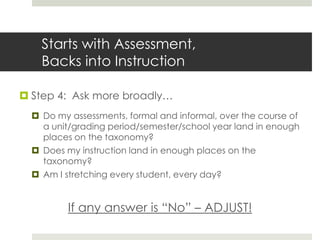
 Step 4: Ask more broadly…
 Do my assessments, formal and informal, over the course of
a unit/grading period/semester/school year land in enough
places on the taxonomy?
 Does my instruction land in enough places on the
taxonomy?
 Am I stretching every student, every day?
If any answer is “No” – ADJUST!
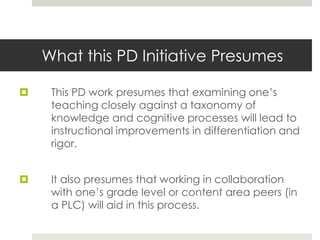
What this PD Initiative Presumes
 This PD work presumes that examining one’s
teaching closely against a taxonomy of
knowledge and cognitive processes will lead to
instructional improvements in differentiation and
rigor.
 It also presumes that working in collaboration
with one’s grade level or content area peers (in
a PLC) will aid in this process.
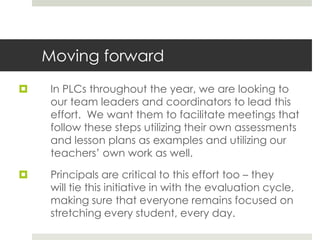
Moving forward
 In PLCs throughout the year, we are looking to
our team leaders and coordinators to lead this
effort. We want them to facilitate meetings that
follow these steps utilizing their own assessments
and lesson plans as examples and utilizing our
teachers’ own work as well.
 Principals are critical to this effort too – they
will tie this initiative in with the evaluation cycle,
making sure that everyone remains focused on
stretching every student, every day.
The Taxonomy Table
Source: Anderson et al. (2001)
N
o
u
n
s
Verbs
Examples
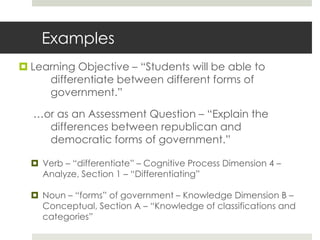
 Learning Objective – “Students will be able to
differentiate between different forms of
government.”
…or as an Assessment Question – “Explain the
differences between republican and
democratic forms of government.”
 Verb – “differentiate” – Cognitive Process Dimension 4 –
Analyze, Section 1 – “Differentiating”
 Noun – “forms” of government – Knowledge Dimension B –
Conceptual, Section A – “Knowledge of classifications and
categories”
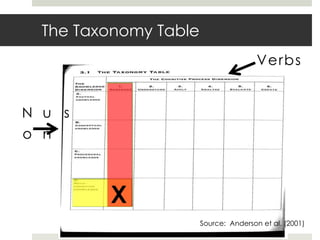
The Taxonomy Table
Source: Anderson et al. (2001)
N
o
u
n
s
Verbs
X
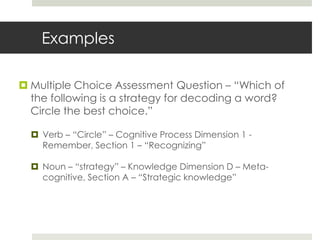
Examples
 Multiple Choice Assessment Question – “Which of
the following is a strategy for decoding a word?
Circle the best choice.”
 Verb – “Circle” – Cognitive Process Dimension 1 -
Remember, Section 1 – “Recognizing”
 Noun – “strategy” – Knowledge Dimension D – Meta-
cognitive, Section A – “Strategic knowledge”
The Taxonomy Table
Source: Anderson et al. (2001)
N
o
u
n
s
Verbs
X
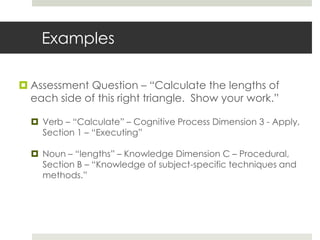
Examples
 Assessment Question – “Calculate the lengths of
each side of this right triangle. Show your work.”
 Verb – “Calculate” – Cognitive Process Dimension 3 - Apply,
Section 1 – “Executing”
 Noun – “lengths” – Knowledge Dimension C – Procedural,
Section B – “Knowledge of subject-specific techniques and
methods.”
The Taxonomy Table
Source: Anderson et al. (2001)
N
o
u
n
s
Verbs
X
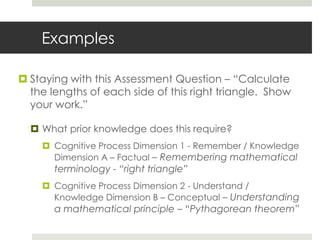
Examples
 Staying with this Assessment Question – “Calculate
the lengths of each side of this right triangle. Show
your work.”
 What prior knowledge does this require?
 Cognitive Process Dimension 1 - Remember / Knowledge
Dimension A – Factual – Remembering mathematical
terminology - “right triangle”
 Cognitive Process Dimension 2 - Understand /
Knowledge Dimension B – Conceptual – Understanding
a mathematical principle – “Pythagorean theorem”
The Taxonomy Table
Source: Anderson et al. (2001)
N
o
u
n
s
Verbs
X
X
X
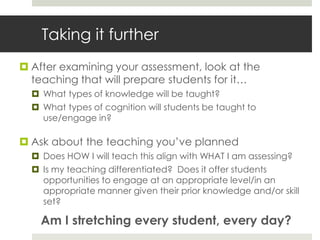
Taking it further
 After examining your assessment, look at the
teaching that will prepare students for it…
 What types of knowledge will be taught?
 What types of cognition will students be taught to
use/engage in?
 Ask about the teaching you’ve planned
 Does HOW I will teach this align with WHAT I am assessing?
 Is my teaching differentiated? Does it offer students
opportunities to engage at an appropriate level/in an
appropriate manner given their prior knowledge and/or skill
set?
Am I stretching every student, every day?
S t r e t c h i n g
Every Student, Every Day
Using Bloom’s Taxonomy (revised)
to examine HOW we teach
Afternoon Session
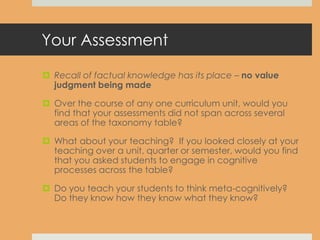
Your Assessment
 Recall of factual knowledge has its place – no value
judgment being made
 Over the course of any one curriculum unit, would you
find that your assessments did not span across several
areas of the taxonomy table?
 What about your teaching? If you looked closely at your
teaching over a unit, quarter or semester, would you find
that you asked students to engage in cognitive
processes across the table?
 Do you teach your students to think meta-cognitively?
Do they know how they know what they know?
The Taxonomy Table
Source: Anderson et al. (2001)
N
o
u
n
s
Verbs
To be completed INDIVIDUALLY
 Apply the taxonomy to your assessment
 What type of knowledge will be assessed?
 Are there different types of knowledge
assessed?
 What type of cognition will be assessed?
 Are there different types of cognitive processes
being tapped?
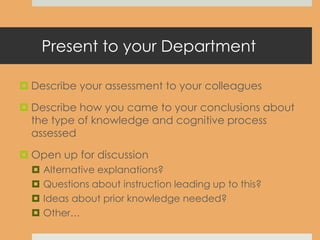
Present to your Department
 Describe your assessment to your colleagues
 Describe how you came to your conclusions about
the type of knowledge and cognitive process
assessed
 Open up for discussion
 Alternative explanations?
 Questions about instruction leading up to this?
 Ideas about prior knowledge needed?
 Other…
Where we are headed…
 Department Meetings – move this from a focus on
assessment to a focus on instruction
 Evaluations – evaluators will keep the focus on
rigorous, differentiated instruction
 November and January Inservice – continue
emphasis on “Stretching Every Student, Every Day.”

Stretching every student every day

  • 1.
    S t re t c h i n g Every Student, Every Day Using Bloom’s Taxonomy (revised) to examine HOW we teach Beachwood City Schools
  • 2.
    Move from WHATto HOW  Two years’ PD spent examining curriculum – WHAT we teach  Shift the PD focus from WHAT we are teaching to HOW we are teaching
  • 3.
    The Taxonomy Table Taken from: “A Taxonomy for Learning, Teaching, and Assessing – A Revision of Bloom’s Taxonomy of Educational Objectives” - Anderson et al. (2001)  Taxonomy Table utilizes two “Dimensions”:  Knowledge Dimension – Factual, Conceptual, Procedural, and Meta-cognitive  Cognitive Process – Remember, Understand, Apply, Analyze, Evaluate, and Create
  • 4.
    Starts with Assessment, Backsinto Instruction  Step 1: Apply the taxonomy to an assessment  What type of knowledge will be assessed?  What type of cognition will be assessed?  Step 2: Examine the teaching that will prepare students for that assessment  What type of knowledge will be taught?  What type of cognition will students be taught to use/engage in? (Verb Tense is Intentional)
  • 5.
    Starts with Assessment, Backsinto Instruction  Step 3: Ask about the teaching unit…  Does HOW I will teach this align with WHAT I am assessing?  Is my teaching differentiated? Does it offer students opportunities to engage at an appropriate level/in an appropriate manner given their prior knowledge and/or skill set?  Am I stretching every student, every day? If any answer is “No” – ADJUST!
  • 6.
    Starts with Assessment, Backsinto Instruction  Step 4: Ask more broadly…  Do my assessments, formal and informal, over the course of a unit/grading period/semester/school year land in enough places on the taxonomy?  Does my instruction land in enough places on the taxonomy?  Am I stretching every student, every day? If any answer is “No” – ADJUST!
  • 7.
    What this PDInitiative Presumes  This PD work presumes that examining one’s teaching closely against a taxonomy of knowledge and cognitive processes will lead to instructional improvements in differentiation and rigor.  It also presumes that working in collaboration with one’s grade level or content area peers (in a PLC) will aid in this process.
  • 8.
    Moving forward  InPLCs throughout the year, we are looking to our team leaders and coordinators to lead this effort. We want them to facilitate meetings that follow these steps utilizing their own assessments and lesson plans as examples and utilizing our teachers’ own work as well.  Principals are critical to this effort too – they will tie this initiative in with the evaluation cycle, making sure that everyone remains focused on stretching every student, every day.
  • 9.
    The Taxonomy Table Source:Anderson et al. (2001) N o u n s Verbs
  • 10.
    Examples  Learning Objective– “Students will be able to differentiate between different forms of government.” …or as an Assessment Question – “Explain the differences between republican and democratic forms of government.”  Verb – “differentiate” – Cognitive Process Dimension 4 – Analyze, Section 1 – “Differentiating”  Noun – “forms” of government – Knowledge Dimension B – Conceptual, Section A – “Knowledge of classifications and categories”
  • 11.
    The Taxonomy Table Source:Anderson et al. (2001) N o u n s Verbs X
  • 12.
    Examples  Multiple ChoiceAssessment Question – “Which of the following is a strategy for decoding a word? Circle the best choice.”  Verb – “Circle” – Cognitive Process Dimension 1 - Remember, Section 1 – “Recognizing”  Noun – “strategy” – Knowledge Dimension D – Meta- cognitive, Section A – “Strategic knowledge”
  • 13.
    The Taxonomy Table Source:Anderson et al. (2001) N o u n s Verbs X
  • 14.
    Examples  Assessment Question– “Calculate the lengths of each side of this right triangle. Show your work.”  Verb – “Calculate” – Cognitive Process Dimension 3 - Apply, Section 1 – “Executing”  Noun – “lengths” – Knowledge Dimension C – Procedural, Section B – “Knowledge of subject-specific techniques and methods.”
  • 15.
    The Taxonomy Table Source:Anderson et al. (2001) N o u n s Verbs X
  • 16.
    Examples  Staying withthis Assessment Question – “Calculate the lengths of each side of this right triangle. Show your work.”  What prior knowledge does this require?  Cognitive Process Dimension 1 - Remember / Knowledge Dimension A – Factual – Remembering mathematical terminology - “right triangle”  Cognitive Process Dimension 2 - Understand / Knowledge Dimension B – Conceptual – Understanding a mathematical principle – “Pythagorean theorem”
  • 17.
    The Taxonomy Table Source:Anderson et al. (2001) N o u n s Verbs X X X
  • 18.
    Taking it further After examining your assessment, look at the teaching that will prepare students for it…  What types of knowledge will be taught?  What types of cognition will students be taught to use/engage in?  Ask about the teaching you’ve planned  Does HOW I will teach this align with WHAT I am assessing?  Is my teaching differentiated? Does it offer students opportunities to engage at an appropriate level/in an appropriate manner given their prior knowledge and/or skill set? Am I stretching every student, every day?
  • 19.
    S t re t c h i n g Every Student, Every Day Using Bloom’s Taxonomy (revised) to examine HOW we teach Afternoon Session
  • 20.
    Your Assessment  Recallof factual knowledge has its place – no value judgment being made  Over the course of any one curriculum unit, would you find that your assessments did not span across several areas of the taxonomy table?  What about your teaching? If you looked closely at your teaching over a unit, quarter or semester, would you find that you asked students to engage in cognitive processes across the table?  Do you teach your students to think meta-cognitively? Do they know how they know what they know?
  • 21.
    The Taxonomy Table Source:Anderson et al. (2001) N o u n s Verbs
  • 22.
    To be completedINDIVIDUALLY  Apply the taxonomy to your assessment  What type of knowledge will be assessed?  Are there different types of knowledge assessed?  What type of cognition will be assessed?  Are there different types of cognitive processes being tapped?
  • 23.
    Present to yourDepartment  Describe your assessment to your colleagues  Describe how you came to your conclusions about the type of knowledge and cognitive process assessed  Open up for discussion  Alternative explanations?  Questions about instruction leading up to this?  Ideas about prior knowledge needed?  Other…
  • 24.
    Where we areheaded…  Department Meetings – move this from a focus on assessment to a focus on instruction  Evaluations – evaluators will keep the focus on rigorous, differentiated instruction  November and January Inservice – continue emphasis on “Stretching Every Student, Every Day.”