Differentiation Made Realistic – 12 strategies  Dr. Fiodhna Gardiner-Hyland
WALT What is differentiation? Steps to differentiation 12 example differentiated strategies Ways to manage differentiation
What is Differentiation? …” is a means of teaching one concept and meeting the different learning needs in a group.” (Regina Public Schools, 2003, retrieved from http://www.saskschools.ca/curr_content/bestpractice/tiered/index.html)
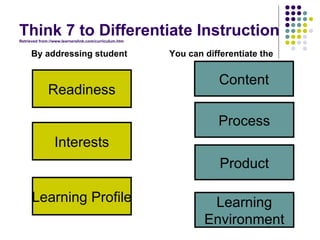
Think 7 to Differentiate Instruction  Retrieved from://www.learnerslink.com/curriculum.htm By addressing student   You can differentiate the   Content Readiness Interests Learning Profile Process Product Learning Environment
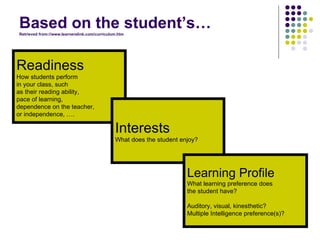
Based on the student’s…   Retrieved from://www.learnerslink.com/curriculum.htm  Readiness How students perform in your class, such  as their reading ability,  pace of learning,  dependence on the teacher, or independence, …. Interests What does the student enjoy? Learning Profile What learning preference does  the student have?  Auditory, visual, kinesthetic?  Multiple Intelligence preference(s)?
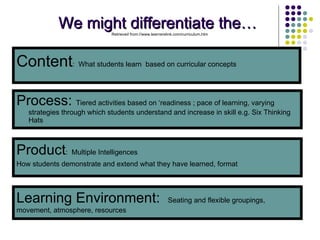
Process:  Tiered activities based on ‘readiness ; pace of learning, varying strategies through which students understand and increase in skill e.g. Six Thinking Hats Content :  What students learn  based on curricular concepts We might differentiate the…   Retrieved from://www.learnerslink.com/curriculum.htm   Product :  Multiple Intelligences How students demonstrate and extend what they have learned, format Learning Environment:  Seating and flexible groupings, movement, atmosphere, resources
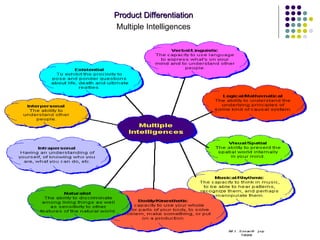
Product Differentiation   Multiple Intelligences
Differentiation and Target Setting in a UAE context “ teaching ensures that all students are challenged and supported…what they offer all students will be challenging, interesting and fun…and based on realistic targets that students understand”  (ADEC, 2010).
Strengths Learning is scaffolded and students are appropriately supported or challenged Addresses student learning styles Focus can remain on key lesson concept Facilitates IEPs Students experience success Maximizes student-centred learning A form of continuous assessment
Limitations Requires additional planning Involves ongoing formative assessment  Classroom management issues Time management issues Difficult to administer one summative assessment to all groups, unless core concept has been taught to all
Differentiation is not… New Just another way to group students Expecting less of struggling learners Engaging in extension activities Intended to replace whole class teaching
Steps  Introduce a concept  to the whole class and emphasize WALT Divide students into tiered groups  according to readiness, interest or learning profile.  Create activities that  focus on the concept  and adjust to provide different levels of difficulty.  Decide on  strategies and management  style Plenary: gather all groups together and  reinforce/re-teach  core concept Assess students’ work  and re-tier if necessary.
12 Example differentiated strategies/activities Write group/individual targets on table/board/books Group chart with flexible groups Adjusting questions Sound, word, sentence, text levels Adjusting stimuli e.g. concrete materials, listening materials, graphic organizers  Choice box/board
12 Example differentiated strategies/activities SSSTTF words (Sight, sound, smell, touch, taste, feelings) Guided reading Learning Centers  Differentiated structured morning play Differentiated homework Portfolios
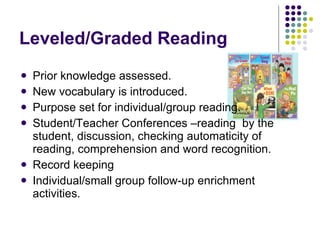
Leveled/Graded Reading Prior knowledge assessed. New vocabulary is introduced. Purpose set for individual/group reading. Student/Teacher Conferences –reading  by the student, discussion, checking automaticity of reading, comprehension and word recognition. Record keeping Individual/small group follow-up enrichment activities.
Think, pair, share In groups, discuss how you can differentiate in an EFL setting. Consider: Student needs Time constraints - single or double classes Planning for differentiation Seating arrangements and class size Classroom management Accessibility of materials Teaching approaches Assessment
Let’s Differentiate! Examine a reading lesson plan for next week. In groups, design 3 differentiated activities for the practice stage of the lesson.
Ways to manage differentiation Devise ability groups based on baseline assessment Limit number of groups Integrate with other approaches, e.g. whole class teaching Limit kinesthetic activities Differentiate during double lessons Use aids to organize groups – charts, checklists Use partial differentiation – practice stage Involve others e.g. classroom assistants, parent helpers; paired work
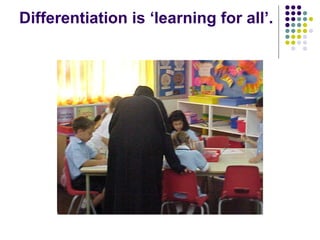
Differentiation is ‘learning for all’.
Recommended Source www.learnerslink.com/curriculum.htm   for ideas, research, and examples of differentiation strategies, Six Hats activities, lessons and units.

Differentiation Made Easy

  • 1.
    Differentiation Made Realistic– 12 strategies Dr. Fiodhna Gardiner-Hyland
  • 2.
    WALT What isdifferentiation? Steps to differentiation 12 example differentiated strategies Ways to manage differentiation
  • 3.
    What is Differentiation?…” is a means of teaching one concept and meeting the different learning needs in a group.” (Regina Public Schools, 2003, retrieved from http://www.saskschools.ca/curr_content/bestpractice/tiered/index.html)
  • 4.
    Think 7 toDifferentiate Instruction Retrieved from://www.learnerslink.com/curriculum.htm By addressing student You can differentiate the Content Readiness Interests Learning Profile Process Product Learning Environment
  • 5.
    Based on thestudent’s… Retrieved from://www.learnerslink.com/curriculum.htm Readiness How students perform in your class, such as their reading ability, pace of learning, dependence on the teacher, or independence, …. Interests What does the student enjoy? Learning Profile What learning preference does the student have? Auditory, visual, kinesthetic? Multiple Intelligence preference(s)?
  • 6.
    Process: Tieredactivities based on ‘readiness ; pace of learning, varying strategies through which students understand and increase in skill e.g. Six Thinking Hats Content : What students learn based on curricular concepts We might differentiate the… Retrieved from://www.learnerslink.com/curriculum.htm Product : Multiple Intelligences How students demonstrate and extend what they have learned, format Learning Environment: Seating and flexible groupings, movement, atmosphere, resources
  • 7.
    Product Differentiation Multiple Intelligences
  • 8.
    Differentiation and TargetSetting in a UAE context “ teaching ensures that all students are challenged and supported…what they offer all students will be challenging, interesting and fun…and based on realistic targets that students understand” (ADEC, 2010).
  • 9.
    Strengths Learning isscaffolded and students are appropriately supported or challenged Addresses student learning styles Focus can remain on key lesson concept Facilitates IEPs Students experience success Maximizes student-centred learning A form of continuous assessment
  • 10.
    Limitations Requires additionalplanning Involves ongoing formative assessment Classroom management issues Time management issues Difficult to administer one summative assessment to all groups, unless core concept has been taught to all
  • 11.
    Differentiation is not…New Just another way to group students Expecting less of struggling learners Engaging in extension activities Intended to replace whole class teaching
  • 12.
    Steps Introducea concept to the whole class and emphasize WALT Divide students into tiered groups according to readiness, interest or learning profile. Create activities that focus on the concept and adjust to provide different levels of difficulty. Decide on strategies and management style Plenary: gather all groups together and reinforce/re-teach core concept Assess students’ work and re-tier if necessary.
  • 13.
    12 Example differentiatedstrategies/activities Write group/individual targets on table/board/books Group chart with flexible groups Adjusting questions Sound, word, sentence, text levels Adjusting stimuli e.g. concrete materials, listening materials, graphic organizers Choice box/board
  • 14.
    12 Example differentiatedstrategies/activities SSSTTF words (Sight, sound, smell, touch, taste, feelings) Guided reading Learning Centers Differentiated structured morning play Differentiated homework Portfolios
  • 15.
    Leveled/Graded Reading Priorknowledge assessed. New vocabulary is introduced. Purpose set for individual/group reading. Student/Teacher Conferences –reading by the student, discussion, checking automaticity of reading, comprehension and word recognition. Record keeping Individual/small group follow-up enrichment activities.
  • 16.
    Think, pair, shareIn groups, discuss how you can differentiate in an EFL setting. Consider: Student needs Time constraints - single or double classes Planning for differentiation Seating arrangements and class size Classroom management Accessibility of materials Teaching approaches Assessment
  • 17.
    Let’s Differentiate! Examinea reading lesson plan for next week. In groups, design 3 differentiated activities for the practice stage of the lesson.
  • 18.
    Ways to managedifferentiation Devise ability groups based on baseline assessment Limit number of groups Integrate with other approaches, e.g. whole class teaching Limit kinesthetic activities Differentiate during double lessons Use aids to organize groups – charts, checklists Use partial differentiation – practice stage Involve others e.g. classroom assistants, parent helpers; paired work
  • 19.
  • 20.
    Recommended Source www.learnerslink.com/curriculum.htm for ideas, research, and examples of differentiation strategies, Six Hats activities, lessons and units.

Editor's Notes

  • #3 I will be referring to this later in my presentation.
  • #4 It is like juggling, the more balls, the more difficult to manage.Tiered instruction:“A flexible approach to teaching in which the teacher plans and carries out varied approach to context, process and product in anticipation of and in response to student differences in readiness, interests and learning needs”.(Tomlinson, C.A.) The idea is that tiered instructions meets the needs of all students. Often gifted students are not appropriately challenged. All students are regularly offered CHOICES.  Based on the student's readiness levels, interests, and learning profile , we modify the content, process, product and/or learning environment .  D ifferentiating instruction makes teaching more interesting and effective as YOU meet the needs of your students.
  • #5 Purpose and types: Why bother differentiating? Whole class teaching is much simpler. Different styles of content and delivery of content, process and product (different ways to express knowledge). It is a blend of whole, small group and individual learning. Focuses on student learning. Supportive learning environment, Continuous assessment of flexible groupings
  • #7 Different starting points for different children, varied resources. Allow movement between groupings so children don’t become stuck in one group. Six thinking hats: blue: thinking; black: caution; red: feelings: yellow: optimism and benefits; green – creativity; white: facts
  • #8 Accomodating multiple learning needs in which children feel valued
  • #9 Lesson should set individual, group and whole class targets Assessment of tiered learning can involve rubrics, tests, checklists, contracts, self-evaluation, peer evaluation, or conferences.
  • #10 Learning is focused. Teachers can reflect on students’ development. Higher leveled students need more challenging tasks and lower leveled students need less intrusive tasks. Enrichment programmes. Research shows… A form of continuous assessment, if groupings are flexible and children can move from one to another.
  • #12 All kids can do extension activities – early finishers. Differentiated activities are not necessarily extra activities. Below grade level: use concrete materials
  • #13 Strategies and management: Lower students on floor, one group working with assistant, other working independently. Assess using checklists, ruberics etc.
  • #14 Structured play: involving classifying, sorting, sequencing, givign reasons for opinions, predicting outcomes, applying imagination, becoming confident. Choices box: – library, vocab, computer. Above grade level (extension activities)
  • #15 Structured play: involving classifying, sorting, sequencing, givign reasons for opinions, predicting outcomes, applying imagination, becoming confident. Choices box: – library, vocab, computer. Above grade level (extension activities)
  • #17 Write on a flip chart: obstacles; possibilities. Feedback. Subject co-ordinators plan for differentiation. Al children learn objective as same tests. Small classes pose logistical problems for differentiated work that involves kinesthetic activities. However, worksheets can be handed out to different groups and no movement is required. In the education of children we continually assess the individual's progress. Tiered instruction lends to this perfectly (IEPs) With assignments that appropriately challenge students 'real' progress occurs. Like any other teaching strategy we must use a wide range of assessment tools.
  • #18 Brown bear story: Lower: Point to the picture and say initial sound Middle: Match animal words to pictures Top: Attempt Sentence level: Rashid, rashid, what can you see, I see a ….looking at me. Lower students on floor, one group working with assistant, other working independently. Below grade level: point to pictures At grade level: describe pictures Above grade level: describe favourite character; part of book/scene Stories, organized thematically Non-fiction books Extension readers Poems Big books Workbooks – phonic, comprehension and grammar , spelling Teacher’s Guide Multimedia – CD-Roms, audiocassettes Kits – alphabet cards, word cards etc. Core Support Extension Brown bear brown bear/Hamda’s surprise. When do you differentiate e.g. in the ppp lesson. Practice stage of the lesson. Divide group in groups, 5, 5, 4,4,4. Your group is going to focus only on one of those areas.
  • #19 When to differentiate? Use classroom assistants for reading groups and reading records
  • #20 Al Yasat School, 2009 Shared Reading for Second Language Learners © Fiodhna Hyland Differentiation is not new, good teachers have always done it. However, it does chime with a new conception of the teacher’s role. Once we teachers taught courses, subjects and classes. But no more. Now we are teaching individuals. Once education was a sieve. The weaker students were ‘seived out’ and they left the classroom for the world of work, while the able students were retained for the next level. This is no longer thought to be the case. Experts on the brain and on learning now stress that everyone can learn more, if they are taught appropriately, whatever they have previously acheived. Differentiation is about giving each child the opportunity to learn to the best of his capabilities. It doesn’t guarantee success for each child, but all we can do is try. Tell me one thing you learned in this lesson. An effective EFL classroom will have a combination of teacher-directed and selected activities, learner-centered and selected activities, whole class, small group and individual instruction