1. Henry's law relates the pressure of a gas in a solution to its solubility. It has applications.
2. Glucose solution will freeze at a specific temperature, calculated using information provided.
3. Raoult's law describes how volatile liquid solutions deviate from ideal behavior. Positive and negative deviations are explained with examples.
![1
CLASS XII ASSIGNMENT
1 State Henry’s law correlating the pressure ofa gas and its solubilityin a solvent andmentiontwo applications of the law.
2 Calculate the temperature at whicha solution containing 54 g of glucose, (C6 H12O6 ) in 250 g of water willfreeze. (Kf for water =1.86 K
mol kg -1 )
3 State Raoult’s lawfor solutions of volatile liquids. Takingsuitable examples explainthe meaningof positive andnegative d eviations from
Raoult’s law. OR
Define the term osmotic pressure. Describe howthe molecular mass of a substance canbe determinedbya methodbasedon
measurement of osmotic pressure?
4 Define osmotic pressure. How is it that measurement of osmotic pressures is more widelyused for determiningmolar masses of
macromoleculesthanthe rise in boilingpoint or fall infreezingpoint oftheir solutions? OR
Derive anequationto express that relative loweringof va pour pressure for a solution is equal to the mole fractionof the solute init
when the solvent alone is volatile.
5 Differentiate betweenmolalityandmolarityof a solution. What is the effect of change intemperature of a solutiononits m olalityand
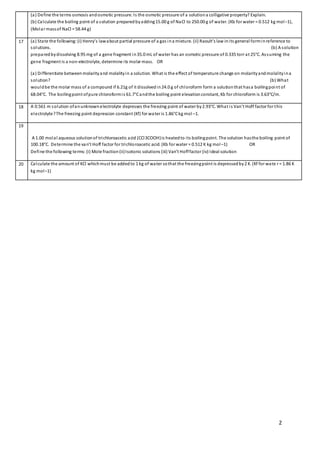
molarity?
6 (a) Define the following terms:(i) Mole fraction(ii)Van’t Hoff factor
(b) 100 mg of a proteinis dissolvedinenough water to make 100 mL of a solution. If thissolutionhas an osmotic pressure 13.3 mm Hg
at 25° C, what is the molar mass of protein? (R = 0.0821 L atmmol–1 K–1 and760 mm Hg = 1 atm.) OR
What is meant by:
(i) Colligative properties (ii)Molalityof a solution.
(b) What concentrationof nitrogenshould be present in a glassof water at room temperature?Assume a temperature of 25° C, total
pressure of 1 atmosphere and mole fractionof nitrogenin air of 0.78. [KH for nitrogen= 8.42 × 10⁻⁷ M/mm Hg]
7 Calculate the freezing point depressionfor 0.0711 m aqueous solutionof sodium sulphate(Na2 SO4), if it is completelyionisedin
solution. If thissolution actuallyfreezes at – 0.320 °C, what is the value of Van’t Hofffactor for it at the freezing point? (Kf for water is
1.86°C mol–1)
8 What is ‘reverse osmosis’?
9 Non-ideal solutions exhibit either positive or negative deviations from Raoult's law. What are these deviations andwhyare they
caused? Explainwith one example for eachtype.
10 A solutionpreparedbydissolving 1.25 g of oil of winter green(methyl salicylate)in99.0 g of benzene has a boiling point of 80.31°C.
Determine the molar mass of this compound. (B.P. of pure Benzene = 80.10°Cand Kb for benzene = 2.53°Ckg mol –1)
11 A solutionof glycerol (C3H8O3;molar mass = 92 g mol-1) in water was preparedbydissolving some glycerol in500 g of water. This
solution has a boiling point of 100.42°C. What mass ofglycerol was dissolvedto make this solution? Kb for water = 0.512 K k g mol-1.
12 Define the terms, ‘osmosis’ and‘osmotic pressure’. What is the advantage of usingosmotic pressure as compared to other colligative
properties for the determination ofmolar masses of solutes in solutions.
13 What massof NaCl (molar mass = 58.5 g mol–1) must be dissolvedin65 g of water to lower the freezing point by7.5°C? The freezing
point depressionconstant, Kf , for water is 1.86 Kkg mol–1. Assume van’t Hoff factor for NaCl is 1.87.
14 What massof ethylene glycol (molar mass = 62.0 g mol –1) must be addedto 5.50 kg of water to lower the freezing point of water from
0°C to – 10.0°C? (Kf for water = 1.86 K kg mol–1)
15 15 g of an unknownmolecular substance wasdissolvedin450 g of water. The resulting solutionfreezes at – 0.34°C. What is the molar
mass ofthe substance? (Kf for water = 1.86 K kg mol –1).
16 (a) Differentiate betweenmolarityand molalityfor a solution. Howdoes a change in temperature influence their values?
(b) Calculate the freezing point of anaqueous solution containing 10.50 g of MgBr2 in 200 g of water. (Molar massof MgBr2= 184 g) (Kf
for water = 1.86 K kg mol–1) OR](https://image.slidesharecdn.com/assignmentofsolution-190521075149/85/Assignment-of-solution-1-320.jpg)
![1
CLASS XII ASSIGNMENT
1 State Henry’s law correlating the pressure ofa gas and its solubilityin a solvent andmentiontwo applications of the law.
2 Calculate the temperature at whicha solution containing 54 g of glucose, (C6 H12O6 ) in 250 g of water willfreeze. (Kf for water =1.86 K
mol kg -1 )
3 State Raoult’s lawfor solutions of volatile liquids. Takingsuitable examples explainthe meaningof positive andnegative d eviations from
Raoult’s law. OR
Define the term osmotic pressure. Describe howthe molecular mass of a substance canbe determinedbya methodbasedon
measurement of osmotic pressure?
4 Define osmotic pressure. How is it that measurement of osmotic pressures is more widelyused for determiningmolar masses of
macromoleculesthanthe rise in boilingpoint or fall infreezingpoint oftheir solutions? OR
Derive anequationto express that relative loweringof va pour pressure for a solution is equal to the mole fractionof the solute init
when the solvent alone is volatile.
5 Differentiate betweenmolalityandmolarityof a solution. What is the effect of change intemperature of a solutiononits m olalityand
molarity?
6 (a) Define the following terms:(i) Mole fraction(ii)Van’t Hoff factor
(b) 100 mg of a proteinis dissolvedinenough water to make 100 mL of a solution. If thissolutionhas an osmotic pressure 13.3 mm Hg
at 25° C, what is the molar mass of protein? (R = 0.0821 L atmmol–1 K–1 and760 mm Hg = 1 atm.) OR
What is meant by:
(i) Colligative properties (ii)Molalityof a solution.
(b) What concentrationof nitrogenshould be present in a glassof water at room temperature?Assume a temperature of 25° C, total
pressure of 1 atmosphere and mole fractionof nitrogenin air of 0.78. [KH for nitrogen= 8.42 × 10⁻⁷ M/mm Hg]
7 Calculate the freezing point depressionfor 0.0711 m aqueous solutionof sodium sulphate(Na2 SO4), if it is completelyionisedin
solution. If thissolution actuallyfreezes at – 0.320 °C, what is the value of Van’t Hofffactor for it at the freezing point? (Kf for water is
1.86°C mol–1)
8 What is ‘reverse osmosis’?
9 Non-ideal solutions exhibit either positive or negative deviations from Raoult's law. What are these deviations andwhyare they
caused? Explainwith one example for eachtype.
10 A solutionpreparedbydissolving 1.25 g of oil of winter green(methyl salicylate)in99.0 g of benzene has a boiling point of 80.31°C.
Determine the molar mass of this compound. (B.P. of pure Benzene = 80.10°Cand Kb for benzene = 2.53°Ckg mol –1)
11 A solutionof glycerol (C3H8O3;molar mass = 92 g mol-1) in water was preparedbydissolving some glycerol in500 g of water. This
solution has a boiling point of 100.42°C. What mass ofglycerol was dissolvedto make this solution? Kb for water = 0.512 K k g mol-1.
12 Define the terms, ‘osmosis’ and‘osmotic pressure’. What is the advantage of usingosmotic pressure as compared to other colligative
properties for the determination ofmolar masses of solutes in solutions.
13 What massof NaCl (molar mass = 58.5 g mol–1) must be dissolvedin65 g of water to lower the freezing point by7.5°C? The freezing
point depressionconstant, Kf , for water is 1.86 Kkg mol–1. Assume van’t Hoff factor for NaCl is 1.87.
14 What massof ethylene glycol (molar mass = 62.0 g mol –1) must be addedto 5.50 kg of water to lower the freezing point of water from
0°C to – 10.0°C? (Kf for water = 1.86 K kg mol–1)
15 15 g of an unknownmolecular substance wasdissolvedin450 g of water. The resulting solutionfreezes at – 0.34°C. What is the molar
mass ofthe substance? (Kf for water = 1.86 K kg mol –1).
16 (a) Differentiate betweenmolarityand molalityfor a solution. Howdoes a change in temperature influence their values?
(b) Calculate the freezing point of anaqueous solution containing 10.50 g of MgBr2 in 200 g of water. (Molar massof MgBr2= 184 g) (Kf
for water = 1.86 K kg mol–1) OR](https://image.slidesharecdn.com/assignmentofsolution-190521075149/75/Assignment-of-solution-1-2048.jpg)