일반화학  2 (09  여름 ) 교수정보  :  이 동 수  ( 화학과 ) 2123-2641 [email_address] 과  442 조교정보 : 엄지원 ,  채경수 연습문제 풀이 조교  : TBA
일반화학  2 (09  여름 ) 주교재  1. Chemistry: The Practical Science(1st ed)  저자 : Kelter, Mosher &  Scott  번역서  자유아카데미 , 2008 년  %
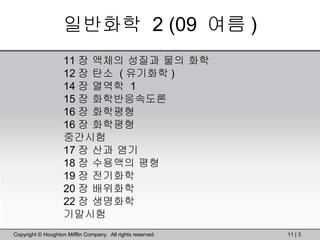
일반화학  2 (09  여름 ) 11 장 액체의 성질과 물의 화학 12 장 탄소  ( 유기화학 ) 14 장 열역학  1 15 장 화학반응속도론 16 장 화학평형  16 장 화학평형 중간시험 17 장 산과 염기  18 장 수용액의 평형 19 장 전기화학  20 장 배위화학 22 장 생명화학 기말시험
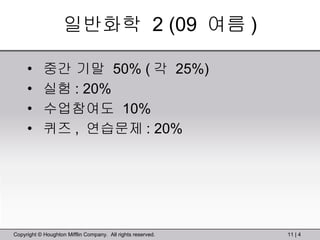
일반화학  2 (09  여름 ) 중간 기말  50% ( 각  25%) 실험 : 20% 수업참여도  10% 퀴즈 ,  연습문제 : 20%
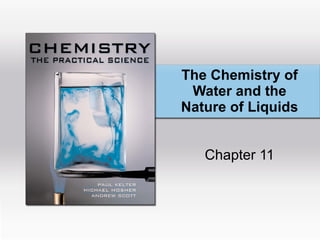
The Chemistry of Water and the Nature of Liquids Chapter 11
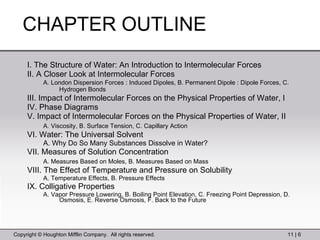
CHAPTER OUTLINE  I. The Structure of Water: An Introduction to Intermolecular Forces  II. A Closer Look at Intermolecular Forces  A. London Dispersion Forces : Induced Dipoles, B. Permanent Dipole : Dipole Forces, C. Hydrogen Bonds   III. Impact of Intermolecular Forces on the Physical Properties of Water, I  IV. Phase Diagrams  V. Impact of Intermolecular Forces on the Physical Properties of Water, II  A. Viscosity, B. Surface Tension, C. Capillary Action   VI. Water: The Universal Solvent  A. Why Do So Many Substances Dissolve in Water?  VII. Measures of Solution Concentration  A. Measures Based on Moles, B. Measures Based on Mass   VIII. The Effect of Temperature and Pressure on Solubility  A. Temperature Effects, B. Pressure Effects  IX. Colligative Properties  A. Vapor Pressure Lowering, B. Boiling Point Elevation, C. Freezing Point Depression, D. Osmosis, E. Reverse Osmosis, F. Back to the Future
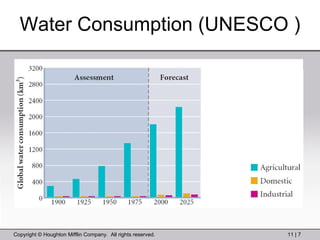
Water Consumption (UNESCO )
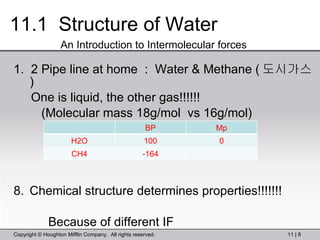
11.1  Structure of Water 1.  2 Pipe line at home  :  Water & Methane ( 도시가스 ) One is liquid, the other gas!!!!!! (Molecular mass 18g/mol  vs 16g/mol) Chemical structure determines properties!!!!!!! Because of different IF  An Introduction to Intermolecular forces BP Mp H2O 100 0 CH4 -164
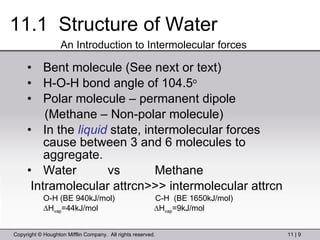
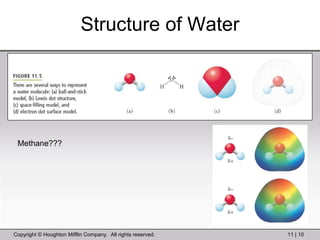
11.1  Structure of Water Bent molecule (See next or text) H-O-H bond angle of 104.5 o Polar molecule – permanent dipole (Methane – Non-polar molecule) In the  liquid  state, intermolecular forces cause between 3 and 6 molecules to aggregate. Water  vs  Methane Intramolecular attrcn>>> intermolecular attrcn O-H (BE 940kJ/mol)  C-H  (BE 1650kJ/mol) ∆ H vap =44kJ/mol  ∆H vap =9kJ/mol An Introduction to Intermolecular forces
Structure of Water Methane???
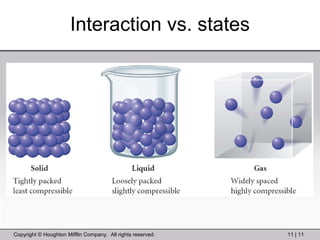
Interaction vs. states
11.2 Intermolecular Forces 1) London dispersion forces : Induced dipole 2) Permanent Dipole-Dipole Forces 3) Hydrogen Bonds 분자간 힘  (*  이온간 힘 ) 분자내 원자간 힘 ???
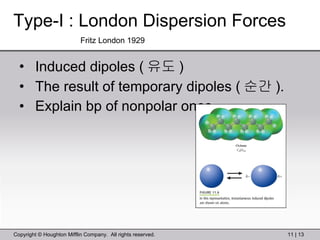
Type-I : London Dispersion Forces   Induced dipoles ( 유도 ) The result of temporary dipoles ( 순간 ). Explain bp of nonpolar ones Fritz London 1929
London Dispersion Forces
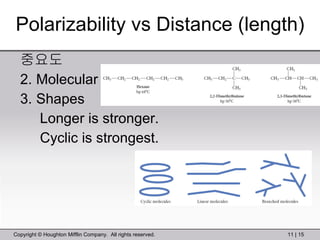
Polarizability vs Distance (length) 중요도  Molecular mass Shapes Longer is stronger. Cyclic is strongest.
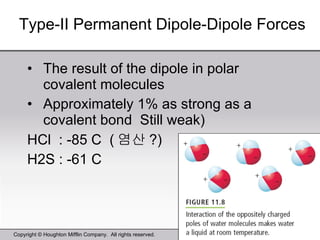
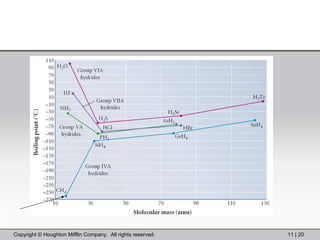
Type-II Permanent Dipole-Dipole Forces The result of the dipole in polar covalent molecules Approximately 1% as strong as a covalent bond  Still weak) HCl  : -85 C  ( 염산 ?) H2S : -61 C
Dipole-Dipole Forces
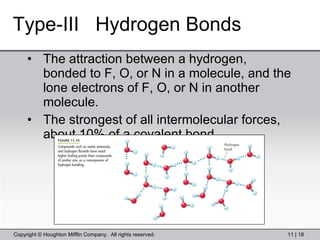
Type-III  Hydrogen Bonds The attraction between a hydrogen, bonded to F, O, or N in a molecule, and the lone electrons of F, O,   or N in another molecule. The strongest of all intermolecular forces, about 10% of a covalent bond.
Hydrogen Bonds
 
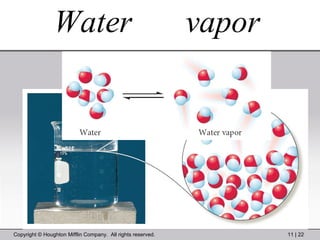
11.3  Phase Change Evaporation the process of molecules leaving the surface of the   liquid phase and entering the vapor phase. Condensation the process of molecules leaving the vapor phase and entering the liquid phase. Sublimation-Deposition the escape of molecules from the solid phase directly to the vapor phase. (Impact of IF on physical properties of H2O)
 
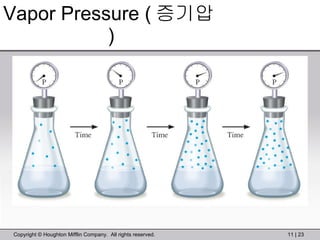
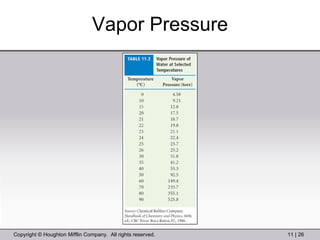
Vapor Pressure ( 증기압 )
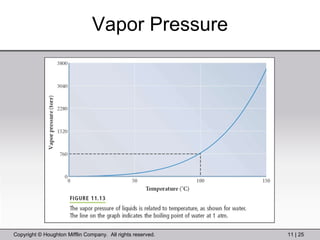
Vapor Pressure The pressure of a vapor over a liquid. Vapor pressure increases with temperature. Heavier molecules have lower vapor pressures than lighter molecules. Molecules with the strongest intermolecular forces will have the lowest vapor pressure.
Vapor Pressure
Vapor Pressure
Heating Curves
Changes of State Boiling point the pressure of a liquid’s vapor is equal to the surrounding pressure. Normal boiling point the boiling point of a liquid if the surrounding pressure is 1 atm. Melting point the temperature at which a solid changes to a liquid.
Changes of State Heat of Fusion the amount of  heat necessary  to convert a  solid to a liquid  at its melting point and constant pressure. Heat of Vaporization the amount of  heat needed  to convert a  liquid to a vapor  at it normal boiling point.
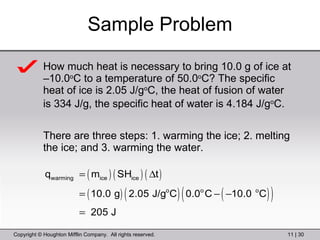
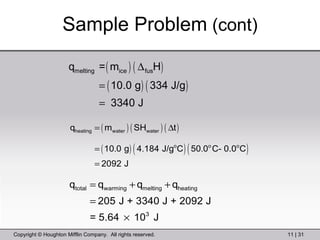
Sample Problem How much heat is necessary to bring 10.0 g of ice at –10.0 o C to a temperature of 50.0 o C? The specific heat of ice is 2.05 J/g o C, the heat of fusion of water is 334 J/g, the specific heat of water is 4.184 J/g o C.   There are three steps: 1. warming the ice; 2. melting the ice; and 3. warming the water.
Sample Problem  (cont)
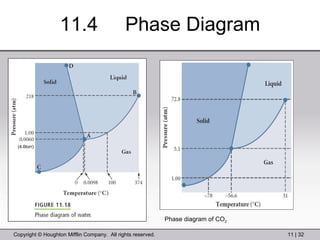
11.4  Phase Diagram (4.6torr) Phase diagram of CO 2
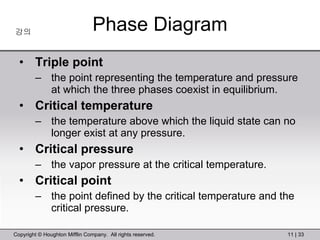
Phase Diagram Triple point the point representing the temperature and pressure at which the three phases coexist in equilibrium. Critical temperature the temperature above which the liquid state can no longer exist at any pressure. Critical pressure the vapor pressure at the critical temperature. Critical point the point defined by the critical temperature and the critical pressure. 강의
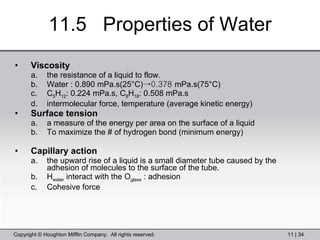
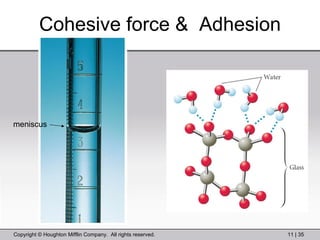
11.5  Properties of Water Viscosity the resistance of a liquid to flow. Water : 0.890 mPa.s(25°C) ->0.378  mPa.s(75°C) C 5 H 12 : 0.224 mPa.s, C 8 H 18 : 0.508 mPa.s intermolecular force, temperature (average kinetic energy) Surface tension a measure of the energy per area on the surface of a liquid To maximize the # of hydrogen bond (minimum energy)  Capillary action the upward rise of a liquid is a small diameter tube caused by the adhesion of molecules to the surface of the tube. H water  interact with the O glass  : adhesion Cohesive force
Cohesive force &  Adhesion meniscus
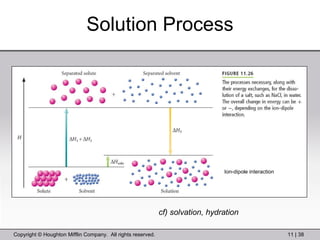
11.6 Water : The Universal Solvent Solution solvent, solute aqueous solution universal solvent Process of Dissolving  Dissolving can be described as occurring in three steps: Solute separation. Solvent separation. Electrostatic interaction between solvent and solute.
Solution Process
Solution Process Ion-dipole interaction cf) solvation, hydration
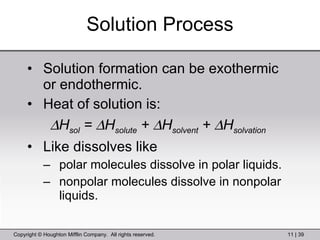
Solution formation can be exothermic or endothermic. Heat of solution is:  H sol  =   H solute  +   H solvent  +   H solvation   Like dissolves like polar molecules dissolve in polar liquids. nonpolar molecules dissolve in nonpolar liquids. Solution Process
Solution Process
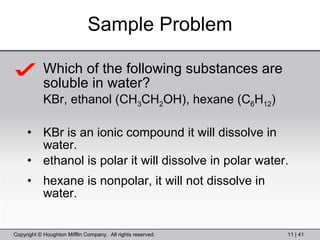
Sample Problem Which of the following substances are soluble in water? KBr, ethanol (CH 3 CH 2 OH), hexane (C 6 H 12 ) KBr is an ionic compound it will dissolve in water. ethanol is polar it will dissolve in polar water. hexane is nonpolar, it will not dissolve in water.
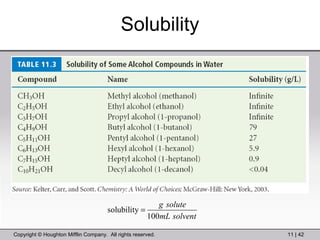
Solubility
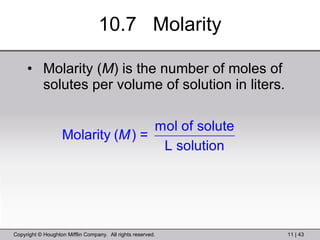
10.7  Molarity Molarity ( M ) is the number of moles of solutes per volume of solution in liters.
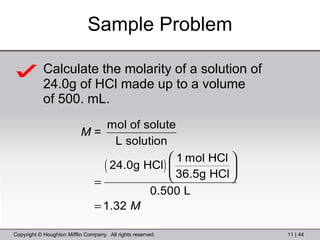
Sample Problem Calculate the molarity of a solution of 24.0g of HCl made up to a volume  of 500. mL.
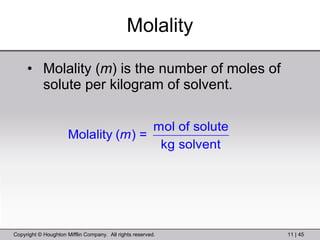
Molality ( m ) is the number of moles of solute per kilogram of solvent. Molality
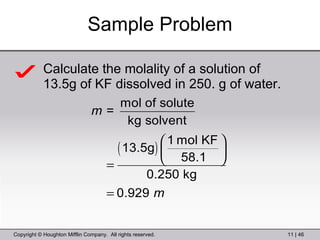
Sample Problem Calculate the molality of a solution of 13.5g of KF dissolved in 250. g of water.
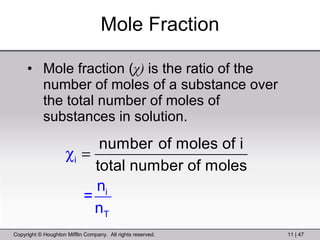
Mole Fraction Mole fraction ( χ )  is the ratio of the number of moles of a   substance over the total number of moles of substances in solution.
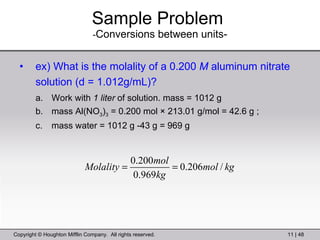
Sample Problem   - Conversions between units- ex) What is the molality of a 0.200  M  aluminum nitrate solution (d = 1.012g/mL)? Work with  1 liter  of solution. mass = 1012 g mass Al(NO 3 ) 3  = 0.200 mol × 213.01 g/mol = 42.6 g ; mass water = 1012 g -43 g = 969 g
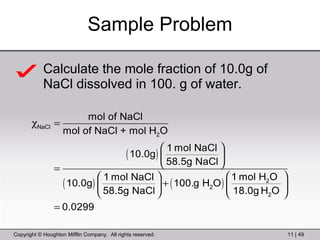
Sample Problem Calculate the mole fraction of 10.0g of NaCl dissolved in 100. g of water.
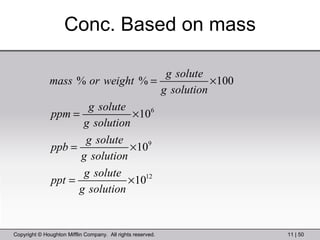
Conc. Based on mass
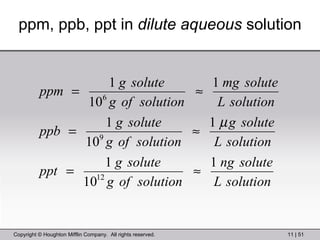
ppm, ppb, ppt in  dilute aqueous  solution
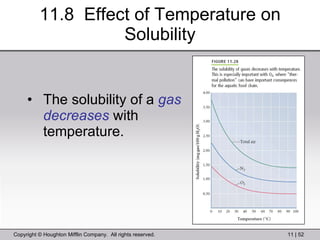
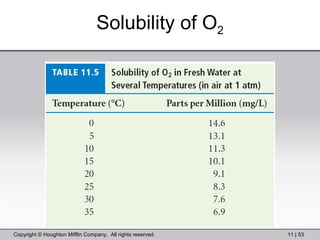
11.8  Effect of Temperature on Solubility The solubility of a  gas   decreases  with temperature.
Solubility of O 2
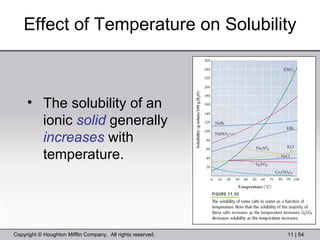
Effect of Temperature on Solubility The solubility of an ionic  solid  generally  increases  with temperature.
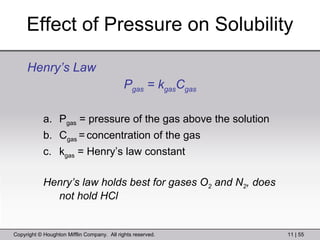
Effect of Pressure on Solubility Henry’s Law P gas  = k gas C gas P gas  = pressure of the gas above the solution C gas  =   concentration of the gas k gas  = Henry’s law constant Henry’s law holds best for gases O 2  and N 2 , does not hold HCl
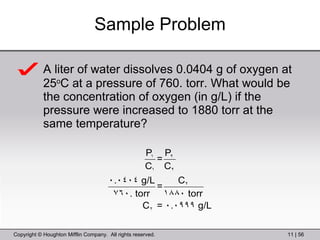
Sample Problem A liter of water dissolves 0.0404 g of oxygen at 25 o C at a pressure of 760. torr. What would be the concentration of oxygen (in g/L) if the pressure were increased to 1880 torr at the same temperature?
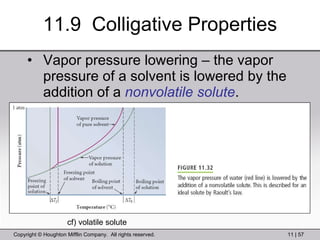
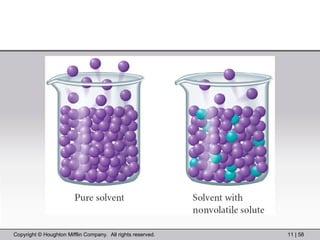
11.9  Colligative Properties Vapor pressure lowering – the vapor pressure of a solvent is lowered by the addition of a  nonvolatile solute . cf) volatile solute
 
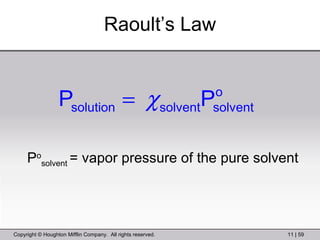
Raoult’s Law P o solvent  = vapor pressure of the pure solvent
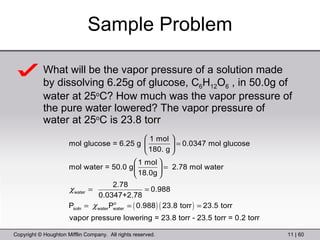
Sample Problem What will be the vapor pressure of a solution made by dissolving 6.25g of glucose, C 6 H 12 O 6  , in 50.0g of water at 25 o C? How much was the vapor pressure of the pure water lowered? The vapor pressure of water at 25 o C is 23.8 torr
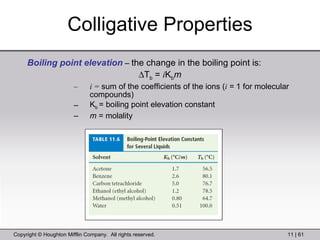
Colligative Properties Boiling point elevation  –  the change in the boiling point is:  T b  =  i K b m i =  sum of the coefficients of the ions ( i  =  1 for   molecular compounds) K b  = boiling point elevation constant m  = molality
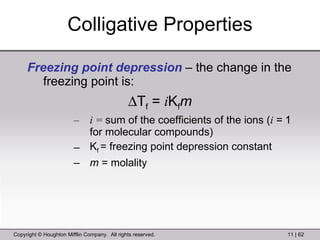
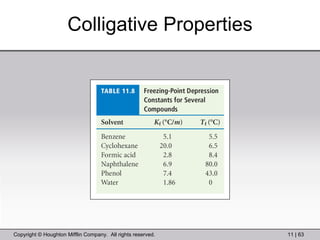
Colligative Properties Freezing point depression  – the change in the freezing point is:  T f  =  i K f m i =  sum of the coefficients of the ions ( i  =  1 for   molecular compounds) K f  = freezing point depression constant m  = molality
Colligative Properties
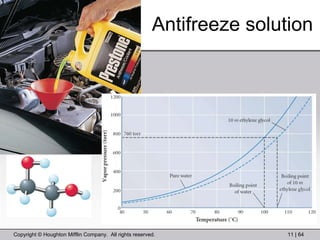
Antifreeze solution
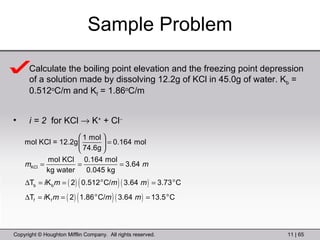
Sample Problem Calculate the boiling point elevation and the freezing point depression of a solution made by dissolving 12.2g of KCl in 45.0g of water. K b  = 0.512 o C/m and K f  = 1.86 o C/m i = 2  for KCl    K +  + Cl 
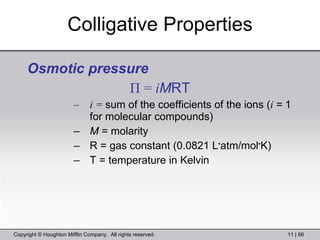
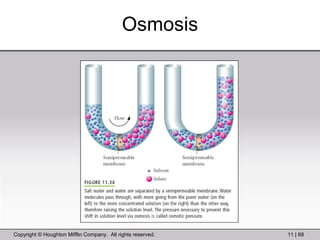
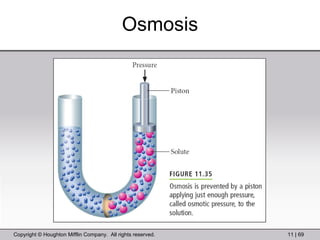
Colligative Properties Osmotic pressure П  =  i M RT i =  sum of the coefficients of the ions ( i  =  1 for   molecular compounds) M  = molarity R = gas constant (0.0821 L • atm/mol • K) T = temperature in Kelvin
Osmosis
Osmosis
Osmosis
 
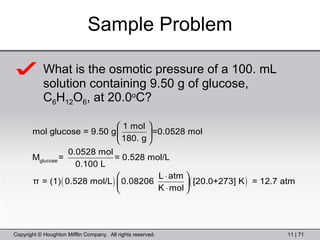
Sample Problem What is the osmotic pressure of a 100. mL solution containing 9.50 g of glucose, C 6 H 12 O 6 , at 20.0 o C?
Problems 4, 22, 34, 47-48, 60, 74, 78, 82, 100, 112

kelter_ch11

  • 1.
    일반화학 2(09 여름 ) 교수정보 : 이 동 수 ( 화학과 ) 2123-2641 [email_address] 과 442 조교정보 : 엄지원 , 채경수 연습문제 풀이 조교 : TBA
  • 2.
    일반화학 2(09 여름 ) 주교재 1. Chemistry: The Practical Science(1st ed) 저자 : Kelter, Mosher & Scott 번역서 자유아카데미 , 2008 년 %
  • 3.
    일반화학 2(09 여름 ) 11 장 액체의 성질과 물의 화학 12 장 탄소 ( 유기화학 ) 14 장 열역학 1 15 장 화학반응속도론 16 장 화학평형 16 장 화학평형 중간시험 17 장 산과 염기 18 장 수용액의 평형 19 장 전기화학 20 장 배위화학 22 장 생명화학 기말시험
  • 4.
    일반화학 2(09 여름 ) 중간 기말 50% ( 각 25%) 실험 : 20% 수업참여도 10% 퀴즈 , 연습문제 : 20%
  • 5.
    The Chemistry ofWater and the Nature of Liquids Chapter 11
  • 6.
    CHAPTER OUTLINE I. The Structure of Water: An Introduction to Intermolecular Forces II. A Closer Look at Intermolecular Forces A. London Dispersion Forces : Induced Dipoles, B. Permanent Dipole : Dipole Forces, C. Hydrogen Bonds III. Impact of Intermolecular Forces on the Physical Properties of Water, I IV. Phase Diagrams V. Impact of Intermolecular Forces on the Physical Properties of Water, II A. Viscosity, B. Surface Tension, C. Capillary Action VI. Water: The Universal Solvent A. Why Do So Many Substances Dissolve in Water? VII. Measures of Solution Concentration A. Measures Based on Moles, B. Measures Based on Mass VIII. The Effect of Temperature and Pressure on Solubility A. Temperature Effects, B. Pressure Effects IX. Colligative Properties A. Vapor Pressure Lowering, B. Boiling Point Elevation, C. Freezing Point Depression, D. Osmosis, E. Reverse Osmosis, F. Back to the Future
  • 7.
  • 8.
    11.1 Structureof Water 1. 2 Pipe line at home : Water & Methane ( 도시가스 ) One is liquid, the other gas!!!!!! (Molecular mass 18g/mol vs 16g/mol) Chemical structure determines properties!!!!!!! Because of different IF An Introduction to Intermolecular forces BP Mp H2O 100 0 CH4 -164
  • 9.
    11.1 Structureof Water Bent molecule (See next or text) H-O-H bond angle of 104.5 o Polar molecule – permanent dipole (Methane – Non-polar molecule) In the liquid state, intermolecular forces cause between 3 and 6 molecules to aggregate. Water vs Methane Intramolecular attrcn>>> intermolecular attrcn O-H (BE 940kJ/mol) C-H (BE 1650kJ/mol) ∆ H vap =44kJ/mol ∆H vap =9kJ/mol An Introduction to Intermolecular forces
  • 10.
  • 11.
  • 12.
    11.2 Intermolecular Forces1) London dispersion forces : Induced dipole 2) Permanent Dipole-Dipole Forces 3) Hydrogen Bonds 분자간 힘 (* 이온간 힘 ) 분자내 원자간 힘 ???
  • 13.
    Type-I : LondonDispersion Forces Induced dipoles ( 유도 ) The result of temporary dipoles ( 순간 ). Explain bp of nonpolar ones Fritz London 1929
  • 14.
  • 15.
    Polarizability vs Distance(length) 중요도 Molecular mass Shapes Longer is stronger. Cyclic is strongest.
  • 16.
    Type-II Permanent Dipole-DipoleForces The result of the dipole in polar covalent molecules Approximately 1% as strong as a covalent bond Still weak) HCl : -85 C ( 염산 ?) H2S : -61 C
  • 17.
  • 18.
    Type-III HydrogenBonds The attraction between a hydrogen, bonded to F, O, or N in a molecule, and the lone electrons of F, O, or N in another molecule. The strongest of all intermolecular forces, about 10% of a covalent bond.
  • 19.
  • 20.
  • 21.
    11.3 PhaseChange Evaporation the process of molecules leaving the surface of the liquid phase and entering the vapor phase. Condensation the process of molecules leaving the vapor phase and entering the liquid phase. Sublimation-Deposition the escape of molecules from the solid phase directly to the vapor phase. (Impact of IF on physical properties of H2O)
  • 22.
  • 23.
    Vapor Pressure (증기압 )
  • 24.
    Vapor Pressure Thepressure of a vapor over a liquid. Vapor pressure increases with temperature. Heavier molecules have lower vapor pressures than lighter molecules. Molecules with the strongest intermolecular forces will have the lowest vapor pressure.
  • 25.
  • 26.
  • 27.
  • 28.
    Changes of StateBoiling point the pressure of a liquid’s vapor is equal to the surrounding pressure. Normal boiling point the boiling point of a liquid if the surrounding pressure is 1 atm. Melting point the temperature at which a solid changes to a liquid.
  • 29.
    Changes of StateHeat of Fusion the amount of heat necessary to convert a solid to a liquid at its melting point and constant pressure. Heat of Vaporization the amount of heat needed to convert a liquid to a vapor at it normal boiling point.
  • 30.
    Sample Problem Howmuch heat is necessary to bring 10.0 g of ice at –10.0 o C to a temperature of 50.0 o C? The specific heat of ice is 2.05 J/g o C, the heat of fusion of water is 334 J/g, the specific heat of water is 4.184 J/g o C. There are three steps: 1. warming the ice; 2. melting the ice; and 3. warming the water.
  • 31.
  • 32.
    11.4 PhaseDiagram (4.6torr) Phase diagram of CO 2
  • 33.
    Phase Diagram Triplepoint the point representing the temperature and pressure at which the three phases coexist in equilibrium. Critical temperature the temperature above which the liquid state can no longer exist at any pressure. Critical pressure the vapor pressure at the critical temperature. Critical point the point defined by the critical temperature and the critical pressure. 강의
  • 34.
    11.5 Propertiesof Water Viscosity the resistance of a liquid to flow. Water : 0.890 mPa.s(25°C) ->0.378 mPa.s(75°C) C 5 H 12 : 0.224 mPa.s, C 8 H 18 : 0.508 mPa.s intermolecular force, temperature (average kinetic energy) Surface tension a measure of the energy per area on the surface of a liquid To maximize the # of hydrogen bond (minimum energy) Capillary action the upward rise of a liquid is a small diameter tube caused by the adhesion of molecules to the surface of the tube. H water interact with the O glass : adhesion Cohesive force
  • 35.
    Cohesive force & Adhesion meniscus
  • 36.
    11.6 Water :The Universal Solvent Solution solvent, solute aqueous solution universal solvent Process of Dissolving Dissolving can be described as occurring in three steps: Solute separation. Solvent separation. Electrostatic interaction between solvent and solute.
  • 37.
  • 38.
    Solution Process Ion-dipoleinteraction cf) solvation, hydration
  • 39.
    Solution formation canbe exothermic or endothermic. Heat of solution is:  H sol =  H solute +  H solvent +  H solvation Like dissolves like polar molecules dissolve in polar liquids. nonpolar molecules dissolve in nonpolar liquids. Solution Process
  • 40.
  • 41.
    Sample Problem Whichof the following substances are soluble in water? KBr, ethanol (CH 3 CH 2 OH), hexane (C 6 H 12 ) KBr is an ionic compound it will dissolve in water. ethanol is polar it will dissolve in polar water. hexane is nonpolar, it will not dissolve in water.
  • 42.
  • 43.
    10.7 MolarityMolarity ( M ) is the number of moles of solutes per volume of solution in liters.
  • 44.
    Sample Problem Calculatethe molarity of a solution of 24.0g of HCl made up to a volume of 500. mL.
  • 45.
    Molality ( m) is the number of moles of solute per kilogram of solvent. Molality
  • 46.
    Sample Problem Calculatethe molality of a solution of 13.5g of KF dissolved in 250. g of water.
  • 47.
    Mole Fraction Molefraction ( χ ) is the ratio of the number of moles of a substance over the total number of moles of substances in solution.
  • 48.
    Sample Problem - Conversions between units- ex) What is the molality of a 0.200 M aluminum nitrate solution (d = 1.012g/mL)? Work with 1 liter of solution. mass = 1012 g mass Al(NO 3 ) 3 = 0.200 mol × 213.01 g/mol = 42.6 g ; mass water = 1012 g -43 g = 969 g
  • 49.
    Sample Problem Calculatethe mole fraction of 10.0g of NaCl dissolved in 100. g of water.
  • 50.
  • 51.
    ppm, ppb, pptin dilute aqueous solution
  • 52.
    11.8 Effectof Temperature on Solubility The solubility of a gas decreases with temperature.
  • 53.
  • 54.
    Effect of Temperatureon Solubility The solubility of an ionic solid generally increases with temperature.
  • 55.
    Effect of Pressureon Solubility Henry’s Law P gas = k gas C gas P gas = pressure of the gas above the solution C gas = concentration of the gas k gas = Henry’s law constant Henry’s law holds best for gases O 2 and N 2 , does not hold HCl
  • 56.
    Sample Problem Aliter of water dissolves 0.0404 g of oxygen at 25 o C at a pressure of 760. torr. What would be the concentration of oxygen (in g/L) if the pressure were increased to 1880 torr at the same temperature?
  • 57.
    11.9 ColligativeProperties Vapor pressure lowering – the vapor pressure of a solvent is lowered by the addition of a nonvolatile solute . cf) volatile solute
  • 58.
  • 59.
    Raoult’s Law Po solvent = vapor pressure of the pure solvent
  • 60.
    Sample Problem Whatwill be the vapor pressure of a solution made by dissolving 6.25g of glucose, C 6 H 12 O 6 , in 50.0g of water at 25 o C? How much was the vapor pressure of the pure water lowered? The vapor pressure of water at 25 o C is 23.8 torr
  • 61.
    Colligative Properties Boilingpoint elevation – the change in the boiling point is:  T b = i K b m i = sum of the coefficients of the ions ( i = 1 for molecular compounds) K b = boiling point elevation constant m = molality
  • 62.
    Colligative Properties Freezingpoint depression – the change in the freezing point is:  T f = i K f m i = sum of the coefficients of the ions ( i = 1 for molecular compounds) K f = freezing point depression constant m = molality
  • 63.
  • 64.
  • 65.
    Sample Problem Calculatethe boiling point elevation and the freezing point depression of a solution made by dissolving 12.2g of KCl in 45.0g of water. K b = 0.512 o C/m and K f = 1.86 o C/m i = 2 for KCl  K + + Cl 
  • 66.
    Colligative Properties Osmoticpressure П = i M RT i = sum of the coefficients of the ions ( i = 1 for molecular compounds) M = molarity R = gas constant (0.0821 L • atm/mol • K) T = temperature in Kelvin
  • 67.
  • 68.
  • 69.
  • 70.
  • 71.
    Sample Problem Whatis the osmotic pressure of a 100. mL solution containing 9.50 g of glucose, C 6 H 12 O 6 , at 20.0 o C?
  • 72.
    Problems 4, 22,34, 47-48, 60, 74, 78, 82, 100, 112