Chapter 16 Review


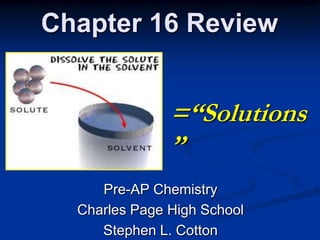
               =“Solutions
               ”
     Pre-AP Chemistry
  Charles Page High School
     Stephen L. Cotton
Chapter 16 Review
 If the solubility of a particular solute is
  10 g/100 g H2O at 20 oC, which of the
  following would represent a
  supersaturated solution of that solute:
  a) 9 g/100 g H2O at 20 oC, or
  b) 11 g/100 g H2O at 20 oC.
 If a crystal added to an aqueous
  solution causes many particles to come
  out of the solution, the original solution
  was ____.
Chapter 16 Review
 Colligative   properties depend upon
  the ____.
 What happens to the solubility of a
  gas in a liquid, if the partial pressure
  of the gas above the liquid
  decreases?
 Which of the following substances is
  less soluble in hot water than in cold
  water: a) CO2(g), or b) KBr(s)?
Chapter 16 Review
 The solubility of a gas in a liquid is
  ____ proportional to ____.
 To what concentration variable is
  change in boiling point directly
  proportional?
 What usually occurs to solubility as
  temperature increases?
 What units are generally used to
  express solubility?
Chapter 16 Review
 What  factors will usually make a
  substance dissolve faster in a
  solvent?
 In a concentrated solution, there is a
  ____ amount of solute.
 What are the three colligative
  properties of a solution we have
  studied?
Chapter 16 Review
 What  are the solution concentration
  units used to express molarity?
 What is the maximum amount of
  KCl that can dissolve in 200 g of
  water at 20 oC? (the solubility of
  KCl is 34 g/100 g H2O at 20 oC)
 What does NOT change when a
  solution is diluted by the addition of
  more solvent?
Chapter 16 Review
 Ifthe percent by volume is 2.0 %
  and the volume of solution is 250
  mL, what is the volume of solute in
  solution?
 What two factors affect the solubility
  of a particular substance?
 Which of the following equations
  yields the number of moles?
  a) M x L, or b) M x mass of solution
Chapter 16 Review
 The  volume of alcohol present in
  620 mL of a 40.0 % (v/v) solution of
  alcohol is ____.
 A solute depresses the freezing
  point because the solute ____.
 To increase the solubility of gas at
  constant temperature from 1.20 g/L
  at 1.4 atm, to 2.3 g/L, the pressure
  would have to be increased to ____.
Chapter 16 Review
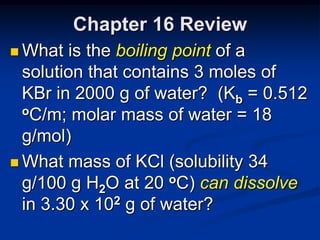
 What  is the boiling point of a
  solution that contains 3 moles of
  KBr in 2000 g of water? (Kb = 0.512
  oC/m; molar mass of water = 18

  g/mol)
 What mass of KCl (solubility 34
  g/100 g H2O at 20 oC) can dissolve
  in 3.30 x 10² g of water?
Chapter 16 Review
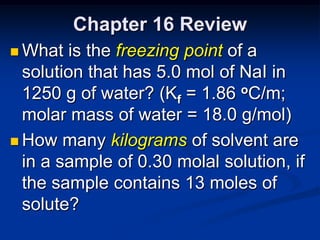
 What  is the freezing point of a
  solution that has 5.0 mol of NaI in
  1250 g of water? (Kf = 1.86 oC/m;
  molar mass of water = 18.0 g/mol)
 How many kilograms of solvent are
  in a sample of 0.30 molal solution, if
  the sample contains 13 moles of
  solute?
Chapter 16 Review
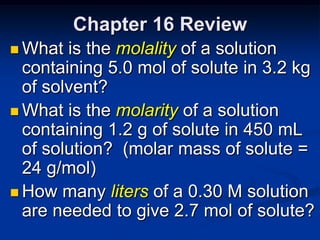
 What  is the molality of a solution
  containing 5.0 mol of solute in 3.2 kg
  of solvent?
 What is the molarity of a solution
  containing 1.2 g of solute in 450 mL
  of solution? (molar mass of solute =
  24 g/mol)
 How many liters of a 0.30 M solution
  are needed to give 2.7 mol of solute?
Chapter 16 Review
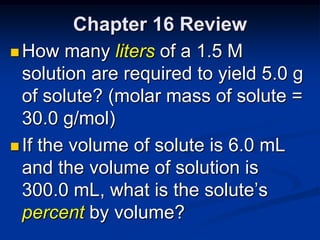
 How many liters of a 1.5 M
  solution are required to yield 5.0 g
  of solute? (molar mass of solute =
  30.0 g/mol)
 If the volume of solute is 6.0 mL
  and the volume of solution is
  300.0 mL, what is the solute’s
  percent by volume?
Chapter 16 Review
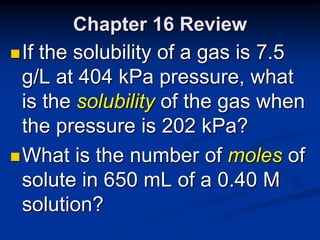
 If the solubility of a gas is 7.5
  g/L at 404 kPa pressure, what
  is the solubility of the gas when
  the pressure is 202 kPa?
 What is the number of moles of
 solute in 650 mL of a 0.40 M
 solution?
Chapter 16 Review
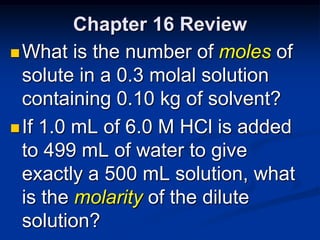
 What is the number of moles of
  solute in a 0.3 molal solution
  containing 0.10 kg of solvent?
 If 1.0 mL of 6.0 M HCl is added
  to 499 mL of water to give
  exactly a 500 mL solution, what
  is the molarity of the dilute
  solution?
Chapter 16 Review
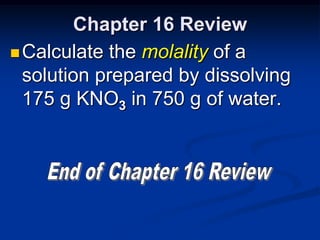
 Calculate the molality of a
  solution prepared by dissolving
  175 g KNO3 in 750 g of water.

Chapter 16 review

  • 1.
    Chapter 16 Review =“Solutions ” Pre-AP Chemistry Charles Page High School Stephen L. Cotton
  • 2.
    Chapter 16 Review If the solubility of a particular solute is 10 g/100 g H2O at 20 oC, which of the following would represent a supersaturated solution of that solute: a) 9 g/100 g H2O at 20 oC, or b) 11 g/100 g H2O at 20 oC.  If a crystal added to an aqueous solution causes many particles to come out of the solution, the original solution was ____.
  • 3.
    Chapter 16 Review Colligative properties depend upon the ____.  What happens to the solubility of a gas in a liquid, if the partial pressure of the gas above the liquid decreases?  Which of the following substances is less soluble in hot water than in cold water: a) CO2(g), or b) KBr(s)?
  • 4.
    Chapter 16 Review The solubility of a gas in a liquid is ____ proportional to ____.  To what concentration variable is change in boiling point directly proportional?  What usually occurs to solubility as temperature increases?  What units are generally used to express solubility?
  • 5.
    Chapter 16 Review What factors will usually make a substance dissolve faster in a solvent?  In a concentrated solution, there is a ____ amount of solute.  What are the three colligative properties of a solution we have studied?
  • 6.
    Chapter 16 Review What are the solution concentration units used to express molarity?  What is the maximum amount of KCl that can dissolve in 200 g of water at 20 oC? (the solubility of KCl is 34 g/100 g H2O at 20 oC)  What does NOT change when a solution is diluted by the addition of more solvent?
  • 7.
    Chapter 16 Review Ifthe percent by volume is 2.0 % and the volume of solution is 250 mL, what is the volume of solute in solution?  What two factors affect the solubility of a particular substance?  Which of the following equations yields the number of moles? a) M x L, or b) M x mass of solution
  • 8.
    Chapter 16 Review The volume of alcohol present in 620 mL of a 40.0 % (v/v) solution of alcohol is ____.  A solute depresses the freezing point because the solute ____.  To increase the solubility of gas at constant temperature from 1.20 g/L at 1.4 atm, to 2.3 g/L, the pressure would have to be increased to ____.
  • 9.
    Chapter 16 Review What is the boiling point of a solution that contains 3 moles of KBr in 2000 g of water? (Kb = 0.512 oC/m; molar mass of water = 18 g/mol)  What mass of KCl (solubility 34 g/100 g H2O at 20 oC) can dissolve in 3.30 x 10² g of water?
  • 10.
    Chapter 16 Review What is the freezing point of a solution that has 5.0 mol of NaI in 1250 g of water? (Kf = 1.86 oC/m; molar mass of water = 18.0 g/mol)  How many kilograms of solvent are in a sample of 0.30 molal solution, if the sample contains 13 moles of solute?
  • 11.
    Chapter 16 Review What is the molality of a solution containing 5.0 mol of solute in 3.2 kg of solvent?  What is the molarity of a solution containing 1.2 g of solute in 450 mL of solution? (molar mass of solute = 24 g/mol)  How many liters of a 0.30 M solution are needed to give 2.7 mol of solute?
  • 12.
    Chapter 16 Review How many liters of a 1.5 M solution are required to yield 5.0 g of solute? (molar mass of solute = 30.0 g/mol)  If the volume of solute is 6.0 mL and the volume of solution is 300.0 mL, what is the solute’s percent by volume?
  • 13.
    Chapter 16 Review If the solubility of a gas is 7.5 g/L at 404 kPa pressure, what is the solubility of the gas when the pressure is 202 kPa?  What is the number of moles of solute in 650 mL of a 0.40 M solution?
  • 14.
    Chapter 16 Review What is the number of moles of solute in a 0.3 molal solution containing 0.10 kg of solvent?  If 1.0 mL of 6.0 M HCl is added to 499 mL of water to give exactly a 500 mL solution, what is the molarity of the dilute solution?
  • 15.
    Chapter 16 Review Calculate the molality of a solution prepared by dissolving 175 g KNO3 in 750 g of water.