1. Which of the following units is useful in relating concentration of solution
with its vapour pressure?
(i) mole fraction (ii)
parts per million
(iii) mass percentage
(iv) molality
2. On dissolving sugar in water at room temperature solution feels cool to touch.
Under which of the following cases dissolution of sugar will be most rapid?
(i) Sugar crystals in cold water.
(ii) Sugar crystals in hot water.
(iii) Powdered sugar in cold water.
(iv) Powdered sugar in hot water.
3. At equilibrium the rate of dissolution of a solid solute in a volatile liquid solvent
is __________.
(i) less than the rate of crystallisation (ii)
greater than the rate of crystallisation
(iii) equal to the rate of crystallisation
(iv) zero
4. A beaker contains a solution of substance ‘A’. Precipitation of substance ‘A’
takes place when small amount of ‘A’ is added to the solution. The solution is
_________.
(i) saturated
I. Multiple Choice Questions (Type-I)
U
U
Un
n
ni
iit
t
t
2
2
S
S
SO
O
OL
L
LU
U
UT
T
TI
IIO
O
ON
N
NS
S
S
S
S
SO
O
OL
L
LU
U
UT
T
TI
IIO
O
ON
N
NS
S
S
www.tiwariacademy.com
18
Exemplar Problems, Chemistry
(ii) supersaturated
(iii) unsaturated
(iv) concentrated
5. Maximum amount of a solid solute that can be dissolved in a specified amount
of a given liquid solvent does not depend upon ____________.
(i) Temperature
(ii) Nature of solute
(iii) Pressure
(iv) Nature of solvent
6. Low concentration of oxygen in the blood and tissues of people living at high
altitude is due to ____________.
(i) low temperature
(ii) low atmospheric pressure
(iii) high atmospheric pressure
(iv) both low temperature and high atmospheric pressure
7. Considering the formation, breaking and strength of hydrogen bond, predict
which of the following mixtures will show a positive deviation from Raoult’s
law?
(i) Methanol and acetone.
(ii) Chloroform and acetone.
(iii) Nitric acid and water.
(iv) Phenol and aniline.
8. Colligative properties depend on ____________.
(i) the nature of the solute particles dissolved in solution.
(ii) the number of solute particles in solution.
(iii) the physical properties of the solute particles dissolved in solution.
(iv) the nature of solvent particles.
9. Which of the following aqueous solutions should have the highest boiling point?
(i) 1.0 M NaOH
(ii) 1.0 M Na2
SO4
(iii) 1.0 M NH4
NO3
(iv) 1.0 M KNO3
10. The unit of ebulioscopic constant is _______________.
(i) K kg mol
–1
or K (molality)
–1
(ii) mol kg K
–1
or K
–1
(molality)
www.tiwariacademy.com
Solutions
19
(iii) kg mol
–1
K
–1
or K
–1
(molality)
–1
(iv) K mol kg
–1
or K (molality)
11. In comparison to a 0.01 M solution of glucose, the depression in freezing point
of a 0.01 M MgCl2
solution is _____________.
(i) the same
(ii) about twice
(iii) about three times
(iv) about six times
12. An unripe mango placed in a concentrated salt solution to prepare pickle,
shrivels because _____________.
(i) it gains water due to osmosis.
(ii) it loses water due to reverse osmosis.
(iii) it gains water due to reverse osmosis.
(iv) it loses water due to osmosis.
13. At a given temperature, osmotic pressure of a concentrated solution of a
substance _____________.
(i) is higher than that at a dilute solution.
(ii) is lower than that of a dilute solution.
(iii) is same as that of a dilute solution.
(iv) cannot be compared with osmotic pressure of dilute solution.
14. Which of the following statements is false?
(i) Two different solutions of sucrose of same molality prepared in different
solvents will have the same depression in freezing point.
(ii) The osmotic pressure of a solution is given by the equation Π = CRT
( where C is the molarity of the solution).
(iii) Decreasing order of osmotic pressure for 0.01 M aqueous solutions of
barium chloride, potassium chloride, acetic acid and sucrose is
BaCl2
> KCl > CH3
COOH > sucrose.
(iv) According to Raoult’s law, the vapour pressure exerted by a volatile
component of a solution is directly proportional to its mole fraction in
the solution.
15. The values of Van’t Hoff factors for KCl, NaCl and K2
SO4
, respectively, are
_____________.
(i) 2, 2 and 2
(ii) 2, 2 and 3
(iii) 1, 1 and 2
(iv) 1, 1 and 1
www.tiwariacademy.com
20
Exemplar Problems, Chemistry
16. Which of the following statements is false?
(i) Units of atmospheric pressure and osmotic pressure are the same.
(ii) In reverse osmosis, solvent molecules move through a semipermeable
membrane from a region of lower concentration of solute to a region of
higher concentration.
(iii) The value of molal depression constant depends on nature of solvent.
(iv) Relative lowering of vapour pressure, is a dimensionless quantity.
17. Value of Henry’s constant KH
____________.
(i) increases with increase in temperature.
(ii) decreases with increase in temperature.
(iii) remains constant.
(iv) first increases then decreases.
18. The value of Henry’s constant KH
is _____________.
(i) greater for gases with higher solubility.
(ii) greater for gases with lower solubility.
(iii) constant for all gases.
(iv) not related to the solubility of gases.
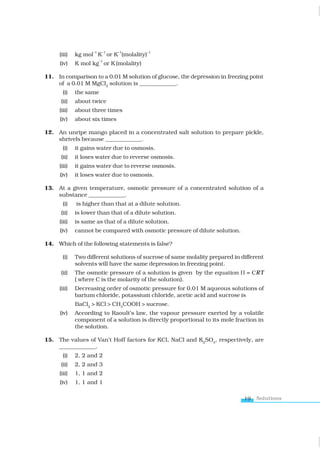
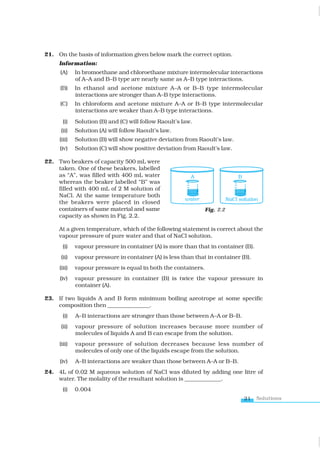
19. Consider the Fig. 2.1 and mark the correct option.
(i) water will move from side (A) to side
(B) if a pressure lower than osmotic
pressure is applied on piston (B).
(ii) water will move from side (B) to side
(A) if a pressure greater than osmotic
pressure is applied on piston (B).
(iii) water will move from side (B) to side
(A) if a pressure equal to osmotic
pressure is applied on piston (B).
(iv) water will move from side (A) to side
(B) if pressure equal to osmotic
pressure is applied on piston (A).
20. We have three aqueous solutions of NaCl labelled as ‘A’, ‘B’ and ‘C’ with
concentrations 0.1M, 0.01M and 0.001M, respectively. The value of van’t Hoff
factor for these solutions will be in the order______.
(i) iA
< iB
< iC
(ii) iA
> iB
> iC
(iii) iA
= iB
= iC
(iv) iA
< iB
> iC
Fig. 2.1
www.tiwariacademy.com
Solutions
21
21. On the basis of information given below mark the correct option.
Information:
(A) In bromoethane and chloroethane mixture intermolecular interactions
of A–A and B–B type are nearly same as A–B type interactions.
(B) In ethanol and acetone mixture A–A or B–B type intermolecular
interactions are stronger than A–B type interactions.
(C) In chloroform and acetone mixture A–A or B–B type intermolecular
interactions are weaker than A–B type interactions.
(i) Solution (B) and (C) will follow Raoult’s law.
(ii) Solution (A) will follow Raoult’s law.
(iii) Solution (B) will show negative deviation from Raoult’s law.
(iv) Solution (C) will show positive deviation from Raoult’s law.
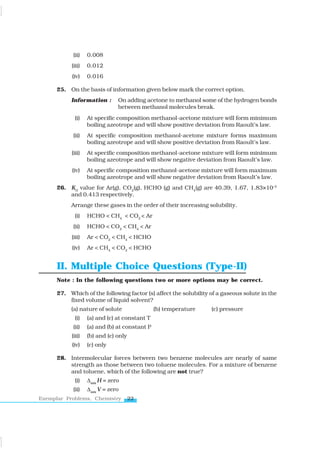
22. Two beakers of capacity 500 mL were
taken. One of these beakers, labelled
as “A”, was filled with 400 mL water
whereas the beaker labelled “B” was
filled with 400 mL of 2 M solution of
NaCl. At the same temperature both
the beakers were placed in closed
containers of same material and same
capacity as shown in Fig. 2.2.
At a given temperature, which of the following statement is correct about the
vapour pressure of pure water and that of NaCl solution.
(i) vapour pressure in container (A) is more than that in container (B).
(ii) vapour pressure in container (A) is less than that in container (B).
(iii) vapour pressure is equal in both the containers.
(iv) vapour pressure in container (B) is twice the vapour pressure in
container (A).
23. If two liquids A and B form minimum boiling azeotrope at some specific
composition then _______________.
(i) A–B interactions are stronger than those between A–A or B–B.
(ii) vapour pressure of solution increases because more number of
molecules of liquids A and B can escape from the solution.
(iii) vapour pressure of solution decreases because less number of
molecules of only one of the liquids escape from the solution.
(iv) A–B interactions are weaker than those between A–A or B–B.
24. 4L of 0.02 M aqueous solution of NaCl was diluted by adding one litre of
water. The molality of the resultant solution is _____________.
(i) 0.004
Fig. 2.2
www.tiwariacademy.com
22
Exemplar Problems, Chemistry
(ii) 0.008
(iii) 0.012
(iv) 0.016
25. On the basis of information given below mark the correct option.
Information : On adding acetone to methanol some of the hydrogen bonds
between methanol molecules break.
(i) At specific composition methanol-acetone mixture will form minimum
boiling azeotrope and will show positive deviation from Raoult’s law.
(ii) At specific composition methanol-acetone mixture forms maximum
boiling azeotrope and will show positive deviation from Raoult’s law.
(iii) At specific composition methanol-acetone mixture will form minimum
boiling azeotrope and will show negative deviation from Raoult’s law.
(iv) At specific composition methanol-acetone mixture will form maximum
boiling azeotrope and will show negative deviation from Raoult’s law.
26. KH
value for Ar(g), CO2
(g), HCHO (g) and CH4
(g) are 40.39, 1.67, 1.83×10⁻⁵
and 0.413 respectively.
Arrange these gases in the order of their increasing solubility.
(i) HCHO < CH4
< CO2
< Ar
(ii) HCHO < CO2
< CH4
< Ar
(iii) Ar < CO2
< CH4
< HCHO
(iv) Ar < CH4
< CO2
< HCHO
II. Multiple Choice Questions (Type-II)
Note : In the following questions two or more options may be correct.
27. Which of the following factor (s) affect the solubility of a gaseous solute in the
fixed volume of liquid solvent?
(a) nature of solute (b) temperature (c) pressure
(i) (a) and (c) at constant T
(ii) (a) and (b) at constant P
(iii) (b) and (c) only
(iv) (c) only
28. Intermolecular forces between two benzene molecules are nearly of same
strength as those between two toluene molecules. For a mixture of benzene
and toluene, which of the following are not true?
(i) Δmix
H = zero
(ii) Δmix
V = zero
www.tiwariacademy.com
Solutions
23
(iii) These will form minimum boiling azeotrope.
(iv) These will not form ideal solution.
29. Relative lowering of vapour pressure is a colligative property because
_____________.
(i) It depends on the concentration of a non electrolyte solute in solution
and does not depend on the nature of the solute molecules.
(ii) It depends on number of particles of electrolyte solute in solution and
does not depend on the nature of the solute particles.
(iii) It depends on the concentration of a non electrolyte solute in solution
as well as on the nature of the solute molecules.
(iv) It depends on the concentration of an electrolyte or nonelectrolyte solute
in solution as well as on the nature of solute molecules.
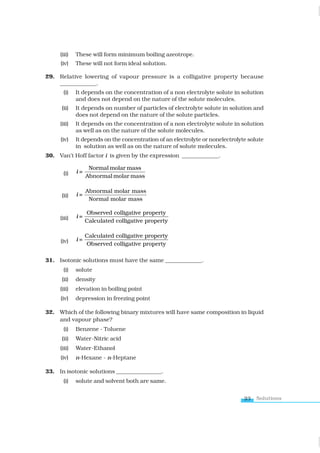
30. Van’t Hoff factor i is given by the expression _____________.
(i) =
Abnormal molar mass
Normal molar mass
i
(ii)
A
=
Normal molar mass
bnormal molar mass
i
(iii) =
Calculated colligative property
Observed colligative property
i
(iv) =
Observed colligative property
Calculated colligative property
i
31. Isotonic solutions must have the same _____________.
(i) solute
(ii) density
(iii) elevation in boiling point
(iv) depression in freezing point
32. Which of the following binary mixtures will have same composition in liquid
and vapour phase?
(i) Benzene - Toluene
(ii) Water-Nitric acid
(iii) Water-Ethanol
(iv) n-Hexane - n-Heptane
33. In isotonic solutions ________________.
(i) solute and solvent both are same.
www.tiwariacademy.com
24
Exemplar Problems, Chemistry
(ii) osmotic pressure is same.
(iii) solute and solvent may or may not be same.
(iv) solute is always same solvent may be different.
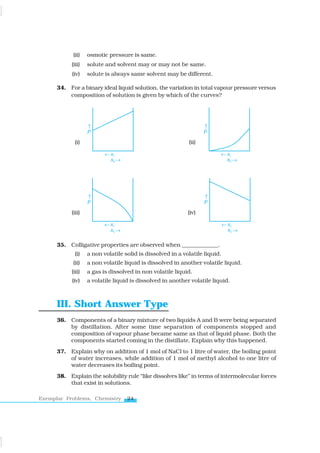
34. For a binary ideal liquid solution, the variation in total vapour pressure versus
composition of solution is given by which of the curves?
(i) (ii)
(iii) (iv)
35. Colligative properties are observed when _____________.
(i) a non volatile solid is dissolved in a volatile liquid.
(ii) a non volatile liquid is dissolved in another volatile liquid.
(iii) a gas is dissolved in non volatile liquid.
(iv) a volatile liquid is dissolved in another volatile liquid.
III. Short Answer Type
36. Components of a binary mixture of two liquids A and B were being separated
by distillation. After some time separation of components stopped and
composition of vapour phase became same as that of liquid phase. Both the
components started coming in the distillate. Explain why this happened.
37. Explain why on addition of 1 mol of NaCl to 1 litre of water, the boiling point
of water increases, while addition of 1 mol of methyl alcohol to one litre of
water decreases its boiling point.
38. Explain the solubility rule “like dissolves like” in terms of intermolecular forces
that exist in solutions.
www.tiwariacademy.com
Solutions
25
39. Concentration terms such as mass percentage, ppm, mole fraction and molality
are independent of temperature, however molarity is a function of temperature.
Explain.
40. What is the significance of Henry’s Law constant KH
?
41. Why are aquatic species more comfortable in cold water in comparison to
warm water?
42. (a) Explain the following phenomena with the help of Henry’s law.
(i) Painful condition known as bends.
(ii) Feeling of weakness and discomfort in breathing at high altitude.
(b) Why soda water bottle kept at room temperature fizzes on opening?
43. Why is the vapour pressure of an aqueous solution of glucose lower than that
of water?
44. How does sprinkling of salt help in clearing the snow covered roads in hilly
areas? Explain the phenomenon involved in the process.
45. What is “semi permeable membrane”?
46. Give an example of a material used for making semipermeable membrane for
carrying out reverse osmosis.
IV. Matching Type
Note : In the following questions match the items given in Column I and
Column II.
47. Match the items given in Column I and Column II.
Column I Column II
(i) Saturated solution (a) Solution having same osmotic
pressure at a given temperature as
that of given solution.
(ii) Binary solution (b) A solution whose osmotic pressure
is less than that of another.
(iii) Isotonic solution (c) Solution with two components.
(iv) Hypotonic solution (d) A solution which contains maximum
amount of solute that can be
dissolved in a given amount of
solvent at a given temperature.
(v) Solid solution (e) A solution whose osmotic pressure
is more than that of another.
(vi) Hypertonic solution (f) A solution in solid phase.
www.tiwariacademy.com
26
Exemplar Problems, Chemistry
48. Match the items given in Column I with the type of solutions given in Column II.
Column I Column II
(i) Soda water (a) A solution of gas in solid
(ii) Sugar solution (b) A solution of gas in gas
(iii) German silver (c) A solution of solid in liquid
(iv) Air (d) A solution of solid in solid
(v) Hydrogen gas in palladium (e) A solution of gas in liquid
(f) A solution of liquid in solid
49. Match the laws given in Column I with expresions given in Column II.
Column I Column II
(i) Raoult’s law (a) ΔTf
= Kf
m
(ii) Henry’s law (b) Π = CRT
(iii) Elevation of boiling point (c) p = x1
p1
o
+ x2
p2
o
(iv) Depression in freezing point (d) ΔTb
= Kb
m
(v) Osmotic pressure (e) p = KH
.x
50. Match the terms given in Column I with expressions given in Column II.
Column I Column II
(i) Mass percentage (a)
Number of moles of the
solute component
Volume of solution in litres
(ii) Volume percentage (b)
Number of moles of a component
Total number of moles of
all the components
(iii) Mole fraction (c) ×
Volume of the solute component
in solution
100
Total volume of solution
(iv) Molality (d) ×
Mass of the solute component
in solution
100
Total mass of the solution
(v) Molarity (e)
Number of moles of the solute
components
Mass of solvent in kilograms
www.tiwariacademy.com
Solutions
27
V. Assertion and Reason Type
Note : In the following questions a statement of assertion followed by a
statement of reason is given. Choose the correct answer out of the following
choices.
(i) Assertion and reason both are correct statements and reason is correct
explanation for assertion.
(ii) Assertion and reason both are correct statements but reason is not correct
explanation for assertion.
(iii) Assertion is correct statement but reason is wrong statement.
(iv) Assertion and reason both are incorrect statements.
(v) Assertion is wrong statement but reason is correct statement.
51. Assertion : Molarity of a solution in liquid state changes with temperature.
Reason : The volume of a solution changes with change in temperature.
52. Assertion : When methyl alcohol is added to water, boiling point of water
increases.
Reason : When a volatile solute is added to a volatile solvent elevation
in boiling point is observed.
53. Assertion : When NaCl is added to water a depression in freezing point is
observed.
Reason : The lowering of vapour pressure of a solution causes
depression in the freezing point.
54. Assertion : When a solution is separated from the pure solvent by a semi-
permeable membrane, the solvent molecules pass through it
from pure solvent side to the solution side.
Reason : Diffusion of solvent occurs from a region of high concentration
solution to a region of low concentration solution.
VI. Long Answer Type
55. Define the following modes of expressing the concentration of a solution. Which
of these modes are independent of temperature and why?
(i) w/w (mass percentage) (v) x (mole fraction)
(ii) V/V (volume percentage) (vi) M (Molarity)
(iii) w/V (mass by volume percentage) (vii) m (Molality)
(iv) ppm. (parts per million)
56. Using Raoult’s law explain how the total vapour pressure over the solution is
related to mole fraction of components in the following solutions.
(i) CHCl3
(l) and CH2
Cl2
(l) (ii) NaCl(s) and H2
O (l)
www.tiwariacademy.com
28
Exemplar Problems, Chemistry
57. Explain the terms ideal and non-ideal solutions in the light of forces of
interactions operating between molecules in liquid solutions.
58. Why is it not possible to obtain pure ethanol by fractional distillation? What
general name is given to binary mixtures which show deviation from Raoult’s
law and whose components cannot be separated by fractional distillation.
How many types of such mixtures are there?
59. When kept in water, raisin swells in size. Name and explain the phenomenon
involved with the help of a diagram. Give three applications of the phenomenon.
60. Discuss biological and industrial importance of osmosis.
61. How can you remove the hard calcium carbonate layer of the egg without
damaging its semiprermiable membrane? Can this egg be inserted into a bottle
with a narrow neck without distorting its shape? Explain the process involved.
62. Why is the mass determined by measuring a colligative property in case of
some solutes abnormal ? Discuss it with the help of Van’t Hoff factor.
www.tiwariacademy.com

chemistry exemplar class 12 solution

  • 1.
    1. Which ofthe following units is useful in relating concentration of solution with its vapour pressure? (i) mole fraction (ii) parts per million (iii) mass percentage (iv) molality 2. On dissolving sugar in water at room temperature solution feels cool to touch. Under which of the following cases dissolution of sugar will be most rapid? (i) Sugar crystals in cold water. (ii) Sugar crystals in hot water. (iii) Powdered sugar in cold water. (iv) Powdered sugar in hot water. 3. At equilibrium the rate of dissolution of a solid solute in a volatile liquid solvent is __________. (i) less than the rate of crystallisation (ii) greater than the rate of crystallisation (iii) equal to the rate of crystallisation (iv) zero 4. A beaker contains a solution of substance ‘A’. Precipitation of substance ‘A’ takes place when small amount of ‘A’ is added to the solution. The solution is _________. (i) saturated I. Multiple Choice Questions (Type-I) U U Un n ni iit t t 2 2 S S SO O OL L LU U UT T TI IIO O ON N NS S S S S SO O OL L LU U UT T TI IIO O ON N NS S S www.tiwariacademy.com
  • 2.
    18 Exemplar Problems, Chemistry (ii)supersaturated (iii) unsaturated (iv) concentrated 5. Maximum amount of a solid solute that can be dissolved in a specified amount of a given liquid solvent does not depend upon ____________. (i) Temperature (ii) Nature of solute (iii) Pressure (iv) Nature of solvent 6. Low concentration of oxygen in the blood and tissues of people living at high altitude is due to ____________. (i) low temperature (ii) low atmospheric pressure (iii) high atmospheric pressure (iv) both low temperature and high atmospheric pressure 7. Considering the formation, breaking and strength of hydrogen bond, predict which of the following mixtures will show a positive deviation from Raoult’s law? (i) Methanol and acetone. (ii) Chloroform and acetone. (iii) Nitric acid and water. (iv) Phenol and aniline. 8. Colligative properties depend on ____________. (i) the nature of the solute particles dissolved in solution. (ii) the number of solute particles in solution. (iii) the physical properties of the solute particles dissolved in solution. (iv) the nature of solvent particles. 9. Which of the following aqueous solutions should have the highest boiling point? (i) 1.0 M NaOH (ii) 1.0 M Na2 SO4 (iii) 1.0 M NH4 NO3 (iv) 1.0 M KNO3 10. The unit of ebulioscopic constant is _______________. (i) K kg mol –1 or K (molality) –1 (ii) mol kg K –1 or K –1 (molality) www.tiwariacademy.com
  • 3.
    Solutions 19 (iii) kg mol –1 K –1 orK –1 (molality) –1 (iv) K mol kg –1 or K (molality) 11. In comparison to a 0.01 M solution of glucose, the depression in freezing point of a 0.01 M MgCl2 solution is _____________. (i) the same (ii) about twice (iii) about three times (iv) about six times 12. An unripe mango placed in a concentrated salt solution to prepare pickle, shrivels because _____________. (i) it gains water due to osmosis. (ii) it loses water due to reverse osmosis. (iii) it gains water due to reverse osmosis. (iv) it loses water due to osmosis. 13. At a given temperature, osmotic pressure of a concentrated solution of a substance _____________. (i) is higher than that at a dilute solution. (ii) is lower than that of a dilute solution. (iii) is same as that of a dilute solution. (iv) cannot be compared with osmotic pressure of dilute solution. 14. Which of the following statements is false? (i) Two different solutions of sucrose of same molality prepared in different solvents will have the same depression in freezing point. (ii) The osmotic pressure of a solution is given by the equation Π = CRT ( where C is the molarity of the solution). (iii) Decreasing order of osmotic pressure for 0.01 M aqueous solutions of barium chloride, potassium chloride, acetic acid and sucrose is BaCl2 > KCl > CH3 COOH > sucrose. (iv) According to Raoult’s law, the vapour pressure exerted by a volatile component of a solution is directly proportional to its mole fraction in the solution. 15. The values of Van’t Hoff factors for KCl, NaCl and K2 SO4 , respectively, are _____________. (i) 2, 2 and 2 (ii) 2, 2 and 3 (iii) 1, 1 and 2 (iv) 1, 1 and 1 www.tiwariacademy.com
  • 4.
    20 Exemplar Problems, Chemistry 16.Which of the following statements is false? (i) Units of atmospheric pressure and osmotic pressure are the same. (ii) In reverse osmosis, solvent molecules move through a semipermeable membrane from a region of lower concentration of solute to a region of higher concentration. (iii) The value of molal depression constant depends on nature of solvent. (iv) Relative lowering of vapour pressure, is a dimensionless quantity. 17. Value of Henry’s constant KH ____________. (i) increases with increase in temperature. (ii) decreases with increase in temperature. (iii) remains constant. (iv) first increases then decreases. 18. The value of Henry’s constant KH is _____________. (i) greater for gases with higher solubility. (ii) greater for gases with lower solubility. (iii) constant for all gases. (iv) not related to the solubility of gases. 19. Consider the Fig. 2.1 and mark the correct option. (i) water will move from side (A) to side (B) if a pressure lower than osmotic pressure is applied on piston (B). (ii) water will move from side (B) to side (A) if a pressure greater than osmotic pressure is applied on piston (B). (iii) water will move from side (B) to side (A) if a pressure equal to osmotic pressure is applied on piston (B). (iv) water will move from side (A) to side (B) if pressure equal to osmotic pressure is applied on piston (A). 20. We have three aqueous solutions of NaCl labelled as ‘A’, ‘B’ and ‘C’ with concentrations 0.1M, 0.01M and 0.001M, respectively. The value of van’t Hoff factor for these solutions will be in the order______. (i) iA < iB < iC (ii) iA > iB > iC (iii) iA = iB = iC (iv) iA < iB > iC Fig. 2.1 www.tiwariacademy.com
  • 5.
    Solutions 21 21. On thebasis of information given below mark the correct option. Information: (A) In bromoethane and chloroethane mixture intermolecular interactions of A–A and B–B type are nearly same as A–B type interactions. (B) In ethanol and acetone mixture A–A or B–B type intermolecular interactions are stronger than A–B type interactions. (C) In chloroform and acetone mixture A–A or B–B type intermolecular interactions are weaker than A–B type interactions. (i) Solution (B) and (C) will follow Raoult’s law. (ii) Solution (A) will follow Raoult’s law. (iii) Solution (B) will show negative deviation from Raoult’s law. (iv) Solution (C) will show positive deviation from Raoult’s law. 22. Two beakers of capacity 500 mL were taken. One of these beakers, labelled as “A”, was filled with 400 mL water whereas the beaker labelled “B” was filled with 400 mL of 2 M solution of NaCl. At the same temperature both the beakers were placed in closed containers of same material and same capacity as shown in Fig. 2.2. At a given temperature, which of the following statement is correct about the vapour pressure of pure water and that of NaCl solution. (i) vapour pressure in container (A) is more than that in container (B). (ii) vapour pressure in container (A) is less than that in container (B). (iii) vapour pressure is equal in both the containers. (iv) vapour pressure in container (B) is twice the vapour pressure in container (A). 23. If two liquids A and B form minimum boiling azeotrope at some specific composition then _______________. (i) A–B interactions are stronger than those between A–A or B–B. (ii) vapour pressure of solution increases because more number of molecules of liquids A and B can escape from the solution. (iii) vapour pressure of solution decreases because less number of molecules of only one of the liquids escape from the solution. (iv) A–B interactions are weaker than those between A–A or B–B. 24. 4L of 0.02 M aqueous solution of NaCl was diluted by adding one litre of water. The molality of the resultant solution is _____________. (i) 0.004 Fig. 2.2 www.tiwariacademy.com
  • 6.
    22 Exemplar Problems, Chemistry (ii)0.008 (iii) 0.012 (iv) 0.016 25. On the basis of information given below mark the correct option. Information : On adding acetone to methanol some of the hydrogen bonds between methanol molecules break. (i) At specific composition methanol-acetone mixture will form minimum boiling azeotrope and will show positive deviation from Raoult’s law. (ii) At specific composition methanol-acetone mixture forms maximum boiling azeotrope and will show positive deviation from Raoult’s law. (iii) At specific composition methanol-acetone mixture will form minimum boiling azeotrope and will show negative deviation from Raoult’s law. (iv) At specific composition methanol-acetone mixture will form maximum boiling azeotrope and will show negative deviation from Raoult’s law. 26. KH value for Ar(g), CO2 (g), HCHO (g) and CH4 (g) are 40.39, 1.67, 1.83×10⁻⁵ and 0.413 respectively. Arrange these gases in the order of their increasing solubility. (i) HCHO < CH4 < CO2 < Ar (ii) HCHO < CO2 < CH4 < Ar (iii) Ar < CO2 < CH4 < HCHO (iv) Ar < CH4 < CO2 < HCHO II. Multiple Choice Questions (Type-II) Note : In the following questions two or more options may be correct. 27. Which of the following factor (s) affect the solubility of a gaseous solute in the fixed volume of liquid solvent? (a) nature of solute (b) temperature (c) pressure (i) (a) and (c) at constant T (ii) (a) and (b) at constant P (iii) (b) and (c) only (iv) (c) only 28. Intermolecular forces between two benzene molecules are nearly of same strength as those between two toluene molecules. For a mixture of benzene and toluene, which of the following are not true? (i) Δmix H = zero (ii) Δmix V = zero www.tiwariacademy.com
  • 7.
    Solutions 23 (iii) These willform minimum boiling azeotrope. (iv) These will not form ideal solution. 29. Relative lowering of vapour pressure is a colligative property because _____________. (i) It depends on the concentration of a non electrolyte solute in solution and does not depend on the nature of the solute molecules. (ii) It depends on number of particles of electrolyte solute in solution and does not depend on the nature of the solute particles. (iii) It depends on the concentration of a non electrolyte solute in solution as well as on the nature of the solute molecules. (iv) It depends on the concentration of an electrolyte or nonelectrolyte solute in solution as well as on the nature of solute molecules. 30. Van’t Hoff factor i is given by the expression _____________. (i) = Abnormal molar mass Normal molar mass i (ii) A = Normal molar mass bnormal molar mass i (iii) = Calculated colligative property Observed colligative property i (iv) = Observed colligative property Calculated colligative property i 31. Isotonic solutions must have the same _____________. (i) solute (ii) density (iii) elevation in boiling point (iv) depression in freezing point 32. Which of the following binary mixtures will have same composition in liquid and vapour phase? (i) Benzene - Toluene (ii) Water-Nitric acid (iii) Water-Ethanol (iv) n-Hexane - n-Heptane 33. In isotonic solutions ________________. (i) solute and solvent both are same. www.tiwariacademy.com
  • 8.
    24 Exemplar Problems, Chemistry (ii)osmotic pressure is same. (iii) solute and solvent may or may not be same. (iv) solute is always same solvent may be different. 34. For a binary ideal liquid solution, the variation in total vapour pressure versus composition of solution is given by which of the curves? (i) (ii) (iii) (iv) 35. Colligative properties are observed when _____________. (i) a non volatile solid is dissolved in a volatile liquid. (ii) a non volatile liquid is dissolved in another volatile liquid. (iii) a gas is dissolved in non volatile liquid. (iv) a volatile liquid is dissolved in another volatile liquid. III. Short Answer Type 36. Components of a binary mixture of two liquids A and B were being separated by distillation. After some time separation of components stopped and composition of vapour phase became same as that of liquid phase. Both the components started coming in the distillate. Explain why this happened. 37. Explain why on addition of 1 mol of NaCl to 1 litre of water, the boiling point of water increases, while addition of 1 mol of methyl alcohol to one litre of water decreases its boiling point. 38. Explain the solubility rule “like dissolves like” in terms of intermolecular forces that exist in solutions. www.tiwariacademy.com
  • 9.
    Solutions 25 39. Concentration termssuch as mass percentage, ppm, mole fraction and molality are independent of temperature, however molarity is a function of temperature. Explain. 40. What is the significance of Henry’s Law constant KH ? 41. Why are aquatic species more comfortable in cold water in comparison to warm water? 42. (a) Explain the following phenomena with the help of Henry’s law. (i) Painful condition known as bends. (ii) Feeling of weakness and discomfort in breathing at high altitude. (b) Why soda water bottle kept at room temperature fizzes on opening? 43. Why is the vapour pressure of an aqueous solution of glucose lower than that of water? 44. How does sprinkling of salt help in clearing the snow covered roads in hilly areas? Explain the phenomenon involved in the process. 45. What is “semi permeable membrane”? 46. Give an example of a material used for making semipermeable membrane for carrying out reverse osmosis. IV. Matching Type Note : In the following questions match the items given in Column I and Column II. 47. Match the items given in Column I and Column II. Column I Column II (i) Saturated solution (a) Solution having same osmotic pressure at a given temperature as that of given solution. (ii) Binary solution (b) A solution whose osmotic pressure is less than that of another. (iii) Isotonic solution (c) Solution with two components. (iv) Hypotonic solution (d) A solution which contains maximum amount of solute that can be dissolved in a given amount of solvent at a given temperature. (v) Solid solution (e) A solution whose osmotic pressure is more than that of another. (vi) Hypertonic solution (f) A solution in solid phase. www.tiwariacademy.com
  • 10.
    26 Exemplar Problems, Chemistry 48.Match the items given in Column I with the type of solutions given in Column II. Column I Column II (i) Soda water (a) A solution of gas in solid (ii) Sugar solution (b) A solution of gas in gas (iii) German silver (c) A solution of solid in liquid (iv) Air (d) A solution of solid in solid (v) Hydrogen gas in palladium (e) A solution of gas in liquid (f) A solution of liquid in solid 49. Match the laws given in Column I with expresions given in Column II. Column I Column II (i) Raoult’s law (a) ΔTf = Kf m (ii) Henry’s law (b) Π = CRT (iii) Elevation of boiling point (c) p = x1 p1 o + x2 p2 o (iv) Depression in freezing point (d) ΔTb = Kb m (v) Osmotic pressure (e) p = KH .x 50. Match the terms given in Column I with expressions given in Column II. Column I Column II (i) Mass percentage (a) Number of moles of the solute component Volume of solution in litres (ii) Volume percentage (b) Number of moles of a component Total number of moles of all the components (iii) Mole fraction (c) × Volume of the solute component in solution 100 Total volume of solution (iv) Molality (d) × Mass of the solute component in solution 100 Total mass of the solution (v) Molarity (e) Number of moles of the solute components Mass of solvent in kilograms www.tiwariacademy.com
  • 11.
    Solutions 27 V. Assertion andReason Type Note : In the following questions a statement of assertion followed by a statement of reason is given. Choose the correct answer out of the following choices. (i) Assertion and reason both are correct statements and reason is correct explanation for assertion. (ii) Assertion and reason both are correct statements but reason is not correct explanation for assertion. (iii) Assertion is correct statement but reason is wrong statement. (iv) Assertion and reason both are incorrect statements. (v) Assertion is wrong statement but reason is correct statement. 51. Assertion : Molarity of a solution in liquid state changes with temperature. Reason : The volume of a solution changes with change in temperature. 52. Assertion : When methyl alcohol is added to water, boiling point of water increases. Reason : When a volatile solute is added to a volatile solvent elevation in boiling point is observed. 53. Assertion : When NaCl is added to water a depression in freezing point is observed. Reason : The lowering of vapour pressure of a solution causes depression in the freezing point. 54. Assertion : When a solution is separated from the pure solvent by a semi- permeable membrane, the solvent molecules pass through it from pure solvent side to the solution side. Reason : Diffusion of solvent occurs from a region of high concentration solution to a region of low concentration solution. VI. Long Answer Type 55. Define the following modes of expressing the concentration of a solution. Which of these modes are independent of temperature and why? (i) w/w (mass percentage) (v) x (mole fraction) (ii) V/V (volume percentage) (vi) M (Molarity) (iii) w/V (mass by volume percentage) (vii) m (Molality) (iv) ppm. (parts per million) 56. Using Raoult’s law explain how the total vapour pressure over the solution is related to mole fraction of components in the following solutions. (i) CHCl3 (l) and CH2 Cl2 (l) (ii) NaCl(s) and H2 O (l) www.tiwariacademy.com
  • 12.
    28 Exemplar Problems, Chemistry 57.Explain the terms ideal and non-ideal solutions in the light of forces of interactions operating between molecules in liquid solutions. 58. Why is it not possible to obtain pure ethanol by fractional distillation? What general name is given to binary mixtures which show deviation from Raoult’s law and whose components cannot be separated by fractional distillation. How many types of such mixtures are there? 59. When kept in water, raisin swells in size. Name and explain the phenomenon involved with the help of a diagram. Give three applications of the phenomenon. 60. Discuss biological and industrial importance of osmosis. 61. How can you remove the hard calcium carbonate layer of the egg without damaging its semiprermiable membrane? Can this egg be inserted into a bottle with a narrow neck without distorting its shape? Explain the process involved. 62. Why is the mass determined by measuring a colligative property in case of some solutes abnormal ? Discuss it with the help of Van’t Hoff factor. www.tiwariacademy.com