The ExternalThe External
AssessmentAssessment
Chapter Three
BY:MADDY.KALEEM
Chapter Objectives
1. Describe how to conduct an external strategic-
management audit.
2. Discuss 10 major external forces that affect
organizations: economic, social, cultural, demographic,
environmental, political, governmental, legal,
technological, and competitive.
3. Describe key sources of external information, including
the Internet.
4. Discuss important forecasting tools used in strategic
management.
5. Discuss the importance of monitoring external trends
and events.
3-2
BY:MADDY.KALEEM
Chapter Objectives (cont.)
6. Explain how to develop an EFE Matrix.
7. Explain how to develop a Competitive Profile
Matrix.
8. Discuss the importance of gathering
competitive intelligence.
9. Describe the trend toward cooperation among
competitors.
10.Discuss market commonality and resource
similarity in relation to competitive analysis.
3-3
BY:MADDY.KALEEM
External Audit
External audit
 focuses on identifying and evaluating trends
and events beyond the control of a single
firm
 reveals key opportunities and threats
confronting an organization so that managers
can formulate strategies to take advantage of
the opportunities and avoid or reduce the
impact of threats
3-4
BY:MADDY.KALEEM
The Nature of an External Audit
The external audit is aimed at identifying
key variables that offer actionable
responses
 Firms should be able to respond either
offensively or defensively to the factors by
formulating strategies that take advantage of
external opportunities or that minimize the
impact of potential threats.
3-5
BY:MADDY.KALEEM
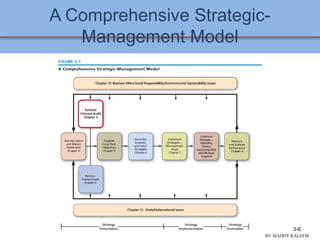
A Comprehensive Strategic-
Management Model
3-6
BY:MADDY.KALEEM
Key External Forces
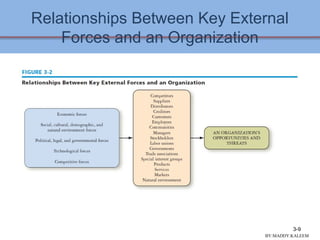
External forces can be divided into five
broad categories:
1.economic forces
2.social, cultural, demographic, and natural
environment forces
3.political, governmental, and legal forces
4.technological forces
5.competitive forces
3-7
BY:MADDY.KALEEM
2–8
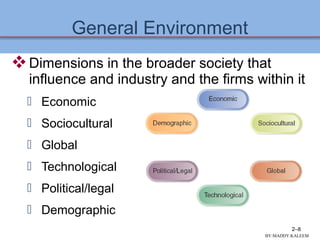
General Environment
Dimensions in the broader society that
influence and industry and the firms within it
 Economic
 Sociocultural
 Global
 Technological
 Political/legal
 Demographic
BY:MADDY.KALEEM
Relationships Between Key External
Forces and an Organization
3-9
BY:MADDY.KALEEM
The Process of Performing an
External Audit
 First, gather competitive intelligence and
information about economic, social, cultural,
demographic, environmental, political,
governmental, legal, and technological trends.
 Information should be assimilated and
evaluated
 A final list of the most important key external
factors should be communicated
3-10
BY:MADDY.KALEEM
The Process of Performing an
External Audit
Key external factors should be:
1.important to achieving long-term and annual
objectives
2.measurable
3.applicable to all competing firms, and
4.hierarchical in the sense that some will pertain
to the overall company and others will be more
narrowly focused on functional or divisional areas
3-11
BY:MADDY.KALEEM
The Industrial Organization
(I/O) View
The Industrial Organization (I/O)
approach to competitive advantage
advocates that external (industry) factors
are more important than internal factors
in a firm for achieving competitive
advantage.
3-12
BY:MADDY.KALEEM
The Industrial Organization
(I/O) View
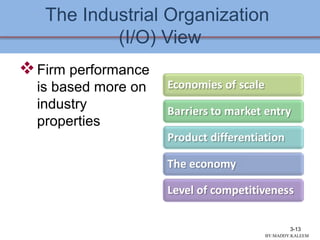
Firm performance
is based more on
industry
properties
3-13
BY:MADDY.KALEEM
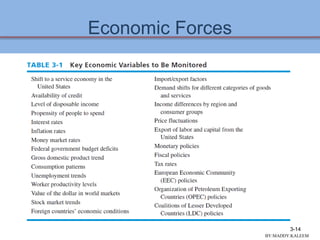
Economic Forces
3-14
BY:MADDY.KALEEM
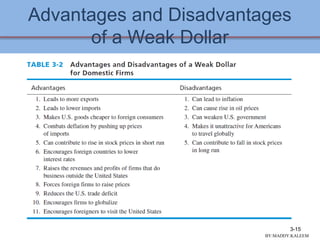
Advantages and Disadvantages
of a Weak Dollar
3-15
BY:MADDY.KALEEM
Social, Cultural, Demographic, and
Natural Environmental Forces
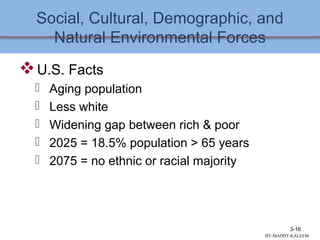
U.S. Facts
 Aging population
 Less white
 Widening gap between rich & poor
 2025 = 18.5% population > 65 years
 2075 = no ethnic or racial majority
3-16
BY:MADDY.KALEEM
Social, Cultural, Demographic, and
Natural Environmental Forces
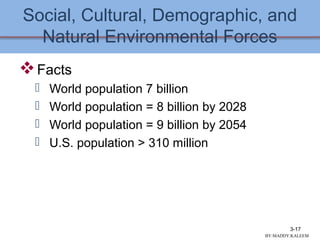
Facts
 World population 7 billion
 World population = 8 billion by 2028
 World population = 9 billion by 2054
 U.S. population > 310 million
3-17
BY:MADDY.KALEEM
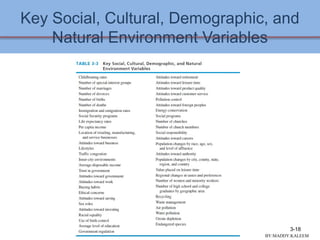
Key Social, Cultural, Demographic, and
Natural Environment Variables
3-18
BY:MADDY.KALEEM
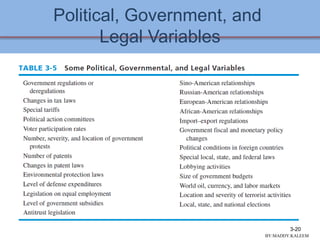
Political, Governmental, and
Legal Forces
The increasing global interdependence
among economies, markets,
governments, and organizations makes it
imperative that firms consider the
possible impact of political variables on
the formulation and implementation of
competitive strategies.
3-19
BY:MADDY.KALEEM
Political, Government, and
Legal Variables
3-20
BY:MADDY.KALEEM
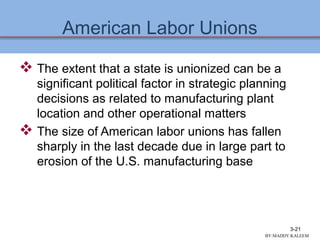
American Labor Unions
 The extent that a state is unionized can be a
significant political factor in strategic planning
decisions as related to manufacturing plant
location and other operational matters
 The size of American labor unions has fallen
sharply in the last decade due in large part to
erosion of the U.S. manufacturing base
3-21
BY:MADDY.KALEEM
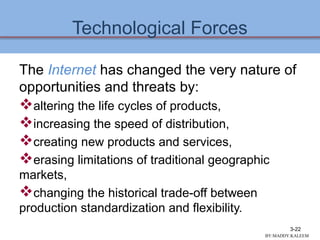
Technological Forces
The Internet has changed the very nature of
opportunities and threats by:
altering the life cycles of products,
increasing the speed of distribution,
creating new products and services,
erasing limitations of traditional geographic
markets,
changing the historical trade-off between
production standardization and flexibility.
3-22
BY:MADDY.KALEEM
Technological Forces
The Internet is altering economies of
scale, changing entry barriers, and
redefining the relationship between
industries and various suppliers,
creditors, customers, and competitors
3-23
BY:MADDY.KALEEM
Technological Forces
Many firms now have a Chief
Information Officer (CIO) and a Chief
Technology Officer (CTO) who work
together to ensure that information
needed to formulate, implement, and
evaluate strategies is available where
and when it is needed
3-24
BY:MADDY.KALEEM
Technological Forces
Technological advancements can:
Create new markets,
Result in a proliferation of new and improved
products,
Change the relative competitive cost positions in
an industry,
Render existing products and services obsolete.
3-25
BY:MADDY.KALEEM
Competitive Forces
An important part of an external audit is
identifying rival firms and determining
their strengths, weaknesses, capabilities,
opportunities, threats, objectives, and
strategies
3-26
BY:MADDY.KALEEM
Competitive Forces
Characteristics of the most competitive
companies:
1.Market share matters
2.Understand and remember precisely what business
you are in
3.Whether it’s broke or not, fix it–make it better
4.Innovate or evaporate
5.Acquisition is essential to growth
6.People make a difference
7.There is no substitute for quality
3-27
BY:MADDY.KALEEM
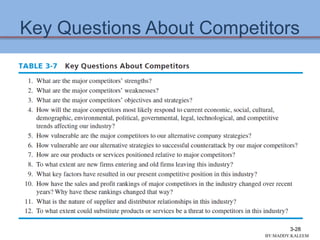
Key Questions About Competitors
3-28
BY:MADDY.KALEEM
Competitive Intelligence
Programs
Competitive intelligence (CI)
 a systematic and ethical process for
gathering and analyzing information about
the competition’s activities and general
business trends to further a business’s own
goals
3-29
BY:MADDY.KALEEM
Competitive Intelligence
Programs
The three basic objectives of a CI program
are:
1.to provide a general understanding of an
industry and its competitors
2.to identify areas in which competitors are
vulnerable and to assess the impact strategic
actions would have on competitors
3-30
BY:MADDY.KALEEM
Competitive Intelligence
Programs
3. to identify potential moves that a
competitor might make that would
endanger a firm’s position in the market
3-31
BY:MADDY.KALEEM
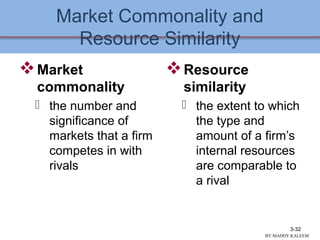
Market Commonality and
Resource Similarity
Market
commonality
 the number and
significance of
markets that a firm
competes in with
rivals
Resource
similarity
 the extent to which
the type and
amount of a firm’s
internal resources
are comparable to
a rival
3-32
BY:MADDY.KALEEM
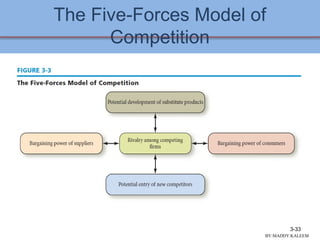
The Five-Forces Model of
Competition
3-33
BY:MADDY.KALEEM
The Five-Forces Model of
Competition
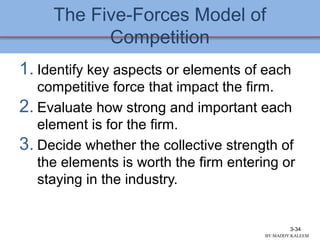
1. Identify key aspects or elements of each
competitive force that impact the firm.
2. Evaluate how strong and important each
element is for the firm.
3. Decide whether the collective strength of
the elements is worth the firm entering or
staying in the industry.
3-34
BY:MADDY.KALEEM
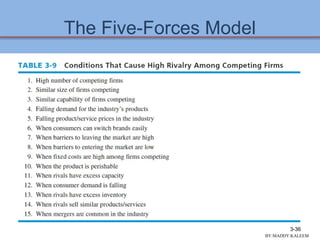
The Five-Forces Model
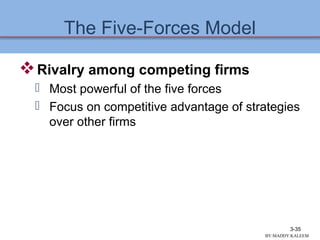
Rivalry among competing firms
 Most powerful of the five forces
 Focus on competitive advantage of strategies
over other firms
3-35
BY:MADDY.KALEEM
The Five-Forces Model
3-36
BY:MADDY.KALEEM
The Five-Forces Model
Potential Entry of New Competitors
 Barriers to entry are important
 Quality, pricing, and marketing can overcome
barriers
3-37
BY:MADDY.KALEEM
Barriers to Entry
 Need to gain economies of scale quickly
 Need to gain technology and specialized know-
how
 Lack of experience
 Strong customer loyalty
 Strong brand preferences
 Large capital requirements
 Lack of adequate distribution channels
3-38
BY:MADDY.KALEEM
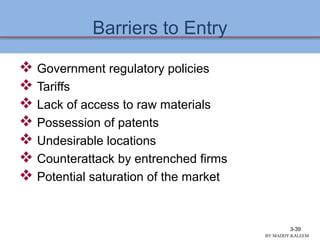
Barriers to Entry
 Government regulatory policies
 Tariffs
 Lack of access to raw materials
 Possession of patents
 Undesirable locations
 Counterattack by entrenched firms
 Potential saturation of the market
3-39
BY:MADDY.KALEEM
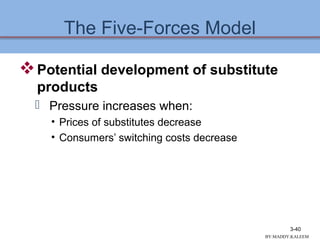
The Five-Forces Model
Potential development of substitute
products
 Pressure increases when:
• Prices of substitutes decrease
• Consumers’ switching costs decrease
3-40
BY:MADDY.KALEEM
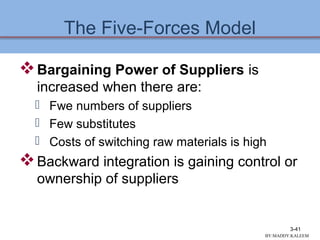
The Five-Forces Model
Bargaining Power of Suppliers is
increased when there are:
 Fwe numbers of suppliers
 Few substitutes
 Costs of switching raw materials is high
Backward integration is gaining control or
ownership of suppliers
3-41
BY:MADDY.KALEEM
The Five-Forces Model
Bargaining power of consumers
 Customers being concentrated or buying in
volume affects intensity of competition
 Consumer power is higher where products
are standard or undifferentiated
3-42
BY:MADDY.KALEEM
Conditions Where Consumers Gain
Bargaining Power
1. If buyers can inexpensively switch
2. If buyers are particularly important
3. If sellers are struggling in the face of falling
consumer demand
4. If buyers are informed about sellers’ products,
prices, and costs
5. If buyers have discretion in whether and when
they purchase the product
3-43
BY:MADDY.KALEEM
Sources of External Information
 Unpublished sources include customer
surveys, market research, speeches at
professional and shareholders’ meetings,
television programs, interviews, and
conversations with stakeholders.
 Published sources of strategic information
include periodicals, journals, reports,
government documents, abstracts, books,
directories, newspapers, and manuals.
3-44
BY:MADDY.KALEEM
Sources of External Information
marketwatch.multexinvestor.com
moneycentral.msn.com
finance.yahoo.com
www.clearstation.com
us.etrade.com/e/t/invest/markets
www.hoovers.com
globaledge.msu.edu/industries/
3-45
BY:MADDY.KALEEM
Forecasting Tools and
Techniques
Forecasts
 educated assumptions about future trends
and events
 quantitative, qualitative techniques
3-46
BY:MADDY.KALEEM
Making Assumptions
Assumptions
 Best present estimates of the impact of major
external factors, over which the manager has
little if any control, but which may exert a
significant impact on performance or the
ability to achieve desired results.
3-47
BY:MADDY.KALEEM
Industry Analysis: The External
Factor Evaluation (EFE) Matrix
Economic
Social
Cultural
Demographic
Environmental
Political
Governmental
Technological
Competitive
Legal
3-48
BY:MADDY.KALEEM
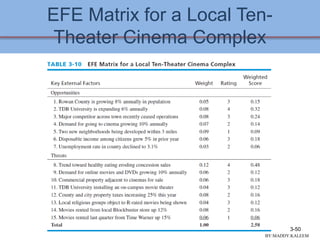
EFE Matrix Steps
1. List key external factors
2. Weight from 0 to 1
3. Rate effectiveness of current strategies
4. Multiply weight * rating
5. Sum weighted scores
3-49
BY:MADDY.KALEEM
EFE Matrix for a Local Ten-
Theater Cinema Complex
3-50
BY:MADDY.KALEEM
Industry Analysis: Competitive
Profile Matrix (CPM)
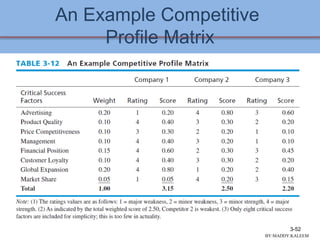
Identifies firm’s major competitors and
their strengths & weaknesses in relation
to a sample firm’s strategic positions
Critical success factors include internal
and external issues
3-51
BY:MADDY.KALEEM
An Example Competitive
Profile Matrix
3-52
BY:MADDY.KALEEM
3-53
BY:MADDY.KALEEM

Strategic Management: Concepts & Cases Chapter 03

  • 1.
  • 2.
    Chapter Objectives 1. Describehow to conduct an external strategic- management audit. 2. Discuss 10 major external forces that affect organizations: economic, social, cultural, demographic, environmental, political, governmental, legal, technological, and competitive. 3. Describe key sources of external information, including the Internet. 4. Discuss important forecasting tools used in strategic management. 5. Discuss the importance of monitoring external trends and events. 3-2 BY:MADDY.KALEEM
  • 3.
    Chapter Objectives (cont.) 6.Explain how to develop an EFE Matrix. 7. Explain how to develop a Competitive Profile Matrix. 8. Discuss the importance of gathering competitive intelligence. 9. Describe the trend toward cooperation among competitors. 10.Discuss market commonality and resource similarity in relation to competitive analysis. 3-3 BY:MADDY.KALEEM
  • 4.
    External Audit External audit focuses on identifying and evaluating trends and events beyond the control of a single firm  reveals key opportunities and threats confronting an organization so that managers can formulate strategies to take advantage of the opportunities and avoid or reduce the impact of threats 3-4 BY:MADDY.KALEEM
  • 5.
    The Nature ofan External Audit The external audit is aimed at identifying key variables that offer actionable responses  Firms should be able to respond either offensively or defensively to the factors by formulating strategies that take advantage of external opportunities or that minimize the impact of potential threats. 3-5 BY:MADDY.KALEEM
  • 6.
    A Comprehensive Strategic- ManagementModel 3-6 BY:MADDY.KALEEM
  • 7.
    Key External Forces Externalforces can be divided into five broad categories: 1.economic forces 2.social, cultural, demographic, and natural environment forces 3.political, governmental, and legal forces 4.technological forces 5.competitive forces 3-7 BY:MADDY.KALEEM
  • 8.
    2–8 General Environment Dimensions inthe broader society that influence and industry and the firms within it  Economic  Sociocultural  Global  Technological  Political/legal  Demographic BY:MADDY.KALEEM
  • 9.
    Relationships Between KeyExternal Forces and an Organization 3-9 BY:MADDY.KALEEM
  • 10.
    The Process ofPerforming an External Audit  First, gather competitive intelligence and information about economic, social, cultural, demographic, environmental, political, governmental, legal, and technological trends.  Information should be assimilated and evaluated  A final list of the most important key external factors should be communicated 3-10 BY:MADDY.KALEEM
  • 11.
    The Process ofPerforming an External Audit Key external factors should be: 1.important to achieving long-term and annual objectives 2.measurable 3.applicable to all competing firms, and 4.hierarchical in the sense that some will pertain to the overall company and others will be more narrowly focused on functional or divisional areas 3-11 BY:MADDY.KALEEM
  • 12.
    The Industrial Organization (I/O)View The Industrial Organization (I/O) approach to competitive advantage advocates that external (industry) factors are more important than internal factors in a firm for achieving competitive advantage. 3-12 BY:MADDY.KALEEM
  • 13.
    The Industrial Organization (I/O)View Firm performance is based more on industry properties 3-13 BY:MADDY.KALEEM
  • 14.
  • 15.
    Advantages and Disadvantages ofa Weak Dollar 3-15 BY:MADDY.KALEEM
  • 16.
    Social, Cultural, Demographic,and Natural Environmental Forces U.S. Facts  Aging population  Less white  Widening gap between rich & poor  2025 = 18.5% population > 65 years  2075 = no ethnic or racial majority 3-16 BY:MADDY.KALEEM
  • 17.
    Social, Cultural, Demographic,and Natural Environmental Forces Facts  World population 7 billion  World population = 8 billion by 2028  World population = 9 billion by 2054  U.S. population > 310 million 3-17 BY:MADDY.KALEEM
  • 18.
    Key Social, Cultural,Demographic, and Natural Environment Variables 3-18 BY:MADDY.KALEEM
  • 19.
    Political, Governmental, and LegalForces The increasing global interdependence among economies, markets, governments, and organizations makes it imperative that firms consider the possible impact of political variables on the formulation and implementation of competitive strategies. 3-19 BY:MADDY.KALEEM
  • 20.
    Political, Government, and LegalVariables 3-20 BY:MADDY.KALEEM
  • 21.
    American Labor Unions The extent that a state is unionized can be a significant political factor in strategic planning decisions as related to manufacturing plant location and other operational matters  The size of American labor unions has fallen sharply in the last decade due in large part to erosion of the U.S. manufacturing base 3-21 BY:MADDY.KALEEM
  • 22.
    Technological Forces The Internethas changed the very nature of opportunities and threats by: altering the life cycles of products, increasing the speed of distribution, creating new products and services, erasing limitations of traditional geographic markets, changing the historical trade-off between production standardization and flexibility. 3-22 BY:MADDY.KALEEM
  • 23.
    Technological Forces The Internetis altering economies of scale, changing entry barriers, and redefining the relationship between industries and various suppliers, creditors, customers, and competitors 3-23 BY:MADDY.KALEEM
  • 24.
    Technological Forces Many firmsnow have a Chief Information Officer (CIO) and a Chief Technology Officer (CTO) who work together to ensure that information needed to formulate, implement, and evaluate strategies is available where and when it is needed 3-24 BY:MADDY.KALEEM
  • 25.
    Technological Forces Technological advancementscan: Create new markets, Result in a proliferation of new and improved products, Change the relative competitive cost positions in an industry, Render existing products and services obsolete. 3-25 BY:MADDY.KALEEM
  • 26.
    Competitive Forces An importantpart of an external audit is identifying rival firms and determining their strengths, weaknesses, capabilities, opportunities, threats, objectives, and strategies 3-26 BY:MADDY.KALEEM
  • 27.
    Competitive Forces Characteristics ofthe most competitive companies: 1.Market share matters 2.Understand and remember precisely what business you are in 3.Whether it’s broke or not, fix it–make it better 4.Innovate or evaporate 5.Acquisition is essential to growth 6.People make a difference 7.There is no substitute for quality 3-27 BY:MADDY.KALEEM
  • 28.
    Key Questions AboutCompetitors 3-28 BY:MADDY.KALEEM
  • 29.
    Competitive Intelligence Programs Competitive intelligence(CI)  a systematic and ethical process for gathering and analyzing information about the competition’s activities and general business trends to further a business’s own goals 3-29 BY:MADDY.KALEEM
  • 30.
    Competitive Intelligence Programs The threebasic objectives of a CI program are: 1.to provide a general understanding of an industry and its competitors 2.to identify areas in which competitors are vulnerable and to assess the impact strategic actions would have on competitors 3-30 BY:MADDY.KALEEM
  • 31.
    Competitive Intelligence Programs 3. toidentify potential moves that a competitor might make that would endanger a firm’s position in the market 3-31 BY:MADDY.KALEEM
  • 32.
    Market Commonality and ResourceSimilarity Market commonality  the number and significance of markets that a firm competes in with rivals Resource similarity  the extent to which the type and amount of a firm’s internal resources are comparable to a rival 3-32 BY:MADDY.KALEEM
  • 33.
    The Five-Forces Modelof Competition 3-33 BY:MADDY.KALEEM
  • 34.
    The Five-Forces Modelof Competition 1. Identify key aspects or elements of each competitive force that impact the firm. 2. Evaluate how strong and important each element is for the firm. 3. Decide whether the collective strength of the elements is worth the firm entering or staying in the industry. 3-34 BY:MADDY.KALEEM
  • 35.
    The Five-Forces Model Rivalryamong competing firms  Most powerful of the five forces  Focus on competitive advantage of strategies over other firms 3-35 BY:MADDY.KALEEM
  • 36.
  • 37.
    The Five-Forces Model PotentialEntry of New Competitors  Barriers to entry are important  Quality, pricing, and marketing can overcome barriers 3-37 BY:MADDY.KALEEM
  • 38.
    Barriers to Entry Need to gain economies of scale quickly  Need to gain technology and specialized know- how  Lack of experience  Strong customer loyalty  Strong brand preferences  Large capital requirements  Lack of adequate distribution channels 3-38 BY:MADDY.KALEEM
  • 39.
    Barriers to Entry Government regulatory policies  Tariffs  Lack of access to raw materials  Possession of patents  Undesirable locations  Counterattack by entrenched firms  Potential saturation of the market 3-39 BY:MADDY.KALEEM
  • 40.
    The Five-Forces Model Potentialdevelopment of substitute products  Pressure increases when: • Prices of substitutes decrease • Consumers’ switching costs decrease 3-40 BY:MADDY.KALEEM
  • 41.
    The Five-Forces Model BargainingPower of Suppliers is increased when there are:  Fwe numbers of suppliers  Few substitutes  Costs of switching raw materials is high Backward integration is gaining control or ownership of suppliers 3-41 BY:MADDY.KALEEM
  • 42.
    The Five-Forces Model Bargainingpower of consumers  Customers being concentrated or buying in volume affects intensity of competition  Consumer power is higher where products are standard or undifferentiated 3-42 BY:MADDY.KALEEM
  • 43.
    Conditions Where ConsumersGain Bargaining Power 1. If buyers can inexpensively switch 2. If buyers are particularly important 3. If sellers are struggling in the face of falling consumer demand 4. If buyers are informed about sellers’ products, prices, and costs 5. If buyers have discretion in whether and when they purchase the product 3-43 BY:MADDY.KALEEM
  • 44.
    Sources of ExternalInformation  Unpublished sources include customer surveys, market research, speeches at professional and shareholders’ meetings, television programs, interviews, and conversations with stakeholders.  Published sources of strategic information include periodicals, journals, reports, government documents, abstracts, books, directories, newspapers, and manuals. 3-44 BY:MADDY.KALEEM
  • 45.
    Sources of ExternalInformation marketwatch.multexinvestor.com moneycentral.msn.com finance.yahoo.com www.clearstation.com us.etrade.com/e/t/invest/markets www.hoovers.com globaledge.msu.edu/industries/ 3-45 BY:MADDY.KALEEM
  • 46.
    Forecasting Tools and Techniques Forecasts educated assumptions about future trends and events  quantitative, qualitative techniques 3-46 BY:MADDY.KALEEM
  • 47.
    Making Assumptions Assumptions  Bestpresent estimates of the impact of major external factors, over which the manager has little if any control, but which may exert a significant impact on performance or the ability to achieve desired results. 3-47 BY:MADDY.KALEEM
  • 48.
    Industry Analysis: TheExternal Factor Evaluation (EFE) Matrix Economic Social Cultural Demographic Environmental Political Governmental Technological Competitive Legal 3-48 BY:MADDY.KALEEM
  • 49.
    EFE Matrix Steps 1.List key external factors 2. Weight from 0 to 1 3. Rate effectiveness of current strategies 4. Multiply weight * rating 5. Sum weighted scores 3-49 BY:MADDY.KALEEM
  • 50.
    EFE Matrix fora Local Ten- Theater Cinema Complex 3-50 BY:MADDY.KALEEM
  • 51.
    Industry Analysis: Competitive ProfileMatrix (CPM) Identifies firm’s major competitors and their strengths & weaknesses in relation to a sample firm’s strategic positions Critical success factors include internal and external issues 3-51 BY:MADDY.KALEEM
  • 52.
    An Example Competitive ProfileMatrix 3-52 BY:MADDY.KALEEM
  • 53.

Editor's Notes

  • #47 Forecasting is complex because of factors such as technological innovation, cultural changes, new products, improved services, stronger competitors, shifts in government priorities, changing social values, unstable economic conditions, and unforeseen events