7-1
Bonds and Their Valuation
 Key features of bonds
 Bond valuation
 Measuring yield
 Assessing risk
By: MADDY.KALEEM
7-2
What is a bond?
 A long-term debt instrument in which
a borrower (Issuer) agrees to make
payments of principal and interest, on
specific dates, to the holders of the
bond.
By: MADDY.KALEEM
7-3
What is a bond
 A bond is a fixed interest financial asset
issued by governments, companies,
banks, public utilities and other large
entities.
 Bonds pay the bearer a fixed amount a
specified end date.
By: MADDY.KALEEM
7-4
Key Features of a Bond
 Par value – face amount of the bond, which
is paid at maturity (assume $1,000).
 Coupon interest rate – stated interest rate
(generally fixed) paid by the issuer. Multiply
by par to get dollar payment of interest.
 Maturity date – years until the bond must be
repaid.
 Issue date – when the bond was issued.
 Yield to maturity - rate of return earned on
a bond held until maturity (also called the
“promised yield”).
By: MADDY.KALEEM
7-5
Types of Bond ( wrt Return)
 Discount Bond - pays the bearer only at
the ending date (Maturity).
 Coupon Bond - pays the bearer a fixed
amount over a specified interval (month,
year, etc.) as well as paying a fixed
amount at the end date
By: MADDY.KALEEM
7-6
Other types (features) of bonds
 Convertible bond – may be exchanged for
common stock of the firm, at the holder’s option.
 Warrant – long-term option to buy a stated number
of shares of common stock at a specified price.
 Income bond – pays interest only when interest is
earned by the firm.
 Indexed bond – interest rate paid is based upon
the rate of inflation.
By: MADDY.KALEEM
7-7
Callable Bond
 A bond that can be redeemed by the
issuer prior to its maturity.
 Usually a premium is paid to the bond
owner when the bond is called.
 The main cause of a call is a decline in
interest rates.
By: MADDY.KALEEM
7-8
Put-able bond
 Allows holder to sell the bond back to
the company prior to maturity.
By: MADDY.KALEEM
7-9
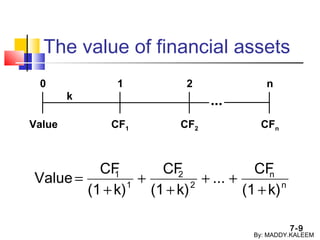
The value of financial assets
n
n
2
2
1
1
k)(1
CF
...
k)(1
CF
k)(1
CF
Value
+
++
+
+
+
=
0 1 2 n
k
CF1 CFnCF2Value
...
By: MADDY.KALEEM
7-10
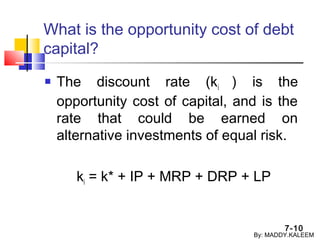
What is the opportunity cost of debt
capital?
 The discount rate (ki ) is the
opportunity cost of capital, and is the
rate that could be earned on
alternative investments of equal risk.
ki = k* + IP + MRP + DRP + LP
By: MADDY.KALEEM
7-11
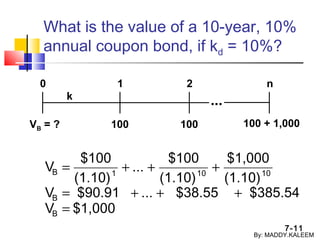
What is the value of a 10-year, 10%
annual coupon bond, if kd = 10%?
$1,000V
$385.54$38.55...$90.91V
(1.10)
$1,000
(1.10)
$100
...
(1.10)
$100
V
B
B
10101B
=
+++=
+++=
0 1 2 n
k
100 100 + 1,000100VB = ?
...
By: MADDY.KALEEM
7-12
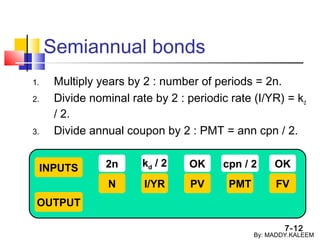
Semiannual bonds
1. Multiply years by 2 : number of periods = 2n.
2. Divide nominal rate by 2 : periodic rate (I/YR) = kd
/ 2.
3. Divide annual coupon by 2 : PMT = ann cpn / 2.
INPUTS
OUTPUT
N I/YR PMTPV FV
2n kd / 2 cpn / 2 OKOK
By: MADDY.KALEEM
7-13
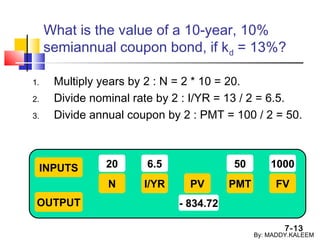
What is the value of a 10-year, 10%
semiannual coupon bond, if kd = 13%?
1. Multiply years by 2 : N = 2 * 10 = 20.
2. Divide nominal rate by 2 : I/YR = 13 / 2 = 6.5.
3. Divide annual coupon by 2 : PMT = 100 / 2 = 50.
INPUTS
OUTPUT
N I/YR PMTPV FV
20 6.5 50 1000
- 834.72
By: MADDY.KALEEM
7-14
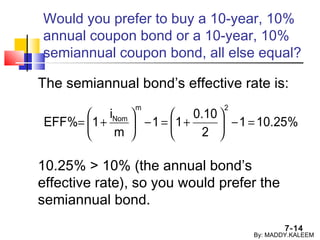
Would you prefer to buy a 10-year, 10%
annual coupon bond or a 10-year, 10%
semiannual coupon bond, all else equal?
The semiannual bond’s effective rate is:
10.25% > 10% (the annual bond’s
effective rate), so you would prefer the
semiannual bond.
10.25%1
2
0.10
11
m
i
1EFF%
2m
Nom
=−





+=−





+=
By: MADDY.KALEEM
7-15
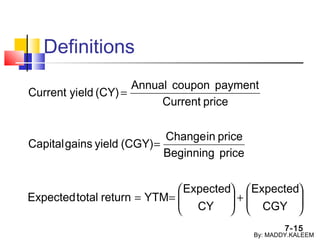
Definitions






+





==
=
=
CGY
Expected
CY
Expected
YTMreturntotalExpected
priceBeginning
priceinChange
(CGY)yieldgainsCapital
priceCurrent
paymentcouponAnnual
(CY)eldCurrent yi
By: MADDY.KALEEM
7-16
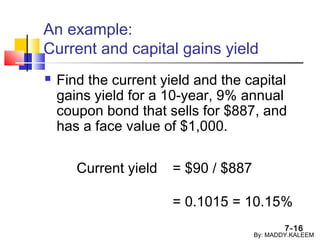
An example:
Current and capital gains yield
 Find the current yield and the capital
gains yield for a 10-year, 9% annual
coupon bond that sells for $887, and
has a face value of $1,000.
Current yield = $90 / $887
= 0.1015 = 10.15%
By: MADDY.KALEEM
7-17
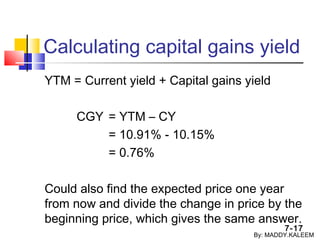
Calculating capital gains yield
YTM = Current yield + Capital gains yield
CGY = YTM – CY
= 10.91% - 10.15%
= 0.76%
Could also find the expected price one year
from now and divide the change in price by the
beginning price, which gives the same answer.
By: MADDY.KALEEM
7-18
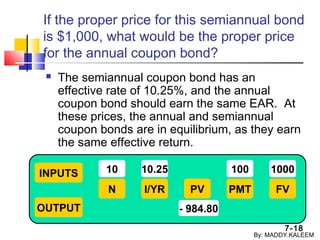
If the proper price for this semiannual bond
is $1,000, what would be the proper price
for the annual coupon bond?
 The semiannual coupon bond has an
effective rate of 10.25%, and the annual
coupon bond should earn the same EAR. At
these prices, the annual and semiannual
coupon bonds are in equilibrium, as they earn
the same effective return.
INPUTS
OUTPUT
N I/YR PMTPV FV
10 10.25 100 1000
- 984.80
By: MADDY.KALEEM
7-19
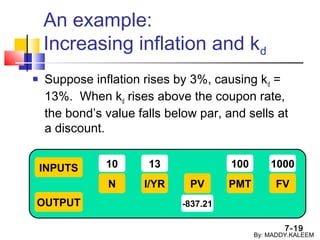
An example:
Increasing inflation and kd
 Suppose inflation rises by 3%, causing kd =
13%. When kd rises above the coupon rate,
the bond’s value falls below par, and sells at
a discount.
INPUTS
OUTPUT
N I/YR PMTPV FV
10 13 100 1000
-837.21
By: MADDY.KALEEM
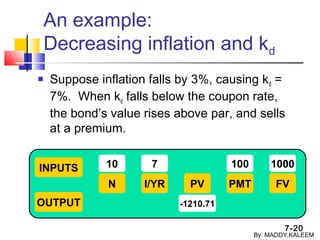
7-20
An example:
Decreasing inflation and kd
 Suppose inflation falls by 3%, causing kd =
7%. When kd falls below the coupon rate,
the bond’s value rises above par, and sells
at a premium.
INPUTS
OUTPUT
N I/YR PMTPV FV
10 7 100 1000
-1210.71
By: MADDY.KALEEM
7-21
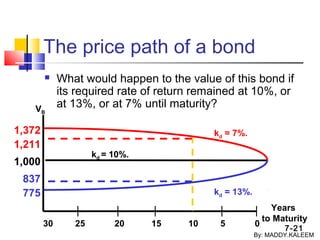
The price path of a bond
 What would happen to the value of this bond if
its required rate of return remained at 10%, or
at 13%, or at 7% until maturity?
Years
to Maturity
1,372
1,211
1,000
837
775
30 25 20 15 10 5 0
kd = 7%.
kd = 13%.
kd = 10%.
VB
By: MADDY.KALEEM
7-22
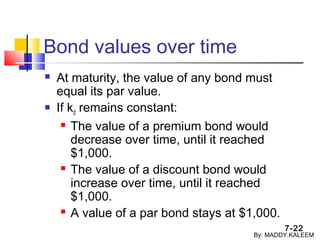
Bond values over time
 At maturity, the value of any bond must
equal its par value.
 If kd remains constant:
 The value of a premium bond would
decrease over time, until it reached
$1,000.
 The value of a discount bond would
increase over time, until it reached
$1,000.
 A value of a par bond stays at $1,000.
By: MADDY.KALEEM
7-23
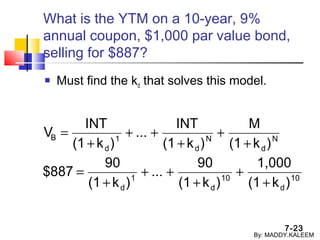
What is the YTM on a 10-year, 9%
annual coupon, $1,000 par value bond,
selling for $887?
 Must find the kd that solves this model.
10
d
10
d
1
d
N
d
N
d
1
d
B
)k(1
1,000
)k(1
90
...
)k(1
90
$887
)k(1
M
)k(1
INT
...
)k(1
INT
V
+
+
+
++
+
=
+
+
+
++
+
=
By: MADDY.KALEEM
7-24
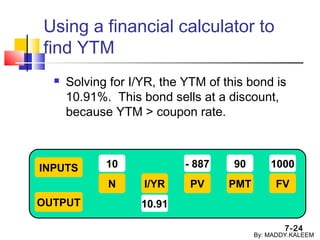
Using a financial calculator to
find YTM
 Solving for I/YR, the YTM of this bond is
10.91%. This bond sells at a discount,
because YTM > coupon rate.
INPUTS
OUTPUT
N I/YR PMTPV FV
10
10.91
90 1000- 887
By: MADDY.KALEEM
7-25
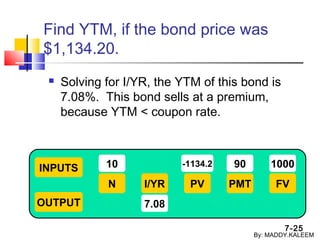
Find YTM, if the bond price was
$1,134.20.
 Solving for I/YR, the YTM of this bond is
7.08%. This bond sells at a premium,
because YTM < coupon rate.
INPUTS
OUTPUT
N I/YR PMTPV FV
10
7.08
90 1000-1134.2
By: MADDY.KALEEM
7-26
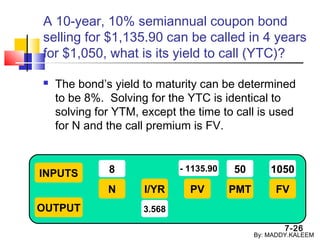
A 10-year, 10% semiannual coupon bond
selling for $1,135.90 can be called in 4 years
for $1,050, what is its yield to call (YTC)?
 The bond’s yield to maturity can be determined
to be 8%. Solving for the YTC is identical to
solving for YTM, except the time to call is used
for N and the call premium is FV.
INPUTS
OUTPUT
N I/YR PMTPV FV
8
3.568
50 1050- 1135.90
By: MADDY.KALEEM
7-27
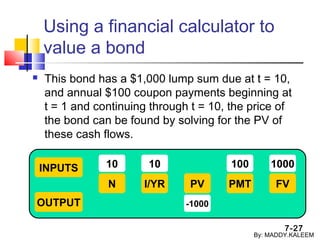
Using a financial calculator to
value a bond
 This bond has a $1,000 lump sum due at t = 10,
and annual $100 coupon payments beginning at
t = 1 and continuing through t = 10, the price of
the bond can be found by solving for the PV of
these cash flows.
INPUTS
OUTPUT
N I/YR PMTPV FV
10 10 100 1000
-1000
By: MADDY.KALEEM

Bond valuation

  • 1.
    7-1 Bonds and TheirValuation  Key features of bonds  Bond valuation  Measuring yield  Assessing risk By: MADDY.KALEEM
  • 2.
    7-2 What is abond?  A long-term debt instrument in which a borrower (Issuer) agrees to make payments of principal and interest, on specific dates, to the holders of the bond. By: MADDY.KALEEM
  • 3.
    7-3 What is abond  A bond is a fixed interest financial asset issued by governments, companies, banks, public utilities and other large entities.  Bonds pay the bearer a fixed amount a specified end date. By: MADDY.KALEEM
  • 4.
    7-4 Key Features ofa Bond  Par value – face amount of the bond, which is paid at maturity (assume $1,000).  Coupon interest rate – stated interest rate (generally fixed) paid by the issuer. Multiply by par to get dollar payment of interest.  Maturity date – years until the bond must be repaid.  Issue date – when the bond was issued.  Yield to maturity - rate of return earned on a bond held until maturity (also called the “promised yield”). By: MADDY.KALEEM
  • 5.
    7-5 Types of Bond( wrt Return)  Discount Bond - pays the bearer only at the ending date (Maturity).  Coupon Bond - pays the bearer a fixed amount over a specified interval (month, year, etc.) as well as paying a fixed amount at the end date By: MADDY.KALEEM
  • 6.
    7-6 Other types (features)of bonds  Convertible bond – may be exchanged for common stock of the firm, at the holder’s option.  Warrant – long-term option to buy a stated number of shares of common stock at a specified price.  Income bond – pays interest only when interest is earned by the firm.  Indexed bond – interest rate paid is based upon the rate of inflation. By: MADDY.KALEEM
  • 7.
    7-7 Callable Bond  Abond that can be redeemed by the issuer prior to its maturity.  Usually a premium is paid to the bond owner when the bond is called.  The main cause of a call is a decline in interest rates. By: MADDY.KALEEM
  • 8.
    7-8 Put-able bond  Allowsholder to sell the bond back to the company prior to maturity. By: MADDY.KALEEM
  • 9.
    7-9 The value offinancial assets n n 2 2 1 1 k)(1 CF ... k)(1 CF k)(1 CF Value + ++ + + + = 0 1 2 n k CF1 CFnCF2Value ... By: MADDY.KALEEM
  • 10.
    7-10 What is theopportunity cost of debt capital?  The discount rate (ki ) is the opportunity cost of capital, and is the rate that could be earned on alternative investments of equal risk. ki = k* + IP + MRP + DRP + LP By: MADDY.KALEEM
  • 11.
    7-11 What is thevalue of a 10-year, 10% annual coupon bond, if kd = 10%? $1,000V $385.54$38.55...$90.91V (1.10) $1,000 (1.10) $100 ... (1.10) $100 V B B 10101B = +++= +++= 0 1 2 n k 100 100 + 1,000100VB = ? ... By: MADDY.KALEEM
  • 12.
    7-12 Semiannual bonds 1. Multiplyyears by 2 : number of periods = 2n. 2. Divide nominal rate by 2 : periodic rate (I/YR) = kd / 2. 3. Divide annual coupon by 2 : PMT = ann cpn / 2. INPUTS OUTPUT N I/YR PMTPV FV 2n kd / 2 cpn / 2 OKOK By: MADDY.KALEEM
  • 13.
    7-13 What is thevalue of a 10-year, 10% semiannual coupon bond, if kd = 13%? 1. Multiply years by 2 : N = 2 * 10 = 20. 2. Divide nominal rate by 2 : I/YR = 13 / 2 = 6.5. 3. Divide annual coupon by 2 : PMT = 100 / 2 = 50. INPUTS OUTPUT N I/YR PMTPV FV 20 6.5 50 1000 - 834.72 By: MADDY.KALEEM
  • 14.
    7-14 Would you preferto buy a 10-year, 10% annual coupon bond or a 10-year, 10% semiannual coupon bond, all else equal? The semiannual bond’s effective rate is: 10.25% > 10% (the annual bond’s effective rate), so you would prefer the semiannual bond. 10.25%1 2 0.10 11 m i 1EFF% 2m Nom =−      +=−      += By: MADDY.KALEEM
  • 15.
  • 16.
    7-16 An example: Current andcapital gains yield  Find the current yield and the capital gains yield for a 10-year, 9% annual coupon bond that sells for $887, and has a face value of $1,000. Current yield = $90 / $887 = 0.1015 = 10.15% By: MADDY.KALEEM
  • 17.
    7-17 Calculating capital gainsyield YTM = Current yield + Capital gains yield CGY = YTM – CY = 10.91% - 10.15% = 0.76% Could also find the expected price one year from now and divide the change in price by the beginning price, which gives the same answer. By: MADDY.KALEEM
  • 18.
    7-18 If the properprice for this semiannual bond is $1,000, what would be the proper price for the annual coupon bond?  The semiannual coupon bond has an effective rate of 10.25%, and the annual coupon bond should earn the same EAR. At these prices, the annual and semiannual coupon bonds are in equilibrium, as they earn the same effective return. INPUTS OUTPUT N I/YR PMTPV FV 10 10.25 100 1000 - 984.80 By: MADDY.KALEEM
  • 19.
    7-19 An example: Increasing inflationand kd  Suppose inflation rises by 3%, causing kd = 13%. When kd rises above the coupon rate, the bond’s value falls below par, and sells at a discount. INPUTS OUTPUT N I/YR PMTPV FV 10 13 100 1000 -837.21 By: MADDY.KALEEM
  • 20.
    7-20 An example: Decreasing inflationand kd  Suppose inflation falls by 3%, causing kd = 7%. When kd falls below the coupon rate, the bond’s value rises above par, and sells at a premium. INPUTS OUTPUT N I/YR PMTPV FV 10 7 100 1000 -1210.71 By: MADDY.KALEEM
  • 21.
    7-21 The price pathof a bond  What would happen to the value of this bond if its required rate of return remained at 10%, or at 13%, or at 7% until maturity? Years to Maturity 1,372 1,211 1,000 837 775 30 25 20 15 10 5 0 kd = 7%. kd = 13%. kd = 10%. VB By: MADDY.KALEEM
  • 22.
    7-22 Bond values overtime  At maturity, the value of any bond must equal its par value.  If kd remains constant:  The value of a premium bond would decrease over time, until it reached $1,000.  The value of a discount bond would increase over time, until it reached $1,000.  A value of a par bond stays at $1,000. By: MADDY.KALEEM
  • 23.
    7-23 What is theYTM on a 10-year, 9% annual coupon, $1,000 par value bond, selling for $887?  Must find the kd that solves this model. 10 d 10 d 1 d N d N d 1 d B )k(1 1,000 )k(1 90 ... )k(1 90 $887 )k(1 M )k(1 INT ... )k(1 INT V + + + ++ + = + + + ++ + = By: MADDY.KALEEM
  • 24.
    7-24 Using a financialcalculator to find YTM  Solving for I/YR, the YTM of this bond is 10.91%. This bond sells at a discount, because YTM > coupon rate. INPUTS OUTPUT N I/YR PMTPV FV 10 10.91 90 1000- 887 By: MADDY.KALEEM
  • 25.
    7-25 Find YTM, ifthe bond price was $1,134.20.  Solving for I/YR, the YTM of this bond is 7.08%. This bond sells at a premium, because YTM < coupon rate. INPUTS OUTPUT N I/YR PMTPV FV 10 7.08 90 1000-1134.2 By: MADDY.KALEEM
  • 26.
    7-26 A 10-year, 10%semiannual coupon bond selling for $1,135.90 can be called in 4 years for $1,050, what is its yield to call (YTC)?  The bond’s yield to maturity can be determined to be 8%. Solving for the YTC is identical to solving for YTM, except the time to call is used for N and the call premium is FV. INPUTS OUTPUT N I/YR PMTPV FV 8 3.568 50 1050- 1135.90 By: MADDY.KALEEM
  • 27.
    7-27 Using a financialcalculator to value a bond  This bond has a $1,000 lump sum due at t = 10, and annual $100 coupon payments beginning at t = 1 and continuing through t = 10, the price of the bond can be found by solving for the PV of these cash flows. INPUTS OUTPUT N I/YR PMTPV FV 10 10 100 1000 -1000 By: MADDY.KALEEM