E-BM
Kenneth C. Laudon
Carol Guercio Traver
business. technology. society.
Sixth Edition
BY:MADDY.KALEE
M Slide 2-1
Slide 1-2
Chapter 2
E-BM, Business Models and
Concepts
BY:MADDY.KALEE
M
Tweet Tweet: What’s Your Business
Model?
Class Discussion
 What characteristics or benchmarks can be used to
assess the business value of a company such as
Twitter that does have revenue?
 Have you used Twitter to communicate with friends
or family? What are your thoughts on this service?
 What are Twitter’s most important assets?
 Which of the possible methods described for
monetizing Twitter’s assets do you feel might be
most successful?
Slide 2-3
BY:MADDY.KALEE
M
E-commerce Business Models
 Business model
Set of planned activities designed to result in a
profit in a marketplace
 Business plan
Describes a firm’s business model
 E-commerce business model
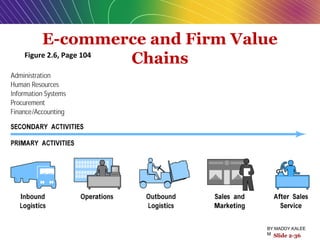
Uses/leverages unique qualities of Internet and
Web
Slide 2-4
BY:MADDY.KALEE
M
8 Key Elements of a Business Model
Slide 2-5
1. Value proposition
2. Revenue model
3. Market opportunity
4. Competitive environment
5. Competitive advantage
6. Market strategy
7. Organizational development
8. Management team
BY:MADDY.KALEE
M
1. Value Proposition
 Why should the customer buy from you?
 Successful e-commerce value
propositions:
 Personalization/customization
 Reduction of product search, price discovery costs
 Facilitation of transactions by managing product delivery
Slide 2-6
BY:MADDY.KALEE
M
What exactly is a value proposition?
“A value proposition is a promise of value to be delivered.
It’s the primary reason a prospect should buy from you.”
In a nutshell, value proposition is a clear statement that
explains how your product solves customers’ problems
or improves their situation (relevancy),
delivers specific benefits (quantified value),
tells the ideal customer why they should buy from you and not
from the competition (unique differentiation).
You have to present your value proposition as the first thing the
visitors see on your home page, but should be visible in all major
entry points of the site.
Slide 2-7
BY:MADDY.KALEE
M
Boosters for your value proposition
 Free shipping
 Fast shipping / Next day shipping
 Free bonus with a purchase
 Free setup / installation
 No setup fee
 No long-term contract, cancel any time
 License for multiple computers (vs 1)
 (Better than) Money-back guarantee
 A discounted price (for a product)
 Customizable
Slide 2-8
BY:MADDY.KALEE
M
2. Revenue Model
 How will the firm earn revenue, generate
profits, and produce a superior return on
invested capital?
 Major types:
 Advertising revenue model
 Subscription revenue model
 Transaction fee revenue model
 Sales revenue model
 Affiliate revenue model
Slide 2-9
BY:MADDY.KALEE
M
3. Market Opportunity
 What marketspace do you intend to
serve and what is its size?
 Marketspace: Area of actual or potential commercial
value in which company intends to operate
 Realistic market opportunity: Defined by revenue
potential in each of market niches in which company
hopes to compete
 Market opportunity typically divided into
smaller niches
Slide 2-10
BY:MADDY.KALEE
M
4. Competitive Environment
 Who else occupies your intended
marketspace?
 Other companies selling similar products in the same
marketspace
 Includes both direct and indirect competitors
 Influenced by:
 Number and size of active competitors
 Each competitor’s market share
 Competitors’ profitability
 Competitors’ pricing
Slide 2-11
BY:MADDY.KALEE
M
5. Competitive Advantage
 What special advantages does your firm bring
to the marketspace?
Achieved when firm produces superior product or
can bring product to market at lower price than
competitors
 Important concepts:
Asymmetries
First-mover advantage
Unfair competitive advantage
Leverage
Slide 2-12
BY:MADDY.KALEE
M
6. Market Strategy
 How do you plan to promote your
products or services to attract your
target audience?
Details how a company intends to enter market
and attract customers
Best business concepts will fail if not properly
marketed to potential customers
Slide 2-13
BY:MADDY.KALEE
M
7. Organizational Development
 What types of organizational structures
within the firm are necessary to carry out
the business plan?
 Describes how firm will organize work
 Typically divided into functional departments
 Hiring moves from generalists to specialists as company
grows
Slide 2-14
BY:MADDY.KALEE
M
8. Management Team
 What kinds of experiences and
background are important for the
company’s leaders to have?
 Employees are responsible for making the business model
work
 Strong management team gives instant credibility to
outside investors
 Strong management team may not be able to salvage a
weak business model, but should be able to change the
model and redefine the business as it becomes necessary
Slide 2-15
BY:MADDY.KALEE
M
 Why do you think Webvan failed?
 Why are more traditional grocery chains succeeding online
today?
 Why would an online customer pay the same price as in the
store plus a delivery charge? What’s the benefit to the
customer?
 What are the important success factors for FreshDirect?
 Do you think FreshDirect would work in your town?
Slide 2-16
Insight on Business
Online Grocers: Finding and
Executing the Right Model
Class Discussion
BY:MADDY.KALEE
M
Categorizing E-commerce
Business Models
 We categorize business models according to:
 E-commerce sector (B2C, B2B, C2C)
 Type of e-commerce technology; i.e., m-commerce
 Similar business models appear in more than
one sector
 Some companies use multiple business
models; e.g., eBay
Slide 2-17
BY:MADDY.KALEE
M
B2C Business Models: Portal
(Gateway)
 Search plus an integrated package of content
and services
 Revenue models:
 Advertising, subscription fees, transaction fees
 Variations:
 Horizontal/General
 Vertical/Specialized (Vortal)
 Pure Search (EXAMPLE YAHOO.COM
Slide 2-18
BY:MADDY.KALEE
M
B2C Models: E- tailor
 Online version of traditional retailer
 Revenue model: Sales
 Variations:
 Virtual merchant (online retail store only – amazon.com )
 Bricks-and-clicks (online distribution channel for a
company that also has physical stores – walmart.com )
 Catalog merchant online version of a mall –
fashionmall.com
 Manufacturer-direct (manufacturer selling directly over
the Web – dell.com)
Slide 2-19
BY:MADDY.KALEE
M
B2C Models: Content Provider
 Digital content on the Web
 News, music, video
 Revenue models:
 Subscription; pay per download (micropayment);
advertising; affiliate recommendation fees
 Variations:
 Content owners
 Syndication
 Web aggregators
(Example CNN.com, sportsline.com
Slide 2-20
BY:MADDY.KALEE
M
B2C Models: Transaction Broker
 Process online transactions for consumers
 Primary value proposition—saving time and money
 Revenue model:
 Transaction fees
 Industries using this model:
 Financial services
 Travel services
 Job placement services
Slide 2-21
BY:MADDY.KALEE
M
B2C Models: Market Creator
 Uses Internet technology to create
markets that bring buyers and sellers
together
 Examples:
Priceline
eBay Eg E-Trade.com
Olx
 Revenue model: Transaction fees Slide 2-22
BY:MADDY.KALEE
M
B2C Models: Service Provider
 Online services
 e.g., Google: Google Maps, Google Docs, and so on
 Value proposition
 Valuable, convenient, time-saving, low-cost alternatives to
traditional service providers
 Revenue models:
 Sales of services, subscription fees, advertising, sales of
marketing data
Slide 2-23
BY:MADDY.KALEE
M
B2C Models: Community
Provider
 Provides online environment (social
network) where people with similar
interests can transact, share content,
and communicate
E.g., Facebook, MySpace, LinkedIn
 Revenue models:
Advertising fees, subscription fees, sales revenues,
transaction fees, affiliate fees
Slide 2-24
BY:MADDY.KALEE
M
B2B Business Models
 Net marketplaces
E-distributor
E-procurement
Exchange
Industry consortium (grouping/association)
 Private industrial network
Single firm
Industry-wide
Slide 2-25
BY:MADDY.KALEE
M
B2B Models: E-distributor
 Supplies products and services directly to
individual businesses
 Owned by one company seeking to serve
many customers
 Revenue model: Sales of goods
 Example: NeoGrid.com
Slide 2-26
BY:MADDY.KALEE
M
B2B Models: Exchanges
 Electronic digital marketplace where suppliers
and purchasers conduct transactions
 Usually owned by independent firms whose business is
making a market
 Usually serve a single vertical industry
 Revenue model: Transaction, commission fees
 Create powerful competition between
suppliers
 Number has dropped dramatically
Slide 2-27
BY:MADDY.KALEE
M
Private Industrial Networks
 Designed to coordinate flow of communication
among firms engaged in business together
 Electronic data interchange (EDI)
 Single firm networks
 Most common form
 Example: Wal-Mart’s network for suppliers
 Industry-wide networks
 Often evolve out of industry associations
 Example: Neogrid
Slide 2-28
BY:MADDY.KALEE
M
Business Models in Emerging
E-Business Areas
 Consumer-to-consumer (C2C)
 Examples: eBay, Half.com
 Peer-to-peer (P2P)
 Examples: The Pirate Bay, Cloudmark
 M-commerce:
 E-commerce models using wireless technologies
 Technology platform continues to evolve
 In the United States, demand still highest for digital
content like ring tones
Slide 2-29
BY:MADDY.KALEE
M
Insight on Society
Where R U?
Class Discussion
 Why should you care if companies track your
location via cell phone?
 Should business firms be allowed to call cell
phones with advertising messages based on
location?
Slide 2-30
BY:MADDY.KALEE
M
E-BM Enablers: The Gold Rush
Model
 E-BM infrastructure companies:
 Hardware, software, networking, security
 E-commerce software systems, payment systems
 Media solutions, performance enhancement
 CRM software
 Databases
 Hosting services, etc.
Slide 2-31
BY:MADDY.KALEE
M
How the Internet and the Web
Change Business
 E-BM changes industry structure by changing:
 Basis of competition among rivals
 Barriers to entry
 Threat of new substitute products
 Strength of suppliers
 Bargaining power of buyers
Slide 2-32
BY:MADDY.KALEE
M
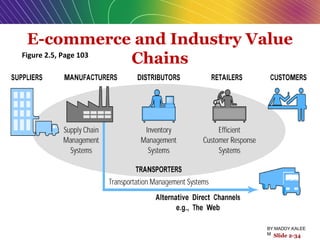
Industry Value Chains
 Set of activities performed by suppliers,
manufacturers, transporters, distributors, and
retailers that transform raw inputs into final
products and services
 Internet reduces cost of information and
other transactional costs
 Leads to greater operational efficiencies,
lowering cost, prices, adding value for
customers
Slide 2-33
BY:MADDY.KALEE
M
E-commerce and Industry Value
ChainsFigure 2.5, Page 103
Slide 2-34
BY:MADDY.KALEE
M
Firm Value Chains
 Activities that a firm engages in to create
final products from raw inputs
 Each step adds value
 Effect of Internet:
 Increases operational efficiency
 Enables product differentiation
 Enables precise coordination of steps in chain
Slide 2-35
BY:MADDY.KALEE
M
E-commerce and Firm Value
ChainsFigure 2.6, Page 104
Slide 2-36
BY:MADDY.KALEE
M
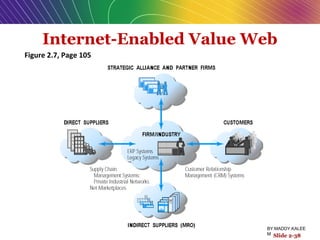
Firm Value Webs
 Networked business ecosystem
 Uses Internet technology to coordinate the
value chains of business partners
 Within an industry
 Within a group of firms
 Coordinates a firm’s suppliers with its own
production needs using an Internet-based
supply chain management system
Slide 2-37
BY:MADDY.KALEE
M
Internet-Enabled Value Web
Figure 2.7, Page 105
Slide 2-38
BY:MADDY.KALEE
M
Business Strategy
 Plan for achieving superior long-term
returns on the capital invested in a
business firm
 Four generic strategies
1. Differentiation
2. Cost
3. Scope
4. Focus
Slide 2-39
BY:MADDY.KALEE
M
Slide 2-40
All rights reserved. No part of this publication may be reproduced, stored in a
retrieval system, or transmitted, in any form or by any means, electronic,
mechanical, photocopying, recording, or otherwise, without the prior written
permission of the publisher. Printed in the United States of America.
Copyright © 2010 Pearson Education, Inc.  Copyright © 2010 Pearson Education, Inc.  
Publishing as Prentice HallPublishing as Prentice Hall
BY:MADDY.KALEE
M

E-BM, Business Models and Concepts

  • 1.
    E-BM Kenneth C. Laudon CarolGuercio Traver business. technology. society. Sixth Edition BY:MADDY.KALEE M Slide 2-1
  • 2.
    Slide 1-2 Chapter 2 E-BM,Business Models and Concepts BY:MADDY.KALEE M
  • 3.
    Tweet Tweet: What’sYour Business Model? Class Discussion  What characteristics or benchmarks can be used to assess the business value of a company such as Twitter that does have revenue?  Have you used Twitter to communicate with friends or family? What are your thoughts on this service?  What are Twitter’s most important assets?  Which of the possible methods described for monetizing Twitter’s assets do you feel might be most successful? Slide 2-3 BY:MADDY.KALEE M
  • 4.
    E-commerce Business Models Business model Set of planned activities designed to result in a profit in a marketplace  Business plan Describes a firm’s business model  E-commerce business model Uses/leverages unique qualities of Internet and Web Slide 2-4 BY:MADDY.KALEE M
  • 5.
    8 Key Elementsof a Business Model Slide 2-5 1. Value proposition 2. Revenue model 3. Market opportunity 4. Competitive environment 5. Competitive advantage 6. Market strategy 7. Organizational development 8. Management team BY:MADDY.KALEE M
  • 6.
    1. Value Proposition Why should the customer buy from you?  Successful e-commerce value propositions:  Personalization/customization  Reduction of product search, price discovery costs  Facilitation of transactions by managing product delivery Slide 2-6 BY:MADDY.KALEE M
  • 7.
    What exactly isa value proposition? “A value proposition is a promise of value to be delivered. It’s the primary reason a prospect should buy from you.” In a nutshell, value proposition is a clear statement that explains how your product solves customers’ problems or improves their situation (relevancy), delivers specific benefits (quantified value), tells the ideal customer why they should buy from you and not from the competition (unique differentiation). You have to present your value proposition as the first thing the visitors see on your home page, but should be visible in all major entry points of the site. Slide 2-7 BY:MADDY.KALEE M
  • 8.
    Boosters for yourvalue proposition  Free shipping  Fast shipping / Next day shipping  Free bonus with a purchase  Free setup / installation  No setup fee  No long-term contract, cancel any time  License for multiple computers (vs 1)  (Better than) Money-back guarantee  A discounted price (for a product)  Customizable Slide 2-8 BY:MADDY.KALEE M
  • 9.
    2. Revenue Model How will the firm earn revenue, generate profits, and produce a superior return on invested capital?  Major types:  Advertising revenue model  Subscription revenue model  Transaction fee revenue model  Sales revenue model  Affiliate revenue model Slide 2-9 BY:MADDY.KALEE M
  • 10.
    3. Market Opportunity What marketspace do you intend to serve and what is its size?  Marketspace: Area of actual or potential commercial value in which company intends to operate  Realistic market opportunity: Defined by revenue potential in each of market niches in which company hopes to compete  Market opportunity typically divided into smaller niches Slide 2-10 BY:MADDY.KALEE M
  • 11.
    4. Competitive Environment Who else occupies your intended marketspace?  Other companies selling similar products in the same marketspace  Includes both direct and indirect competitors  Influenced by:  Number and size of active competitors  Each competitor’s market share  Competitors’ profitability  Competitors’ pricing Slide 2-11 BY:MADDY.KALEE M
  • 12.
    5. Competitive Advantage What special advantages does your firm bring to the marketspace? Achieved when firm produces superior product or can bring product to market at lower price than competitors  Important concepts: Asymmetries First-mover advantage Unfair competitive advantage Leverage Slide 2-12 BY:MADDY.KALEE M
  • 13.
    6. Market Strategy How do you plan to promote your products or services to attract your target audience? Details how a company intends to enter market and attract customers Best business concepts will fail if not properly marketed to potential customers Slide 2-13 BY:MADDY.KALEE M
  • 14.
    7. Organizational Development What types of organizational structures within the firm are necessary to carry out the business plan?  Describes how firm will organize work  Typically divided into functional departments  Hiring moves from generalists to specialists as company grows Slide 2-14 BY:MADDY.KALEE M
  • 15.
    8. Management Team What kinds of experiences and background are important for the company’s leaders to have?  Employees are responsible for making the business model work  Strong management team gives instant credibility to outside investors  Strong management team may not be able to salvage a weak business model, but should be able to change the model and redefine the business as it becomes necessary Slide 2-15 BY:MADDY.KALEE M
  • 16.
     Why doyou think Webvan failed?  Why are more traditional grocery chains succeeding online today?  Why would an online customer pay the same price as in the store plus a delivery charge? What’s the benefit to the customer?  What are the important success factors for FreshDirect?  Do you think FreshDirect would work in your town? Slide 2-16 Insight on Business Online Grocers: Finding and Executing the Right Model Class Discussion BY:MADDY.KALEE M
  • 17.
    Categorizing E-commerce Business Models We categorize business models according to:  E-commerce sector (B2C, B2B, C2C)  Type of e-commerce technology; i.e., m-commerce  Similar business models appear in more than one sector  Some companies use multiple business models; e.g., eBay Slide 2-17 BY:MADDY.KALEE M
  • 18.
    B2C Business Models:Portal (Gateway)  Search plus an integrated package of content and services  Revenue models:  Advertising, subscription fees, transaction fees  Variations:  Horizontal/General  Vertical/Specialized (Vortal)  Pure Search (EXAMPLE YAHOO.COM Slide 2-18 BY:MADDY.KALEE M
  • 19.
    B2C Models: E-tailor  Online version of traditional retailer  Revenue model: Sales  Variations:  Virtual merchant (online retail store only – amazon.com )  Bricks-and-clicks (online distribution channel for a company that also has physical stores – walmart.com )  Catalog merchant online version of a mall – fashionmall.com  Manufacturer-direct (manufacturer selling directly over the Web – dell.com) Slide 2-19 BY:MADDY.KALEE M
  • 20.
    B2C Models: ContentProvider  Digital content on the Web  News, music, video  Revenue models:  Subscription; pay per download (micropayment); advertising; affiliate recommendation fees  Variations:  Content owners  Syndication  Web aggregators (Example CNN.com, sportsline.com Slide 2-20 BY:MADDY.KALEE M
  • 21.
    B2C Models: TransactionBroker  Process online transactions for consumers  Primary value proposition—saving time and money  Revenue model:  Transaction fees  Industries using this model:  Financial services  Travel services  Job placement services Slide 2-21 BY:MADDY.KALEE M
  • 22.
    B2C Models: MarketCreator  Uses Internet technology to create markets that bring buyers and sellers together  Examples: Priceline eBay Eg E-Trade.com Olx  Revenue model: Transaction fees Slide 2-22 BY:MADDY.KALEE M
  • 23.
    B2C Models: ServiceProvider  Online services  e.g., Google: Google Maps, Google Docs, and so on  Value proposition  Valuable, convenient, time-saving, low-cost alternatives to traditional service providers  Revenue models:  Sales of services, subscription fees, advertising, sales of marketing data Slide 2-23 BY:MADDY.KALEE M
  • 24.
    B2C Models: Community Provider Provides online environment (social network) where people with similar interests can transact, share content, and communicate E.g., Facebook, MySpace, LinkedIn  Revenue models: Advertising fees, subscription fees, sales revenues, transaction fees, affiliate fees Slide 2-24 BY:MADDY.KALEE M
  • 25.
    B2B Business Models Net marketplaces E-distributor E-procurement Exchange Industry consortium (grouping/association)  Private industrial network Single firm Industry-wide Slide 2-25 BY:MADDY.KALEE M
  • 26.
    B2B Models: E-distributor Supplies products and services directly to individual businesses  Owned by one company seeking to serve many customers  Revenue model: Sales of goods  Example: NeoGrid.com Slide 2-26 BY:MADDY.KALEE M
  • 27.
    B2B Models: Exchanges Electronic digital marketplace where suppliers and purchasers conduct transactions  Usually owned by independent firms whose business is making a market  Usually serve a single vertical industry  Revenue model: Transaction, commission fees  Create powerful competition between suppliers  Number has dropped dramatically Slide 2-27 BY:MADDY.KALEE M
  • 28.
    Private Industrial Networks Designed to coordinate flow of communication among firms engaged in business together  Electronic data interchange (EDI)  Single firm networks  Most common form  Example: Wal-Mart’s network for suppliers  Industry-wide networks  Often evolve out of industry associations  Example: Neogrid Slide 2-28 BY:MADDY.KALEE M
  • 29.
    Business Models inEmerging E-Business Areas  Consumer-to-consumer (C2C)  Examples: eBay, Half.com  Peer-to-peer (P2P)  Examples: The Pirate Bay, Cloudmark  M-commerce:  E-commerce models using wireless technologies  Technology platform continues to evolve  In the United States, demand still highest for digital content like ring tones Slide 2-29 BY:MADDY.KALEE M
  • 30.
    Insight on Society WhereR U? Class Discussion  Why should you care if companies track your location via cell phone?  Should business firms be allowed to call cell phones with advertising messages based on location? Slide 2-30 BY:MADDY.KALEE M
  • 31.
    E-BM Enablers: TheGold Rush Model  E-BM infrastructure companies:  Hardware, software, networking, security  E-commerce software systems, payment systems  Media solutions, performance enhancement  CRM software  Databases  Hosting services, etc. Slide 2-31 BY:MADDY.KALEE M
  • 32.
    How the Internetand the Web Change Business  E-BM changes industry structure by changing:  Basis of competition among rivals  Barriers to entry  Threat of new substitute products  Strength of suppliers  Bargaining power of buyers Slide 2-32 BY:MADDY.KALEE M
  • 33.
    Industry Value Chains Set of activities performed by suppliers, manufacturers, transporters, distributors, and retailers that transform raw inputs into final products and services  Internet reduces cost of information and other transactional costs  Leads to greater operational efficiencies, lowering cost, prices, adding value for customers Slide 2-33 BY:MADDY.KALEE M
  • 34.
    E-commerce and IndustryValue ChainsFigure 2.5, Page 103 Slide 2-34 BY:MADDY.KALEE M
  • 35.
    Firm Value Chains Activities that a firm engages in to create final products from raw inputs  Each step adds value  Effect of Internet:  Increases operational efficiency  Enables product differentiation  Enables precise coordination of steps in chain Slide 2-35 BY:MADDY.KALEE M
  • 36.
    E-commerce and FirmValue ChainsFigure 2.6, Page 104 Slide 2-36 BY:MADDY.KALEE M
  • 37.
    Firm Value Webs Networked business ecosystem  Uses Internet technology to coordinate the value chains of business partners  Within an industry  Within a group of firms  Coordinates a firm’s suppliers with its own production needs using an Internet-based supply chain management system Slide 2-37 BY:MADDY.KALEE M
  • 38.
    Internet-Enabled Value Web Figure2.7, Page 105 Slide 2-38 BY:MADDY.KALEE M
  • 39.
    Business Strategy  Planfor achieving superior long-term returns on the capital invested in a business firm  Four generic strategies 1. Differentiation 2. Cost 3. Scope 4. Focus Slide 2-39 BY:MADDY.KALEE M
  • 40.
    Slide 2-40 All rightsreserved. No part of this publication may be reproduced, stored in a retrieval system, or transmitted, in any form or by any means, electronic, mechanical, photocopying, recording, or otherwise, without the prior written permission of the publisher. Printed in the United States of America. Copyright © 2010 Pearson Education, Inc.  Copyright © 2010 Pearson Education, Inc.   Publishing as Prentice HallPublishing as Prentice Hall BY:MADDY.KALEE M

Editor's Notes

  • #10 The advertising model is often used by Media businesses which use their platforms where content is provided to the customer as an advertising space. Possible examples are newspapers and magazines which generate revenue through the various adverts encountered in their issues. The subscription business model is a business model where a customer must pay a subscription price to have access to the product/service. The model was pioneered by magazines and newspapers, but is now used by many businesses and websites.
  • #11 Niches= positions The maximum profits that each call has the potential to bring to the organization.
  • #13 In marketing strategy, first-mover advantage, or FMA, is the advantage gained by the initial ("first-moving") significant occupant of a market segment. Unfair competition in a sense means that the competitors compete on unequal terms, because favorable or disadvantageous conditions are applied to some competitors but not to others; or that the actions of some competitors actively harm the position of others with respect to their ability to compete on equal and fair .. leverage (sometimes referred to as gearing in the United Kingdom and Australia) is any technique to multiply gains and losses.
  • #21 Aggregator refers to a web site or computer software that aggregates a specific type of information from multiple online sources:  Web syndication is a form of syndication in which website material is made available to multiple other sites. Most commonly, web syndication refers to making web feeds available from a site in order to provide other people with a summary or update of the website's recently added content (for example, the latest news or forum posts).
  • #26 E-procurement (electronic procurement, sometimes also known as supplier exchange) is the business-to-business or business-to-consumer or business-to-government purchase and sale of supplies, work, and services through the Internet as well as other information and networking systems, such as electronic data interchange ..
  • #32 Gold rush model: a large-scale migration of people to a territory where gold has been found