Copyright © 2011 Pearson Education, Inc.
Publishing as Prentice Hall
Ch 3 -1
Chapter 3
The External Assessment
Strategic Management:
Concepts & Cases
13th
Edition
Fred David
Copyright © 2011 Pearson Education, Inc.
Publishing as Prentice Hall
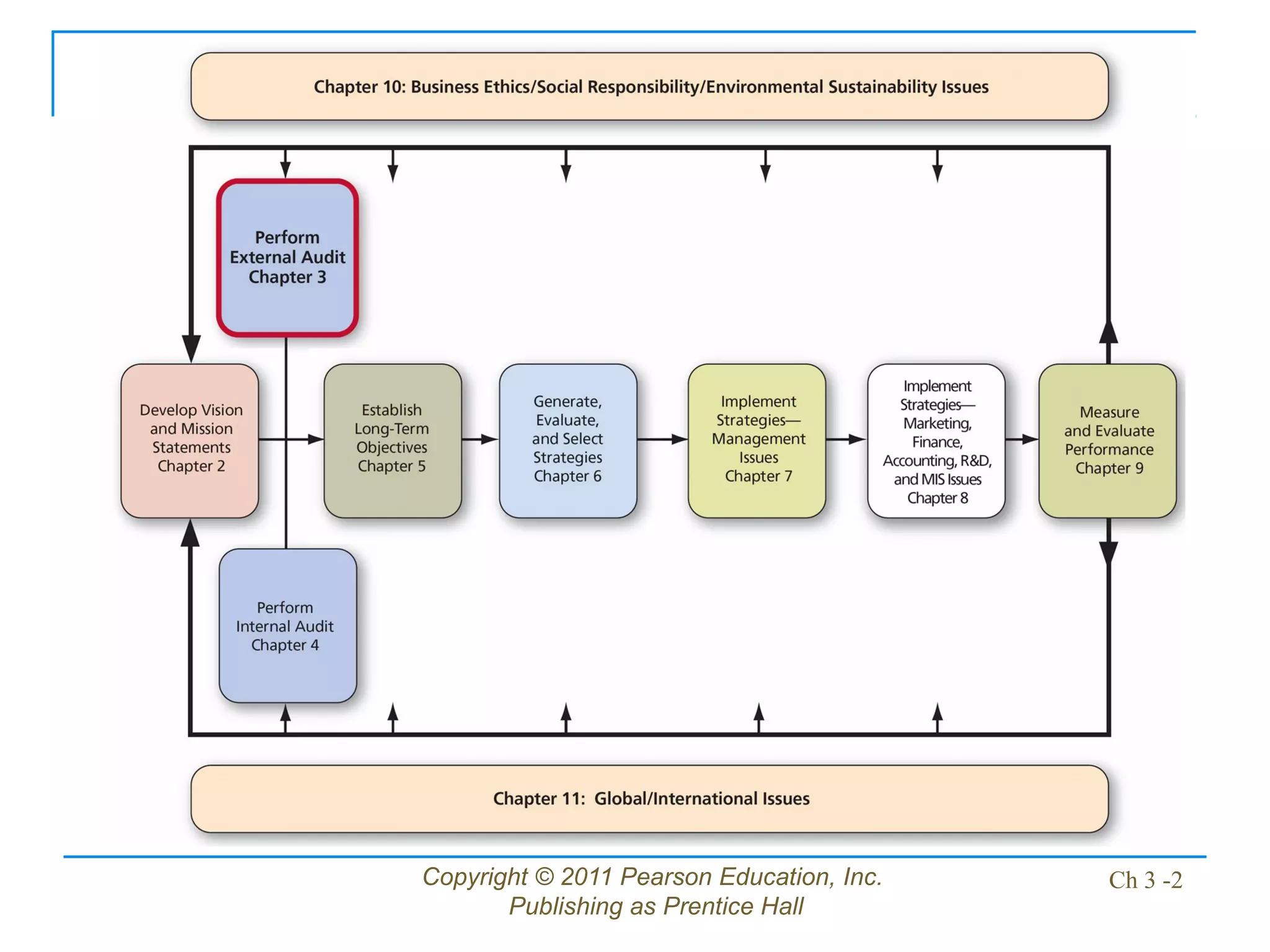
Ch 3 -2
Copyright © 2011 Pearson Education, Inc.
Publishing as Prentice Hall
Ch 3 -3
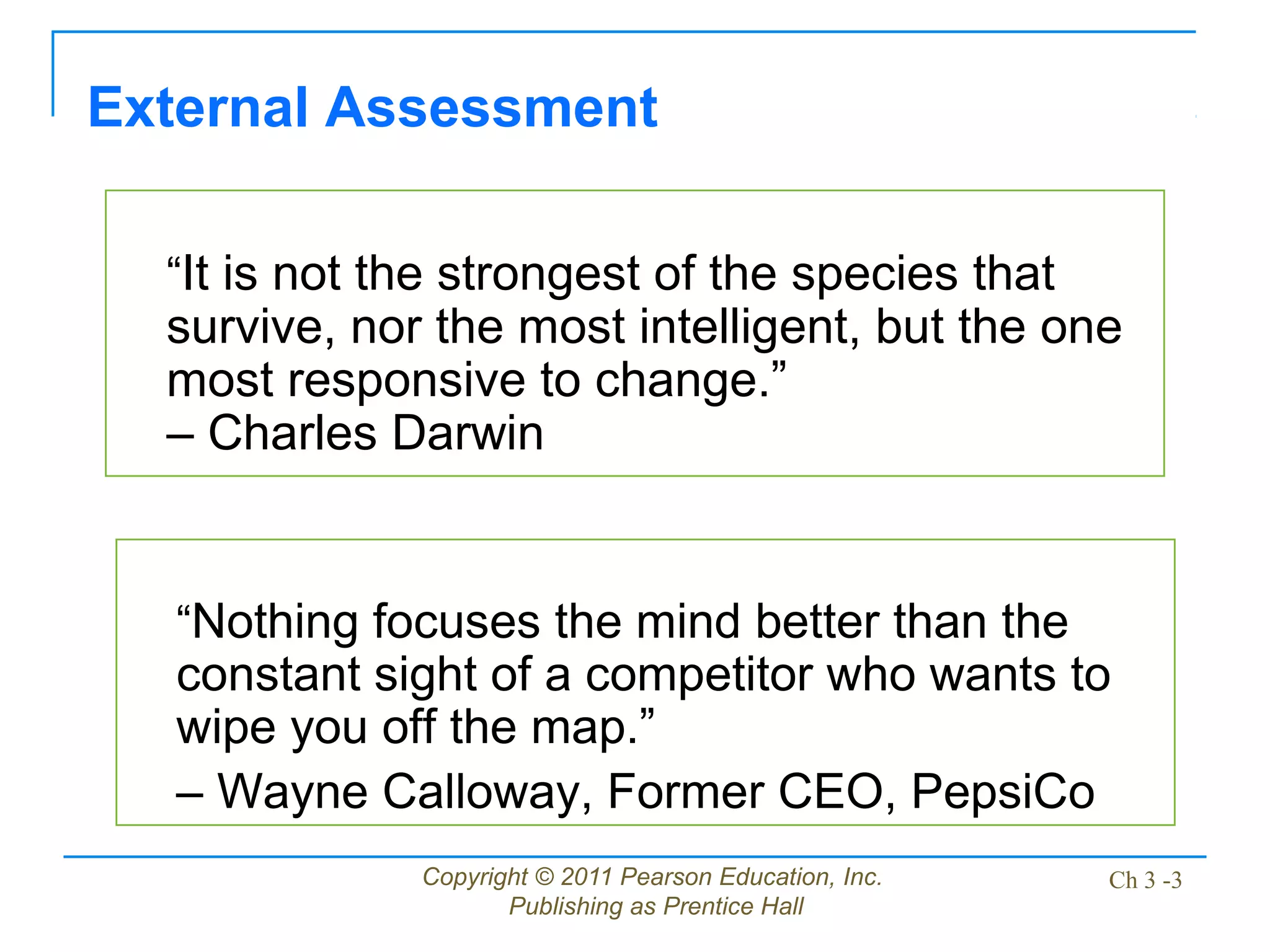
“It is not the strongest of the species that
survive, nor the most intelligent, but the one
most responsive to change.”
– Charles Darwin
External Assessment
“Nothing focuses the mind better than the
constant sight of a competitor who wants to
wipe you off the map.”
– Wayne Calloway, Former CEO, PepsiCo
Copyright © 2011 Pearson Education, Inc.
Publishing as Prentice Hall
Ch 3 -4
External Strategic
Management Audit
– Environmental Scanning
– Industry Analysis
Copyright © 2011 Pearson Education, Inc.
Publishing as Prentice Hall
Ch 3 -5
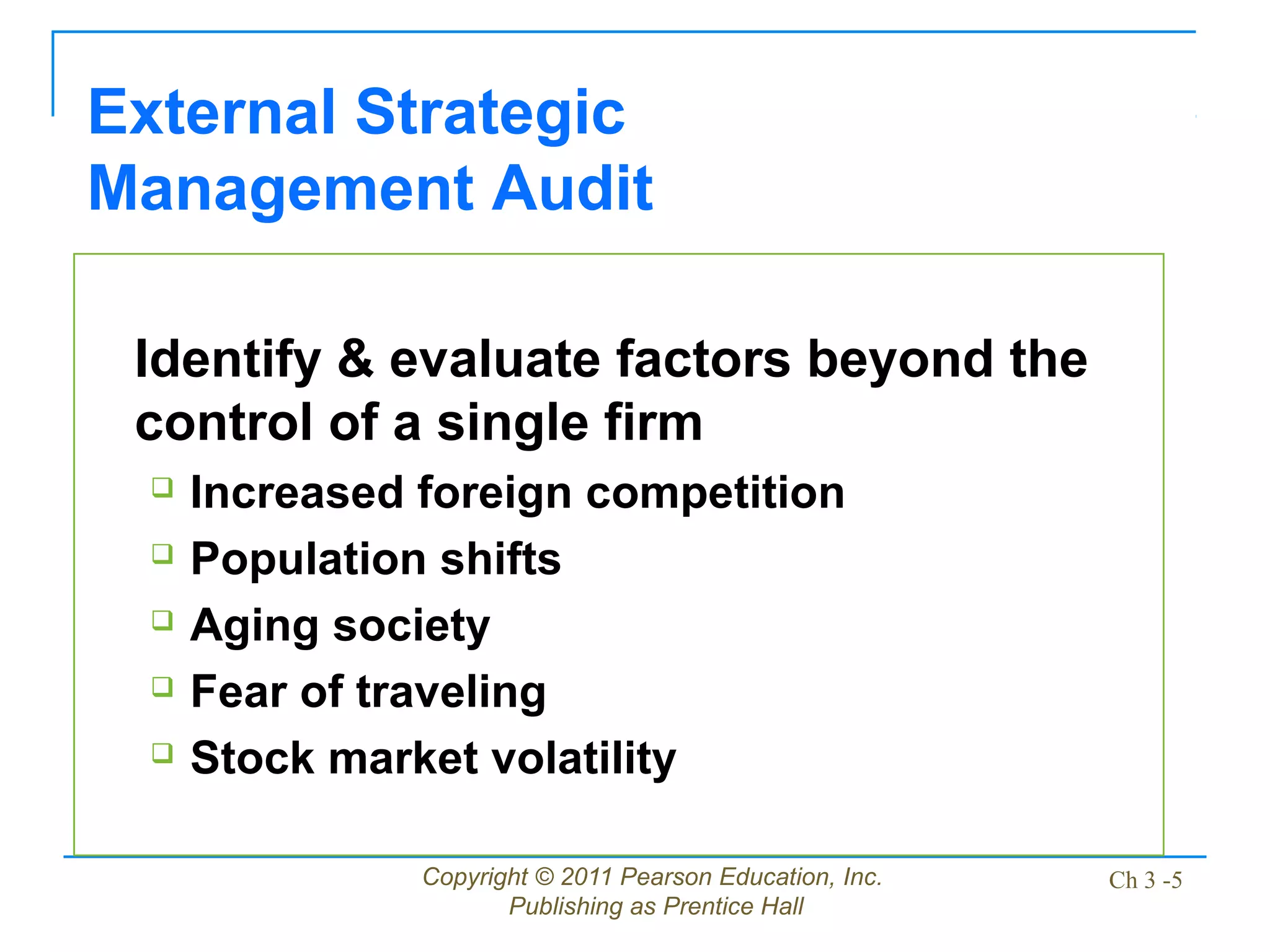
Identify & evaluate factors beyond the
control of a single firm
 Increased foreign competition
 Population shifts
 Aging society
 Fear of traveling
 Stock market volatility
External Strategic
Management Audit
Copyright © 2011 Pearson Education, Inc.
Publishing as Prentice Hall
Ch 3 -6
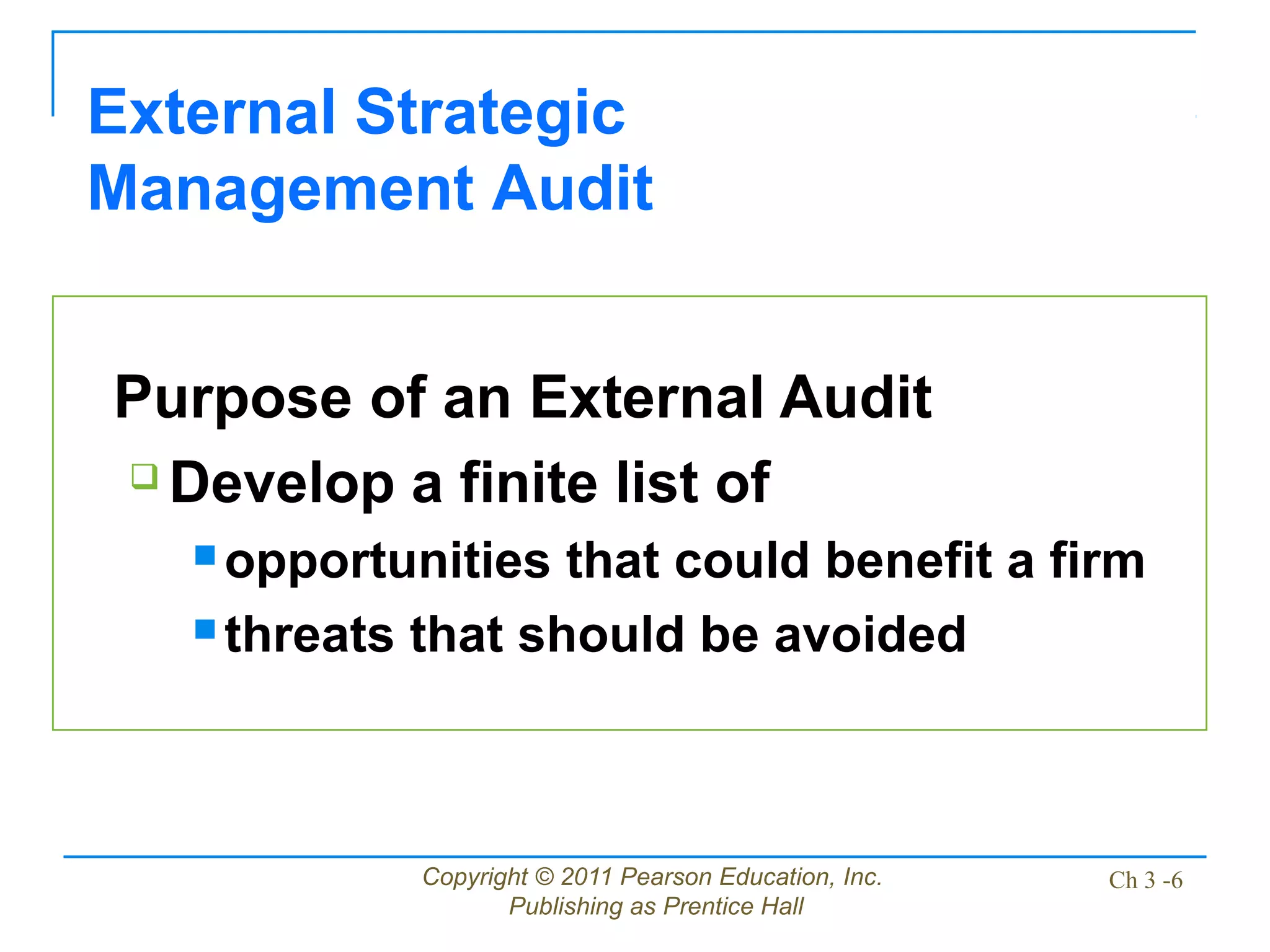
Purpose of an External Audit
 Develop a finite list of
 opportunities that could benefit a firm
 threats that should be avoided
External Strategic
Management Audit
Copyright © 2011 Pearson Education, Inc.
Publishing as Prentice Hall
Ch 3 -7
Copyright © 2011 Pearson Education, Inc.
Publishing as Prentice Hall
Ch 3 -8
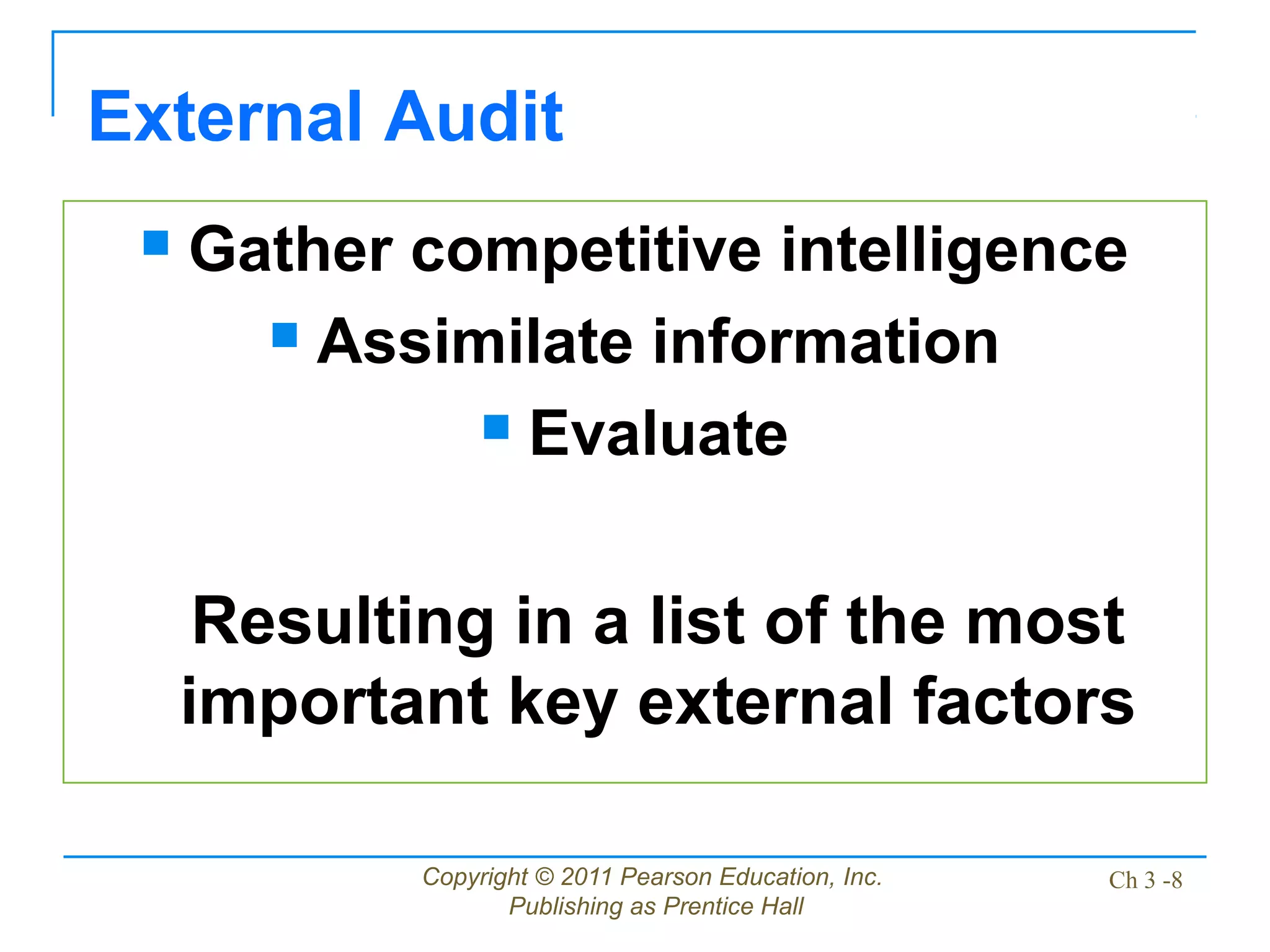
 Gather competitive intelligence
 Assimilate information
 Evaluate
Resulting in a list of the most
important key external factors
External Audit
Copyright © 2011 Pearson Education, Inc.
Publishing as Prentice Hall
Ch 3 -9
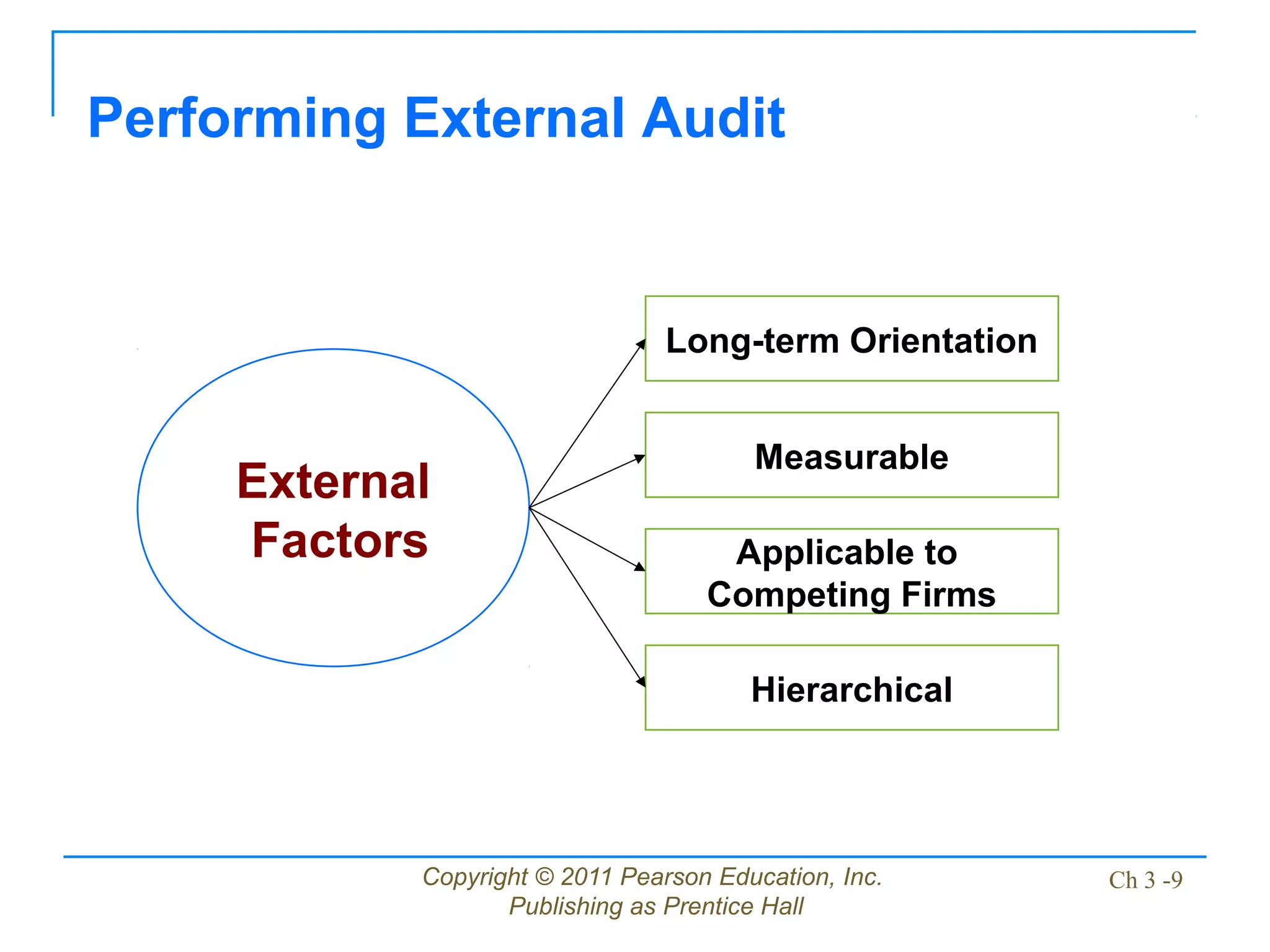
Performing External Audit
External
Factors
Measurable
Long-term Orientation
Applicable to
Competing Firms
Hierarchical
Copyright © 2011 Pearson Education, Inc.
Publishing as Prentice Hall
Ch 3 -10
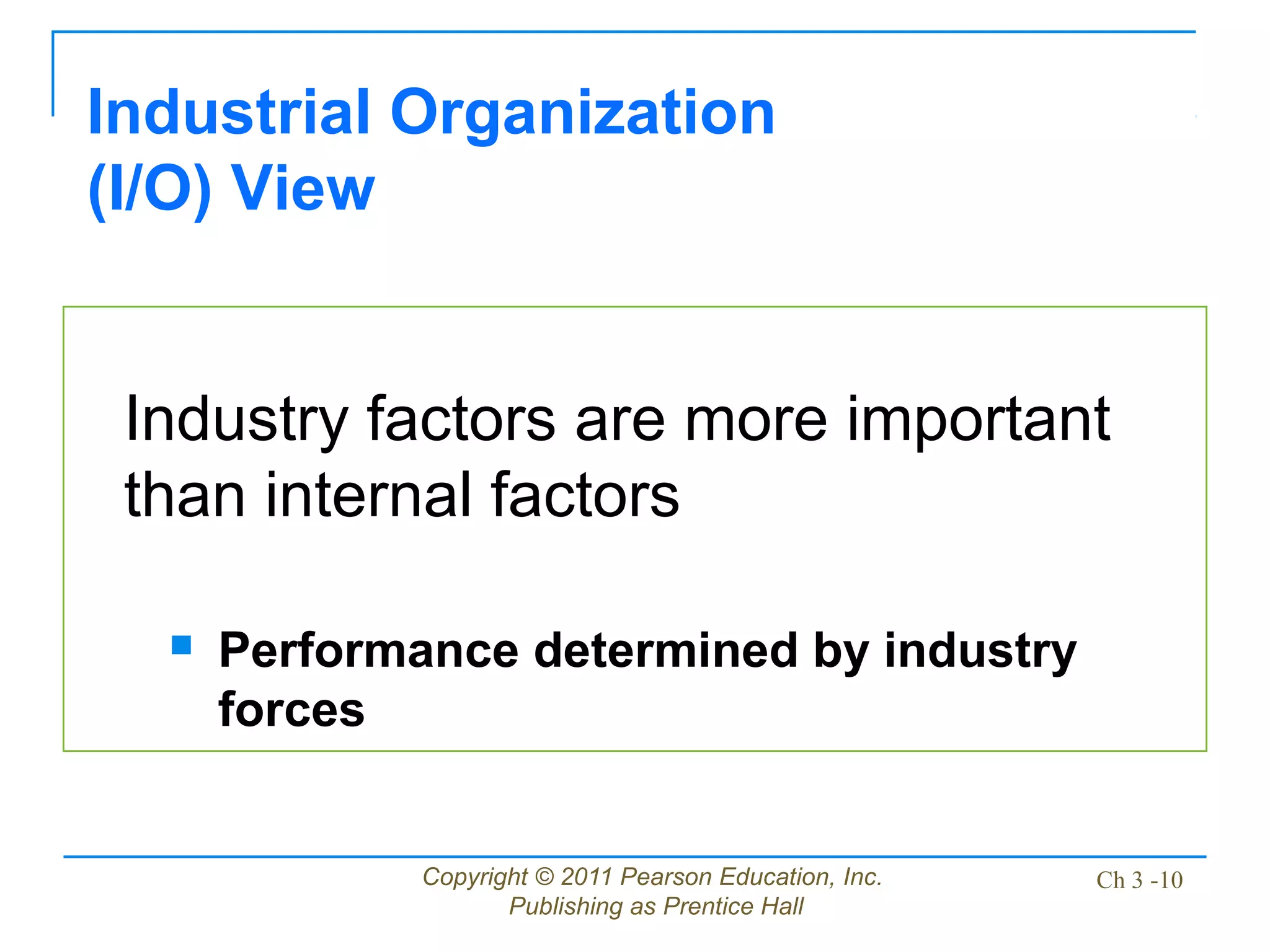
Industrial Organization
(I/O) View
Industry factors are more important
than internal factors
 Performance determined by industry
forces
Copyright © 2011 Pearson Education, Inc.
Publishing as Prentice Hall
Ch 3 -11
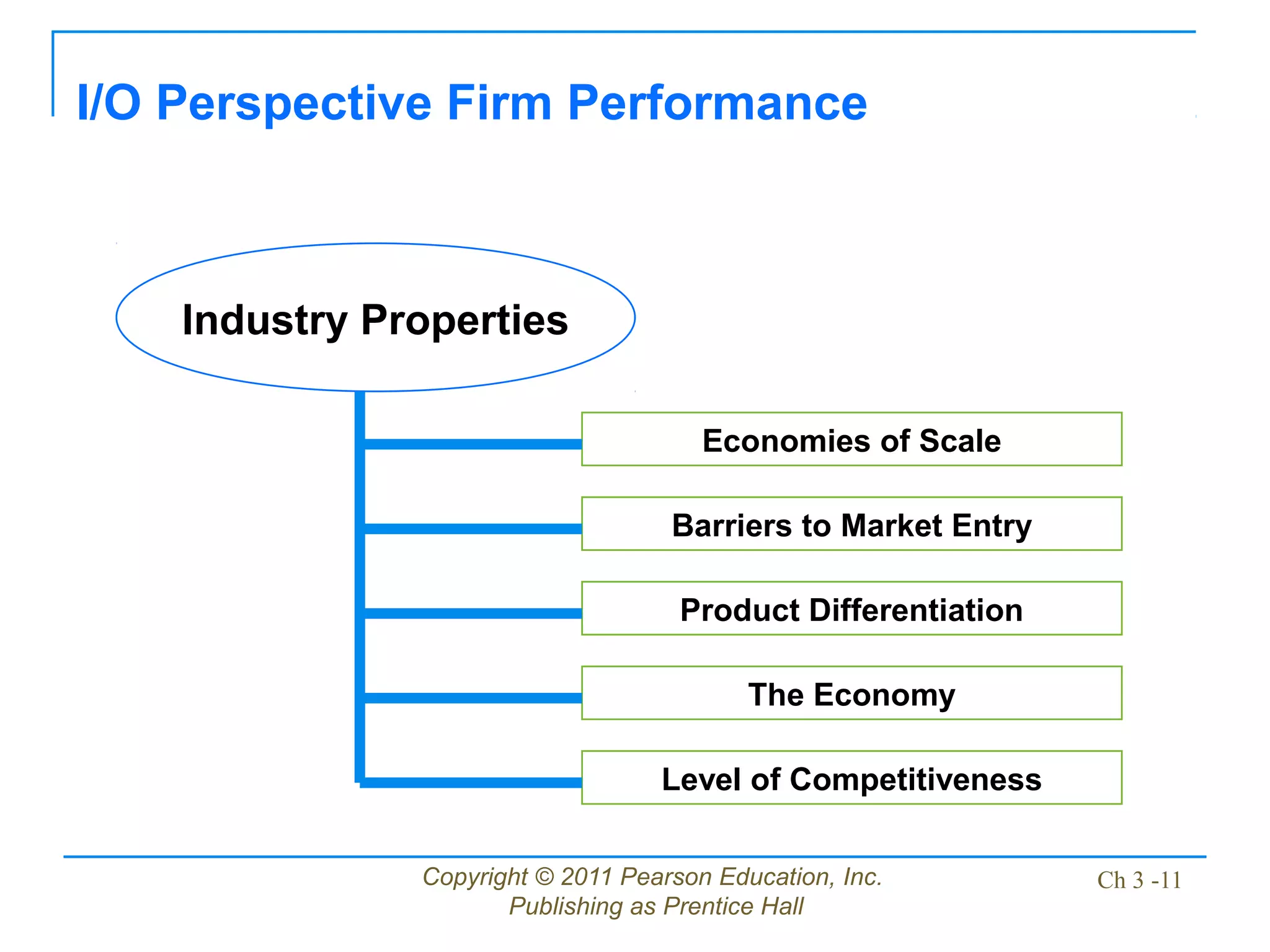
Economies of Scale
Industry Properties
Barriers to Market Entry
Product Differentiation
The Economy
I/O Perspective Firm Performance
Level of Competitiveness
Copyright © 2011 Pearson Education, Inc.
Publishing as Prentice Hall
Ch 3 -12
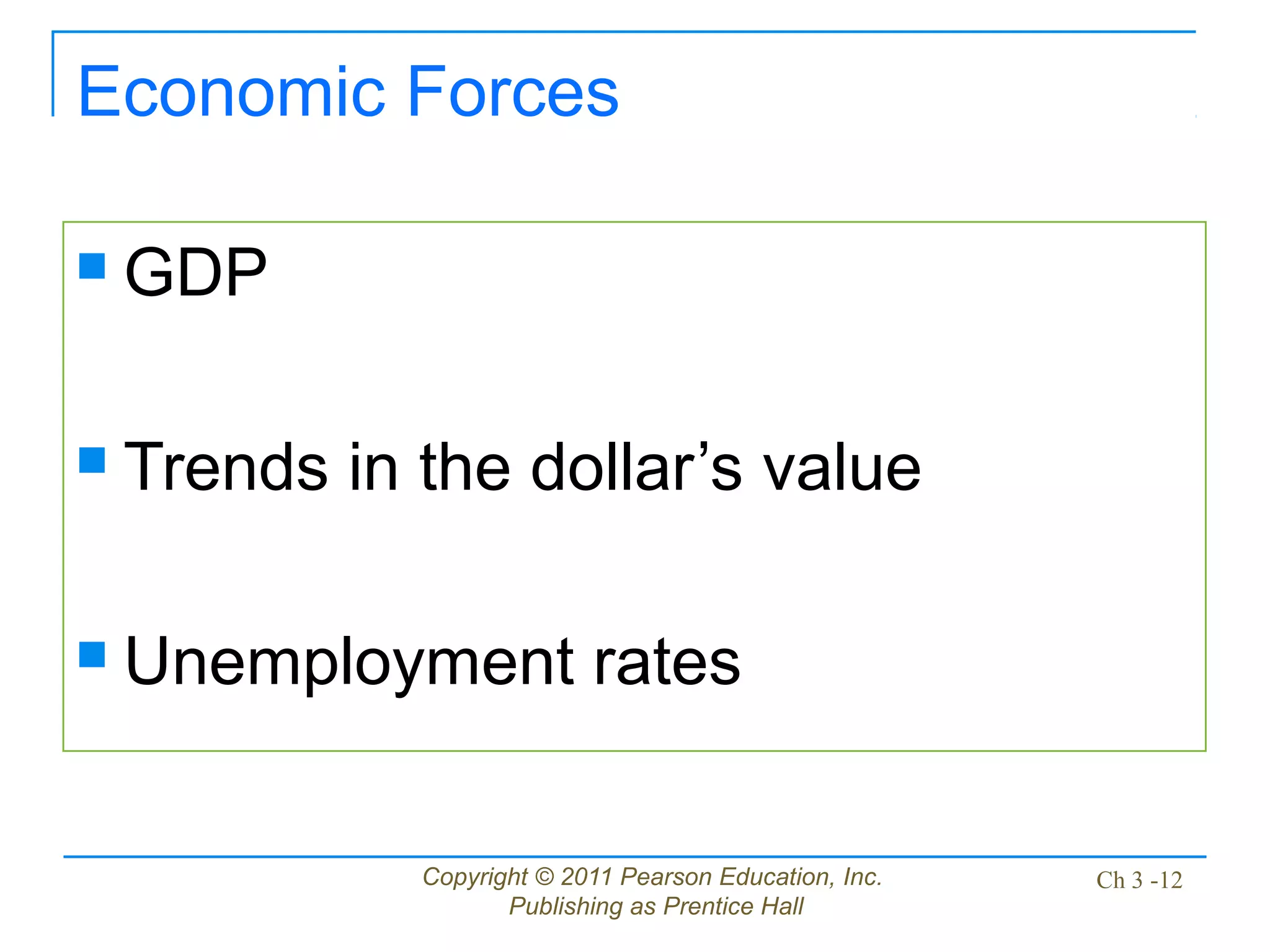
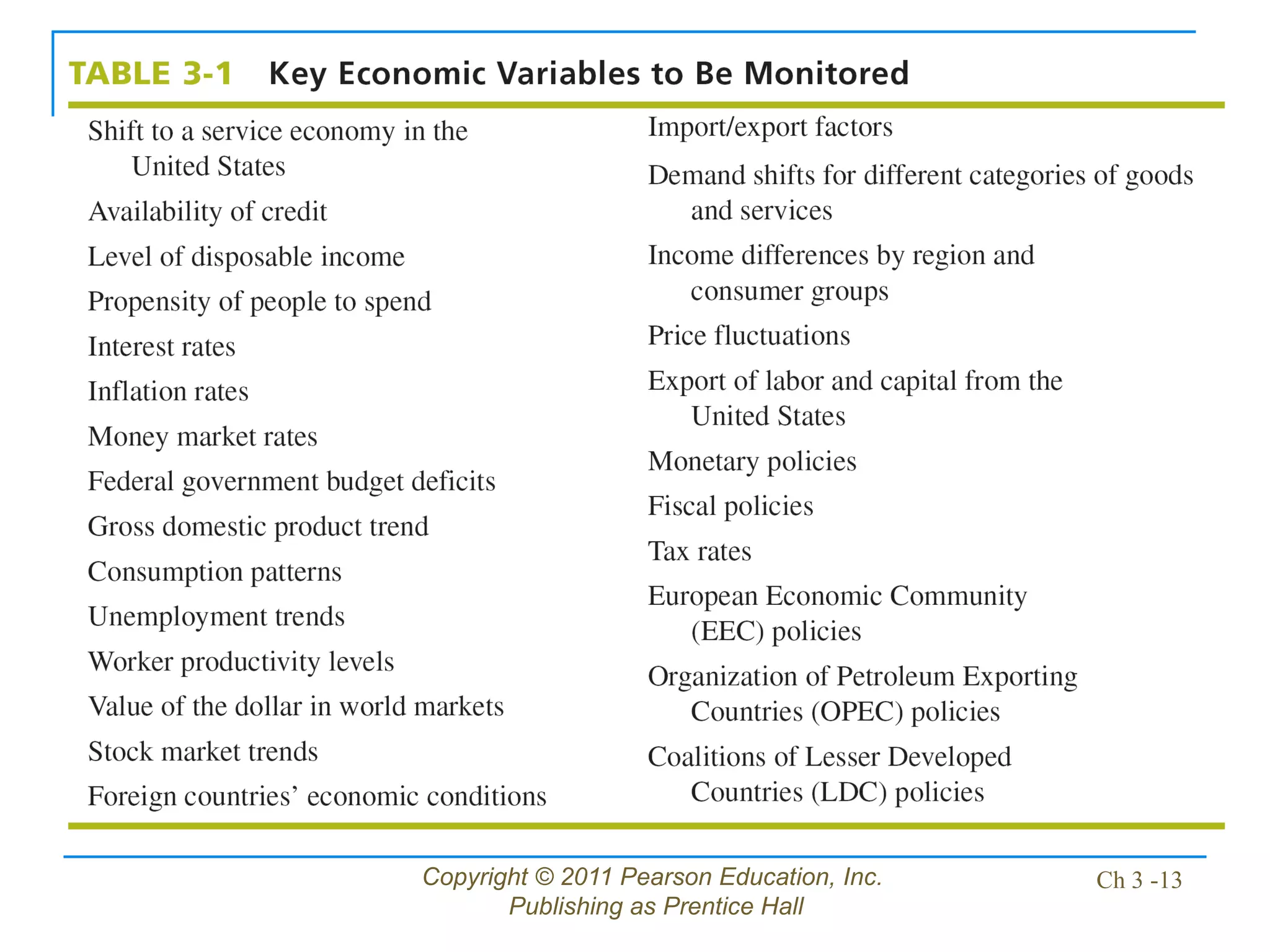
Economic Forces
 GDP
 Trends in the dollar’s value
 Unemployment rates
Copyright © 2011 Pearson Education, Inc.
Publishing as Prentice Hall
Ch 3 -13
Copyright © 2011 Pearson Education, Inc.
Publishing as Prentice Hall
Ch 3 -14
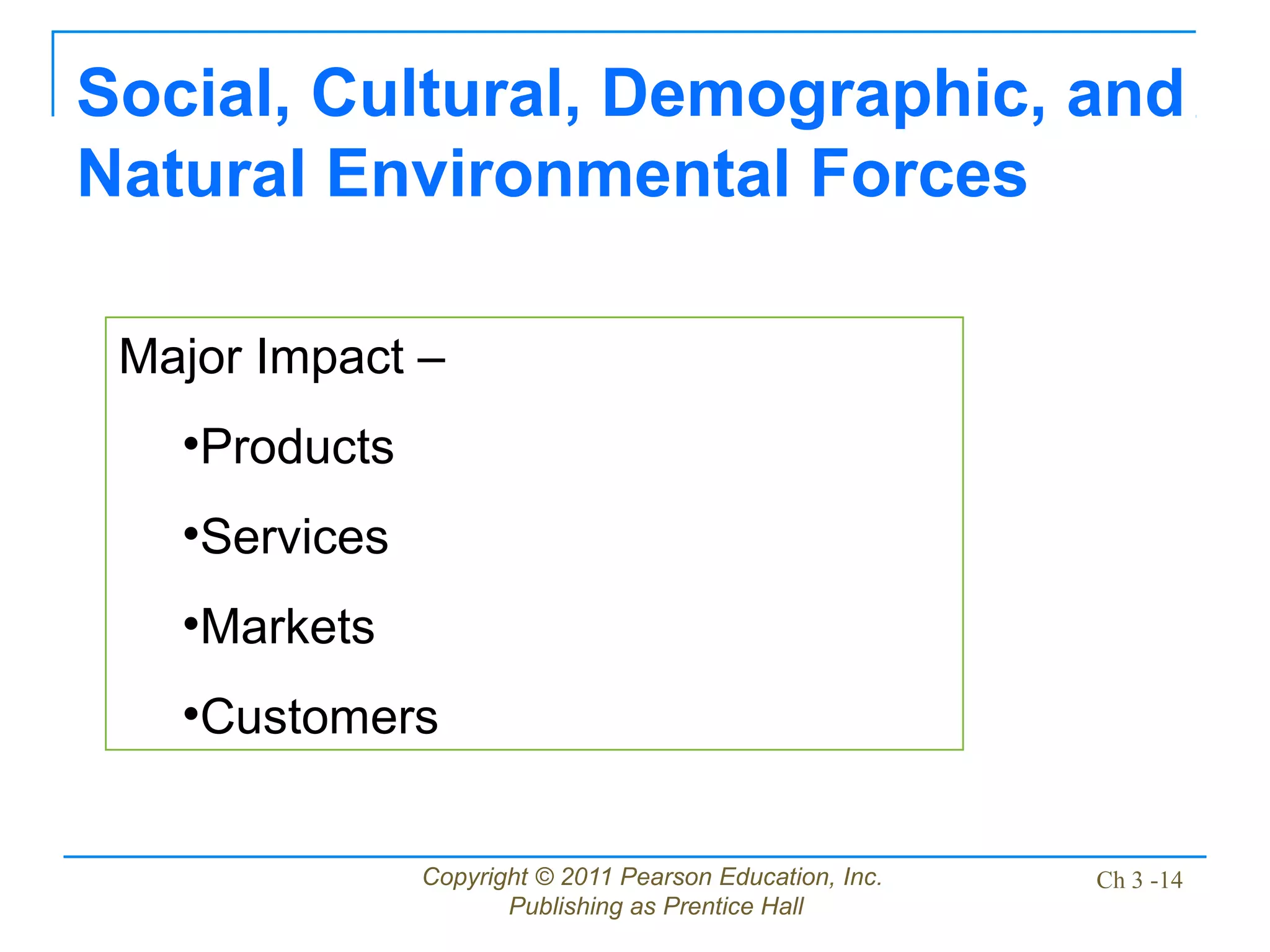
Social, Cultural, Demographic, and
Natural Environmental Forces
Major Impact –
•Products
•Services
•Markets
•Customers
Copyright © 2011 Pearson Education, Inc.
Publishing as Prentice Hall
Ch 3 -15
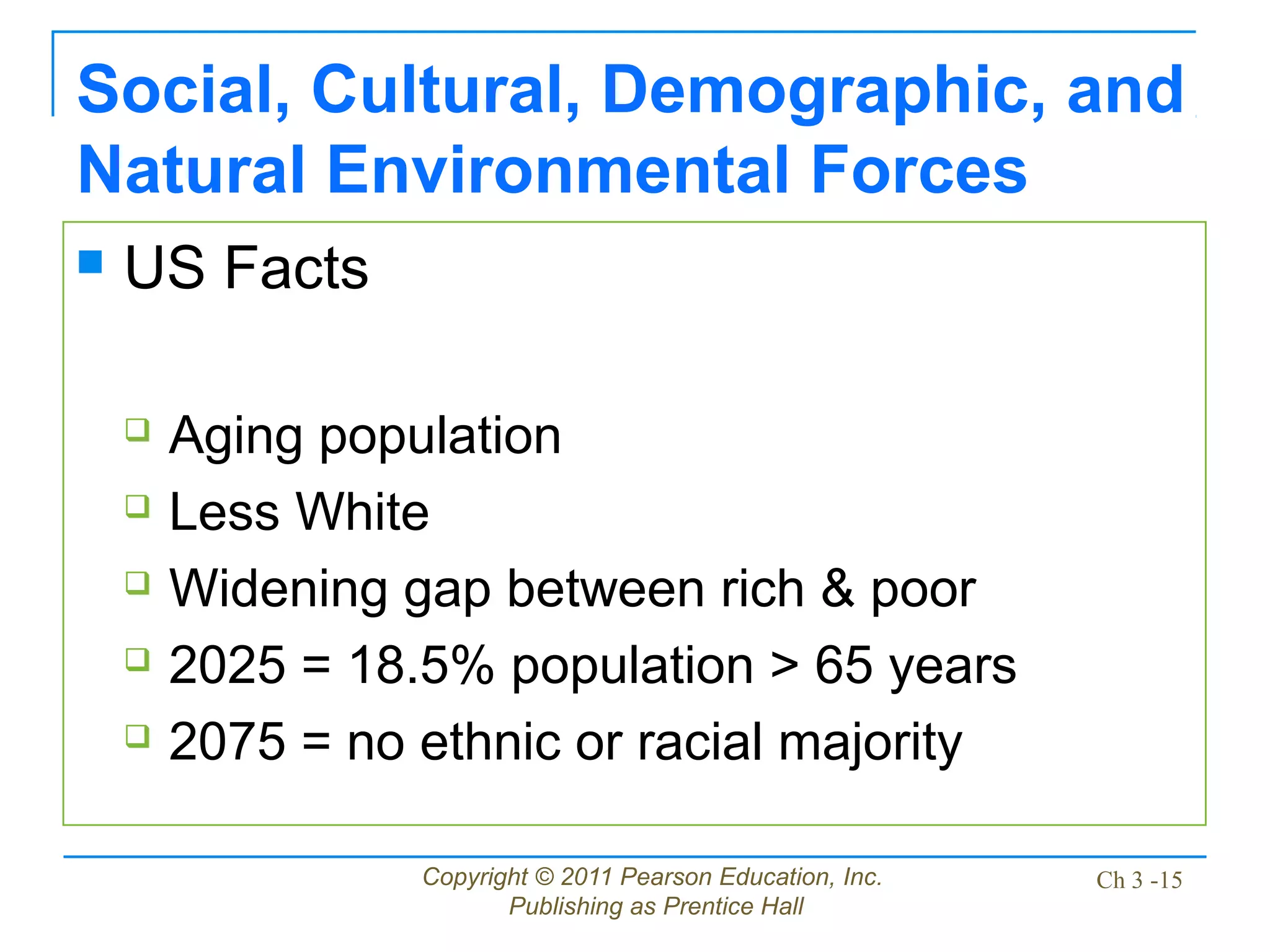
Social, Cultural, Demographic, and
Natural Environmental Forces
 US Facts
 Aging population
 Less White
 Widening gap between rich & poor
 2025 = 18.5% population > 65 years
 2075 = no ethnic or racial majority
Copyright © 2011 Pearson Education, Inc.
Publishing as Prentice Hall
Ch 3 -16
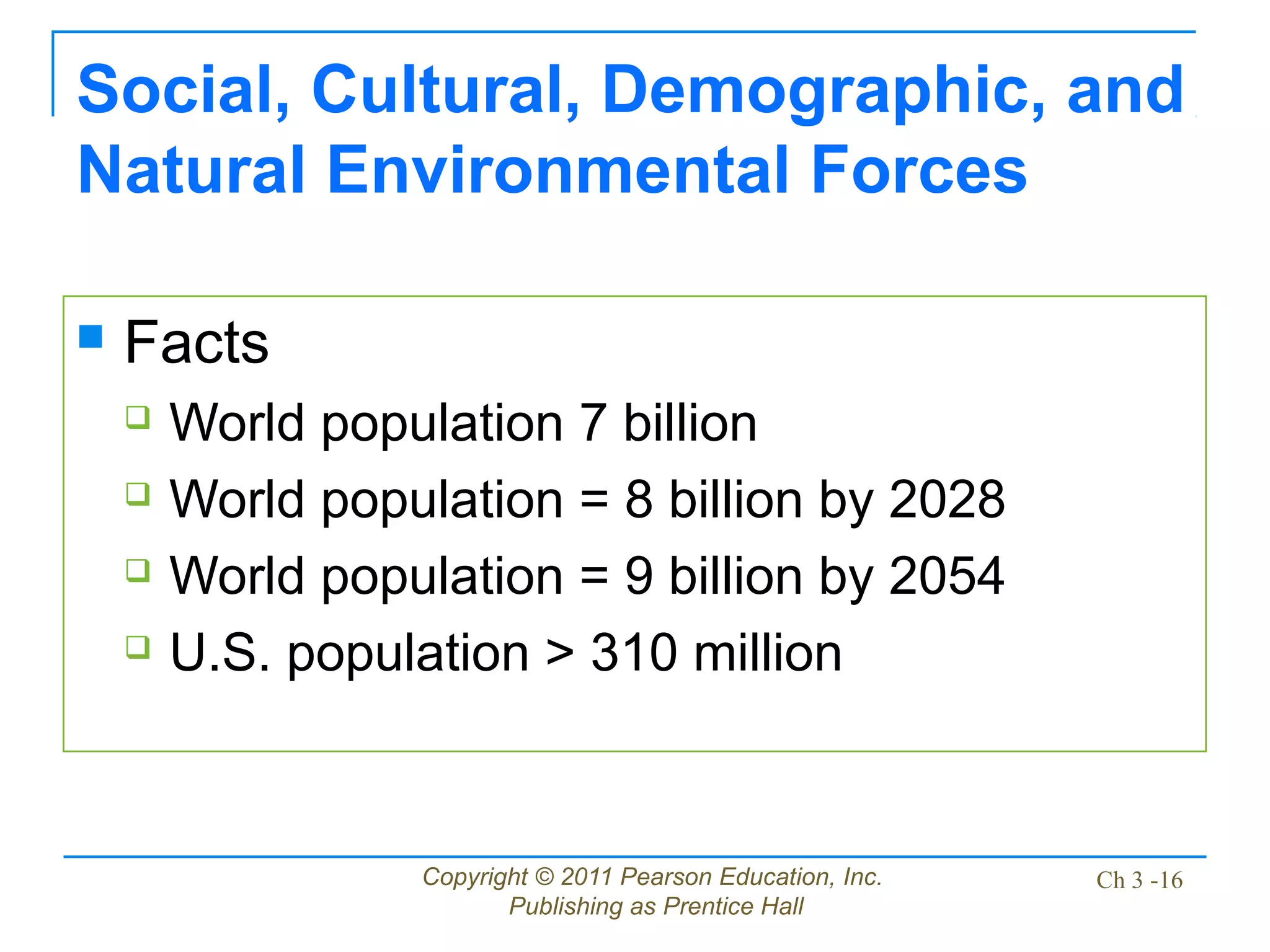
Social, Cultural, Demographic, and
Natural Environmental Forces
 Facts
 World population 7 billion
 World population = 8 billion by 2028
 World population = 9 billion by 2054
 U.S. population > 310 million
Copyright © 2011 Pearson Education, Inc.
Publishing as Prentice Hall
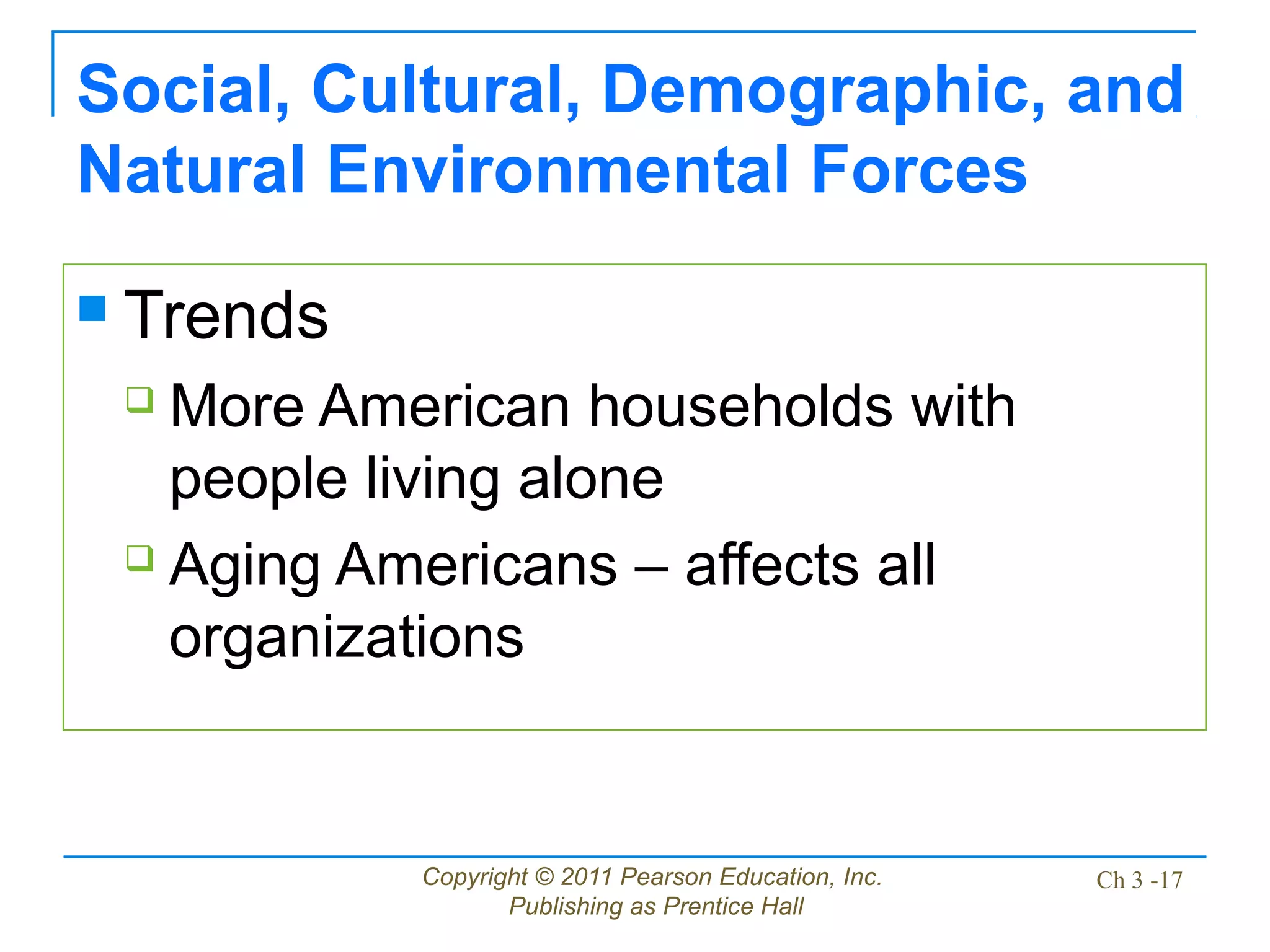
Ch 3 -17
 Trends
 More American households with
people living alone
 Aging Americans – affects all
organizations
Social, Cultural, Demographic, and
Natural Environmental Forces
Copyright © 2011 Pearson Education, Inc.
Publishing as Prentice Hall
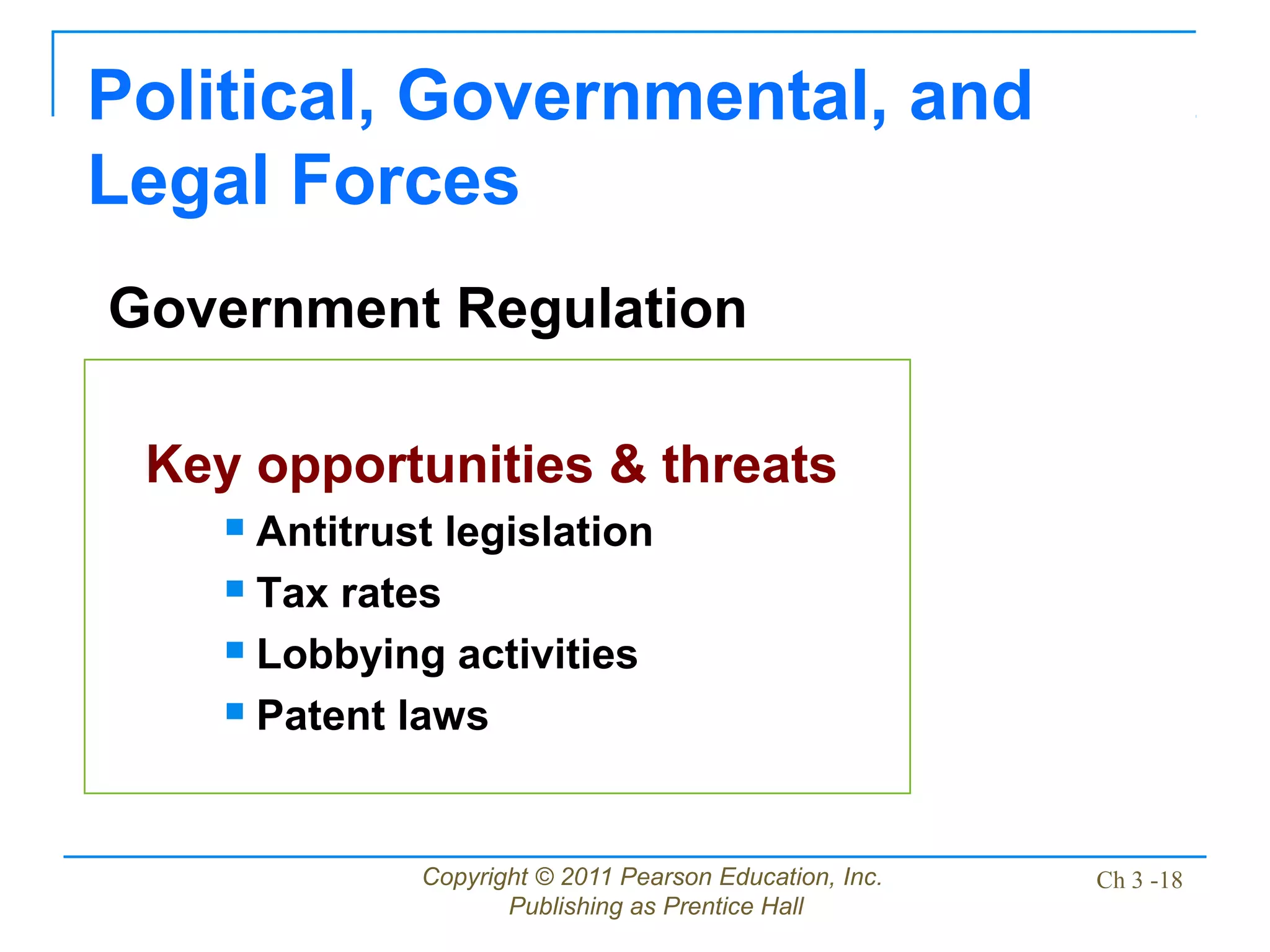
Ch 3 -18
Political, Governmental, and
Legal Forces
Key opportunities & threats
 Antitrust legislation
 Tax rates
 Lobbying activities
 Patent laws
Government Regulation
Copyright © 2011 Pearson Education, Inc.
Publishing as Prentice Hall
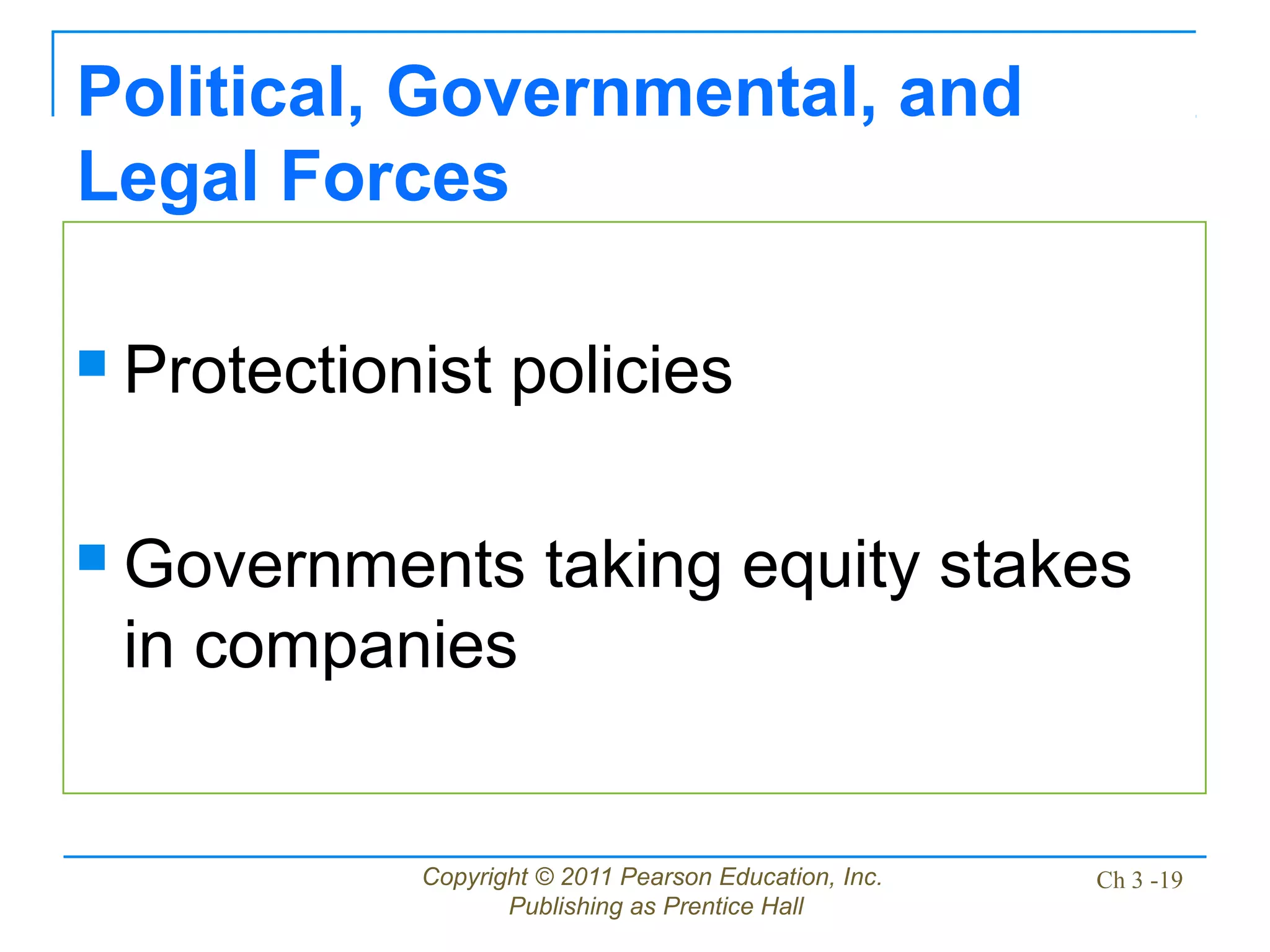
Ch 3 -19
Political, Governmental, and
Legal Forces
 Protectionist policies
 Governments taking equity stakes
in companies
Copyright © 2011 Pearson Education, Inc.
Publishing as Prentice Hall
Ch 3 -20
Technological Forces
Major Impact –
•Internet
Copyright © 2011 Pearson Education, Inc.
Publishing as Prentice Hall
Ch 3 -21
Technological Forces
Significance of IT
•Chief Information Officer (CIO)
•Chief Technology Officer (CTO)
Copyright © 2011 Pearson Education, Inc.
Publishing as Prentice Hall
Ch 3 -22
Technological Forces
Essential for nearly every
strategic decision
Copyright © 2011 Pearson Education, Inc.
Publishing as Prentice Hall
Ch 3 -23
Competitive Forces
Collection & evaluation of data on
competitors is essential for successful
strategy formulation
Copyright © 2011 Pearson Education, Inc.
Publishing as Prentice Hall
Ch 3 -24
Competitive Forces
•Strengths
•Weaknesses
•Capabilities
•Opportunities
•Threats
•Objectives
•Strategies
Identify Rival Firms’
Copyright © 2011 Pearson Education, Inc.
Publishing as Prentice Hall
Ch 3 -25
Competitive Forces
Competition in virtually all
industries can be described as
intense
Copyright © 2011 Pearson Education, Inc.
Publishing as Prentice Hall
Ch 3 -26
Key Questions Concerning
Competitors
 Their strengths
 Their weaknesses
 Their objectives and strategies
 Their responses to external variables
 Their vulnerability to our alternative
strategies
 Our vulnerability to strategic counterattack
Copyright © 2011 Pearson Education, Inc.
Publishing as Prentice Hall
Ch 3 -27
Key Questions Concerning
Competitors
 Our product/service positioning
 Entry and exit of firms in the industry
 Key factors for our current position in industry
 Sales/profit ranking of competitors over time
 Nature of supplier and distributor
relationships
 The threat of substitute products/services
Copyright © 2011 Pearson Education, Inc.
Publishing as Prentice Hall
Ch 3 -28
Competitive Forces
 7 characteristics of most competitive firms
 Market share matters
 Understanding what business you are in
 Broke or not, fix it
 Innovate or evaporate
 Acquisition is essential to growth
 People make a difference
 No substitute for quality
Copyright © 2011 Pearson Education, Inc.
Publishing as Prentice Hall
Ch 3 -29
Competitive Intelligence
 A systematic and ethical process for
gathering and analyzing information
about the competition’s activities and
general business trends to further a
business’s own goals
Copyright © 2011 Pearson Education, Inc.
Publishing as Prentice Hall
Ch 3 -30
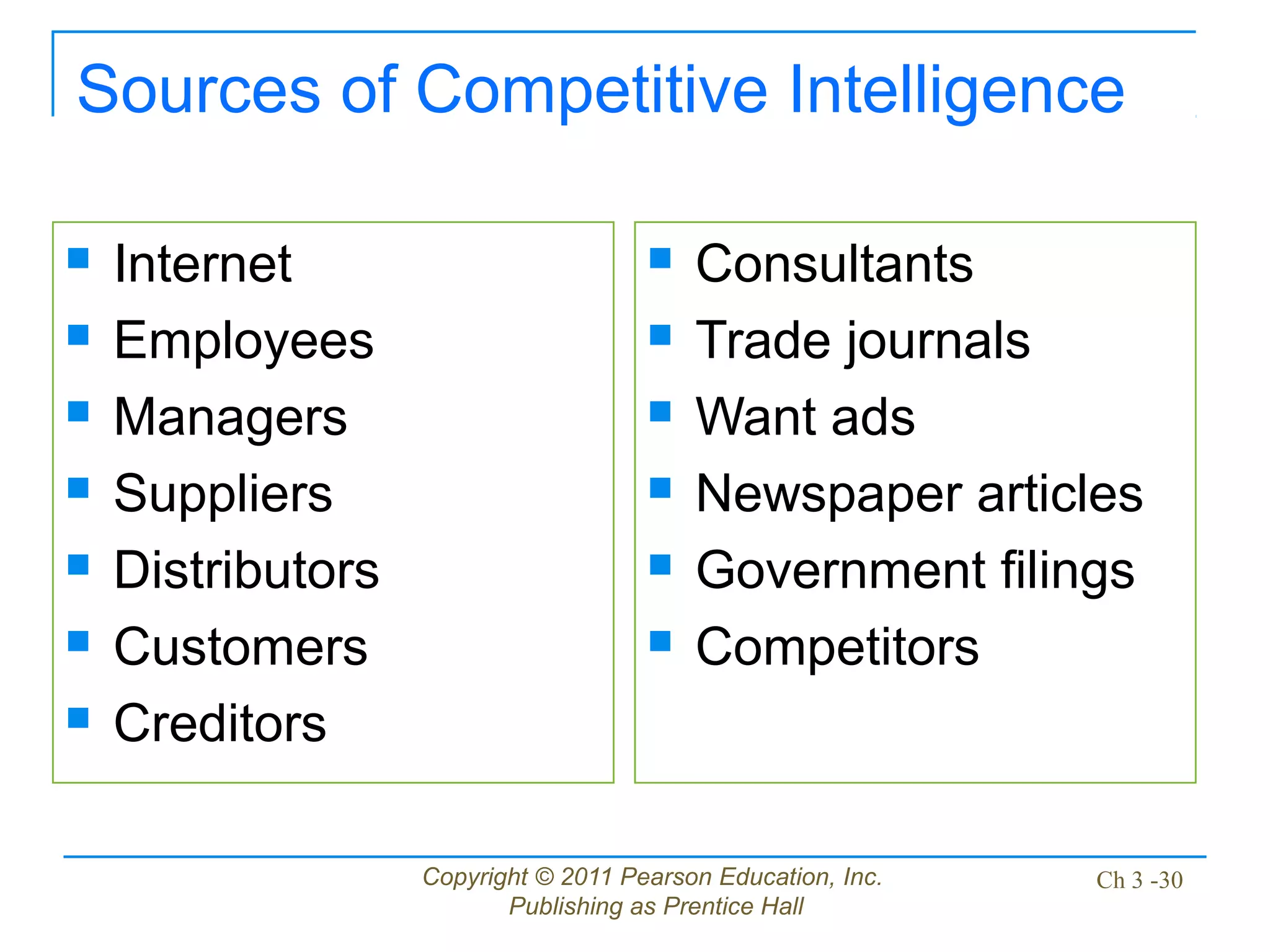
Sources of Competitive Intelligence
 Internet
 Employees
 Managers
 Suppliers
 Distributors
 Customers
 Creditors
 Consultants
 Trade journals
 Want ads
 Newspaper articles
 Government filings
 Competitors
Copyright © 2011 Pearson Education, Inc.
Publishing as Prentice Hall
Ch 3 -31
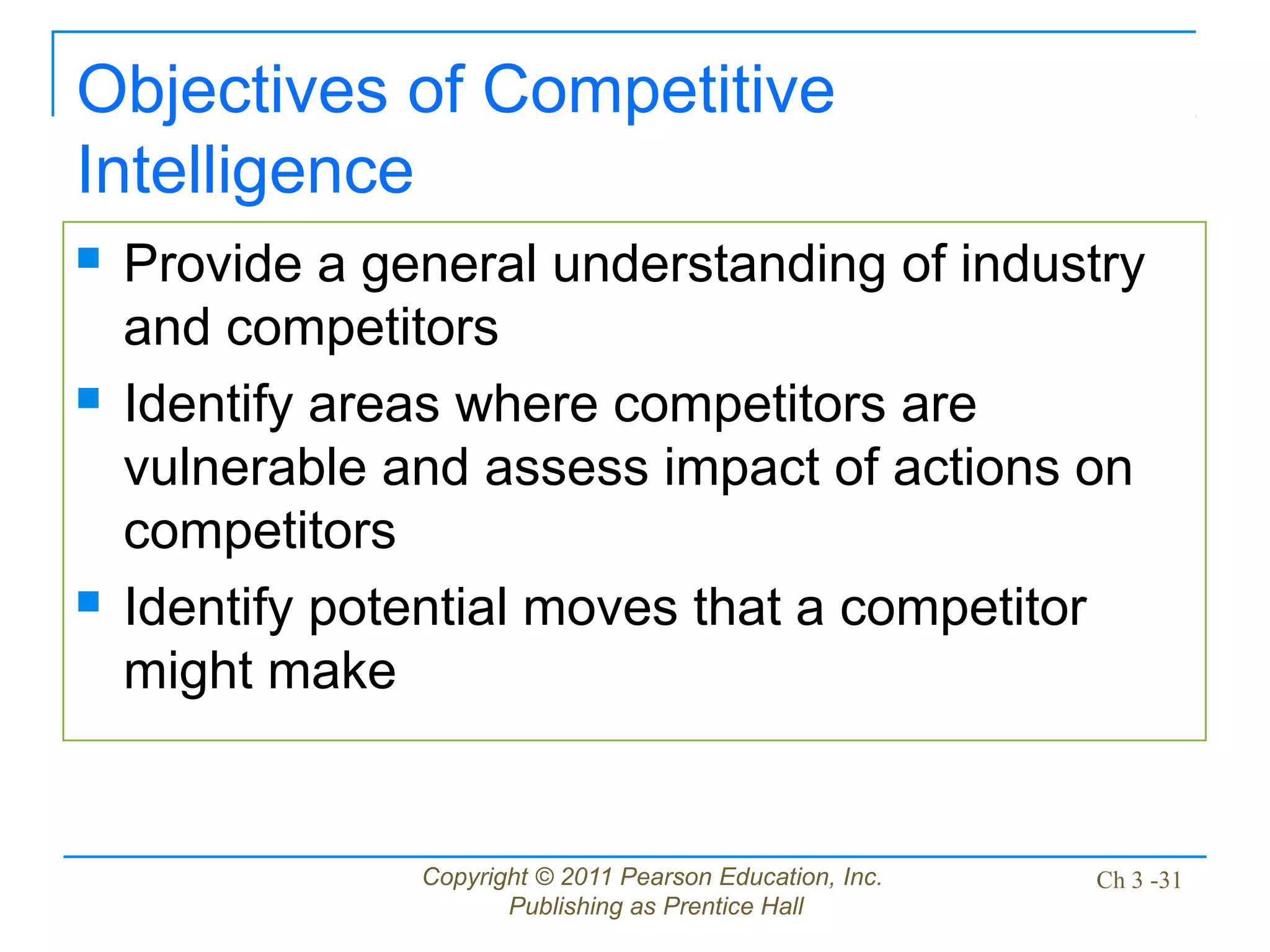
Objectives of Competitive
Intelligence
 Provide a general understanding of industry
and competitors
 Identify areas where competitors are
vulnerable and assess impact of actions on
competitors
 Identify potential moves that a competitor
might make
Copyright © 2011 Pearson Education, Inc.
Publishing as Prentice Hall
Ch 3 -32
Market Commonality
 The number and significance of
markets that a firm competes in
with rivals
Copyright © 2011 Pearson Education, Inc.
Publishing as Prentice Hall
Ch 3 -33
Resource Similarity
 Extent to which the type and
amount of a firm’s internal
resources are comparable to a
rival
Copyright © 2011 Pearson Education, Inc.
Publishing as Prentice Hall
Ch 3 -34
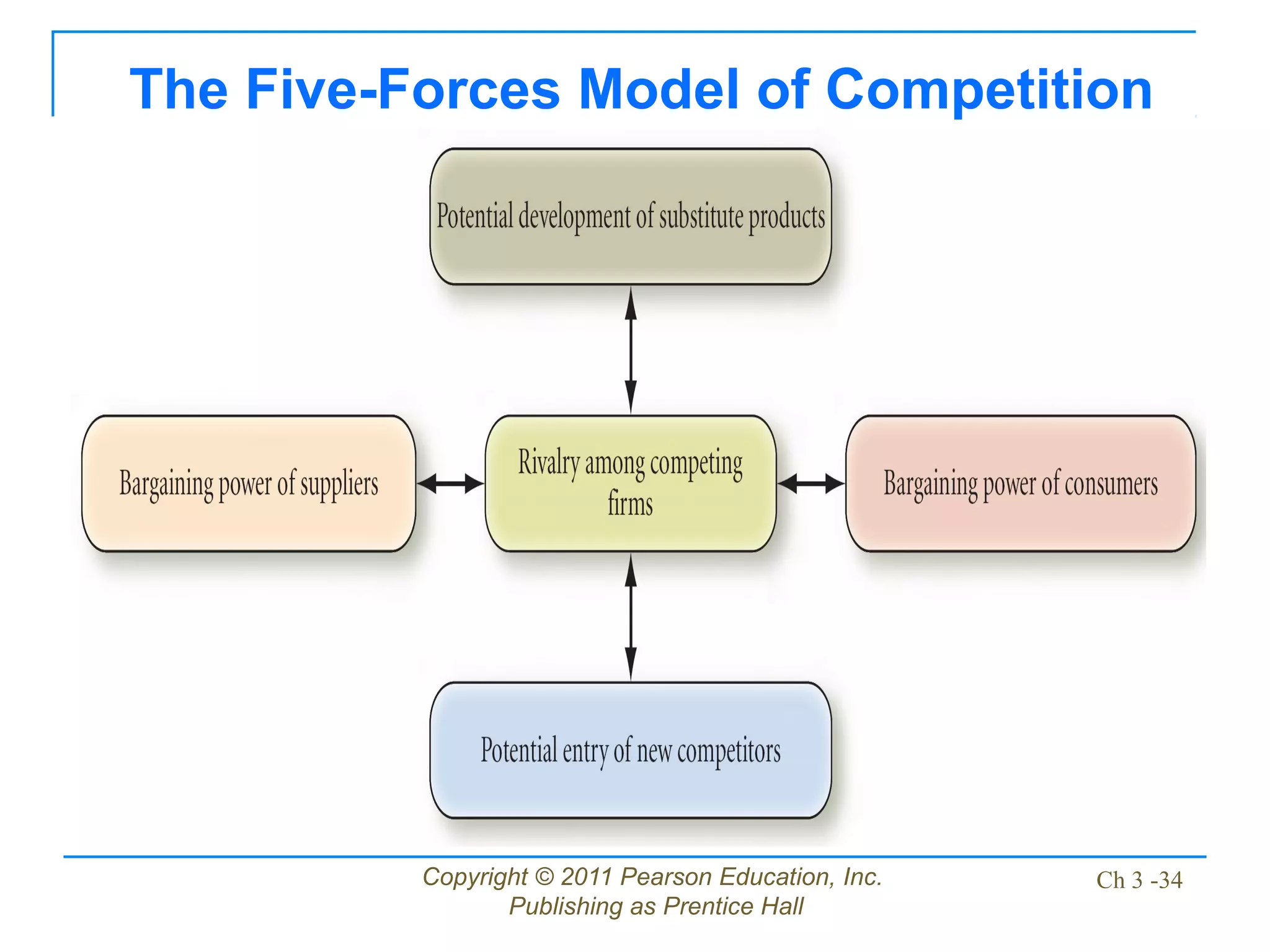
The Five-Forces Model of Competition
Copyright © 2011 Pearson Education, Inc.
Publishing as Prentice Hall
Ch 3 -35
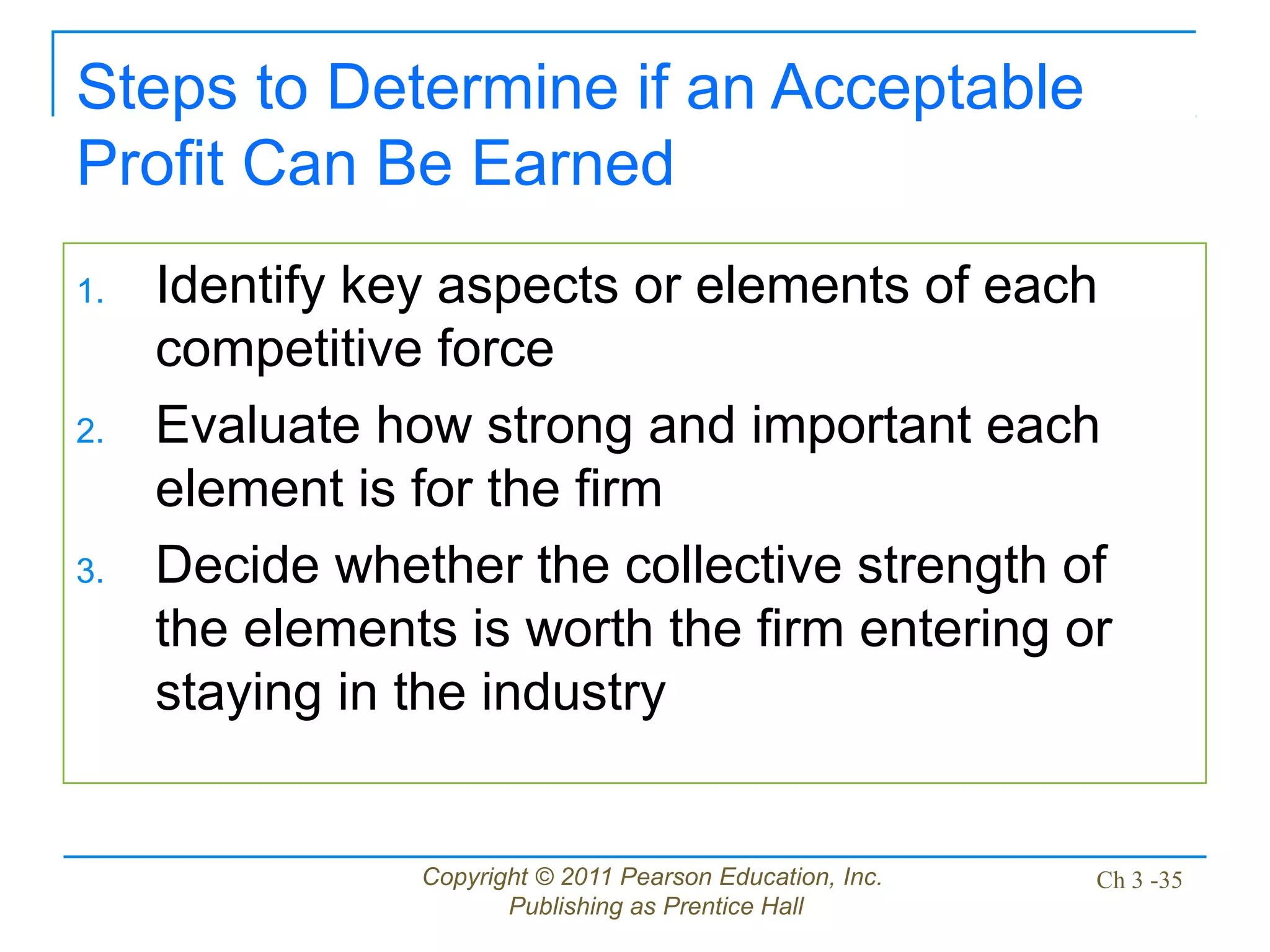
Steps to Determine if an Acceptable
Profit Can Be Earned
1. Identify key aspects or elements of each
competitive force
2. Evaluate how strong and important each
element is for the firm
3. Decide whether the collective strength of
the elements is worth the firm entering or
staying in the industry
Copyright © 2011 Pearson Education, Inc.
Publishing as Prentice Hall
Ch 3 -36
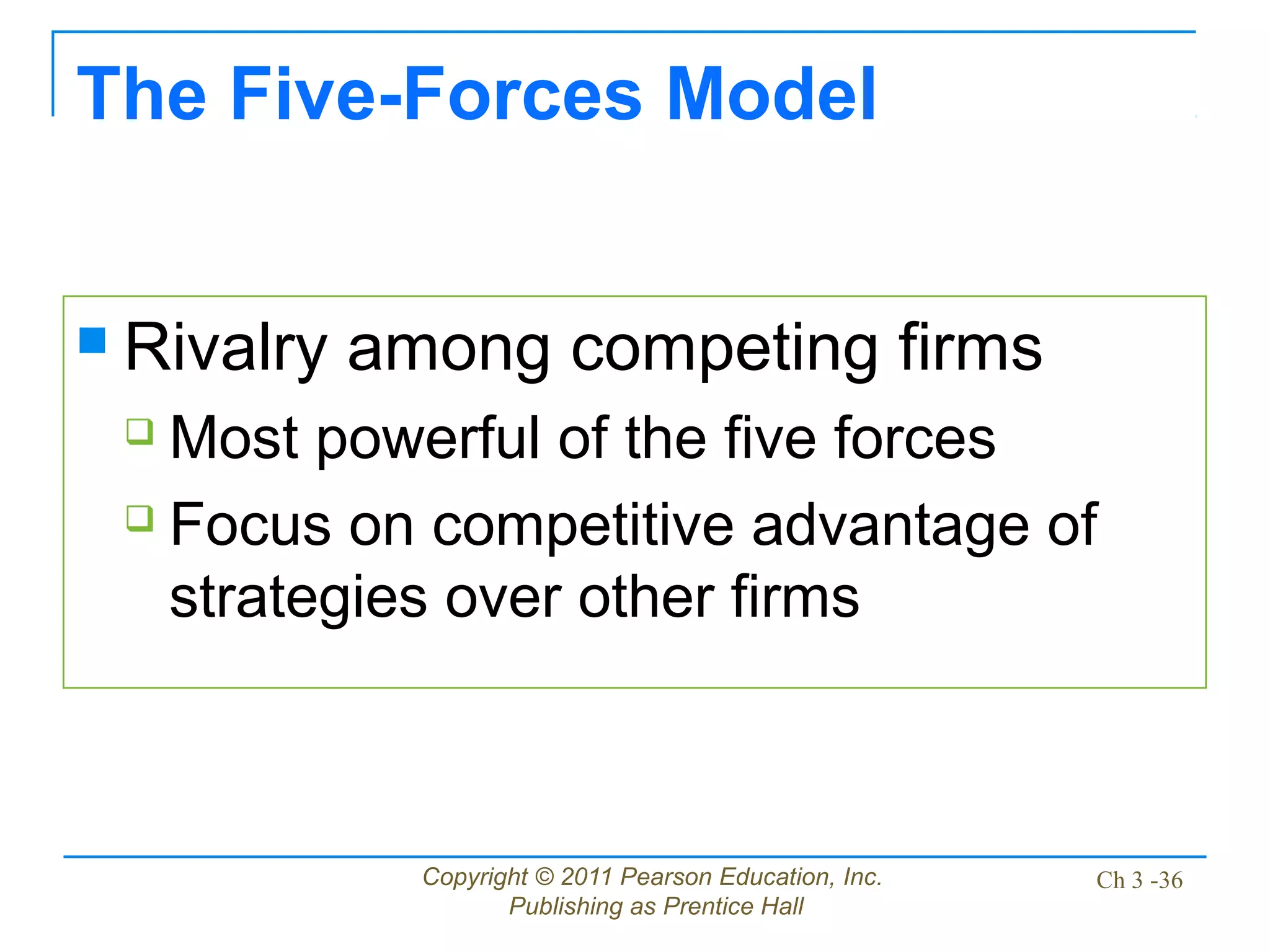
The Five-Forces Model
 Rivalry among competing firms
 Most powerful of the five forces
 Focus on competitive advantage of
strategies over other firms
Copyright © 2011 Pearson Education, Inc.
Publishing as Prentice Hall
Ch 3 -37
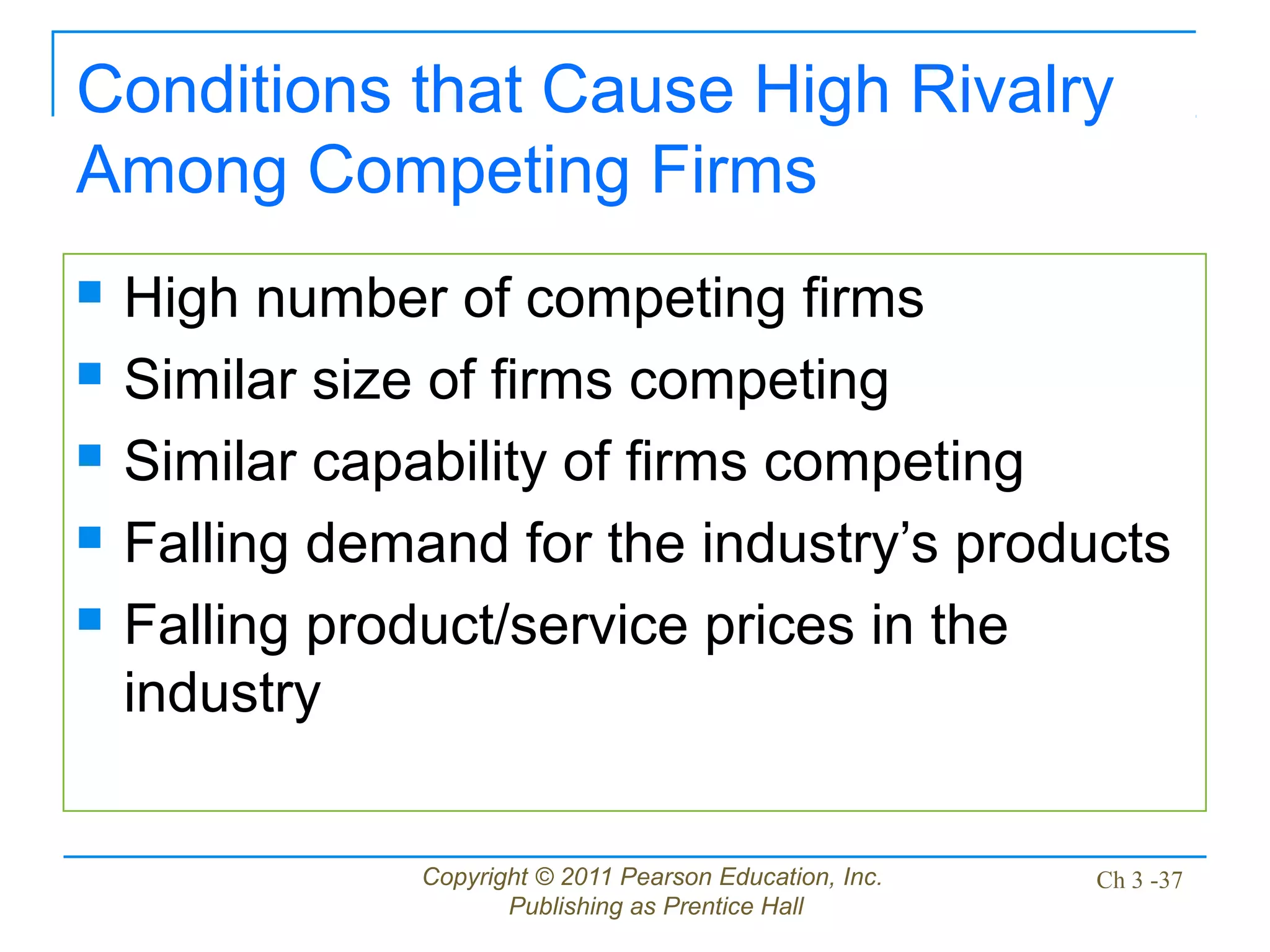
Conditions that Cause High Rivalry
Among Competing Firms
 High number of competing firms
 Similar size of firms competing
 Similar capability of firms competing
 Falling demand for the industry’s products
 Falling product/service prices in the
industry
Copyright © 2011 Pearson Education, Inc.
Publishing as Prentice Hall
Ch 3 -38
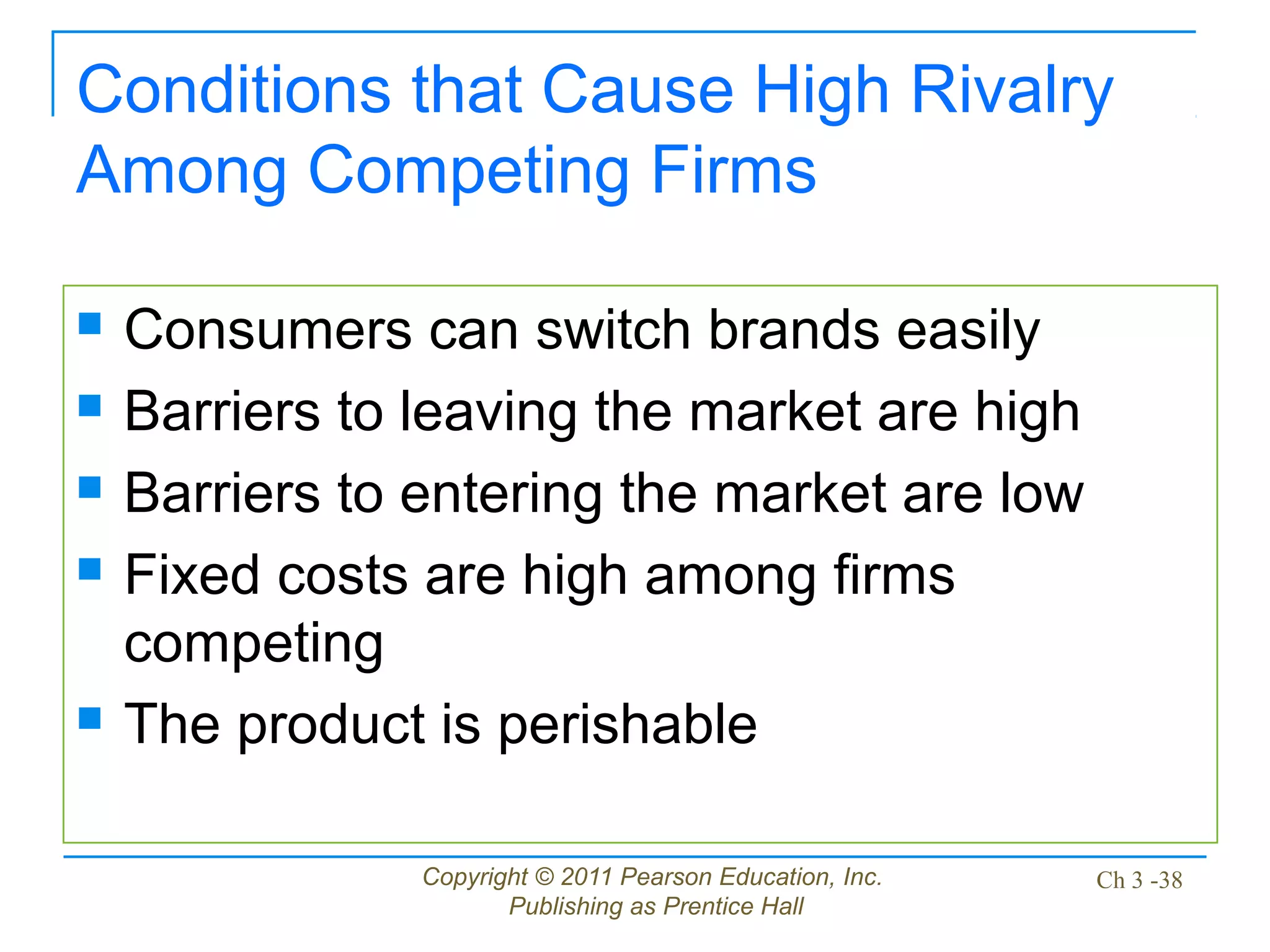
Conditions that Cause High Rivalry
Among Competing Firms
 Consumers can switch brands easily
 Barriers to leaving the market are high
 Barriers to entering the market are low
 Fixed costs are high among firms
competing
 The product is perishable
Copyright © 2011 Pearson Education, Inc.
Publishing as Prentice Hall
Ch 3 -39
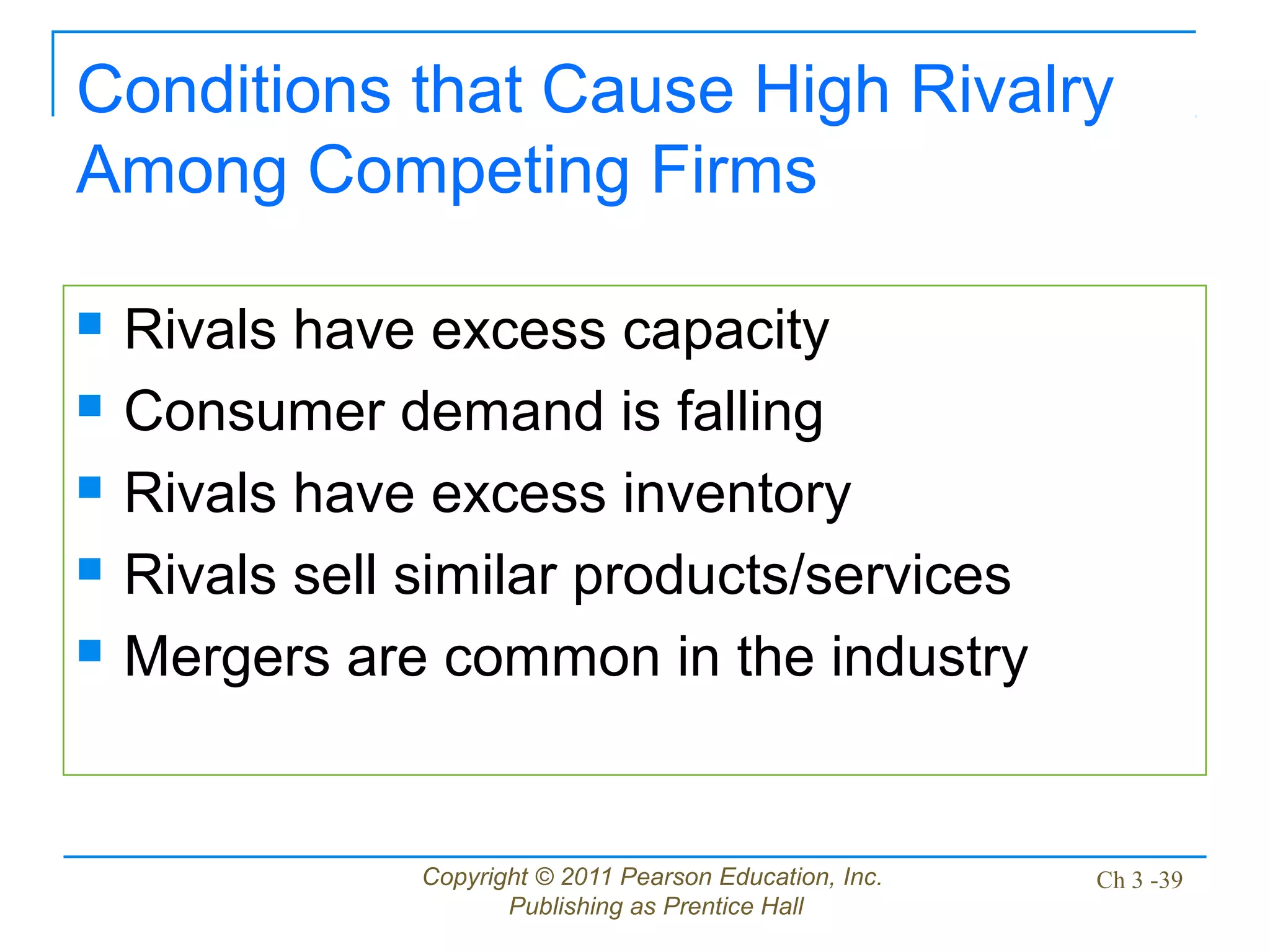
Conditions that Cause High Rivalry
Among Competing Firms
 Rivals have excess capacity
 Consumer demand is falling
 Rivals have excess inventory
 Rivals sell similar products/services
 Mergers are common in the industry
Copyright © 2011 Pearson Education, Inc.
Publishing as Prentice Hall
Ch 3 -40
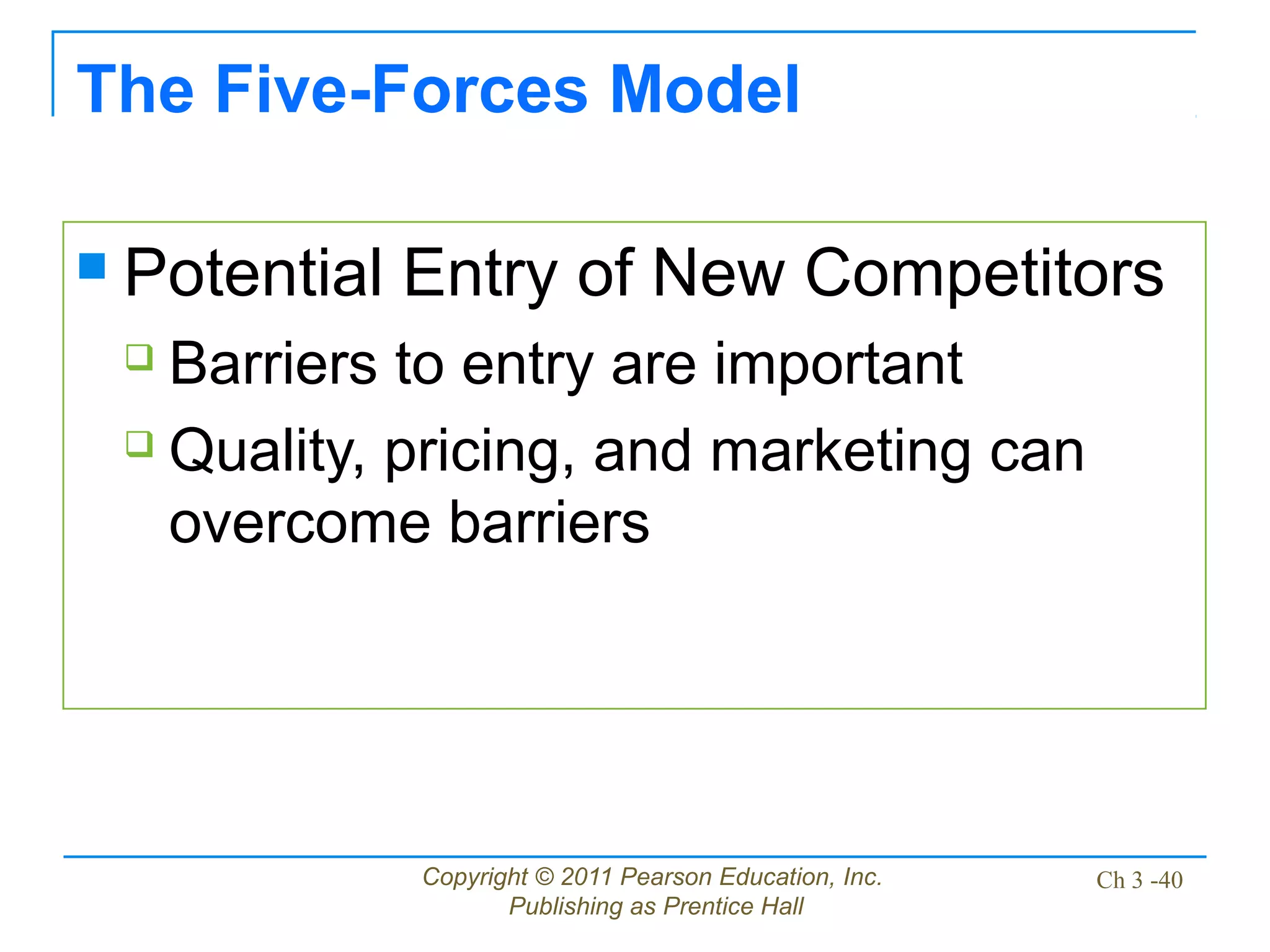
The Five-Forces Model
 Potential Entry of New Competitors
 Barriers to entry are important
 Quality, pricing, and marketing can
overcome barriers
Copyright © 2011 Pearson Education, Inc.
Publishing as Prentice Hall
Ch 3 -41
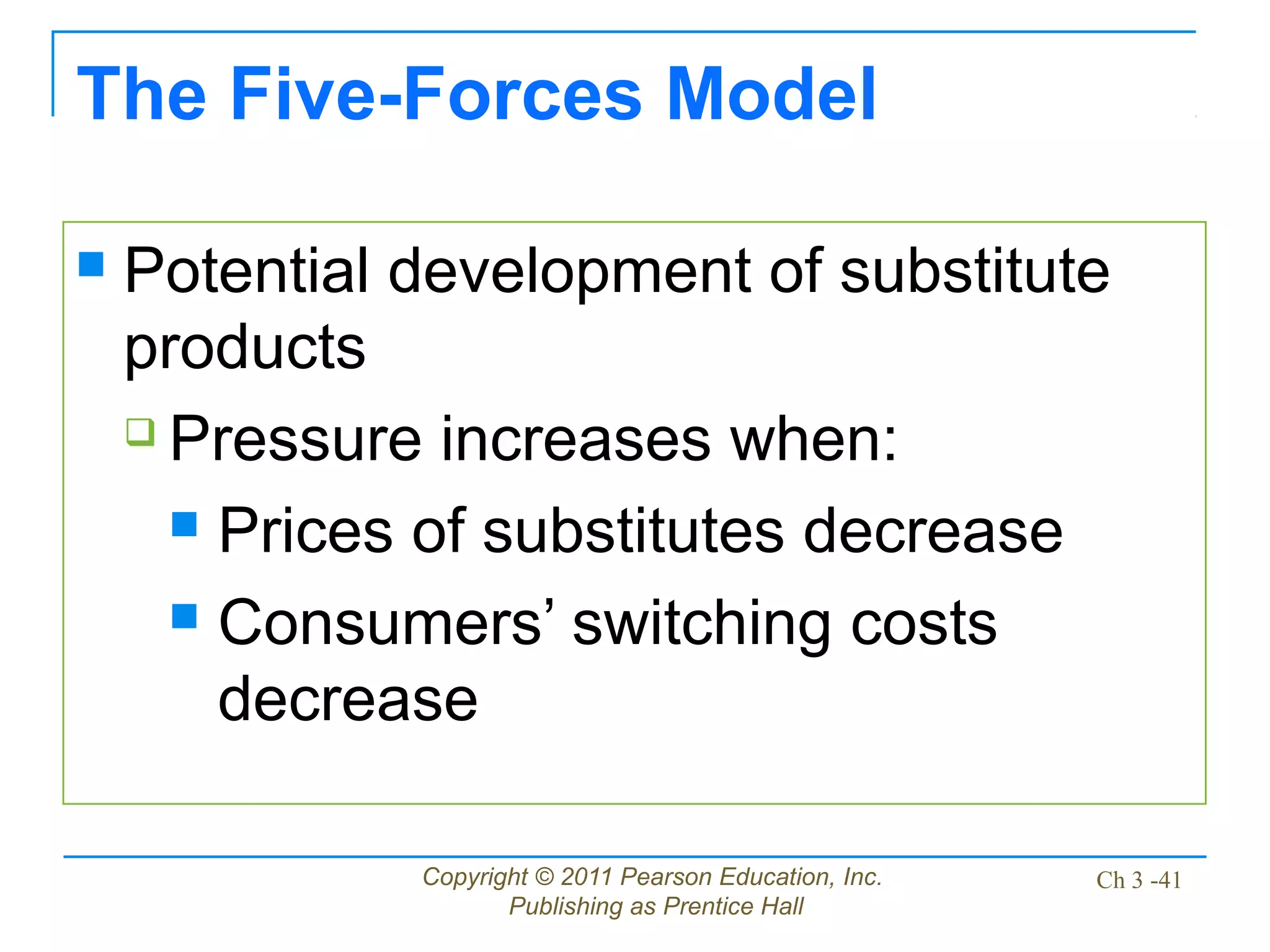
The Five-Forces Model
 Potential development of substitute
products
 Pressure increases when:
 Prices of substitutes decrease
 Consumers’ switching costs
decrease
Copyright © 2011 Pearson Education, Inc.
Publishing as Prentice Hall
Ch 3 -42
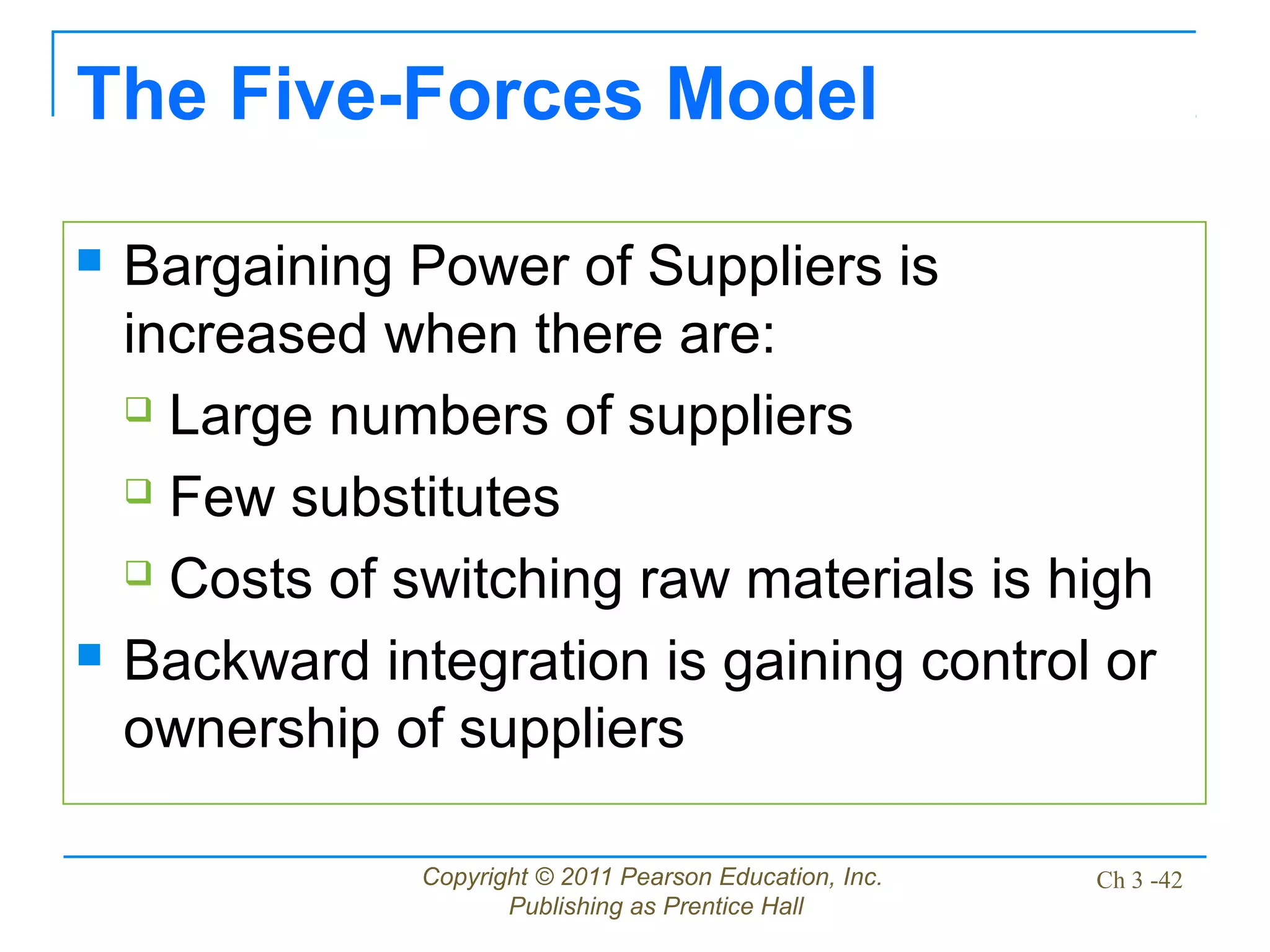
The Five-Forces Model
 Bargaining Power of Suppliers is
increased when there are:
 Large numbers of suppliers
 Few substitutes
 Costs of switching raw materials is high
 Backward integration is gaining control or
ownership of suppliers
Copyright © 2011 Pearson Education, Inc.
Publishing as Prentice Hall
Ch 3 -43
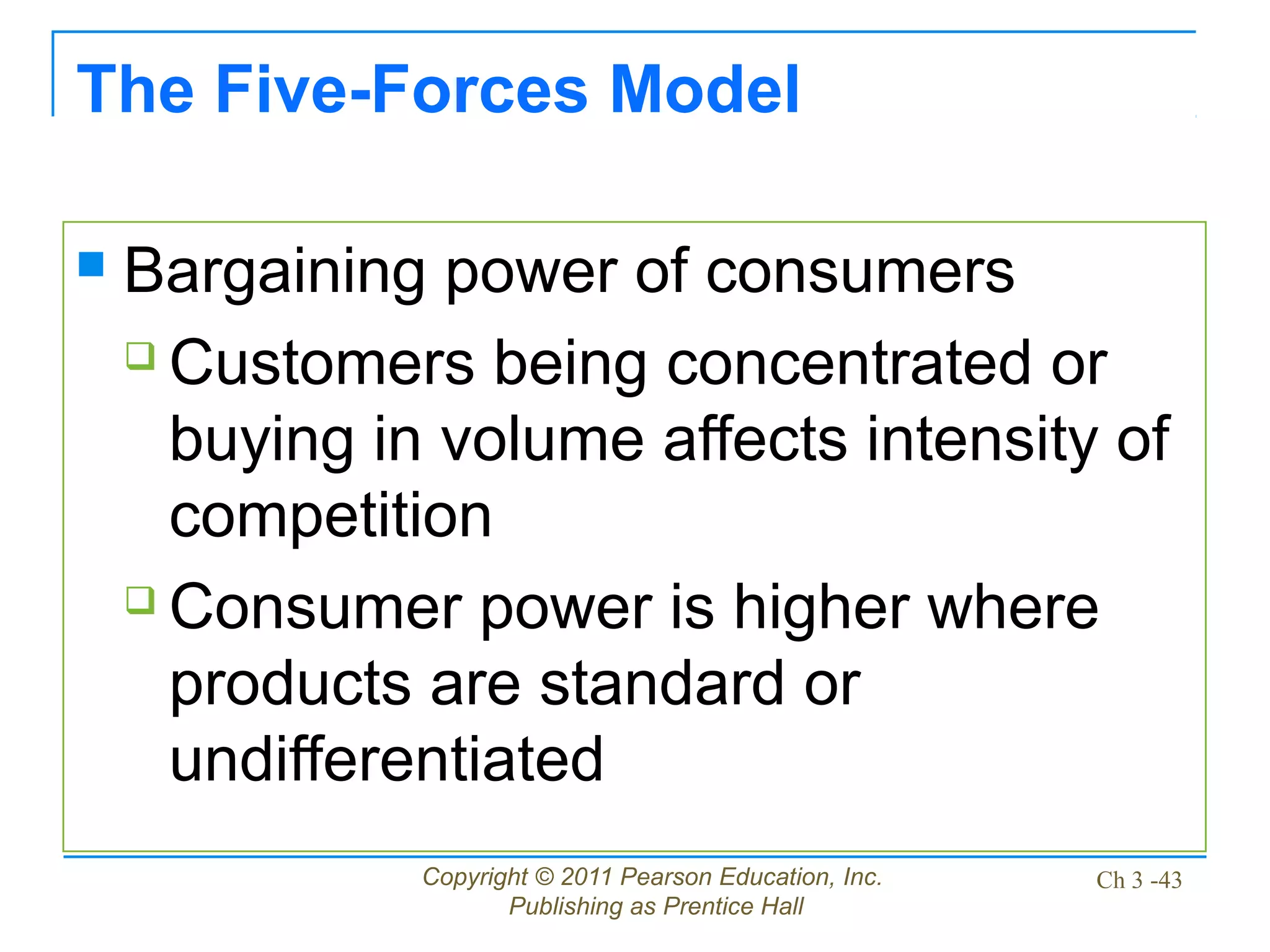
The Five-Forces Model
 Bargaining power of consumers
 Customers being concentrated or
buying in volume affects intensity of
competition
 Consumer power is higher where
products are standard or
undifferentiated
Copyright © 2011 Pearson Education, Inc.
Publishing as Prentice Hall
Ch 3 -44
Conditions Where Consumers Gain
Bargaining Power
 If buyers can inexpensively switch
 If buyers are particularly important
 If sellers are struggling in the face of falling
consumer demand
 If buyers are informed about sellers’
products, prices, and costs
 If buyers have discretion in whether and
when they purchase the product
Copyright © 2011 Pearson Education, Inc.
Publishing as Prentice Hall
Ch 3 -45
Sources of External Information:
Unpublished Sources
 Customer surveys
 Market research
 Speeches at professional or shareholder
meetings
 Television programs
 Interviews and conversations with
stakeholders
Copyright © 2011 Pearson Education, Inc.
Publishing as Prentice Hall
Ch 3 -46
Sources of External Information:
Published Sources
 Periodicals
 Journals
 Reports
 Government documents
 Abstracts
 Books
 Directories
 Newspapers
 Manuals
Copyright © 2011 Pearson Education, Inc.
Publishing as Prentice Hall
Ch 3 -47
Sources of External Information:
Web Sites
 http://marketwatch.multexinvestor.com
 http://moneycentral.msn.com
 http://finance.yahoo.com
 www.clearstation.com
 https://us.etrade.com/e/t/invest/markets
 www.hoovers.com
Copyright © 2011 Pearson Education, Inc.
Publishing as Prentice Hall
Ch 3 -48
Forecasting Tools and Techniques
 Forecasts are educated assumptions
about future trends and events
 Quantitative techniques – most
appropriate when historical data is
available and there is a constant
relationship
 Qualitative techniques
Copyright © 2011 Pearson Education, Inc.
Publishing as Prentice Hall
Ch 3 -49
Assumptions
Estimates of future events based
upon the best available
information in the present
Copyright © 2011 Pearson Education, Inc.
Publishing as Prentice Hall
Ch 3 -50
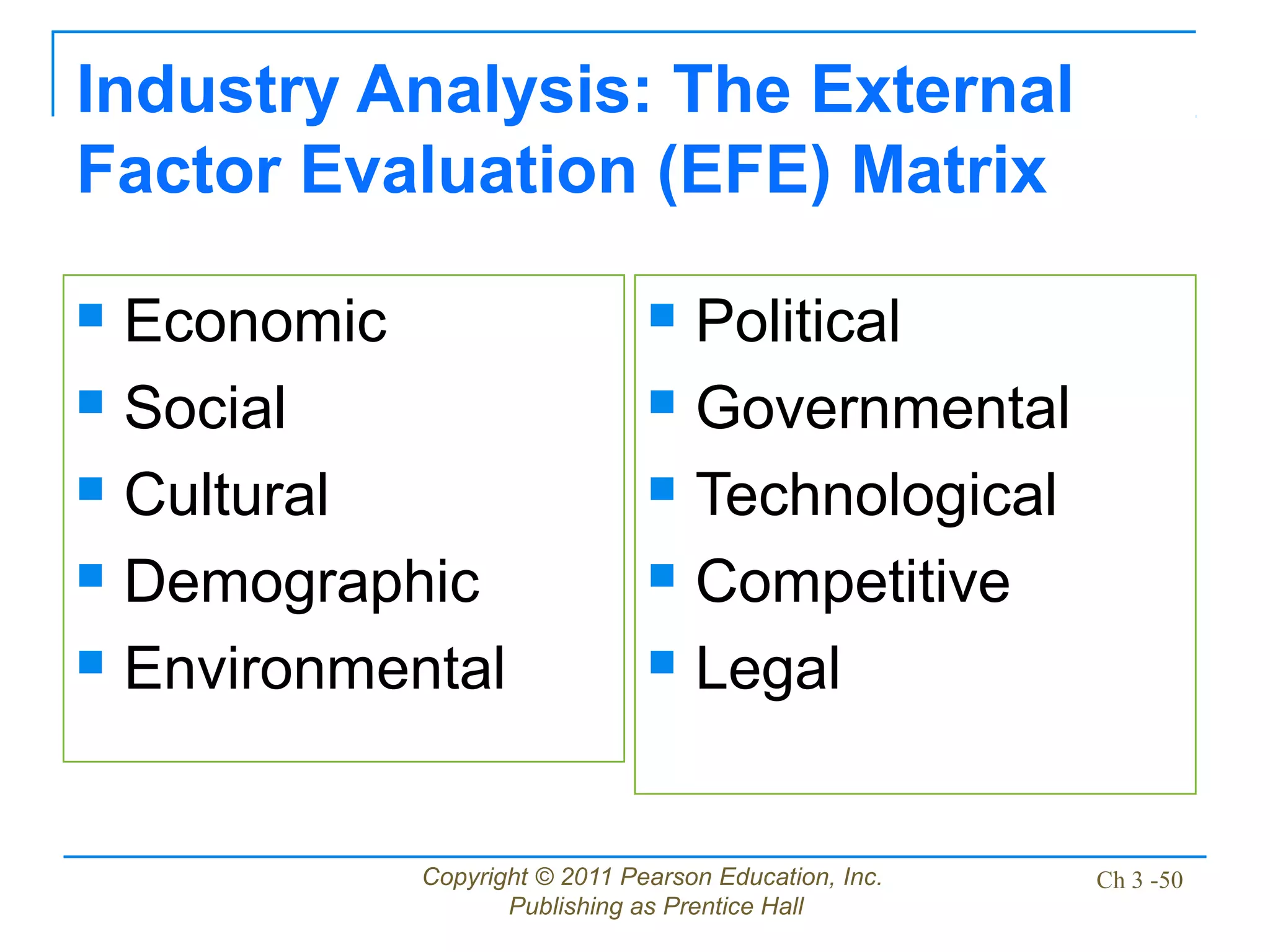
Industry Analysis: The External
Factor Evaluation (EFE) Matrix
 Economic
 Social
 Cultural
 Demographic
 Environmental
 Political
 Governmental
 Technological
 Competitive
 Legal
Copyright © 2011 Pearson Education, Inc.
Publishing as Prentice Hall
Ch 3 -51
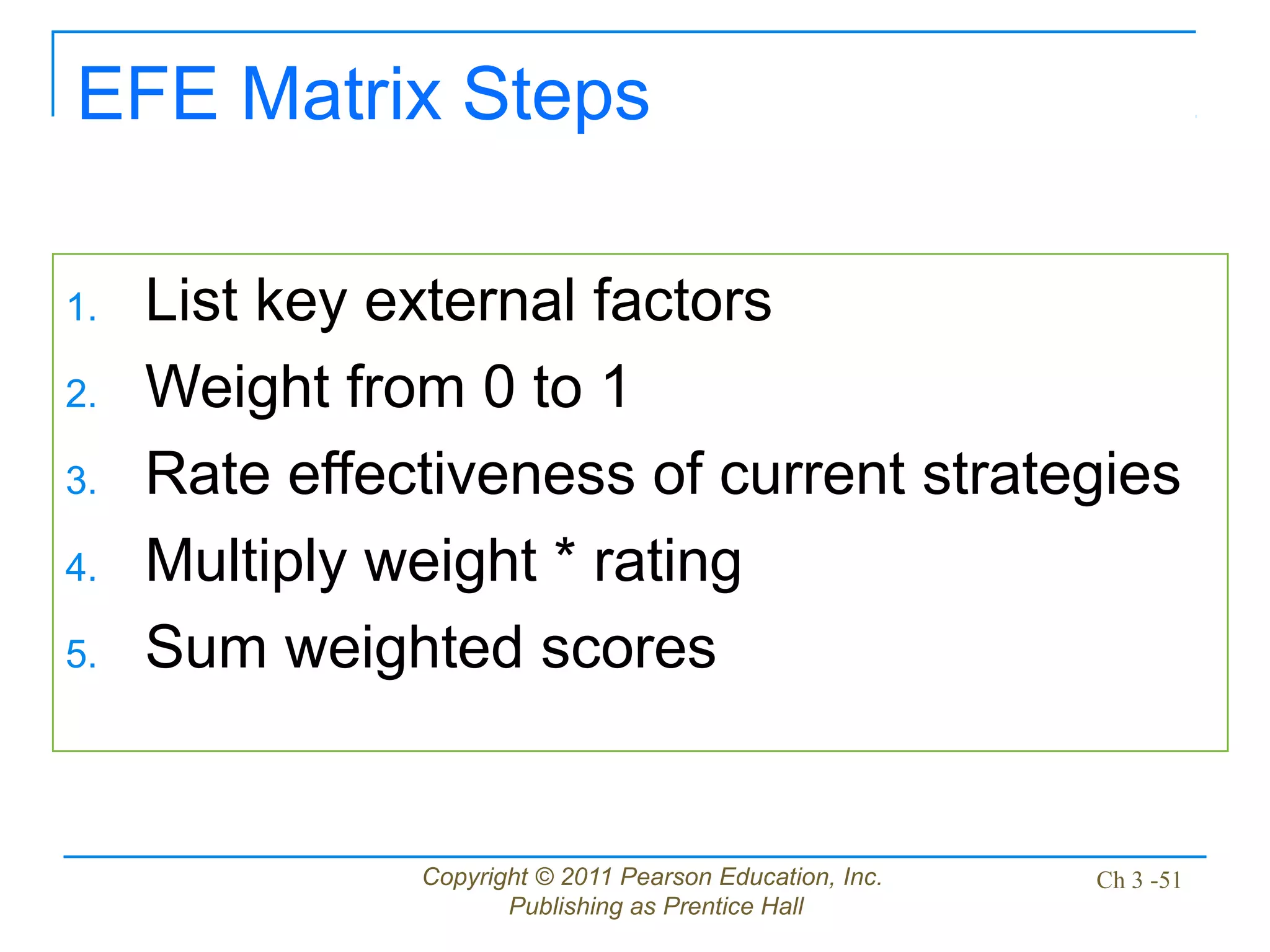
EFE Matrix Steps
1. List key external factors
2. Weight from 0 to 1
3. Rate effectiveness of current strategies
4. Multiply weight * rating
5. Sum weighted scores
Copyright © 2011 Pearson Education, Inc.
Publishing as Prentice Hall
Ch 3 -52
Copyright © 2011 Pearson Education, Inc.
Publishing as Prentice Hall
Ch 3 -53
Copyright © 2011 Pearson Education, Inc.
Publishing as Prentice Hall
Ch 3 -54
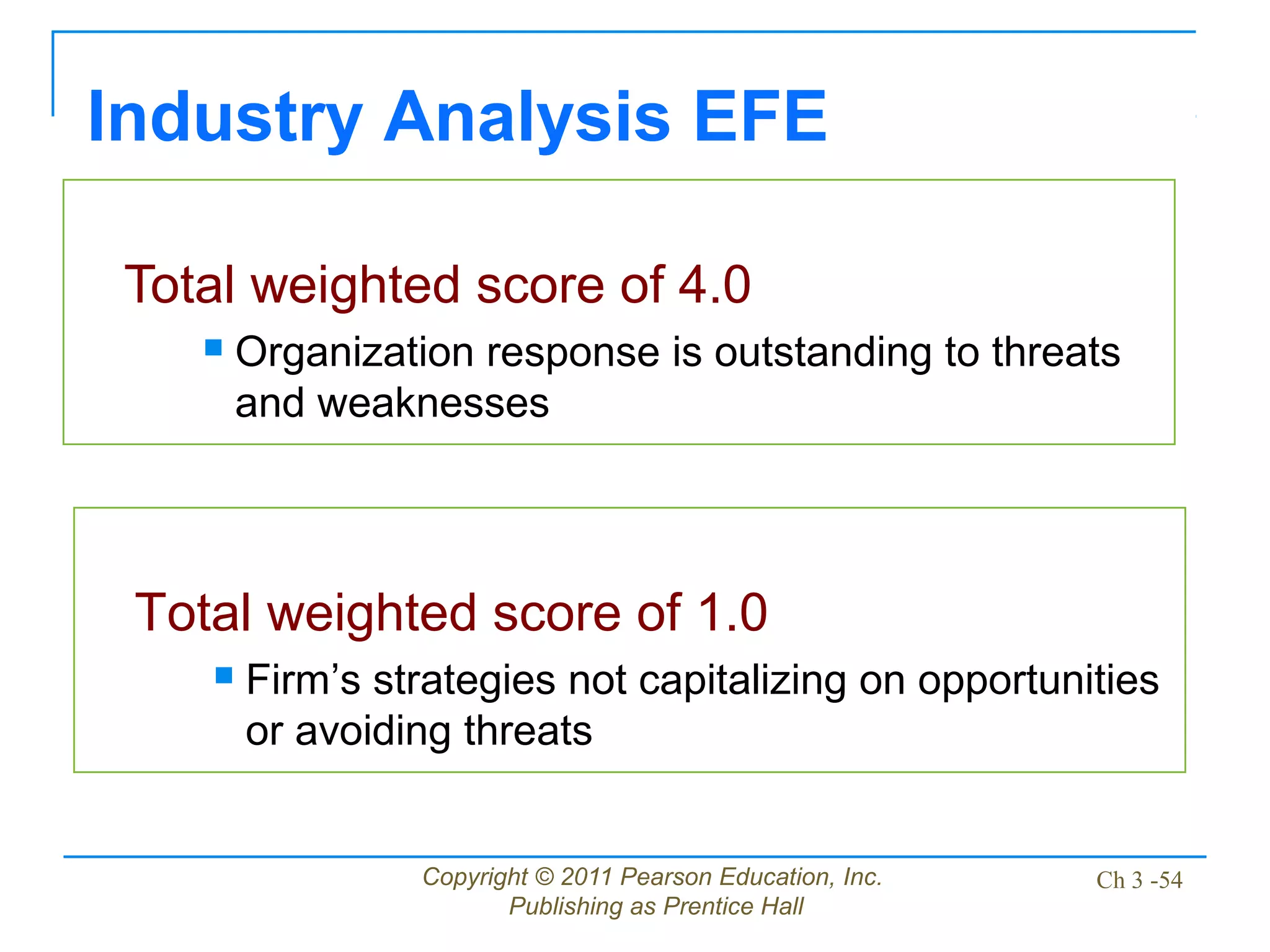
Total weighted score of 4.0
 Organization response is outstanding to threats
and weaknesses
Industry Analysis EFE
Total weighted score of 1.0
 Firm’s strategies not capitalizing on opportunities
or avoiding threats
Copyright © 2011 Pearson Education, Inc.
Publishing as Prentice Hall
Ch 3 -55
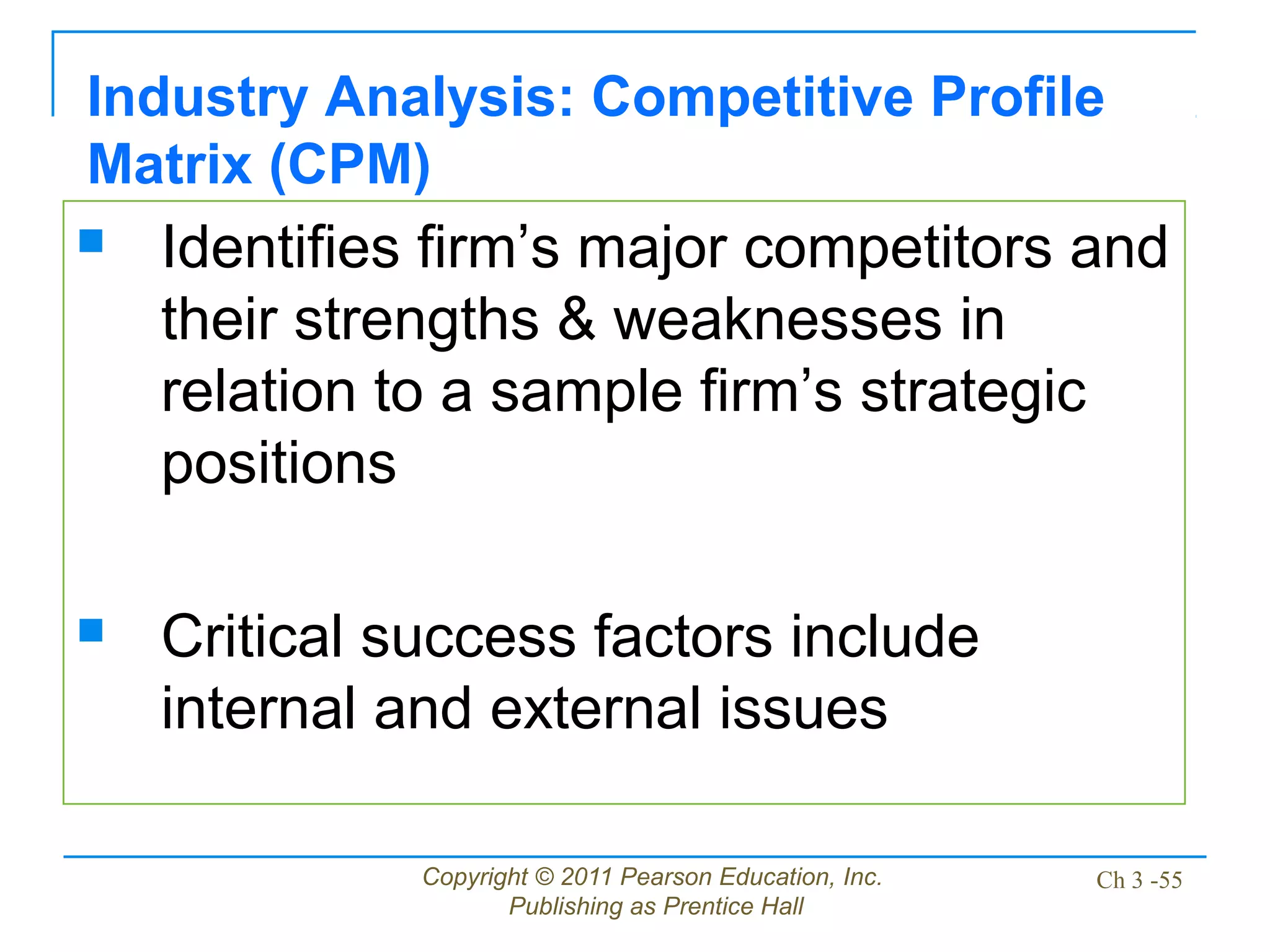
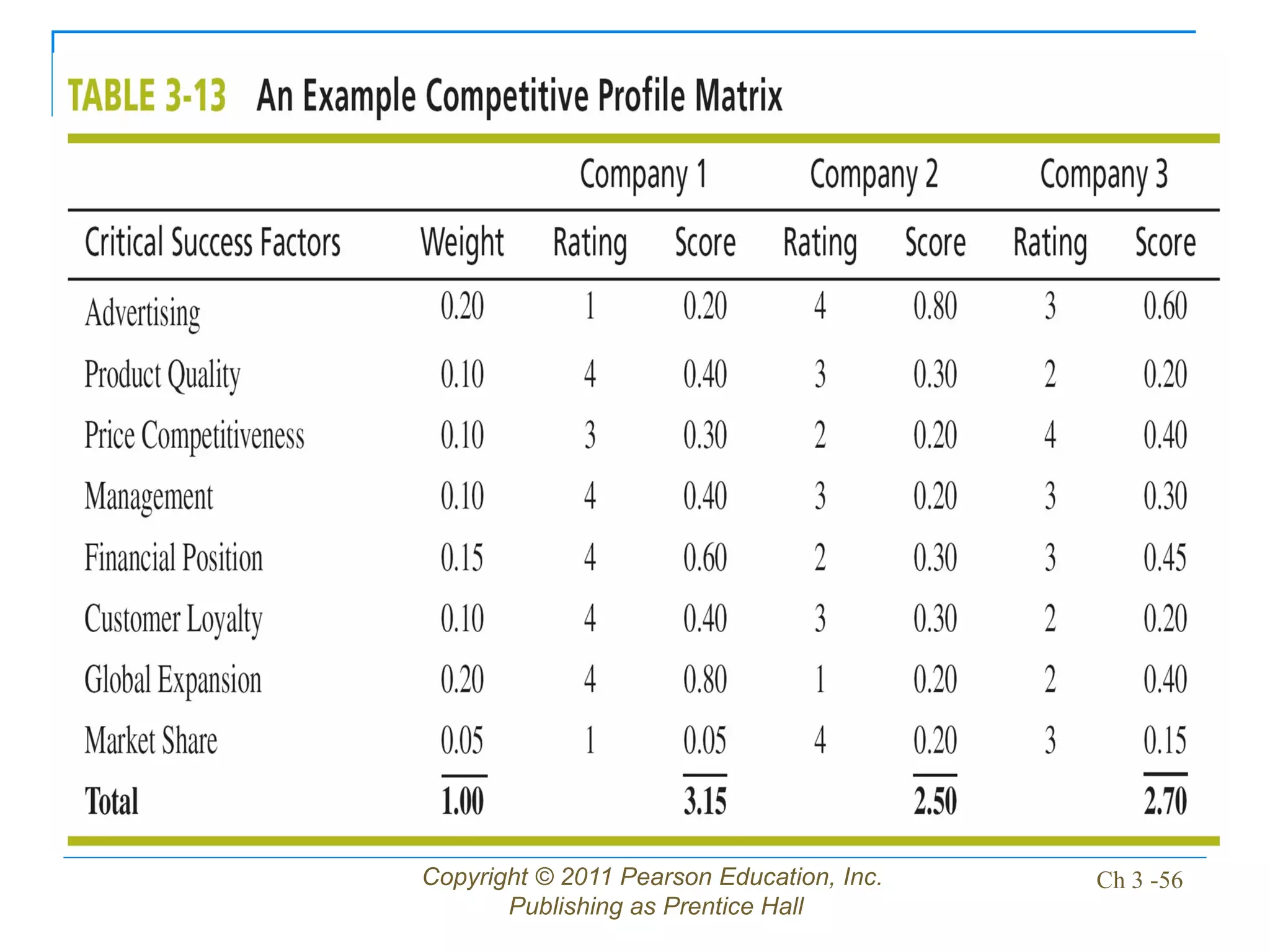
Industry Analysis: Competitive Profile
Matrix (CPM)
 Identifies firm’s major competitors and
their strengths & weaknesses in
relation to a sample firm’s strategic
positions
 Critical success factors include
internal and external issues
Copyright © 2011 Pearson Education, Inc.
Publishing as Prentice Hall
Ch 3 -56
Copyright © 2011 Pearson Education, Inc.
Publishing as Prentice Hall
Ch 3 -57
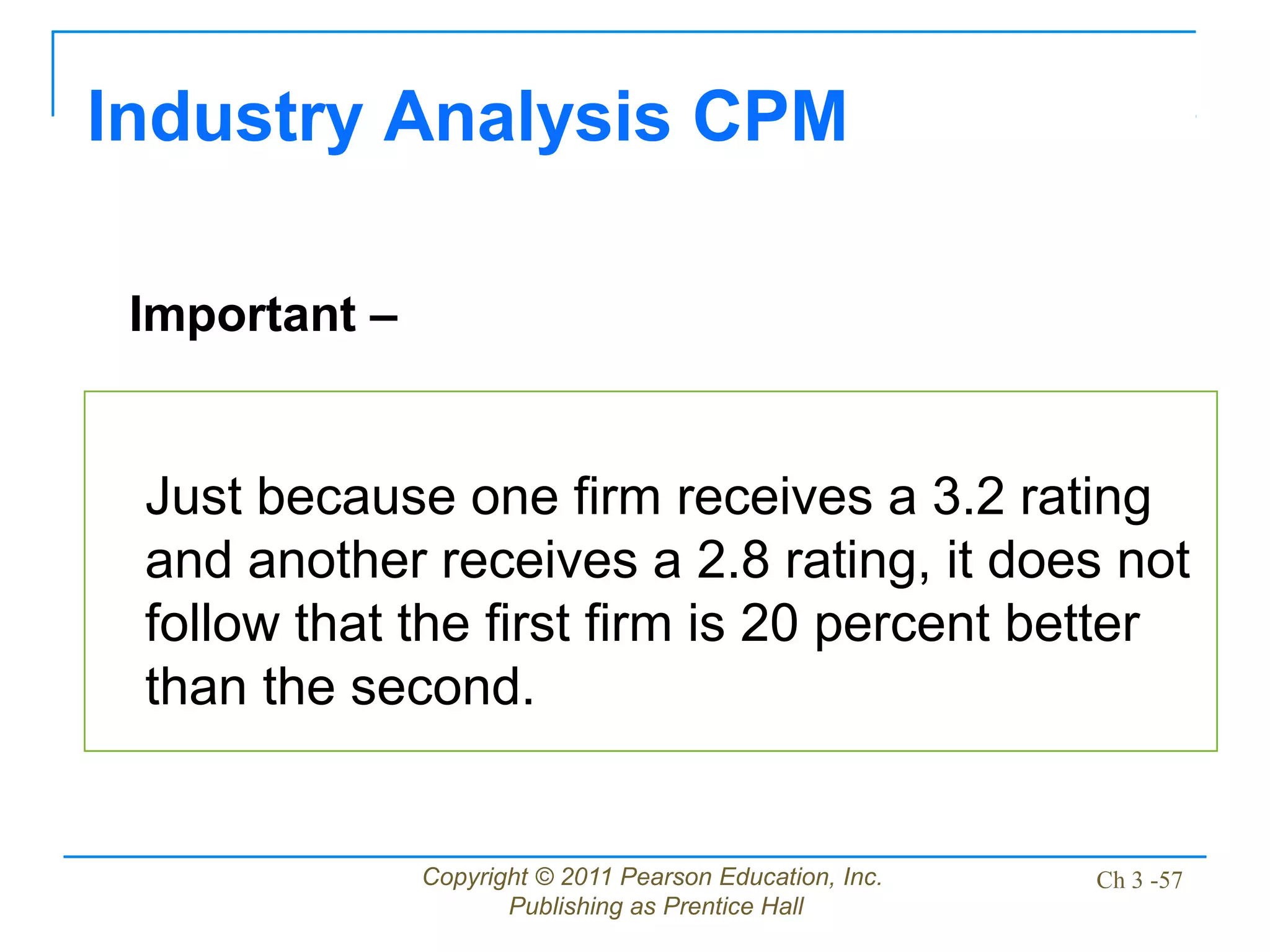
Industry Analysis CPM
Just because one firm receives a 3.2 rating
and another receives a 2.8 rating, it does not
follow that the first firm is 20 percent better
than the second.
Important –
Copyright © 2011 Pearson Education, Inc.
Publishing as Prentice Hall
Ch 3 -58
All rights reserved. No part of this publication may be reproduced, stored in a
retrieval system, or transmitted, in any form or by any means, electronic,
mechanical, photocopying, recording, or otherwise, without the prior written
permission of the publisher. Printed in the United States of America.

David sm13 ppt_03

  • 1.
    Copyright © 2011Pearson Education, Inc. Publishing as Prentice Hall Ch 3 -1 Chapter 3 The External Assessment Strategic Management: Concepts & Cases 13th Edition Fred David
  • 2.
    Copyright © 2011Pearson Education, Inc. Publishing as Prentice Hall Ch 3 -2
  • 3.
    Copyright © 2011Pearson Education, Inc. Publishing as Prentice Hall Ch 3 -3 “It is not the strongest of the species that survive, nor the most intelligent, but the one most responsive to change.” – Charles Darwin External Assessment “Nothing focuses the mind better than the constant sight of a competitor who wants to wipe you off the map.” – Wayne Calloway, Former CEO, PepsiCo
  • 4.
    Copyright © 2011Pearson Education, Inc. Publishing as Prentice Hall Ch 3 -4 External Strategic Management Audit – Environmental Scanning – Industry Analysis
  • 5.
    Copyright © 2011Pearson Education, Inc. Publishing as Prentice Hall Ch 3 -5 Identify & evaluate factors beyond the control of a single firm  Increased foreign competition  Population shifts  Aging society  Fear of traveling  Stock market volatility External Strategic Management Audit
  • 6.
    Copyright © 2011Pearson Education, Inc. Publishing as Prentice Hall Ch 3 -6 Purpose of an External Audit  Develop a finite list of  opportunities that could benefit a firm  threats that should be avoided External Strategic Management Audit
  • 7.
    Copyright © 2011Pearson Education, Inc. Publishing as Prentice Hall Ch 3 -7
  • 8.
    Copyright © 2011Pearson Education, Inc. Publishing as Prentice Hall Ch 3 -8  Gather competitive intelligence  Assimilate information  Evaluate Resulting in a list of the most important key external factors External Audit
  • 9.
    Copyright © 2011Pearson Education, Inc. Publishing as Prentice Hall Ch 3 -9 Performing External Audit External Factors Measurable Long-term Orientation Applicable to Competing Firms Hierarchical
  • 10.
    Copyright © 2011Pearson Education, Inc. Publishing as Prentice Hall Ch 3 -10 Industrial Organization (I/O) View Industry factors are more important than internal factors  Performance determined by industry forces
  • 11.
    Copyright © 2011Pearson Education, Inc. Publishing as Prentice Hall Ch 3 -11 Economies of Scale Industry Properties Barriers to Market Entry Product Differentiation The Economy I/O Perspective Firm Performance Level of Competitiveness
  • 12.
    Copyright © 2011Pearson Education, Inc. Publishing as Prentice Hall Ch 3 -12 Economic Forces  GDP  Trends in the dollar’s value  Unemployment rates
  • 13.
    Copyright © 2011Pearson Education, Inc. Publishing as Prentice Hall Ch 3 -13
  • 14.
    Copyright © 2011Pearson Education, Inc. Publishing as Prentice Hall Ch 3 -14 Social, Cultural, Demographic, and Natural Environmental Forces Major Impact – •Products •Services •Markets •Customers
  • 15.
    Copyright © 2011Pearson Education, Inc. Publishing as Prentice Hall Ch 3 -15 Social, Cultural, Demographic, and Natural Environmental Forces  US Facts  Aging population  Less White  Widening gap between rich & poor  2025 = 18.5% population > 65 years  2075 = no ethnic or racial majority
  • 16.
    Copyright © 2011Pearson Education, Inc. Publishing as Prentice Hall Ch 3 -16 Social, Cultural, Demographic, and Natural Environmental Forces  Facts  World population 7 billion  World population = 8 billion by 2028  World population = 9 billion by 2054  U.S. population > 310 million
  • 17.
    Copyright © 2011Pearson Education, Inc. Publishing as Prentice Hall Ch 3 -17  Trends  More American households with people living alone  Aging Americans – affects all organizations Social, Cultural, Demographic, and Natural Environmental Forces
  • 18.
    Copyright © 2011Pearson Education, Inc. Publishing as Prentice Hall Ch 3 -18 Political, Governmental, and Legal Forces Key opportunities & threats  Antitrust legislation  Tax rates  Lobbying activities  Patent laws Government Regulation
  • 19.
    Copyright © 2011Pearson Education, Inc. Publishing as Prentice Hall Ch 3 -19 Political, Governmental, and Legal Forces  Protectionist policies  Governments taking equity stakes in companies
  • 20.
    Copyright © 2011Pearson Education, Inc. Publishing as Prentice Hall Ch 3 -20 Technological Forces Major Impact – •Internet
  • 21.
    Copyright © 2011Pearson Education, Inc. Publishing as Prentice Hall Ch 3 -21 Technological Forces Significance of IT •Chief Information Officer (CIO) •Chief Technology Officer (CTO)
  • 22.
    Copyright © 2011Pearson Education, Inc. Publishing as Prentice Hall Ch 3 -22 Technological Forces Essential for nearly every strategic decision
  • 23.
    Copyright © 2011Pearson Education, Inc. Publishing as Prentice Hall Ch 3 -23 Competitive Forces Collection & evaluation of data on competitors is essential for successful strategy formulation
  • 24.
    Copyright © 2011Pearson Education, Inc. Publishing as Prentice Hall Ch 3 -24 Competitive Forces •Strengths •Weaknesses •Capabilities •Opportunities •Threats •Objectives •Strategies Identify Rival Firms’
  • 25.
    Copyright © 2011Pearson Education, Inc. Publishing as Prentice Hall Ch 3 -25 Competitive Forces Competition in virtually all industries can be described as intense
  • 26.
    Copyright © 2011Pearson Education, Inc. Publishing as Prentice Hall Ch 3 -26 Key Questions Concerning Competitors  Their strengths  Their weaknesses  Their objectives and strategies  Their responses to external variables  Their vulnerability to our alternative strategies  Our vulnerability to strategic counterattack
  • 27.
    Copyright © 2011Pearson Education, Inc. Publishing as Prentice Hall Ch 3 -27 Key Questions Concerning Competitors  Our product/service positioning  Entry and exit of firms in the industry  Key factors for our current position in industry  Sales/profit ranking of competitors over time  Nature of supplier and distributor relationships  The threat of substitute products/services
  • 28.
    Copyright © 2011Pearson Education, Inc. Publishing as Prentice Hall Ch 3 -28 Competitive Forces  7 characteristics of most competitive firms  Market share matters  Understanding what business you are in  Broke or not, fix it  Innovate or evaporate  Acquisition is essential to growth  People make a difference  No substitute for quality
  • 29.
    Copyright © 2011Pearson Education, Inc. Publishing as Prentice Hall Ch 3 -29 Competitive Intelligence  A systematic and ethical process for gathering and analyzing information about the competition’s activities and general business trends to further a business’s own goals
  • 30.
    Copyright © 2011Pearson Education, Inc. Publishing as Prentice Hall Ch 3 -30 Sources of Competitive Intelligence  Internet  Employees  Managers  Suppliers  Distributors  Customers  Creditors  Consultants  Trade journals  Want ads  Newspaper articles  Government filings  Competitors
  • 31.
    Copyright © 2011Pearson Education, Inc. Publishing as Prentice Hall Ch 3 -31 Objectives of Competitive Intelligence  Provide a general understanding of industry and competitors  Identify areas where competitors are vulnerable and assess impact of actions on competitors  Identify potential moves that a competitor might make
  • 32.
    Copyright © 2011Pearson Education, Inc. Publishing as Prentice Hall Ch 3 -32 Market Commonality  The number and significance of markets that a firm competes in with rivals
  • 33.
    Copyright © 2011Pearson Education, Inc. Publishing as Prentice Hall Ch 3 -33 Resource Similarity  Extent to which the type and amount of a firm’s internal resources are comparable to a rival
  • 34.
    Copyright © 2011Pearson Education, Inc. Publishing as Prentice Hall Ch 3 -34 The Five-Forces Model of Competition
  • 35.
    Copyright © 2011Pearson Education, Inc. Publishing as Prentice Hall Ch 3 -35 Steps to Determine if an Acceptable Profit Can Be Earned 1. Identify key aspects or elements of each competitive force 2. Evaluate how strong and important each element is for the firm 3. Decide whether the collective strength of the elements is worth the firm entering or staying in the industry
  • 36.
    Copyright © 2011Pearson Education, Inc. Publishing as Prentice Hall Ch 3 -36 The Five-Forces Model  Rivalry among competing firms  Most powerful of the five forces  Focus on competitive advantage of strategies over other firms
  • 37.
    Copyright © 2011Pearson Education, Inc. Publishing as Prentice Hall Ch 3 -37 Conditions that Cause High Rivalry Among Competing Firms  High number of competing firms  Similar size of firms competing  Similar capability of firms competing  Falling demand for the industry’s products  Falling product/service prices in the industry
  • 38.
    Copyright © 2011Pearson Education, Inc. Publishing as Prentice Hall Ch 3 -38 Conditions that Cause High Rivalry Among Competing Firms  Consumers can switch brands easily  Barriers to leaving the market are high  Barriers to entering the market are low  Fixed costs are high among firms competing  The product is perishable
  • 39.
    Copyright © 2011Pearson Education, Inc. Publishing as Prentice Hall Ch 3 -39 Conditions that Cause High Rivalry Among Competing Firms  Rivals have excess capacity  Consumer demand is falling  Rivals have excess inventory  Rivals sell similar products/services  Mergers are common in the industry
  • 40.
    Copyright © 2011Pearson Education, Inc. Publishing as Prentice Hall Ch 3 -40 The Five-Forces Model  Potential Entry of New Competitors  Barriers to entry are important  Quality, pricing, and marketing can overcome barriers
  • 41.
    Copyright © 2011Pearson Education, Inc. Publishing as Prentice Hall Ch 3 -41 The Five-Forces Model  Potential development of substitute products  Pressure increases when:  Prices of substitutes decrease  Consumers’ switching costs decrease
  • 42.
    Copyright © 2011Pearson Education, Inc. Publishing as Prentice Hall Ch 3 -42 The Five-Forces Model  Bargaining Power of Suppliers is increased when there are:  Large numbers of suppliers  Few substitutes  Costs of switching raw materials is high  Backward integration is gaining control or ownership of suppliers
  • 43.
    Copyright © 2011Pearson Education, Inc. Publishing as Prentice Hall Ch 3 -43 The Five-Forces Model  Bargaining power of consumers  Customers being concentrated or buying in volume affects intensity of competition  Consumer power is higher where products are standard or undifferentiated
  • 44.
    Copyright © 2011Pearson Education, Inc. Publishing as Prentice Hall Ch 3 -44 Conditions Where Consumers Gain Bargaining Power  If buyers can inexpensively switch  If buyers are particularly important  If sellers are struggling in the face of falling consumer demand  If buyers are informed about sellers’ products, prices, and costs  If buyers have discretion in whether and when they purchase the product
  • 45.
    Copyright © 2011Pearson Education, Inc. Publishing as Prentice Hall Ch 3 -45 Sources of External Information: Unpublished Sources  Customer surveys  Market research  Speeches at professional or shareholder meetings  Television programs  Interviews and conversations with stakeholders
  • 46.
    Copyright © 2011Pearson Education, Inc. Publishing as Prentice Hall Ch 3 -46 Sources of External Information: Published Sources  Periodicals  Journals  Reports  Government documents  Abstracts  Books  Directories  Newspapers  Manuals
  • 47.
    Copyright © 2011Pearson Education, Inc. Publishing as Prentice Hall Ch 3 -47 Sources of External Information: Web Sites  http://marketwatch.multexinvestor.com  http://moneycentral.msn.com  http://finance.yahoo.com  www.clearstation.com  https://us.etrade.com/e/t/invest/markets  www.hoovers.com
  • 48.
    Copyright © 2011Pearson Education, Inc. Publishing as Prentice Hall Ch 3 -48 Forecasting Tools and Techniques  Forecasts are educated assumptions about future trends and events  Quantitative techniques – most appropriate when historical data is available and there is a constant relationship  Qualitative techniques
  • 49.
    Copyright © 2011Pearson Education, Inc. Publishing as Prentice Hall Ch 3 -49 Assumptions Estimates of future events based upon the best available information in the present
  • 50.
    Copyright © 2011Pearson Education, Inc. Publishing as Prentice Hall Ch 3 -50 Industry Analysis: The External Factor Evaluation (EFE) Matrix  Economic  Social  Cultural  Demographic  Environmental  Political  Governmental  Technological  Competitive  Legal
  • 51.
    Copyright © 2011Pearson Education, Inc. Publishing as Prentice Hall Ch 3 -51 EFE Matrix Steps 1. List key external factors 2. Weight from 0 to 1 3. Rate effectiveness of current strategies 4. Multiply weight * rating 5. Sum weighted scores
  • 52.
    Copyright © 2011Pearson Education, Inc. Publishing as Prentice Hall Ch 3 -52
  • 53.
    Copyright © 2011Pearson Education, Inc. Publishing as Prentice Hall Ch 3 -53
  • 54.
    Copyright © 2011Pearson Education, Inc. Publishing as Prentice Hall Ch 3 -54 Total weighted score of 4.0  Organization response is outstanding to threats and weaknesses Industry Analysis EFE Total weighted score of 1.0  Firm’s strategies not capitalizing on opportunities or avoiding threats
  • 55.
    Copyright © 2011Pearson Education, Inc. Publishing as Prentice Hall Ch 3 -55 Industry Analysis: Competitive Profile Matrix (CPM)  Identifies firm’s major competitors and their strengths & weaknesses in relation to a sample firm’s strategic positions  Critical success factors include internal and external issues
  • 56.
    Copyright © 2011Pearson Education, Inc. Publishing as Prentice Hall Ch 3 -56
  • 57.
    Copyright © 2011Pearson Education, Inc. Publishing as Prentice Hall Ch 3 -57 Industry Analysis CPM Just because one firm receives a 3.2 rating and another receives a 2.8 rating, it does not follow that the first firm is 20 percent better than the second. Important –
  • 58.
    Copyright © 2011Pearson Education, Inc. Publishing as Prentice Hall Ch 3 -58 All rights reserved. No part of this publication may be reproduced, stored in a retrieval system, or transmitted, in any form or by any means, electronic, mechanical, photocopying, recording, or otherwise, without the prior written permission of the publisher. Printed in the United States of America.

Editor's Notes

  • #48 These are clickable links in slideshow mode.