
Enlightenment

  1700 CE – 1790 CE
Path to Enlightenment
 • The Enlightenment was an 18th- century philosophical
   movement of intellectuals who based their ideas on the
   achievements of the Scientific Revolution.

 • Enlightenment philosophers wanted to make progress
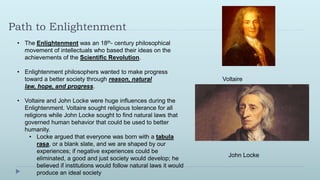
   toward a better society through reason, natural                     Voltaire
   law, hope, and progress.

 • Voltaire and John Locke were huge influences during the
   Enlightenment. Voltaire sought religious tolerance for all
   religions while John Locke sought to find natural laws that
   governed human behavior that could be used to better
   humanity.
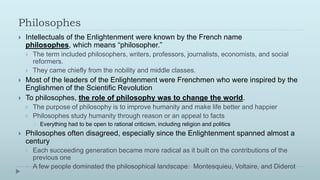
     • Locke argued that everyone was born with a tabula
         rasa, or a blank slate, and we are shaped by our
         experiences; if negative experiences could be
                                                                         John Locke
         eliminated, a good and just society would develop; he
         believed if institutions would follow natural laws it would
         produce an ideal society
Philosophes
   Intellectuals of the Enlightenment were known by the French name
    philosophes, which means “philosopher.”
       The term included philosophers, writers, professors, journalists, economists, and social
        reformers.
       They came chiefly from the nobility and middle classes.
   Most of the leaders of the Enlightenment were Frenchmen who were inspired by the
    Englishmen of the Scientific Revolution
   To philosophes, the role of philosophy was to change the world.
       The purpose of philosophy is to improve humanity and make life better and happier
       Philosophes study humanity through reason or an appeal to facts
           Everything had to be open to rational criticism, including religion and politics
   Philosophes often disagreed, especially since the Enlightenment spanned almost a
    century
       Each succeeding generation became more radical as it built on the contributions of the
        previous one
       A few people dominated the philosophical landscape: Montesquieu, Voltaire, and Diderot
Montesquieu
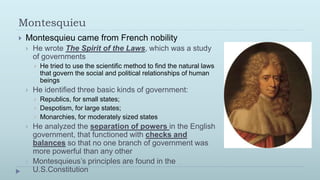
   Montesquieu came from French nobility
       He wrote The Spirit of the Laws, which was a study
        of governments
           He tried to use the scientific method to find the natural laws
            that govern the social and political relationships of human
            beings
       He identified three basic kinds of government:
           Republics, for small states;
           Despotism, for large states;
           Monarchies, for moderately sized states
       He analyzed the separation of powers in the English
        government, that functioned with checks and
        balances so that no one branch of government was
        more powerful than any other
       Montesquieus’s principles are found in the
        U.S.Constitution
Voltaire
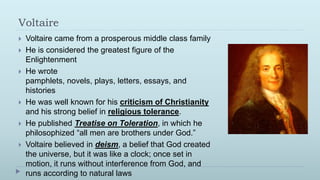
   Voltaire came from a prosperous middle class family
   He is considered the greatest figure of the
    Enlightenment
   He wrote
    pamphlets, novels, plays, letters, essays, and
    histories
   He was well known for his criticism of Christianity
    and his strong belief in religious tolerance.
   He published Treatise on Toleration, in which he
    philosophized “all men are brothers under God.”
   Voltaire believed in deism, a belief that God created
    the universe, but it was like a clock; once set in
    motion, it runs without interference from God, and
    runs according to natural laws
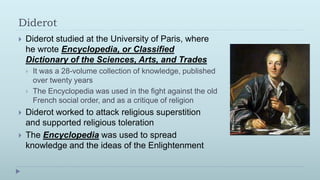
Diderot
   Diderot studied at the University of Paris, where
    he wrote Encyclopedia, or Classified
    Dictionary of the Sciences, Arts, and Trades
       It was a 28-volume collection of knowledge, published
        over twenty years
       The Encyclopedia was used in the fight against the old
        French social order, and as a critique of religion
   Diderot worked to attack religious superstition
    and supported religious toleration
   The Encyclopedia was used to spread
    knowledge and the ideas of the Enlightenment
Social Sciences
   Economics – Adam Smith, a Scottish philosopher, is considered one
    of the founders of the social science economics, along with the French
    physiocrats.
       The Physiocrats were interested in identifying the natural economic laws that
        governed human society; they maintained that if individuals were free to
        pursue their own economic self-interests, all society would ultimately
        benefit
           The Physiocrats believed the State (government) should not interrupt the free play of
            natural economic forces by imposing government regulation on the economy; the state
            should leave the economy alone
               This doctrine is known as laissez-faire economics, meaning “let the people do what they want”
       Adam Smith wrote The Wealth of Nations, which supported the laissez-faire
        doctrine that government should not interfere with the economy
           Smith believed the government had only three basic roles:
               Protecting society from invasion (army)
               Defending citizens from injustice (police)
               Keeping up certain public works, such as roads and canals
Crime & Punishment
   By the 18th century, most European states had developed a system of
    courts to deal with the punishment of crime
       Punishments were often cruel and were meant to deter others from committing
        crimes, partially because the state could not maintain a large police force to
        ensure the capture of criminals
   Cesare Beccaria wrote On Crimes and Punishments, which
    postulated that punishments should not be exercises in brutality
       He opposed capital punishment because he believed it did not stop others from
        committing crimes
       He did not believe the state should commit murder: “Is it not absurd, that the
        laws, which punish murder, should, in order to prevent murder, publicly commit
        murder themselves?”
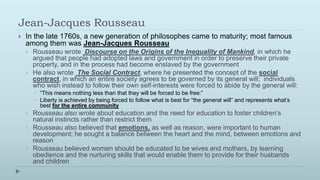
Jean-Jacques Rousseau
   In the late 1760s, a new generation of philosophes came to maturity; most famous
    among them was Jean-Jacques Rousseau
       Rousseau wrote Discourse on the Origins of the Inequality of Mankind, in which he
        argued that people had adopted laws and government in order to preserve their private
        property, and in the process had become enslaved by the government
       He also wrote The Social Contract, where he presented the concept of the social
        contract, in which an entire society agrees to be governed by its general will; individuals
        who wish instead to follow their own self-interests were forced to abide by the general will:
           “This means nothing less than that they will be forced to be free:”
           Liberty is achieved by being forced to follow what is best for “the general will” and represents what’s
            best for the entire community
       Rousseau also wrote about education and the need for education to foster children’s
        natural instincts rather than restrict them
       Rousseau also believed that emotions, as well as reason, were important to human
        development; he sought a balance between the heart and the mind, between emotions and
        reason
       Rousseau believed women should be educated to be wives and mothers, by learning
        obedience and the nurturing skills that would enable them to provide for their husbands
        and children
Rights of Women
   Male philosophers for centuries had postulated that women were
    inferior to men, which made male domination of women necessary
   Female philosophers in the 18th century began to express their ideas
    about improving the conditions of women
   Mary Wollstonecraft wrote Vindication of the Rights of
    Women, which identified two problems with the views of many
    Enlightenment thinkers:
       The same people who argued that women must obey men also said
        government based on the arbitrary power of the monarchs over their subjects
        was wrong; she pointed out that the arbitrary power of men over women was
        equally wrong
       She also argued that the Enlightenment was based on an ideal of reason in all
        human beings; because women have reason, they are entitled to the same
        rights as men
       Wollstonecraft believed women should have equal rights in education, as well
Social World of the Enlightenment
   Growth of Reading – Both publishing and the rate of literacy increased
    during the Enlightenment; the amount of books being published per
    year tripled in just under thirty years (from 1750 to 1780) and the
    literacy rate increased, especially among the middle class; magazines
    also began being published, along with daily newspapers
   Salons – Salons were elegant drawing rooms of the wealthy upper
    class’s great urban houses; gatherings in salons brought
    writers, artists, and the upper class together and helped to spread
    Enlightenment ideas; women who hosted salons found themselves in a
    position to sway political opinion and influence literary and artistic taste
Religion in the Enlightenment
   Although religion was attacked by philosophes throughout the
    Enlightenment, most Europeans were still Christians
   The Catholic parish remained an important center of life for the entire
    community
   Protestant churches had settled into well-established patterns and were often
    controlled by state authorities; many Protestants sought a deeper religious
    experience, which led to new religious movements
       The most famous new religious movement – the Methodists – was the work of John
        Wesley, an Anglican minister who believed he had a mystical experience in which “the
        gift of God’s grace” assured him of salvation
           He became a missionary among the English; his powerful sermons caused many to convert
            to his cause; his converts joined Methodist societies which gave them a sense of purpose
            and community
           Methodism appealed to the middle and lower classes;
Impact of the Enlightenment – The Arts
   Kings built grandiose palaces based on Louis XIV palace at Versailles
   Balthasar Neumann was considered one of the greatest architects of
    the Enlightenment
       He designed the Church of the Fourteen Saints in Germany and The
        Residence, a palace of the prince-bishop of Wurzburg
           Bright, light colors, fanciful decoration, and lavish ornamentation were hallmarks of the
            Enlightenment period
   A new style developed, called Rococo, which was based on the
    baroque and neoclassical styles that dominated the 17th century;
    rococo emphasized grace, charm, and gentle actions – it made use of
    delicate designs colored in gold with graceful curves
   Rococo is seen in music, architecture, and art like sculpture and
    painting
Impact of Enlightenment - Music
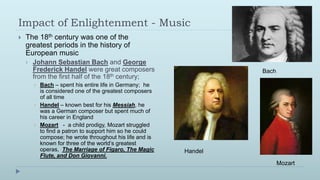
   The 18th century was one of the
    greatest periods in the history of
    European music
       Johann Sebastian Bach and George
        Frederick Handel were great composers                       Bach
        from the first half of the 18th century;
           Bach – spent his entire life in Germany; he
            is considered one of the greatest composers
            of all time
           Handel – known best for his Messiah, he
            was a German composer but spent much of
            his career in England
           Mozart - a child prodigy, Mozart struggled
            to find a patron to support him so he could
            compose; he wrote throughout his life and is
            known for three of the world’s greatest
            operas, The Marriage of Figaro, The Magic      Handel
            Flute, and Don Giovanni.
                                                                           Mozart
Enlightened Absolutism
   Enlightenment thought had an affect on the political life in European
    states
       Philosophes believed in natural rights for all people, including equality before
        the law, freedom of religious worship, freedom of speech, freedom of the
        press, and the right to assemble, hold property, and pursue happiness (sound
        familiar ? It should!)
       Philosophes believed people needed to be governed by Enlightened
        leaders, or those who allow religious tolerance, freedom of speech and
        press, and the protection of private property
       A new type of monarchy emerged in the 18th century, which historians call
        enlightened absolutism, where rulers tried to govern based on Enlightenment
        principles
           The major monarchs of the period sometimes followed Enlightenment practices and
            sometimes did not; we will examine Prussia, Austria, and Russia as examples
Prussia: Army & Bureaucracy
   Frederick William I and Frederick William II were two Prussian kings who helped
    make Prussia a major European power in the 18th century
       Frederick I built a strong bureaucracy of civil service workers; the values of the
        bureaucracy were obedience, honor, and service to the king
       Frederick I also built a huge army; he had the fourth largest army in Europe; because of its
        size and its reputation as one of the best armies in Europe, it was the most important
        institution in the state
           Members of the nobility were the officers of the army; they believed in duty, obedience, and sacrifice
            and had a strong sense of service to the king
   Frederick II, also known as Frederick the Great, was one of the best educated and
    most cultured monarchs in the 18th century
       He was well-versed in the ideas of the Enlightenment (he invited Voltaire to his court to live
        for several years)
       He enlarged the bureaucracy and the army
       He implemented some reforms based on the Enlightenment: he abolished the use of
        torture except in murder or treason cases; he granted limited freedom of the speech and
        press, and allowed greater religious toleration
           He kept the rigid social structure intact and avoided reforming the social structure, leaving serfs without
            much protection
Austrian Empire
   Austria was difficult to rule because of its size; it was composed of
    many different nationalities, languages, religions and cultures
   Empress Maria Theresa, who inherited the throne in 1740, worked to
    centralize the empire and strengthen the power of the state
   Her son Joseph II believed in the need to sweep away anything that
    stood in the path of reason; he believed Enlightenment Philosophy
    should be used to rules the empire
       He abolished serfdom, eliminated the death penalty, established the principle of
        equality of all before the law, and enacted religious reforms, including religious
        toleration
       His reform program largely failed; he alienated the nobles when he freed the
        serfs, he alienated the Catholic Church with his religious reforms;
       His successors undid nearly all of his reforms
Russia: Catherine the Great
   Peter the Great was followed by six weak successors; after the last of
    these, Peter III was murdered, his German wife Catherine emerged as
    the ruler of all the Russians
   Catherine II, or Catherine the Great, ruled Russia from 1762 to 1796
       She studied Enlightenment principles and invited philosophers to her court
       She did not make any of the reforms suggested by philosophers, as she
        needed to keep the Russian nobles happy in order to maintain their support
       She favored the Russian nobility, which made conditions worse for the Russian
        peasants, which eventually led to rebellion; the rebellion soon collapsed, and
        Catherine took stronger measures against the peasants; all rural reform was
        halted and serfdom was expanded
       Catherine also expanded the Russian territory, gaining about 50% of Poland’s
        territory and spreading southward to the Black Sea
Enlightened Absolutism
   18th century monarchs were concerned with power, strengthening the
    state, and expanding territory
   They did not use Enlightenment ideals to rule (except Joseph II, who
    had an unsuccessful attempt)
   Monarchs were concerned with the balance of power; the idea that
    states should have equal power in order to prevent any one from
    dominating the others
   They did not have a desire for peace – large armies were created to
    defend state security, but were often used to conquer new lands
War of Austrian Succession
   The War of Austrian Succession was fought from 1740 to 1748
       The Austrian Emperor Charles VI did in 1740; he was succeeded by his
        daughter Maria Theresa
       King Frederick II of Prussia took advantage of the succession and invaded
        Austrian Silesia
           This caused France to enter the war against Austria, it’s traditional enemy
           Maria Theresa struck an alliance with Great Britain
       In Europe, Prussia seized Silesia while France occupied the Austrian
        Netherlands
           In the Far East, France took Madras in India from the British
           In North America, the British captured the French fortress of Louisbourg at the entrance
            of the St. Lawrence River
       The Treaty of Aix-la-Chapelle guaranteed the return of all occupied territories
        except Silesia to their original owners; Prussia and Austria still fought over
        Silesia
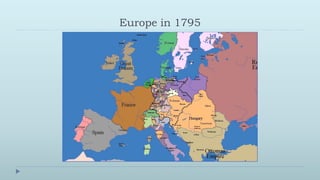
Europe in 1795
Seven Year’s War
   Maria Theresa refused to accept the loss of Silesia to the Prussians
       She rebuilt her army while working to separate France from Prussia (they were strong
        allies)
       In 1756, she achieved a diplomatic revolution, in which France abandoned Prussia
        and allied with Austria, Russia also joined this alliance
           This led to another worldwide war that had three major theaters: Europe, India, and North
            America
       In Europe, the British and Prussians fought the Austrians, Russians, and French
           Frederick II of Prussia’s armies were able to hold out for awhile, but facing attack from three
            directions, it was difficult to maintain his armies and he was gradually worn down
               Russia’s Peter III withdrew his troops from the conflict and gave back the lands the Russians occupied;
                this led to a stalemate and the desire for peace; the war ended in 1763
       In India, Britain and France struggled over territory, but the British won out
       In North America, the French and British fought over territory; French North America
        (Canada and Louisiana) were large trading areas with high value
           The British & French fought over the Gulf of St. Lawrence and the Ohio River Valley; the
            French had the support of the Indians and scored several victories at first
           The British were able to defeat the French through their use of their strong navy; the French
            were unable to reinforce their garrisons and forts, which led to British victories throughout the
            French territory

Enlightenment

  • 1.
    Enlightenment 1700CE – 1790 CE
  • 2.
    Path to Enlightenment • The Enlightenment was an 18th- century philosophical movement of intellectuals who based their ideas on the achievements of the Scientific Revolution. • Enlightenment philosophers wanted to make progress toward a better society through reason, natural Voltaire law, hope, and progress. • Voltaire and John Locke were huge influences during the Enlightenment. Voltaire sought religious tolerance for all religions while John Locke sought to find natural laws that governed human behavior that could be used to better humanity. • Locke argued that everyone was born with a tabula rasa, or a blank slate, and we are shaped by our experiences; if negative experiences could be John Locke eliminated, a good and just society would develop; he believed if institutions would follow natural laws it would produce an ideal society
  • 3.
    Philosophes  Intellectuals of the Enlightenment were known by the French name philosophes, which means “philosopher.”  The term included philosophers, writers, professors, journalists, economists, and social reformers.  They came chiefly from the nobility and middle classes.  Most of the leaders of the Enlightenment were Frenchmen who were inspired by the Englishmen of the Scientific Revolution  To philosophes, the role of philosophy was to change the world.  The purpose of philosophy is to improve humanity and make life better and happier  Philosophes study humanity through reason or an appeal to facts  Everything had to be open to rational criticism, including religion and politics  Philosophes often disagreed, especially since the Enlightenment spanned almost a century  Each succeeding generation became more radical as it built on the contributions of the previous one  A few people dominated the philosophical landscape: Montesquieu, Voltaire, and Diderot
  • 4.
    Montesquieu  Montesquieu came from French nobility  He wrote The Spirit of the Laws, which was a study of governments  He tried to use the scientific method to find the natural laws that govern the social and political relationships of human beings  He identified three basic kinds of government:  Republics, for small states;  Despotism, for large states;  Monarchies, for moderately sized states  He analyzed the separation of powers in the English government, that functioned with checks and balances so that no one branch of government was more powerful than any other  Montesquieus’s principles are found in the U.S.Constitution
  • 5.
    Voltaire  Voltaire came from a prosperous middle class family  He is considered the greatest figure of the Enlightenment  He wrote pamphlets, novels, plays, letters, essays, and histories  He was well known for his criticism of Christianity and his strong belief in religious tolerance.  He published Treatise on Toleration, in which he philosophized “all men are brothers under God.”  Voltaire believed in deism, a belief that God created the universe, but it was like a clock; once set in motion, it runs without interference from God, and runs according to natural laws
  • 6.
    Diderot  Diderot studied at the University of Paris, where he wrote Encyclopedia, or Classified Dictionary of the Sciences, Arts, and Trades  It was a 28-volume collection of knowledge, published over twenty years  The Encyclopedia was used in the fight against the old French social order, and as a critique of religion  Diderot worked to attack religious superstition and supported religious toleration  The Encyclopedia was used to spread knowledge and the ideas of the Enlightenment
  • 7.
    Social Sciences  Economics – Adam Smith, a Scottish philosopher, is considered one of the founders of the social science economics, along with the French physiocrats.  The Physiocrats were interested in identifying the natural economic laws that governed human society; they maintained that if individuals were free to pursue their own economic self-interests, all society would ultimately benefit  The Physiocrats believed the State (government) should not interrupt the free play of natural economic forces by imposing government regulation on the economy; the state should leave the economy alone  This doctrine is known as laissez-faire economics, meaning “let the people do what they want”  Adam Smith wrote The Wealth of Nations, which supported the laissez-faire doctrine that government should not interfere with the economy  Smith believed the government had only three basic roles:  Protecting society from invasion (army)  Defending citizens from injustice (police)  Keeping up certain public works, such as roads and canals
  • 8.
    Crime & Punishment  By the 18th century, most European states had developed a system of courts to deal with the punishment of crime  Punishments were often cruel and were meant to deter others from committing crimes, partially because the state could not maintain a large police force to ensure the capture of criminals  Cesare Beccaria wrote On Crimes and Punishments, which postulated that punishments should not be exercises in brutality  He opposed capital punishment because he believed it did not stop others from committing crimes  He did not believe the state should commit murder: “Is it not absurd, that the laws, which punish murder, should, in order to prevent murder, publicly commit murder themselves?”
  • 9.
    Jean-Jacques Rousseau  In the late 1760s, a new generation of philosophes came to maturity; most famous among them was Jean-Jacques Rousseau  Rousseau wrote Discourse on the Origins of the Inequality of Mankind, in which he argued that people had adopted laws and government in order to preserve their private property, and in the process had become enslaved by the government  He also wrote The Social Contract, where he presented the concept of the social contract, in which an entire society agrees to be governed by its general will; individuals who wish instead to follow their own self-interests were forced to abide by the general will:  “This means nothing less than that they will be forced to be free:”  Liberty is achieved by being forced to follow what is best for “the general will” and represents what’s best for the entire community  Rousseau also wrote about education and the need for education to foster children’s natural instincts rather than restrict them  Rousseau also believed that emotions, as well as reason, were important to human development; he sought a balance between the heart and the mind, between emotions and reason  Rousseau believed women should be educated to be wives and mothers, by learning obedience and the nurturing skills that would enable them to provide for their husbands and children
  • 10.
    Rights of Women  Male philosophers for centuries had postulated that women were inferior to men, which made male domination of women necessary  Female philosophers in the 18th century began to express their ideas about improving the conditions of women  Mary Wollstonecraft wrote Vindication of the Rights of Women, which identified two problems with the views of many Enlightenment thinkers:  The same people who argued that women must obey men also said government based on the arbitrary power of the monarchs over their subjects was wrong; she pointed out that the arbitrary power of men over women was equally wrong  She also argued that the Enlightenment was based on an ideal of reason in all human beings; because women have reason, they are entitled to the same rights as men  Wollstonecraft believed women should have equal rights in education, as well
  • 11.
    Social World ofthe Enlightenment  Growth of Reading – Both publishing and the rate of literacy increased during the Enlightenment; the amount of books being published per year tripled in just under thirty years (from 1750 to 1780) and the literacy rate increased, especially among the middle class; magazines also began being published, along with daily newspapers  Salons – Salons were elegant drawing rooms of the wealthy upper class’s great urban houses; gatherings in salons brought writers, artists, and the upper class together and helped to spread Enlightenment ideas; women who hosted salons found themselves in a position to sway political opinion and influence literary and artistic taste
  • 12.
    Religion in theEnlightenment  Although religion was attacked by philosophes throughout the Enlightenment, most Europeans were still Christians  The Catholic parish remained an important center of life for the entire community  Protestant churches had settled into well-established patterns and were often controlled by state authorities; many Protestants sought a deeper religious experience, which led to new religious movements  The most famous new religious movement – the Methodists – was the work of John Wesley, an Anglican minister who believed he had a mystical experience in which “the gift of God’s grace” assured him of salvation  He became a missionary among the English; his powerful sermons caused many to convert to his cause; his converts joined Methodist societies which gave them a sense of purpose and community  Methodism appealed to the middle and lower classes;
  • 13.
    Impact of theEnlightenment – The Arts  Kings built grandiose palaces based on Louis XIV palace at Versailles  Balthasar Neumann was considered one of the greatest architects of the Enlightenment  He designed the Church of the Fourteen Saints in Germany and The Residence, a palace of the prince-bishop of Wurzburg  Bright, light colors, fanciful decoration, and lavish ornamentation were hallmarks of the Enlightenment period  A new style developed, called Rococo, which was based on the baroque and neoclassical styles that dominated the 17th century; rococo emphasized grace, charm, and gentle actions – it made use of delicate designs colored in gold with graceful curves  Rococo is seen in music, architecture, and art like sculpture and painting
  • 14.
    Impact of Enlightenment- Music  The 18th century was one of the greatest periods in the history of European music  Johann Sebastian Bach and George Frederick Handel were great composers Bach from the first half of the 18th century;  Bach – spent his entire life in Germany; he is considered one of the greatest composers of all time  Handel – known best for his Messiah, he was a German composer but spent much of his career in England  Mozart - a child prodigy, Mozart struggled to find a patron to support him so he could compose; he wrote throughout his life and is known for three of the world’s greatest operas, The Marriage of Figaro, The Magic Handel Flute, and Don Giovanni. Mozart
  • 15.
    Enlightened Absolutism  Enlightenment thought had an affect on the political life in European states  Philosophes believed in natural rights for all people, including equality before the law, freedom of religious worship, freedom of speech, freedom of the press, and the right to assemble, hold property, and pursue happiness (sound familiar ? It should!)  Philosophes believed people needed to be governed by Enlightened leaders, or those who allow religious tolerance, freedom of speech and press, and the protection of private property  A new type of monarchy emerged in the 18th century, which historians call enlightened absolutism, where rulers tried to govern based on Enlightenment principles  The major monarchs of the period sometimes followed Enlightenment practices and sometimes did not; we will examine Prussia, Austria, and Russia as examples
  • 16.
    Prussia: Army &Bureaucracy  Frederick William I and Frederick William II were two Prussian kings who helped make Prussia a major European power in the 18th century  Frederick I built a strong bureaucracy of civil service workers; the values of the bureaucracy were obedience, honor, and service to the king  Frederick I also built a huge army; he had the fourth largest army in Europe; because of its size and its reputation as one of the best armies in Europe, it was the most important institution in the state  Members of the nobility were the officers of the army; they believed in duty, obedience, and sacrifice and had a strong sense of service to the king  Frederick II, also known as Frederick the Great, was one of the best educated and most cultured monarchs in the 18th century  He was well-versed in the ideas of the Enlightenment (he invited Voltaire to his court to live for several years)  He enlarged the bureaucracy and the army  He implemented some reforms based on the Enlightenment: he abolished the use of torture except in murder or treason cases; he granted limited freedom of the speech and press, and allowed greater religious toleration  He kept the rigid social structure intact and avoided reforming the social structure, leaving serfs without much protection
  • 17.
    Austrian Empire  Austria was difficult to rule because of its size; it was composed of many different nationalities, languages, religions and cultures  Empress Maria Theresa, who inherited the throne in 1740, worked to centralize the empire and strengthen the power of the state  Her son Joseph II believed in the need to sweep away anything that stood in the path of reason; he believed Enlightenment Philosophy should be used to rules the empire  He abolished serfdom, eliminated the death penalty, established the principle of equality of all before the law, and enacted religious reforms, including religious toleration  His reform program largely failed; he alienated the nobles when he freed the serfs, he alienated the Catholic Church with his religious reforms;  His successors undid nearly all of his reforms
  • 18.
    Russia: Catherine theGreat  Peter the Great was followed by six weak successors; after the last of these, Peter III was murdered, his German wife Catherine emerged as the ruler of all the Russians  Catherine II, or Catherine the Great, ruled Russia from 1762 to 1796  She studied Enlightenment principles and invited philosophers to her court  She did not make any of the reforms suggested by philosophers, as she needed to keep the Russian nobles happy in order to maintain their support  She favored the Russian nobility, which made conditions worse for the Russian peasants, which eventually led to rebellion; the rebellion soon collapsed, and Catherine took stronger measures against the peasants; all rural reform was halted and serfdom was expanded  Catherine also expanded the Russian territory, gaining about 50% of Poland’s territory and spreading southward to the Black Sea
  • 19.
    Enlightened Absolutism  18th century monarchs were concerned with power, strengthening the state, and expanding territory  They did not use Enlightenment ideals to rule (except Joseph II, who had an unsuccessful attempt)  Monarchs were concerned with the balance of power; the idea that states should have equal power in order to prevent any one from dominating the others  They did not have a desire for peace – large armies were created to defend state security, but were often used to conquer new lands
  • 20.
    War of AustrianSuccession  The War of Austrian Succession was fought from 1740 to 1748  The Austrian Emperor Charles VI did in 1740; he was succeeded by his daughter Maria Theresa  King Frederick II of Prussia took advantage of the succession and invaded Austrian Silesia  This caused France to enter the war against Austria, it’s traditional enemy  Maria Theresa struck an alliance with Great Britain  In Europe, Prussia seized Silesia while France occupied the Austrian Netherlands  In the Far East, France took Madras in India from the British  In North America, the British captured the French fortress of Louisbourg at the entrance of the St. Lawrence River  The Treaty of Aix-la-Chapelle guaranteed the return of all occupied territories except Silesia to their original owners; Prussia and Austria still fought over Silesia
  • 21.
  • 22.
    Seven Year’s War  Maria Theresa refused to accept the loss of Silesia to the Prussians  She rebuilt her army while working to separate France from Prussia (they were strong allies)  In 1756, she achieved a diplomatic revolution, in which France abandoned Prussia and allied with Austria, Russia also joined this alliance  This led to another worldwide war that had three major theaters: Europe, India, and North America  In Europe, the British and Prussians fought the Austrians, Russians, and French  Frederick II of Prussia’s armies were able to hold out for awhile, but facing attack from three directions, it was difficult to maintain his armies and he was gradually worn down  Russia’s Peter III withdrew his troops from the conflict and gave back the lands the Russians occupied; this led to a stalemate and the desire for peace; the war ended in 1763  In India, Britain and France struggled over territory, but the British won out  In North America, the French and British fought over territory; French North America (Canada and Louisiana) were large trading areas with high value  The British & French fought over the Gulf of St. Lawrence and the Ohio River Valley; the French had the support of the Indians and scored several victories at first  The British were able to defeat the French through their use of their strong navy; the French were unable to reinforce their garrisons and forts, which led to British victories throughout the French territory