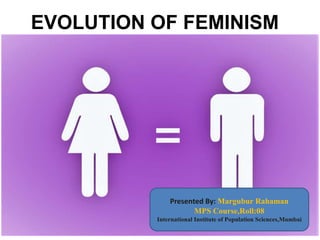

EVOLUTION OF FEMINISM
Presented By: Margubur Rahaman
MPS Course,Roll:08
International Institute of Population Sciences,Mumbai
INTRODUCTION
• The term feminism can be used to describe a
political, cultural or economic movement aimed at
establishing equal rights and legal protection for
women.
• Feminism involves political and sociological theories
and philosophies concerned with issues of gender
difference, as well as a movement that advocates
gender equality for women and campaigns for
women's rights and interests.
• Although the terms "feminism" and "feminist" did
not gain widespread use until the 1970s.
EVOLUTION OF FEMINISM
 Feminists and scholars have divided the movement's history
into three "waves“-
WAVES
1ST WAVE
(19th-1960)
2ND WAVE
(1960-1980)
3RD WAVE
(After 1980-2012)
US
Sweden
Bulgaria
England
Canada
Russia
Japan,Australia
Kuwait, Canada
New Zealand
Sweden
Switzerland
United Kingdom
China, south
east Asia,
middle west
countries
BEFORE 1ST WAVE(BEFORE 19TH CENTURY)
• According to Miriam Schneir, simon de beauvoirde
Beauvoir wrote that the first woman to "take up her
pen in defense of her sex" was Christine de Pizan in
the 15th century.
• Anne Bradstreet wrote poem on equality of sexes.
• Wollstonecraft published one of the first feminist
treatises, A Vindication of the Rights of
Woman (1792), in which she advocated the social
and moral equality of the sexes.
• 1882, Rose Scott was feminist-chiefly concerned
with suffrage & consequently with women's access
to parliaments and other political activities.
FIRST WAVE
• Mainly evolve throughout the Western
world.
• It focused on legal issues, primarily on
gaining the right to vote.
• It focused on the promotion of equal
contract and property rights for women.
• active in campaigning for women's
sexual, reproductive, and economic
rights at this time.
Result of feminist movement
• Western Australia, UK, Turkey granted women the right
to vote.
• Women were allowed to practice law in France.
• The post office profession was opened to women in
Korea
• The first public elementary school for girls was opened
in Korea, Egypt.
• The women's university was opened in japan, china,
Germany.
• Sweden: Maternity leave was granted for female
industrial workers.
• International Women's Day was celebrated in China
from 1922 on.
• Great Britain: The Sex Disqualification (Removal) Act
1919 became law.
SECOND WAVE
• 2nd wave feminism refers to the period of activity in
the early 1960s and lasting through the late 1980s.
• second wave was largely concerned with other issues
of equality, such as ending discrimination.
• The feminist activist and author Carol Hanisch
coined the slogan "The Personal is Political" which
became synonymous with the second wave.
• "Women’s Liberation" was first used in the United
States in 1964 and first appeared in print in 1966.
THIRD WAVE
• Third-wave feminism began in the early 1990s, arising
as a response to perceived failures of the second wave
• A post-structuralist interpretation of gender and
sexuality is central to much of the third wave's
ideology.
• Third-wave feminists often focus on "micro-politics"
and challenge the second wave's paradigm as to what
is, or is not, good for females.
• Feminist leaders rooted in the second wave like Gloria
Anzaldua, bell hooks, Chela Sandoval, Cherrie
Moraga, Audre Lorde, Maxine Hong Kingston, and
many other black feminists
POST-FEMINISM
• Post-feminism describes a range of viewpoints
reacting to feminism.
• Nadine Strossen, consider feminism to hold simply
that "women are people".
• McRobbie believes that post-feminism is most
clearly seen on so-called feminist media products,
such as Bridget Jones's Diary, Sex and the City, and
Ally McBeal.
• Feminist theory is an extension of feminism into
theoretical or philosophical fields.
Socialist and Marxist
• Socialist feminism connects the oppression of
women to Marxist ideas about exploitation,
oppression and labour.
• Socialist feminists think unequal standing in both
the workplace and the domestic sphere holds
women down.
• Socialist feminists see prostitution, domestic work,
childcare and marriage as ways in which women
are exploited by a patriarchal system that devalues
women and the substantial work they do.
• Socialist feminists focus their energies on broad
change that affects society as a whole, rather than
on an individual basis.
Others feminism philosophy
• postcolonial and third-world
• libertarian
• post-structural and postmodern
• ecofeminism
• heterosexual relationships
• religion
• "feminist sex wars” a) anti-pornography
movement b) sex-positive movement
• pro-feminism
• pro-feminism is the support of feminism without
implying that the supporter is a member of the
feminist movement.
CONCLUSION
• Feminism is not a single theory, but theories
as it differ, according to land, experience, and
the term 'feminism' has many different uses
and its meanings are often contested. The
feminist movement emerged to resist the
injustices against women. As there is no
consensus on the exact list of these injustices,
many theories developed according to the
situation, which has more or less same
relevance and as such the topic has no
uniformity in approach.
THANK YOU

Evolution of feminism

  • 1.
    EVOLUTION OF FEMINISM PresentedBy: Margubur Rahaman MPS Course,Roll:08 International Institute of Population Sciences,Mumbai
  • 2.
    INTRODUCTION • The termfeminism can be used to describe a political, cultural or economic movement aimed at establishing equal rights and legal protection for women. • Feminism involves political and sociological theories and philosophies concerned with issues of gender difference, as well as a movement that advocates gender equality for women and campaigns for women's rights and interests. • Although the terms "feminism" and "feminist" did not gain widespread use until the 1970s.
  • 3.
    EVOLUTION OF FEMINISM Feminists and scholars have divided the movement's history into three "waves“- WAVES 1ST WAVE (19th-1960) 2ND WAVE (1960-1980) 3RD WAVE (After 1980-2012) US Sweden Bulgaria England Canada Russia Japan,Australia Kuwait, Canada New Zealand Sweden Switzerland United Kingdom China, south east Asia, middle west countries
  • 4.
    BEFORE 1ST WAVE(BEFORE19TH CENTURY) • According to Miriam Schneir, simon de beauvoirde Beauvoir wrote that the first woman to "take up her pen in defense of her sex" was Christine de Pizan in the 15th century. • Anne Bradstreet wrote poem on equality of sexes. • Wollstonecraft published one of the first feminist treatises, A Vindication of the Rights of Woman (1792), in which she advocated the social and moral equality of the sexes. • 1882, Rose Scott was feminist-chiefly concerned with suffrage & consequently with women's access to parliaments and other political activities.
  • 5.
    FIRST WAVE • Mainlyevolve throughout the Western world. • It focused on legal issues, primarily on gaining the right to vote. • It focused on the promotion of equal contract and property rights for women. • active in campaigning for women's sexual, reproductive, and economic rights at this time.
  • 6.
    Result of feministmovement • Western Australia, UK, Turkey granted women the right to vote. • Women were allowed to practice law in France. • The post office profession was opened to women in Korea • The first public elementary school for girls was opened in Korea, Egypt. • The women's university was opened in japan, china, Germany. • Sweden: Maternity leave was granted for female industrial workers. • International Women's Day was celebrated in China from 1922 on. • Great Britain: The Sex Disqualification (Removal) Act 1919 became law.
  • 7.
    SECOND WAVE • 2ndwave feminism refers to the period of activity in the early 1960s and lasting through the late 1980s. • second wave was largely concerned with other issues of equality, such as ending discrimination. • The feminist activist and author Carol Hanisch coined the slogan "The Personal is Political" which became synonymous with the second wave. • "Women’s Liberation" was first used in the United States in 1964 and first appeared in print in 1966.
  • 8.
    THIRD WAVE • Third-wavefeminism began in the early 1990s, arising as a response to perceived failures of the second wave • A post-structuralist interpretation of gender and sexuality is central to much of the third wave's ideology. • Third-wave feminists often focus on "micro-politics" and challenge the second wave's paradigm as to what is, or is not, good for females. • Feminist leaders rooted in the second wave like Gloria Anzaldua, bell hooks, Chela Sandoval, Cherrie Moraga, Audre Lorde, Maxine Hong Kingston, and many other black feminists
  • 9.
    POST-FEMINISM • Post-feminism describesa range of viewpoints reacting to feminism. • Nadine Strossen, consider feminism to hold simply that "women are people". • McRobbie believes that post-feminism is most clearly seen on so-called feminist media products, such as Bridget Jones's Diary, Sex and the City, and Ally McBeal. • Feminist theory is an extension of feminism into theoretical or philosophical fields.
  • 10.
    Socialist and Marxist •Socialist feminism connects the oppression of women to Marxist ideas about exploitation, oppression and labour. • Socialist feminists think unequal standing in both the workplace and the domestic sphere holds women down. • Socialist feminists see prostitution, domestic work, childcare and marriage as ways in which women are exploited by a patriarchal system that devalues women and the substantial work they do. • Socialist feminists focus their energies on broad change that affects society as a whole, rather than on an individual basis.
  • 11.
    Others feminism philosophy •postcolonial and third-world • libertarian • post-structural and postmodern • ecofeminism • heterosexual relationships • religion • "feminist sex wars” a) anti-pornography movement b) sex-positive movement • pro-feminism • pro-feminism is the support of feminism without implying that the supporter is a member of the feminist movement.
  • 12.
    CONCLUSION • Feminism isnot a single theory, but theories as it differ, according to land, experience, and the term 'feminism' has many different uses and its meanings are often contested. The feminist movement emerged to resist the injustices against women. As there is no consensus on the exact list of these injustices, many theories developed according to the situation, which has more or less same relevance and as such the topic has no uniformity in approach.
  • 13.