Palmoplantar Keratodermasfacebook.com/groups/dermatologycourseonline
Palmoplantar keratodermas
Also known as ‘keratosis palmaris et
plantaris’
Palmoplantar keratodermas
Its inherited or acquired heterogeneous
group of skin conditions with chronic
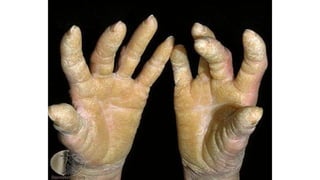
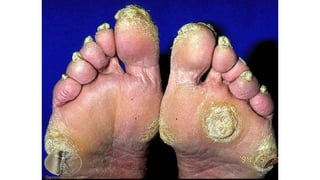
thick hyperkeratotic palms/soles
PPK
It is important to determine whether
other features are present
PPK
must perform complete dermatological
examination including skin (atrophy,
knuckle pads, blisters, pseudoainhum) nails,
hair, and mucosa.
also impaired hearing cardiomyopathy
(in patients with woolly hair), starfish
keratoses
PPK
TRANSGREDIENS = hyperkeratosis
that crosses palm/sole edge
contiguously or as callosities on
pressure points on the fingers or
knuckles, or elsewhere
NON-TRANSGRADIENT =
hyperkeratosis involves only the palms
and soles
Classification of PPK
HEREDITARY
ACQUIRED
Hereditary keratoderma
the condition runs in families, its AD or
AR usually most severe (i.e. mal de
Meleda, Papillon–Lefèvre)
Acquired keratoderma
more common & occurs as a result
of a change in the health or the
environment of the affected person or
associated with skin disorders
Classification
PPK is classified clinically as
DIFFUSE
FOCAL
PUNCTUATE
Palmoplantar keratodermas
1. Diffuse type: uniform involvement
of the palmoplantar surface
Palmoplantar keratodermas
2.Focal type: localized areas of
hyperkeratosis located mainly on
pressure points and sites of recurrent
friction
Palmoplantar keratodermas
3.Punctate type: multiple small,
hyperkeratotic papules, spicules, or
nodules on the palms and soles may
involve the entire palmoplantar
surface or may be restricted to certain
locations
Palmoplantar keratodermas
The genetic basis of many keratodermas
particularly involves mutations in genes
encoding
Keratins
Connexins
desmosomal components
HEREDITARY PALMOPLANTAR KERATODERMA
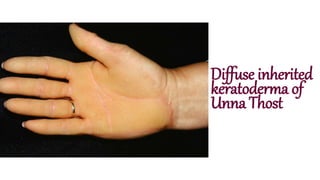
Diffuse inherited
keratoderma of
Unna Thost
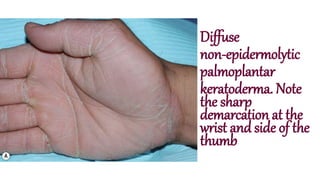
Diffuse
non-epidermolytic
palmoplantar
keratoderma. Note
the sharp
demarcation at the
wrist and side of the
thumb
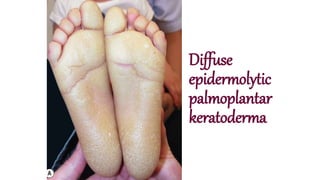
Diffuse
epidermolytic
palmoplantar
keratoderma
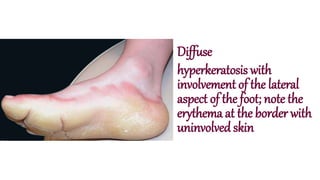
Diffuse
hyperkeratosis with
involvement of the lateral
aspect of the foot; note the
erythema at the border with
uninvolved skin
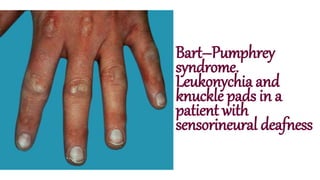
Bart–Pumphrey
syndrome.
Leukonychia and
knuckle pads in a
patient with
sensorineural deafness
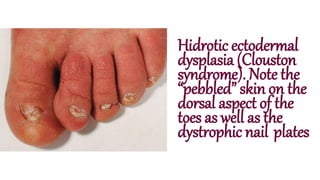
Hidrotic ectodermal
dysplasia (Clouston
syndrome). Note the
“pebbled” skin on the
dorsal aspect of the
toes as well as the
dystrophic nail plates
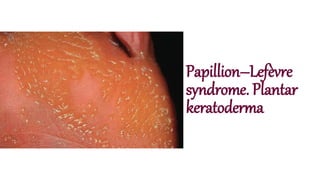
Papillion–Lefèvre
syndrome. Plantar
keratoderma
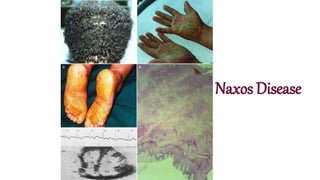
Naxos Disease
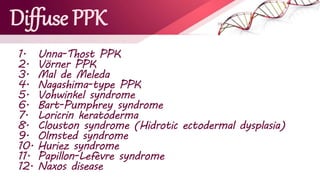
Diffuse PPK
1. Unna-Thost PPK
2. Vörner PPK
3. Mal de Meleda
4. Nagashima-type PPK
5. Vohwinkel syndrome
6. Bart-Pumphrey syndrome
7. Loricrin keratoderma
8. Clouston syndrome (Hidrotic ectodermal dysplasia)
9. Olmsted syndrome
10. Huriez syndrome
11. Papillon-Lefèvre syndrome
12. Naxos disease
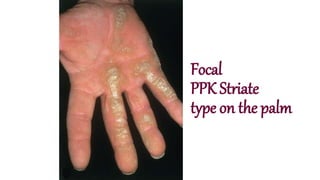
Focal
PPK Striate
type on the palm
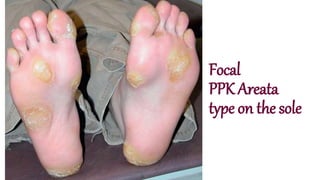
Focal
PPK Areata
type on the sole
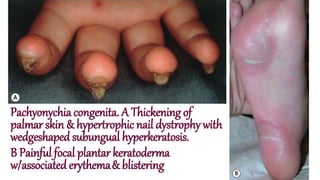
Pachyonychia congenita. A Thickening of
palmar skin & hypertrophic nail dystrophy with
wedgeshaped subungual hyperkeratosis.
B Painful focal plantar keratoderma
w/associated erythema& blistering
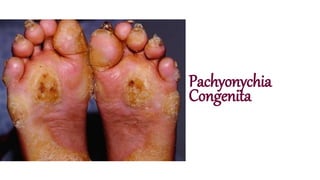
Pachyonychia
Congenita
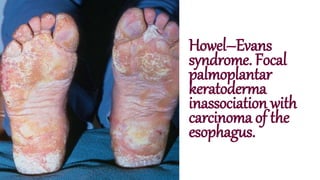
Howel–Evans
syndrome. Focal
palmoplantar
keratoderma
inassociation with
carcinoma of the
esophagus.
Focal type
1. Focal PPK areata type or striate type
(Brunauer-Fohs-Siemens syndrome)
2. Focal palmoplantar and gingival keratosis
(characterized clinically by focal PPK with
leukoplakic appearance on the labial surface
of the attached gingival lesion, and
histologically by focal epidermolytic PPK)
3. Focal keratoderma with oral leukokeratosis
4. Pachyonychia congenita
5. Focal PPK associated w/esophageal carcinoma
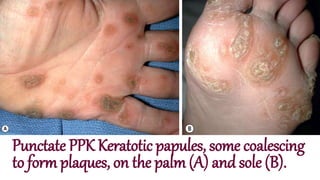
Punctate PPK Keratotic papules, some coalescing
to form plaques, on the palm (A) and sole (B).
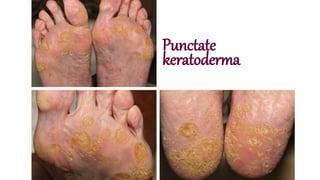
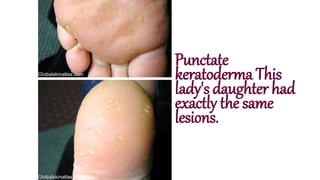
Punctate
keratoderma
Punctate
keratoderma This
lady's daughter had
exactly the same
lesions.
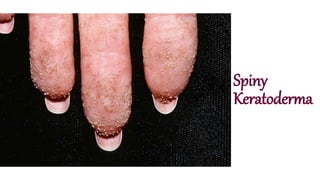
Spiny
Keratoderma
Punctate type
Buschke-Fischer syndrome
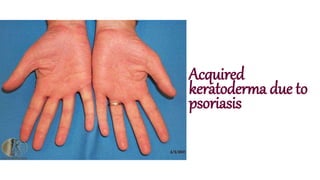
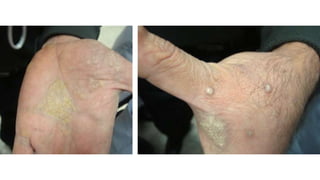
ACQUIRED PALMOPLANTAR KERATODERMAS
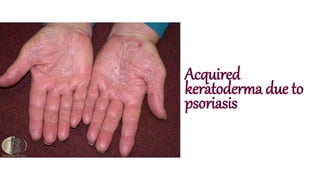
Acquired
keratoderma due to
psoriasis
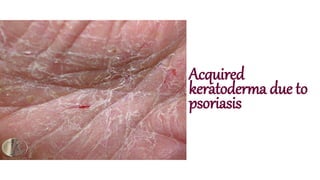
Acquired
keratoderma due to
psoriasis
Acquired
keratoderma due to
psoriasis
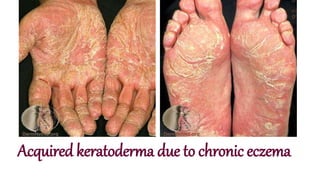
Acquired keratoderma due to chronic eczema
Acquired PPK
NOT inherited as a primary genetic
condition. They may occur as part of a
generalised skin condition (some of
which may be inherited) or as a result of
another illness
Acquired PPK
more likely to present in adulthood
CAUSES OF ACQUIRED KERATODERMA
I. INFLAMMATORY SKIN CONDITIONS
II. INFECTIONS
III. CIRCULATORY PROBLEMS
IV. 2ry TO INHERITED CONDITIONS THAT
MAY NOT USUALLY RESULT IN PPK
V. DRUGS AND TOXINS
VI. INTERNAL DISORDERS
VII. MISCELLANEOUS
Complications of PKK
Complications of PPK
1. Severe pain
2. Difficulty in walking
3. Secondary infection
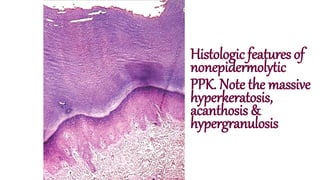
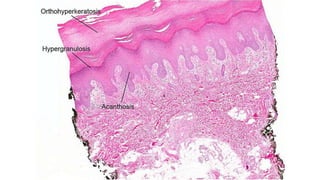
Histopathology of PPK
Histologic features of
nonepidermolytic
PPK. Note the massive
hyperkeratosis,
acanthosis &
hypergranulosis
Treatments of PPK
Treatment
Treatment of all types of hereditary
and nonhereditary keratodermas can be
difficult.
Most treatment options only
result in short-term improvement
and are compounded frequently by side
effects
I. GENERAL MEASURES
II. TOPICAL
III.SYSTEMIC
IV.SURGICAL
General Measures
Evaluation of family members in
hereditary case and genetic
counseling
In acquired cases, identify and
address possible underlying causes
Regular foot care, careful selection of
footwear, and treatment of fungal
infections are important
Topical
1. Keratolytics e.g. 5 – 10% salicylic acid,
10% lactic acid, or 10% urea in a neutral base
OR 6% salicylic acid in 70% propylene glycol
2.Emollients
3.Benzoic acid compounds
4.Topical retinoids tretinoin
5.Calcipotriol
6.Topical steroids in conditions where
there is an inflammatory component
Systemic
Retinoids effective, especially in some
hereditary PPKs such as Mal de Meleda,
Papillon-Lefevre syndrome, and
erythrokeratodermia variabilis but require
long-term treatment
Surgery
1. Dermabrasion
2. CO2 laser
3. Surgical excision: For severe,
difficult to treat keratoderma. Total
excision of hyperkeratotic skin followed
by grafts has been successful in a
number of cases
REFERENCES
Dermatology Illustrated Study Guide &
Comprehensive Board Review 2012
Google images
emedicine.medscape.com
dermnetnz.org
globalskinatlas.com
youThank

Palmoplantar Keratodermas