EPIDERMAL KINETICS
Dr. Rohit Kr.Singh
P.G.Resident
Skin centre(BH)
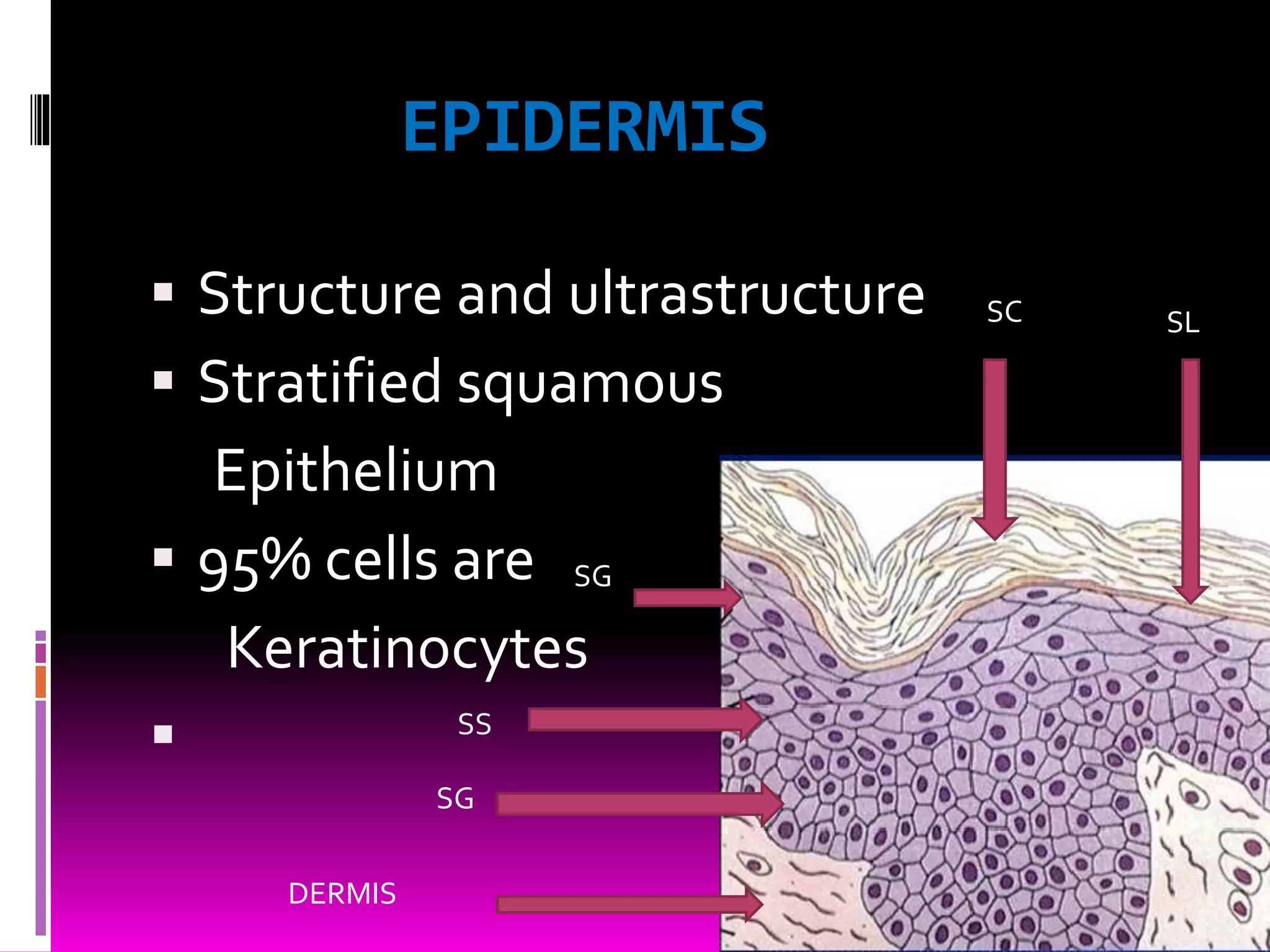
EPIDERMIS
 Structure and ultrastructure
 Stratified squamous
Epithelium
 95% cells are
Keratinocytes

SC SL
SG
SS
SG
DERMIS
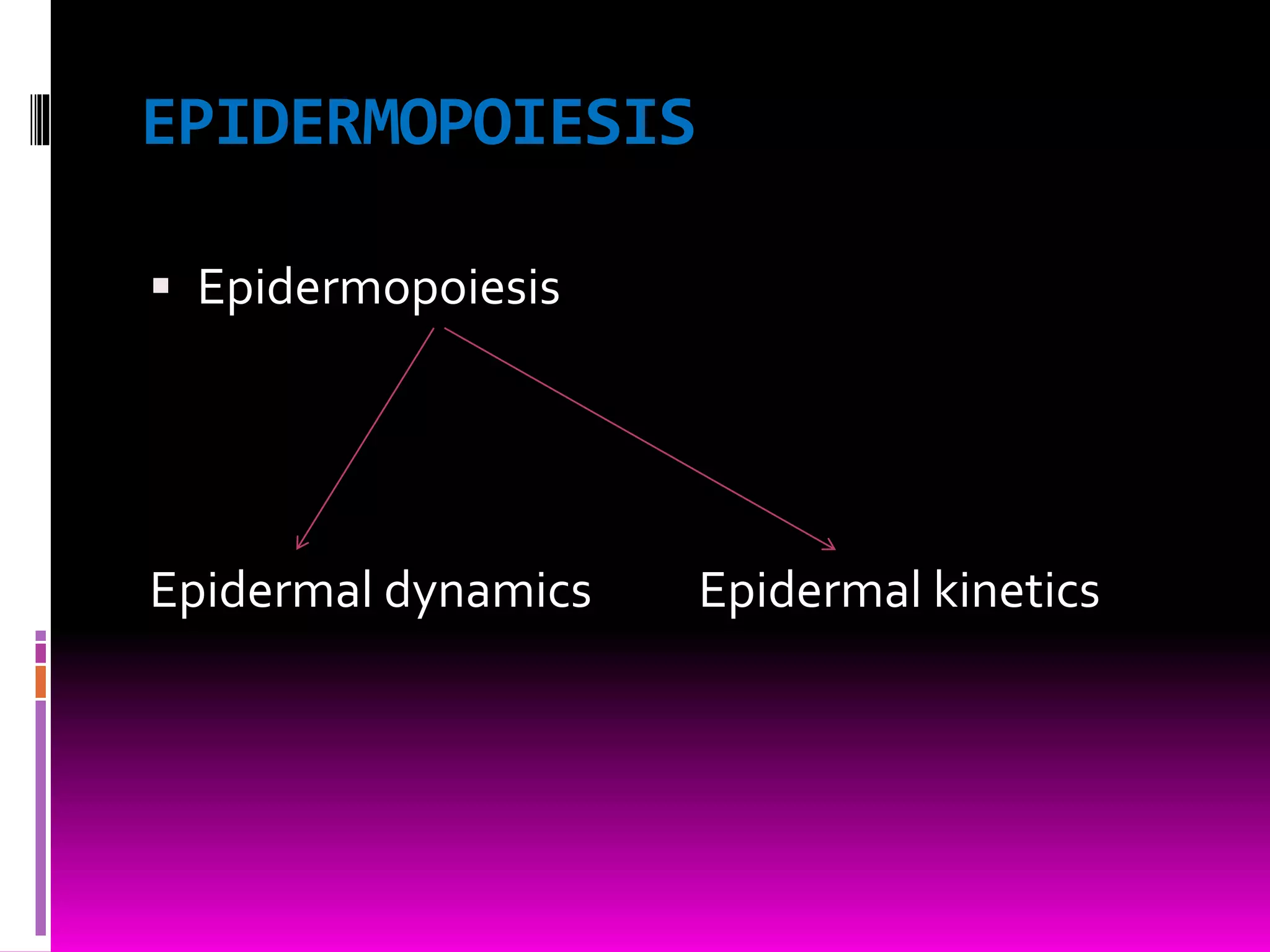
EPIDERMOPOIESIS
 Epidermopoiesis
Epidermal dynamics Epidermal kinetics
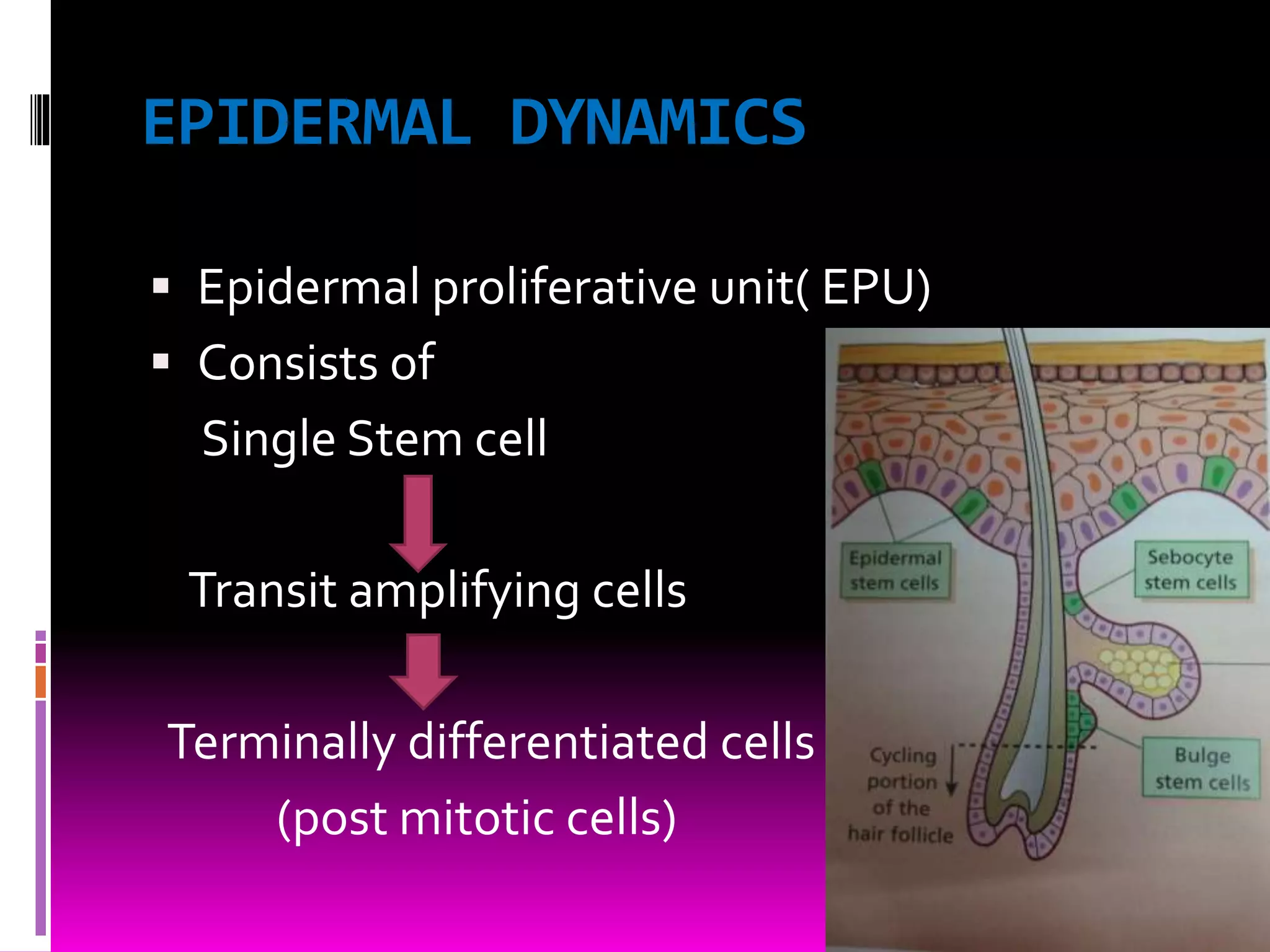
EPIDERMAL DYNAMICS
 Epidermal proliferative unit( EPU)
 Consists of
Single Stem cell
Transit amplifying cells
Terminally differentiated cells
(post mitotic cells)
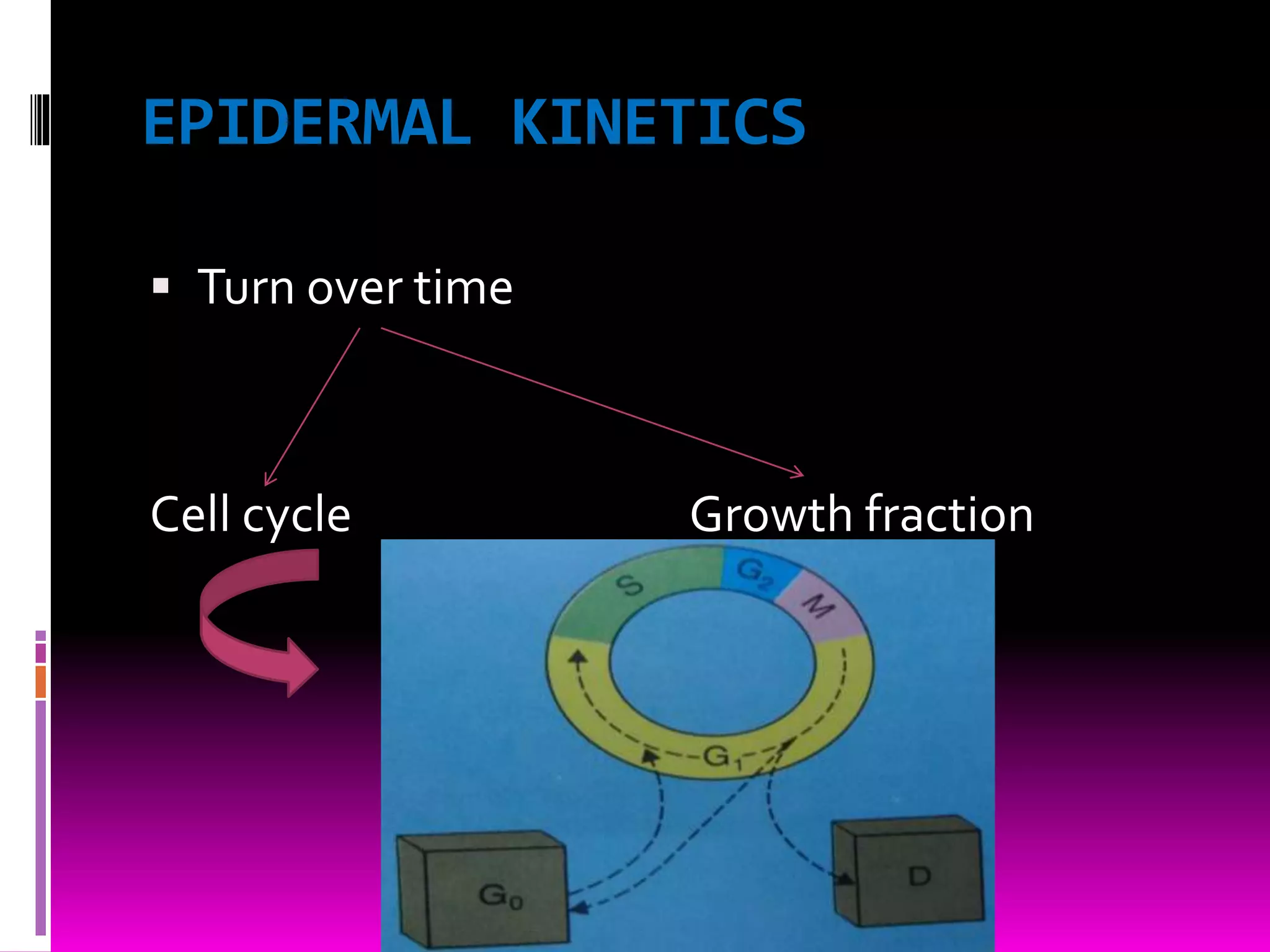
EPIDERMAL KINETICS
 Turn over time
Cell cycle Growth fraction
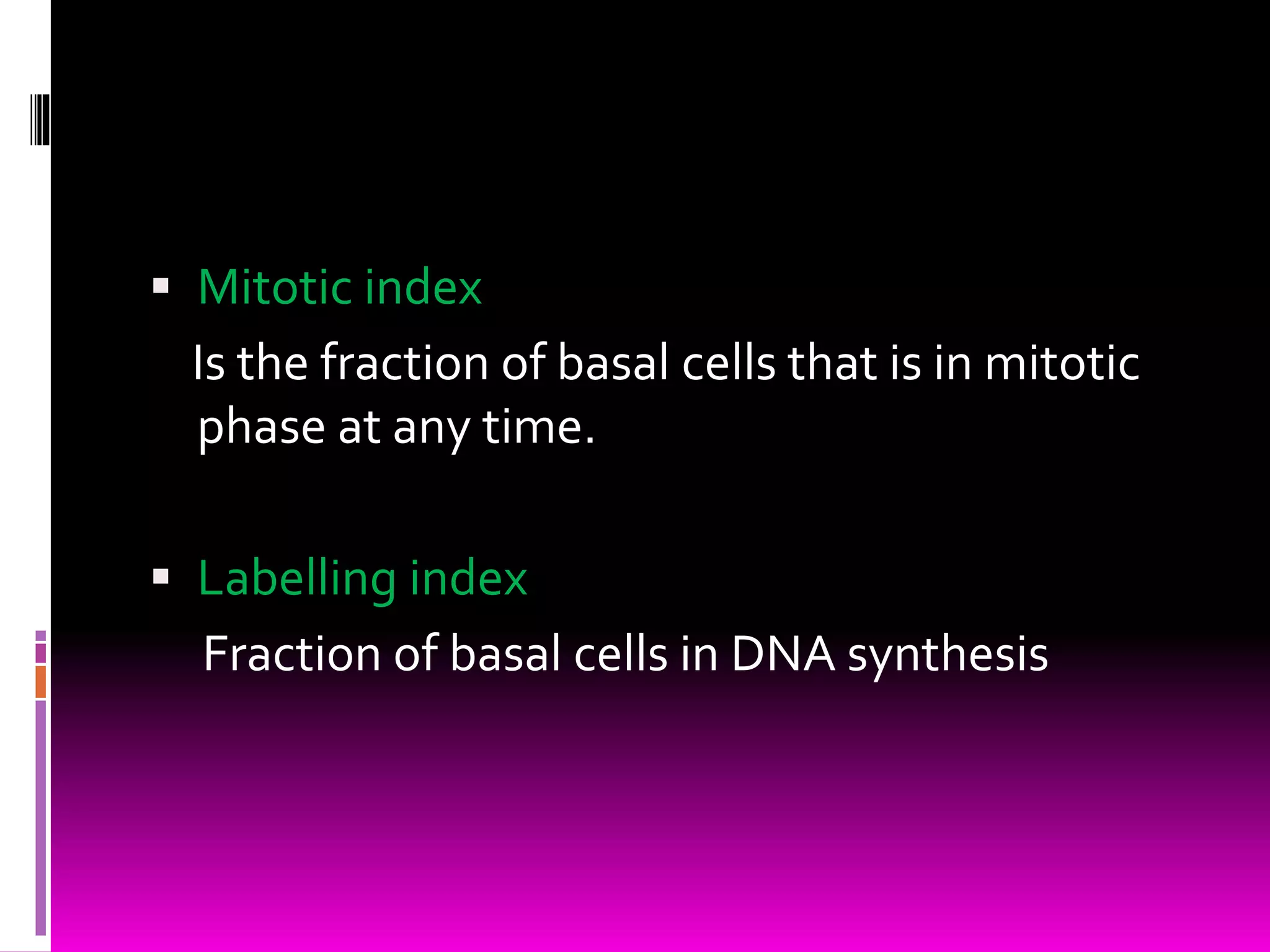
 Mitotic index
Is the fraction of basal cells that is in mitotic
phase at any time.
 Labelling index
Fraction of basal cells in DNA synthesis
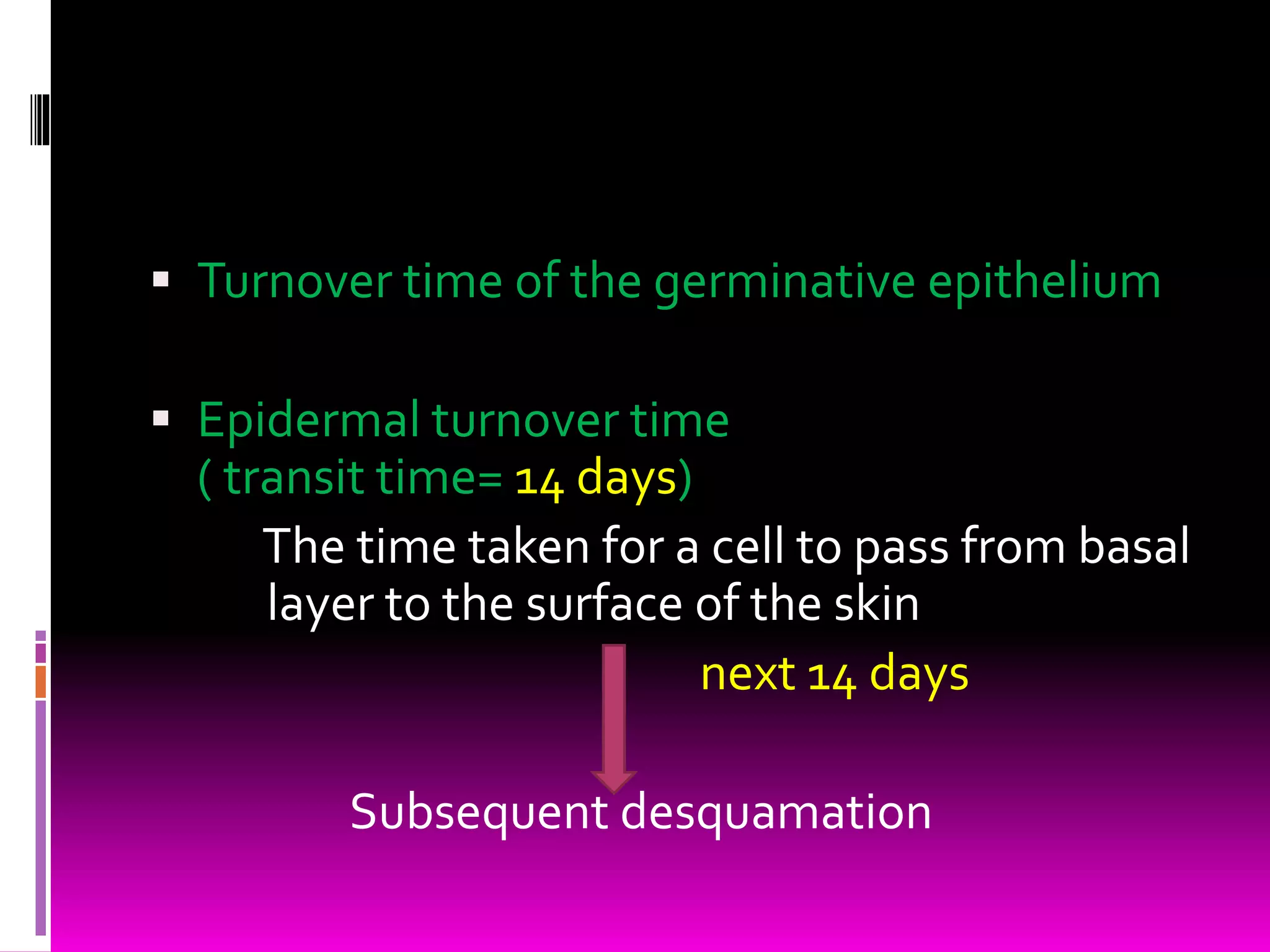
 Turnover time of the germinative epithelium
 Epidermal turnover time
( transit time= 14 days)
The time taken for a cell to pass from basal
layer to the surface of the skin
next 14 days
Subsequent desquamation
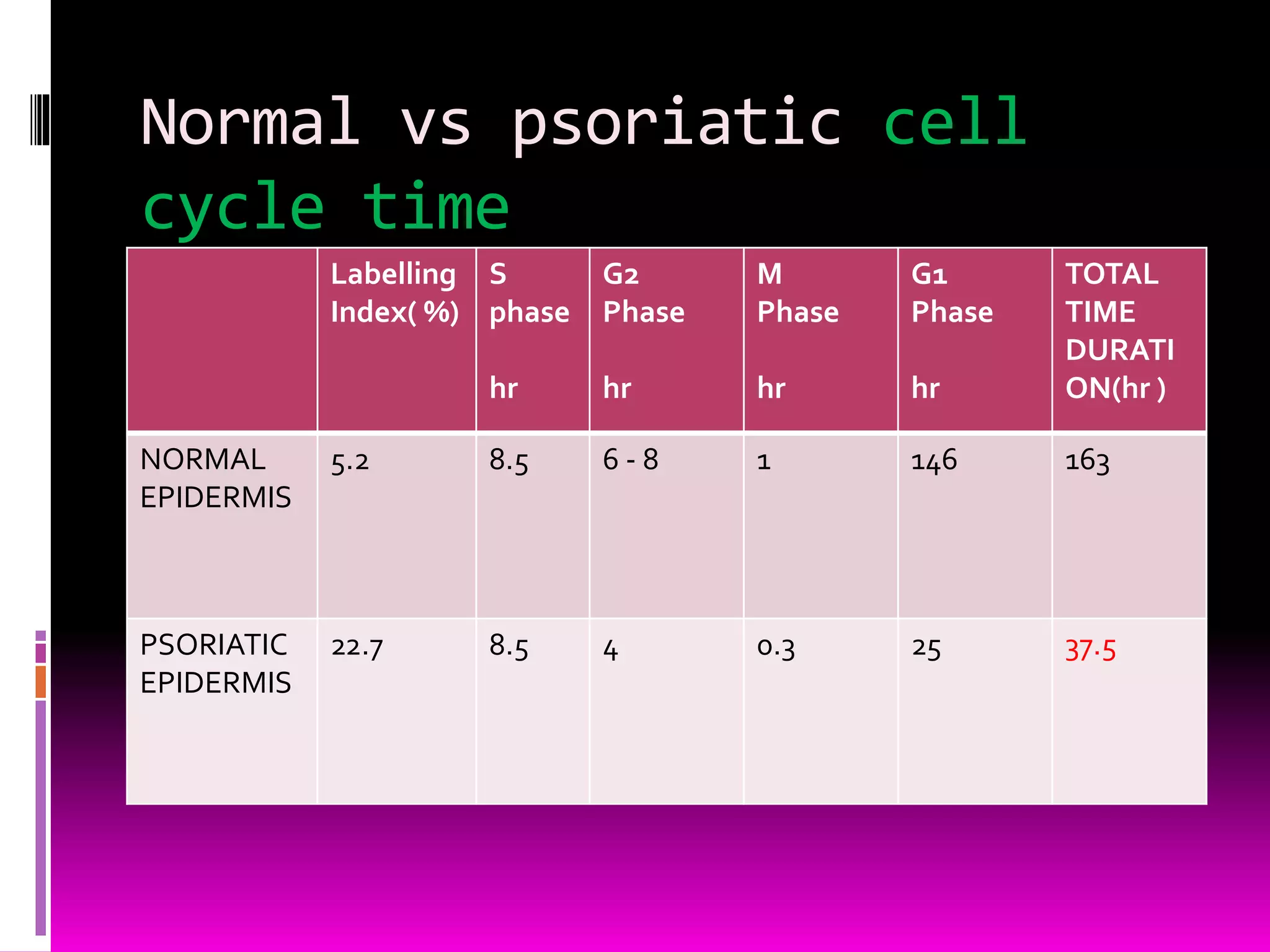
Normal vs psoriatic cell
cycle time
Labelling
Index( %)
S
phase
hr
G2
Phase
hr
M
Phase
hr
G1
Phase
hr
TOTAL
TIME
DURATI
ON(hr )
NORMAL
EPIDERMIS
5.2 8.5 6 - 8 1 146 163
PSORIATIC
EPIDERMIS
22.7 8.5 4 0.3 25 37.5
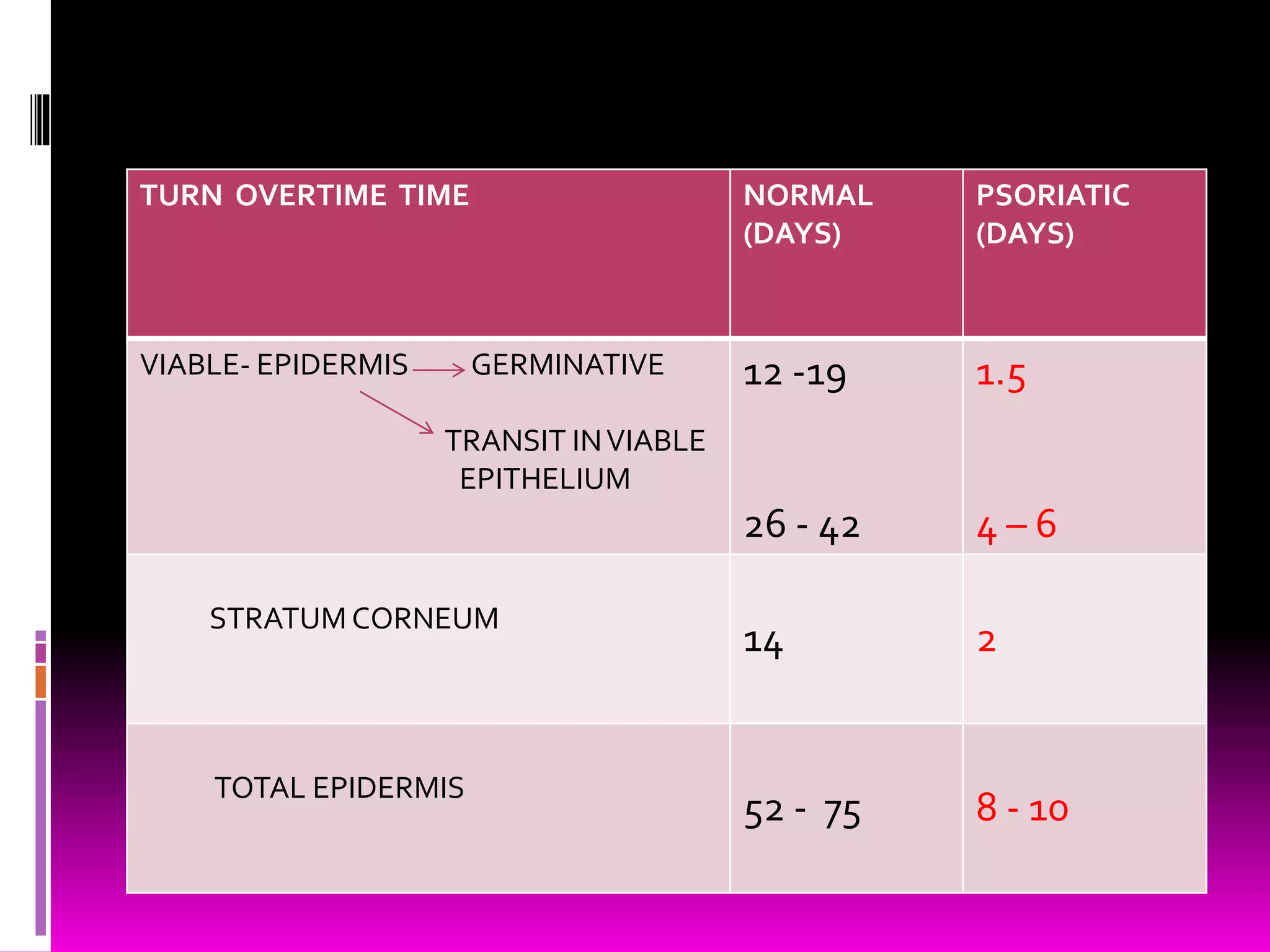
TURN OVERTIME TIME NORMAL
(DAYS)
PSORIATIC
(DAYS)
VIABLE- EPIDERMIS GERMINATIVE
TRANSIT INVIABLE
EPITHELIUM
12 -19
26 - 42
1.5
4 – 6
STRATUM CORNEUM
14 2
TOTAL EPIDERMIS
52 - 75 8 - 10
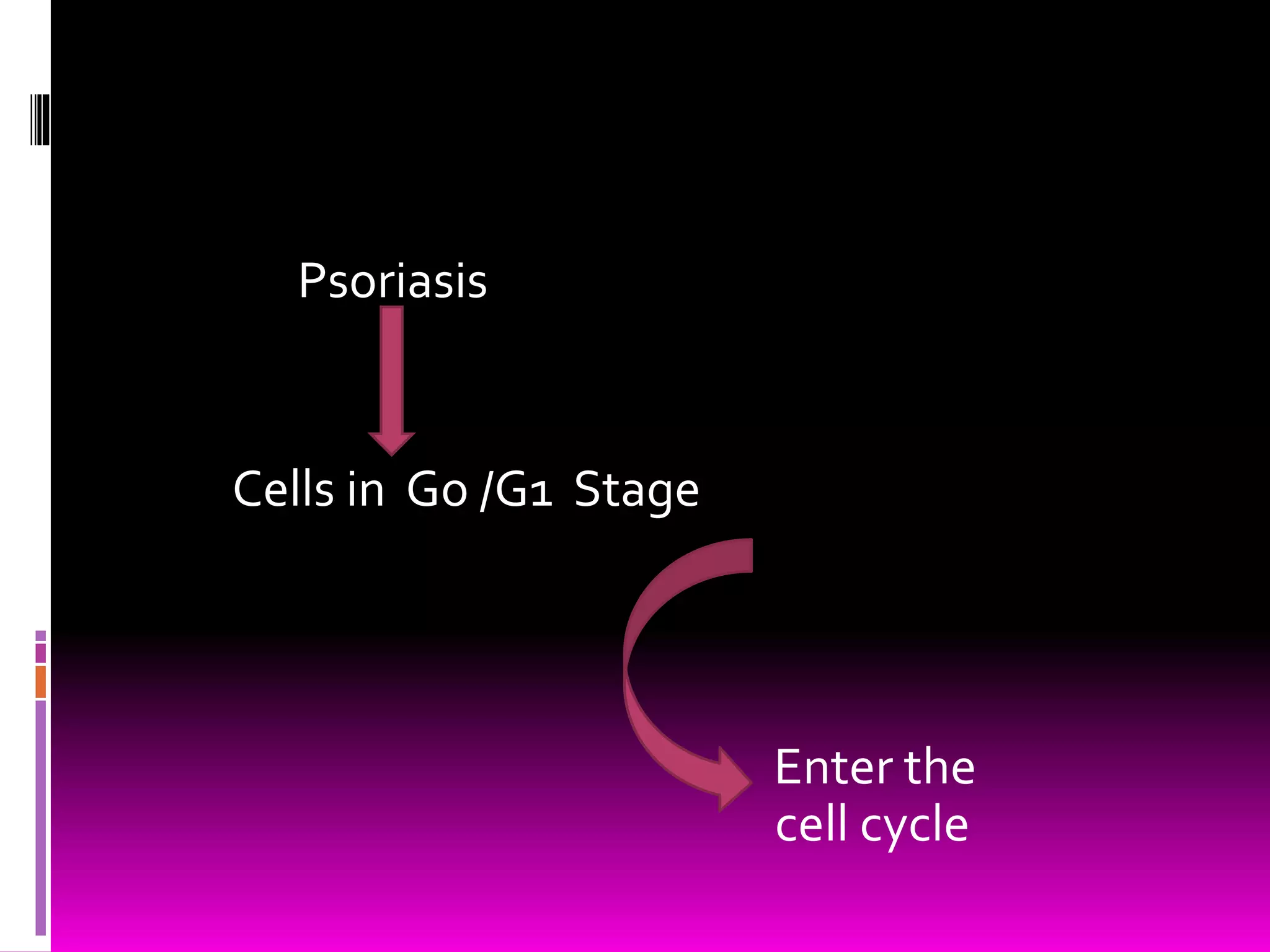
Psoriasis
Cells in Go /G1 Stage
Enter the
cell cycle
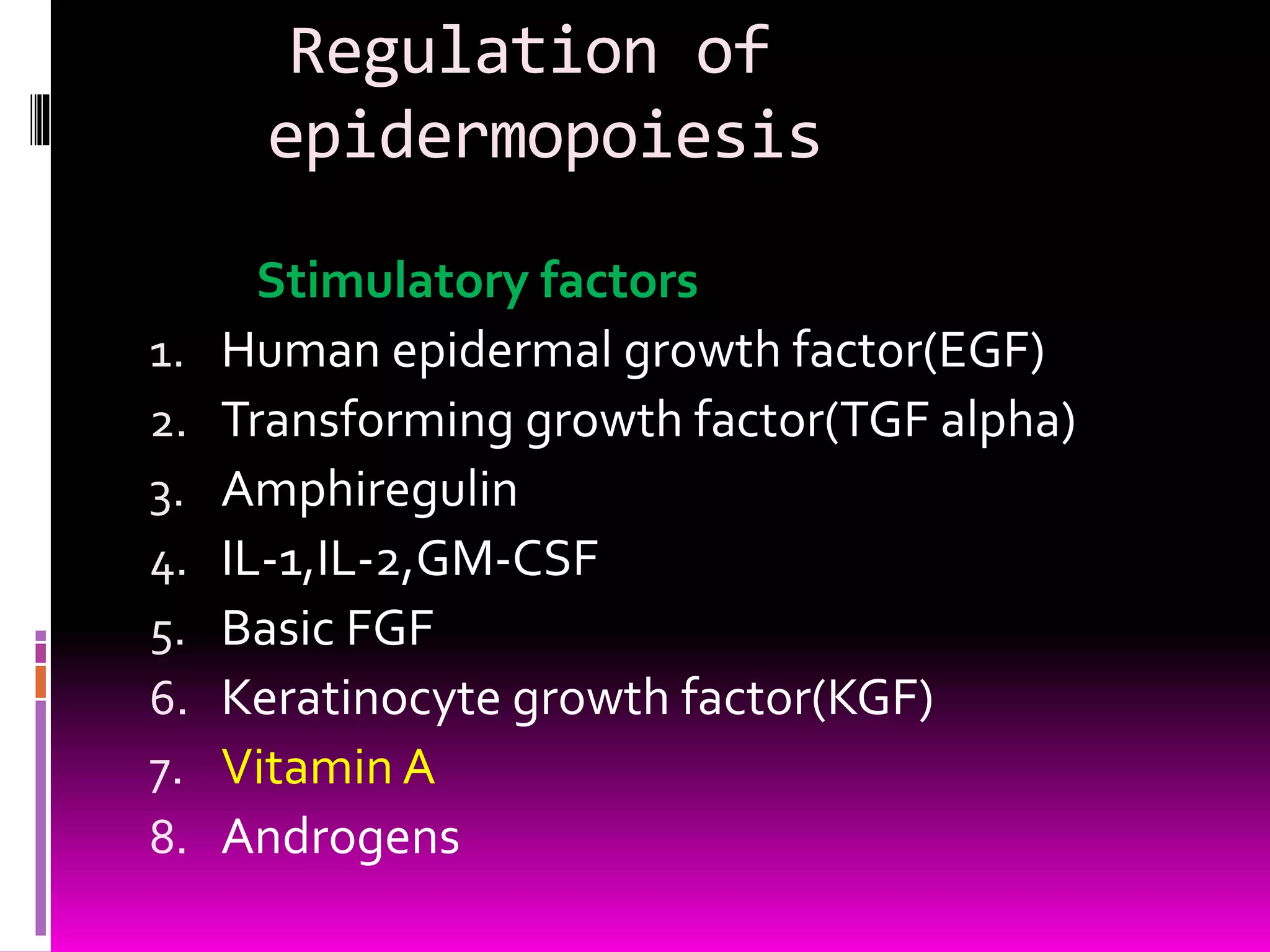
Regulation of
epidermopoiesis
Stimulatory factors
1. Human epidermal growth factor(EGF)
2. Transforming growth factor(TGF alpha)
3. Amphiregulin
4. IL-1,IL-2,GM-CSF
5. Basic FGF
6. Keratinocyte growth factor(KGF)
7. Vitamin A
8. Androgens
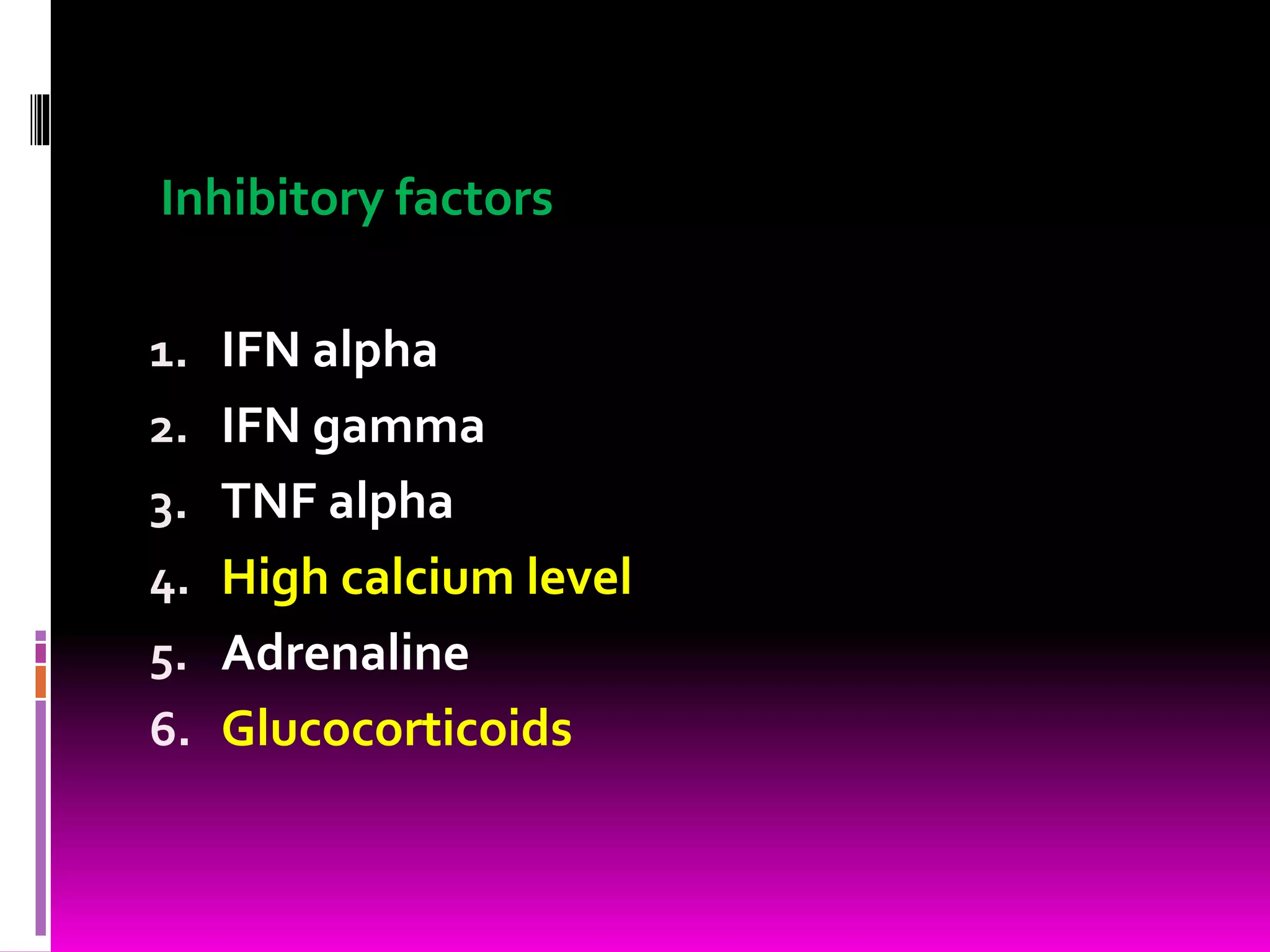
Inhibitory factors
1. IFN alpha
2. IFN gamma
3. TNF alpha
4. High calcium level
5. Adrenaline
6. Glucocorticoids
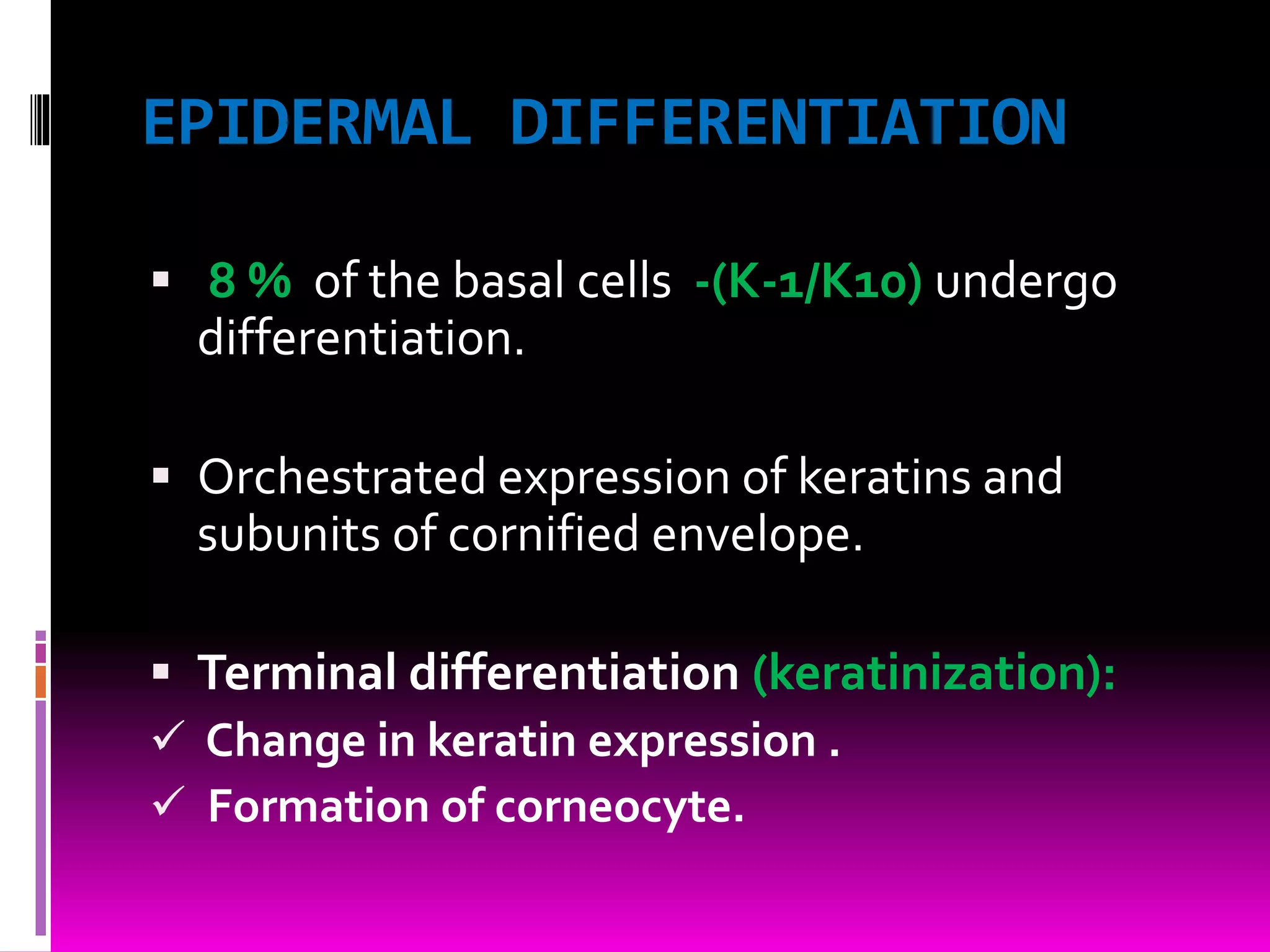
EPIDERMAL DIFFERENTIATION
 8 % of the basal cells -(K-1/K10) undergo
differentiation.
 Orchestrated expression of keratins and
subunits of cornified envelope.
 Terminal differentiation (keratinization):
 Change in keratin expression .
 Formation of corneocyte.
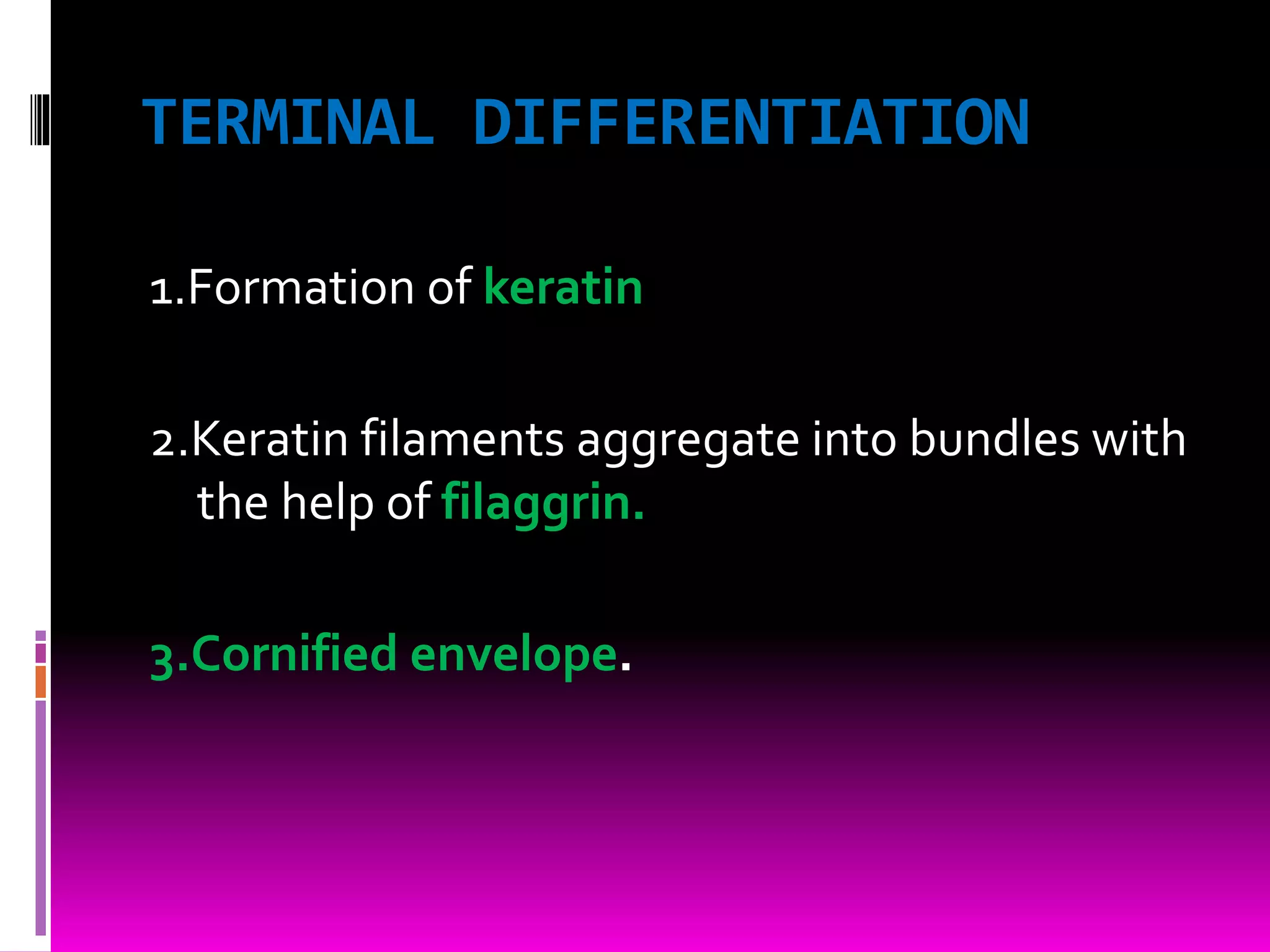
TERMINAL DIFFERENTIATION
1.Formation of keratin
2.Keratin filaments aggregate into bundles with
the help of filaggrin.
3.Cornified envelope.
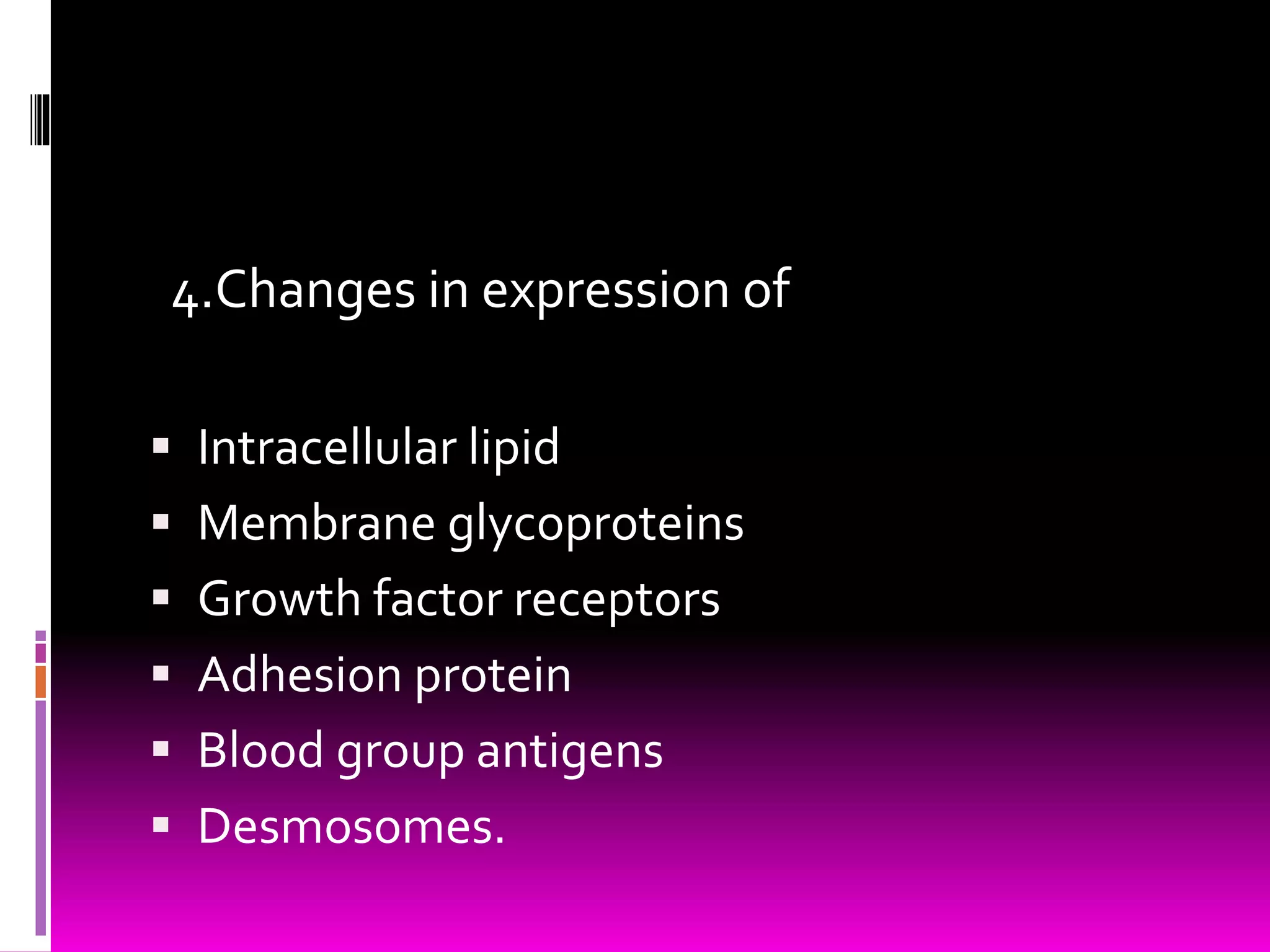
4.Changes in expression of
 Intracellular lipid
 Membrane glycoproteins
 Growth factor receptors
 Adhesion protein
 Blood group antigens
 Desmosomes.
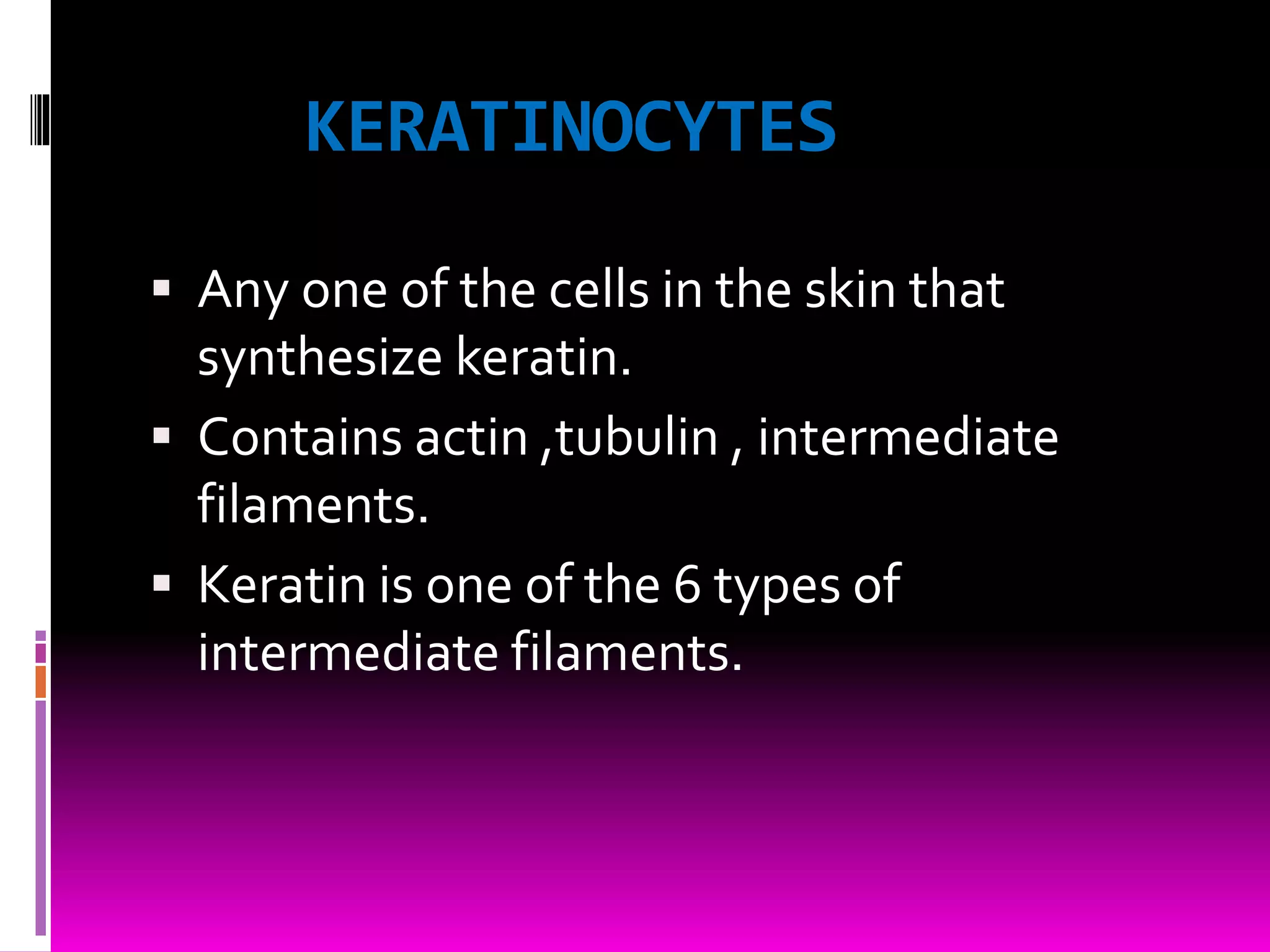
KERATINOCYTES
 Any one of the cells in the skin that
synthesize keratin.
 Contains actin ,tubulin , intermediate
filaments.
 Keratin is one of the 6 types of
intermediate filaments.
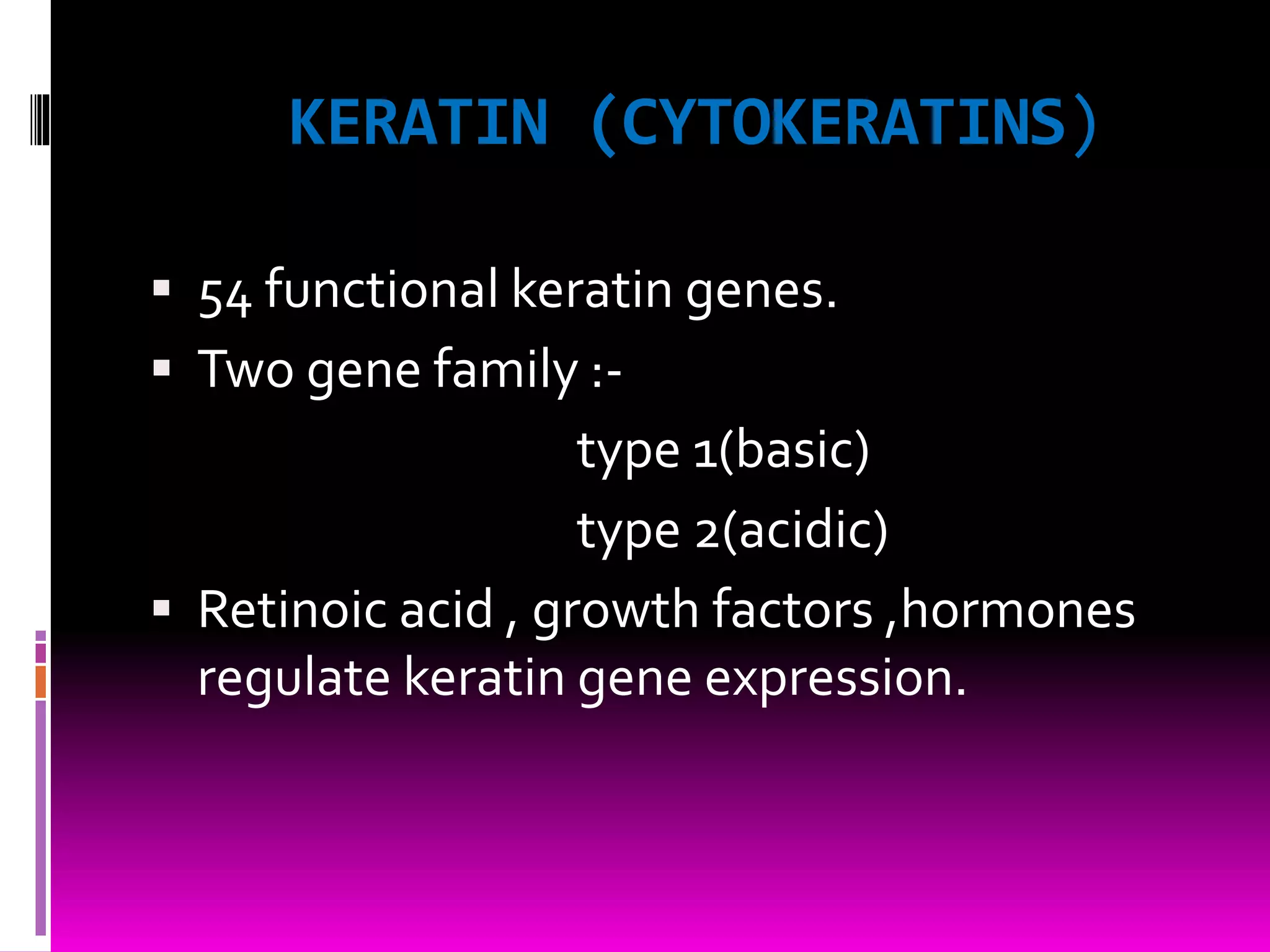
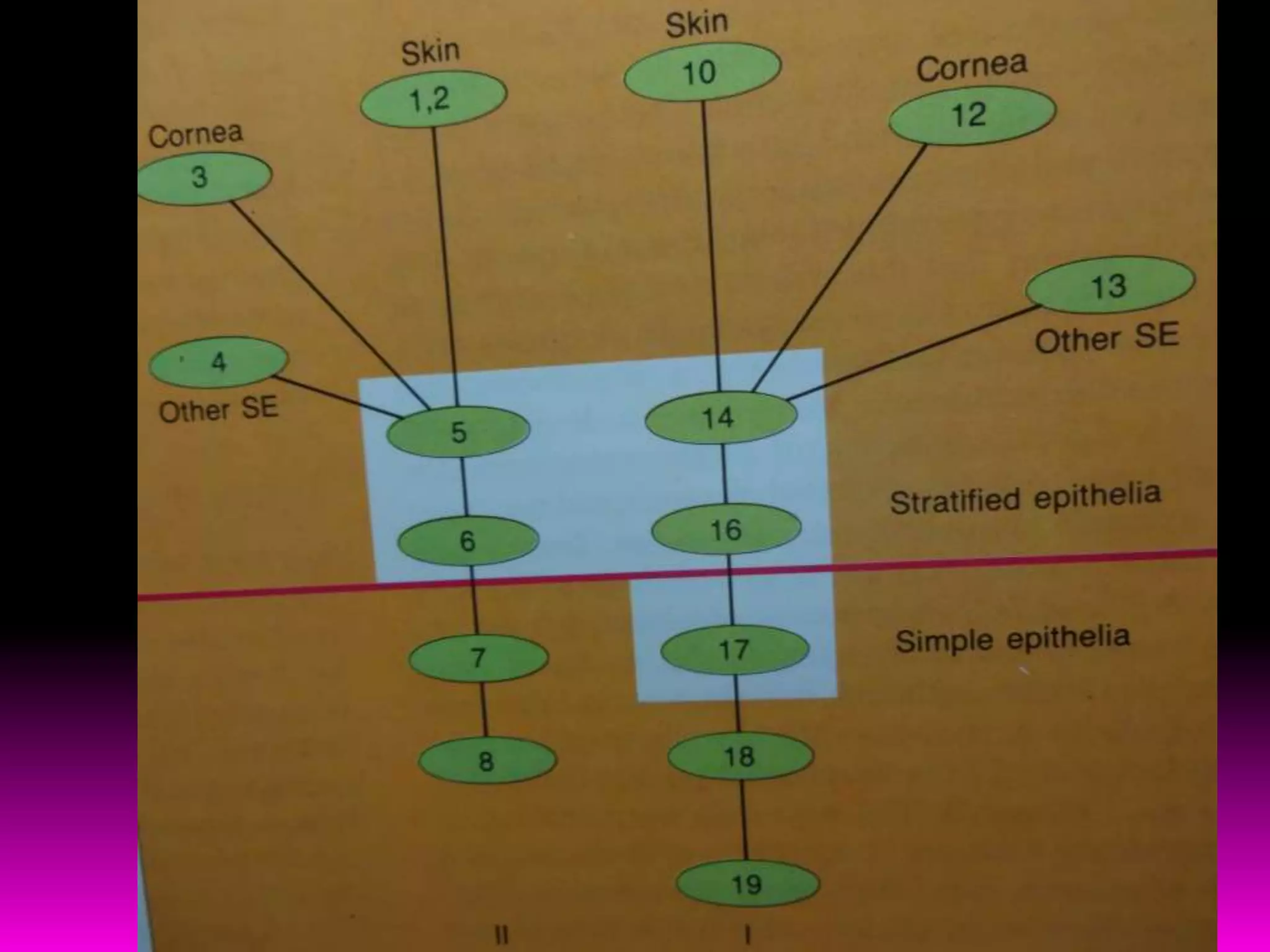
KERATIN (CYTOKERATINS)
 54 functional keratin genes.
 Two gene family :-
type 1(basic)
type 2(acidic)
 Retinoic acid , growth factors ,hormones
regulate keratin gene expression.
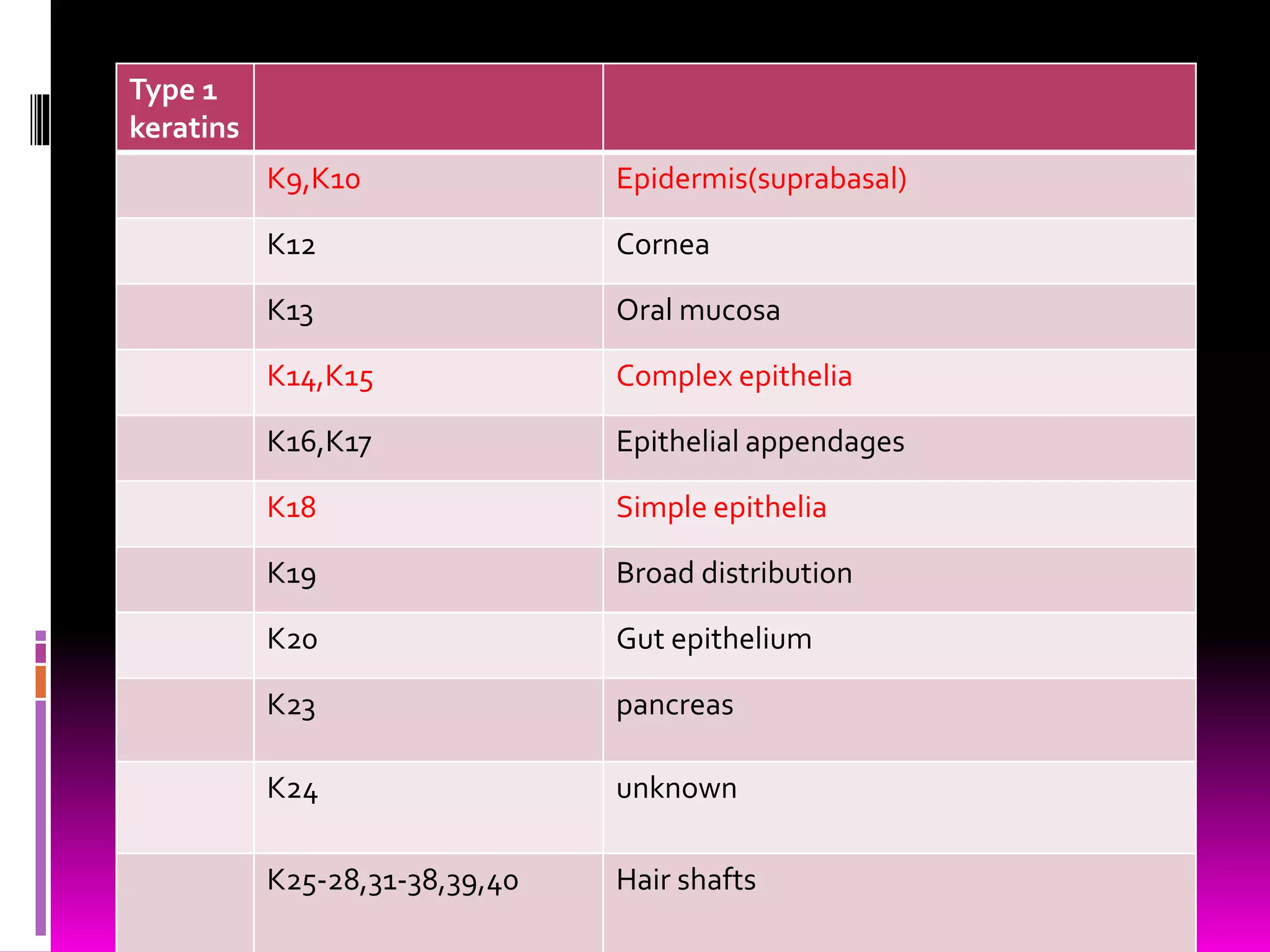
Type 1
keratins
K9,K10 Epidermis(suprabasal)
K12 Cornea
K13 Oral mucosa
K14,K15 Complex epithelia
K16,K17 Epithelial appendages
K18 Simple epithelia
K19 Broad distribution
K20 Gut epithelium
K23 pancreas
K24 unknown
K25-28,31-38,39,40 Hair shafts
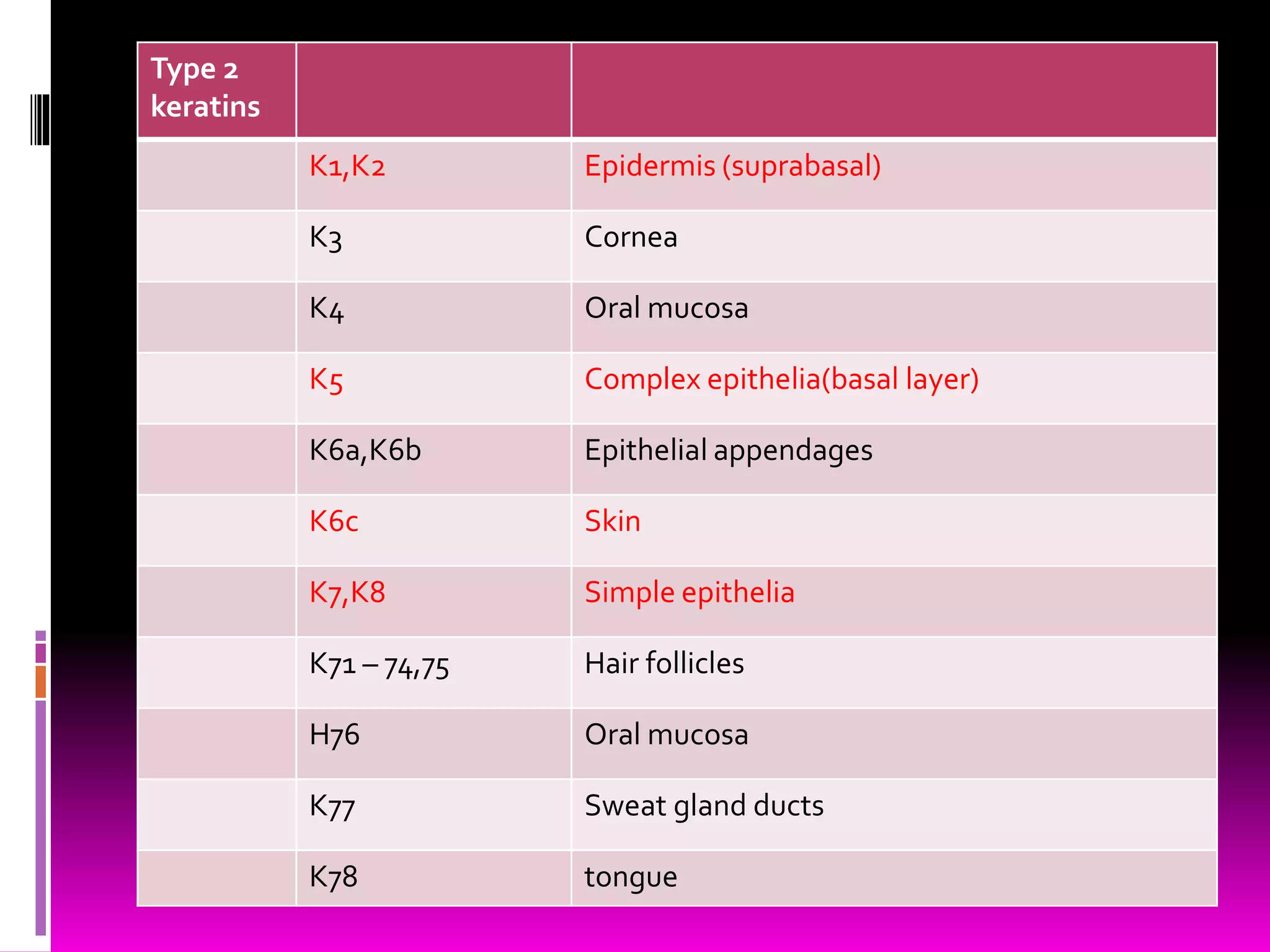
Type 2
keratins
K1,K2 Epidermis (suprabasal)
K3 Cornea
K4 Oral mucosa
K5 Complex epithelia(basal layer)
K6a,K6b Epithelial appendages
K6c Skin
K7,K8 Simple epithelia
K71 – 74,75 Hair follicles
H76 Oral mucosa
K77 Sweat gland ducts
K78 tongue
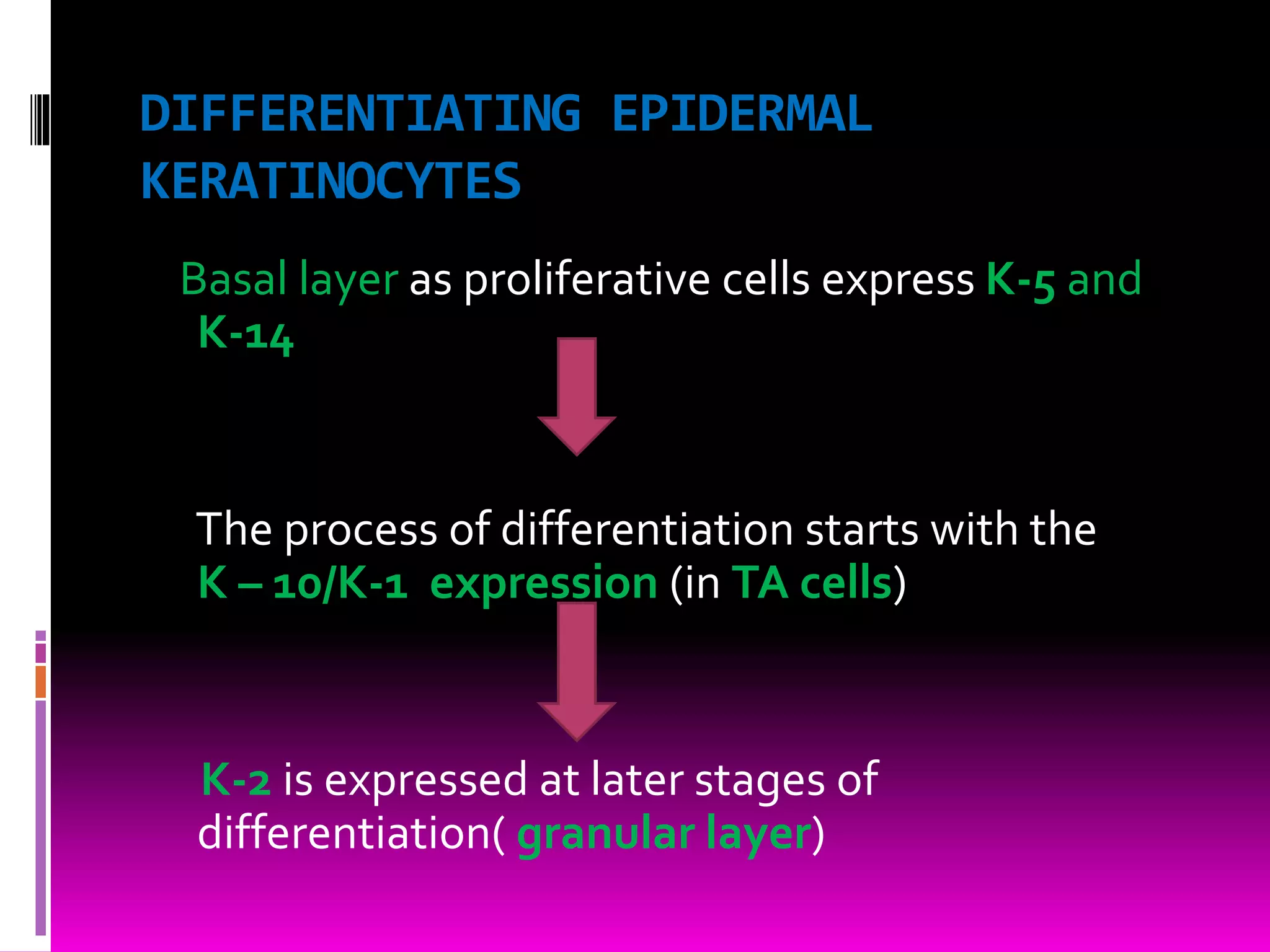
DIFFERENTIATING EPIDERMAL
KERATINOCYTES
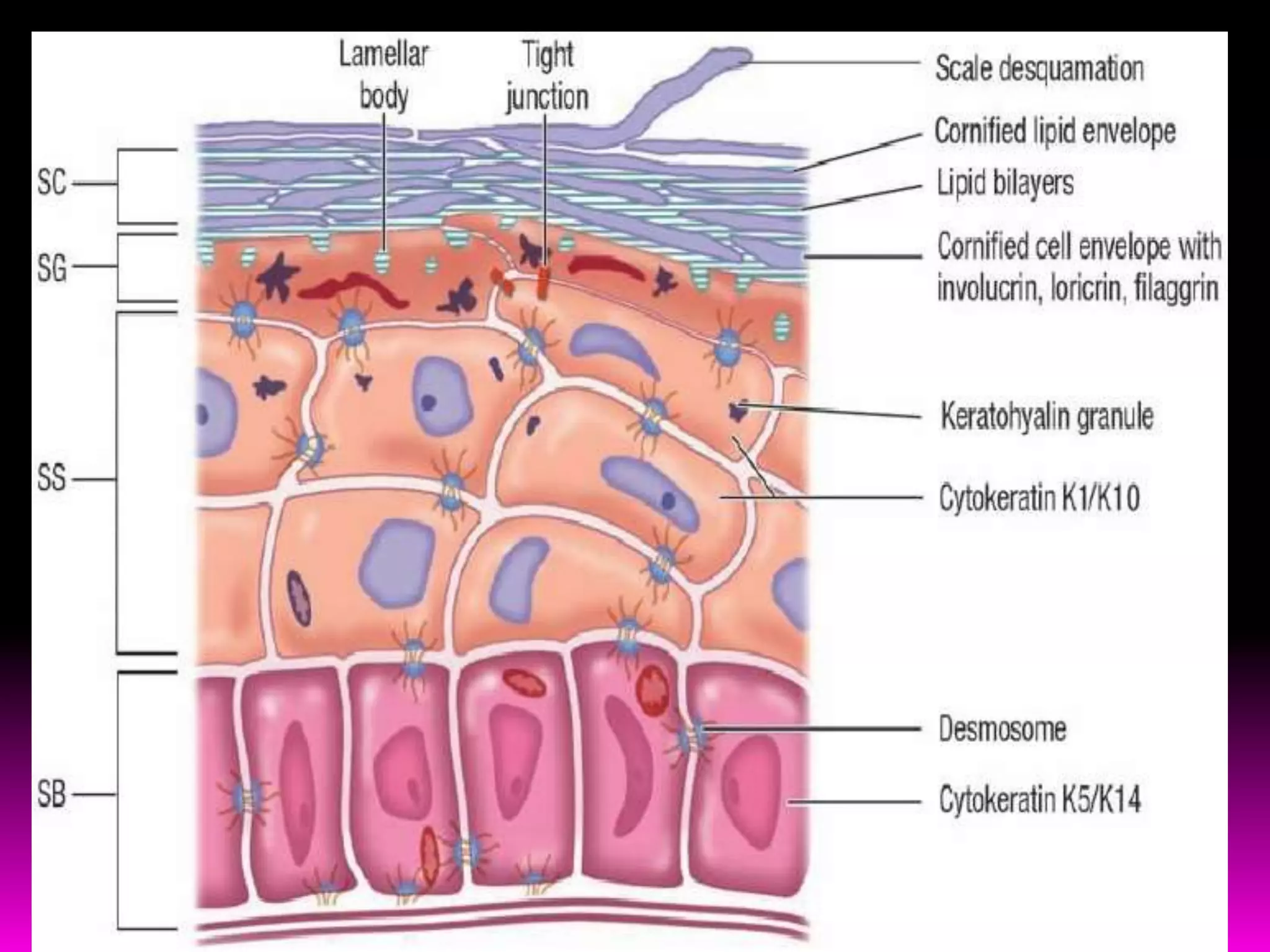
Basal layer as proliferative cells express K-5 and
K-14
The process of differentiation starts with the
K – 10/K-1 expression (in TA cells)
K-2 is expressed at later stages of
differentiation( granular layer)
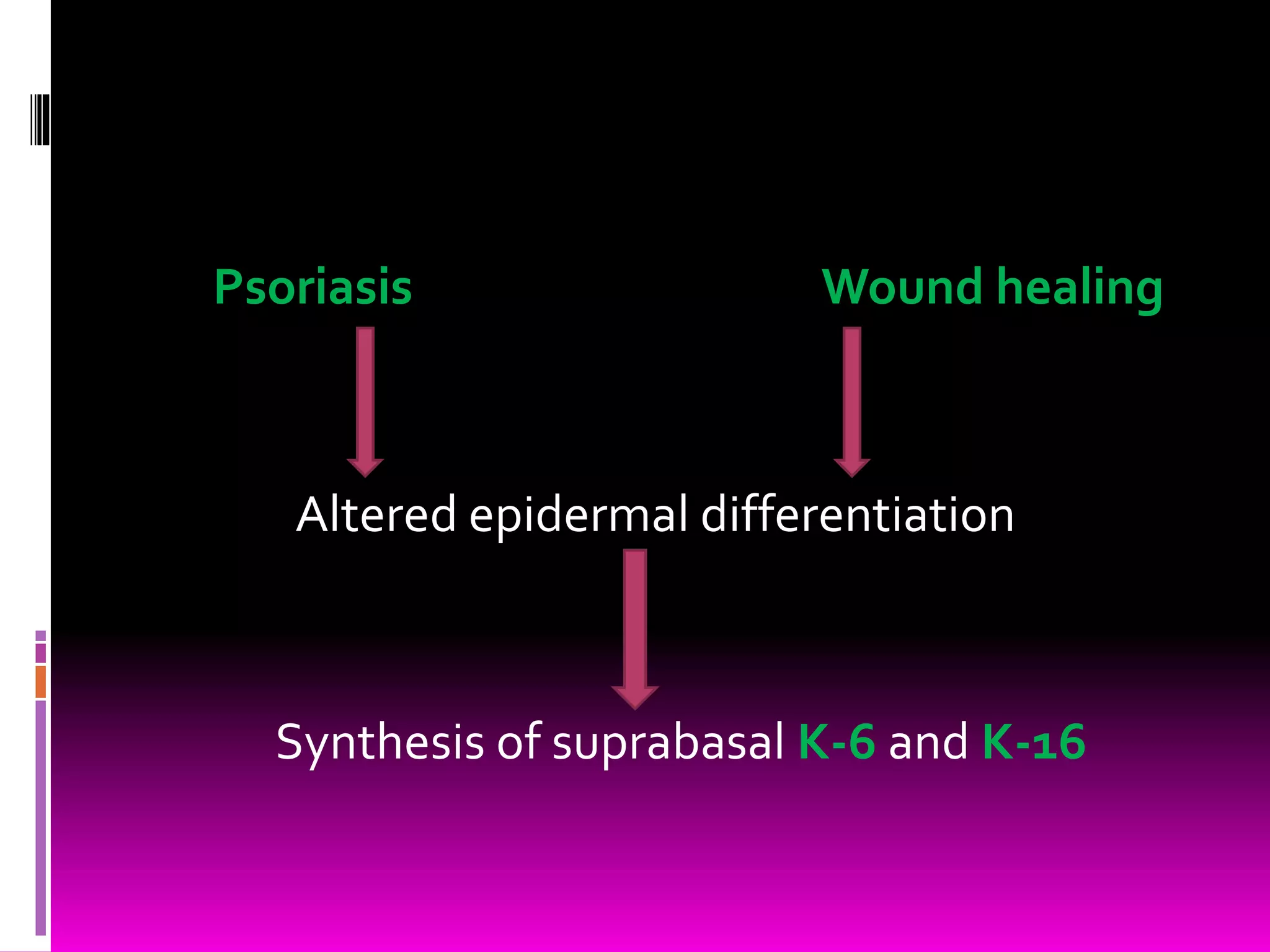
Psoriasis Wound healing
Altered epidermal differentiation
Synthesis of suprabasal K-6 and K-16
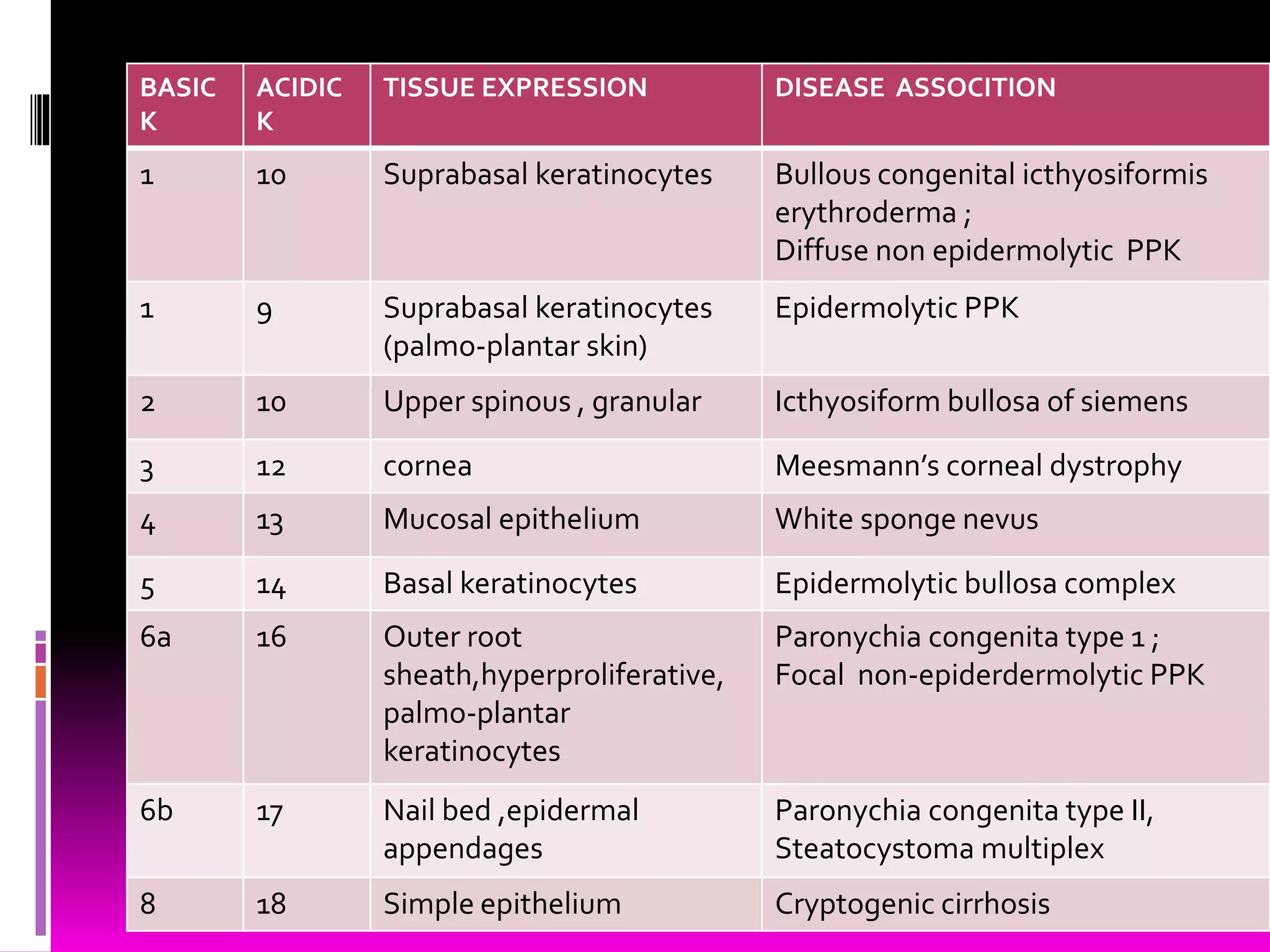
BASIC
K
ACIDIC
K
TISSUE EXPRESSION DISEASE ASSOCITION
1 10 Suprabasal keratinocytes Bullous congenital icthyosiformis
erythroderma ;
Diffuse non epidermolytic PPK
1 9 Suprabasal keratinocytes
(palmo-plantar skin)
Epidermolytic PPK
2 10 Upper spinous , granular Icthyosiform bullosa of siemens
3 12 cornea Meesmann’s corneal dystrophy
4 13 Mucosal epithelium White sponge nevus
5 14 Basal keratinocytes Epidermolytic bullosa complex
6a 16 Outer root
sheath,hyperproliferative,
palmo-plantar
keratinocytes
Paronychia congenita type 1 ;
Focal non-epiderdermolytic PPK
6b 17 Nail bed ,epidermal
appendages
Paronychia congenita type II,
Steatocystoma multiplex
8 18 Simple epithelium Cryptogenic cirrhosis
Keratohyaline granules
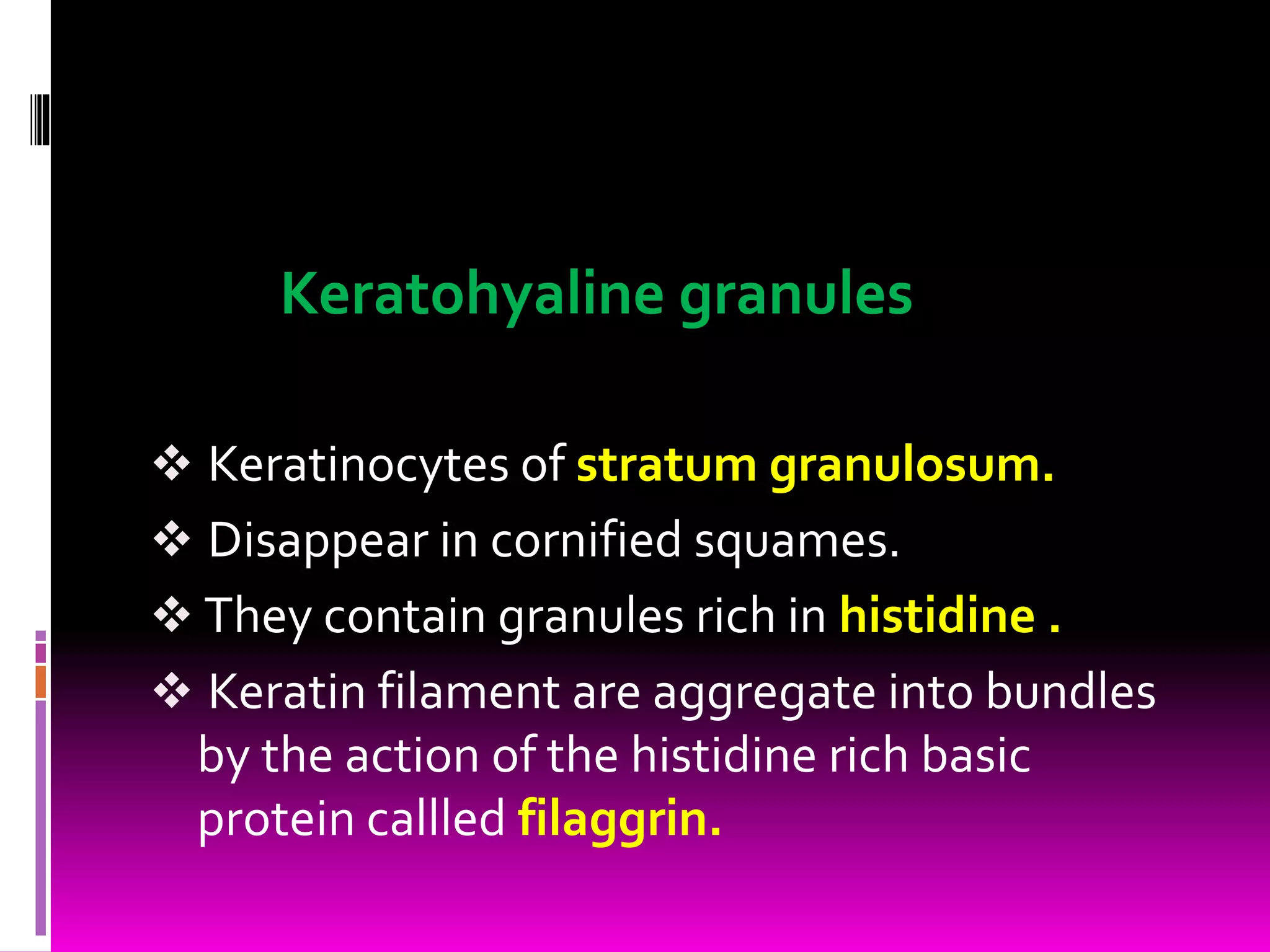
 Keratinocytes of stratum granulosum.
 Disappear in cornified squames.
 They contain granules rich in histidine .
 Keratin filament are aggregate into bundles
by the action of the histidine rich basic
protein callled filaggrin.
Membrane – coating granules
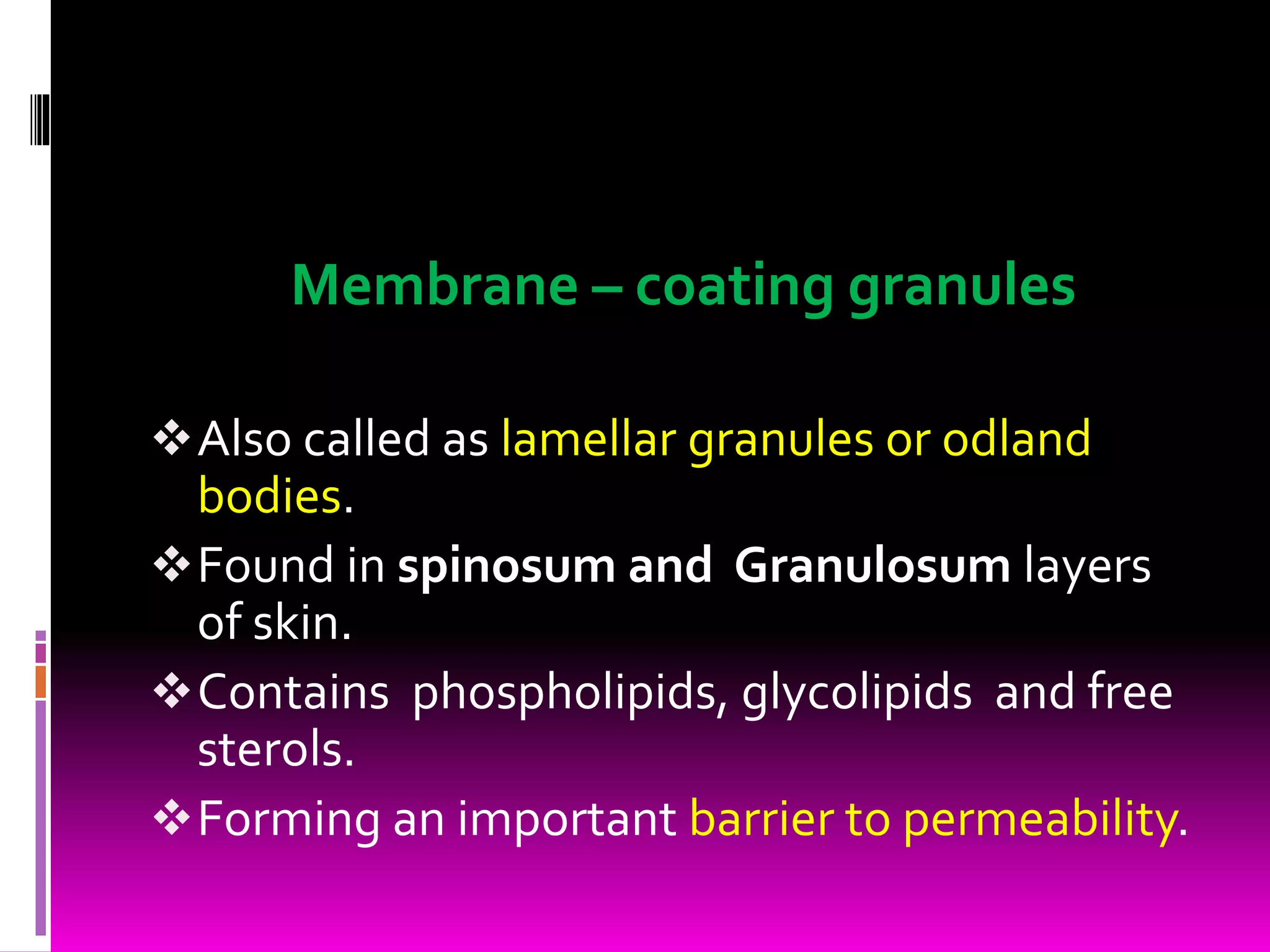
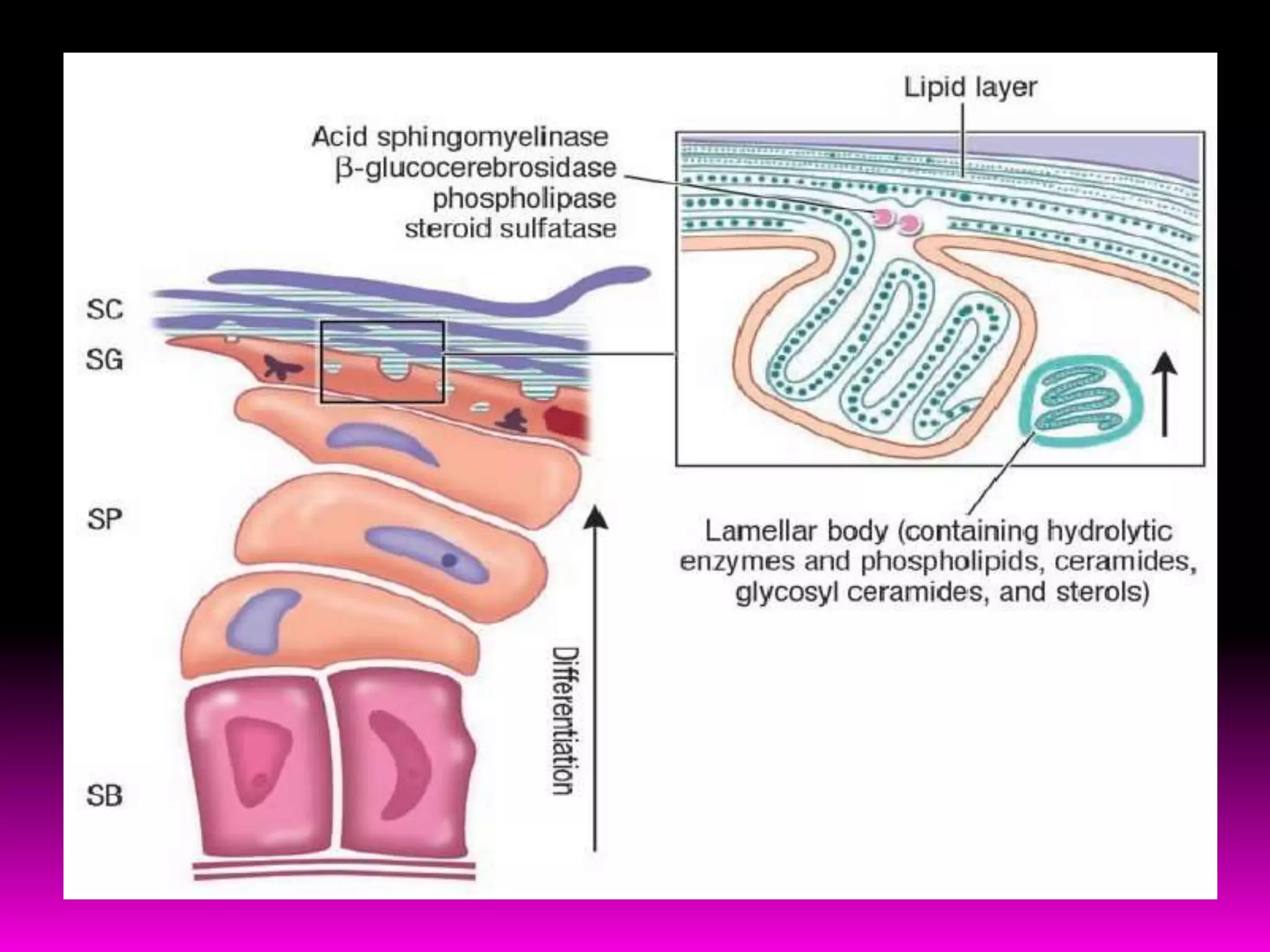
Also called as lamellar granules or odland
bodies.
Found in spinosum and Granulosum layers
of skin.
Contains phospholipids, glycolipids and free
sterols.
Forming an important barrier to permeability.
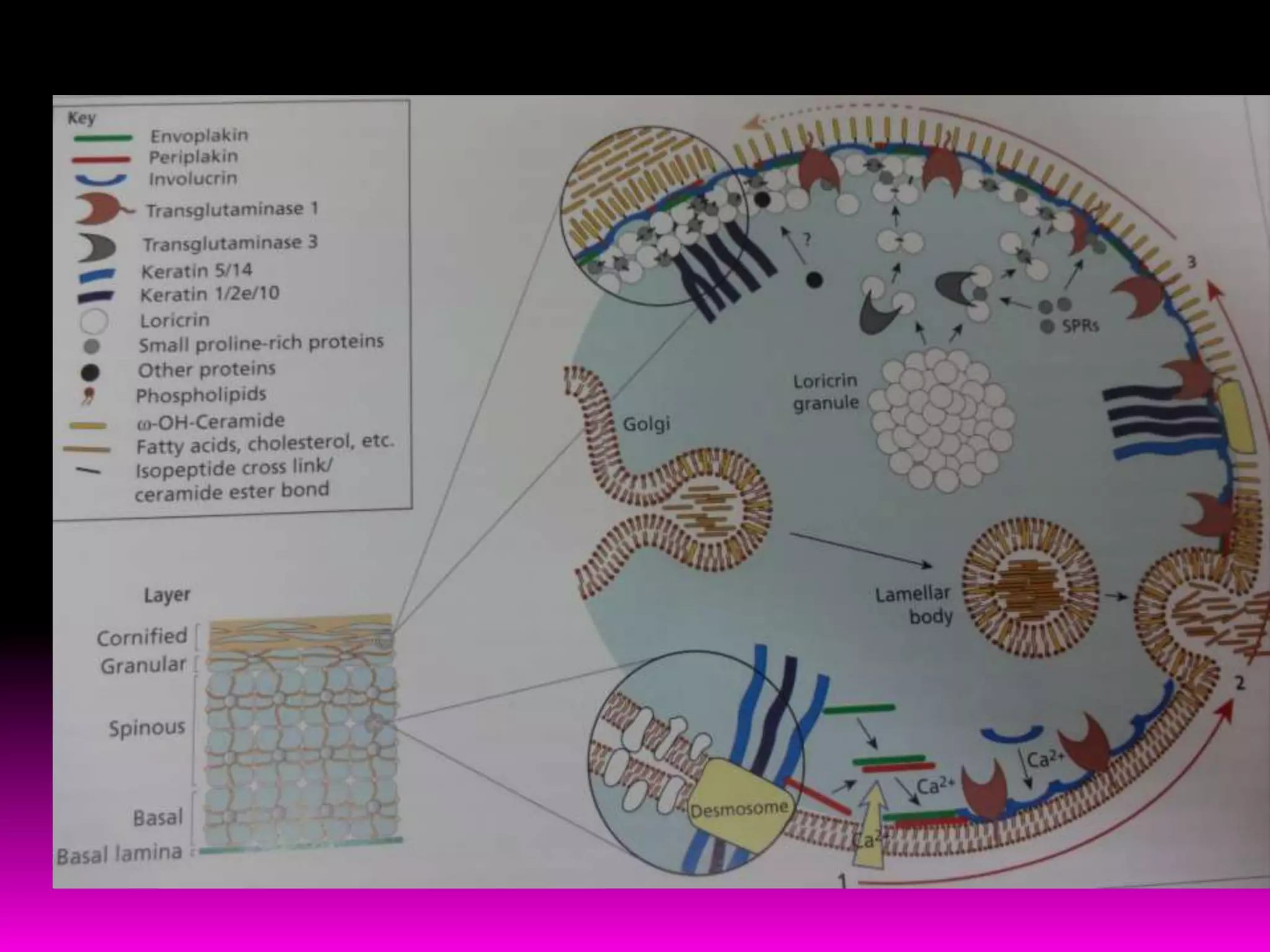
CORNIFIED ENVELOPE
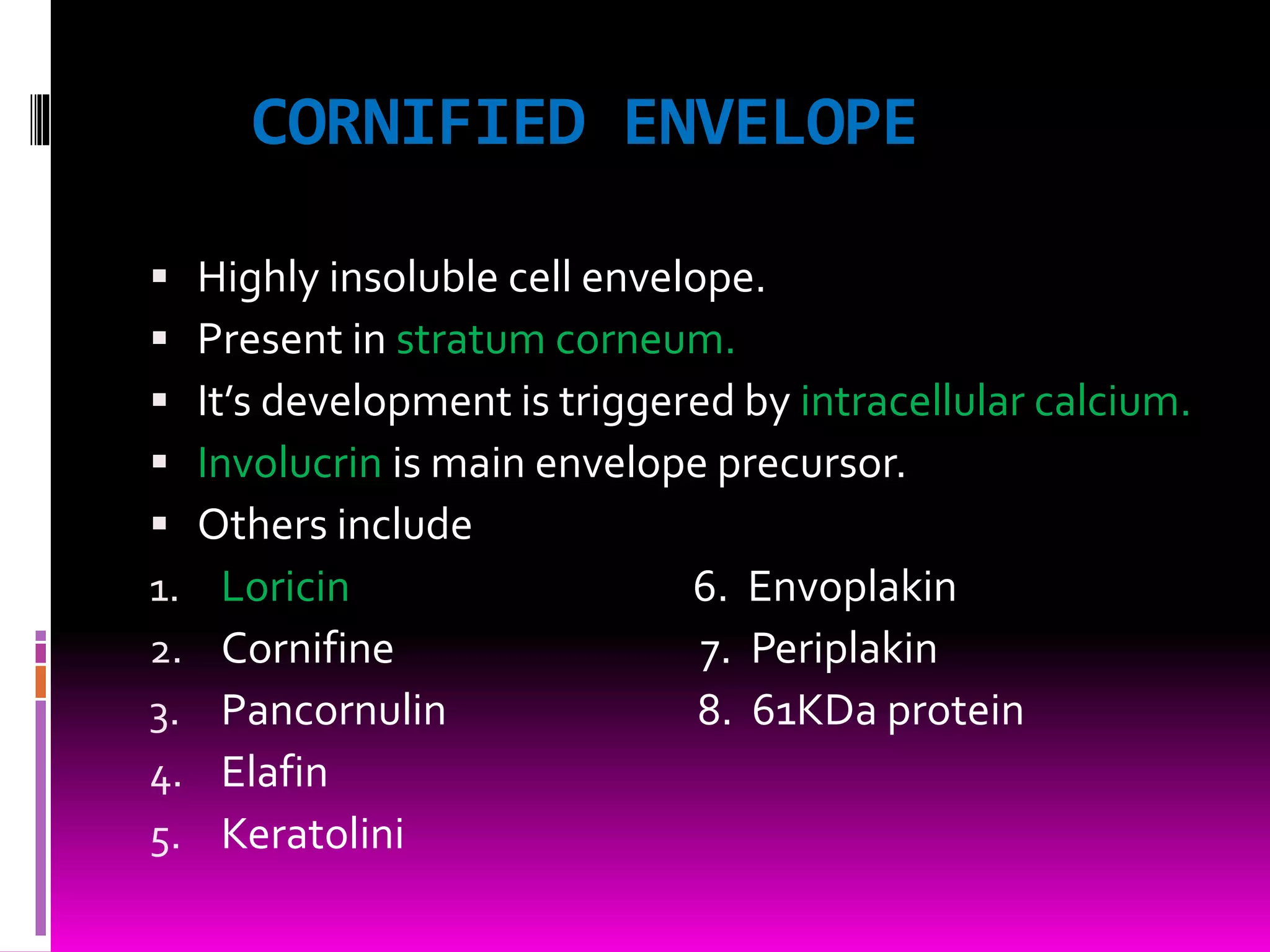
 Highly insoluble cell envelope.
 Present in stratum corneum.
 It’s development is triggered by intracellular calcium.
 Involucrin is main envelope precursor.
 Others include
1. Loricin 6. Envoplakin
2. Cornifine 7. Periplakin
3. Pancornulin 8. 61KDa protein
4. Elafin
5. Keratolini
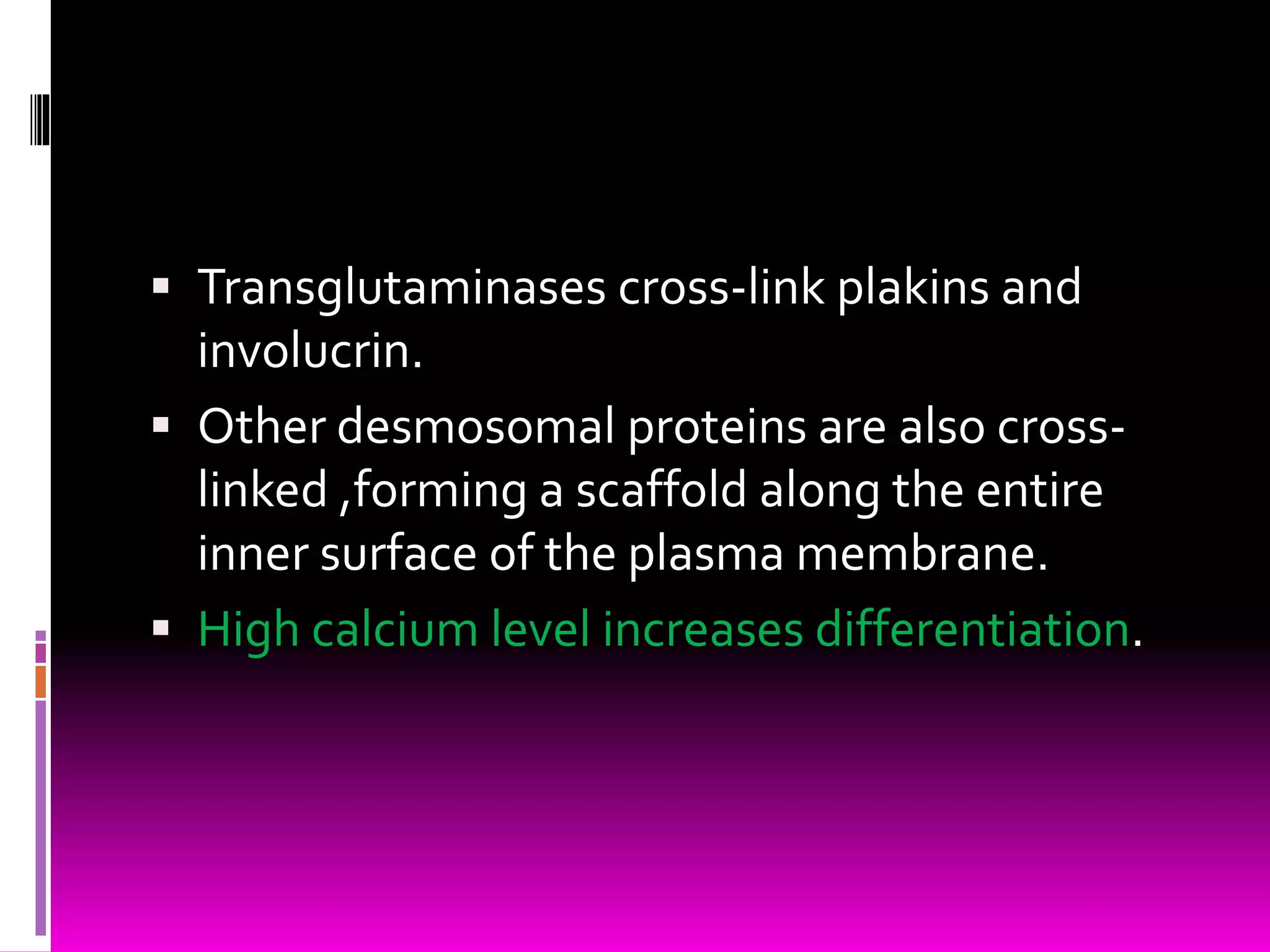
 Transglutaminases cross-link plakins and
involucrin.
 Other desmosomal proteins are also cross-
linked ,forming a scaffold along the entire
inner surface of the plasma membrane.
 High calcium level increases differentiation.
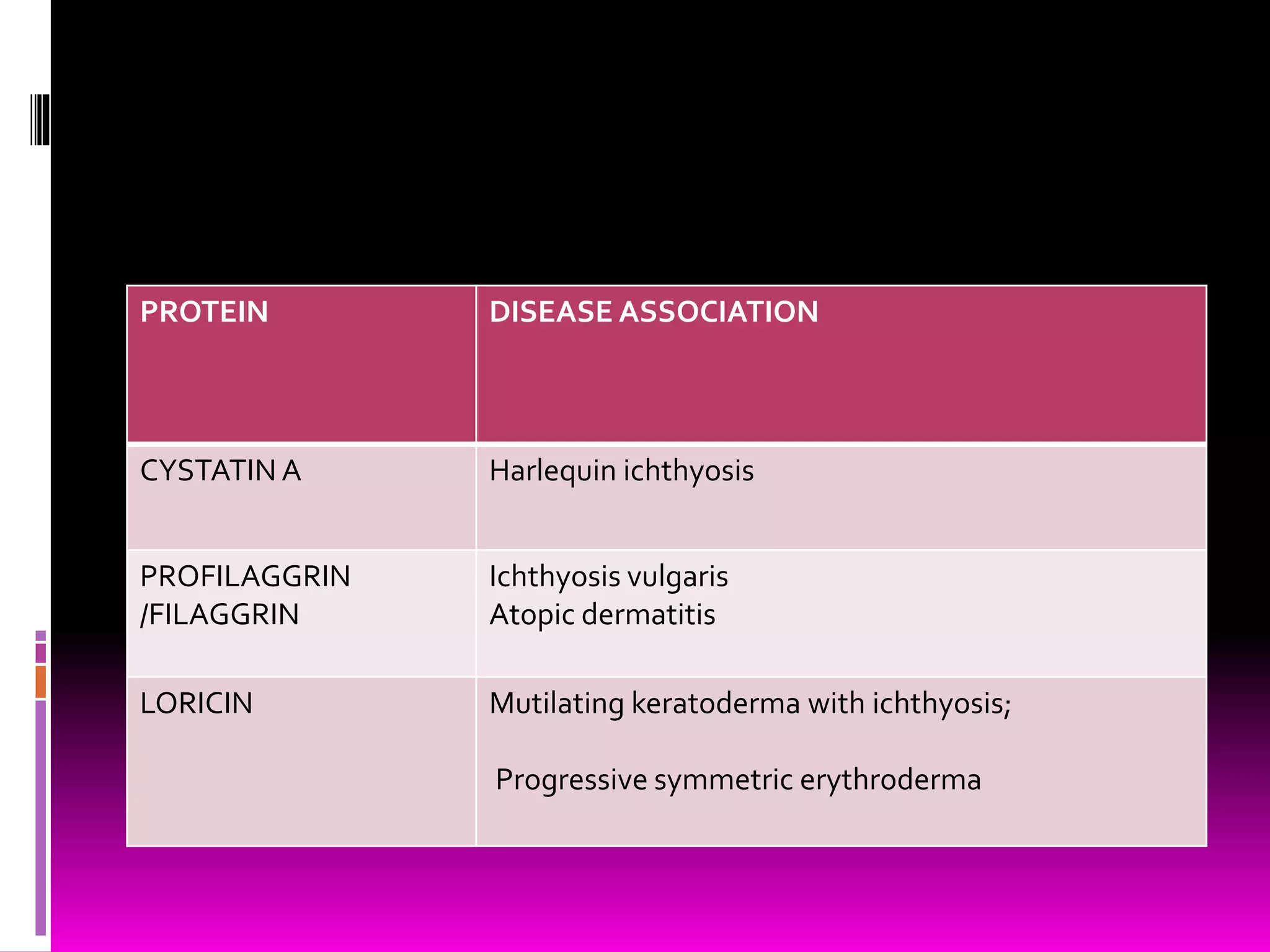
PROTEIN DISEASE ASSOCIATION
CYSTATIN A Harlequin ichthyosis
PROFILAGGRIN
/FILAGGRIN
Ichthyosis vulgaris
Atopic dermatitis
LORICIN Mutilating keratoderma with ichthyosis;
Progressive symmetric erythroderma
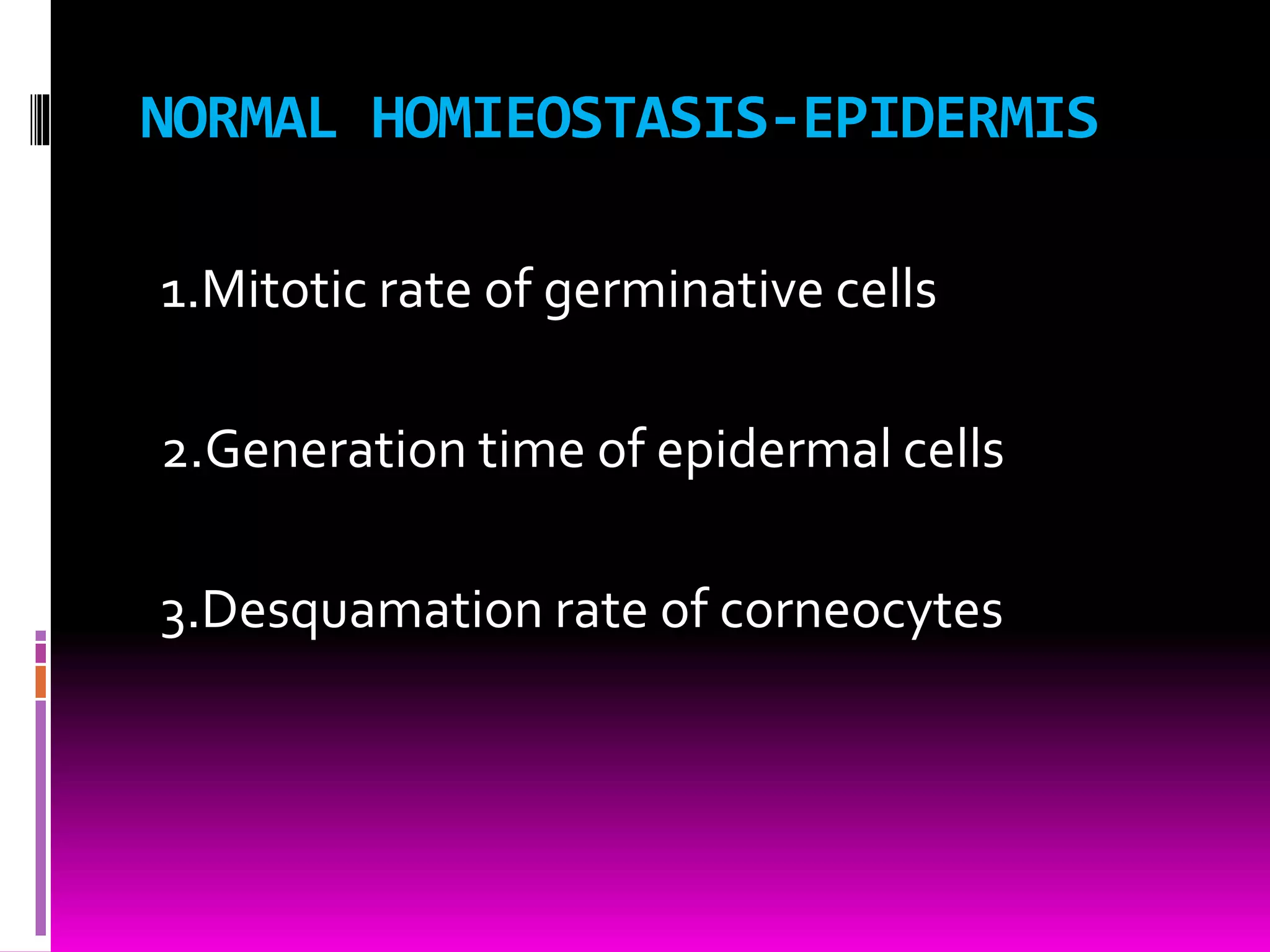
NORMAL HOMIEOSTASIS-EPIDERMIS
1.Mitotic rate of germinative cells
2.Generation time of epidermal cells
3.Desquamation rate of corneocytes
DISTURBANCE IN EPIDERMAL KINETICS
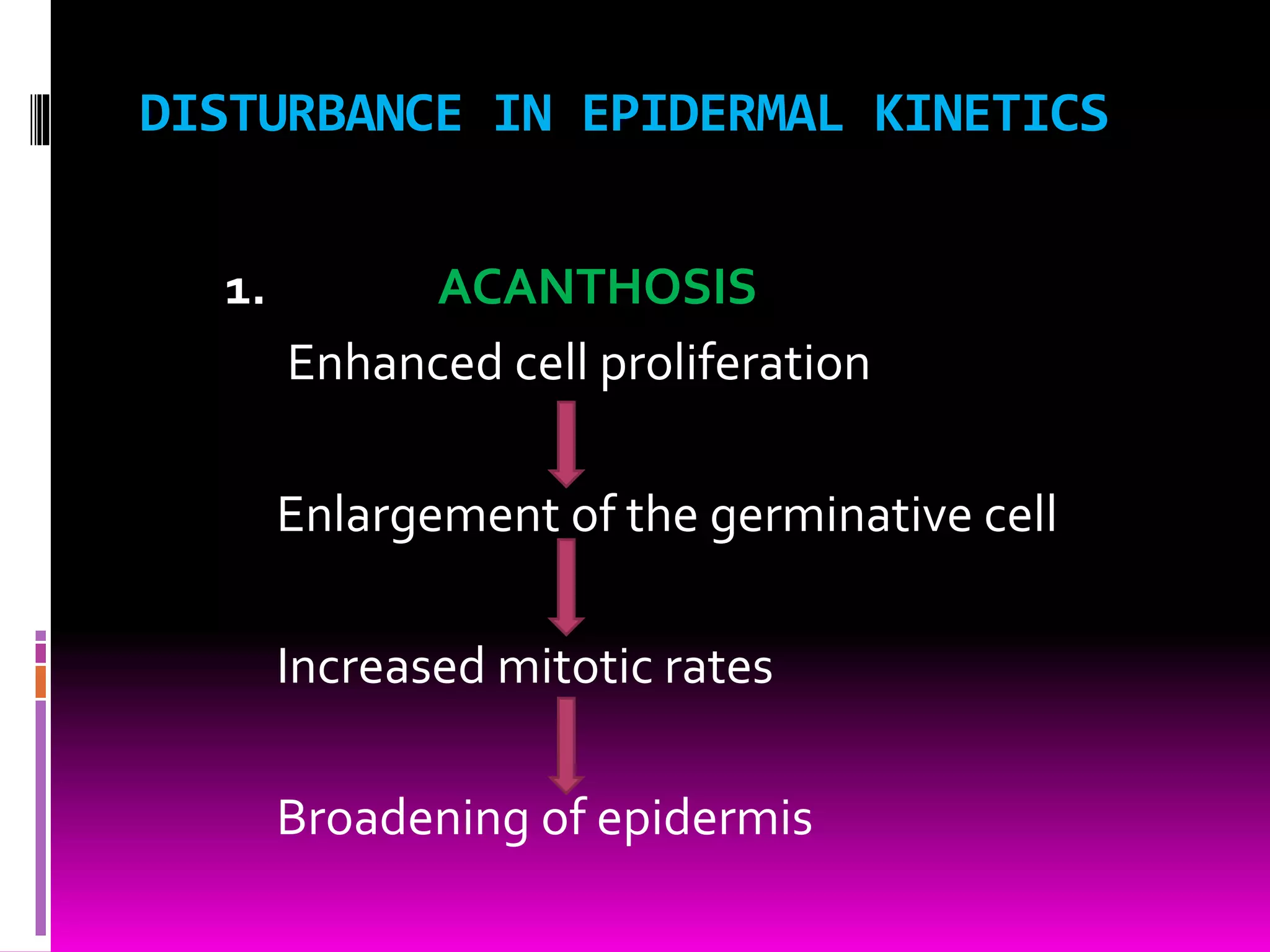
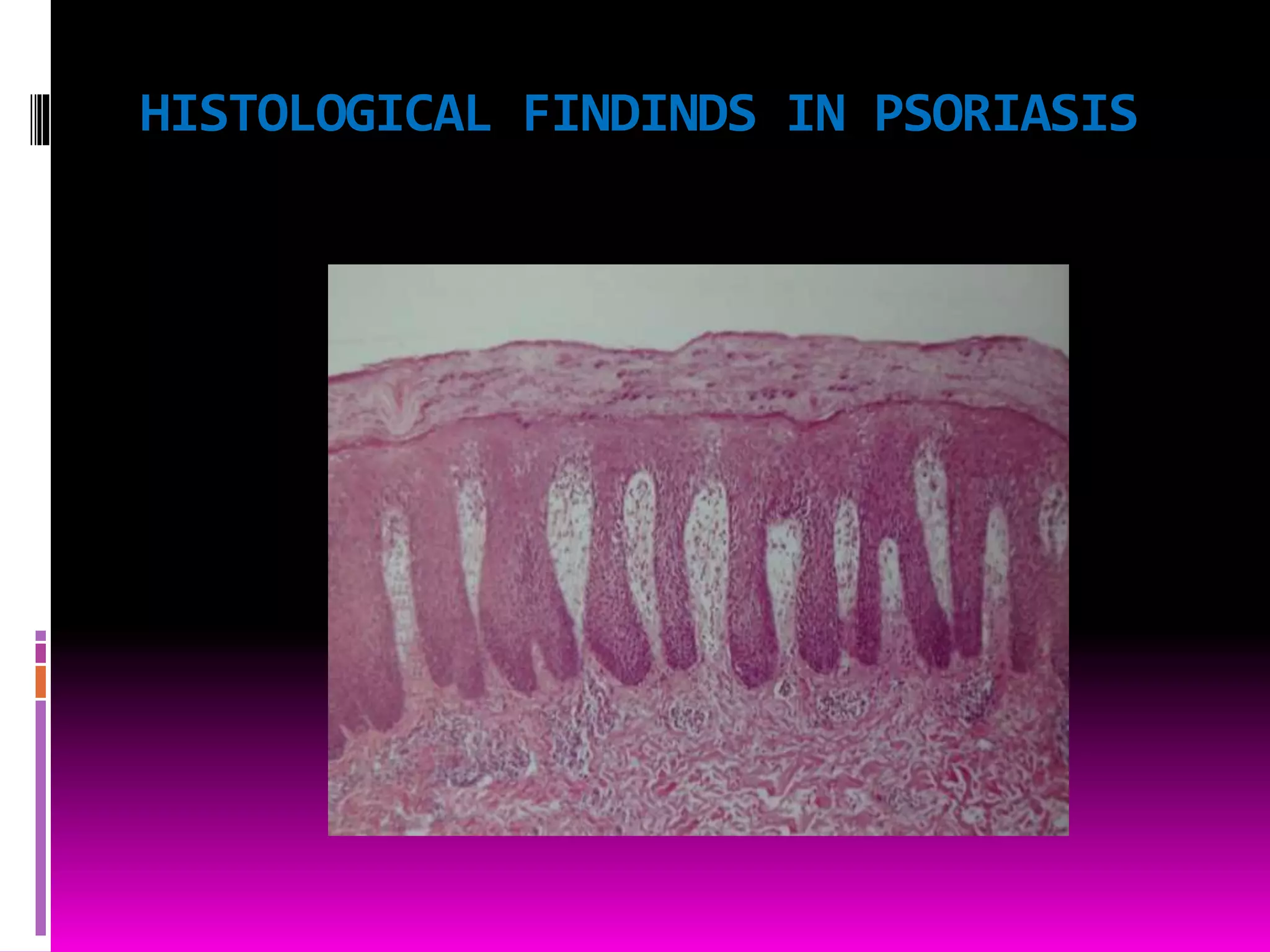
1. ACANTHOSIS
Enhanced cell proliferation
Enlargement of the germinative cell
Increased mitotic rates
Broadening of epidermis
 Conditions showing Acanthosis:-
1. Psoriasis
2. Eczema
3. Condyloma acuminatum
DISTURBANCE IN EPIDERMAL DIFFERENTIATION
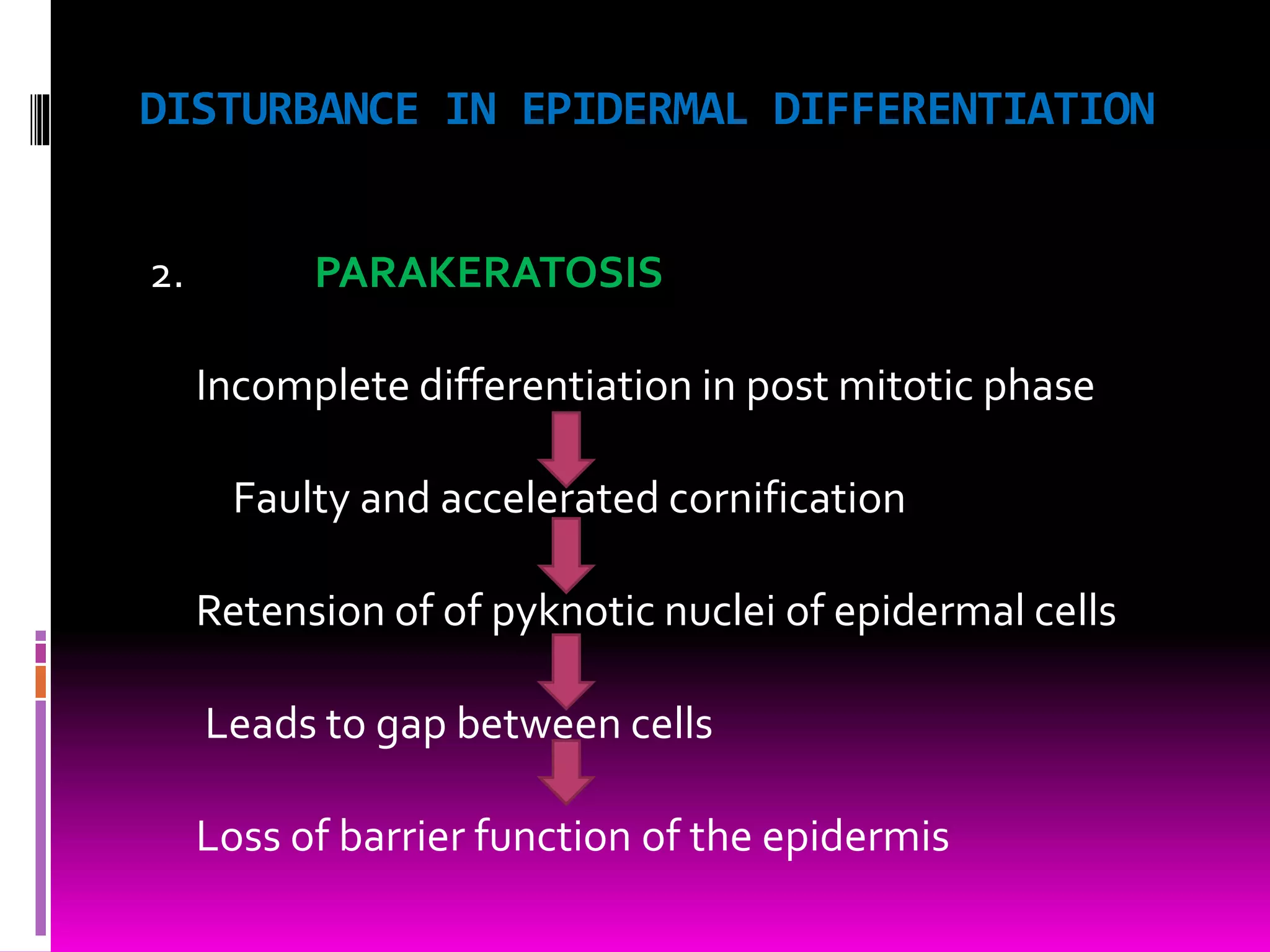
2. PARAKERATOSIS
Incomplete differentiation in post mitotic phase
Faulty and accelerated cornification
Retension of of pyknotic nuclei of epidermal cells
Leads to gap between cells
Loss of barrier function of the epidermis
HISTOLOGICAL FINDINDS IN PSORIASIS
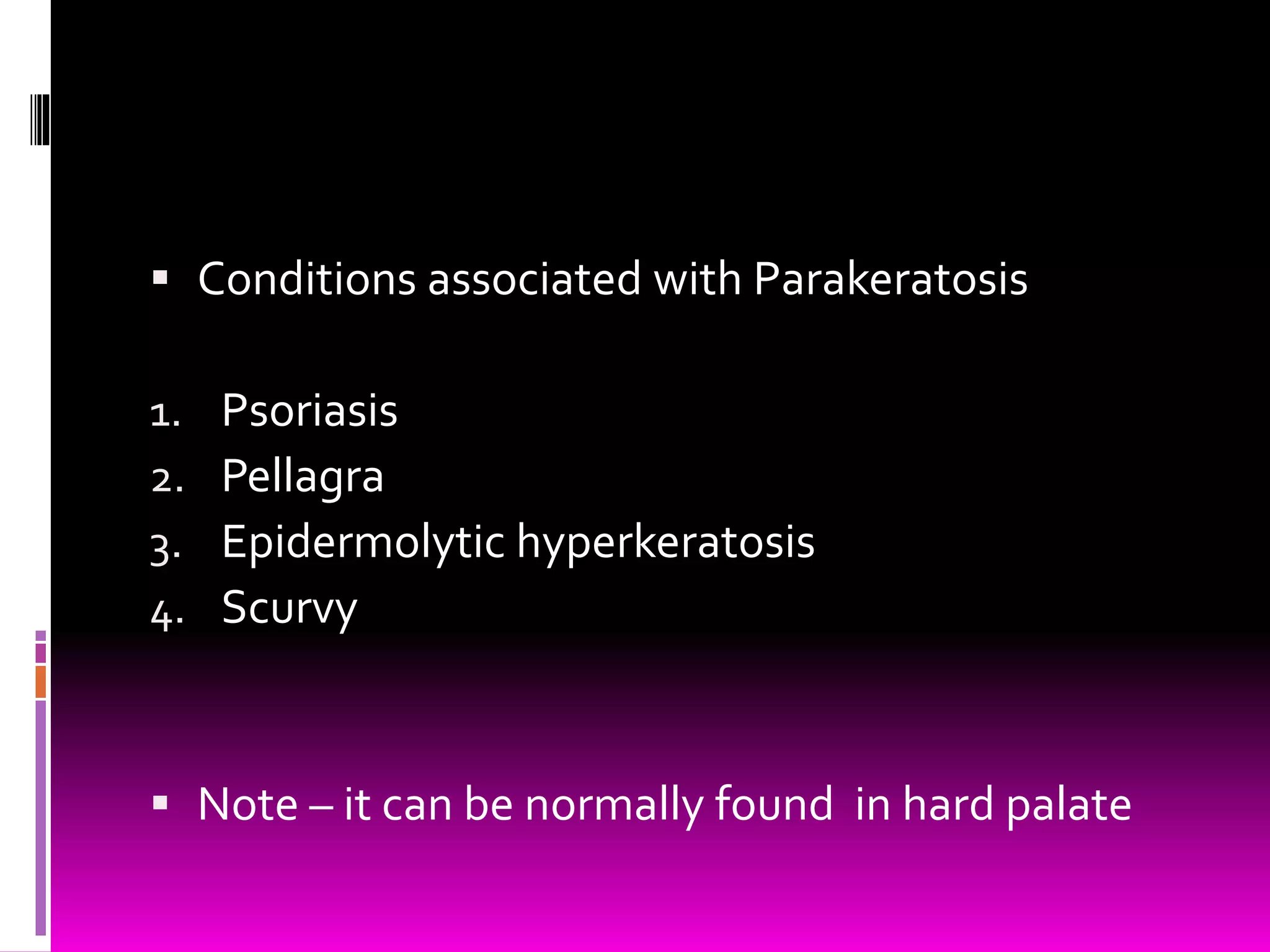
 Conditions associated with Parakeratosis
1. Psoriasis
2. Pellagra
3. Epidermolytic hyperkeratosis
4. Scurvy
 Note – it can be normally found in hard palate
3. DYSKERATOSIS
 Morphologic presentaion of apoptosis of
keratinocytes
 Eosinophilic cytoplasm ,pyknotic nucleus
 Cells are packed with keratin filaments
Cell will tent to round up
Loose it’s attachment with surrounding cells
 Conditions showing dyskeratosis
1. Darier disease
2. Actinic keratosis
3. Squamous cell carcinoma
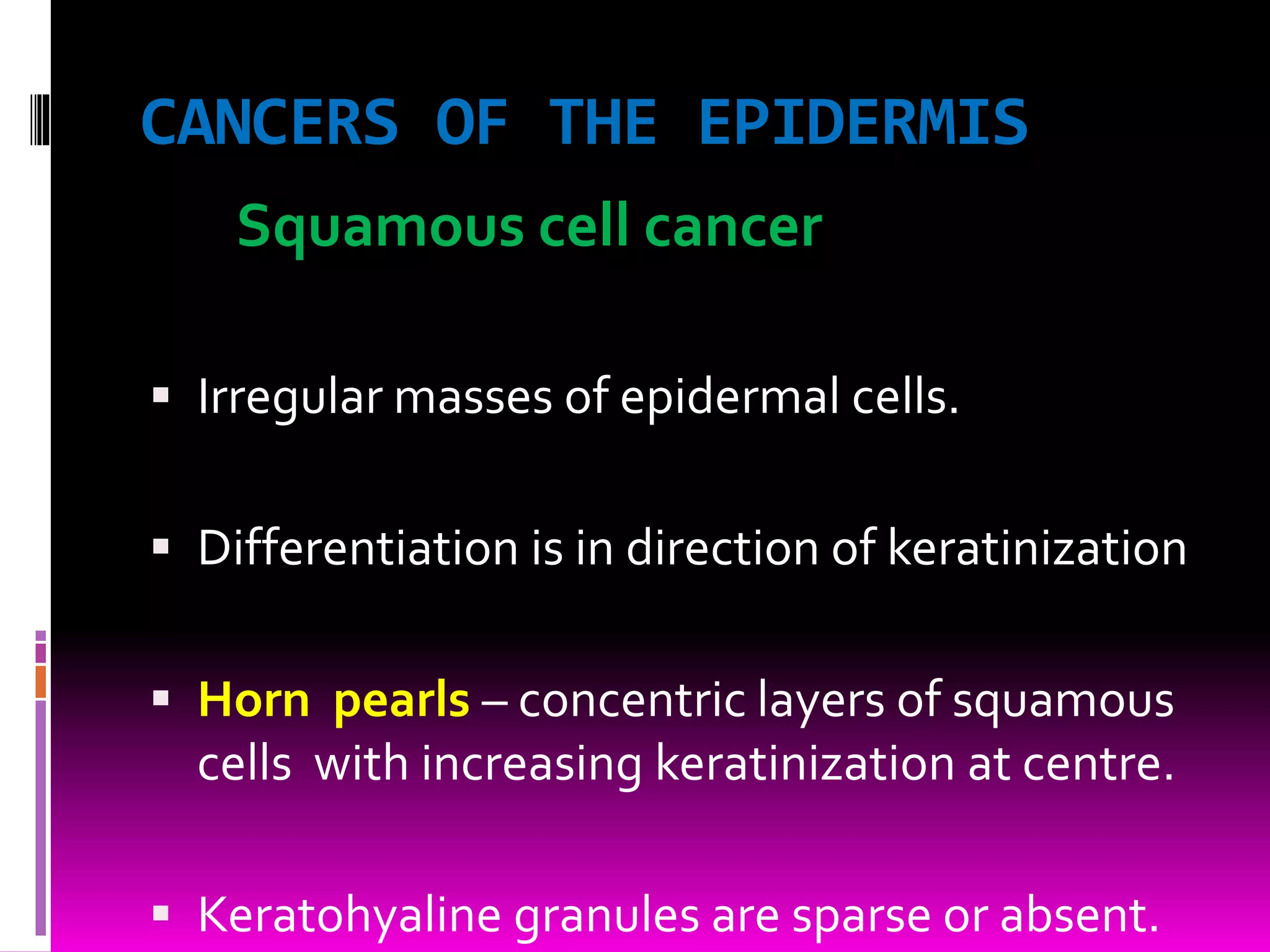
CANCERS OF THE EPIDERMIS
Squamous cell cancer
 Irregular masses of epidermal cells.
 Differentiation is in direction of keratinization
 Horn pearls – concentric layers of squamous
cells with increasing keratinization at centre.
 Keratohyaline granules are sparse or absent.
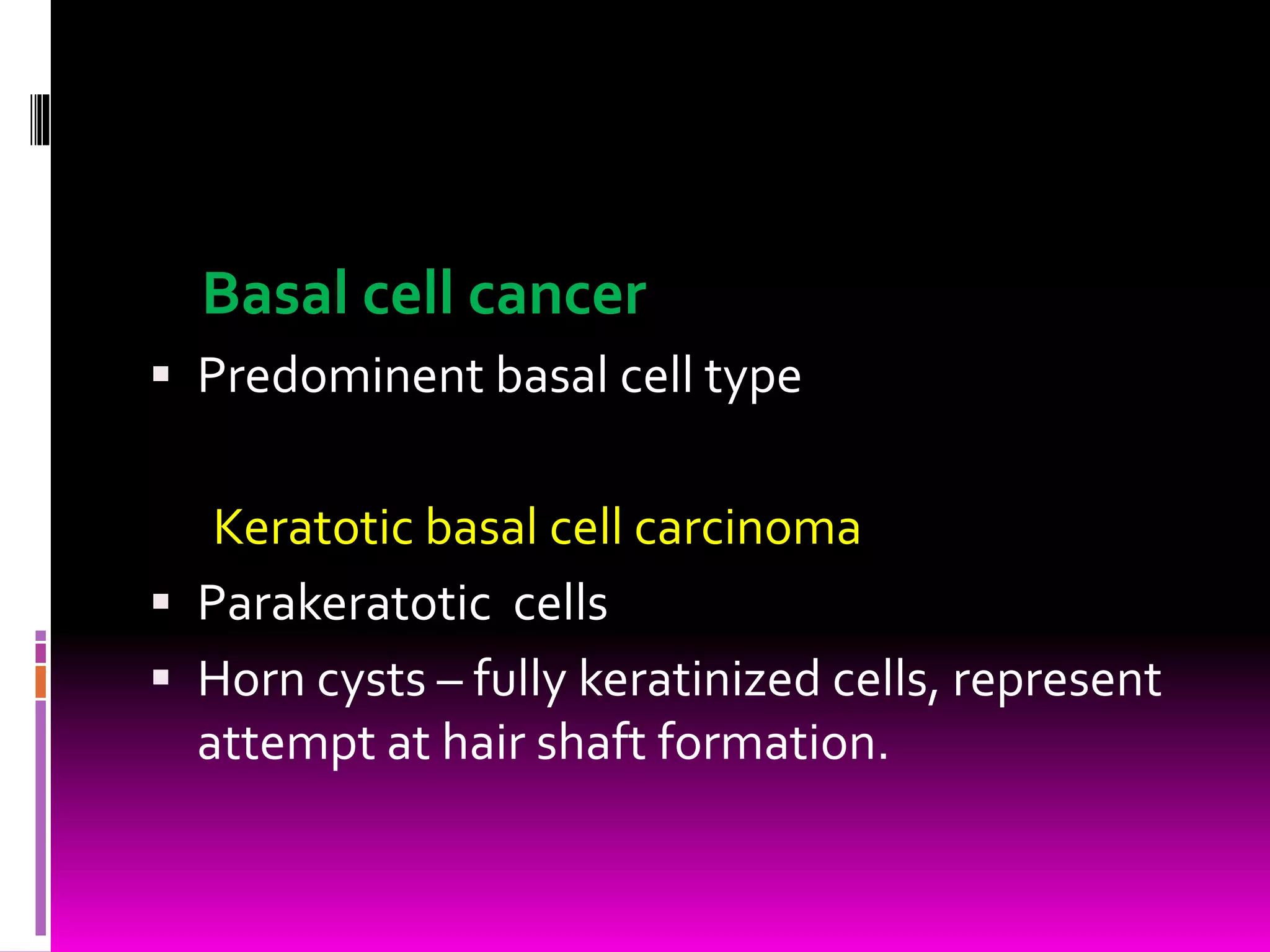
Basal cell cancer
 Predominent basal cell type
Keratotic basal cell carcinoma
 Parakeratotic cells
 Horn cysts – fully keratinized cells, represent
attempt at hair shaft formation.
DRUGS ACTING ON EPIDERMAL CELL
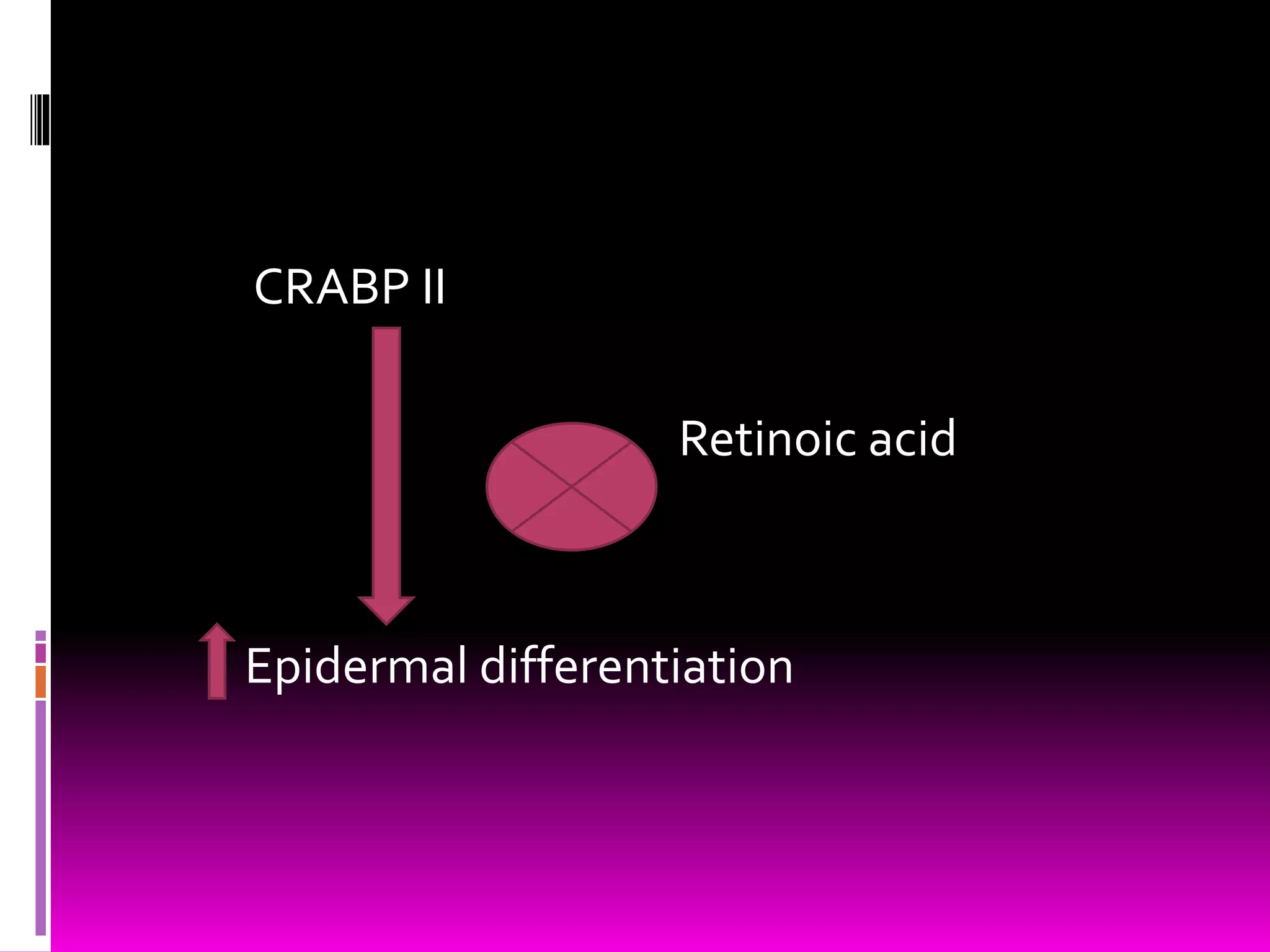
 Retinoic acids
 Acts on retinoic acid receptors RAR and RXR
 CRABP II – in human epidermis
 Epidermal differentiation
 Increased in –
1. Psoriasis
2. Lamellar ichtyosis
3. Darier’s disease
4. PRP
CRABP II
Retinoic acid
Epidermal differentiation
Vitamin D analogues(calcitriol,calcipotriol)
 Acts on vit D receptors on keratinocytes
 MOA-
 Regulate keratinocyte proliferation.
 Epidermal differentiation.
 Formation of cornified membrane.
Tazarotene
 Acts on retinoic acid receptors
 Modulate abnormal epidermal differentiation
and proliferation.
 Upregulation of K-10 terminal differentiation.
Coal tar
 Inhibit DNA synthesis
 Atrophogenic effect
Salicylic acid
 > 3% keratolytic
 MOA –
 Dissolves the intercellular cement substance
of the corneocytes.
REFERENCES
 1) FITZPATRICK’S DERMATOLOGY IN
GENERAL MEDICINE
 2) ROOK’STEXTBOOKOF DERMATOLOGY
 3) IADVALTEXTBOOKAND ATLASOF
DERMATOLOGY BY R.G AND AMEETVALIA
 4) COLOUR ATLAS OF HISTOLOGY OFTHE
SKIN BYWALTER F.LEVER
THANK YOU

Epidermal kinetics

  • 1.
    EPIDERMAL KINETICS Dr. RohitKr.Singh P.G.Resident Skin centre(BH)
  • 2.
    EPIDERMIS  Structure andultrastructure  Stratified squamous Epithelium  95% cells are Keratinocytes  SC SL SG SS SG DERMIS
  • 3.
  • 4.
    EPIDERMAL DYNAMICS  Epidermalproliferative unit( EPU)  Consists of Single Stem cell Transit amplifying cells Terminally differentiated cells (post mitotic cells)
  • 5.
    EPIDERMAL KINETICS  Turnover time Cell cycle Growth fraction
  • 6.
     Mitotic index Isthe fraction of basal cells that is in mitotic phase at any time.  Labelling index Fraction of basal cells in DNA synthesis
  • 7.
     Turnover timeof the germinative epithelium  Epidermal turnover time ( transit time= 14 days) The time taken for a cell to pass from basal layer to the surface of the skin next 14 days Subsequent desquamation
  • 8.
    Normal vs psoriaticcell cycle time Labelling Index( %) S phase hr G2 Phase hr M Phase hr G1 Phase hr TOTAL TIME DURATI ON(hr ) NORMAL EPIDERMIS 5.2 8.5 6 - 8 1 146 163 PSORIATIC EPIDERMIS 22.7 8.5 4 0.3 25 37.5
  • 9.
    TURN OVERTIME TIMENORMAL (DAYS) PSORIATIC (DAYS) VIABLE- EPIDERMIS GERMINATIVE TRANSIT INVIABLE EPITHELIUM 12 -19 26 - 42 1.5 4 – 6 STRATUM CORNEUM 14 2 TOTAL EPIDERMIS 52 - 75 8 - 10
  • 10.
    Psoriasis Cells in Go/G1 Stage Enter the cell cycle
  • 11.
    Regulation of epidermopoiesis Stimulatory factors 1.Human epidermal growth factor(EGF) 2. Transforming growth factor(TGF alpha) 3. Amphiregulin 4. IL-1,IL-2,GM-CSF 5. Basic FGF 6. Keratinocyte growth factor(KGF) 7. Vitamin A 8. Androgens
  • 12.
    Inhibitory factors 1. IFNalpha 2. IFN gamma 3. TNF alpha 4. High calcium level 5. Adrenaline 6. Glucocorticoids
  • 13.
    EPIDERMAL DIFFERENTIATION  8% of the basal cells -(K-1/K10) undergo differentiation.  Orchestrated expression of keratins and subunits of cornified envelope.  Terminal differentiation (keratinization):  Change in keratin expression .  Formation of corneocyte.
  • 14.
    TERMINAL DIFFERENTIATION 1.Formation ofkeratin 2.Keratin filaments aggregate into bundles with the help of filaggrin. 3.Cornified envelope.
  • 15.
    4.Changes in expressionof  Intracellular lipid  Membrane glycoproteins  Growth factor receptors  Adhesion protein  Blood group antigens  Desmosomes.
  • 17.
    KERATINOCYTES  Any oneof the cells in the skin that synthesize keratin.  Contains actin ,tubulin , intermediate filaments.  Keratin is one of the 6 types of intermediate filaments.
  • 18.
    KERATIN (CYTOKERATINS)  54functional keratin genes.  Two gene family :- type 1(basic) type 2(acidic)  Retinoic acid , growth factors ,hormones regulate keratin gene expression.
  • 19.
    Type 1 keratins K9,K10 Epidermis(suprabasal) K12Cornea K13 Oral mucosa K14,K15 Complex epithelia K16,K17 Epithelial appendages K18 Simple epithelia K19 Broad distribution K20 Gut epithelium K23 pancreas K24 unknown K25-28,31-38,39,40 Hair shafts
  • 20.
    Type 2 keratins K1,K2 Epidermis(suprabasal) K3 Cornea K4 Oral mucosa K5 Complex epithelia(basal layer) K6a,K6b Epithelial appendages K6c Skin K7,K8 Simple epithelia K71 – 74,75 Hair follicles H76 Oral mucosa K77 Sweat gland ducts K78 tongue
  • 22.
    DIFFERENTIATING EPIDERMAL KERATINOCYTES Basal layeras proliferative cells express K-5 and K-14 The process of differentiation starts with the K – 10/K-1 expression (in TA cells) K-2 is expressed at later stages of differentiation( granular layer)
  • 23.
    Psoriasis Wound healing Alteredepidermal differentiation Synthesis of suprabasal K-6 and K-16
  • 24.
    BASIC K ACIDIC K TISSUE EXPRESSION DISEASEASSOCITION 1 10 Suprabasal keratinocytes Bullous congenital icthyosiformis erythroderma ; Diffuse non epidermolytic PPK 1 9 Suprabasal keratinocytes (palmo-plantar skin) Epidermolytic PPK 2 10 Upper spinous , granular Icthyosiform bullosa of siemens 3 12 cornea Meesmann’s corneal dystrophy 4 13 Mucosal epithelium White sponge nevus 5 14 Basal keratinocytes Epidermolytic bullosa complex 6a 16 Outer root sheath,hyperproliferative, palmo-plantar keratinocytes Paronychia congenita type 1 ; Focal non-epiderdermolytic PPK 6b 17 Nail bed ,epidermal appendages Paronychia congenita type II, Steatocystoma multiplex 8 18 Simple epithelium Cryptogenic cirrhosis
  • 25.
    Keratohyaline granules  Keratinocytesof stratum granulosum.  Disappear in cornified squames.  They contain granules rich in histidine .  Keratin filament are aggregate into bundles by the action of the histidine rich basic protein callled filaggrin.
  • 26.
    Membrane – coatinggranules Also called as lamellar granules or odland bodies. Found in spinosum and Granulosum layers of skin. Contains phospholipids, glycolipids and free sterols. Forming an important barrier to permeability.
  • 28.
    CORNIFIED ENVELOPE  Highlyinsoluble cell envelope.  Present in stratum corneum.  It’s development is triggered by intracellular calcium.  Involucrin is main envelope precursor.  Others include 1. Loricin 6. Envoplakin 2. Cornifine 7. Periplakin 3. Pancornulin 8. 61KDa protein 4. Elafin 5. Keratolini
  • 29.
     Transglutaminases cross-linkplakins and involucrin.  Other desmosomal proteins are also cross- linked ,forming a scaffold along the entire inner surface of the plasma membrane.  High calcium level increases differentiation.
  • 31.
    PROTEIN DISEASE ASSOCIATION CYSTATINA Harlequin ichthyosis PROFILAGGRIN /FILAGGRIN Ichthyosis vulgaris Atopic dermatitis LORICIN Mutilating keratoderma with ichthyosis; Progressive symmetric erythroderma
  • 32.
    NORMAL HOMIEOSTASIS-EPIDERMIS 1.Mitotic rateof germinative cells 2.Generation time of epidermal cells 3.Desquamation rate of corneocytes
  • 33.
    DISTURBANCE IN EPIDERMALKINETICS 1. ACANTHOSIS Enhanced cell proliferation Enlargement of the germinative cell Increased mitotic rates Broadening of epidermis
  • 34.
     Conditions showingAcanthosis:- 1. Psoriasis 2. Eczema 3. Condyloma acuminatum
  • 35.
    DISTURBANCE IN EPIDERMALDIFFERENTIATION 2. PARAKERATOSIS Incomplete differentiation in post mitotic phase Faulty and accelerated cornification Retension of of pyknotic nuclei of epidermal cells Leads to gap between cells Loss of barrier function of the epidermis
  • 36.
  • 37.
     Conditions associatedwith Parakeratosis 1. Psoriasis 2. Pellagra 3. Epidermolytic hyperkeratosis 4. Scurvy  Note – it can be normally found in hard palate
  • 38.
    3. DYSKERATOSIS  Morphologicpresentaion of apoptosis of keratinocytes  Eosinophilic cytoplasm ,pyknotic nucleus  Cells are packed with keratin filaments Cell will tent to round up Loose it’s attachment with surrounding cells
  • 39.
     Conditions showingdyskeratosis 1. Darier disease 2. Actinic keratosis 3. Squamous cell carcinoma
  • 40.
    CANCERS OF THEEPIDERMIS Squamous cell cancer  Irregular masses of epidermal cells.  Differentiation is in direction of keratinization  Horn pearls – concentric layers of squamous cells with increasing keratinization at centre.  Keratohyaline granules are sparse or absent.
  • 41.
    Basal cell cancer Predominent basal cell type Keratotic basal cell carcinoma  Parakeratotic cells  Horn cysts – fully keratinized cells, represent attempt at hair shaft formation.
  • 42.
    DRUGS ACTING ONEPIDERMAL CELL  Retinoic acids  Acts on retinoic acid receptors RAR and RXR  CRABP II – in human epidermis  Epidermal differentiation  Increased in – 1. Psoriasis 2. Lamellar ichtyosis 3. Darier’s disease 4. PRP
  • 43.
  • 44.
    Vitamin D analogues(calcitriol,calcipotriol) Acts on vit D receptors on keratinocytes  MOA-  Regulate keratinocyte proliferation.  Epidermal differentiation.  Formation of cornified membrane.
  • 45.
    Tazarotene  Acts onretinoic acid receptors  Modulate abnormal epidermal differentiation and proliferation.  Upregulation of K-10 terminal differentiation.
  • 46.
    Coal tar  InhibitDNA synthesis  Atrophogenic effect
  • 47.
    Salicylic acid  >3% keratolytic  MOA –  Dissolves the intercellular cement substance of the corneocytes.
  • 48.
    REFERENCES  1) FITZPATRICK’SDERMATOLOGY IN GENERAL MEDICINE  2) ROOK’STEXTBOOKOF DERMATOLOGY  3) IADVALTEXTBOOKAND ATLASOF DERMATOLOGY BY R.G AND AMEETVALIA  4) COLOUR ATLAS OF HISTOLOGY OFTHE SKIN BYWALTER F.LEVER
  • 49.