1
MEWAR UNIVERSITY
2
Divergence Theorem
3
Divergence Theorem
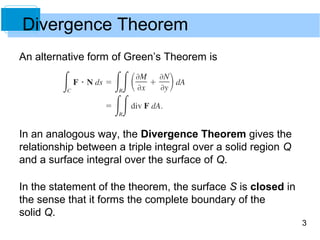
An alternative form of Green’s Theorem is
In an analogous way, the Divergence Theorem gives the
relationship between a triple integral over a solid region Q
and a surface integral over the surface of Q.
In the statement of the theorem, the surface S is closed in
the sense that it forms the complete boundary of the
solid Q.
4
Assume that Q is a solid region on which a triple integral
can be evaluated, and that the closed surface S is oriented
by outward unit normal vectors, as shown in Figure 15.54.
Figure 15.54
Divergence Theorem
5
With these restrictions on S and Q, the Divergence
Theorem can be stated as shown below.
Divergence Theorem
6
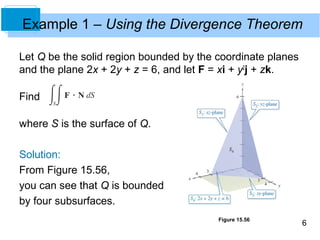
Let Q be the solid region bounded by the coordinate planes
and the plane 2x + 2y + z = 6, and let F = xi + y2
j + zk.
Find
where S is the surface of Q.
Solution:
From Figure 15.56,
you can see that Q is bounded
by four subsurfaces.
Example 1 – Using the Divergence Theorem
Figure 15.56
7
So, you would need four surface integrals to evaluate
However, by the Divergence Theorem, you need only one
triple integral. Because
you have
Example 1 – Solution cont’d
8
Example 1 – Solution cont’d
9
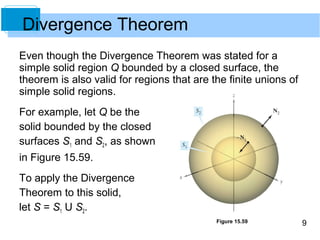
Even though the Divergence Theorem was stated for a
simple solid region Q bounded by a closed surface, the
theorem is also valid for regions that are the finite unions of
simple solid regions.
For example, let Q be the
solid bounded by the closed
surfaces S1 and S2, as shown
in Figure 15.59.
To apply the Divergence
Theorem to this solid,
let S = S1 U S2.
Figure 15.59
Divergence Theorem
10
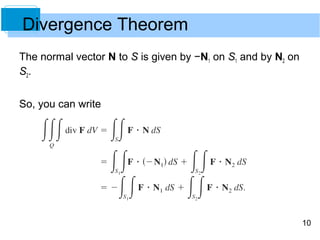
The normal vector N to S is given by −N1 on S1 and by N2 on
S2.
So, you can write
Divergence Theorem
11
tHaNkS yOutHaNkS yOu

Divergence Theorem by Himanshu Vaid

  • 1.
  • 2.
  • 3.
    3 Divergence Theorem An alternativeform of Green’s Theorem is In an analogous way, the Divergence Theorem gives the relationship between a triple integral over a solid region Q and a surface integral over the surface of Q. In the statement of the theorem, the surface S is closed in the sense that it forms the complete boundary of the solid Q.
  • 4.
    4 Assume that Qis a solid region on which a triple integral can be evaluated, and that the closed surface S is oriented by outward unit normal vectors, as shown in Figure 15.54. Figure 15.54 Divergence Theorem
  • 5.
    5 With these restrictionson S and Q, the Divergence Theorem can be stated as shown below. Divergence Theorem
  • 6.
    6 Let Q bethe solid region bounded by the coordinate planes and the plane 2x + 2y + z = 6, and let F = xi + y2 j + zk. Find where S is the surface of Q. Solution: From Figure 15.56, you can see that Q is bounded by four subsurfaces. Example 1 – Using the Divergence Theorem Figure 15.56
  • 7.
    7 So, you wouldneed four surface integrals to evaluate However, by the Divergence Theorem, you need only one triple integral. Because you have Example 1 – Solution cont’d
  • 8.
    8 Example 1 –Solution cont’d
  • 9.
    9 Even though theDivergence Theorem was stated for a simple solid region Q bounded by a closed surface, the theorem is also valid for regions that are the finite unions of simple solid regions. For example, let Q be the solid bounded by the closed surfaces S1 and S2, as shown in Figure 15.59. To apply the Divergence Theorem to this solid, let S = S1 U S2. Figure 15.59 Divergence Theorem
  • 10.
    10 The normal vectorN to S is given by −N1 on S1 and by N2 on S2. So, you can write Divergence Theorem
  • 11.