Positive Displacement Pumps
Petroskills course
Hector Nguema Ondo Perez
Introduction to PD pumps
Introduction to pumps
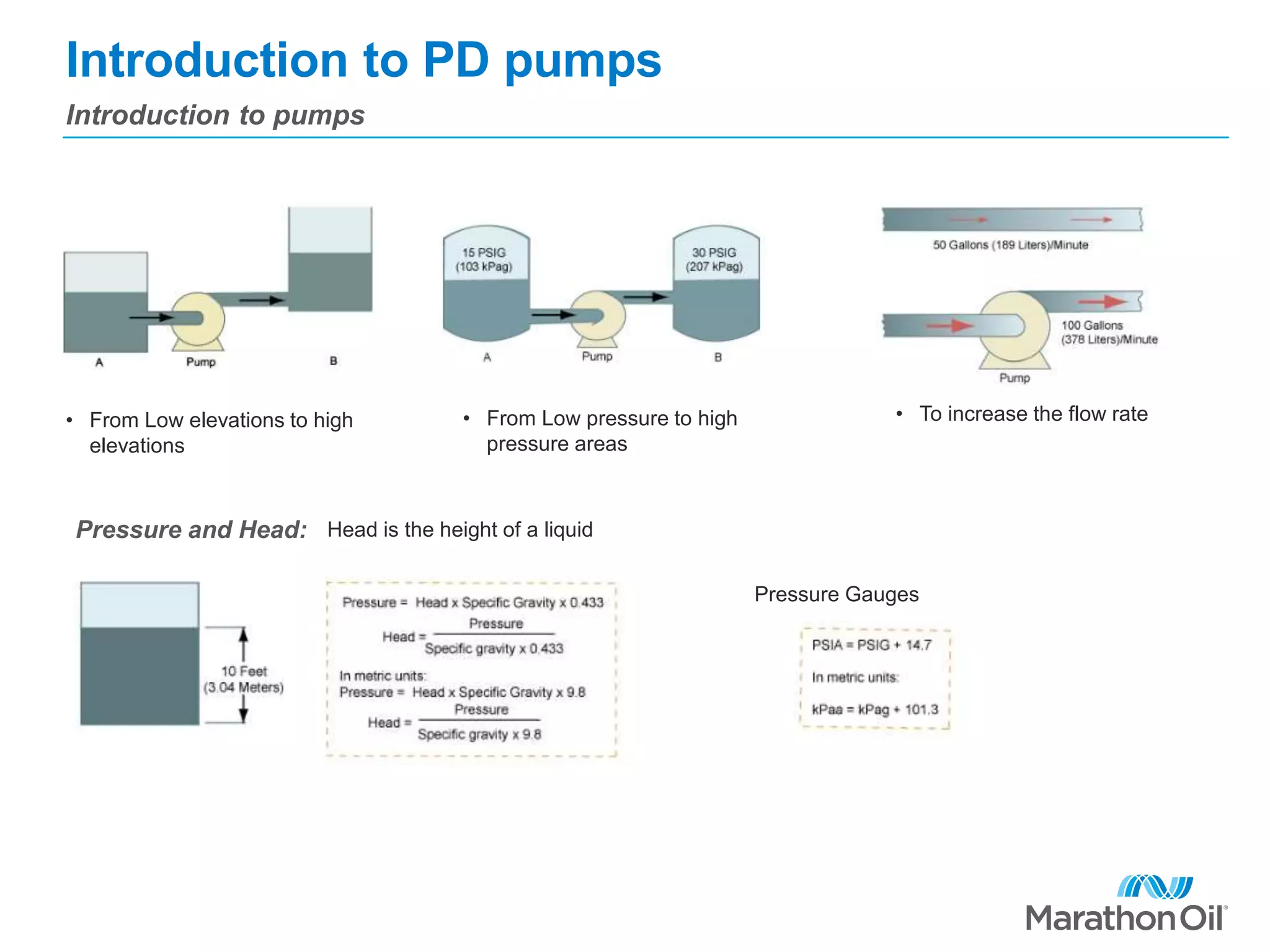
• From Low elevations to high
elevations
• From Low pressure to high
pressure areas
• To increase the flow rate
Pressure and Head: Head is the height of a liquid
Pressure Gauges
Introduction to PD pumps
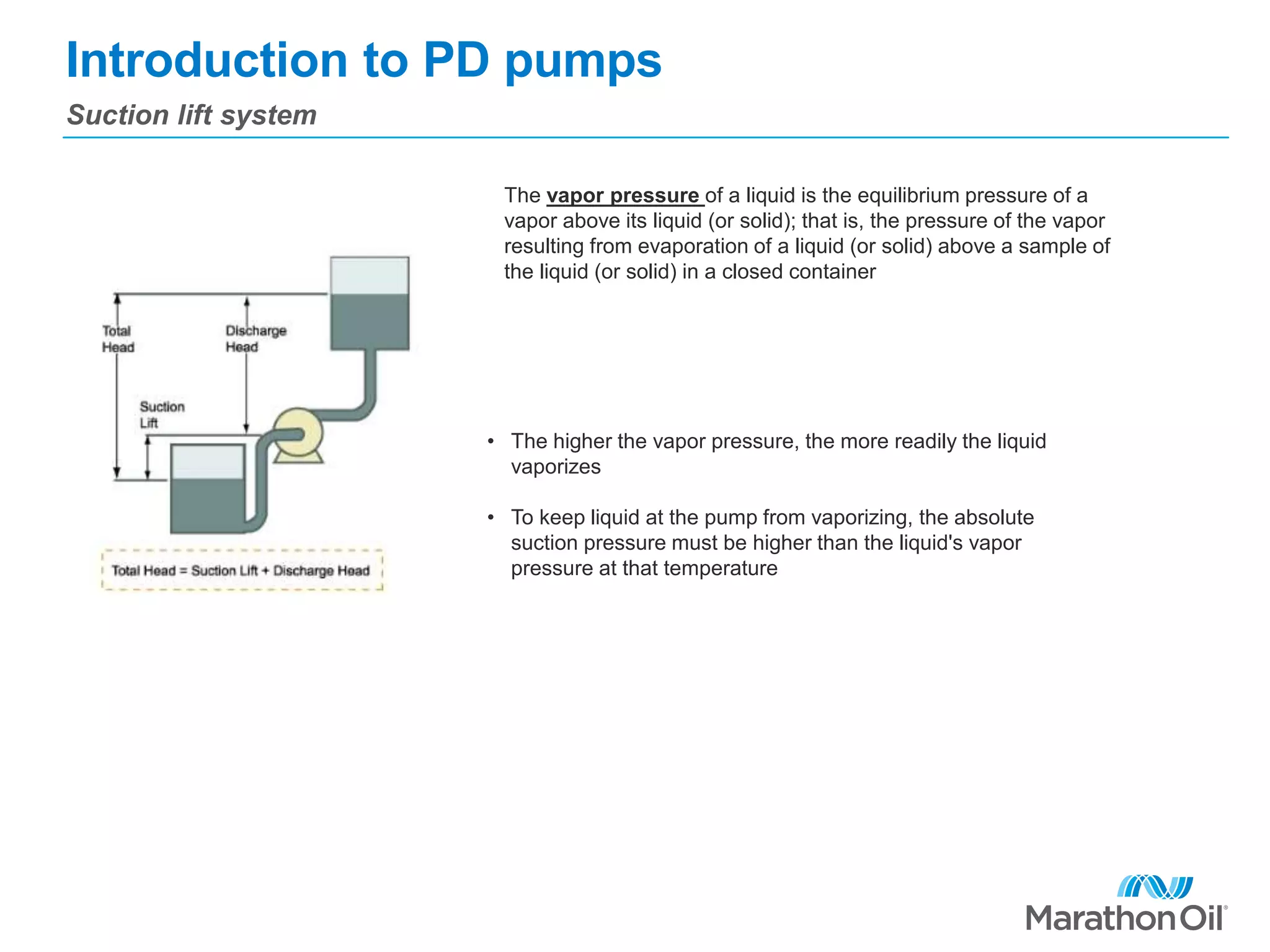
Suction lift system
• The higher the vapor pressure, the more readily the liquid
vaporizes
• To keep liquid at the pump from vaporizing, the absolute
suction pressure must be higher than the liquid's vapor
pressure at that temperature
The vapor pressure of a liquid is the equilibrium pressure of a
vapor above its liquid (or solid); that is, the pressure of the vapor
resulting from evaporation of a liquid (or solid) above a sample of
the liquid (or solid) in a closed container
Positive Displacement pumps
Types of reciprocating pumps
Piston pump
Plunger Pump
• Piston fits close to the cylinder's walls.
• Designed to push liquid from the cylinder.
• Rings to reduce fluid leakage between the piston and the
cylinder walls.
• Cylinder is fitted with a replaceable liner.
• Plunger does not touch the cylinder walls.
• Displaces only part of the liquid in the cylinder.
• Reciprocates inside a stationary packing to prevent leakage
between the plunger and the cylinder.
• Does not require a liner.
Positive Displacement pumps
Types of reciprocating pumps
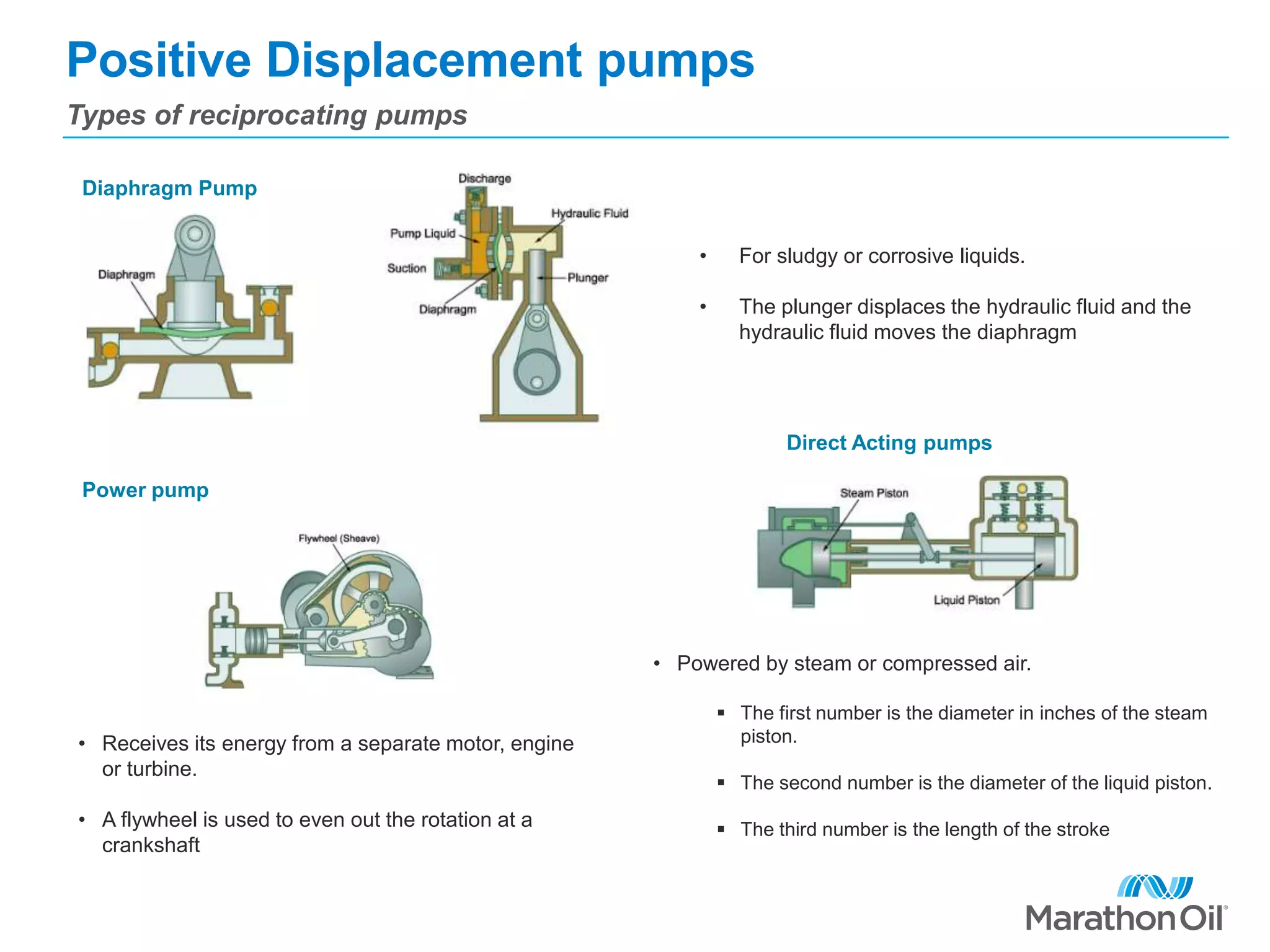
Diaphragm Pump
• For sludgy or corrosive liquids.
• The plunger displaces the hydraulic fluid and the
hydraulic fluid moves the diaphragm
Power pump
• Receives its energy from a separate motor, engine
or turbine.
• A flywheel is used to even out the rotation at a
crankshaft
Direct Acting pumps
• Powered by steam or compressed air.
 The first number is the diameter in inches of the steam
piston.
 The second number is the diameter of the liquid piston.
 The third number is the length of the stroke
Positive Displacement pumps
Types of rotary pumps
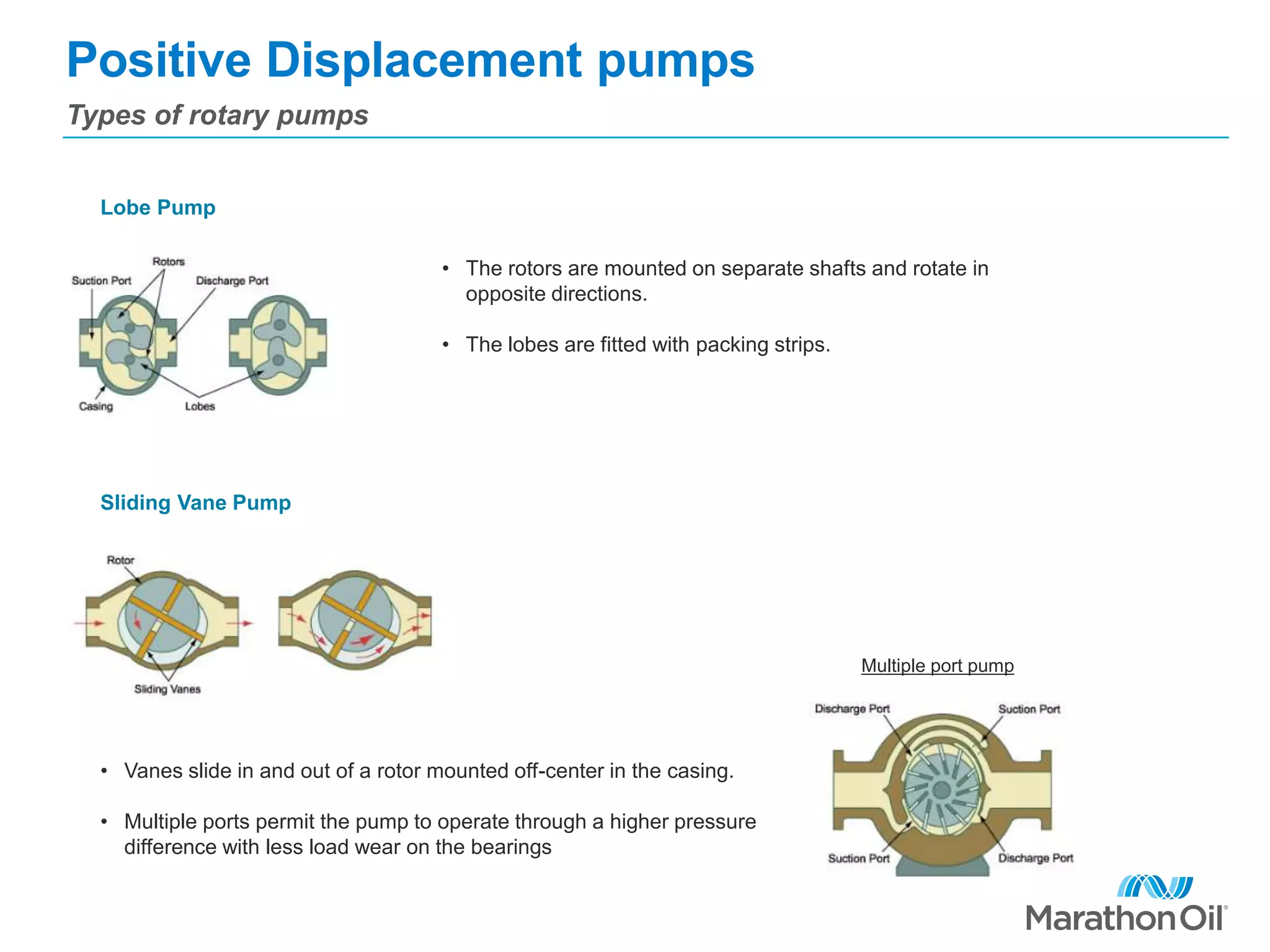
Lobe Pump
• The rotors are mounted on separate shafts and rotate in
opposite directions.
• The lobes are fitted with packing strips.
Sliding Vane Pump
• Vanes slide in and out of a rotor mounted off-center in the casing.
• Multiple ports permit the pump to operate through a higher pressure
difference with less load wear on the bearings
Multiple port pump
Positive Displacement pumps
Types of rotary pumps
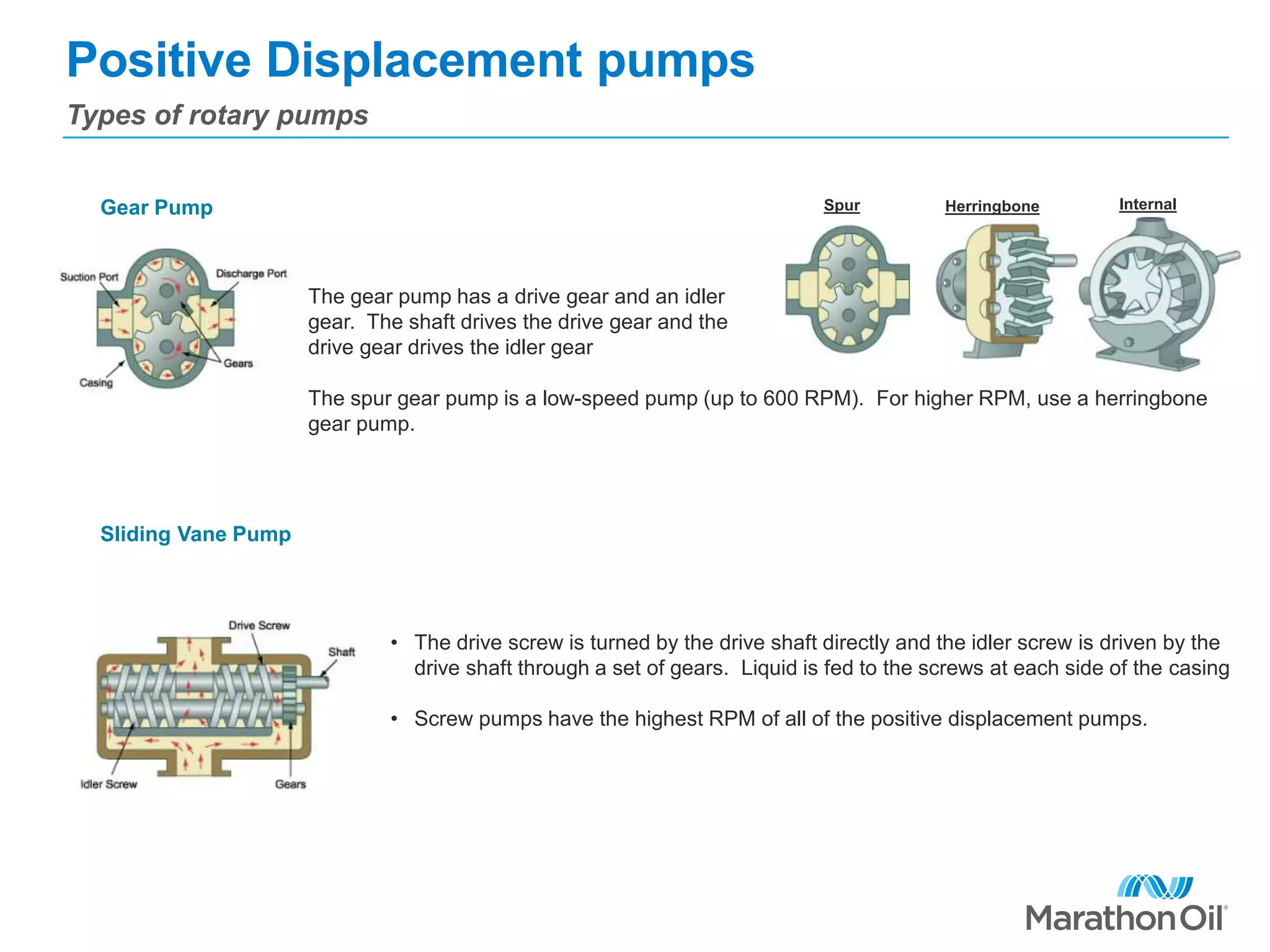
Gear Pump
Sliding Vane Pump
The gear pump has a drive gear and an idler
gear. The shaft drives the drive gear and the
drive gear drives the idler gear
Spur Herringbone Internal
The spur gear pump is a low-speed pump (up to 600 RPM). For higher RPM, use a herringbone
gear pump.
• The drive screw is turned by the drive shaft directly and the idler screw is driven by the
drive shaft through a set of gears. Liquid is fed to the screws at each side of the casing
• Screw pumps have the highest RPM of all of the positive displacement pumps.
Pump Components
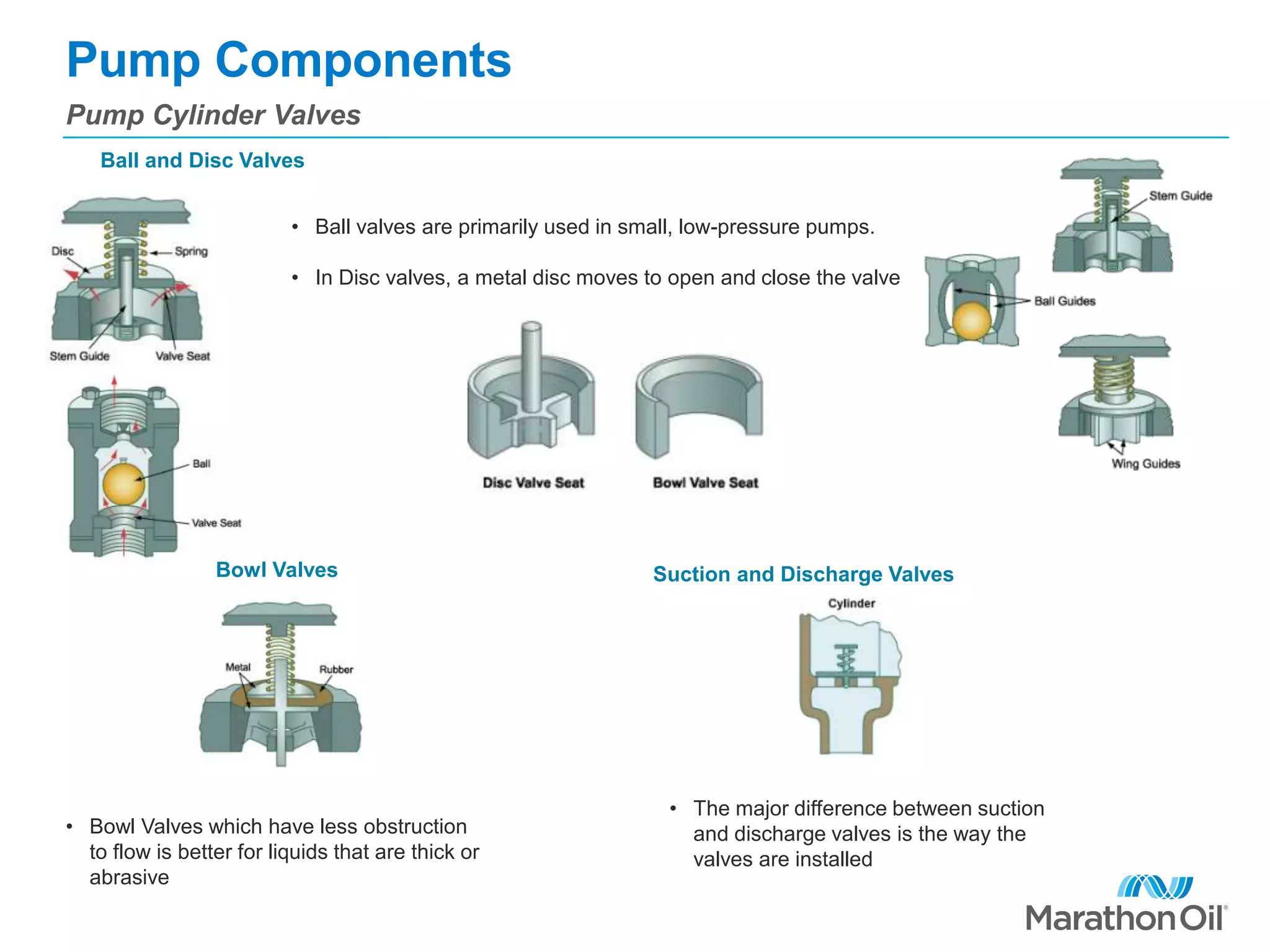
Pump Cylinder Valves
Ball and Disc Valves
• Ball valves are primarily used in small, low-pressure pumps.
• In Disc valves, a metal disc moves to open and close the valve
Bowl Valves
• Bowl Valves which have less obstruction
to flow is better for liquids that are thick or
abrasive
Suction and Discharge Valves
• The major difference between suction
and discharge valves is the way the
valves are installed
Pump Components
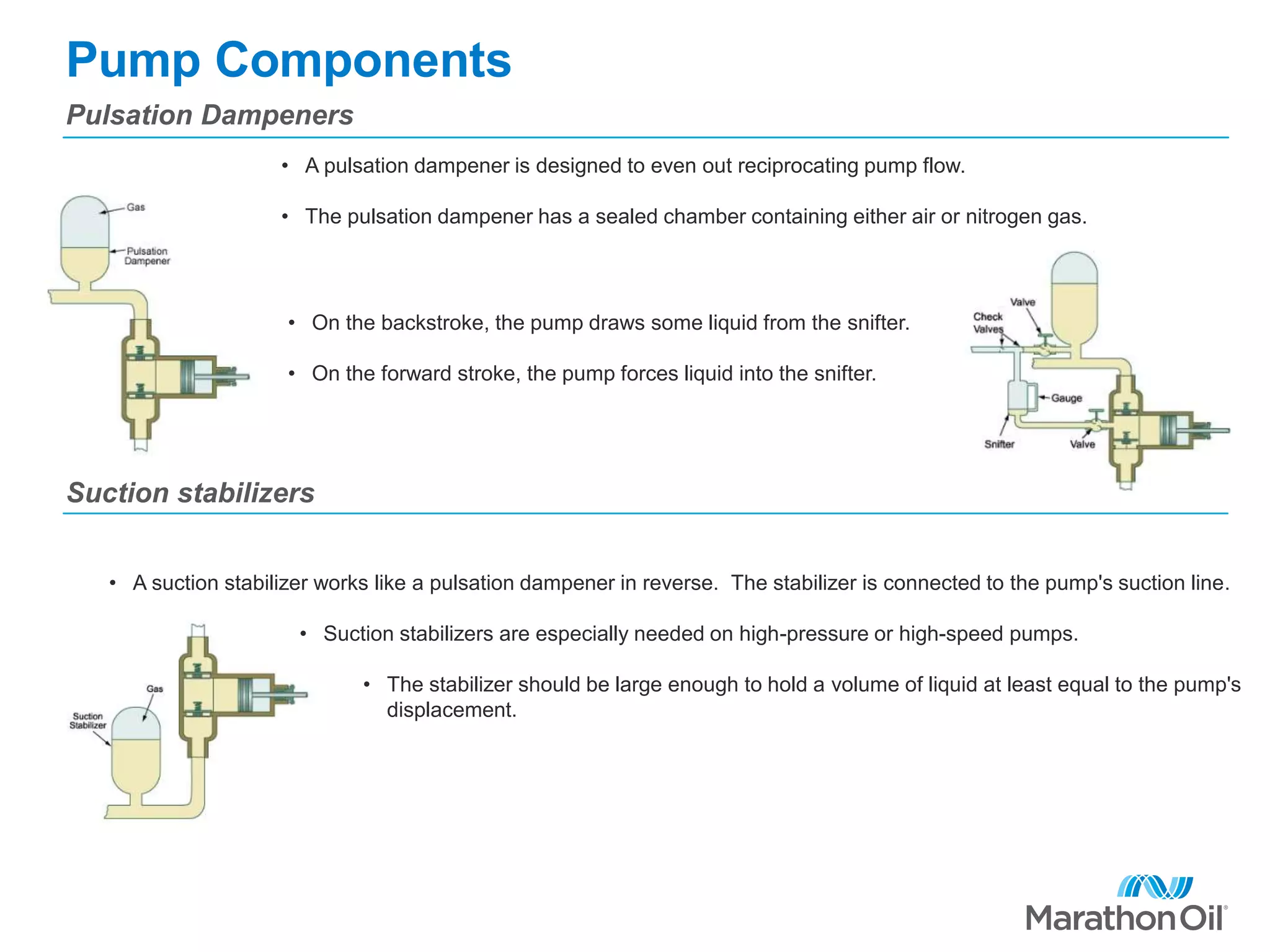
Pulsation Dampeners
• A pulsation dampener is designed to even out reciprocating pump flow.
• The pulsation dampener has a sealed chamber containing either air or nitrogen gas.
• On the backstroke, the pump draws some liquid from the snifter.
• On the forward stroke, the pump forces liquid into the snifter.
• A suction stabilizer works like a pulsation dampener in reverse. The stabilizer is connected to the pump's suction line.
• Suction stabilizers are especially needed on high-pressure or high-speed pumps.
• The stabilizer should be large enough to hold a volume of liquid at least equal to the pump's
displacement.
Suction stabilizers
Pump Components
Bypass and relief valves
• This pump is equipped with a safety relief valve
installed in the discharge-to-suction bypass
• Engines and turbines cannot be started with
a load so they are equipped with a discharge-
to-suction bypass
Variable Displacement Devices
• Variable displacement pumps are built to permit changes in capacity without changing operating speed
• Changing the plunger pump displacement is to change the size of the plunger.
• Changing the lost motion distance changes the length of the plunger stroke.
Maintaining PD pumps
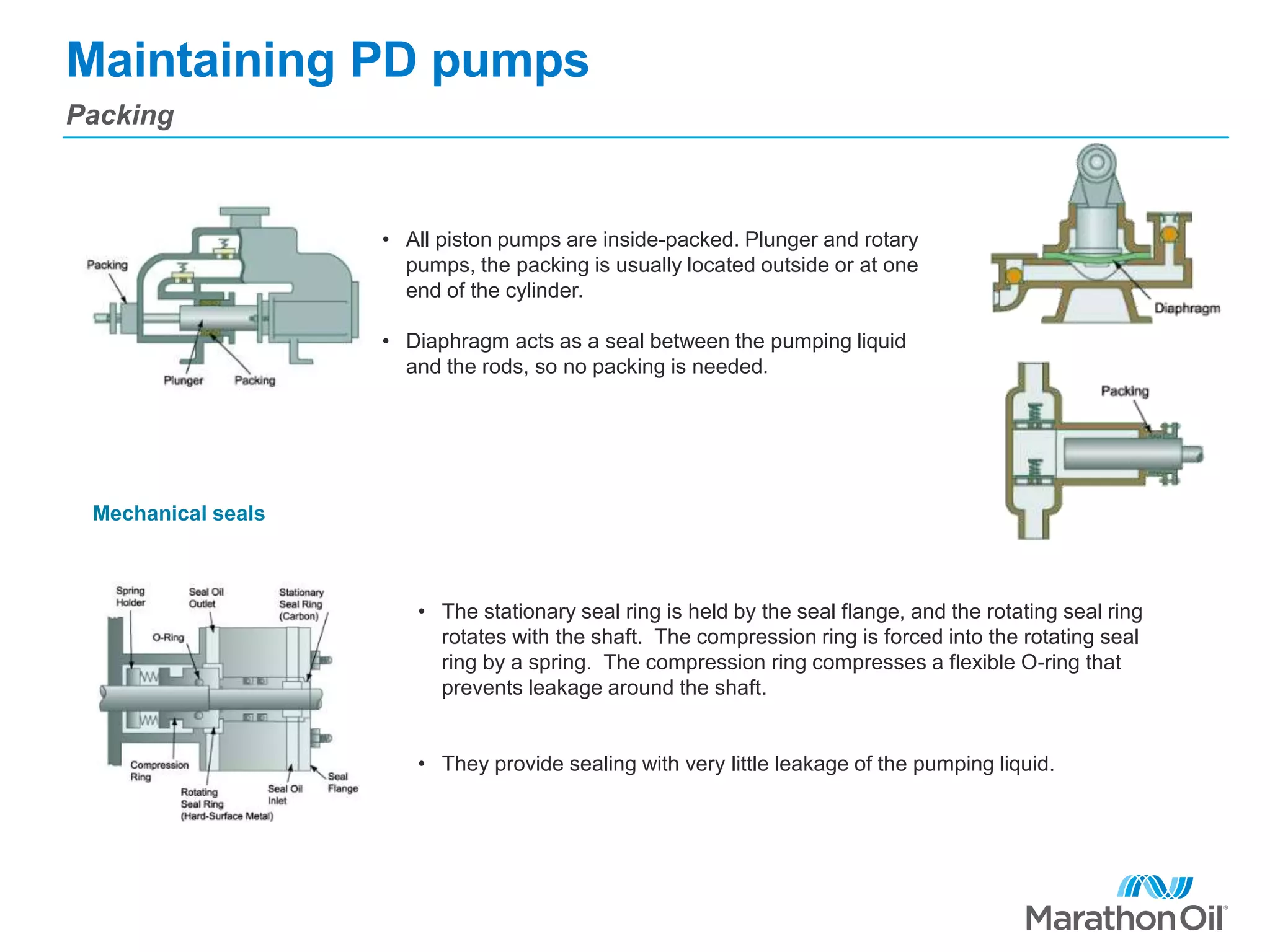
Packing
Mechanical seals
• All piston pumps are inside-packed. Plunger and rotary
pumps, the packing is usually located outside or at one
end of the cylinder.
• Diaphragm acts as a seal between the pumping liquid
and the rods, so no packing is needed.
• The stationary seal ring is held by the seal flange, and the rotating seal ring
rotates with the shaft. The compression ring is forced into the rotating seal
ring by a spring. The compression ring compresses a flexible O-ring that
prevents leakage around the shaft.
• They provide sealing with very little leakage of the pumping liquid.
Maintaining PD pumps
Lubrication System
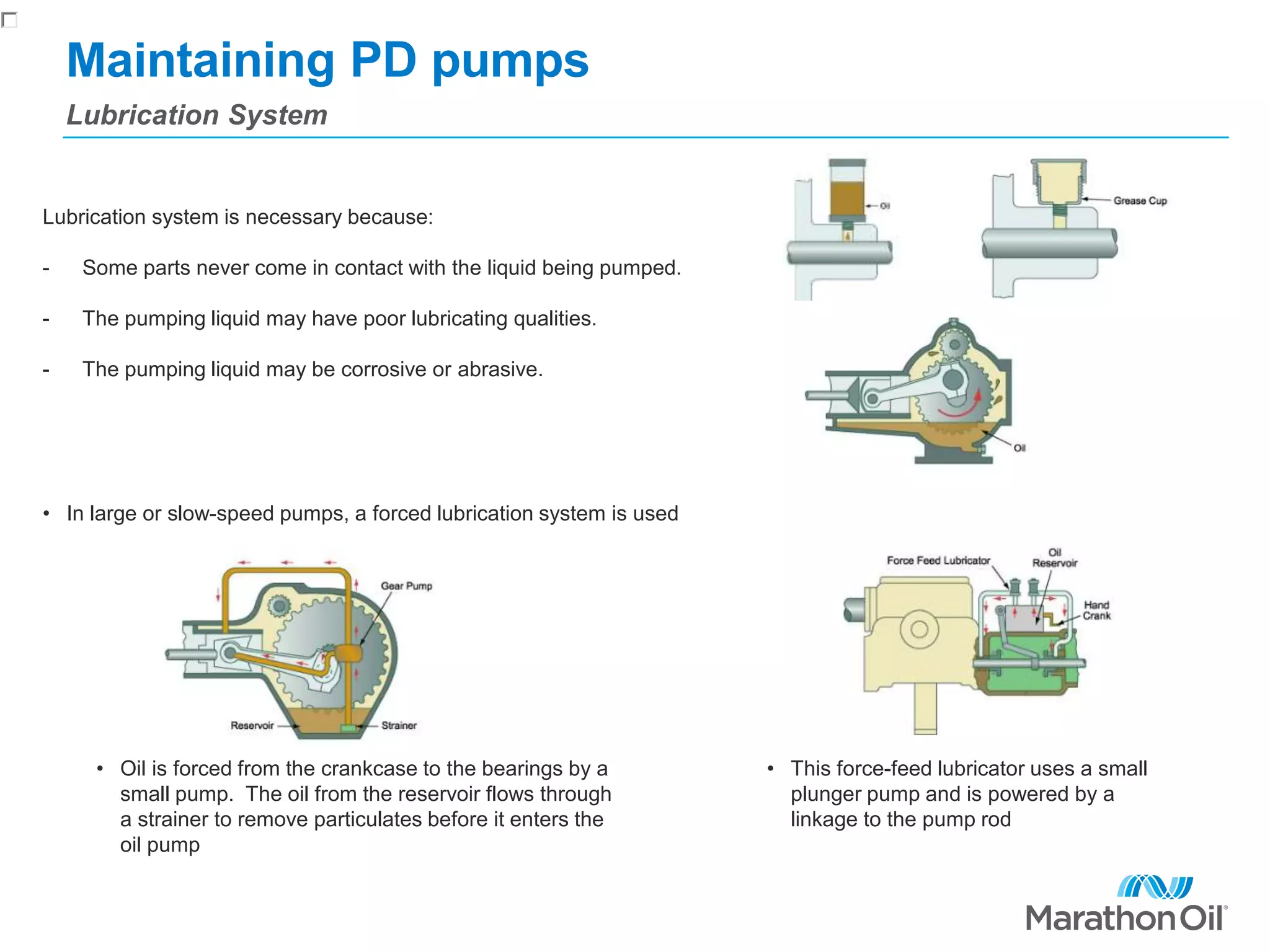
Lubrication system is necessary because:
- Some parts never come in contact with the liquid being pumped.
- The pumping liquid may have poor lubricating qualities.
- The pumping liquid may be corrosive or abrasive.
• In large or slow-speed pumps, a forced lubrication system is used
• This force-feed lubricator uses a small
plunger pump and is powered by a
linkage to the pump rod
• Oil is forced from the crankcase to the bearings by a
small pump. The oil from the reservoir flows through
a strainer to remove particulates before it enters the
oil pump
Maintaining PD pumps
• Wear rings : simplify maintenance by protecting the casing and the impeller
• Packing Box: Must be always lubricated.
– Ring Packing lubricated by the liquid being pumped
– Lantern ring and packing are lubricated by oil.
• Bearings and Couplings
Bearings
There is almost no friction
between the balls and any of the
other parts they touch because of
the lubrication.
Used in large pumps. Has more
surface area than a ball bearing
and can support a very heavy
shaft.
Used in pumps with a large axial
load. The shoes are pivoted to
absorb minor variations in the
rotation of the collar.
Maintaining PD pumps
Pumps alignment and pump cooling
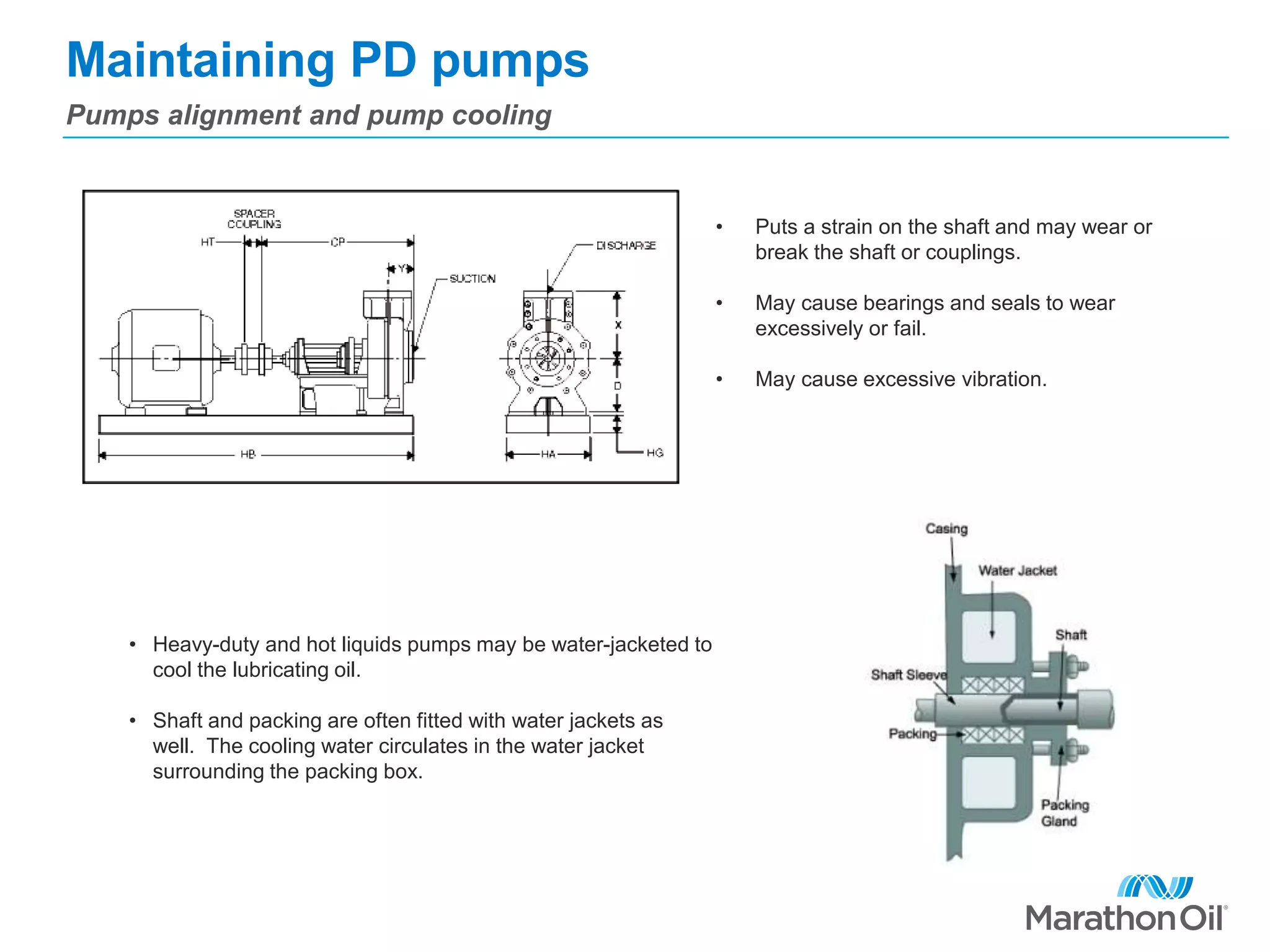
• Puts a strain on the shaft and may wear or
break the shaft or couplings.
• May cause bearings and seals to wear
excessively or fail.
• May cause excessive vibration.
• Heavy-duty and hot liquids pumps may be water-jacketed to
cool the lubricating oil.
• Shaft and packing are often fitted with water jackets as
well. The cooling water circulates in the water jacket
surrounding the packing box.
Common pumping problems
• Gradual Loss of Capacity Wear and leakage in the pump
• Loss of Suction Prevent the pump from filling properly with liquid
• Sudden Loss of Capacity A blocked discharge line prevents the pump from discharging
liquid. Direct-acting steam pumps and power pumps will stall if the discharge is blocked. But if the driver of a power
pump does not stall or fail, a blocked discharge without a relief valve will rupture gaskets, piping or some part of the
pump
Loss of capacity
Vapor Locking
Evaporation of the pumping liquid can also cause vapor lock and loss of suction. To prevent vaporization, NPSH
available must be equal to or greater than NPSH required. NPSH can be increased by either:
• Increasing the suction pressure.
• Decreasing the temperature of the suction liquid.
Common pumping problems
• Overloading Excessive friction, blocked discharge line or increase in viscosity or density
• Overspeeding Overload leads to somewhat the same results in either direct-acting or power pumps
• Short-Stroking Short strokes may be caused by a piston rod packing that is too tight. On direct-
acting pumps equipped with cushion valves, long- or short-stroking may call for an adjustment of these valves
Overloading, overspeeding and short-stroking
Noise and vibration
Signs of faulty operation. Either can be caused by:
• Vapor locking.
• Improper alignment or balanced rotating assembly.
• A worn or loose bearing.
• Improper lubrication, which can cause pump parts to grab and seize.
• Operating at too high a speed
• Etc…
Final comments
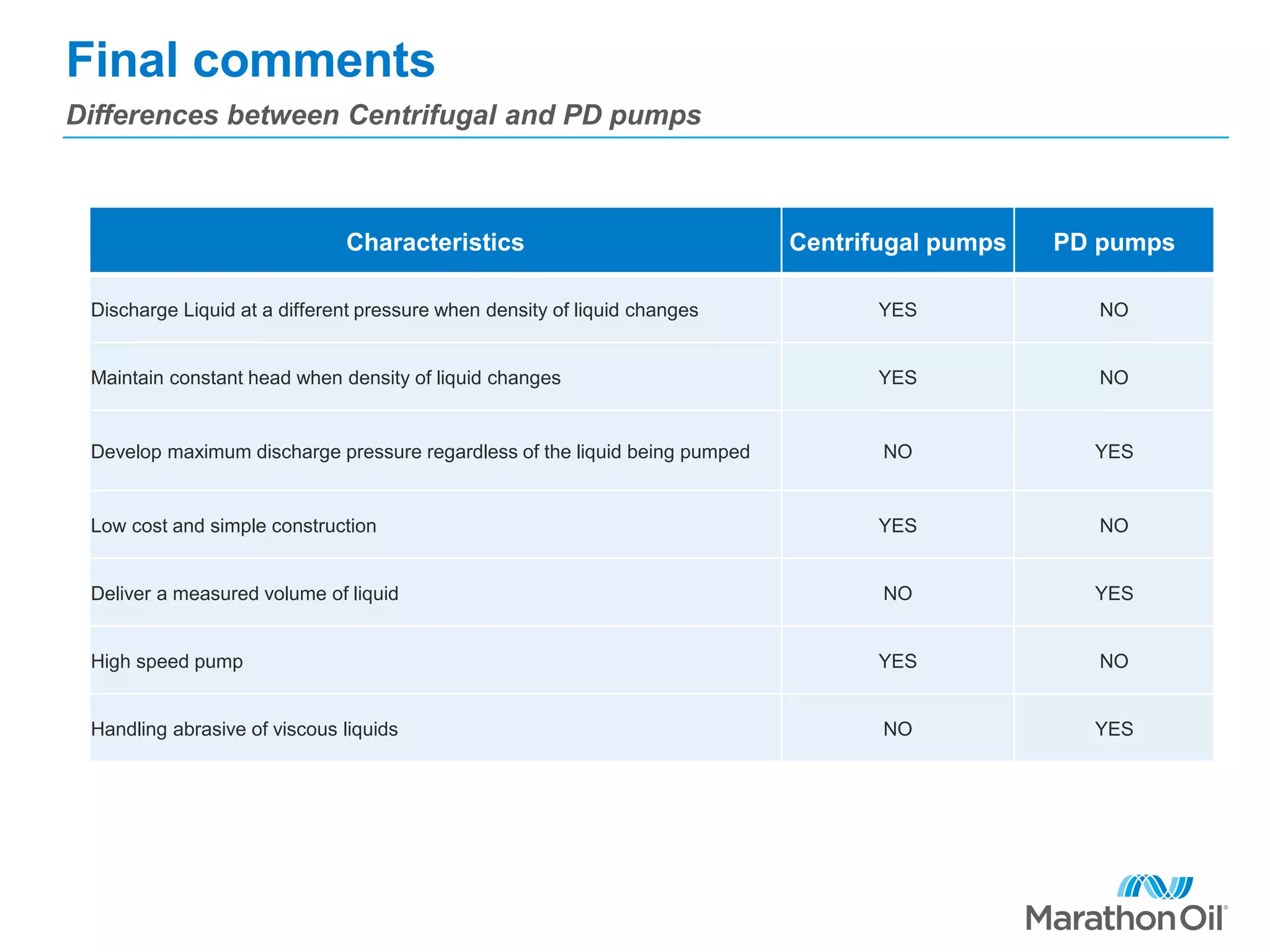
Differences between Centrifugal and PD pumps
Characteristics Centrifugal pumps PD pumps
Discharge Liquid at a different pressure when density of liquid changes YES NO
Maintain constant head when density of liquid changes YES NO
Develop maximum discharge pressure regardless of the liquid being pumped NO YES
Low cost and simple construction YES NO
Deliver a measured volume of liquid NO YES
High speed pump YES NO
Handling abrasive of viscous liquids NO YES
Thanks for coming
Any questions?
Hector Nguema Ondo Perez

Positive Displacement Pumps

  • 1.
    Positive Displacement Pumps Petroskillscourse Hector Nguema Ondo Perez
  • 2.
    Introduction to PDpumps Introduction to pumps • From Low elevations to high elevations • From Low pressure to high pressure areas • To increase the flow rate Pressure and Head: Head is the height of a liquid Pressure Gauges
  • 3.
    Introduction to PDpumps Suction lift system • The higher the vapor pressure, the more readily the liquid vaporizes • To keep liquid at the pump from vaporizing, the absolute suction pressure must be higher than the liquid's vapor pressure at that temperature The vapor pressure of a liquid is the equilibrium pressure of a vapor above its liquid (or solid); that is, the pressure of the vapor resulting from evaporation of a liquid (or solid) above a sample of the liquid (or solid) in a closed container
  • 4.
    Positive Displacement pumps Typesof reciprocating pumps Piston pump Plunger Pump • Piston fits close to the cylinder's walls. • Designed to push liquid from the cylinder. • Rings to reduce fluid leakage between the piston and the cylinder walls. • Cylinder is fitted with a replaceable liner. • Plunger does not touch the cylinder walls. • Displaces only part of the liquid in the cylinder. • Reciprocates inside a stationary packing to prevent leakage between the plunger and the cylinder. • Does not require a liner.
  • 5.
    Positive Displacement pumps Typesof reciprocating pumps Diaphragm Pump • For sludgy or corrosive liquids. • The plunger displaces the hydraulic fluid and the hydraulic fluid moves the diaphragm Power pump • Receives its energy from a separate motor, engine or turbine. • A flywheel is used to even out the rotation at a crankshaft Direct Acting pumps • Powered by steam or compressed air.  The first number is the diameter in inches of the steam piston.  The second number is the diameter of the liquid piston.  The third number is the length of the stroke
  • 6.
    Positive Displacement pumps Typesof rotary pumps Lobe Pump • The rotors are mounted on separate shafts and rotate in opposite directions. • The lobes are fitted with packing strips. Sliding Vane Pump • Vanes slide in and out of a rotor mounted off-center in the casing. • Multiple ports permit the pump to operate through a higher pressure difference with less load wear on the bearings Multiple port pump
  • 7.
    Positive Displacement pumps Typesof rotary pumps Gear Pump Sliding Vane Pump The gear pump has a drive gear and an idler gear. The shaft drives the drive gear and the drive gear drives the idler gear Spur Herringbone Internal The spur gear pump is a low-speed pump (up to 600 RPM). For higher RPM, use a herringbone gear pump. • The drive screw is turned by the drive shaft directly and the idler screw is driven by the drive shaft through a set of gears. Liquid is fed to the screws at each side of the casing • Screw pumps have the highest RPM of all of the positive displacement pumps.
  • 8.
    Pump Components Pump CylinderValves Ball and Disc Valves • Ball valves are primarily used in small, low-pressure pumps. • In Disc valves, a metal disc moves to open and close the valve Bowl Valves • Bowl Valves which have less obstruction to flow is better for liquids that are thick or abrasive Suction and Discharge Valves • The major difference between suction and discharge valves is the way the valves are installed
  • 9.
    Pump Components Pulsation Dampeners •A pulsation dampener is designed to even out reciprocating pump flow. • The pulsation dampener has a sealed chamber containing either air or nitrogen gas. • On the backstroke, the pump draws some liquid from the snifter. • On the forward stroke, the pump forces liquid into the snifter. • A suction stabilizer works like a pulsation dampener in reverse. The stabilizer is connected to the pump's suction line. • Suction stabilizers are especially needed on high-pressure or high-speed pumps. • The stabilizer should be large enough to hold a volume of liquid at least equal to the pump's displacement. Suction stabilizers
  • 10.
    Pump Components Bypass andrelief valves • This pump is equipped with a safety relief valve installed in the discharge-to-suction bypass • Engines and turbines cannot be started with a load so they are equipped with a discharge- to-suction bypass Variable Displacement Devices • Variable displacement pumps are built to permit changes in capacity without changing operating speed • Changing the plunger pump displacement is to change the size of the plunger. • Changing the lost motion distance changes the length of the plunger stroke.
  • 11.
    Maintaining PD pumps Packing Mechanicalseals • All piston pumps are inside-packed. Plunger and rotary pumps, the packing is usually located outside or at one end of the cylinder. • Diaphragm acts as a seal between the pumping liquid and the rods, so no packing is needed. • The stationary seal ring is held by the seal flange, and the rotating seal ring rotates with the shaft. The compression ring is forced into the rotating seal ring by a spring. The compression ring compresses a flexible O-ring that prevents leakage around the shaft. • They provide sealing with very little leakage of the pumping liquid.
  • 12.
    Maintaining PD pumps LubricationSystem Lubrication system is necessary because: - Some parts never come in contact with the liquid being pumped. - The pumping liquid may have poor lubricating qualities. - The pumping liquid may be corrosive or abrasive. • In large or slow-speed pumps, a forced lubrication system is used • This force-feed lubricator uses a small plunger pump and is powered by a linkage to the pump rod • Oil is forced from the crankcase to the bearings by a small pump. The oil from the reservoir flows through a strainer to remove particulates before it enters the oil pump
  • 13.
    Maintaining PD pumps •Wear rings : simplify maintenance by protecting the casing and the impeller • Packing Box: Must be always lubricated. – Ring Packing lubricated by the liquid being pumped – Lantern ring and packing are lubricated by oil. • Bearings and Couplings Bearings There is almost no friction between the balls and any of the other parts they touch because of the lubrication. Used in large pumps. Has more surface area than a ball bearing and can support a very heavy shaft. Used in pumps with a large axial load. The shoes are pivoted to absorb minor variations in the rotation of the collar.
  • 14.
    Maintaining PD pumps Pumpsalignment and pump cooling • Puts a strain on the shaft and may wear or break the shaft or couplings. • May cause bearings and seals to wear excessively or fail. • May cause excessive vibration. • Heavy-duty and hot liquids pumps may be water-jacketed to cool the lubricating oil. • Shaft and packing are often fitted with water jackets as well. The cooling water circulates in the water jacket surrounding the packing box.
  • 15.
    Common pumping problems •Gradual Loss of Capacity Wear and leakage in the pump • Loss of Suction Prevent the pump from filling properly with liquid • Sudden Loss of Capacity A blocked discharge line prevents the pump from discharging liquid. Direct-acting steam pumps and power pumps will stall if the discharge is blocked. But if the driver of a power pump does not stall or fail, a blocked discharge without a relief valve will rupture gaskets, piping or some part of the pump Loss of capacity Vapor Locking Evaporation of the pumping liquid can also cause vapor lock and loss of suction. To prevent vaporization, NPSH available must be equal to or greater than NPSH required. NPSH can be increased by either: • Increasing the suction pressure. • Decreasing the temperature of the suction liquid.
  • 16.
    Common pumping problems •Overloading Excessive friction, blocked discharge line or increase in viscosity or density • Overspeeding Overload leads to somewhat the same results in either direct-acting or power pumps • Short-Stroking Short strokes may be caused by a piston rod packing that is too tight. On direct- acting pumps equipped with cushion valves, long- or short-stroking may call for an adjustment of these valves Overloading, overspeeding and short-stroking Noise and vibration Signs of faulty operation. Either can be caused by: • Vapor locking. • Improper alignment or balanced rotating assembly. • A worn or loose bearing. • Improper lubrication, which can cause pump parts to grab and seize. • Operating at too high a speed • Etc…
  • 17.
    Final comments Differences betweenCentrifugal and PD pumps Characteristics Centrifugal pumps PD pumps Discharge Liquid at a different pressure when density of liquid changes YES NO Maintain constant head when density of liquid changes YES NO Develop maximum discharge pressure regardless of the liquid being pumped NO YES Low cost and simple construction YES NO Deliver a measured volume of liquid NO YES High speed pump YES NO Handling abrasive of viscous liquids NO YES
  • 18.
    Thanks for coming Anyquestions? Hector Nguema Ondo Perez

Editor's Notes

  • #14 A sleeve bearing: Has more surface area than a ball bearing. Can support a very heavy shaft. Controls radial movement. Is made of low-friction metal (babbitt). Is lubricated by a film of oil.