POSITIVE
DISPLACEMENT
PUMPS
POSITIVE DISPLACEMENT PUMPS
PUMPS CAN BE PUT INTO THREE CLASSES:
CENTRIFUGAL
•Develops pressure as a result of centrifugal forces
•Mostly used where large volumes at relatively low pressures
are required
•Operate at comparatively high speed usually directly
connected to driver
•Not self-priming and delivered capacity will vary considerably
with change in discharge pressure
•Not particularly adapted to handling viscous fluids
RECIPROCATING
•Has positive pressure characteristics – Creates flow
•Used principally to handle small volumes at relatively high
pressures
•Speeds relatively low due to reciprocating motion and inertia
effect of parts
•Self-priming and delivered capacity is practically constant
regardless of discharge pressure
•Capable of handling practically all types of fluids with
uniformly high volumetric efficiency
POSITIVE DISPLACEMENT PUMPS
ROTARY
•Combines the rotary motion of the centrifugal with the positive
pressure characteristics of the reciprocating
•Is a positive displacement type as reciprocating and delivers
with each revolution a given quantity of fluid
•Self-priming and gives practically constant delivered capacity
regardless of pressure
•Speeds are much higher and hence possible to directly connect
with driver in most cases
•Can pump practically any fluid that will flow
POSITIVE DISPLACEMENT PUMPS
TYPES:
1. RECIPROCATING
• PISTON
• PLUNGER
• DIAPHRAGM
2. ROTARY
• SCREW (Single, Twin, Triple)
• GEAR
• VANE
• LOBE (Two & Three)
POSITIVE DISPLACEMENT PUMPS
PROGRESSIVE CAVITY PUMP
POSITIVE DISPLACEMENT PUMPS
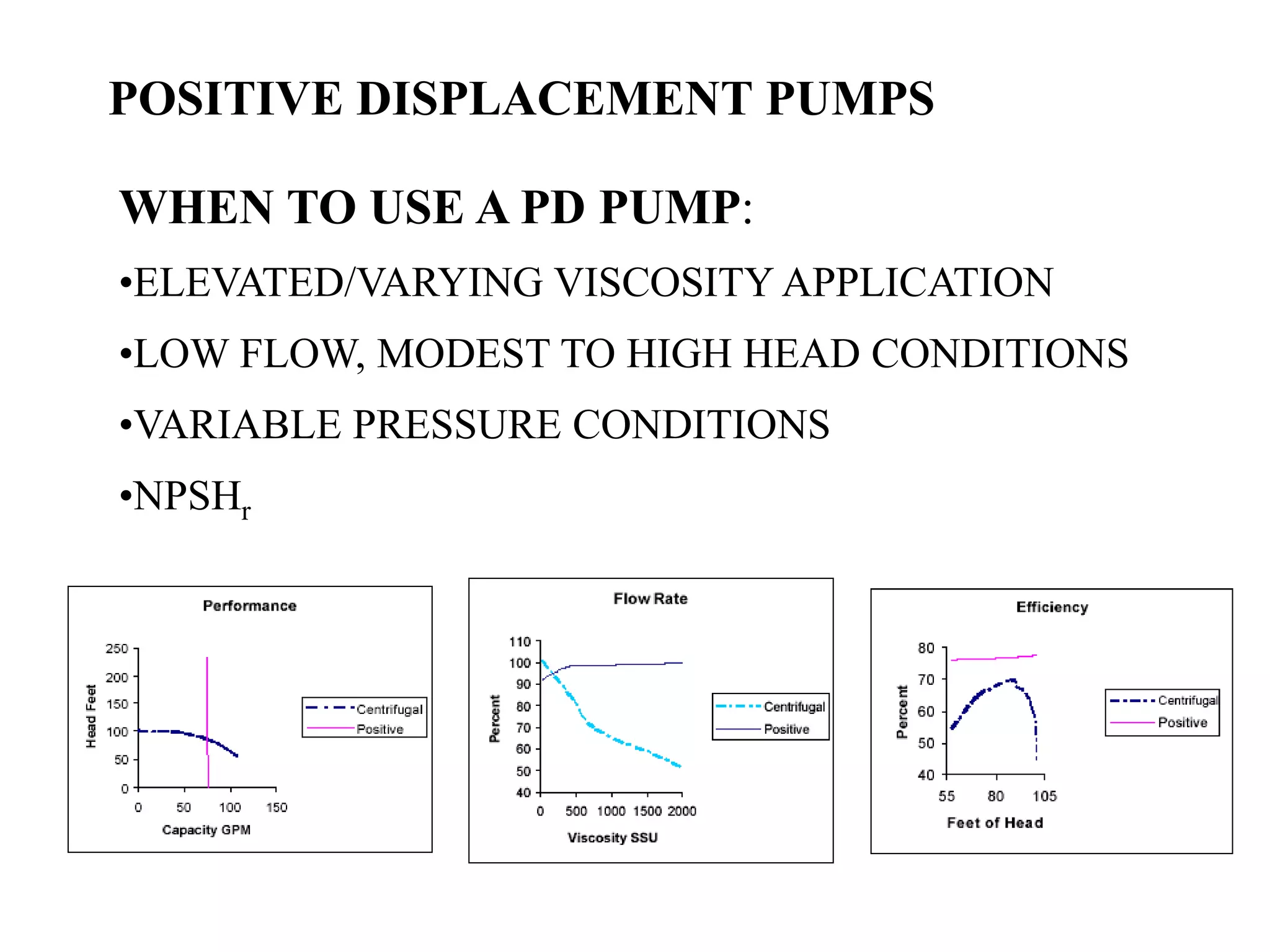
WHEN TO USE A PD PUMP:
•ELEVATED/VARYING VISCOSITY APPLICATION
•LOW FLOW, MODEST TO HIGH HEAD CONDITIONS
•VARIABLE PRESSURE CONDITIONS
•NPSHr
POSITIVE DISPLACEMENT PUMPS
•CENTRIFUGAL IS BEST WHEN SYSTEM CALLS FOR
PRESSURIZED NETWORK OF PIPING WITH
CONSTANT PRESSURE AT VARYING FLOWRATES
•PD PUMP BEST FOR SYSTEMS WITH CONSTANT
FLOWRATES AT VARIOUS PRESSURES (LIKE WITH
VARYING VISCOSITY)
POSITIVE DISPLACEMENT PUMPS
CONTROLLING A PD PUMP:
POSITIVE DISPLACEMENT PUMPS
DISCHARGE/SUCTION THROTTLING:
POSITIVE DISPLACEMENT PUMPS
RECYCLE CONTROL:
POSITIVE DISPLACEMENT PUMPS
SPEED CONTROL:
•The maximum speed at which a reciprocating positive
displacement pump can properly operate decreases as the
viscosity of a liquid increases. Therefore, as viscosity
increases, the maximum flow rate through the pump
decreases.
•The characteristic curve for a positive displacement pump
operating at a certain speed is a vertical line on a graph of
head versus flow.
•Slippage is the rate at which liquid leaks from the discharge
of the pump back to the pump suction.
•Positive displacement pumps are protected from over
pressurization by a relief valve on the upstream side of the
pump discharge valve.
POSITIVE DISPLACEMENT PUMPS
MACHINE PROTECTION:
The greatest danger is OVERPRESSURE. A blocked discharge
means overpressure is certain.
Protection is generally in-built in the form of an integral relief
valve to relief excess pressure from discharge back to suction.
In majority of cases, an external relief valve must be provided
as close to discharge as possible with no means for blocking at
its inlet or outlet.
Instrumentation provision, in addition to relief valve, to
shutdown machine in case of high discharge pressure is
advisable.
POSITIVE DISPLACEMENT PUMPS
CONCLUSION
The flow delivered by a centrifugal pump during one
revolution of the impeller depends upon the head against which
the pump is operating. The positive displacement pump
delivers a definite volume of fluid for each cycle
of pump operation regardless of the head against which the
pump is operating.
Positive displacement pumps may be classified in the
following ways:
Reciprocating piston pump Gear-type rotary pump
Lobe-type rotary pump Screw-type rotary pump
Moving vane pump Diaphragm pump
POSITIVE DISPLACEMENT PUMPS
•The maximum speed at which a reciprocating positive
displacement pump can properly operate decreases as the
viscosity of a liquid increases. Therefore, as viscosity
increases, the maximum flow rate through the pump decreases.
•The characteristic curve for a positive displacement pump
operating at a certain speed is a vertical line on a graph of head
versus flow.
•Slippage is the rate at which liquid leaks from the discharge of
the pump back to the pump suction.
•Positive displacement pumps are protected from over
pressurization by a relief valve on the upstream side of the
pump discharge valve.

Positive displacement pumps

  • 1.
  • 2.
    POSITIVE DISPLACEMENT PUMPS PUMPSCAN BE PUT INTO THREE CLASSES: CENTRIFUGAL •Develops pressure as a result of centrifugal forces •Mostly used where large volumes at relatively low pressures are required •Operate at comparatively high speed usually directly connected to driver •Not self-priming and delivered capacity will vary considerably with change in discharge pressure •Not particularly adapted to handling viscous fluids
  • 3.
    RECIPROCATING •Has positive pressurecharacteristics – Creates flow •Used principally to handle small volumes at relatively high pressures •Speeds relatively low due to reciprocating motion and inertia effect of parts •Self-priming and delivered capacity is practically constant regardless of discharge pressure •Capable of handling practically all types of fluids with uniformly high volumetric efficiency POSITIVE DISPLACEMENT PUMPS
  • 4.
    POSITIVE DISPLACEMENT PUMPS ROTARY •Combinesthe rotary motion of the centrifugal with the positive pressure characteristics of the reciprocating •Is a positive displacement type as reciprocating and delivers with each revolution a given quantity of fluid •Self-priming and gives practically constant delivered capacity regardless of pressure •Speeds are much higher and hence possible to directly connect with driver in most cases •Can pump practically any fluid that will flow
  • 5.
    POSITIVE DISPLACEMENT PUMPS TYPES: 1.RECIPROCATING • PISTON • PLUNGER • DIAPHRAGM 2. ROTARY • SCREW (Single, Twin, Triple) • GEAR • VANE • LOBE (Two & Three)
  • 6.
  • 7.
  • 8.
  • 9.
  • 10.
  • 11.
  • 12.
    POSITIVE DISPLACEMENT PUMPS WHENTO USE A PD PUMP: •ELEVATED/VARYING VISCOSITY APPLICATION •LOW FLOW, MODEST TO HIGH HEAD CONDITIONS •VARIABLE PRESSURE CONDITIONS •NPSHr
  • 13.
    POSITIVE DISPLACEMENT PUMPS •CENTRIFUGALIS BEST WHEN SYSTEM CALLS FOR PRESSURIZED NETWORK OF PIPING WITH CONSTANT PRESSURE AT VARYING FLOWRATES •PD PUMP BEST FOR SYSTEMS WITH CONSTANT FLOWRATES AT VARIOUS PRESSURES (LIKE WITH VARYING VISCOSITY)
  • 14.
  • 15.
  • 16.
  • 17.
  • 18.
    •The maximum speedat which a reciprocating positive displacement pump can properly operate decreases as the viscosity of a liquid increases. Therefore, as viscosity increases, the maximum flow rate through the pump decreases. •The characteristic curve for a positive displacement pump operating at a certain speed is a vertical line on a graph of head versus flow. •Slippage is the rate at which liquid leaks from the discharge of the pump back to the pump suction. •Positive displacement pumps are protected from over pressurization by a relief valve on the upstream side of the pump discharge valve. POSITIVE DISPLACEMENT PUMPS
  • 19.
    POSITIVE DISPLACEMENT PUMPS MACHINEPROTECTION: The greatest danger is OVERPRESSURE. A blocked discharge means overpressure is certain. Protection is generally in-built in the form of an integral relief valve to relief excess pressure from discharge back to suction. In majority of cases, an external relief valve must be provided as close to discharge as possible with no means for blocking at its inlet or outlet. Instrumentation provision, in addition to relief valve, to shutdown machine in case of high discharge pressure is advisable.
  • 20.
    POSITIVE DISPLACEMENT PUMPS CONCLUSION Theflow delivered by a centrifugal pump during one revolution of the impeller depends upon the head against which the pump is operating. The positive displacement pump delivers a definite volume of fluid for each cycle of pump operation regardless of the head against which the pump is operating. Positive displacement pumps may be classified in the following ways: Reciprocating piston pump Gear-type rotary pump Lobe-type rotary pump Screw-type rotary pump Moving vane pump Diaphragm pump
  • 21.
    POSITIVE DISPLACEMENT PUMPS •Themaximum speed at which a reciprocating positive displacement pump can properly operate decreases as the viscosity of a liquid increases. Therefore, as viscosity increases, the maximum flow rate through the pump decreases. •The characteristic curve for a positive displacement pump operating at a certain speed is a vertical line on a graph of head versus flow. •Slippage is the rate at which liquid leaks from the discharge of the pump back to the pump suction. •Positive displacement pumps are protected from over pressurization by a relief valve on the upstream side of the pump discharge valve.