
DESIGN
COLLABORATION

         By:
           Arun K S
            Ist sem M.tech
           SJCET PALAI

       ksarun1987@gmail.com
OUTLINE
Key sourcing related processes are:
 Supplier scoring and assessment
 Supplier selection and contract negotiation
 DESIGN COLLABORATION
 Procurement
 Sourcing planning & Analysis
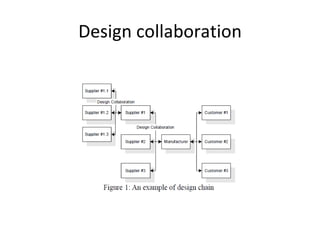
DESIGN COLLABORATION

• Integrating supplier in to design phase of Product
  development.


• Eg: Gold corp Inc.
   – They collaborated with Two Australian companies for 3-
     dimensional depiction of their mines.

   – This led to increase in their production rate from 53000
     ounces @ $360 an ounce in 1996 to 504000 ounces @ $ 59
     per ton in 2001.
Design collaboration
Factors to be considered while Design
               sourcing
• 80% of cost of product is determined during
  design stage. So active participation of supplier is
  needed in this stage.
• 50 – 70% of spending at manufacturer is for
  procurement process (during delivery of
  outsourced parts). So this has to be lowered.
• Coordination is necessary if dealing with a
  number of suppliers.
• Mutual understanding with customers.
• Manufacturer should act as a design coordinator.
Mutual Understandings
1. Design for Logistics
2. Design for Manufacturability
1. DESIGN FOR LOGISTICS
• Attempts to reduce Transportation, Handling
  and Inventory costs during distribution by taking
  appropriate actions during Design.

• To reduce Transportation and Handling cost
  manufacturer should convey information's about:
  – Expected order sizes
  – Packaging details (to be compact & Easiness for
    stacking).
1. DESIGN FOR LOGISTICS                      contd……


• To reduce Inventory cost Primary approach is
  to postponement or mass customization:
  – Postponement: Aim is to design a production and
    production process so that features that
    differentiate the end product are late in
    manufacturing Phase.
     Eg: Dell designs it’s PC’s after customer order
    comes. This helps them to lower inventories by
    aggregating them as components.
• Mass Customization: similar approach as that
  of postponement. Here design is so that
  inventory can be carried in a form that
  aggregates across multiple end products.
• Customization occurs along following 3 stages:
  – a. Module customization: Product is designed as
    modules. Eg: PC assembly at dell.
-b. Adjustable customization: All inventory is
maintained in a single product. Eg: Washing
m/c designed by Matsushita.
-c. Dimensional customization: Eg: National
bicycle which cuts frame tubing to fit
according to size of customer.
2. Design for Manufacturability
• Attempts to design product for ease of
  manufacturing.
• Key principles used while designing
  manufacturability are:
  –   Part commonality
  –   Designing symmetrical parts
  –   Combining parts
  –   Using catalogue part rather than designing new one
  –   Design parts to provide access for other parts and tools.
Advantages of design collaboration
• Design collaboration can:
  – Lower material purchase cost
  – Lower logistic cost
  – Lower manufacturing cost.
  – Design collaboration is also helpful for a company
    which tries to produce a lot of variety and
    customization.
  – Increases product development time significantly.
  – Cost decreases by 20%, Quality improves by 30%,
    Time to market decreases by 50 %.
Conclusion
• Design collaboration helps a firm to reduce
  cost, Improve quality and decrease time to
  market.
• Ensuring of design for logistics and design for
  manufacturability by manufacturer.
• To be successful, manufacturers should
  become effective design coordinators in
  supply chain.
THANK YOU

Design collaboration

  • 1.
    DESIGN COLLABORATION By: Arun K S Ist sem M.tech SJCET PALAI ksarun1987@gmail.com
  • 2.
    OUTLINE Key sourcing relatedprocesses are:  Supplier scoring and assessment  Supplier selection and contract negotiation  DESIGN COLLABORATION  Procurement  Sourcing planning & Analysis
  • 3.
    DESIGN COLLABORATION • Integratingsupplier in to design phase of Product development. • Eg: Gold corp Inc. – They collaborated with Two Australian companies for 3- dimensional depiction of their mines. – This led to increase in their production rate from 53000 ounces @ $360 an ounce in 1996 to 504000 ounces @ $ 59 per ton in 2001.
  • 4.
  • 5.
    Factors to beconsidered while Design sourcing • 80% of cost of product is determined during design stage. So active participation of supplier is needed in this stage. • 50 – 70% of spending at manufacturer is for procurement process (during delivery of outsourced parts). So this has to be lowered. • Coordination is necessary if dealing with a number of suppliers. • Mutual understanding with customers. • Manufacturer should act as a design coordinator.
  • 6.
    Mutual Understandings 1. Designfor Logistics 2. Design for Manufacturability
  • 7.
    1. DESIGN FORLOGISTICS • Attempts to reduce Transportation, Handling and Inventory costs during distribution by taking appropriate actions during Design. • To reduce Transportation and Handling cost manufacturer should convey information's about: – Expected order sizes – Packaging details (to be compact & Easiness for stacking).
  • 8.
    1. DESIGN FORLOGISTICS contd…… • To reduce Inventory cost Primary approach is to postponement or mass customization: – Postponement: Aim is to design a production and production process so that features that differentiate the end product are late in manufacturing Phase. Eg: Dell designs it’s PC’s after customer order comes. This helps them to lower inventories by aggregating them as components.
  • 9.
    • Mass Customization:similar approach as that of postponement. Here design is so that inventory can be carried in a form that aggregates across multiple end products. • Customization occurs along following 3 stages: – a. Module customization: Product is designed as modules. Eg: PC assembly at dell.
  • 10.
    -b. Adjustable customization:All inventory is maintained in a single product. Eg: Washing m/c designed by Matsushita. -c. Dimensional customization: Eg: National bicycle which cuts frame tubing to fit according to size of customer.
  • 11.
    2. Design forManufacturability • Attempts to design product for ease of manufacturing. • Key principles used while designing manufacturability are: – Part commonality – Designing symmetrical parts – Combining parts – Using catalogue part rather than designing new one – Design parts to provide access for other parts and tools.
  • 12.
    Advantages of designcollaboration • Design collaboration can: – Lower material purchase cost – Lower logistic cost – Lower manufacturing cost. – Design collaboration is also helpful for a company which tries to produce a lot of variety and customization. – Increases product development time significantly. – Cost decreases by 20%, Quality improves by 30%, Time to market decreases by 50 %.
  • 13.
    Conclusion • Design collaborationhelps a firm to reduce cost, Improve quality and decrease time to market. • Ensuring of design for logistics and design for manufacturability by manufacturer. • To be successful, manufacturers should become effective design coordinators in supply chain.
  • 14.