Reliability criteria in design and
its application
OUTLINE
• What is Reliability..?
• Importance of Reliability
• Terminology related with Reliability
• Development of Product Reliability
• System Reliability
What is Reliability..?
The meaning of reliability is “soundness and
consistence of quality”
Reliability is defined “Probability of a device performing
its, purpose adequately for the period intended under the
given operating condition”
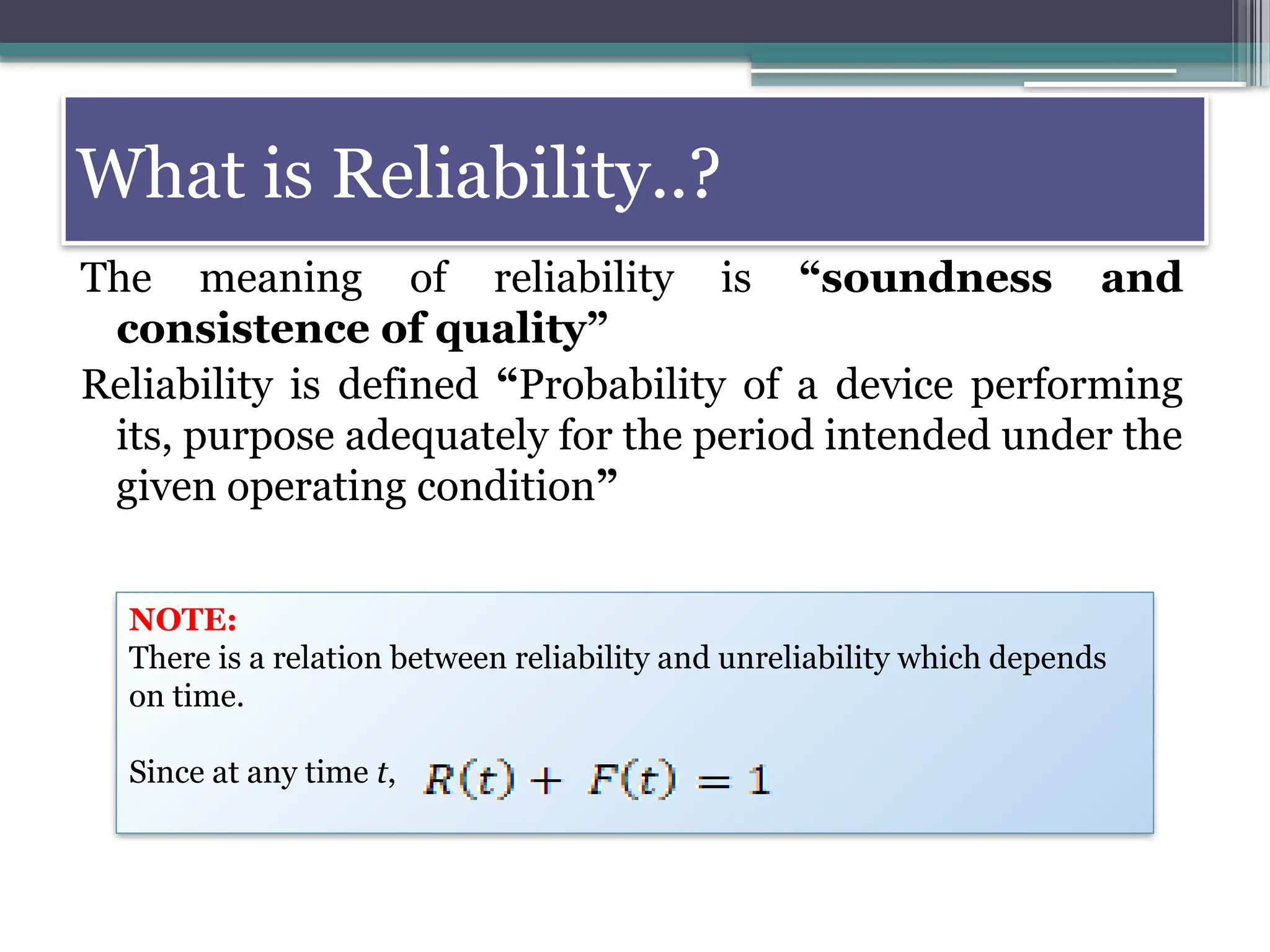
NOTE:
There is a relation between reliability and unreliability which depends
on time.
Since at any time t,
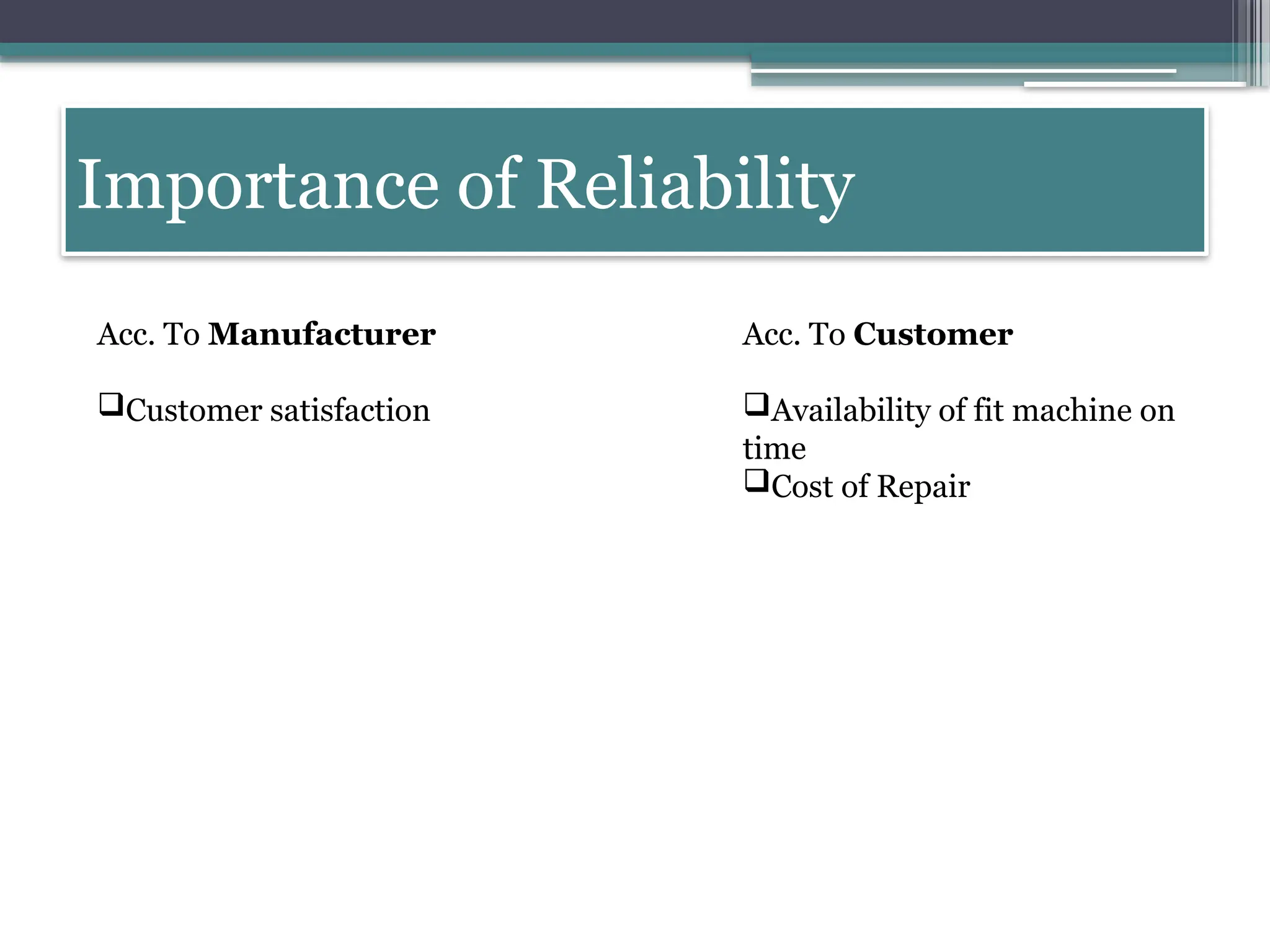
Importance of Reliability
Acc. To Manufacturer
Customer satisfaction
Acc. To Customer
Availability of fit machine on
time
Cost of Repair
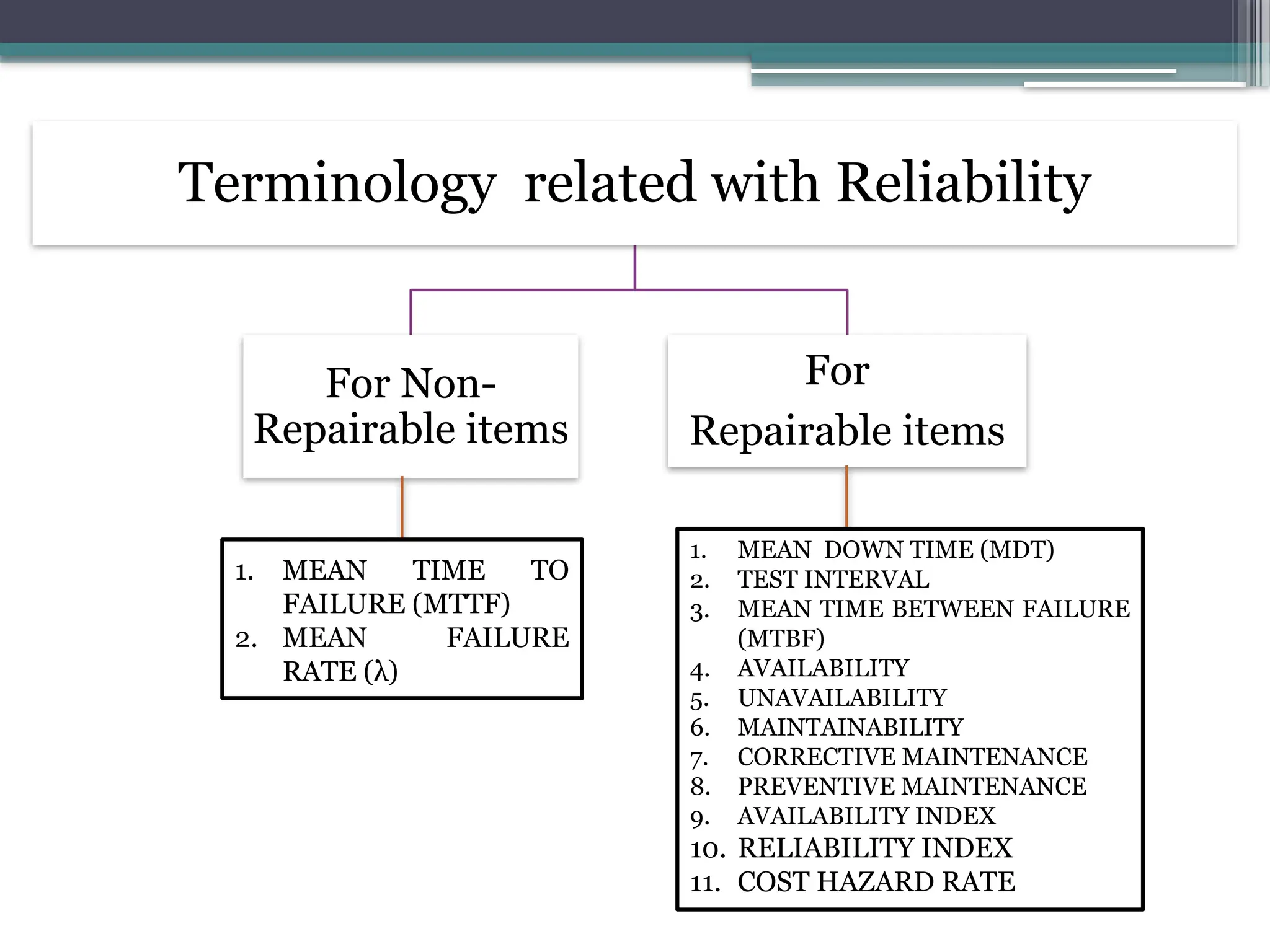
Terminology related with Reliability
For Non-
Repairable items
For
Repairable items
1. MEAN TIME TO
FAILURE (MTTF)
2. MEAN FAILURE
RATE (λ)
1. MEAN DOWN TIME (MDT)
2. TEST INTERVAL
3. MEAN TIME BETWEEN FAILURE
(MTBF)
4. AVAILABILITY
5. UNAVAILABILITY
6. MAINTAINABILITY
7. CORRECTIVE MAINTENANCE
8. PREVENTIVE MAINTENANCE
9. AVAILABILITY INDEX
10. RELIABILITY INDEX
11. COST HAZARD RATE
For Non- Repairable items
MEAN TIME TO FAILURE
(MTTF)
MEAN FAILURE RATE (λ)
• Reciprocal of mean time to failure
For Repairable items
1. Mean Down Time (MDT) 2. TEST INTERVAL
3. MEAN TIME BETWEEN FAILURE
(MTBF)
4. AVAILABILITY (A)
5. UNAVAILABILITY (UA)
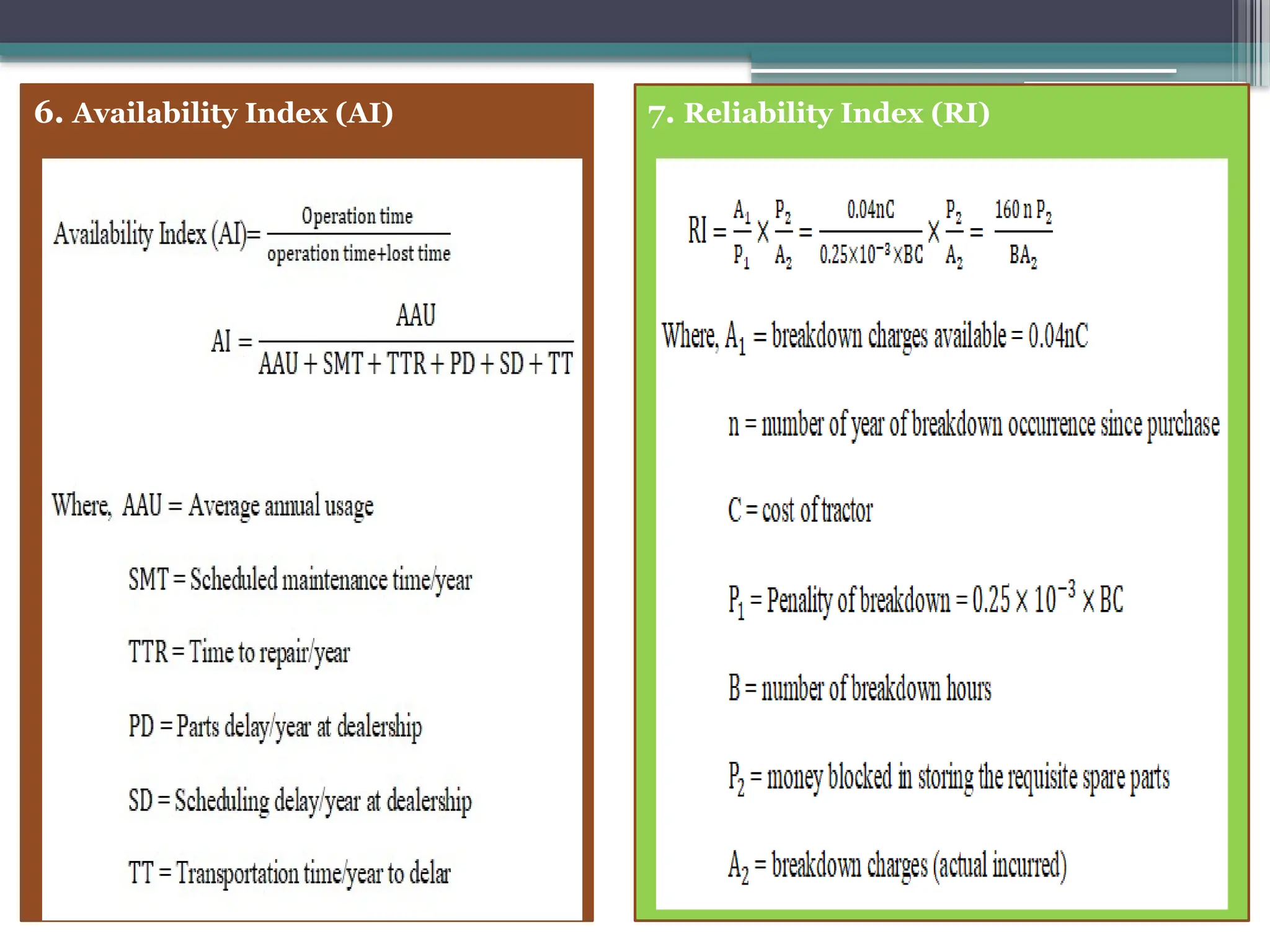
6. Availability Index (AI) 7. Reliability Index (RI)
Development of Product Reliability
• Product Definition
• Reliability Goals
• Design Analysis
— Failure Mode and Effect Analysis (FMEA)
— Multifunctional Design Reviews
• Testing
— Laboratory and Stress Tests
— Complete Machine Tests
— Correlation Factor
• Reliability Growth Curves
Reliability Growth Curves
The Reliability growth give the
guidelines for reliability growth
needed during a new product
development program in order to
achieve the reliability goals in
customer service.
System Reliability
 The elements and sub-systems which constitute the given
system and whose individual reliability factors can be
estimated are identified
 Logical manner or configuration in which these units
are connected to form the system is represented by a clock
diagram or a circuit diagram
 The condition for the successful operation of the system
is then determined, that is, it may be decided as to how the
units should function.
 Finally, the combinational rules of probability theory
(i.e.) addition rule, multiplication rule and their combinations
are applied to arrive at the system reliability factor.
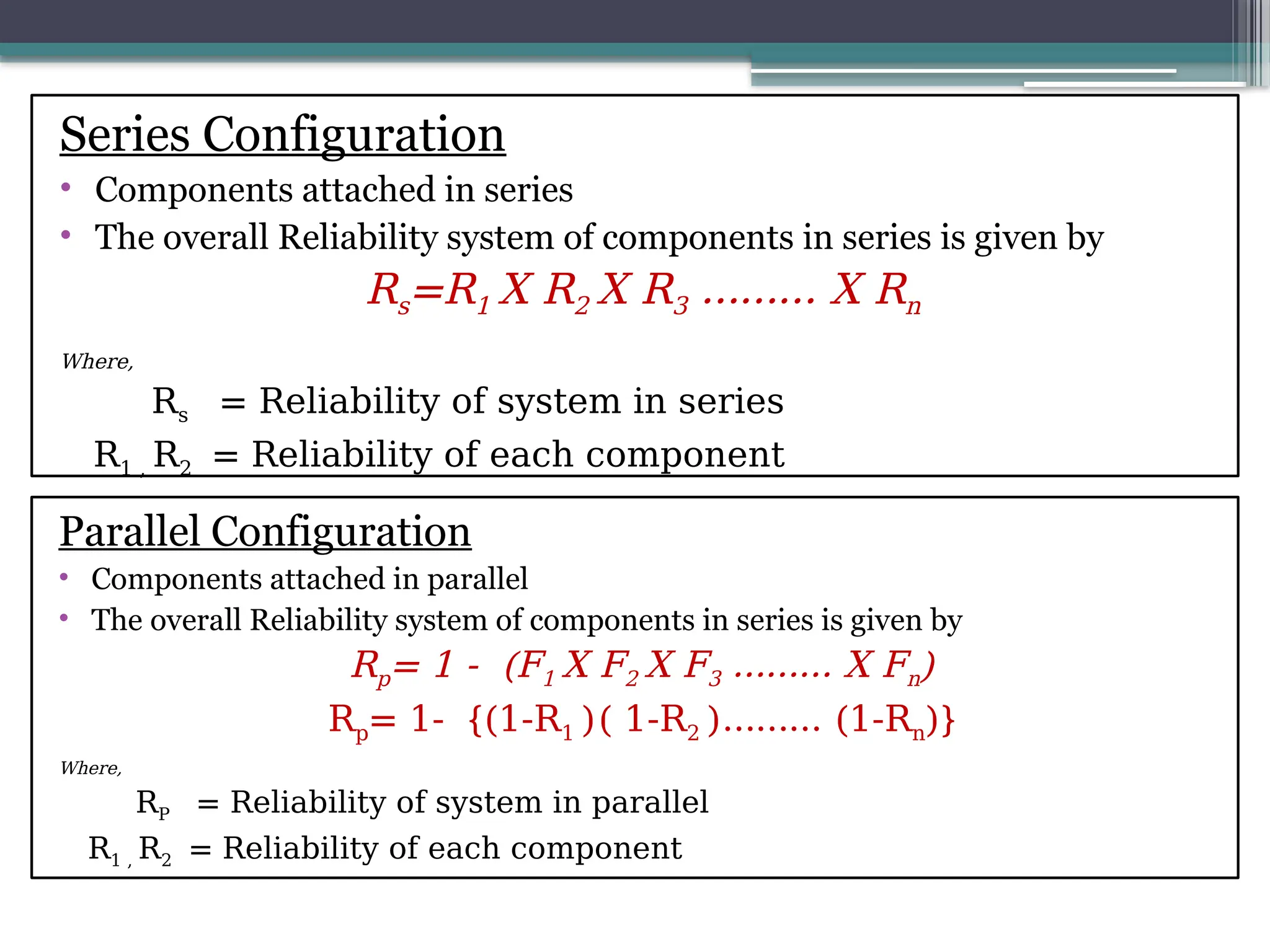
Series Configuration
• Components attached in series
• The overall Reliability system of components in series is given by
Rs=R1 X R2 X R3 ……… X Rn
Where,
Rs = Reliability of system in series
R1 , R2 = Reliability of each component
Parallel Configuration
• Components attached in parallel
• The overall Reliability system of components in series is given by
Rp= 1 - (F1 X F2 X F3 ……… X Fn)
Rp= 1- {(1-R1 )( 1-R2 )……… (1-Rn)}
Where,
RP = Reliability of system in parallel
R1 , R2 = Reliability of each component
THANK
YOU
FOR
LISTENING

Reliability criteria in design and its application.pptx

  • 1.
    Reliability criteria indesign and its application
  • 2.
    OUTLINE • What isReliability..? • Importance of Reliability • Terminology related with Reliability • Development of Product Reliability • System Reliability
  • 3.
    What is Reliability..? Themeaning of reliability is “soundness and consistence of quality” Reliability is defined “Probability of a device performing its, purpose adequately for the period intended under the given operating condition” NOTE: There is a relation between reliability and unreliability which depends on time. Since at any time t,
  • 4.
    Importance of Reliability Acc.To Manufacturer Customer satisfaction Acc. To Customer Availability of fit machine on time Cost of Repair
  • 5.
    Terminology related withReliability For Non- Repairable items For Repairable items 1. MEAN TIME TO FAILURE (MTTF) 2. MEAN FAILURE RATE (λ) 1. MEAN DOWN TIME (MDT) 2. TEST INTERVAL 3. MEAN TIME BETWEEN FAILURE (MTBF) 4. AVAILABILITY 5. UNAVAILABILITY 6. MAINTAINABILITY 7. CORRECTIVE MAINTENANCE 8. PREVENTIVE MAINTENANCE 9. AVAILABILITY INDEX 10. RELIABILITY INDEX 11. COST HAZARD RATE
  • 6.
    For Non- Repairableitems MEAN TIME TO FAILURE (MTTF) MEAN FAILURE RATE (λ) • Reciprocal of mean time to failure
  • 7.
    For Repairable items 1.Mean Down Time (MDT) 2. TEST INTERVAL 3. MEAN TIME BETWEEN FAILURE (MTBF) 4. AVAILABILITY (A) 5. UNAVAILABILITY (UA)
  • 8.
    6. Availability Index(AI) 7. Reliability Index (RI)
  • 9.
    Development of ProductReliability • Product Definition • Reliability Goals • Design Analysis — Failure Mode and Effect Analysis (FMEA) — Multifunctional Design Reviews • Testing — Laboratory and Stress Tests — Complete Machine Tests — Correlation Factor • Reliability Growth Curves
  • 10.
    Reliability Growth Curves TheReliability growth give the guidelines for reliability growth needed during a new product development program in order to achieve the reliability goals in customer service.
  • 11.
    System Reliability  Theelements and sub-systems which constitute the given system and whose individual reliability factors can be estimated are identified  Logical manner or configuration in which these units are connected to form the system is represented by a clock diagram or a circuit diagram  The condition for the successful operation of the system is then determined, that is, it may be decided as to how the units should function.  Finally, the combinational rules of probability theory (i.e.) addition rule, multiplication rule and their combinations are applied to arrive at the system reliability factor.
  • 12.
    Series Configuration • Componentsattached in series • The overall Reliability system of components in series is given by Rs=R1 X R2 X R3 ……… X Rn Where, Rs = Reliability of system in series R1 , R2 = Reliability of each component Parallel Configuration • Components attached in parallel • The overall Reliability system of components in series is given by Rp= 1 - (F1 X F2 X F3 ……… X Fn) Rp= 1- {(1-R1 )( 1-R2 )……… (1-Rn)} Where, RP = Reliability of system in parallel R1 , R2 = Reliability of each component
  • 13.