Design for Testability
Doing the right things vs. doing things right
@4calibr4
Pawel Kalbrun, 23 July 2014
Design Goal
● High Cohesion
● Low coupling
● Good encapsulation
Design Goal : How
● Single responsibility principle
● Open/closed principle
● Liskov substitution principle
● Interface segregation principle
● Dependency inversion principle
TESTABILITY
KPI of your DESIGN
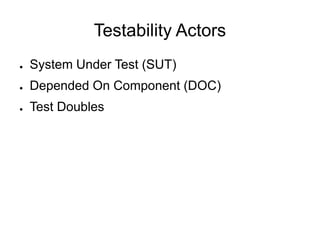
Testability Actors
● System Under Test (SUT)
● Depended On Component (DOC)
● Test Doubles
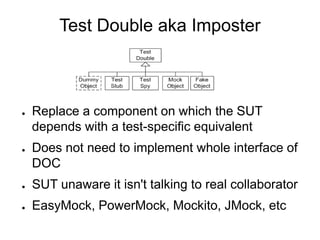
Test Double aka Imposter
● Replace a component on which the SUT
depends with a test-specific equivalent
● Does not need to implement whole interface of
DOC
● SUT unaware it isn't talking to real collaborator
● EasyMock, PowerMock, Mockito, JMock, etc
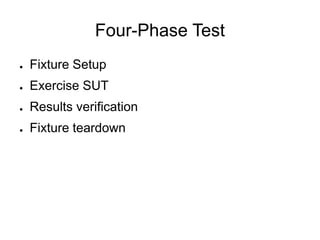
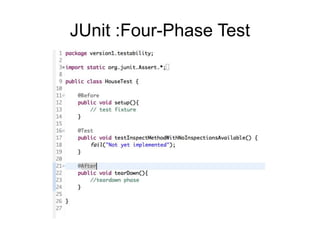
Four-Phase Test
● Fixture Setup
● Exercise SUT
● Results verification
● Fixture teardown
JUnit :Four-Phase Test
WHAT TO
KEEP AN EYE ON
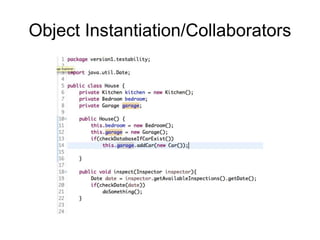
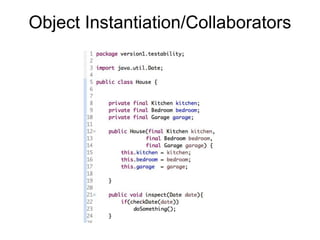
Object Instantiation/Collaborators
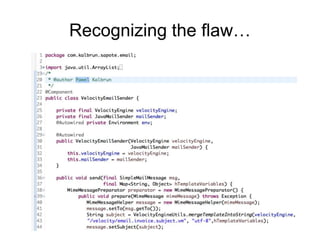
Recognizing the flaw…
SOLUTION
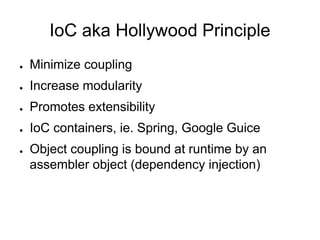
IoC aka Hollywood Principle
● Minimize coupling
● Increase modularity
● Promotes extensibility
● IoC containers, ie. Spring, Google Guice
● Object coupling is bound at runtime by an
assembler object (dependency injection)
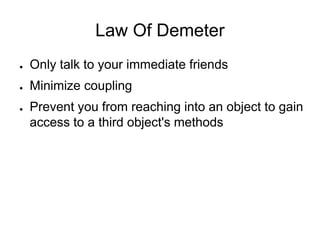
Law Of Demeter
● Only talk to your immediate friends
● Minimize coupling
● Prevent you from reaching into an object to gain
access to a third object's methods
Law Of Demeter vs. Mockito
when(mock.getBar().getName()).thenReturn("deep");
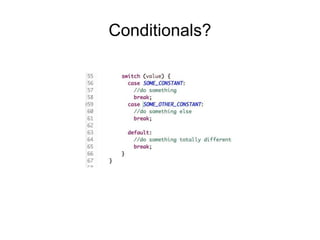
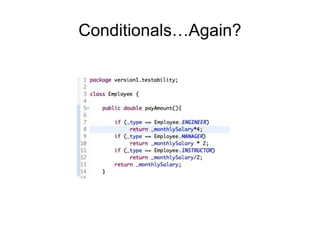
Conditionals?
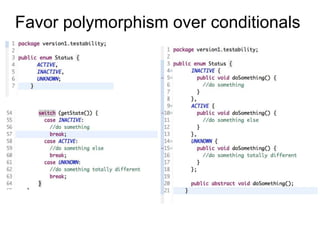
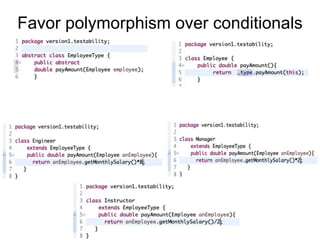
Favor polymorphism over conditionals
Conditionals…Again?
Favor polymorphism over conditionals
Conditionals, why not?
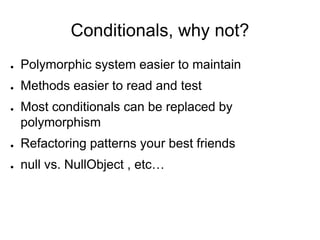
● Polymorphic system easier to maintain
● Methods easier to read and test
● Most conditionals can be replaced by
polymorphism
● Refactoring patterns your best friends
● null vs. NullObject , etc…
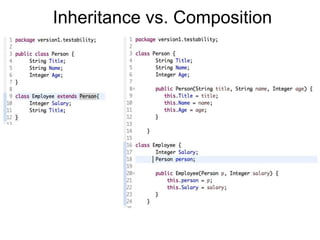
Inheritance vs. Composition
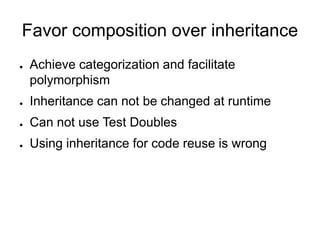
Favor composition over inheritance
● Achieve categorization and facilitate
polymorphism
● Inheritance can not be changed at runtime
● Can not use Test Doubles
● Using inheritance for code reuse is wrong
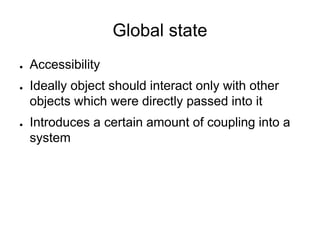
Global state
● Accessibility
● Ideally object should interact only with other
objects which were directly passed into it
● Introduces a certain amount of coupling into a
system
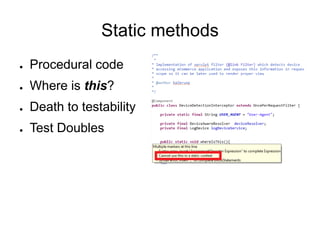
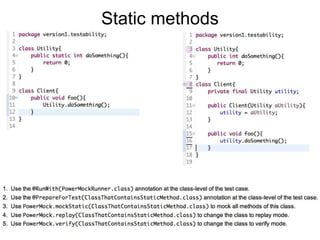
Static methods
● Procedural code
● Where is this?
● Death to testability
● Test Doubles
Static methods
Warning signs – Wrap up
● DI is your friend, new is NOT
● Conditionals all over your codebase
● Global state
● Mixing object graph construction with app logic
● Static methods
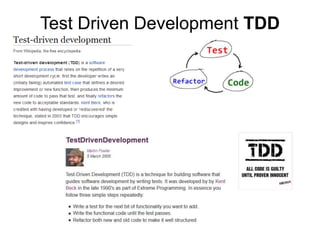
Test Driven Development TDD
TESTING
Best Practices
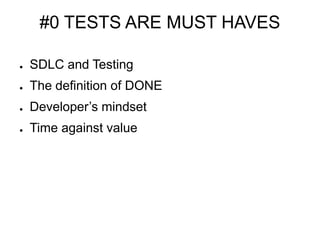
#0 TESTS ARE MUST HAVES
● SDLC and Testing
● The definition of DONE
● Developer’s mindset
● Time against value
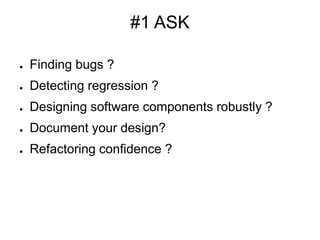
#1 ASK
● Finding bugs ?
● Detecting regression ?
● Designing software components robustly ?
● Document your design?
● Refactoring confidence ?
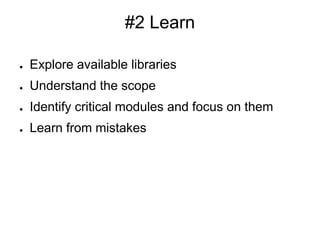
#2 Learn
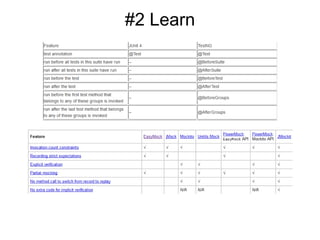
● Explore available libraries
● Understand the scope
● Identify critical modules and focus on them
● Learn from mistakes
#2 Learn
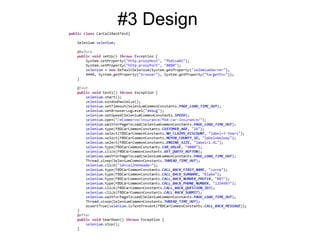
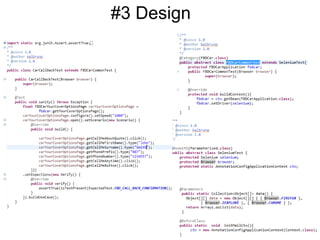
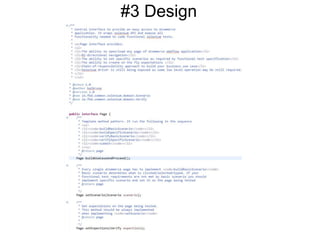
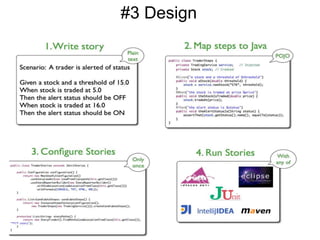
#3 Design
#3 Design
#3 Design
#3 Design
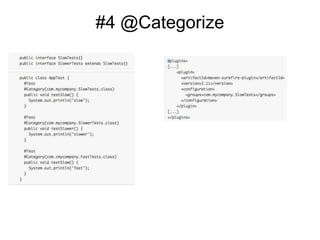
#4 @Categorize
#5 Forget @Ignore
#6 Continuous integration
Chuck is just waiting for -DskipTests

Design for Testability