TEAM DETAILS
GYANENDRA AWASTHI (13135043)
ANKIT SAXENA (13135019)
NITIN KUMAR (13135059)
MUKUT KUMAR MEENA (13135057)
RAHUL KUMAR (13135063)
ASHOK KUMAR MEENA (13135026)
CONTENTS
1. BRIEF INTRODUCTION
2. MATERIAL SELECTION
3. DESIGN AND APPLICATIONS OF STUFFING BOX
4. MANUFACTURING PROCESSES
 Casting
 Machining
 Consolidation
5. DEFECTS OBSERVED
 A stuffing box is an assembly which is used to prevent
leakage of fluid, such as water or steam, between sliding
sliding or turning parts of machine elements, specifically a
rotating or reciprocating shaft.
 A Stuffing box assembly satisfies two requirements;
 preventing any leakage of steam out of the cylinder
and
 at the same time allowing free movement of shaft.
BRIEF ABOUT STUFFING BOX
The Stuffing Box is a cylindrical
space in the pump casing
surrounding the shaft.
 Packing is the material in the form
of rings or strands that is placed in
the stuffing box to form a seal to
control the rate of leakage around
the shaft.
 Packing is then held in place and
compressed by the ‘Gland’ to give a
give a leak-tight seal.
MATERIAL SELECTION
 Stuffing box and Gland are made up of Cast Iron due to its following properties:
 Good casting properties
 Good machinability
 Good wear resistance
 Low notch sensitivity
 excellent vibrational damping characteristics
.
 The space around the piston is filled with asbestos-fibre packing because its fibrous
nature makes it a good absorber of both leaking fluids as well as lubricants. Also, it
is chemically inert, can sustain high temperatures and halt the spread of fire.
 Studs and nuts are made of Mild Steel due to its better ability to resist tensile failure.
 Variety in designs of stuffing box has increased significantly as
processes and the pumps used have evolved but purpose is same
same i.e. “ SHAFT SEAL”.
 Dimensions
used
DESIGN OF STUFFING BOX
MODELLING IN CATIA
APPLICATIONS
 BOAT PROPELLER -
 Here, Stuffing box is used to prevent “WATER LEAKAGE”.
 HOW it works??.....stuffing box prevents sea water from entering the
boat's hull.
 AUTOMOBILE-
 Here, Stuffing box is used to prevent “GAS LEAKAGE”.
 HOW it works??.....gas coming out of piston arrangement is prevented.
 STEAM ENGINE-
In a steam engine, where the piston rod reciprocates through the cylinder cover, a
stuffing box provided in the cylinder cover prevents the leakage of steam from the cylinder.
MANUFACTURING PROCESSES INVOLVED
CASTING MACHINING CONSOLIDATION
 Stuffing box assembly is made by green sand casting process.
 Green sand composition is…
70-85% silica sand (SiO2)
10-12% bonding material e.g., clay etc.
3-6% water
 Casting is the preferred method to manufacture stuffing box
because it has a quite complex shape.
 Green sand casting is quite economical.
CASTIN
G
1.Mold cavity is produced having the desired shape and
size of the part-
Dimensional allowance for cast iron is 0.8% -1.0% .
2.Melting and Pouring of metal-
Metal is melted at elevated temperature and poured into the
at a proper rate to ensure that erosion and defects are minimized.
3. Solidification- Liquid metal is allowed to solidify under controlled
conditions to obtain desirable mechanical properties.
Steps involved in casting
4.Mold removal- The casting is removed by breaking away the sand
mold.
STEPS INVOLVED
HARDNESS 47.1 – 54.4HRC
ULTIMATE TENSILE
STRENGTH
345 – 689MPa
 Typical values of some mechanical properties of casting
made up of cast iron
DEFECTS OBSERVED
1. BLOW HOLES : It is a fairly large, well-rounded cavity produced
It is occurred by the gases which displace the molten metal at the cope surface.
Blows. Usually occur on a convex casting surface and can be avoided by having a
proper venting and adequate permeability . A controlled content of moisture and
volatile constituents in the sand mix also helps in avoiding the blow
holes.
This contains very small holes uniformly dispersed
throughout the casting. It arises when there is a
decrease in gas solubility during solidification.
:
2.POROSITY :
3. CORE SHIFT : A misalignment between two halves of a
mould give rise to a defective casting , as shown in fig.
,this defect is called a mould shift or a core shift.
 Core shift observed: 1mm
4. SCAR : A shallow blow, usually found on a flat casting
surface , is referred to as scar.
5.PIN HOLES : these are nothing but tiny holes, and occur
either at or just below the casting surface . Normally, these are
found in large numbers and are almost uniformly distributed in
entire casting surface
MACHINING
 Post casting operations:
 Excess material has to be removed along parting lines.
The casting also requires to be grinded to ensure a good surface finish.
Drilling:
 For hard metals(C.I.), drilling is to be done slowly and steadily. But, soft
metals(Al) will require a faster speed because the metal shaving may
melt if machined too slowly. Even with soft metals too high speeds are
avoided.
 Since we have drilled metric fine threads, so we used drill of 8.5mm
diameter size for drilling the holes and producing threads of size
M10*1.5.
THREADING
 We used hand taps for threading.
1. At first we used Tapered tap because, each turn of
this tap will remove only a small part of material and the
threads will be cut gradually. This reduces the stress on the tap,
which is important because taps are brittle and it's not
uncommon to break one while tapping. Also TAPER TAPS have a
lead of 7-10 threads at 5 degrees per side. This taper lead
distributes the cutting force over a large area, and the taper
shape helps the thread to start. They can therefore be used to
start a thread prior to use of second or bottom leads, or for
through holes.
Alignment of taps to holes should be done properly
because misalignment of taps may cause breakage of taps as
well as improper threading.
 Started tapping the hole with the tapered tap and then used the bottoming tap.
 Two bolts of size (M10×1.5) were used for joining the stuffing box with the gland.
2.After this we used Bottoming tap-.for forming the last few threads which were not formed
by tapered tap due to its tapered size.TheseTAPS have a chamfer (lead) of 1–2 threads, the angle
of the lead being around 18 degrees per side.They are used to produce threads close to the bottom
of blind holes.
THANKYOU!

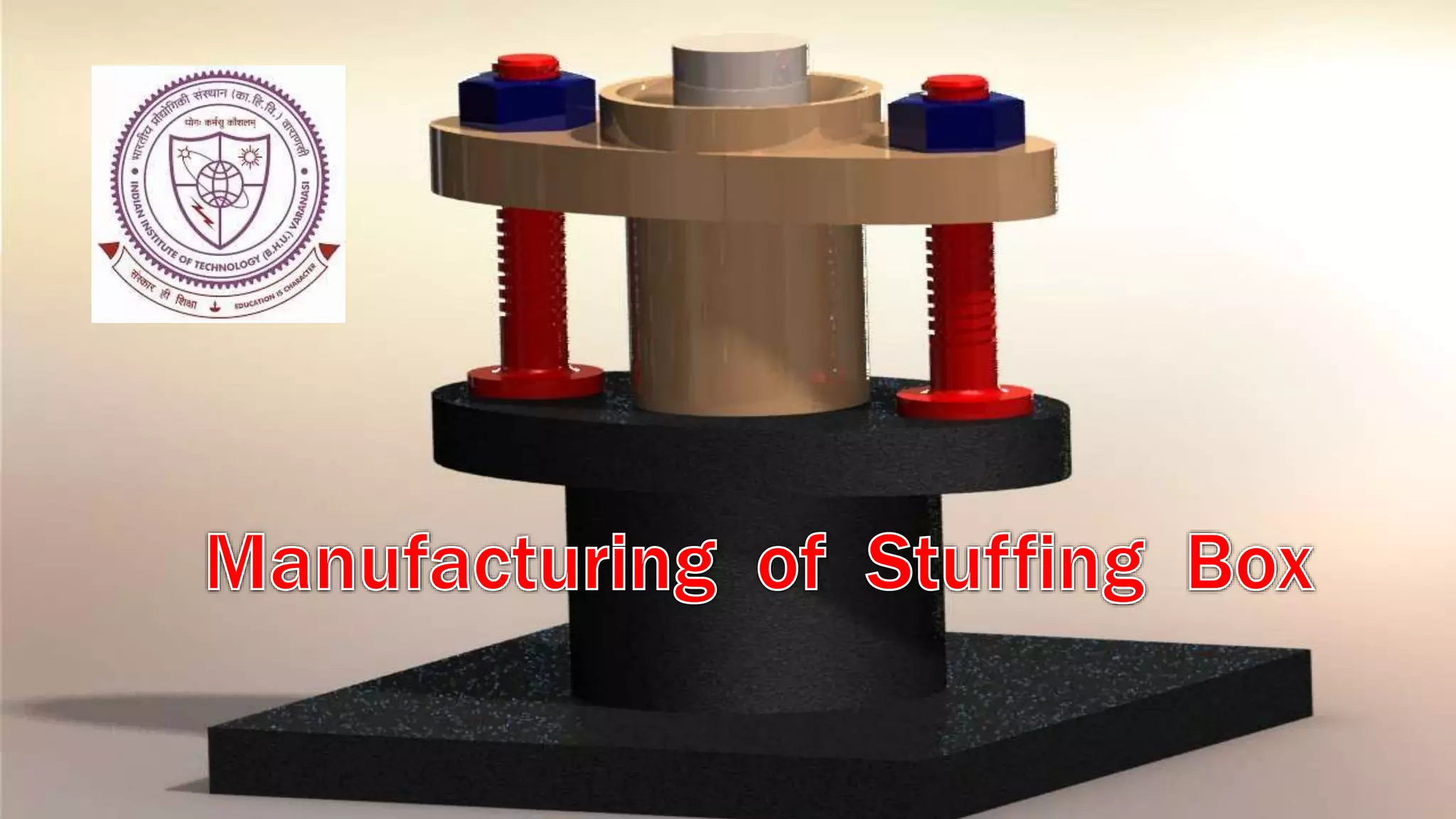
Manufacturing of Stuffing box

  • 2.
    TEAM DETAILS GYANENDRA AWASTHI(13135043) ANKIT SAXENA (13135019) NITIN KUMAR (13135059) MUKUT KUMAR MEENA (13135057) RAHUL KUMAR (13135063) ASHOK KUMAR MEENA (13135026)
  • 3.
    CONTENTS 1. BRIEF INTRODUCTION 2.MATERIAL SELECTION 3. DESIGN AND APPLICATIONS OF STUFFING BOX 4. MANUFACTURING PROCESSES  Casting  Machining  Consolidation 5. DEFECTS OBSERVED
  • 4.
     A stuffingbox is an assembly which is used to prevent leakage of fluid, such as water or steam, between sliding sliding or turning parts of machine elements, specifically a rotating or reciprocating shaft.  A Stuffing box assembly satisfies two requirements;  preventing any leakage of steam out of the cylinder and  at the same time allowing free movement of shaft. BRIEF ABOUT STUFFING BOX
  • 5.
    The Stuffing Boxis a cylindrical space in the pump casing surrounding the shaft.  Packing is the material in the form of rings or strands that is placed in the stuffing box to form a seal to control the rate of leakage around the shaft.  Packing is then held in place and compressed by the ‘Gland’ to give a give a leak-tight seal.
  • 6.
    MATERIAL SELECTION  Stuffingbox and Gland are made up of Cast Iron due to its following properties:  Good casting properties  Good machinability  Good wear resistance  Low notch sensitivity  excellent vibrational damping characteristics .  The space around the piston is filled with asbestos-fibre packing because its fibrous nature makes it a good absorber of both leaking fluids as well as lubricants. Also, it is chemically inert, can sustain high temperatures and halt the spread of fire.
  • 7.
     Studs andnuts are made of Mild Steel due to its better ability to resist tensile failure.
  • 9.
     Variety indesigns of stuffing box has increased significantly as processes and the pumps used have evolved but purpose is same same i.e. “ SHAFT SEAL”.  Dimensions used DESIGN OF STUFFING BOX
  • 10.
  • 11.
    APPLICATIONS  BOAT PROPELLER-  Here, Stuffing box is used to prevent “WATER LEAKAGE”.  HOW it works??.....stuffing box prevents sea water from entering the boat's hull.  AUTOMOBILE-  Here, Stuffing box is used to prevent “GAS LEAKAGE”.  HOW it works??.....gas coming out of piston arrangement is prevented.  STEAM ENGINE- In a steam engine, where the piston rod reciprocates through the cylinder cover, a stuffing box provided in the cylinder cover prevents the leakage of steam from the cylinder.
  • 12.
  • 13.
     Stuffing boxassembly is made by green sand casting process.  Green sand composition is… 70-85% silica sand (SiO2) 10-12% bonding material e.g., clay etc. 3-6% water  Casting is the preferred method to manufacture stuffing box because it has a quite complex shape.  Green sand casting is quite economical. CASTIN G
  • 14.
    1.Mold cavity isproduced having the desired shape and size of the part- Dimensional allowance for cast iron is 0.8% -1.0% . 2.Melting and Pouring of metal- Metal is melted at elevated temperature and poured into the at a proper rate to ensure that erosion and defects are minimized. 3. Solidification- Liquid metal is allowed to solidify under controlled conditions to obtain desirable mechanical properties. Steps involved in casting 4.Mold removal- The casting is removed by breaking away the sand mold.
  • 15.
  • 16.
    HARDNESS 47.1 –54.4HRC ULTIMATE TENSILE STRENGTH 345 – 689MPa  Typical values of some mechanical properties of casting made up of cast iron
  • 17.
    DEFECTS OBSERVED 1. BLOWHOLES : It is a fairly large, well-rounded cavity produced It is occurred by the gases which displace the molten metal at the cope surface. Blows. Usually occur on a convex casting surface and can be avoided by having a proper venting and adequate permeability . A controlled content of moisture and volatile constituents in the sand mix also helps in avoiding the blow holes. This contains very small holes uniformly dispersed throughout the casting. It arises when there is a decrease in gas solubility during solidification. : 2.POROSITY :
  • 18.
    3. CORE SHIFT: A misalignment between two halves of a mould give rise to a defective casting , as shown in fig. ,this defect is called a mould shift or a core shift.  Core shift observed: 1mm 4. SCAR : A shallow blow, usually found on a flat casting surface , is referred to as scar. 5.PIN HOLES : these are nothing but tiny holes, and occur either at or just below the casting surface . Normally, these are found in large numbers and are almost uniformly distributed in entire casting surface
  • 19.
    MACHINING  Post castingoperations:  Excess material has to be removed along parting lines. The casting also requires to be grinded to ensure a good surface finish. Drilling:  For hard metals(C.I.), drilling is to be done slowly and steadily. But, soft metals(Al) will require a faster speed because the metal shaving may melt if machined too slowly. Even with soft metals too high speeds are avoided.  Since we have drilled metric fine threads, so we used drill of 8.5mm diameter size for drilling the holes and producing threads of size M10*1.5.
  • 20.
    THREADING  We usedhand taps for threading. 1. At first we used Tapered tap because, each turn of this tap will remove only a small part of material and the threads will be cut gradually. This reduces the stress on the tap, which is important because taps are brittle and it's not uncommon to break one while tapping. Also TAPER TAPS have a lead of 7-10 threads at 5 degrees per side. This taper lead distributes the cutting force over a large area, and the taper shape helps the thread to start. They can therefore be used to start a thread prior to use of second or bottom leads, or for through holes. Alignment of taps to holes should be done properly because misalignment of taps may cause breakage of taps as well as improper threading.
  • 21.
     Started tappingthe hole with the tapered tap and then used the bottoming tap.  Two bolts of size (M10×1.5) were used for joining the stuffing box with the gland. 2.After this we used Bottoming tap-.for forming the last few threads which were not formed by tapered tap due to its tapered size.TheseTAPS have a chamfer (lead) of 1–2 threads, the angle of the lead being around 18 degrees per side.They are used to produce threads close to the bottom of blind holes.
  • 22.