KUMARAGURU COLLEGE OF TECHNOLOGY
P15CCT102/ APPLIED MATERIALS ENGINEERING
Presented By,
RAGHUL (17MCC006)
GAUTHAM (17MCC007)
MATERIAL SELECTION
FOR
PISTON
PISTON:
 A piston is a cylindrical engine component that
slides back and forth in the cylinder bore by forces
produced during the combustion process.
 The piston acts as a movable end of the
combustion chamber.
 Its purpose is to transfer force from expanding
gas in the cylinder to the crankshaft via a piston
rod.
PISTON MATERIALS:
The most commonly used Piston
materials are
• Cast Iron
• Aluminium Alloys
Cast iron pistons are used for moderately rated
engines with piston speed below 6m/s.
Aluminium alloy pistons are used for highly
rated engines with piston speed above 6m/s.
CAST IRON:
 Cast iron is a group of iron-carbon alloys with a
carbon content greater than 2%.
 Carbon (C) ranging from 1.8–4 wt%, and silicon (Si)
1–3 wt% are the main alloying elements of cast
iron.
Types of Cast Iron
 Grey cast iron
 White cast iron
 Malleable cast iron
 Ductile cast iron
Cast Iron Characteristics:
 It is hard.
 Brittle.
 Non-malleable (i.e. it cannot be bent, stretched or
hammered into shape).
 More fusible than steel.
 Very good in compression.
ALUMINIUM ALLOYS:
 Aluminium alloys (or aluminum alloys) are alloys in
which aluminium (Al) is the predominant metal.
 The typical alloying elements are copper,
magnesium, manganese, silicon, tin and zinc.
 Cast aluminium alloys yield cost-effective products
due to the low melting point.
Aluminum Alloy Characteristics:
 High operating temperatures
 Outstanding corrosion resistance
 Lightweight
 Very good strength and hardness
 Good stiffness and strength-to-weight ratio
 Excellent EMI and RFI shielding properties
 Excellent thermal conductivity
 High electrical conductivity
 Good finishing characteristics
 Full recyclability
Applications for Aluminum:
 Aluminum castings improve automotive fuel
efficiency by contributing to weight saving
requirements
 Aluminum is used in a broad range of networking
and infrastructure equipment in the telecom and
computing industries because RF filter boxes and
housings require heat dissipation
 In handheld devices, aluminum castings provide
EMI/RFI shielding, rigidity, and durability with
minimal weight
 Because of aluminum’s excellent electrical
performance and shielding properties, even in high-
temperature environments, die cast aluminum is
ideal for electronic connectors and housings
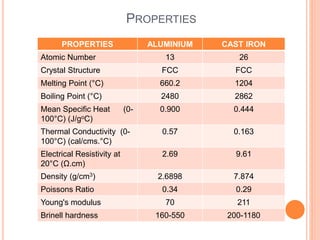
PROPERTIES
PROPERTIES ALUMINIUM CAST IRON
Atomic Number 13 26
Crystal Structure FCC FCC
Melting Point (°C) 660.2 1204
Boiling Point (°C) 2480 2862
Mean Specific Heat (0-
100°C) (J/goC)
0.900 0.444
Thermal Conductivity (0-
100°C) (cal/cms.°C)
0.57 0.163
Electrical Resistivity at
20°C (Ω.cm)
2.69 9.61
Density (g/cm3) 2.6898 7.874
Poissons Ratio 0.34 0.29
Young's modulus 70 211
Brinell hardness 160-550 200-1180
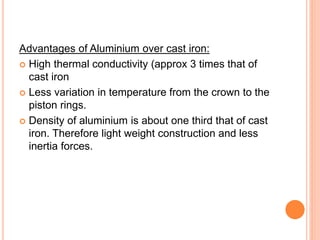
Advantages of Aluminium over cast iron:
 High thermal conductivity (approx 3 times that of
cast iron
 Less variation in temperature from the crown to the
piston rings.
 Density of aluminium is about one third that of cast
iron. Therefore light weight construction and less
inertia forces.
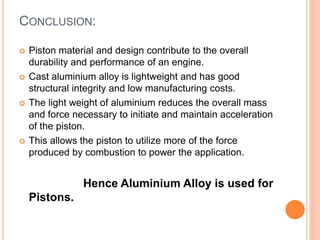
CONCLUSION:
 Piston material and design contribute to the overall
durability and performance of an engine.
 Cast aluminium alloy is lightweight and has good
structural integrity and low manufacturing costs.
 The light weight of aluminium reduces the overall mass
and force necessary to initiate and maintain acceleration
of the piston.
 This allows the piston to utilize more of the force
produced by combustion to power the application.
Hence Aluminium Alloy is used for
Pistons.
THANK U

piston material selection

  • 1.
    KUMARAGURU COLLEGE OFTECHNOLOGY P15CCT102/ APPLIED MATERIALS ENGINEERING Presented By, RAGHUL (17MCC006) GAUTHAM (17MCC007)
  • 2.
  • 3.
    PISTON:  A pistonis a cylindrical engine component that slides back and forth in the cylinder bore by forces produced during the combustion process.  The piston acts as a movable end of the combustion chamber.  Its purpose is to transfer force from expanding gas in the cylinder to the crankshaft via a piston rod.
  • 4.
    PISTON MATERIALS: The mostcommonly used Piston materials are • Cast Iron • Aluminium Alloys Cast iron pistons are used for moderately rated engines with piston speed below 6m/s. Aluminium alloy pistons are used for highly rated engines with piston speed above 6m/s.
  • 5.
    CAST IRON:  Castiron is a group of iron-carbon alloys with a carbon content greater than 2%.  Carbon (C) ranging from 1.8–4 wt%, and silicon (Si) 1–3 wt% are the main alloying elements of cast iron. Types of Cast Iron  Grey cast iron  White cast iron  Malleable cast iron  Ductile cast iron
  • 6.
    Cast Iron Characteristics: It is hard.  Brittle.  Non-malleable (i.e. it cannot be bent, stretched or hammered into shape).  More fusible than steel.  Very good in compression.
  • 7.
    ALUMINIUM ALLOYS:  Aluminiumalloys (or aluminum alloys) are alloys in which aluminium (Al) is the predominant metal.  The typical alloying elements are copper, magnesium, manganese, silicon, tin and zinc.  Cast aluminium alloys yield cost-effective products due to the low melting point.
  • 8.
    Aluminum Alloy Characteristics: High operating temperatures  Outstanding corrosion resistance  Lightweight  Very good strength and hardness  Good stiffness and strength-to-weight ratio  Excellent EMI and RFI shielding properties  Excellent thermal conductivity  High electrical conductivity  Good finishing characteristics  Full recyclability
  • 9.
    Applications for Aluminum: Aluminum castings improve automotive fuel efficiency by contributing to weight saving requirements  Aluminum is used in a broad range of networking and infrastructure equipment in the telecom and computing industries because RF filter boxes and housings require heat dissipation  In handheld devices, aluminum castings provide EMI/RFI shielding, rigidity, and durability with minimal weight  Because of aluminum’s excellent electrical performance and shielding properties, even in high- temperature environments, die cast aluminum is ideal for electronic connectors and housings
  • 10.
    PROPERTIES PROPERTIES ALUMINIUM CASTIRON Atomic Number 13 26 Crystal Structure FCC FCC Melting Point (°C) 660.2 1204 Boiling Point (°C) 2480 2862 Mean Specific Heat (0- 100°C) (J/goC) 0.900 0.444 Thermal Conductivity (0- 100°C) (cal/cms.°C) 0.57 0.163 Electrical Resistivity at 20°C (Ω.cm) 2.69 9.61 Density (g/cm3) 2.6898 7.874 Poissons Ratio 0.34 0.29 Young's modulus 70 211 Brinell hardness 160-550 200-1180
  • 11.
    Advantages of Aluminiumover cast iron:  High thermal conductivity (approx 3 times that of cast iron  Less variation in temperature from the crown to the piston rings.  Density of aluminium is about one third that of cast iron. Therefore light weight construction and less inertia forces.
  • 12.
    CONCLUSION:  Piston materialand design contribute to the overall durability and performance of an engine.  Cast aluminium alloy is lightweight and has good structural integrity and low manufacturing costs.  The light weight of aluminium reduces the overall mass and force necessary to initiate and maintain acceleration of the piston.  This allows the piston to utilize more of the force produced by combustion to power the application. Hence Aluminium Alloy is used for Pistons.
  • 13.