Paul Deutsch
What is a Horizontal Curve?
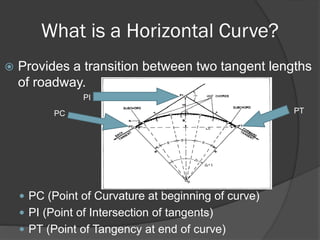
Provides a transition between two tangent lengths
of roadway.
PC (Point of Curvature at beginning of curve)
PI (Point of Intersection of tangents)
PT (Point of Tangency at end of curve)
PC
PI
PT
Why are Horizontal Curves Needed?
Necessary for gradual change in
direction when a direct point of
intersection is not feasible
Ex. Highways, Interstates, high speed
roads with constant flow of traffic
Types of Curves
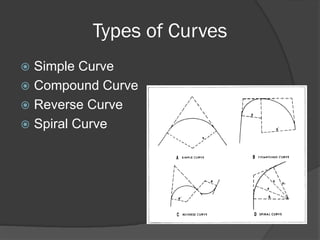
Simple Curve
Compound Curve
Reverse Curve
Spiral Curve
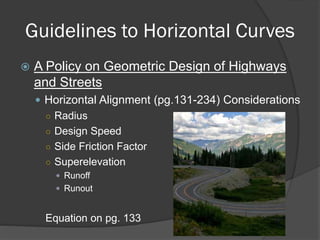
Guidelines to Horizontal Curves
A Policy on Geometric Design of Highways
and Streets
Horizontal Alignment (pg.131-234) Considerations
○ Radius
○ Design Speed
○ Side Friction Factor
○ Superelevation
Runoff
Runout
Equation on pg. 133
Design Considerations
Safe
Economically Practical
For the most part, Design Speed is used as
the overall design control
Radius
Parameters
Design of roadway curves should be
based on an appropriate relationship
between design speed and curvature and
on their joint relationships with
superelevation and side friction
Superelevation
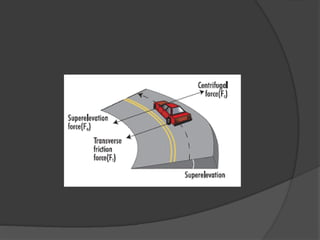
Super elevation is tilting the roadway to
help offset centripetal forces developed
as the vehicle goes around a curve.
Along with friction, they are what keeps
a vehicle from going off the road.
Must be done gradually over a distance
without noticeable reduction in speed or
safety
Superelevation
Practical upper limits – 6% (NDDOT)
Climate
○ Water
○ Ice
Terrain conditions
○ Flat
○ Mountainous
Adjacent land use (rural or urban)
Frequency of slow moving vehicles
○ Tractors, Etc.
Methods of Attaining Superelevation
Revolve traveled way with normal cross
slopes about the centerline profile
Revolve traveled way with normal cross
slope about the inside-edge profile
Revolve traveled way with normal cross
slope about the outside-edge profile
Revolve traveled way with straight cross
slope about the outside edge profile
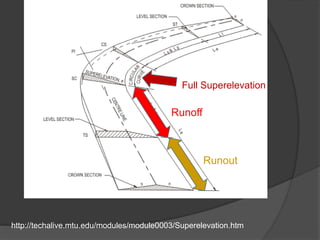
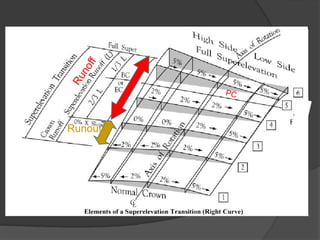
Superelevation Transitions
Consists of Runoff and Tangent Runout
sections
Runoff: length of roadway needed to
accomplish a change in outside lane
cross slope from zero to full
Runout: length of roadway needed to
accomplish a change in outside lane
cross slope from normal rate to zero
Runoff
Runout
Full Superelevation
http://techalive.mtu.edu/modules/module0003/Superelevation.htm
Runoff
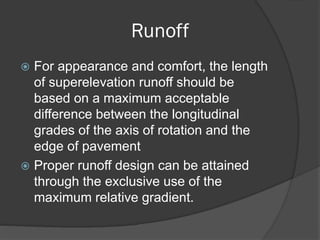
For appearance and comfort, the length
of superelevation runoff should be
based on a maximum acceptable
difference between the longitudinal
grades of the axis of rotation and the
edge of pavement
Proper runoff design can be attained
through the exclusive use of the
maximum relative gradient.
Runoff
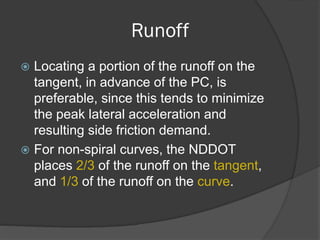
Locating a portion of the runoff on the
tangent, in advance of the PC, is
preferable, since this tends to minimize
the peak lateral acceleration and
resulting side friction demand.
For non-spiral curves, the NDDOT
places 2/3 of the runoff on the tangent,
and 1/3 of the runoff on the curve.
Runout
Runoff
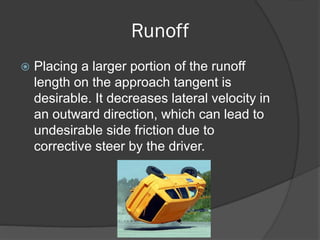
Placing a larger portion of the runoff
length on the approach tangent is
desirable. It decreases lateral velocity in
an outward direction, which can lead to
undesirable side friction due to
corrective steer by the driver.
Equation for minimum length of superelevation
runoff
Where w = width of one traffic lane (ft)
N = number of lanes rotated
e = design superelevation rate (%)
b = adjustment factor for # of lanes
G = max relative gradient (%)
Runout
Determined by the amount of adverse
cross slope to be removed and the rate
at which is removed. To effect a smooth
edge of pavement profile, the rate of
removal should equal the relative
gradient used to define the
superelevation runoff length
Methods of Distribution of
Superelevation and Side Friction
5 methods
Methods #2 and #5 are the most common
Method #2: Side friction is such that a vehicle
has all lateral acceleration sustained by side
friction. Superelevation is used once f is
equal to f_max.
Method #5: Side friction and superelevation
are in a curvilinear relation with the inverse
of the radius of the curve.
Methods of Distribution of
Superelevation and Side Friction
Method #2
Used mostly for urban streets
○ Where speed is not uniform
○ Where constraints do not allow for
superelevation
Superelevation is not needed on flatter
curves that need less than maximum side
friction for vehicles.
Methods of Distribution of
Superelevation and Side Friction
Method #5
Superelevation and side friction distributed
concurrently
Most practical
Finding Minimum Radius
Minimum Radius and Design Speeds are the
common limiting values of curvature
determined from max rate of superelevation
and max side friction factor
Equation found on pg. 133 and pg. 143
Can use this equation to solve for R_min
2
R_min = _____V________
15(.01e_max + f_max)
Example/Handout
According to NDDOT Cadd Standards
6% max table on pg. 159
Max Relative Gradient (MRG) table on pg. 170
○ Determine Desired Relative Gradient (DRG)
○ NDDOT uses DRG as 83.3 % of MRG
Main Points
Horizontal curves provide transitions
between two tangent lengths of roadway
Simple Curves have 4 variables
Radius
Design Speed
Side Friction Factor
Superelevation
Main Points
Considerations for Horizontal Curves
Safety
Economically Practical
Superelevation Transitions
Runout
Runoff
Sources
○ A Policy on Geometric Design of Highways
and Streets, 2001
○ Cadd Standards
http://www.dot.nd.gov/manuals/design/caddm
anual/caddmanual.pdf

Horizontal curves PRESENTATION

  • 1.
  • 2.
    What is aHorizontal Curve? Provides a transition between two tangent lengths of roadway. PC (Point of Curvature at beginning of curve) PI (Point of Intersection of tangents) PT (Point of Tangency at end of curve) PC PI PT
  • 3.
    Why are HorizontalCurves Needed? Necessary for gradual change in direction when a direct point of intersection is not feasible Ex. Highways, Interstates, high speed roads with constant flow of traffic
  • 4.
    Types of Curves SimpleCurve Compound Curve Reverse Curve Spiral Curve
  • 5.
    Guidelines to HorizontalCurves A Policy on Geometric Design of Highways and Streets Horizontal Alignment (pg.131-234) Considerations ○ Radius ○ Design Speed ○ Side Friction Factor ○ Superelevation Runoff Runout Equation on pg. 133
  • 6.
    Design Considerations Safe Economically Practical Forthe most part, Design Speed is used as the overall design control Radius
  • 7.
    Parameters Design of roadwaycurves should be based on an appropriate relationship between design speed and curvature and on their joint relationships with superelevation and side friction
  • 8.
    Superelevation Super elevation istilting the roadway to help offset centripetal forces developed as the vehicle goes around a curve. Along with friction, they are what keeps a vehicle from going off the road. Must be done gradually over a distance without noticeable reduction in speed or safety
  • 10.
    Superelevation Practical upper limits– 6% (NDDOT) Climate ○ Water ○ Ice Terrain conditions ○ Flat ○ Mountainous Adjacent land use (rural or urban) Frequency of slow moving vehicles ○ Tractors, Etc.
  • 11.
    Methods of AttainingSuperelevation Revolve traveled way with normal cross slopes about the centerline profile Revolve traveled way with normal cross slope about the inside-edge profile Revolve traveled way with normal cross slope about the outside-edge profile Revolve traveled way with straight cross slope about the outside edge profile
  • 12.
    Superelevation Transitions Consists ofRunoff and Tangent Runout sections Runoff: length of roadway needed to accomplish a change in outside lane cross slope from zero to full Runout: length of roadway needed to accomplish a change in outside lane cross slope from normal rate to zero
  • 13.
  • 14.
    Runoff For appearance andcomfort, the length of superelevation runoff should be based on a maximum acceptable difference between the longitudinal grades of the axis of rotation and the edge of pavement Proper runoff design can be attained through the exclusive use of the maximum relative gradient.
  • 15.
    Runoff Locating a portionof the runoff on the tangent, in advance of the PC, is preferable, since this tends to minimize the peak lateral acceleration and resulting side friction demand. For non-spiral curves, the NDDOT places 2/3 of the runoff on the tangent, and 1/3 of the runoff on the curve.
  • 16.
  • 17.
    Runoff Placing a largerportion of the runoff length on the approach tangent is desirable. It decreases lateral velocity in an outward direction, which can lead to undesirable side friction due to corrective steer by the driver.
  • 18.
    Equation for minimumlength of superelevation runoff Where w = width of one traffic lane (ft) N = number of lanes rotated e = design superelevation rate (%) b = adjustment factor for # of lanes G = max relative gradient (%)
  • 19.
    Runout Determined by theamount of adverse cross slope to be removed and the rate at which is removed. To effect a smooth edge of pavement profile, the rate of removal should equal the relative gradient used to define the superelevation runoff length
  • 20.
    Methods of Distributionof Superelevation and Side Friction 5 methods Methods #2 and #5 are the most common Method #2: Side friction is such that a vehicle has all lateral acceleration sustained by side friction. Superelevation is used once f is equal to f_max. Method #5: Side friction and superelevation are in a curvilinear relation with the inverse of the radius of the curve.
  • 21.
    Methods of Distributionof Superelevation and Side Friction Method #2 Used mostly for urban streets ○ Where speed is not uniform ○ Where constraints do not allow for superelevation Superelevation is not needed on flatter curves that need less than maximum side friction for vehicles.
  • 22.
    Methods of Distributionof Superelevation and Side Friction Method #5 Superelevation and side friction distributed concurrently Most practical
  • 23.
    Finding Minimum Radius MinimumRadius and Design Speeds are the common limiting values of curvature determined from max rate of superelevation and max side friction factor Equation found on pg. 133 and pg. 143 Can use this equation to solve for R_min 2 R_min = _____V________ 15(.01e_max + f_max)
  • 24.
    Example/Handout According to NDDOTCadd Standards 6% max table on pg. 159 Max Relative Gradient (MRG) table on pg. 170 ○ Determine Desired Relative Gradient (DRG) ○ NDDOT uses DRG as 83.3 % of MRG
  • 25.
    Main Points Horizontal curvesprovide transitions between two tangent lengths of roadway Simple Curves have 4 variables Radius Design Speed Side Friction Factor Superelevation
  • 26.
    Main Points Considerations forHorizontal Curves Safety Economically Practical Superelevation Transitions Runout Runoff
  • 27.
    Sources ○ A Policyon Geometric Design of Highways and Streets, 2001 ○ Cadd Standards http://www.dot.nd.gov/manuals/design/caddm anual/caddmanual.pdf