Download to read offline




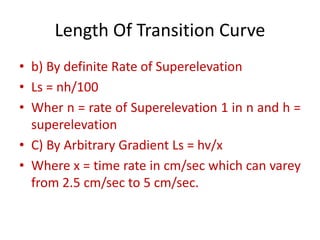
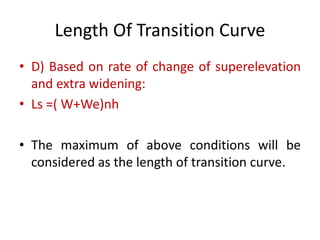





![Ex:1
• Calculate the length of transition curve for
V=65kmph, R=220m, rate of introduction of
super elevation is 1 in 150, W+We= 7.5 m.
(Hint: c=0.57)
• [Answer: Ls1=47.1m, Ls2=39m (e=0.07,
pavement rotated with reference to
centerline), Ls3=51.9m, Ls =52m]](https://image.slidesharecdn.com/transitioncurve-210816162648-230525151953-b62018df/85/transitioncurve-210816162648-pdf-31-320.jpg)
![Ex:2
• NH passing through rolling terrain of heavy
rainfall area, R=500m. Design length of
Transition curve. (Hint: Heavy rainfall.
Pavement surface rotated with respect to
inner edge. V=80kmph, W=7.0m, N=1 in 150)
[Answer: c = 0.52, Ls1 = 42.3, Ls2 = 63.7m(e =
0.057, W+We = 7.45), Ls3 = 34.6m, Ls = 64m]](https://image.slidesharecdn.com/transitioncurve-210816162648-230525151953-b62018df/85/transitioncurve-210816162648-pdf-32-320.jpg)

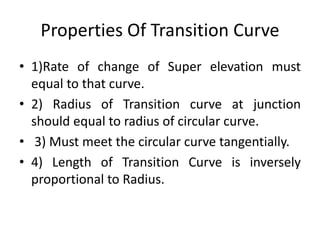
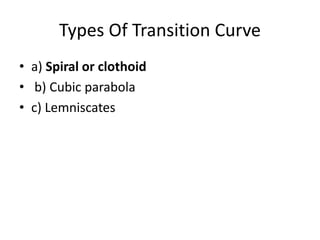
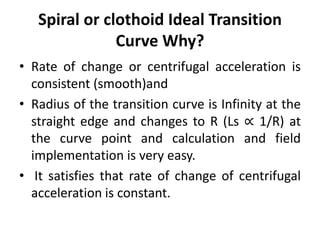
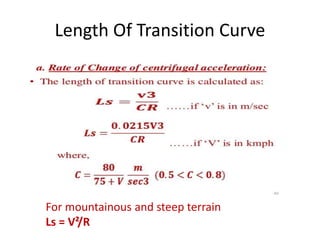
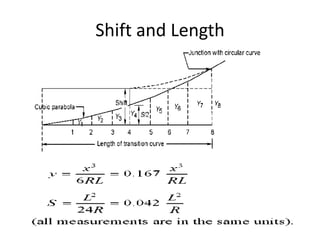
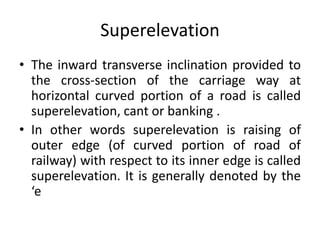
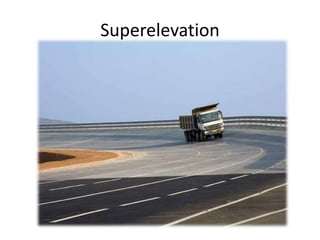
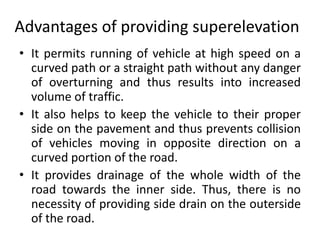
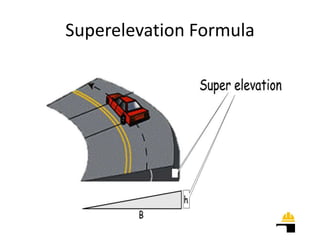
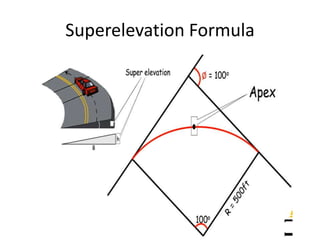
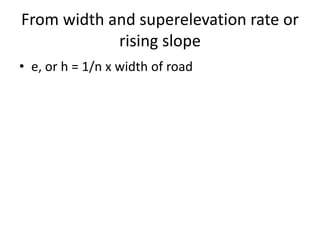
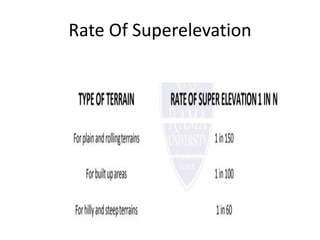
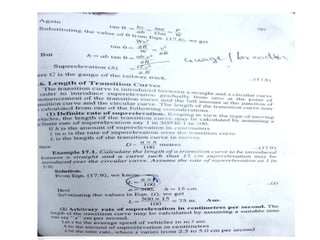
This document discusses transition curves, which are curves used to gradually change a roadway from a straight alignment to a circular curve. This allows vehicles to smoothly negotiate the curve without sudden shifts in centrifugal force. Transition curves decrease the radius gradually from infinity to the curve radius. They also provide a gradual increase in superelevation or banking from 0 to the level needed for the circular curve. Common transition curve types include spiral curves and parabolic curves. The length of a transition curve depends on factors like design speed, curve radius, and the rate of superelevation introduction. Formulas are provided to calculate superelevation and transition curve length for road design. Examples are included to demonstrate using the formulas.


![10 Geometric Design of Railway Track [Horizontal Alignment] (Railway Engineer...](https://cdn.slidesharecdn.com/ss_thumbnails/geometricdesignofrailwaytrack-i-200415171932-thumbnail.jpg?width=640&height=640&fit=bounds)


