 A precise is like a miniature portrait of the passage. 
 It retains the absolute essential points accompanied with the mood and tone 
of the author of the passage. 
 One should not add one’s subjective interpretation or comments to the 
précis 
 
 One should try to retain the original author’s voice and opinions.
 Is marked by clarity and precision 
 It must have a title 
 It should be written in reported speech 
 It must have a certain logical order 
 It must contain linking words such as so, therefore, and, because and so on 
 Must not contain any detail not found in the originals
 SQ3R provides a different method of reading textbooks that will most likely 
enhance understanding and retention of material. 
 It's not a quicker way to read a chapter in a textbook but it is likely to reduce 
the amount of time one will need to spend studying the material immediately 
prior to the test. This is so because more time is spent actually understanding 
the chapter when it is read initially. 
 Study time then becomes deepening your understanding of the material. 
 The SQ4R Method provides a systematic way of attaching textbook reading 
assignments. 
 It encourages active rather than passive reading. In passive reading, one simply 
decodes the words without any mental engagement with the information in the 
text. In active reading, one is deliberately seeking information from a text by 
asking questions, anticipating information to come, making connections with 
previously read material or formulating personal reactions. The more mental 
interaction one has with the text, the more likely one will understand and retain 
it
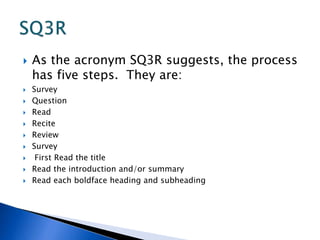
 As the acronym SQ3R suggests, the process 
has five steps. They are: 
 Survey 
 Question 
 Read 
 Recite 
 Review 
 Survey 
 First Read the title 
 Read the introduction and/or summary 
 Read each boldface heading and subheading
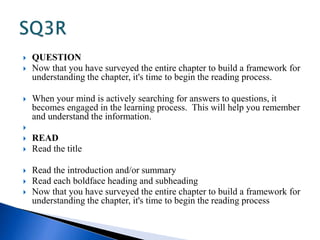
 QUESTION 
 Now that you have surveyed the entire chapter to build a framework for 
understanding the chapter, it's time to begin the reading process. 
 When your mind is actively searching for answers to questions, it 
becomes engaged in the learning process. This will help you remember 
and understand the information. 
 
 READ 
 Read the title 
 Read the introduction and/or summary 
 Read each boldface heading and subheading 
 Now that you have surveyed the entire chapter to build a framework for 
understanding the chapter, it's time to begin the reading process
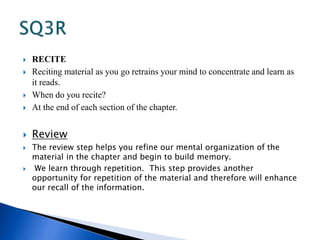
 RECITE 
 Reciting material as you go retrains your mind to concentrate and learn as 
it reads. 
 When do you recite? 
 At the end of each section of the chapter. 
 Review 
 The review step helps you refine our mental organization of the 
material in the chapter and begin to build memory. 
 We learn through repetition. This step provides another 
opportunity for repetition of the material and therefore will enhance 
our recall of the information.
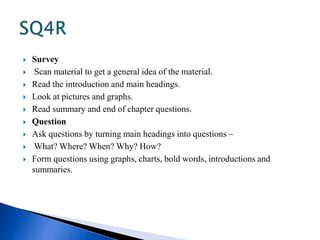
 Survey 
 Scan material to get a general idea of the material. 
 Read the introduction and main headings. 
 Look at pictures and graphs. 
 Read summary and end of chapter questions. 
 Question 
 Ask questions by turning main headings into questions – 
 What? Where? When? Why? How? 
 Form questions using graphs, charts, bold words, introductions and 
summaries.
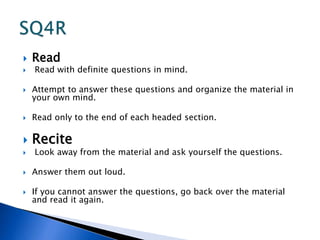
 Read 
 Read with definite questions in mind. 
 Attempt to answer these questions and organize the material in 
your own mind. 
 Read only to the end of each headed section. 
 Recite 
 Look away from the material and ask yourself the questions. 
 Answer them out loud. 
 If you cannot answer the questions, go back over the material 
and read it again.
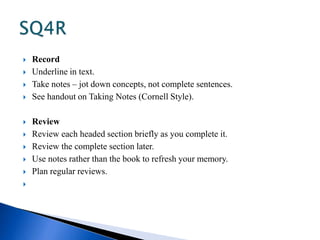
 Record 
 Underline in text. 
 Take notes – jot down concepts, not complete sentences. 
 See handout on Taking Notes (Cornell Style). 
 Review 
 Review each headed section briefly as you complete it. 
 Review the complete section later. 
 Use notes rather than the book to refresh your memory. 
 Plan regular reviews. 

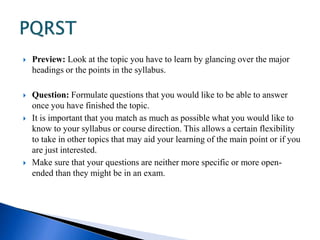
 Preview: Look at the topic you have to learn by glancing over the major 
headings or the points in the syllabus. 
 Question: Formulate questions that you would like to be able to answer 
once you have finished the topic. 
 It is important that you match as much as possible what you would like to 
know to your syllabus or course direction. This allows a certain flexibility 
to take in other topics that may aid your learning of the main point or if you 
are just interested. 
 Make sure that your questions are neither more specific or more open-ended 
than they might be in an exam.
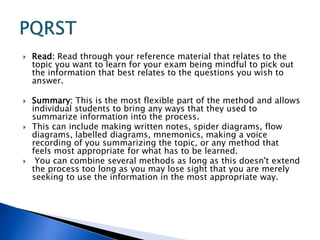
 Read: Read through your reference material that relates to the 
topic you want to learn for your exam being mindful to pick out 
the information that best relates to the questions you wish to 
answer. 
 Summary: This is the most flexible part of the method and allows 
individual students to bring any ways that they used to 
summarize information into the process. 
 This can include making written notes, spider diagrams, flow 
diagrams, labelled diagrams, mnemonics, making a voice 
recording of you summarizing the topic, or any method that 
feels most appropriate for what has to be learned. 
 You can combine several methods as long as this doesn't extend 
the process too long as you may lose sight that you are merely 
seeking to use the information in the most appropriate way.
 Test: Use this step to assess whether you have focused on the important 
information and stayed on topic. 
 Answer the questions that you set for yourself in the Question section as 
fully as you can as this using of the information is another way of using the 
information and remembering more of it. 
 This section also reminds you to continually manipulate the information so 
that you are focused on whatever form of assessment that it is needed for. 
 It is sometimes easy to lose sight of the point of learning and see it as a task 
to be completed mundanely. 
 Try to avoid adding questions that you didn't formulate in the Q section.
 I hope that this presentation is useful for the listeners and must have given 
them an insight on the comprehension skills. The steps that are mentioned 
in the presentation are followed by us in some way or the other but are 
often not recognised. Keeping them in mind we can reduce the amount of 
time and effort required to answer a comprehension. 
 Thank you
 Anurag Pandey A2324612030 
 Bhupesh Kumar Singh A2324612029 
 Harshvardhan Joshi A2324612049

Precis Writing

  • 1.
     A preciseis like a miniature portrait of the passage.  It retains the absolute essential points accompanied with the mood and tone of the author of the passage.  One should not add one’s subjective interpretation or comments to the précis   One should try to retain the original author’s voice and opinions.
  • 2.
     Is markedby clarity and precision  It must have a title  It should be written in reported speech  It must have a certain logical order  It must contain linking words such as so, therefore, and, because and so on  Must not contain any detail not found in the originals
  • 3.
     SQ3R providesa different method of reading textbooks that will most likely enhance understanding and retention of material.  It's not a quicker way to read a chapter in a textbook but it is likely to reduce the amount of time one will need to spend studying the material immediately prior to the test. This is so because more time is spent actually understanding the chapter when it is read initially.  Study time then becomes deepening your understanding of the material.  The SQ4R Method provides a systematic way of attaching textbook reading assignments.  It encourages active rather than passive reading. In passive reading, one simply decodes the words without any mental engagement with the information in the text. In active reading, one is deliberately seeking information from a text by asking questions, anticipating information to come, making connections with previously read material or formulating personal reactions. The more mental interaction one has with the text, the more likely one will understand and retain it
  • 4.
     As theacronym SQ3R suggests, the process has five steps. They are:  Survey  Question  Read  Recite  Review  Survey  First Read the title  Read the introduction and/or summary  Read each boldface heading and subheading
  • 5.
     QUESTION Now that you have surveyed the entire chapter to build a framework for understanding the chapter, it's time to begin the reading process.  When your mind is actively searching for answers to questions, it becomes engaged in the learning process. This will help you remember and understand the information.   READ  Read the title  Read the introduction and/or summary  Read each boldface heading and subheading  Now that you have surveyed the entire chapter to build a framework for understanding the chapter, it's time to begin the reading process
  • 6.
     RECITE Reciting material as you go retrains your mind to concentrate and learn as it reads.  When do you recite?  At the end of each section of the chapter.  Review  The review step helps you refine our mental organization of the material in the chapter and begin to build memory.  We learn through repetition. This step provides another opportunity for repetition of the material and therefore will enhance our recall of the information.
  • 7.
     Survey Scan material to get a general idea of the material.  Read the introduction and main headings.  Look at pictures and graphs.  Read summary and end of chapter questions.  Question  Ask questions by turning main headings into questions –  What? Where? When? Why? How?  Form questions using graphs, charts, bold words, introductions and summaries.
  • 8.
     Read Read with definite questions in mind.  Attempt to answer these questions and organize the material in your own mind.  Read only to the end of each headed section.  Recite  Look away from the material and ask yourself the questions.  Answer them out loud.  If you cannot answer the questions, go back over the material and read it again.
  • 9.
     Record Underline in text.  Take notes – jot down concepts, not complete sentences.  See handout on Taking Notes (Cornell Style).  Review  Review each headed section briefly as you complete it.  Review the complete section later.  Use notes rather than the book to refresh your memory.  Plan regular reviews. 
  • 10.
     Preview: Lookat the topic you have to learn by glancing over the major headings or the points in the syllabus.  Question: Formulate questions that you would like to be able to answer once you have finished the topic.  It is important that you match as much as possible what you would like to know to your syllabus or course direction. This allows a certain flexibility to take in other topics that may aid your learning of the main point or if you are just interested.  Make sure that your questions are neither more specific or more open-ended than they might be in an exam.
  • 11.
     Read: Readthrough your reference material that relates to the topic you want to learn for your exam being mindful to pick out the information that best relates to the questions you wish to answer.  Summary: This is the most flexible part of the method and allows individual students to bring any ways that they used to summarize information into the process.  This can include making written notes, spider diagrams, flow diagrams, labelled diagrams, mnemonics, making a voice recording of you summarizing the topic, or any method that feels most appropriate for what has to be learned.  You can combine several methods as long as this doesn't extend the process too long as you may lose sight that you are merely seeking to use the information in the most appropriate way.
  • 12.
     Test: Usethis step to assess whether you have focused on the important information and stayed on topic.  Answer the questions that you set for yourself in the Question section as fully as you can as this using of the information is another way of using the information and remembering more of it.  This section also reminds you to continually manipulate the information so that you are focused on whatever form of assessment that it is needed for.  It is sometimes easy to lose sight of the point of learning and see it as a task to be completed mundanely.  Try to avoid adding questions that you didn't formulate in the Q section.
  • 13.
     I hopethat this presentation is useful for the listeners and must have given them an insight on the comprehension skills. The steps that are mentioned in the presentation are followed by us in some way or the other but are often not recognised. Keeping them in mind we can reduce the amount of time and effort required to answer a comprehension.  Thank you
  • 14.
     Anurag PandeyA2324612030  Bhupesh Kumar Singh A2324612029  Harshvardhan Joshi A2324612049