DICTIONARY
SKILLS.
How to make the best use of
dictionary.
MEANING OF DICTIONARY;
REF: OXFORD ENGLISH
DICTIONARY.

n.

book explaining, usually in
alphabetical order, words of a
language, or giving their
equivalent in another language;
reference book of words and
topics of subjects arranged in
DICTIONARY: ITS
MEANING.
is primarily a book of reference , a
book worth studying.
It is to supply much more than just
meanings and spellings .
It has a wealth of information .
It records the changes in vocabulary.
It
HOW TO USE A
DICTIONARY?
Dictionary

can be easy to use by
knowing its Plan, the Dictionary
plan.
Each and every dictionary has its
unique plan.
Read first a few pages of dictionary
to understand dictionary .
 To

WHY USE THE DICTIONARY?

Look up the meaning of an English word you see or hear.
 To Find the English translation of a word in your language.
 To Check the spelling of a word.
 To Check the plural of a noun or past tense of a verb.
 To Find out other grammatical information about a word.
 To Find the synonym or antonym of a word.
 To Look up the collocations of a word.
 To Check the part of speech of a word.
 To Find out how to say a word.
 To Find out about the register of a word.
 To Find examples of the use of a word in natural language.
FUNCTIONS OF
DICTIONARY.
What most of people think is that the dictionary
has only one function to describe one word’s
meaning, but the dictionary has even more
1. Synonyms.
functions, that are mentioned below:
words.
Pronunciation.

2. Usage of

3. Parts of speech.
5.Syllabication.
7. Etymology.

4.
6. Meaning.
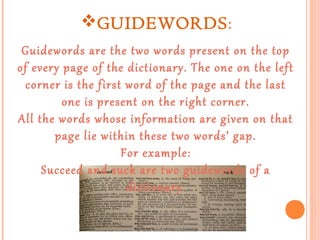
GUIDEWORDS:
Guidewords are the two words present on the top
of every page of the dictionary. The one on the left
corner is the first word of the page and the last
one is present on the right corner.
All the words whose information are given on that
page lie within these two words’ gap.
For example:
Succeed and suck are two guidewords of a
dictionary.
 ENTRY WORD
Entry words are the words that are
explained on the page. They are typed in
bold letters so that it is easy to locate the
word we want to search the meaning of.
For Example:
Highroad.
High school.
High sounding, etc.
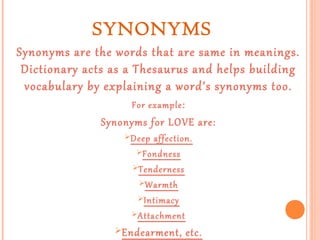
SYNONYMS

Synonyms are the words that are same in meanings.
Dictionary acts as a Thesaurus and helps building
vocabulary by explaining a word’s synonyms too.
For example :

Synonyms for LOVE are:
Deep

affection.
Fondness
Tenderness
Warmth
Intimacy
Attachment

Endearment,

etc.
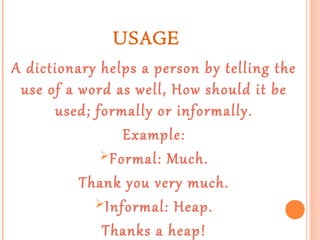
USAGE
A dictionary helps a person by telling the
use of a word as well, How should it be
used; formally or informally.
Example:
Formal: Much.
Thank you very much.
Informal: Heap.
Thanks a heap!
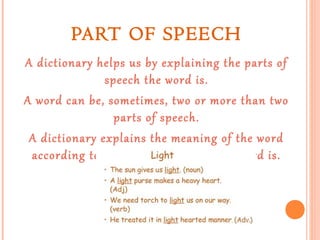
PART OF SPEECH
A dictionary helps us by explaining the parts of
speech the word is.
A word can be, sometimes, two or more than two
parts of speech.
A dictionary explains the meaning of the word
according to every part of speech the word is.
For example:
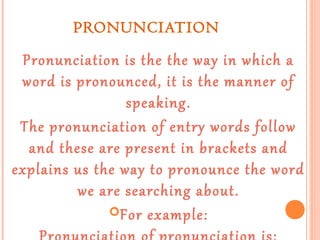
PRONUNCIATION

Pronunciation is the the way in which a
word is pronounced, it is the manner of
speaking.
The pronunciation of entry words follow
and these are present in brackets and
explains us the way to pronounce the word
we are searching about.
For example:
SYLLABICATION
It is Accentuation: Stress pattern.
It is important to learn which syllable take
stress (it is indicated by a dash or dot placed
immediately after the stressed syllable).
Transfer of stress form one syllable to
another sometimes alter the grammatical
functions as well as the meaning of a word.
For instance,
ab’stract, with stress on first syllable, is a
noun and means a summary, while abstract’,
MEANING
The most important function of the
dictionary for which we commonly consult
it is finding the meaning of a word. A
dictionary explains all the possible
meanings of a word.
For example:
The word ‘Choke’ has 4 meanings.
One as a verb, one as a phrasal verb and
the other two as noun.
ETYMOLOGY

Etymology means the study of
roots. In dictionary, Etymology of
words are given which tell us from
where the word is derived, what is
its origin, when was it first spoken,
what did it mean previously, etc.
VARIANTS
Variants are the different ways of saying a
word.
These variations are caused by spellings or
pronunciations.
For Example:
Colour and color.
Behaviour and Behavior.
Flavour and Flavor.
INFLECTIONS
In grammar, inflection or inflexion is the

modification of a word to express different
grammatical categories ;
Such as tense, mood, voice, aspect, person,
number, gender and case.

The inflection of verbs is also
called conjugation, and the inflection
ANOTHER FUNCTION OF
DICTIONARY IS THAT IT
ENRICHES VOCABULARY.
A

good vocabulary is one of the
hall-marks of an educated person,
and a priceless possession in
educational, business and in social
life.
How to acquire it?
ACQUIRE VOCABULARY
FROM:

Conversations, By Listening to radio,
Watching TV, audio tracks, Reading and
Regular use of the DICTIONARY.
DON’T FORGET!
It is not enough to know only what a word
means one must be able to use it in
conversation and writing.
 Ability

THE NEED FOR
EXACTNESS:

to choose and use the right words depends
upon the range of one’s vocabulary, and this will be
adequate only if opportunities are taken to refer
good dictionaries.
 Words change their meanings.
 See this example:
Variants of word ‘KILL’
 He was slain on the battlefield.
 The robbers killed him.
 He was murdered in cold blood.
 All the sheep were slaughtered.

Dictionary skills.

  • 1.
    DICTIONARY SKILLS. How to makethe best use of dictionary.
  • 2.
    MEANING OF DICTIONARY; REF:OXFORD ENGLISH DICTIONARY. n. book explaining, usually in alphabetical order, words of a language, or giving their equivalent in another language; reference book of words and topics of subjects arranged in
  • 3.
    DICTIONARY: ITS MEANING. is primarilya book of reference , a book worth studying. It is to supply much more than just meanings and spellings . It has a wealth of information . It records the changes in vocabulary. It
  • 4.
    HOW TO USEA DICTIONARY? Dictionary can be easy to use by knowing its Plan, the Dictionary plan. Each and every dictionary has its unique plan. Read first a few pages of dictionary to understand dictionary .
  • 5.
     To WHY USETHE DICTIONARY? Look up the meaning of an English word you see or hear.  To Find the English translation of a word in your language.  To Check the spelling of a word.  To Check the plural of a noun or past tense of a verb.  To Find out other grammatical information about a word.  To Find the synonym or antonym of a word.  To Look up the collocations of a word.  To Check the part of speech of a word.  To Find out how to say a word.  To Find out about the register of a word.  To Find examples of the use of a word in natural language.
  • 6.
    FUNCTIONS OF DICTIONARY. What mostof people think is that the dictionary has only one function to describe one word’s meaning, but the dictionary has even more 1. Synonyms. functions, that are mentioned below: words. Pronunciation. 2. Usage of 3. Parts of speech. 5.Syllabication. 7. Etymology. 4. 6. Meaning.
  • 7.
    GUIDEWORDS: Guidewords are thetwo words present on the top of every page of the dictionary. The one on the left corner is the first word of the page and the last one is present on the right corner. All the words whose information are given on that page lie within these two words’ gap. For example: Succeed and suck are two guidewords of a dictionary.
  • 8.
     ENTRY WORD Entrywords are the words that are explained on the page. They are typed in bold letters so that it is easy to locate the word we want to search the meaning of. For Example: Highroad. High school. High sounding, etc.
  • 9.
    SYNONYMS Synonyms are thewords that are same in meanings. Dictionary acts as a Thesaurus and helps building vocabulary by explaining a word’s synonyms too. For example : Synonyms for LOVE are: Deep affection. Fondness Tenderness Warmth Intimacy Attachment Endearment, etc.
  • 10.
    USAGE A dictionary helpsa person by telling the use of a word as well, How should it be used; formally or informally. Example: Formal: Much. Thank you very much. Informal: Heap. Thanks a heap!
  • 11.
    PART OF SPEECH Adictionary helps us by explaining the parts of speech the word is. A word can be, sometimes, two or more than two parts of speech. A dictionary explains the meaning of the word according to every part of speech the word is. For example:
  • 12.
    PRONUNCIATION Pronunciation is thethe way in which a word is pronounced, it is the manner of speaking. The pronunciation of entry words follow and these are present in brackets and explains us the way to pronounce the word we are searching about. For example:
  • 13.
    SYLLABICATION It is Accentuation:Stress pattern. It is important to learn which syllable take stress (it is indicated by a dash or dot placed immediately after the stressed syllable). Transfer of stress form one syllable to another sometimes alter the grammatical functions as well as the meaning of a word. For instance, ab’stract, with stress on first syllable, is a noun and means a summary, while abstract’,
  • 14.
    MEANING The most importantfunction of the dictionary for which we commonly consult it is finding the meaning of a word. A dictionary explains all the possible meanings of a word. For example: The word ‘Choke’ has 4 meanings. One as a verb, one as a phrasal verb and the other two as noun.
  • 15.
    ETYMOLOGY Etymology means thestudy of roots. In dictionary, Etymology of words are given which tell us from where the word is derived, what is its origin, when was it first spoken, what did it mean previously, etc.
  • 16.
    VARIANTS Variants are thedifferent ways of saying a word. These variations are caused by spellings or pronunciations. For Example: Colour and color. Behaviour and Behavior. Flavour and Flavor.
  • 17.
    INFLECTIONS In grammar, inflectionor inflexion is the modification of a word to express different grammatical categories ; Such as tense, mood, voice, aspect, person, number, gender and case. The inflection of verbs is also called conjugation, and the inflection
  • 18.
    ANOTHER FUNCTION OF DICTIONARYIS THAT IT ENRICHES VOCABULARY. A good vocabulary is one of the hall-marks of an educated person, and a priceless possession in educational, business and in social life. How to acquire it?
  • 19.
    ACQUIRE VOCABULARY FROM: Conversations, ByListening to radio, Watching TV, audio tracks, Reading and Regular use of the DICTIONARY. DON’T FORGET! It is not enough to know only what a word means one must be able to use it in conversation and writing.
  • 20.
     Ability THE NEEDFOR EXACTNESS: to choose and use the right words depends upon the range of one’s vocabulary, and this will be adequate only if opportunities are taken to refer good dictionaries.  Words change their meanings.  See this example: Variants of word ‘KILL’  He was slain on the battlefield.  The robbers killed him.  He was murdered in cold blood.  All the sheep were slaughtered.