A Crow, exhausted and dying of thirst, came upon a pitcher with water in the bottom; but when the Crow put its beak into the mouth of the pitcher, he found that, no matter how hard he tried, he could not reach far enough to drink. He tried for five minutes, almost giving up in despair. But, continuing to think of other options, a creative thought came to him. He took a pebble and dropped it into the pitcher. He repeated the process, dropping in one pebble after another. At last, he saw the water level rising, and after casting in a few more pebbles, he was able to quench his thirst and save his life. As we explore the meaning of this parable, students identify the importance of changing strategies when what they are doing isn’t working. As the semester progresses and a student is getting frustrated by lack of success, someone may remind her to try something different, but the words are, “Find some pebbles!” THE CROW AND THE PITCHER
Test-Taking ExerciseCreate a 10 question test for Chapters 1 and 22-True-false2-matching2-fill-in-the-blank2-multiple choice2-short answer or essay questions
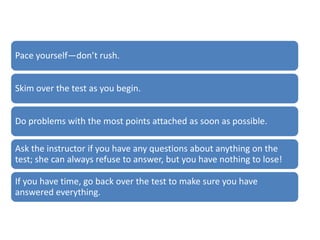
Test Taking Skills
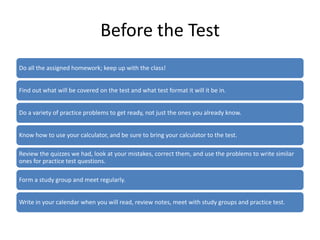
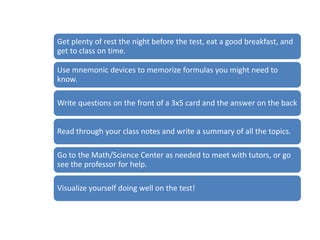
Before the Test
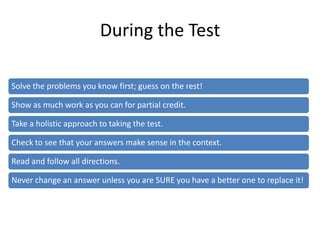
During the Test
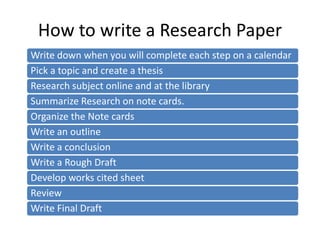
How to write a Research Paper
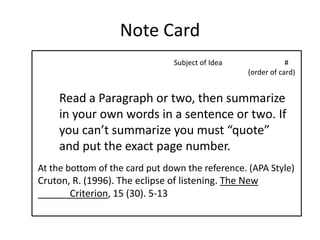
Note CardSubject of Idea                                  #                        	                       (order of card)Read a Paragraph or two, then summarize in your own words in a sentence or two. If you can’t summarize you must “quote” and put the exact page number.At the bottom of the card put down the reference. (APA Style)Cruton, R. (1996). The eclipse of listening. The New 	Criterion, 15 (30). 5-13
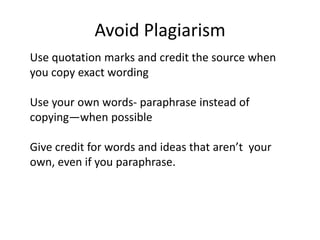
Avoid PlagiarismUse quotation marks and credit the source when you copy exact wordingUse your own words- paraphrase instead of copying—when possibleGive credit for words and ideas that aren’t  your own, even if you paraphrase.
Owl Websitehttp://owl.english.purdue.edu/owl/
GCC Library Websitehttp://lib.gccaz.edu/lmc/
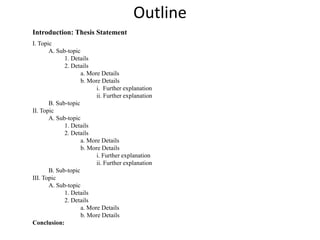
OutlineIntroduction: Thesis StatementI. TopicA. Sub-topic1. Details2. Detailsa. More Detailsb. More Detailsi.  Further explanation ii. Further explanationB. Sub-topicII. TopicA. Sub-topic1. Details2. Detailsa. More Detailsb. More Detailsi. Further explanation ii. Further explanationB. Sub-topicIII. TopicA. Sub-topic1. Details2. Detailsa. More Detailsb. More DetailsConclusion:
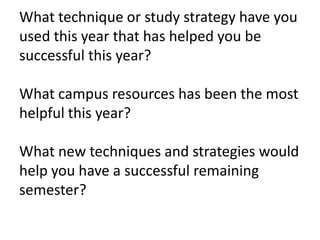
What technique or study strategy have you used this year that has helped you be successful this year?What campus resources has been the most helpful this year?What new techniques and strategies would help you have a successful remaining semester?
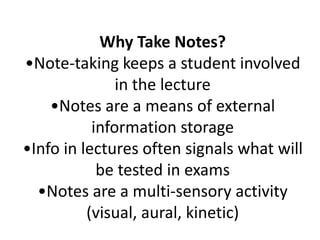
Why Take Notes?•Note-taking keeps a student involved in the lecture•Notes are a means of external information storage•Info in lectures often signals what will be tested in exams•Notes are a multi-sensory activity (visual, aural, kinetic)
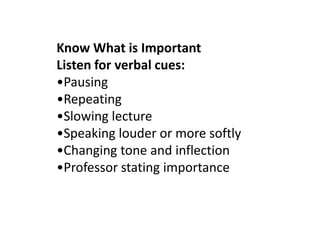
Know What is ImportantListen for verbal cues:•Pausing •Repeating•Slowing lecture•Speaking louder or more softly•Changing tone and inflection•Professor stating importance
Know What is ImportantLook for non-verbal cues:•Writing on board•Making eye contact•Using dramatic gestures
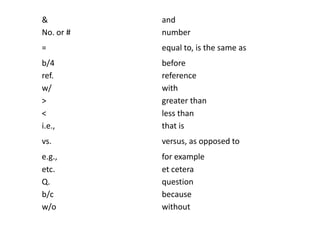
Short-hand method: Abbreviate or write out part of the word so that you can keep up with the rest of the lecture.  Some teachers speak really fast and catching every word is nearly impossible.  If you shorten words or abbreviate, it will be easier to write down an entire point.Fragments: Writing the entire sentence is just as bad as writing one word the teacher says.  Instead, just write a fragment of a sentence with the major point included.
Visuals: If you have extra time in between notes, draw out a point so that you have a visual aid to help you remember.
Practice listening: Try to train your ears to listen to the professor as much as possible so that the words flow out of your pen.  You can always go back to read your notes, so don’t worry about reading it while you write.
Stay organized: Use bullets, numbers, or letters to organize your notes so that they are not all over the place. Title your notes, put dates and subtitles for different sections.  Being organized is easy when the professor gives organized lectures. Some professors just speak without clear organization; therefore, organizing your own notes will help.
Effective Reading
During ReadingRead for answers to the questions from the headings you came up withRead in ChunksConcentrate on reading fasterRead for main ideas and support details and highlight themTake notesRecite what you just readLook up key words that are new to you
After ReadingReread anything that was difficultReview your notes and what you highlightedAnswer end of the chapter questionsRead other resources on the subject (articles and websites)Make a class study group to quiz each otherDiscuss or teach others what you learnedSeek help if you have difficulty understandingReview over time (note cards you can take with you anywhere)
How to Read TextbooksUse the SQR3 method of reading to be an active and effective reader. The passive reader learns little. The aggressive reader organizes information and answers questions. SQR3: survey, question, read, recite, review.
Survey the chapterRead the introduction to the chapter.
Look over the major section headings.
Glance at the figures.
Skim questions, key words and summaries at the end of the chapter.
Create a context for remembering information.
Generate interest and a sense of what is important.
Plan your study session.

Aaa 115 lesson 3

  • 1.
    A Crow, exhaustedand dying of thirst, came upon a pitcher with water in the bottom; but when the Crow put its beak into the mouth of the pitcher, he found that, no matter how hard he tried, he could not reach far enough to drink. He tried for five minutes, almost giving up in despair. But, continuing to think of other options, a creative thought came to him. He took a pebble and dropped it into the pitcher. He repeated the process, dropping in one pebble after another. At last, he saw the water level rising, and after casting in a few more pebbles, he was able to quench his thirst and save his life. As we explore the meaning of this parable, students identify the importance of changing strategies when what they are doing isn’t working. As the semester progresses and a student is getting frustrated by lack of success, someone may remind her to try something different, but the words are, “Find some pebbles!” THE CROW AND THE PITCHER
  • 3.
    Test-Taking ExerciseCreate a10 question test for Chapters 1 and 22-True-false2-matching2-fill-in-the-blank2-multiple choice2-short answer or essay questions
  • 4.
  • 5.
  • 7.
  • 9.
    How to writea Research Paper
  • 10.
    Note CardSubject ofIdea # (order of card)Read a Paragraph or two, then summarize in your own words in a sentence or two. If you can’t summarize you must “quote” and put the exact page number.At the bottom of the card put down the reference. (APA Style)Cruton, R. (1996). The eclipse of listening. The New Criterion, 15 (30). 5-13
  • 11.
    Avoid PlagiarismUse quotationmarks and credit the source when you copy exact wordingUse your own words- paraphrase instead of copying—when possibleGive credit for words and ideas that aren’t your own, even if you paraphrase.
  • 12.
  • 13.
  • 14.
    OutlineIntroduction: Thesis StatementI.TopicA. Sub-topic1. Details2. Detailsa. More Detailsb. More Detailsi. Further explanation ii. Further explanationB. Sub-topicII. TopicA. Sub-topic1. Details2. Detailsa. More Detailsb. More Detailsi. Further explanation ii. Further explanationB. Sub-topicIII. TopicA. Sub-topic1. Details2. Detailsa. More Detailsb. More DetailsConclusion:
  • 15.
    What technique orstudy strategy have you used this year that has helped you be successful this year?What campus resources has been the most helpful this year?What new techniques and strategies would help you have a successful remaining semester?
  • 16.
    Why Take Notes?•Note-takingkeeps a student involved in the lecture•Notes are a means of external information storage•Info in lectures often signals what will be tested in exams•Notes are a multi-sensory activity (visual, aural, kinetic)
  • 17.
    Know What isImportantListen for verbal cues:•Pausing •Repeating•Slowing lecture•Speaking louder or more softly•Changing tone and inflection•Professor stating importance
  • 18.
    Know What isImportantLook for non-verbal cues:•Writing on board•Making eye contact•Using dramatic gestures
  • 19.
    Short-hand method: Abbreviateor write out part of the word so that you can keep up with the rest of the lecture.  Some teachers speak really fast and catching every word is nearly impossible.  If you shorten words or abbreviate, it will be easier to write down an entire point.Fragments: Writing the entire sentence is just as bad as writing one word the teacher says.  Instead, just write a fragment of a sentence with the major point included.
  • 21.
    Visuals: If youhave extra time in between notes, draw out a point so that you have a visual aid to help you remember.
  • 22.
    Practice listening: Tryto train your ears to listen to the professor as much as possible so that the words flow out of your pen.  You can always go back to read your notes, so don’t worry about reading it while you write.
  • 23.
    Stay organized: Usebullets, numbers, or letters to organize your notes so that they are not all over the place. Title your notes, put dates and subtitles for different sections.  Being organized is easy when the professor gives organized lectures. Some professors just speak without clear organization; therefore, organizing your own notes will help.
  • 24.
  • 25.
    During ReadingRead foranswers to the questions from the headings you came up withRead in ChunksConcentrate on reading fasterRead for main ideas and support details and highlight themTake notesRecite what you just readLook up key words that are new to you
  • 26.
    After ReadingReread anythingthat was difficultReview your notes and what you highlightedAnswer end of the chapter questionsRead other resources on the subject (articles and websites)Make a class study group to quiz each otherDiscuss or teach others what you learnedSeek help if you have difficulty understandingReview over time (note cards you can take with you anywhere)
  • 27.
    How to ReadTextbooksUse the SQR3 method of reading to be an active and effective reader. The passive reader learns little. The aggressive reader organizes information and answers questions. SQR3: survey, question, read, recite, review.
  • 28.
    Survey the chapterReadthe introduction to the chapter.
  • 29.
    Look over themajor section headings.
  • 30.
    Glance at thefigures.
  • 31.
    Skim questions, keywords and summaries at the end of the chapter.
  • 32.
    Create a contextfor remembering information.
  • 33.
    Generate interest anda sense of what is important.
  • 34.
  • 35.
    Set a timelimit for working. Include breaks and rewards.(Personally I always wrote down the end of chapter questions and answered them as I read)
  • 36.
    Question. Create andanswer questions.For each section in the chapter, ask these 4 basic questions:1.    What is the main point? 2.    What evidence supports the main point? 3.    What are the applications or examples? 4.    How is this related to the rest of the chapter, the book, the world, to me?
  • 37.
    Questioning helps yourmind engage and concentrate on what you are reading.
  • 38.
    Turn boldface headingsand subheadings into as many questions as you think will be answered in the section you are reading.
  • 39.
    Turning headings intoquestions directs your reading so that you can find the details and examples that support major points.  
  • 40.
    As you readeach section carefully, try to find the answers to questions you formed from the headings.
  • 41.
    The better thequestions, the better your comprehension will be. Read the section.Skim or read the section actively.
  • 42.
    Search for theanswers to your questions.
  • 43.
    Always read throughthe section again, especially if it seems particularly technical or complex. Be sure to underline main ideas and/or key thoughts.
  • 44.
    Make notes inthe margins to create your own organization
  • 45.
    Writing down theauthor's ideas in your own words also aids your recall.
  • 46.
    Creating notes, underliningor highlighting, and constructing study guides are essential to active reading. Recite the main points.Recitation is an essential aid to memory and comprehension. Look up from the book and verbalize the answers to your questions.
  • 47.
    Talk out loudand listen to the answers.
  • 48.
  • 49.
    If you havetrouble doing this, then you probably have not understood the section and you need to reread it. Don't move on to the next section until you can recite.
  • 50.
    If the centralidea comes easily to mind, then you can be confident that you understand what you have read. Review.Now go back and highlight or underline the main points in the section.
  • 51.
    Add more notesin the text and margin.
  • 52.
    Repeat SQR3 foreach section; mini-survey, question, read, recite and review. When finished, create a one page hierarchical summary of the entire chapter.
  • 53.
    Go back overall the questions from all the headings, and see if you can still answer them. If not, refresh your memory and continue.
  • 54.
    Now do anyhomework assignments. Use your summary first, then the text.
  • 55.
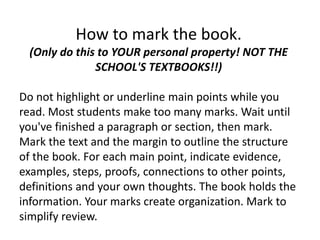
    Review often andreward yourself for a job well done.How to mark the book. (Only do this to YOUR personal property! NOT THE SCHOOL'S TEXTBOOKS!!)Do not highlight or underline main points while you read. Most students make too many marks. Wait until you've finished a paragraph or section, then mark.Mark the text and the margin to outline the structure of the book. For each main point, indicate evidence, examples, steps, proofs, connections to other points, definitions and your own thoughts. The book holds the information. Your marks create organization. Mark to simplify review.