PLASMA 
The Fourth State of Matter
States of Matter 
Starts from next page 
2
States of Matter 
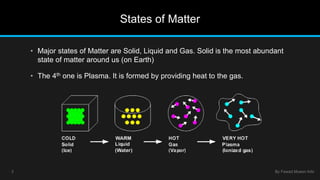
• Major states of Matter are Solid, Liquid and Gas. Solid is the most abundant 
state of matter around us (on Earth) 
• The 4th one is Plasma. It is formed by providing heat to the gas. 
3 By Fawad Mueen Arbi
Other States of Matter 
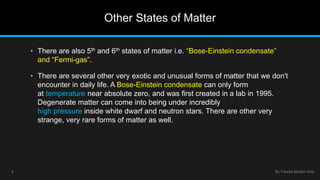
• There are also 5th and 6th states of matter i.e. “Bose-Einstein condensate” 
and “Fermi-gas”. 
• There are several other very exotic and unusual forms of matter that we don't 
encounter in daily life. A Bose-Einstein condensate can only form 
at temperature near absolute zero, and was first created in a lab in 1995. 
Degenerate matter can come into being under incredibly 
high pressure inside white dwarf and neutron stars. There are other very 
strange, very rare forms of matter as well. 
4 By Fawad Mueen Arbi
Plasma as The 4th State of Matter 
Starts from next page 
5
What is Plasma? 
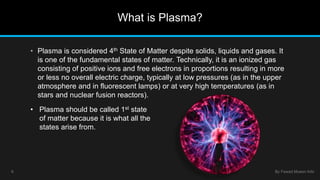
• Plasma is considered 4th State of Matter despite solids, liquids and gases. It 
is one of the fundamental states of matter. Technically, it is an ionized gas 
consisting of positive ions and free electrons in proportions resulting in more 
or less no overall electric charge, typically at low pressures (as in the upper 
atmosphere and in fluorescent lamps) or at very high temperatures (as in 
stars and nuclear fusion reactors). 
• Plasma should be called 1st state 
of matter because it is what all the 
states arise from. 
6 By Fawad Mueen Arbi
Why is Plasma considered the 4th State of Matter 
• The characteristics of plasmas are significantly different from those of 
ordinary neutral gases so that plasmas are considered a distinct "fourth state 
of matter." For example, because plasmas are made up of electrically 
charged particles, they are strongly influenced by electric and magnetic fields 
while neutral gases are not. 
• It’s behavior doesn’t resemble with any other State of Matter. It is significantly 
unique. 
• It is an interesting fact that most of the material in the visible Universe (The 
whole Universe, as much as 99.9% according to some estimates, is in the 
Plasma State. 
7 By Fawad Mueen Arbi
Discovery of Plasma 
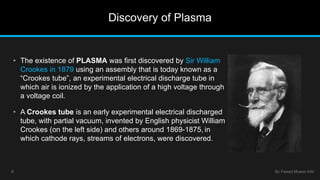
• The existence of PLASMA was first discovered by Sir William 
Crookes in 1879 using an assembly that is today known as a 
“Crookes tube”, an experimental electrical discharge tube in 
which air is ionized by the application of a high voltage through 
a voltage coil. 
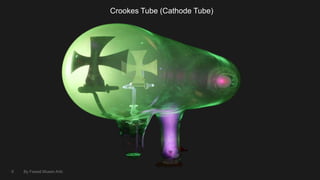
• A Crookes tube is an early experimental electrical discharged 
tube, with partial vacuum, invented by English physicist William 
Crookes (on the left side) and others around 1869-1875, in 
which cathode rays, streams of electrons, were discovered. 
8 By Fawad Mueen Arbi
Crookes Tube (Cathode Tube) 
9 By Fawad Mueen Arbi
Formation of Plasma 
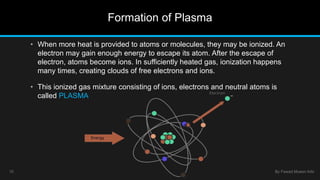
• When more heat is provided to atoms or molecules, they may be ionized. An 
electron may gain enough energy to escape its atom. After the escape of 
electron, atoms become ions. In sufficiently heated gas, ionization happens 
many times, creating clouds of free electrons and ions. 
• This ionized gas mixture consisting of ions, electrons and neutral atoms is 
called PLASMA 
10 By Fawad Mueen Arbi
Types of Plasma 
• There are two major types of Plasma i.e. 
1. Natural Plasma Natural Plasma only exist at very high temperature 
or low temperature vacuum. It do not react rapidly but it is extremely hot 
(over 20,000 oC). There energy is so high that it vaporizes everything they 
touch. 
2. Artificial Plasma Artificial Plasma can be created by ionization of a 
gas , as in neon signs. Plasma at low temperature is hard to maintain 
because outside a vacuum, low temperature plasma reacts rapidly with any 
molecule it encounters. This aspect makes this material, both very useful 
and hard to use. 
11 By Fawad Mueen Arbi
Properties of Plasma 
• Although Plasma includes ions, electrons and neutral atoms, it is 
macroscopically neutral as a whole because electrons and ions are equally 
balanced. 
• A Plasma must have sufficient number of charged particles as a whole, it 
exhibits a collective response to electrical and magnetic field. The motion of 
particles in the Plasma generate fields and electric currents from within 
Plasma Density. 
• This complex behavior makes Plasma Unique. 
12 By Fawad Mueen Arbi
Applications of Plasma 
• Neon Signs are also made of 
Plasma. 
• The glowing "gas" in a 
fluorescent bulb is Plasma. 
• Plasma Globes are also used 
to make Plasma in Labs 
• Plasma Televisions
Applications of Plasma 
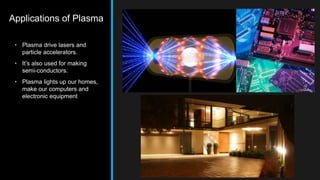
• Plasma drive lasers and 
particle accelerators. 
• It’s also used for making 
semi-conductors. 
• Plasma lights up our homes, 
make our computers and 
electronic equipment
Interesting Facts about Plasma 
Listed from next page.
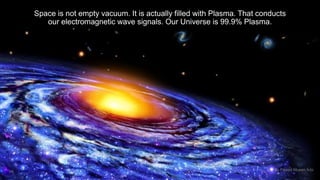
Space is not empty vacuum. It is actually filled with Plasma. That conducts 
our electromagnetic wave signals. Our Universe is 99.9% Plasma. 
16 By Fawad Mueen Arbi
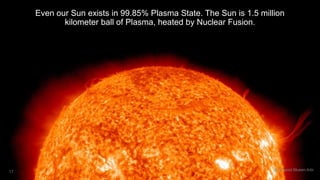
Even our Sun exists in 99.85% Plasma State. The Sun is 1.5 million 
kilometer ball of Plasma, heated by Nuclear Fusion. 
17 By Fawad Mueen Arbi
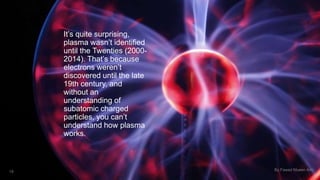
It’s quite surprising, 
plasma wasn’t identified 
until the Twenties (2000- 
2014). That’s because 
electrons weren’t 
discovered until the late 
19th century, and 
without an 
understanding of 
subatomic charged 
particles, you can’t 
understand how plasma 
works. 
18 By Fawad Mueen Arbi
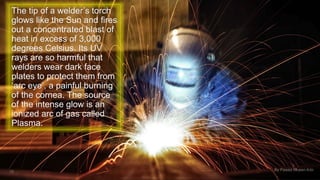
The tip of a welder’s torch 
glows like the Sun and fires 
out a concentrated blast of 
heat in excess of 3,000 
degrees Celsius. Its UV 
rays are so harmful that 
welders wear dark face 
plates to protect them from 
‘arc eye’, a painful burning 
of the cornea. The source 
of the intense glow is an 
ionized arc of gas called 
Plasma. 
19 By Fawad Mueen Arbi
Water can’t be converted into Plasma. It can only exist as 
Solid, Liquid or Gas. For water to become a plasma, the 
individual hydrogen and oxygen atoms would need to be 
broken apart and ionized separately. And if the molecular 
structure is broken apart, then water is no longer water. 
20 By Fawad Mueen Arbi

Plasma

  • 1.
    PLASMA The FourthState of Matter
  • 2.
    States of Matter Starts from next page 2
  • 3.
    States of Matter • Major states of Matter are Solid, Liquid and Gas. Solid is the most abundant state of matter around us (on Earth) • The 4th one is Plasma. It is formed by providing heat to the gas. 3 By Fawad Mueen Arbi
  • 4.
    Other States ofMatter • There are also 5th and 6th states of matter i.e. “Bose-Einstein condensate” and “Fermi-gas”. • There are several other very exotic and unusual forms of matter that we don't encounter in daily life. A Bose-Einstein condensate can only form at temperature near absolute zero, and was first created in a lab in 1995. Degenerate matter can come into being under incredibly high pressure inside white dwarf and neutron stars. There are other very strange, very rare forms of matter as well. 4 By Fawad Mueen Arbi
  • 5.
    Plasma as The4th State of Matter Starts from next page 5
  • 6.
    What is Plasma? • Plasma is considered 4th State of Matter despite solids, liquids and gases. It is one of the fundamental states of matter. Technically, it is an ionized gas consisting of positive ions and free electrons in proportions resulting in more or less no overall electric charge, typically at low pressures (as in the upper atmosphere and in fluorescent lamps) or at very high temperatures (as in stars and nuclear fusion reactors). • Plasma should be called 1st state of matter because it is what all the states arise from. 6 By Fawad Mueen Arbi
  • 7.
    Why is Plasmaconsidered the 4th State of Matter • The characteristics of plasmas are significantly different from those of ordinary neutral gases so that plasmas are considered a distinct "fourth state of matter." For example, because plasmas are made up of electrically charged particles, they are strongly influenced by electric and magnetic fields while neutral gases are not. • It’s behavior doesn’t resemble with any other State of Matter. It is significantly unique. • It is an interesting fact that most of the material in the visible Universe (The whole Universe, as much as 99.9% according to some estimates, is in the Plasma State. 7 By Fawad Mueen Arbi
  • 8.
    Discovery of Plasma • The existence of PLASMA was first discovered by Sir William Crookes in 1879 using an assembly that is today known as a “Crookes tube”, an experimental electrical discharge tube in which air is ionized by the application of a high voltage through a voltage coil. • A Crookes tube is an early experimental electrical discharged tube, with partial vacuum, invented by English physicist William Crookes (on the left side) and others around 1869-1875, in which cathode rays, streams of electrons, were discovered. 8 By Fawad Mueen Arbi
  • 9.
    Crookes Tube (CathodeTube) 9 By Fawad Mueen Arbi
  • 10.
    Formation of Plasma • When more heat is provided to atoms or molecules, they may be ionized. An electron may gain enough energy to escape its atom. After the escape of electron, atoms become ions. In sufficiently heated gas, ionization happens many times, creating clouds of free electrons and ions. • This ionized gas mixture consisting of ions, electrons and neutral atoms is called PLASMA 10 By Fawad Mueen Arbi
  • 11.
    Types of Plasma • There are two major types of Plasma i.e. 1. Natural Plasma Natural Plasma only exist at very high temperature or low temperature vacuum. It do not react rapidly but it is extremely hot (over 20,000 oC). There energy is so high that it vaporizes everything they touch. 2. Artificial Plasma Artificial Plasma can be created by ionization of a gas , as in neon signs. Plasma at low temperature is hard to maintain because outside a vacuum, low temperature plasma reacts rapidly with any molecule it encounters. This aspect makes this material, both very useful and hard to use. 11 By Fawad Mueen Arbi
  • 12.
    Properties of Plasma • Although Plasma includes ions, electrons and neutral atoms, it is macroscopically neutral as a whole because electrons and ions are equally balanced. • A Plasma must have sufficient number of charged particles as a whole, it exhibits a collective response to electrical and magnetic field. The motion of particles in the Plasma generate fields and electric currents from within Plasma Density. • This complex behavior makes Plasma Unique. 12 By Fawad Mueen Arbi
  • 13.
    Applications of Plasma • Neon Signs are also made of Plasma. • The glowing "gas" in a fluorescent bulb is Plasma. • Plasma Globes are also used to make Plasma in Labs • Plasma Televisions
  • 14.
    Applications of Plasma • Plasma drive lasers and particle accelerators. • It’s also used for making semi-conductors. • Plasma lights up our homes, make our computers and electronic equipment
  • 15.
    Interesting Facts aboutPlasma Listed from next page.
  • 16.
    Space is notempty vacuum. It is actually filled with Plasma. That conducts our electromagnetic wave signals. Our Universe is 99.9% Plasma. 16 By Fawad Mueen Arbi
  • 17.
    Even our Sunexists in 99.85% Plasma State. The Sun is 1.5 million kilometer ball of Plasma, heated by Nuclear Fusion. 17 By Fawad Mueen Arbi
  • 18.
    It’s quite surprising, plasma wasn’t identified until the Twenties (2000- 2014). That’s because electrons weren’t discovered until the late 19th century, and without an understanding of subatomic charged particles, you can’t understand how plasma works. 18 By Fawad Mueen Arbi
  • 19.
    The tip ofa welder’s torch glows like the Sun and fires out a concentrated blast of heat in excess of 3,000 degrees Celsius. Its UV rays are so harmful that welders wear dark face plates to protect them from ‘arc eye’, a painful burning of the cornea. The source of the intense glow is an ionized arc of gas called Plasma. 19 By Fawad Mueen Arbi
  • 20.
    Water can’t beconverted into Plasma. It can only exist as Solid, Liquid or Gas. For water to become a plasma, the individual hydrogen and oxygen atoms would need to be broken apart and ionized separately. And if the molecular structure is broken apart, then water is no longer water. 20 By Fawad Mueen Arbi

Editor's Notes

  • #2 Speak it out loud.
  • #4 Solids have definite shape by special arrangement of their atoms.
  • #8 Pay attention to whole universe
  • #17 Space is full Plasma
  • #18 Sun is Pure Plasma
  • #19 2000-2014 Plasma was identified
  • #20 3000 C temp happens at the tip of welder’s torch
  • #21 Water cant exist like that