Presented by
Tahir ejaz (sap≠22162)
Asadullah(sap≠20652)
Awis zafer(sap≠20651)
Muhammad Ansir(sap=21564)
Presented to
Dr faiza anjum
Introduction of plasma
We will discuss about the following points in this
presentation:
1. What is the matter and its types
2. What is a Plasma
3. What’s In It?
4. History of plasma
5. Formation of Plasma
6. Properties of Plasma
7. Form of plasma
8. Where do we find plasmas?
9. Types of plasma
10. Interesting Facts About Plasma
11. Application Of Plasma
12. Research filed of plasma
Outline
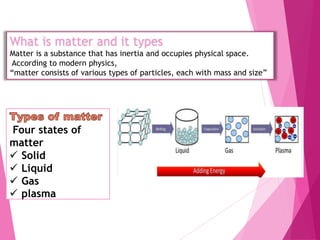
Four states of
matter
 Solid
 Liquid
 Gas
 plasma
What is matter and it types
Matter is a substance that has inertia and occupies physical space.
According to modern physics,
“matter consists of various types of particles, each with mass and size”
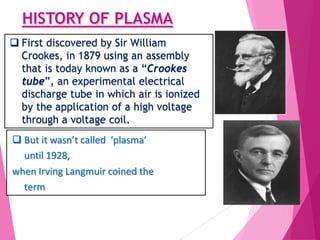
 First discovered by Sir William
Crookes, in 1879 using an assembly
that is today known as a “Crookes
tube”, an experimental electrical
discharge tube in which air is ionized
by the application of a high voltage
through a voltage coil.
 But it wasn’t called ‘plasma’
until 1928,
when Irving Langmuir coined the
term
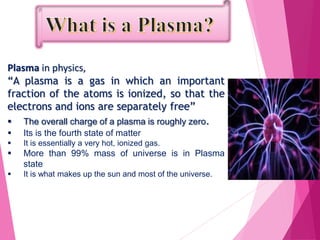
Plasma in physics,
“A plasma is a gas in which an important
fraction of the atoms is ionized, so that the
electrons and ions are separately free”
 The overall charge of a plasma is roughly zero.
 Its is the fourth state of matter
 It is essentially a very hot, ionized gas.
 More than 99% mass of universe is in Plasma
state
 It is what makes up the sun and most of the universe.
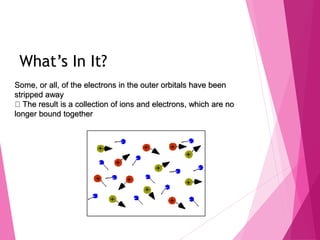
What’s In It?
Some, or all, of the electrons in the outer orbitals have been
stripped away
The result is a collection of ions and electrons, which are no
longer bound together
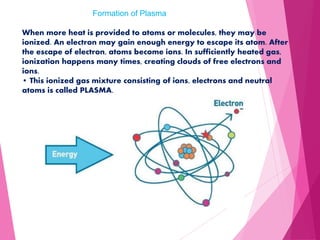
Formation of Plasma
When more heat is provided to atoms or molecules, they may be
ionized. An electron may gain enough energy to escape its atom. After
the escape of electron, atoms become ions. In sufficiently heated gas,
ionization happens many times, creating clouds of free electrons and
ions.
• This ionized gas mixture consisting of ions, electrons and neutral
atoms is called PLASMA.
Natural
plasma
• Natural plasma only exist at very high temperature or low
temperature vacuum.
• It do not react rapidly but it is extremely hot (over 20,000ͦc.
• There energy is so high that it vaporizes everything they touch.
Artificial
plasma
•Artificial plasma can be created by ionization of a gas , as in neon signs.
• Plasma at very low temperature is hard to maintain because outside a
vacuum low temperature plasma reacts rapidly with any molecule it
encounters.
•This aspect makes this material both very useful and hard to use.
Terrestrial
plasma:
• Terrestrial plasma is a plasma layer that
blankets the outer reaches of the earth’s
atmosphere.
Example of natural plasma
 Lightning
 Aurora
 Comet tail
 Solar wind
 Stars (including the Sun)
 Interstellar gas clouds
Artificial plasma examples
♥ Those found in plasma displays and TVs.
♥ Inside fluorescent lamps (low energy lighting), neon
signs.
♥ Rocket exhaust.
♥ The area in front of a spacecraft's heat shield during re-
entry into the atmosphere.
♥ Fusion energy research.
Examples of terrestrial plasma:
¶ Lightning
¶ Ball lightning
¶ St. Elmo's fire
¶ Sprites, elves, jets
¶ The ionosphere
¶ The polar aurorae
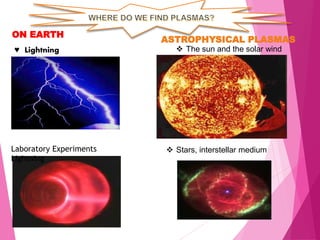
ON EARTH
ASTROPHYSICAL PLASMAS
♥ Lightning
Laboratory Experiments
Lightning
 Stars, interstellar medium
 The sun and the solar wind
Types of plasma
Cold plasma
 Isn’t really cold
Typical electron temperatures for cold plasmas are in the thousands of degrees
Only a small fraction of the gas molecules are ionized (degree of ionization)
 Usually on the order of 1%
 Often created using strong electric fields
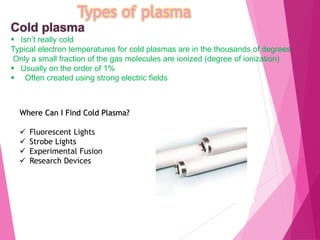
Where Can I Find Cold Plasma?
 Fluorescent Lights
 Strobe Lights
 Experimental Fusion
 Research Devices
Hot Plasma
 Really hot
Like the Sun (15,000,000° C at the core)
 The molecules are nearly if not fully ionized
 Created by heating the molecules to extremely high
temperatures
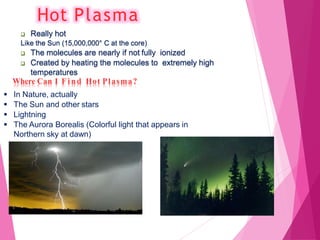
Where Can I F i n d Hot Plasma?
 In Nature, actually
 The Sun and other stars
 Lightning
 The Aurora Borealis (Colorful light that appears in
Northern sky at dawn)
 It is possible to create ultracold plasmas, by using lasers to trap and cool
neutral atoms to temperatures of 1 mK or lower.
 Another laser then ionizes the atoms by giving each of the outermost
electrons just enough energy to escape the electrical attraction of its parent
ion.
 The key point about ultracold plasmas is that by manipulating the atoms
with lasers, the kinetic energy of the liberated electrons can be controlled
 Ultracold plasmas tend to be rather delicate, experiments being carried out
in vacuum
Ultracold
plasma
 Space is not empty vacuum. It is actually filled with Plasma. That
conducts our electromagnetic wave signals.
 Galaxy formation in the Plasma Universe is modeled as two
adjacent interacting Birkland filaments. The simulation produces a
flat rotation Curve Even our Sun exists in 99.85% Plasma State.
The Sun is 1.5 million kilometer ball of Plasma, heated by Nuclear
Fusion
 Solar winds are also the example of plasma
 The tip of a welder’s torch glows like the Sun and fires out a
concentrated blast of heat in excess of 3,000 degrees Celsius. Its
UV rays are so harmful that welders wear dark face plates to protect
them from ‘arc eye’, a painful burning of the cornea. The source of
the intense glow is an ionized arc of gas called Plasma
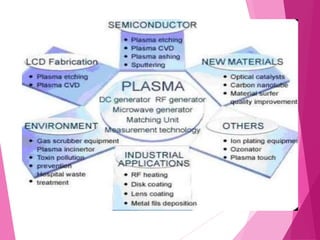
Application Of Plasma
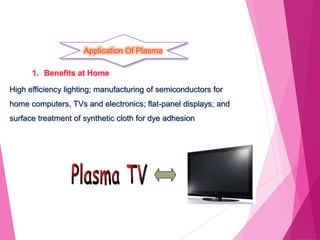
1. Benefits at Home
High efficiency lighting; manufacturing of semiconductors for
home computers, TVs and electronics; flat-panel displays; and
surface treatment of synthetic cloth for dye adhesion
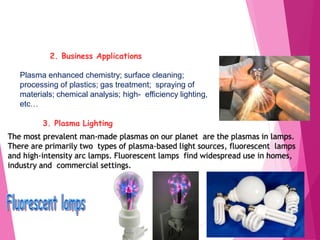
2. Business Applications
Plasma enhanced chemistry; surface cleaning;
processing of plastics; gas treatment; spraying of
materials; chemical analysis; high- efficiency lighting,
etc…
3. Plasma Lighting
The most prevalent man-made plasmas on our planet are the plasmas in lamps.
There are primarily two types of plasma-based light sources, fluorescent lamps
and high-intensity arc lamps. Fluorescent lamps find widespread use in homes,
industry and commercial settings.
Research filed of plasma
 Plasma theory Plasma equilibrium and stability
 Plasma interactions with waves and beams
 Guiding centre
 Plasma cosmology
 Plasma Astronomy
 Industrial plasmas
 Plasmas in nature The Earth's ionosphere
 Plasma sources
 Dusty Plasmas
 Plasma diagnostics
 Fusion power
 Food processing ( Nonthermal plasma)
Thank
you

introduc plasma by Muhammad Ansir

  • 2.
    Presented by Tahir ejaz(sap≠22162) Asadullah(sap≠20652) Awis zafer(sap≠20651) Muhammad Ansir(sap=21564) Presented to Dr faiza anjum Introduction of plasma
  • 3.
    We will discussabout the following points in this presentation: 1. What is the matter and its types 2. What is a Plasma 3. What’s In It? 4. History of plasma 5. Formation of Plasma 6. Properties of Plasma 7. Form of plasma 8. Where do we find plasmas? 9. Types of plasma 10. Interesting Facts About Plasma 11. Application Of Plasma 12. Research filed of plasma Outline
  • 4.
    Four states of matter Solid  Liquid  Gas  plasma What is matter and it types Matter is a substance that has inertia and occupies physical space. According to modern physics, “matter consists of various types of particles, each with mass and size”
  • 5.
     First discoveredby Sir William Crookes, in 1879 using an assembly that is today known as a “Crookes tube”, an experimental electrical discharge tube in which air is ionized by the application of a high voltage through a voltage coil.  But it wasn’t called ‘plasma’ until 1928, when Irving Langmuir coined the term
  • 6.
    Plasma in physics, “Aplasma is a gas in which an important fraction of the atoms is ionized, so that the electrons and ions are separately free”  The overall charge of a plasma is roughly zero.  Its is the fourth state of matter  It is essentially a very hot, ionized gas.  More than 99% mass of universe is in Plasma state  It is what makes up the sun and most of the universe.
  • 7.
    What’s In It? Some,or all, of the electrons in the outer orbitals have been stripped away The result is a collection of ions and electrons, which are no longer bound together
  • 8.
    Formation of Plasma Whenmore heat is provided to atoms or molecules, they may be ionized. An electron may gain enough energy to escape its atom. After the escape of electron, atoms become ions. In sufficiently heated gas, ionization happens many times, creating clouds of free electrons and ions. • This ionized gas mixture consisting of ions, electrons and neutral atoms is called PLASMA.
  • 10.
    Natural plasma • Natural plasmaonly exist at very high temperature or low temperature vacuum. • It do not react rapidly but it is extremely hot (over 20,000ͦc. • There energy is so high that it vaporizes everything they touch. Artificial plasma •Artificial plasma can be created by ionization of a gas , as in neon signs. • Plasma at very low temperature is hard to maintain because outside a vacuum low temperature plasma reacts rapidly with any molecule it encounters. •This aspect makes this material both very useful and hard to use. Terrestrial plasma: • Terrestrial plasma is a plasma layer that blankets the outer reaches of the earth’s atmosphere.
  • 11.
    Example of naturalplasma  Lightning  Aurora  Comet tail  Solar wind  Stars (including the Sun)  Interstellar gas clouds Artificial plasma examples ♥ Those found in plasma displays and TVs. ♥ Inside fluorescent lamps (low energy lighting), neon signs. ♥ Rocket exhaust. ♥ The area in front of a spacecraft's heat shield during re- entry into the atmosphere. ♥ Fusion energy research.
  • 12.
    Examples of terrestrialplasma: ¶ Lightning ¶ Ball lightning ¶ St. Elmo's fire ¶ Sprites, elves, jets ¶ The ionosphere ¶ The polar aurorae
  • 13.
    ON EARTH ASTROPHYSICAL PLASMAS ♥Lightning Laboratory Experiments Lightning  Stars, interstellar medium  The sun and the solar wind
  • 14.
    Types of plasma Coldplasma  Isn’t really cold Typical electron temperatures for cold plasmas are in the thousands of degrees Only a small fraction of the gas molecules are ionized (degree of ionization)  Usually on the order of 1%  Often created using strong electric fields Where Can I Find Cold Plasma?  Fluorescent Lights  Strobe Lights  Experimental Fusion  Research Devices
  • 15.
    Hot Plasma  Reallyhot Like the Sun (15,000,000° C at the core)  The molecules are nearly if not fully ionized  Created by heating the molecules to extremely high temperatures Where Can I F i n d Hot Plasma?  In Nature, actually  The Sun and other stars  Lightning  The Aurora Borealis (Colorful light that appears in Northern sky at dawn)
  • 16.
     It ispossible to create ultracold plasmas, by using lasers to trap and cool neutral atoms to temperatures of 1 mK or lower.  Another laser then ionizes the atoms by giving each of the outermost electrons just enough energy to escape the electrical attraction of its parent ion.  The key point about ultracold plasmas is that by manipulating the atoms with lasers, the kinetic energy of the liberated electrons can be controlled  Ultracold plasmas tend to be rather delicate, experiments being carried out in vacuum Ultracold plasma
  • 17.
     Space isnot empty vacuum. It is actually filled with Plasma. That conducts our electromagnetic wave signals.  Galaxy formation in the Plasma Universe is modeled as two adjacent interacting Birkland filaments. The simulation produces a flat rotation Curve Even our Sun exists in 99.85% Plasma State. The Sun is 1.5 million kilometer ball of Plasma, heated by Nuclear Fusion  Solar winds are also the example of plasma  The tip of a welder’s torch glows like the Sun and fires out a concentrated blast of heat in excess of 3,000 degrees Celsius. Its UV rays are so harmful that welders wear dark face plates to protect them from ‘arc eye’, a painful burning of the cornea. The source of the intense glow is an ionized arc of gas called Plasma
  • 18.
    Application Of Plasma 1.Benefits at Home High efficiency lighting; manufacturing of semiconductors for home computers, TVs and electronics; flat-panel displays; and surface treatment of synthetic cloth for dye adhesion
  • 19.
    2. Business Applications Plasmaenhanced chemistry; surface cleaning; processing of plastics; gas treatment; spraying of materials; chemical analysis; high- efficiency lighting, etc… 3. Plasma Lighting The most prevalent man-made plasmas on our planet are the plasmas in lamps. There are primarily two types of plasma-based light sources, fluorescent lamps and high-intensity arc lamps. Fluorescent lamps find widespread use in homes, industry and commercial settings.
  • 21.
    Research filed ofplasma  Plasma theory Plasma equilibrium and stability  Plasma interactions with waves and beams  Guiding centre  Plasma cosmology  Plasma Astronomy  Industrial plasmas  Plasmas in nature The Earth's ionosphere  Plasma sources  Dusty Plasmas  Plasma diagnostics  Fusion power  Food processing ( Nonthermal plasma)
  • 22.