Plasma, the 4 th  state of matter Done by : Jeremy Teo (14) 1O2
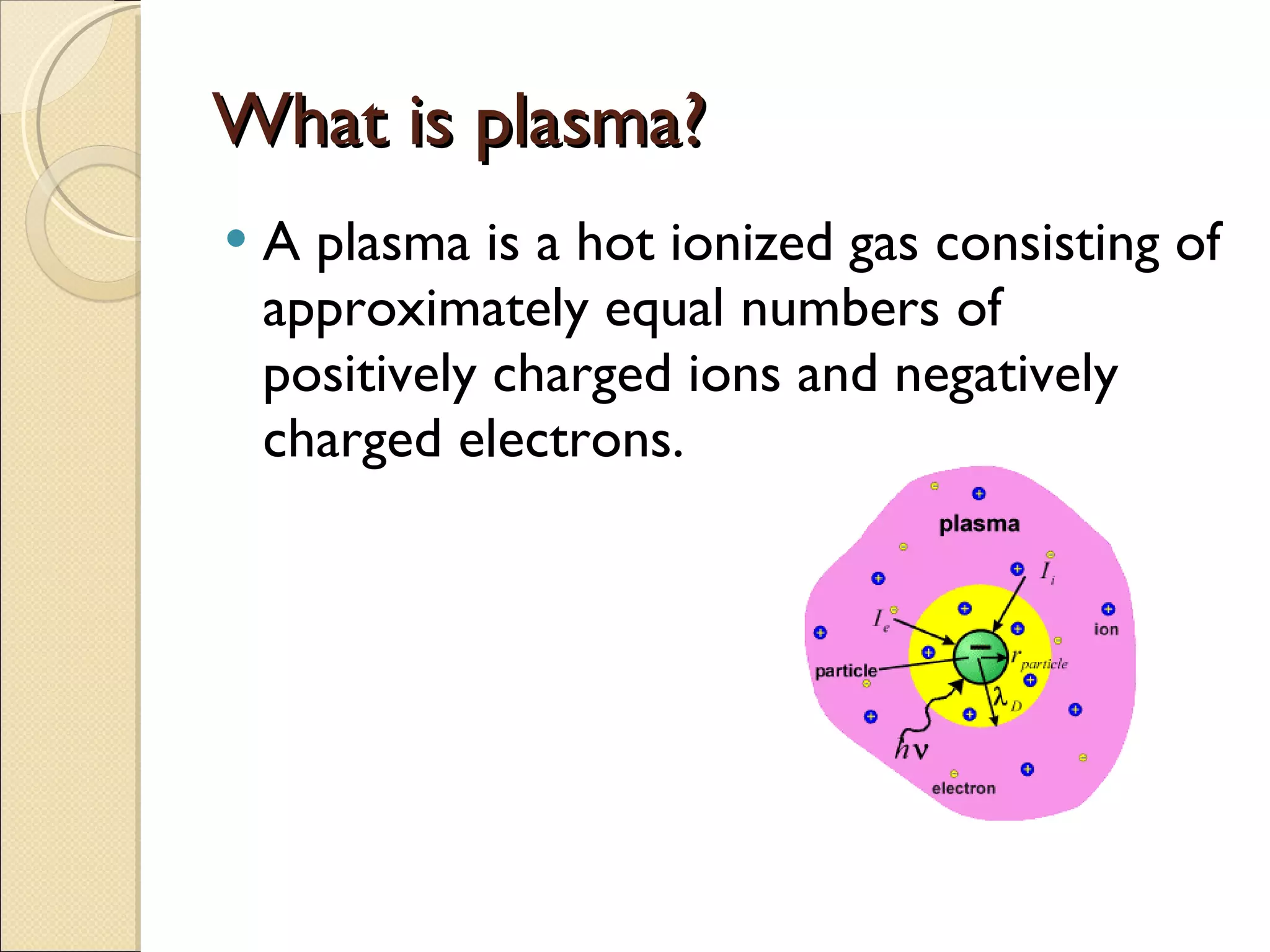
What is plasma? A plasma is a hot ionized gas consisting of approximately equal numbers of positively charged ions and negatively charged electrons.
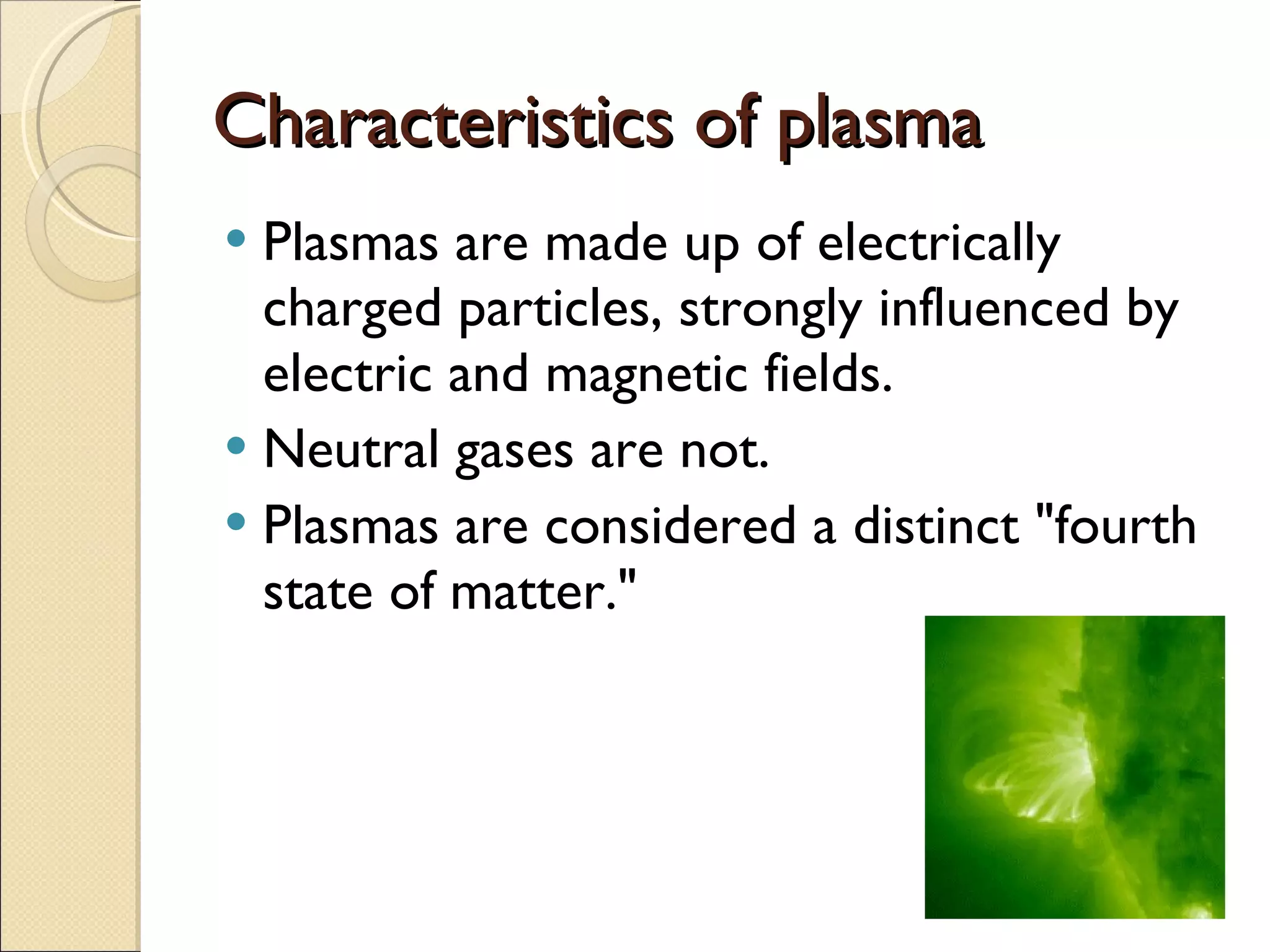
Characteristics of plasma Plasmas are made up of electrically charged particles, strongly influenced by electric and magnetic fields.  Neutral gases are not. Plasmas are considered a distinct "fourth state of matter."
Plasma and geomagnetic fields Plasma is influenced Externally - by the Earth's magnetic field or the interplanetary magnetic field and  Internally – by the localized charge concentrations and electric currents that result from the differential motion of the ions and electrons.
The forces affect the particles within the plasma. It gives the particles' behaviour a coherent, collective quality that neutral gases do not display.
The plasma universe About 99% of the matter in the observable universe is in the plasma state, In our solar system, the Sun, the interplanetary medium, the magnetospheres and ionospheres of the Earth and other planets, as well as the ionospheres of comets and certain planetary moons all consist of plasmas.
Space plasmas The plasmas of interest to space physicists are extremely tenuous, with densities dramatically lower than those achieved in laboratory vacuums.  The temperatures of space plasmas are very high, ranging from several thousand degrees Celsius in the plasma sphere to several million degrees in the ring current.
While the temperatures of the "cooler" plasmas of the ionosphere and plasma sphere are typically given in degrees Kelvin, those of the "hotter" magnetospheric plasmas are more commonly expressed in terms of the average kinetic energies of their constituent particles measured in "electron volts."
An electron volt (eV) is the energy that an electron acquires as it is accelerated through a potential difference of one volt and is equivalent to 11,600 degrees Kelvin. Magnetospheric plasmas are often characterized as being "cold" or "hot." Although these labels are quite subjective, they are widely used in the space physics literature.
As a rule of thumb, plasmas with temperatures less than about 100 eV are "cold," while those with temperatures ranging from 100 eV to 30 keV can be considered "hot." (Particles with higher energies--such as those that populate the radiation belt--are termed "energetic.")
Examples of artificially produced plasmas  Those found in plasma displays, including TVs Inside fluorescent lamps (low energy lighting), neon signs Rocket exhaust and ion thrusters The area in front of a spacecraft's heat shield during re-entry into the atmosphere Inside a corona discharge ozone generator
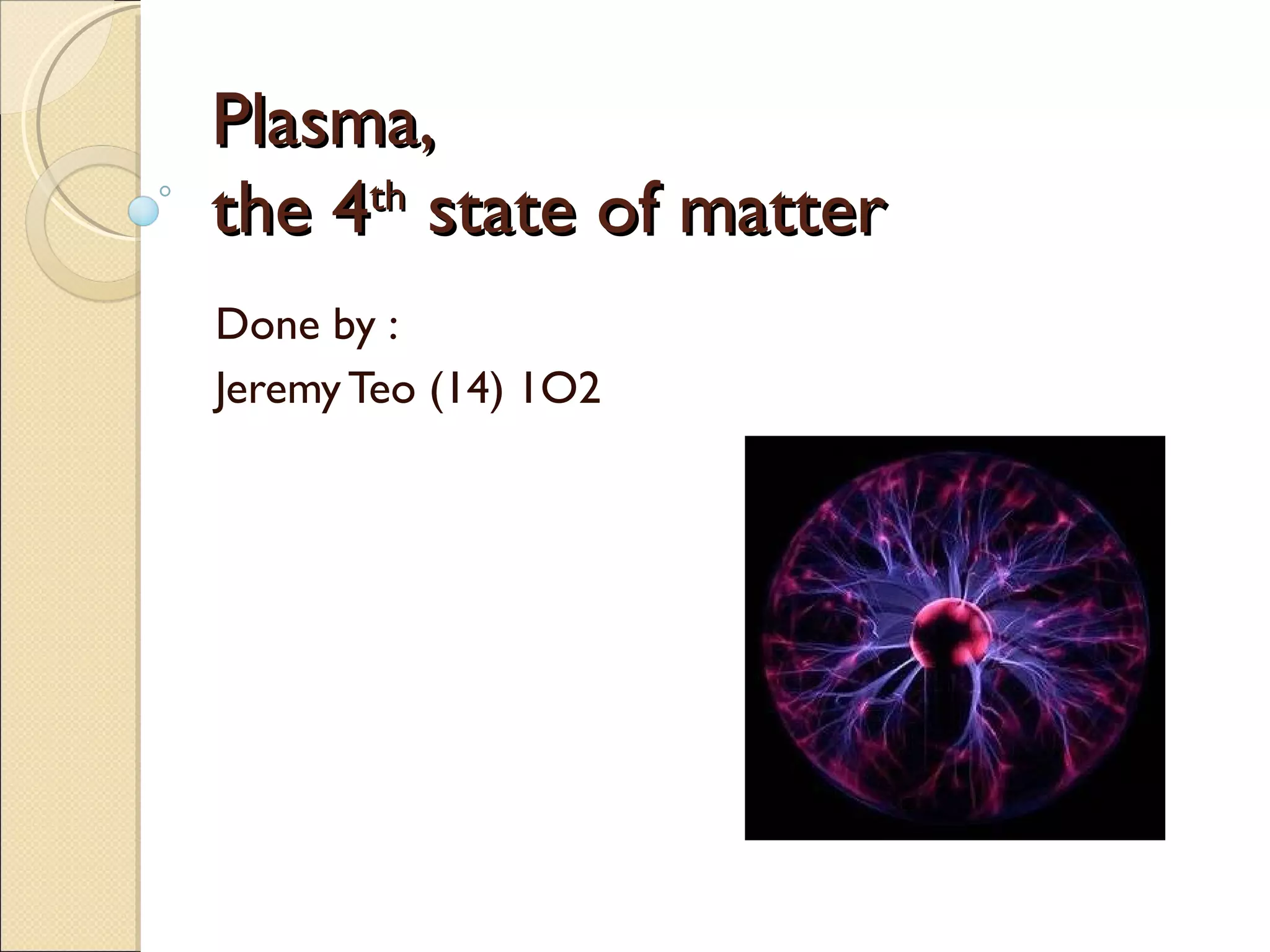
Plasma ball or plasma globe Arcs produced by Tesla coils (resonant air core transformer or disruptor coil that produces arcs similar to lightning but with alternating current rather than static electricity) Plasmas used in semiconductor device fabrication including reactive-ion etching, sputtering, surface cleaning and plasma-enhanced chemical vapor deposition Laser-produced plasmas (LPP), found when high power lasers interact with materials.
Fusion energy research The electric arc in an arc lamp, an arc welder or plasma torch Inductively coupled plasmas (ICP), formed typically in argon gas for optical emission spectroscopy or mass spectrometry Magnetically induced plasmas (MIP), typically produced using microwaves as a resonant coupling method
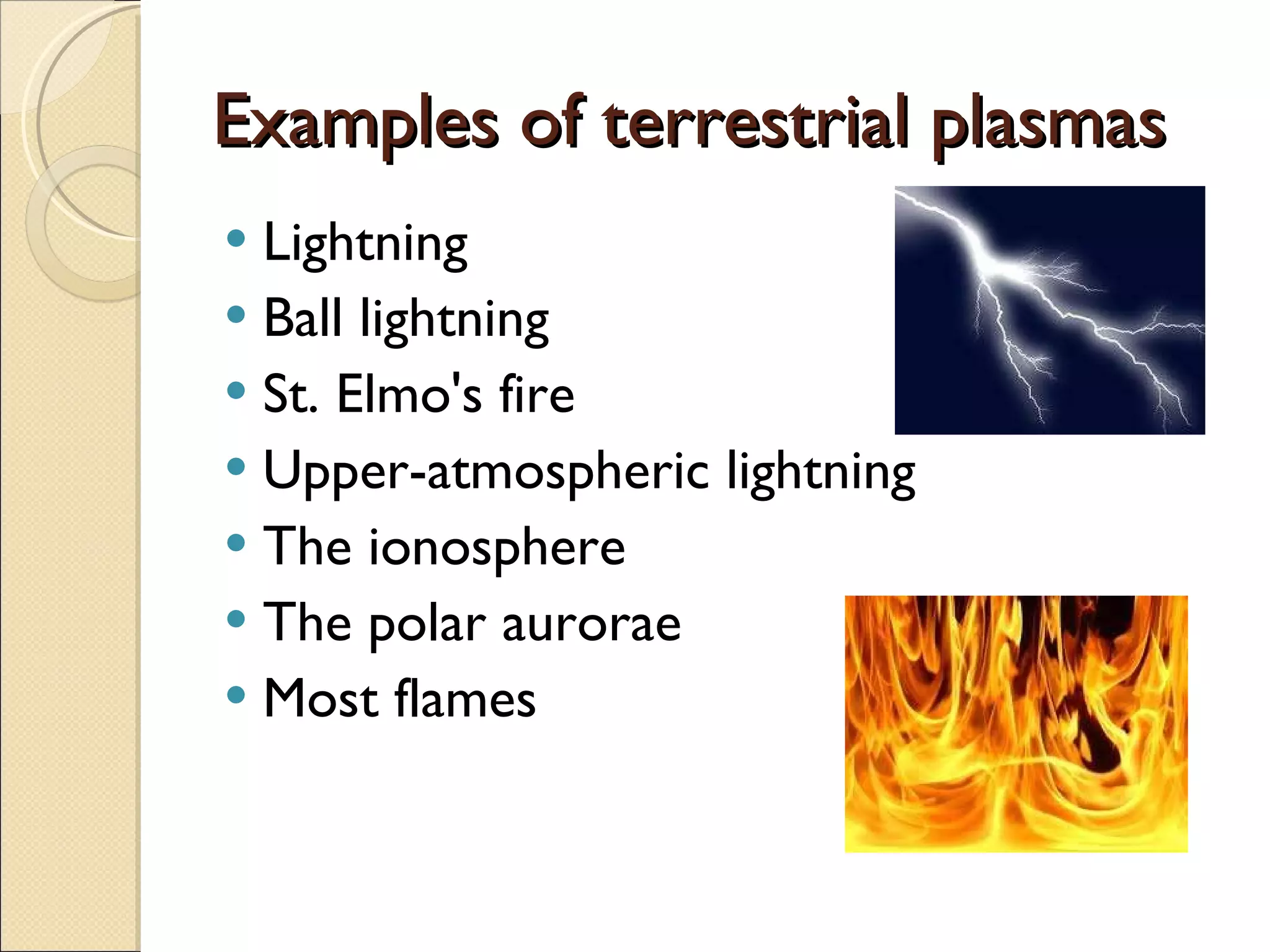
Examples of terrestrial plasmas  Lightning Ball lightning St. Elmo's fire Upper-atmospheric lightning The ionosphere The polar aurorae Most flames
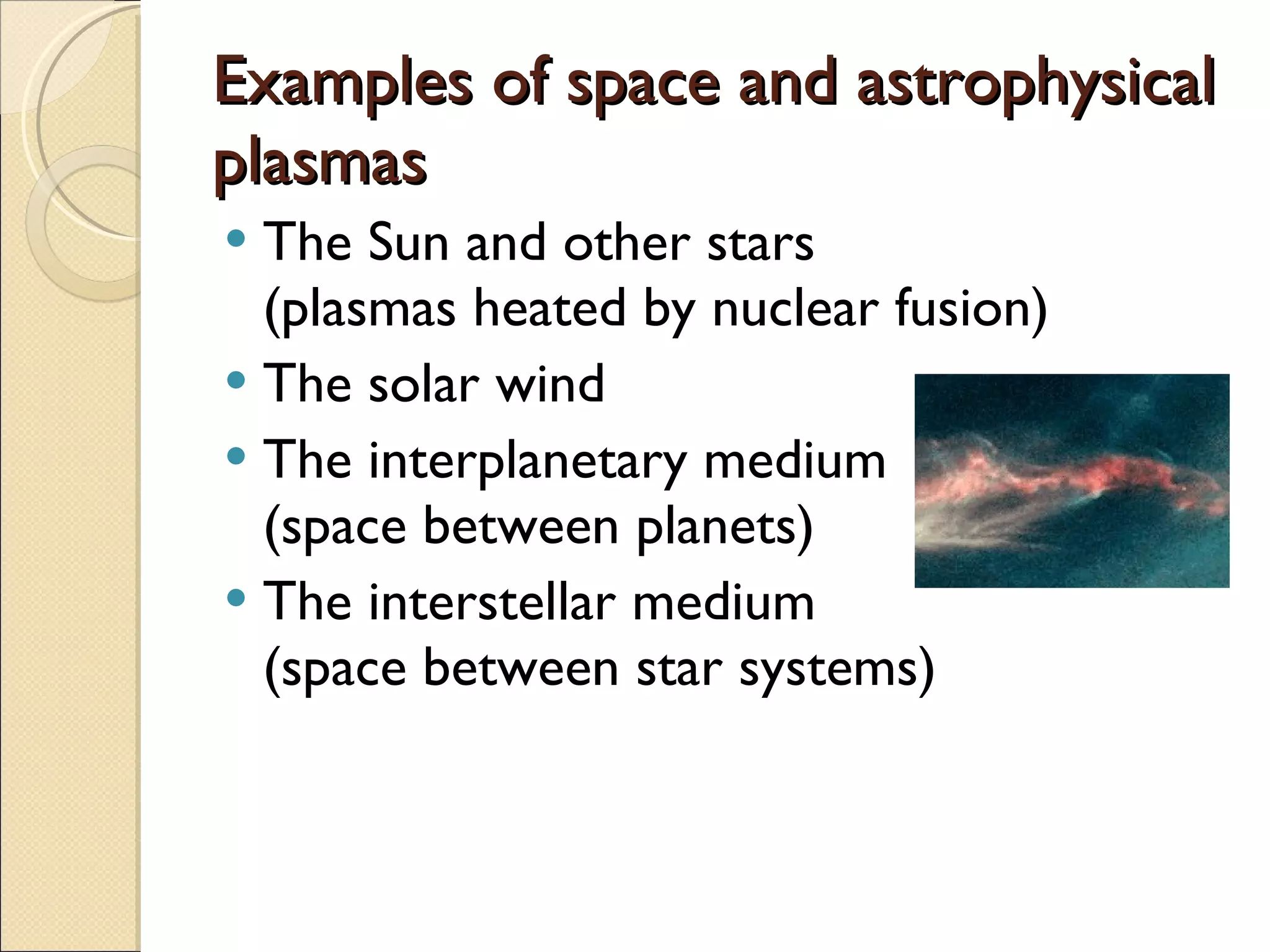
Examples of space and astrophysical plasmas The Sun and other stars (plasmas heated by nuclear fusion) The solar wind The interplanetary medium (space between planets) The interstellar medium (space between star systems)
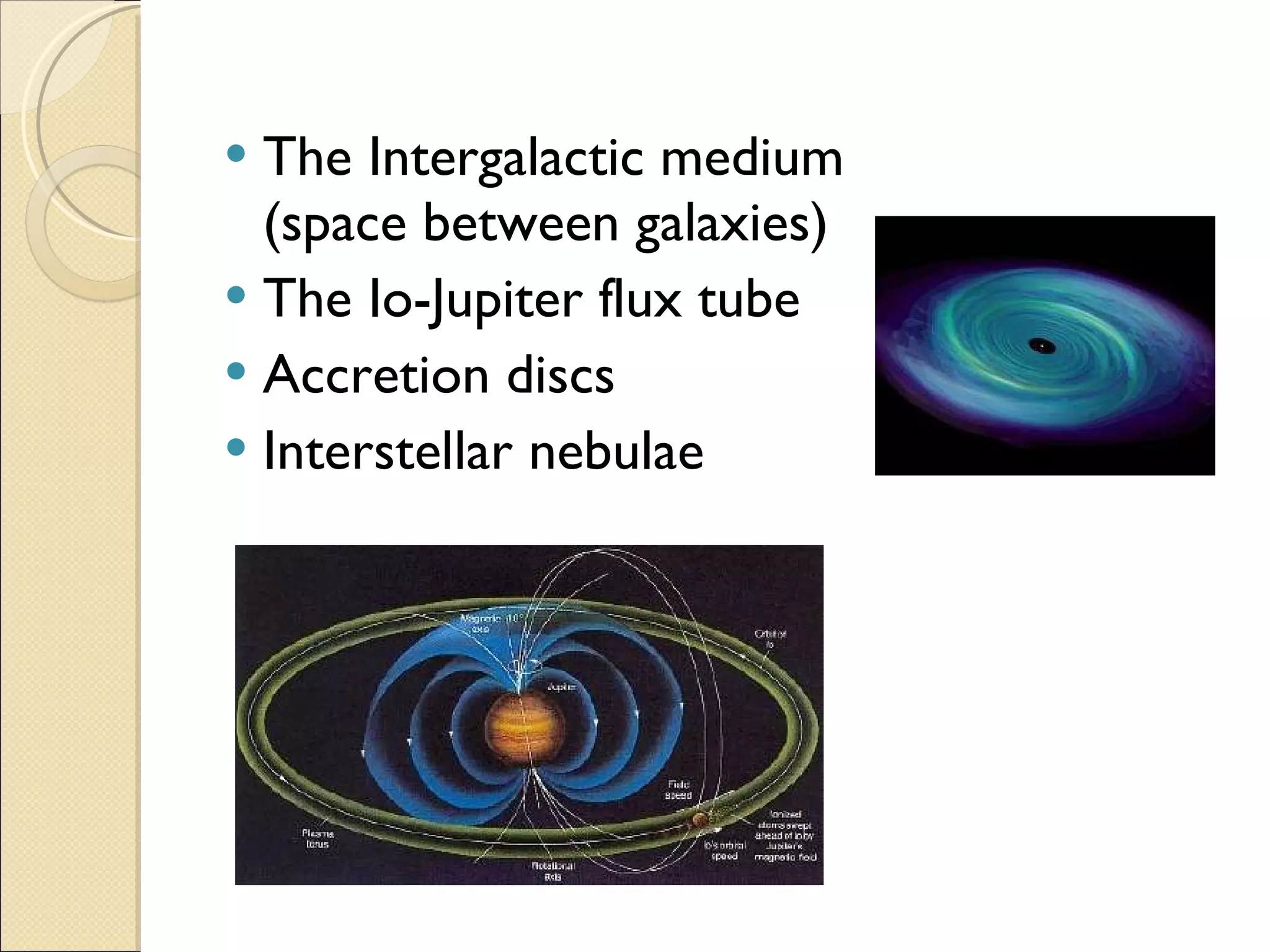
The Intergalactic medium (space between galaxies) The Io-Jupiter flux tube Accretion discs Interstellar nebulae
References http://pluto.space.swri.edu/IMAGE/glossary/plasma.html http://www.google.com.sg/ http://www.google.com.sg/imghp?hl=en&tab=wi http://en.wikipedia.org/wiki/Plasma_(physics)
Thank you for all your attention!

The 4th state of matter -Plasma

  • 1.
    Plasma, the 4th state of matter Done by : Jeremy Teo (14) 1O2
  • 2.
    What is plasma?A plasma is a hot ionized gas consisting of approximately equal numbers of positively charged ions and negatively charged electrons.
  • 3.
    Characteristics of plasmaPlasmas are made up of electrically charged particles, strongly influenced by electric and magnetic fields. Neutral gases are not. Plasmas are considered a distinct "fourth state of matter."
  • 4.
    Plasma and geomagneticfields Plasma is influenced Externally - by the Earth's magnetic field or the interplanetary magnetic field and Internally – by the localized charge concentrations and electric currents that result from the differential motion of the ions and electrons.
  • 5.
    The forces affectthe particles within the plasma. It gives the particles' behaviour a coherent, collective quality that neutral gases do not display.
  • 6.
    The plasma universeAbout 99% of the matter in the observable universe is in the plasma state, In our solar system, the Sun, the interplanetary medium, the magnetospheres and ionospheres of the Earth and other planets, as well as the ionospheres of comets and certain planetary moons all consist of plasmas.
  • 7.
    Space plasmas Theplasmas of interest to space physicists are extremely tenuous, with densities dramatically lower than those achieved in laboratory vacuums. The temperatures of space plasmas are very high, ranging from several thousand degrees Celsius in the plasma sphere to several million degrees in the ring current.
  • 8.
    While the temperaturesof the "cooler" plasmas of the ionosphere and plasma sphere are typically given in degrees Kelvin, those of the "hotter" magnetospheric plasmas are more commonly expressed in terms of the average kinetic energies of their constituent particles measured in "electron volts."
  • 9.
    An electron volt(eV) is the energy that an electron acquires as it is accelerated through a potential difference of one volt and is equivalent to 11,600 degrees Kelvin. Magnetospheric plasmas are often characterized as being "cold" or "hot." Although these labels are quite subjective, they are widely used in the space physics literature.
  • 10.
    As a ruleof thumb, plasmas with temperatures less than about 100 eV are "cold," while those with temperatures ranging from 100 eV to 30 keV can be considered "hot." (Particles with higher energies--such as those that populate the radiation belt--are termed "energetic.")
  • 11.
    Examples of artificiallyproduced plasmas Those found in plasma displays, including TVs Inside fluorescent lamps (low energy lighting), neon signs Rocket exhaust and ion thrusters The area in front of a spacecraft's heat shield during re-entry into the atmosphere Inside a corona discharge ozone generator
  • 12.
    Plasma ball orplasma globe Arcs produced by Tesla coils (resonant air core transformer or disruptor coil that produces arcs similar to lightning but with alternating current rather than static electricity) Plasmas used in semiconductor device fabrication including reactive-ion etching, sputtering, surface cleaning and plasma-enhanced chemical vapor deposition Laser-produced plasmas (LPP), found when high power lasers interact with materials.
  • 13.
    Fusion energy research The electricarc in an arc lamp, an arc welder or plasma torch Inductively coupled plasmas (ICP), formed typically in argon gas for optical emission spectroscopy or mass spectrometry Magnetically induced plasmas (MIP), typically produced using microwaves as a resonant coupling method
  • 14.
    Examples of terrestrialplasmas Lightning Ball lightning St. Elmo's fire Upper-atmospheric lightning The ionosphere The polar aurorae Most flames
  • 15.
    Examples of spaceand astrophysical plasmas The Sun and other stars (plasmas heated by nuclear fusion) The solar wind The interplanetary medium (space between planets) The interstellar medium (space between star systems)
  • 16.
    The Intergalactic medium (spacebetween galaxies) The Io-Jupiter flux tube Accretion discs Interstellar nebulae
  • 17.
    References http://pluto.space.swri.edu/IMAGE/glossary/plasma.html http://www.google.com.sg/http://www.google.com.sg/imghp?hl=en&tab=wi http://en.wikipedia.org/wiki/Plasma_(physics)
  • 18.
    Thank you forall your attention!