FREE SPACE OPTICAL
LINK DESIGN
-Falak Shah & Kavish Shah
Guided By Prof. Dhaval Shah
Contents
1. What is FSO ?
2. FSO v/s Fiber, RF & DSL lines
3. Advantage, Limitation, Application of FSO
4. Transmitter
5. Receiver
6. Transceiver Implementation
2
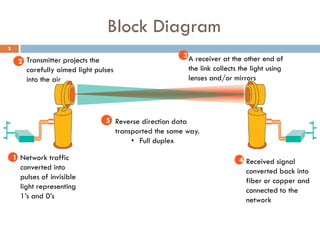
Block Diagram
1 Network traffic
converted into
pulses of invisible
light representing
1’s and 0’s
2 Transmitter projects the
carefully aimed light pulses
into the air
5 Reverse direction data
transported the same way.
• Full duplex
3A receiver at the other end of
the link collects the light using
lenses and/or mirrors
4 Received signal
converted back into
fiber or copper and
connected to the
network
3
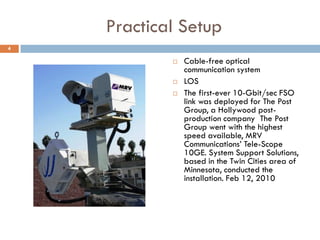
Practical Setup
 Cable-free optical
communication system
 LOS
 The first-ever 10-Gbit/sec FSO
link was deployed for The Post
Group, a Hollywood post-
production company The Post
Group went with the highest
speed available, MRV
Communications’ Tele-Scope
10GE. System Support Solutions,
based in the Twin Cities area of
Minnesota, conducted the
installation. Feb 12, 2010
4
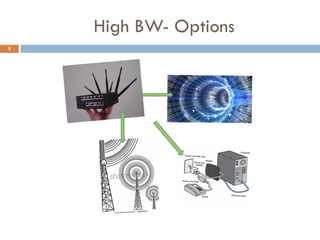
High BW- Options
5
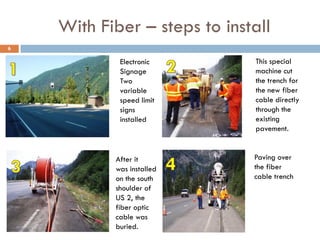
With Fiber – steps to install
Electronic
Signage
Two
variable
speed limit
signs
installed
This special
machine cut
the trench for
the new fiber
cable directly
through the
existing
pavement.
After it
was installed
on the south
shoulder of
US 2, the
fiber optic
cable was
buried.
Paving over
the fiber
cable trench
6
Fiber is …
But Sunk Cost as they cost US $100000-
$200000/km in metropolitan areas, with
85 percent of the total figure tied to
trenching and installation.[1]
7
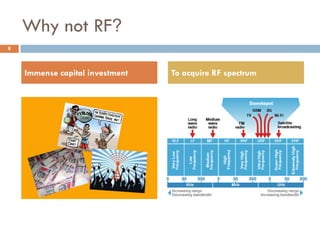
Why not RF?
Immense capital investment To acquire RF spectrum
8
BW- Endangered
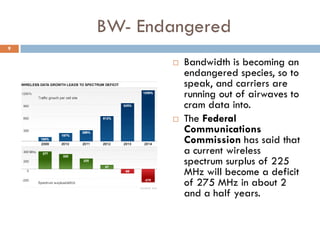
 Bandwidth is becoming an
endangered species, so to
speak, and carriers are
running out of airwaves to
cram data into.
 The Federal
Communications
Commission has said that
a current wireless
spectrum surplus of 225
MHz will become a deficit
of 275 MHz in about 2
and a half years.
9
With DSL Lines
10
With DSL Lines
11
With DSL Lines
12
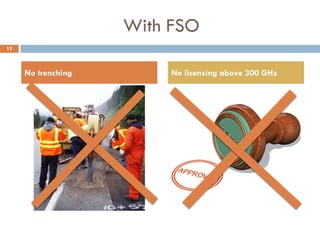
With FSO
No trenching No licensing above 300 GHz
13
Advantages
Higher bandwidth
Low Cost-These free-space systems require less
than a fifth the capital outlay of comparable
ground-based fiber-optic technologies[2]
14
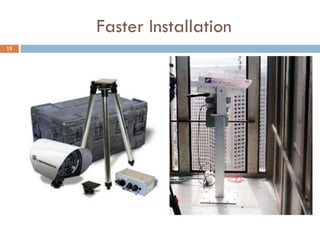
Faster Installation
15
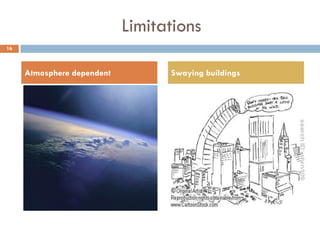
Limitations
Atmosphere dependent Swaying buildings
16
Limitations
Eye safety Small range
17
Applications
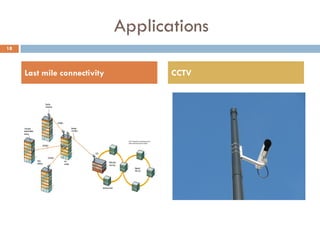
Last mile connectivity CCTV
18
Applications
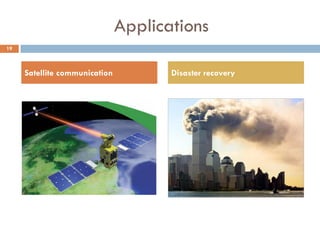
Satellite communication Disaster recovery
19
TRANSMITTER20
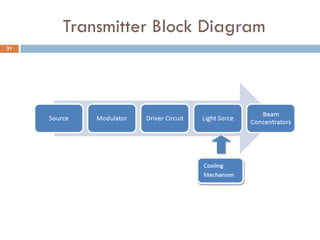
Transmitter Block Diagram
21
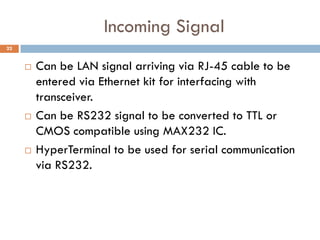
Incoming Signal
 Can be LAN signal arriving via RJ-45 cable to be
entered via Ethernet kit for interfacing with
transceiver.
 Can be RS232 signal to be converted to TTL or
CMOS compatible using MAX232 IC.
 HyperTerminal to be used for serial communication
via RS232.
22
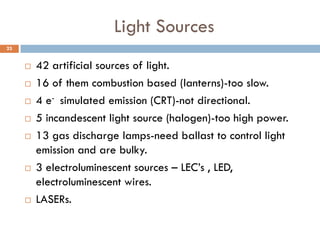
Light Sources
 42 artificial sources of light.
 16 of them combustion based (lanterns)-too slow.
 4 e- simulated emission (CRT)-not directional.
 5 incandescent light source (halogen)-too high power.
 13 gas discharge lamps-need ballast to control light
emission and are bulky.
 3 electroluminescent sources – LEC’s , LED,
electroluminescent wires.
 LASERs.
23
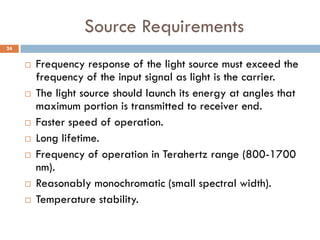
Source Requirements
 Frequency response of the light source must exceed the
frequency of the input signal as light is the carrier.
 The light source should launch its energy at angles that
maximum portion is transmitted to receiver end.
 Faster speed of operation.
 Long lifetime.
 Frequency of operation in Terahertz range (800-1700
nm).
 Reasonably monochromatic (small spectral width).
 Temperature stability.
24
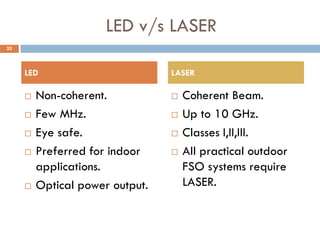
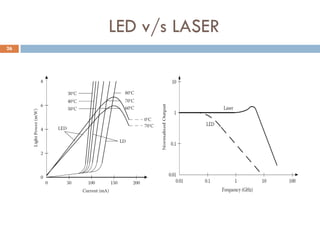
LED v/s LASER
 Non-coherent.
 Few MHz.
 Eye safe.
 Preferred for indoor
applications.
 Optical power output.
 Coherent Beam.
 Up to 10 GHz.
 Classes I,II,III.
 All practical outdoor
FSO systems require
LASER.
LED LASER
25
LED v/s LASER
26
Types of LASERs
 Diode laser.
 Helium-Neon laser.
 Argon/Krypton ion laser.
 Carbon Dioxide laser.
 Helium-Cadmium (HeCd) laser.
 We use LASER diode as it is small in size, easy to
handle, cost effective, electrically run and easily
available as it is used in fiber optics.
27
Classes of LASERs
 Class 1: Inherently Safe.
 Class 2: Safe as aversion of eye prevents damage.
 Class 3: Unsafe even when reflected.
 We use red laser as near infrared (780 nm) and higher
wavelength up to 1550 nm has lower attenuation.
 Class II lasers with power up to 5mW as per range
requirement are used.
 When using LED, IR LED is used due to lower
attenuation.
28
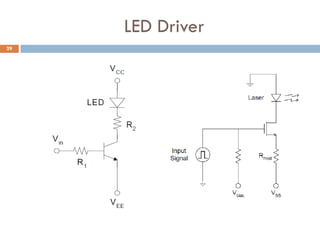
LED Driver
29
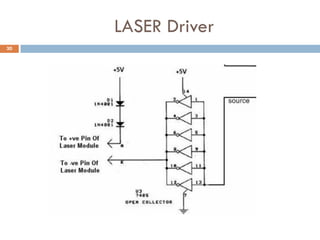
LASER Driver
30
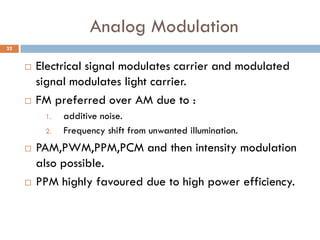
Analog Modulation
 Electrical signal modulates carrier and modulated
signal modulates light carrier.
 FM preferred over AM due to :
1. additive noise.
2. Frequency shift from unwanted illumination.
 PAM,PWM,PPM,PCM and then intensity modulation
also possible.
 PPM highly favoured due to high power efficiency.
32
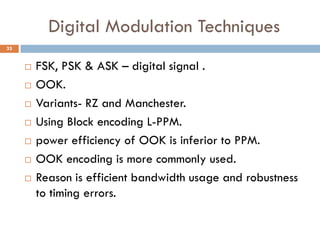
Digital Modulation Techniques
 FSK, PSK & ASK – digital signal .
 OOK.
 Variants- RZ and Manchester.
 Using Block encoding L-PPM.
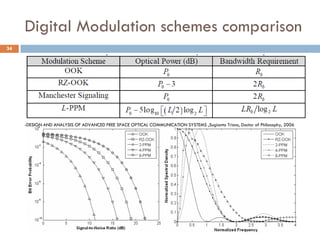
 power efficiency of OOK is inferior to PPM.
 OOK encoding is more commonly used.
 Reason is efficient bandwidth usage and robustness
to timing errors.
33
Digital Modulation schemes comparison
-DESIGN AND ANALYSIS OF ADVANCED FREE SPACE OPTICAL COMMUNICATION SYSTEMS ,Sugianto Trisno, Doctor of Philosophy, 2006
34
Receiver35
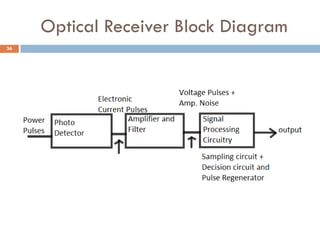
Optical Receiver Block Diagram
36
Photo detector - requirements
 High responsivity.
 Low internal noise.
 Sufficient bandwidth.
 Insensitivity to external conditions.
 Linearity.
 Cost effective, reliability, high stability, small size.
37
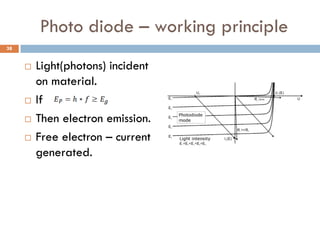
Photo diode – working principle
 Light(photons) incident
on material.
 If
 Then electron emission.
 Free electron – current
generated.
38
39
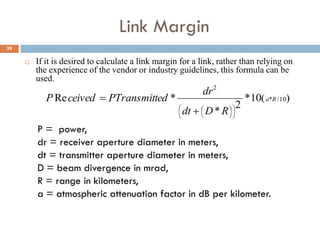
Link Margin
 If it is desired to calculate a link margin for a link, rather than relying on
the experience of the vendor or industry guidelines, this formula can be
used.
P = power,
dr = receiver aperture diameter in meters,
dt = transmitter aperture diameter in meters,
D = beam divergence in mrad,
R = range in kilometers,
a = atmospheric attenuation factor in dB per kilometer.
 10/*
2
10*
2
*
*Re Ra
RDdt
dr
edPTransmittceivedP













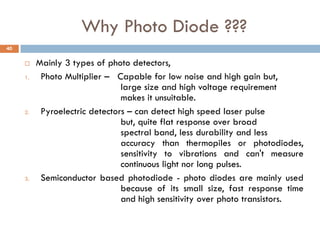
Why Photo Diode ???
 Mainly 3 types of photo detectors,
1. Photo Multiplier – Capable for low noise and high gain but,
large size and high voltage requirement
makes it unsuitable.
2. Pyroelectric detectors – can detect high speed laser pulse
but, quite flat response over broad
spectral band, less durability and less
accuracy than thermopiles or photodiodes,
sensitivity to vibrations and can't measure
continuous light nor long pulses.
3. Semiconductor based photodiode - photo diodes are mainly used
because of its small size, fast response time
and high sensitivity over photo transistors.
40
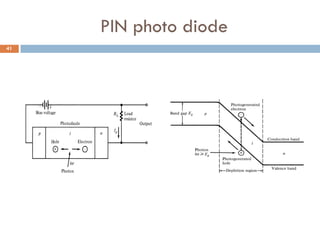
PIN photo diode
41
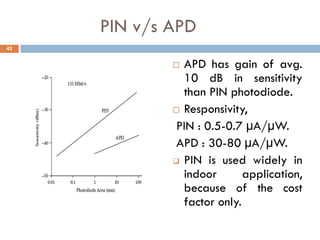
PIN v/s APD
 APD has gain of avg.
10 dB in sensitivity
than PIN photodiode.
 Responsivity,
PIN : 0.5-0.7 µA/µW.
APD : 30-80 µA/µW.
 PIN is used widely in
indoor application,
because of the cost
factor only.
42
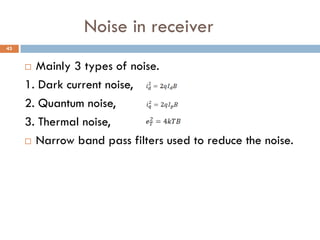
Noise in receiver
 Mainly 3 types of noise.
1. Dark current noise,
2. Quantum noise,
3. Thermal noise,
 Narrow band pass filters used to reduce the noise.
43
Pre - amplifier
 3 types of pre-amplifiers,
1. Low-impedance amplifier.
2. High- impedance amplifier.
3. Trans- impedance amplifier.
 3 parameters to choose particular amplifier –
noise, bandwidth and sensitivity.
 Load resistance play an important role.
44
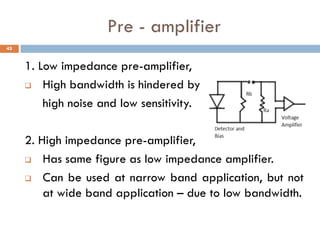
Pre - amplifier
1. Low impedance pre-amplifier,
 High bandwidth is hindered by
high noise and low sensitivity.
2. High impedance pre-amplifier,
 Has same figure as low impedance amplifier.
 Can be used at narrow band application, but not
at wide band application – due to low bandwidth.
45
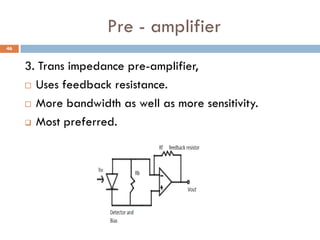
Pre - amplifier
3. Trans impedance pre-amplifier,
 Uses feedback resistance.
 More bandwidth as well as more sensitivity.
 Most preferred.
46
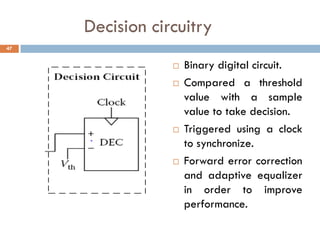
Decision circuitry
 Binary digital circuit.
 Compared a threshold
value with a sample
value to take decision.
 Triggered using a clock
to synchronize.
 Forward error correction
and adaptive equalizer
in order to improve
performance.
47
Transceiver Design48
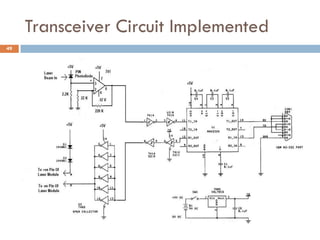
Transceiver Circuit Implemented
49
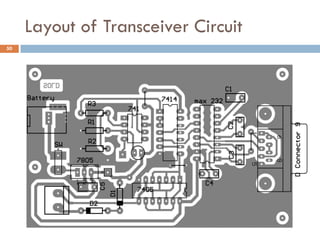
Layout of Transceiver Circuit
50
Transceiver Design Specifications
 IC used –
• max232 – Driver of RS232(serial port).
- Uses dual charge pump voltage converter.
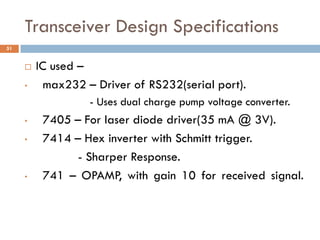
• 7405 – For laser diode driver(35 mA @ 3V).
• 7414 – Hex inverter with Schmitt trigger.
- Sharper Response.
• 741 – OPAMP, with gain 10 for received signal.
51
Transceiver Design Specifications
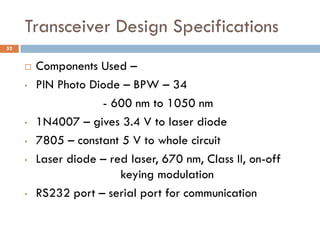
 Components Used –
• PIN Photo Diode – BPW – 34
- 600 nm to 1050 nm
• 1N4007 – gives 3.4 V to laser diode
• 7805 – constant 5 V to whole circuit
• Laser diode – red laser, 670 nm, Class II, on-off
keying modulation
• RS232 port – serial port for communication
52
Working Process
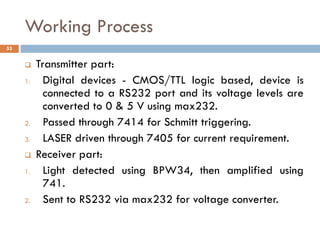
 Transmitter part:
1. Digital devices - CMOS/TTL logic based, device is
connected to a RS232 port and its voltage levels are
converted to 0 & 5 V using max232.
2. Passed through 7414 for Schmitt triggering.
3. LASER driven through 7405 for current requirement.
 Receiver part:
1. Light detected using BPW34, then amplified using
741.
2. Sent to RS232 via max232 for voltage converter.
53
Channel Model54
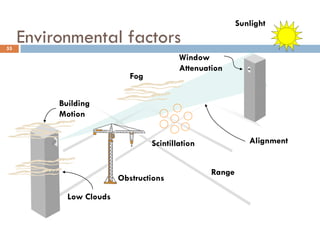
Environmental factors
Sunlight
Building
Motion
Alignment
Window
Attenuation
Fog
Scintillation
Range
Obstructions
Low Clouds
55
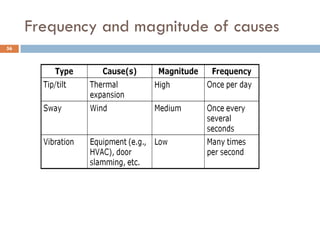
Frequency and magnitude of causes
56
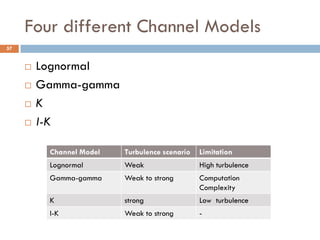
Four different Channel Models
57
 Lognormal
 Gamma-gamma
 K
 I-K
Channel Model Turbulence scenario Limitation
Lognormal Weak High turbulence
Gamma-gamma Weak to strong Computation
Complexity
K strong Low turbulence
I-K Weak to strong -
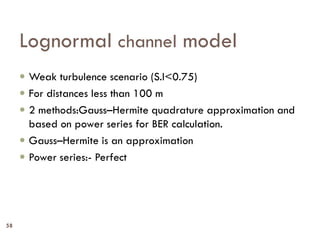
Lognormal channel model
 Weak turbulence scenario (S.I<0.75)
 For distances less than 100 m
 2 methods:Gauss–Hermite quadrature approximation and
based on power series for BER calculation.
 Gauss–Hermite is an approximation
 Power series:- Perfect
58
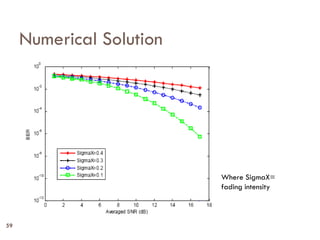
Numerical Solution
59
Where SigmaX=
fading intensity
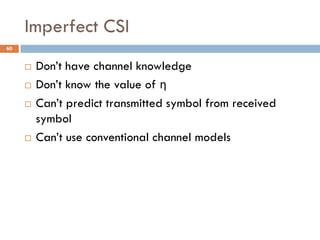
Imperfect CSI
 Don’t have channel knowledge
 Don’t know the value of η
 Can’t predict transmitted symbol from received
symbol
 Can’t use conventional channel models
60
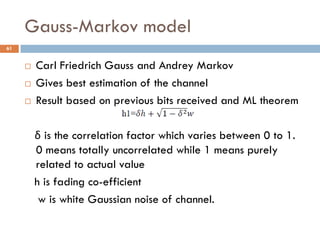
Gauss-Markov model
 Carl Friedrich Gauss and Andrey Markov
 Gives best estimation of the channel
 Result based on previous bits received and ML theorem
δ is the correlation factor which varies between 0 to 1.
0 means totally uncorrelated while 1 means purely
related to actual value
h is fading co-efficient
w is white Gaussian noise of channel.
61
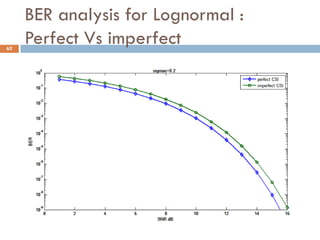
BER analysis for Lognormal :
Perfect Vs imperfect62
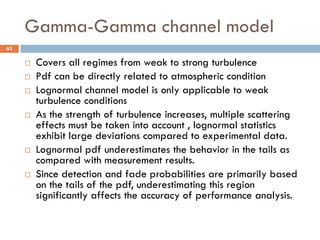
Gamma-Gamma channel model
63
 Covers all regimes from weak to strong turbulence
 Pdf can be directly related to atmospheric condition
 Lognormal channel model is only applicable to weak
turbulence conditions
 As the strength of turbulence increases, multiple scattering
effects must be taken into account , lognormal statistics
exhibit large deviations compared to experimental data.
 Lognormal pdf underestimates the behavior in the tails as
compared with measurement results.
 Since detection and fade probabilities are primarily based
on the tails of the pdf, underestimating this region
significantly affects the accuracy of performance analysis.
Future Work
64
 Test the hardware for datarate and functioning in
different environmental conditions.
 Place a proposal for FSO link between blocks of
the institute.
 Study IEEE papers and present paper based on
channel performance or modulation technique.
References
1. FreeSpaceOptic.com
2. Fiber optics without fiber, BY HEINZ A. WILLEBR AND & BAKSHEESH S. GHUMAN,LightPointe Communications Inc.
IEEE Spectrum, Aug,2001
3. OPTICAL WIRELESS COMMUNICATION, by Roberto Ramirez-Iniguez, Sevia M. Idrus, Ziran Sun.
4. Understanding the performance of free-space optics by Scott Bloom, AirFiber, San Diego, California, Eric Korevaar
MRV Communications, FSO Division, Chatsworth, California
5. DESIGN AND ANALYSIS OF ADVANCED FREE SPACE OPTICAL COMMUNICATION SYSTEMS Sugianto Trisno, Doctor
of Philosophy, 2006
6. Free Space Optics in Next Generation Wireless Networks,Technology Digest, monthly bulletin of telecom
technology, Issue 8, February,2012
7. J.M. Senior, Optical Fiber Communications: Principles and Practice, 2nd ed. Prentice Hall International, 1992.
8. D.C. O’Brien, G. Faulkner, K. Jim, E. Zyambo, D.J. Edwards, M. Whitehead, P.N.Stavrinou, G. Parry, V.M. Joyner, R.J.
Samsudin, D.M. Holburn, and R.J. Mears, High-Speed Integrated Transceivers for Optical Wireless, IEEE
Communications Magazine, 41(3), 58–62, 2003
9. Sinah, J. John, Y.N. Singh, and K.K. Tripathi, Design Aspects of High-Performance Indoor Optical Wireless
Transceivers, presented at IEEE ICPWC2005, New Delhi, 2005, pp. 14–18
10. L. Matthews and G. Garcia, Laser and Eye Safety in the Laboratory. in SPIE Press, IEEE Press,1995.
11. Fso.net
12. Lightpointe.com
65
Thank You66

Free Space Optics

  • 1.
    FREE SPACE OPTICAL LINKDESIGN -Falak Shah & Kavish Shah Guided By Prof. Dhaval Shah
  • 2.
    Contents 1. What isFSO ? 2. FSO v/s Fiber, RF & DSL lines 3. Advantage, Limitation, Application of FSO 4. Transmitter 5. Receiver 6. Transceiver Implementation 2
  • 3.
    Block Diagram 1 Networktraffic converted into pulses of invisible light representing 1’s and 0’s 2 Transmitter projects the carefully aimed light pulses into the air 5 Reverse direction data transported the same way. • Full duplex 3A receiver at the other end of the link collects the light using lenses and/or mirrors 4 Received signal converted back into fiber or copper and connected to the network 3
  • 4.
    Practical Setup  Cable-freeoptical communication system  LOS  The first-ever 10-Gbit/sec FSO link was deployed for The Post Group, a Hollywood post- production company The Post Group went with the highest speed available, MRV Communications’ Tele-Scope 10GE. System Support Solutions, based in the Twin Cities area of Minnesota, conducted the installation. Feb 12, 2010 4
  • 5.
  • 6.
    With Fiber –steps to install Electronic Signage Two variable speed limit signs installed This special machine cut the trench for the new fiber cable directly through the existing pavement. After it was installed on the south shoulder of US 2, the fiber optic cable was buried. Paving over the fiber cable trench 6
  • 7.
    Fiber is … ButSunk Cost as they cost US $100000- $200000/km in metropolitan areas, with 85 percent of the total figure tied to trenching and installation.[1] 7
  • 8.
    Why not RF? Immensecapital investment To acquire RF spectrum 8
  • 9.
    BW- Endangered  Bandwidthis becoming an endangered species, so to speak, and carriers are running out of airwaves to cram data into.  The Federal Communications Commission has said that a current wireless spectrum surplus of 225 MHz will become a deficit of 275 MHz in about 2 and a half years. 9
  • 10.
  • 11.
  • 12.
  • 13.
    With FSO No trenchingNo licensing above 300 GHz 13
  • 14.
    Advantages Higher bandwidth Low Cost-Thesefree-space systems require less than a fifth the capital outlay of comparable ground-based fiber-optic technologies[2] 14
  • 15.
  • 16.
  • 17.
  • 18.
  • 19.
  • 20.
  • 21.
  • 22.
    Incoming Signal  Canbe LAN signal arriving via RJ-45 cable to be entered via Ethernet kit for interfacing with transceiver.  Can be RS232 signal to be converted to TTL or CMOS compatible using MAX232 IC.  HyperTerminal to be used for serial communication via RS232. 22
  • 23.
    Light Sources  42artificial sources of light.  16 of them combustion based (lanterns)-too slow.  4 e- simulated emission (CRT)-not directional.  5 incandescent light source (halogen)-too high power.  13 gas discharge lamps-need ballast to control light emission and are bulky.  3 electroluminescent sources – LEC’s , LED, electroluminescent wires.  LASERs. 23
  • 24.
    Source Requirements  Frequencyresponse of the light source must exceed the frequency of the input signal as light is the carrier.  The light source should launch its energy at angles that maximum portion is transmitted to receiver end.  Faster speed of operation.  Long lifetime.  Frequency of operation in Terahertz range (800-1700 nm).  Reasonably monochromatic (small spectral width).  Temperature stability. 24
  • 25.
    LED v/s LASER Non-coherent.  Few MHz.  Eye safe.  Preferred for indoor applications.  Optical power output.  Coherent Beam.  Up to 10 GHz.  Classes I,II,III.  All practical outdoor FSO systems require LASER. LED LASER 25
  • 26.
  • 27.
    Types of LASERs Diode laser.  Helium-Neon laser.  Argon/Krypton ion laser.  Carbon Dioxide laser.  Helium-Cadmium (HeCd) laser.  We use LASER diode as it is small in size, easy to handle, cost effective, electrically run and easily available as it is used in fiber optics. 27
  • 28.
    Classes of LASERs Class 1: Inherently Safe.  Class 2: Safe as aversion of eye prevents damage.  Class 3: Unsafe even when reflected.  We use red laser as near infrared (780 nm) and higher wavelength up to 1550 nm has lower attenuation.  Class II lasers with power up to 5mW as per range requirement are used.  When using LED, IR LED is used due to lower attenuation. 28
  • 29.
  • 30.
  • 31.
    Analog Modulation  Electricalsignal modulates carrier and modulated signal modulates light carrier.  FM preferred over AM due to : 1. additive noise. 2. Frequency shift from unwanted illumination.  PAM,PWM,PPM,PCM and then intensity modulation also possible.  PPM highly favoured due to high power efficiency. 32
  • 32.
    Digital Modulation Techniques FSK, PSK & ASK – digital signal .  OOK.  Variants- RZ and Manchester.  Using Block encoding L-PPM.  power efficiency of OOK is inferior to PPM.  OOK encoding is more commonly used.  Reason is efficient bandwidth usage and robustness to timing errors. 33
  • 33.
    Digital Modulation schemescomparison -DESIGN AND ANALYSIS OF ADVANCED FREE SPACE OPTICAL COMMUNICATION SYSTEMS ,Sugianto Trisno, Doctor of Philosophy, 2006 34
  • 34.
  • 35.
  • 36.
    Photo detector -requirements  High responsivity.  Low internal noise.  Sufficient bandwidth.  Insensitivity to external conditions.  Linearity.  Cost effective, reliability, high stability, small size. 37
  • 37.
    Photo diode –working principle  Light(photons) incident on material.  If  Then electron emission.  Free electron – current generated. 38
  • 38.
    39 Link Margin  Ifit is desired to calculate a link margin for a link, rather than relying on the experience of the vendor or industry guidelines, this formula can be used. P = power, dr = receiver aperture diameter in meters, dt = transmitter aperture diameter in meters, D = beam divergence in mrad, R = range in kilometers, a = atmospheric attenuation factor in dB per kilometer.  10/* 2 10* 2 * *Re Ra RDdt dr edPTransmittceivedP             
  • 39.
    Why Photo Diode???  Mainly 3 types of photo detectors, 1. Photo Multiplier – Capable for low noise and high gain but, large size and high voltage requirement makes it unsuitable. 2. Pyroelectric detectors – can detect high speed laser pulse but, quite flat response over broad spectral band, less durability and less accuracy than thermopiles or photodiodes, sensitivity to vibrations and can't measure continuous light nor long pulses. 3. Semiconductor based photodiode - photo diodes are mainly used because of its small size, fast response time and high sensitivity over photo transistors. 40
  • 40.
  • 41.
    PIN v/s APD APD has gain of avg. 10 dB in sensitivity than PIN photodiode.  Responsivity, PIN : 0.5-0.7 µA/µW. APD : 30-80 µA/µW.  PIN is used widely in indoor application, because of the cost factor only. 42
  • 42.
    Noise in receiver Mainly 3 types of noise. 1. Dark current noise, 2. Quantum noise, 3. Thermal noise,  Narrow band pass filters used to reduce the noise. 43
  • 43.
    Pre - amplifier 3 types of pre-amplifiers, 1. Low-impedance amplifier. 2. High- impedance amplifier. 3. Trans- impedance amplifier.  3 parameters to choose particular amplifier – noise, bandwidth and sensitivity.  Load resistance play an important role. 44
  • 44.
    Pre - amplifier 1.Low impedance pre-amplifier,  High bandwidth is hindered by high noise and low sensitivity. 2. High impedance pre-amplifier,  Has same figure as low impedance amplifier.  Can be used at narrow band application, but not at wide band application – due to low bandwidth. 45
  • 45.
    Pre - amplifier 3.Trans impedance pre-amplifier,  Uses feedback resistance.  More bandwidth as well as more sensitivity.  Most preferred. 46
  • 46.
    Decision circuitry  Binarydigital circuit.  Compared a threshold value with a sample value to take decision.  Triggered using a clock to synchronize.  Forward error correction and adaptive equalizer in order to improve performance. 47
  • 47.
  • 48.
  • 49.
  • 50.
    Transceiver Design Specifications IC used – • max232 – Driver of RS232(serial port). - Uses dual charge pump voltage converter. • 7405 – For laser diode driver(35 mA @ 3V). • 7414 – Hex inverter with Schmitt trigger. - Sharper Response. • 741 – OPAMP, with gain 10 for received signal. 51
  • 51.
    Transceiver Design Specifications Components Used – • PIN Photo Diode – BPW – 34 - 600 nm to 1050 nm • 1N4007 – gives 3.4 V to laser diode • 7805 – constant 5 V to whole circuit • Laser diode – red laser, 670 nm, Class II, on-off keying modulation • RS232 port – serial port for communication 52
  • 52.
    Working Process  Transmitterpart: 1. Digital devices - CMOS/TTL logic based, device is connected to a RS232 port and its voltage levels are converted to 0 & 5 V using max232. 2. Passed through 7414 for Schmitt triggering. 3. LASER driven through 7405 for current requirement.  Receiver part: 1. Light detected using BPW34, then amplified using 741. 2. Sent to RS232 via max232 for voltage converter. 53
  • 53.
  • 54.
  • 55.
  • 56.
    Four different ChannelModels 57  Lognormal  Gamma-gamma  K  I-K Channel Model Turbulence scenario Limitation Lognormal Weak High turbulence Gamma-gamma Weak to strong Computation Complexity K strong Low turbulence I-K Weak to strong -
  • 57.
    Lognormal channel model Weak turbulence scenario (S.I<0.75)  For distances less than 100 m  2 methods:Gauss–Hermite quadrature approximation and based on power series for BER calculation.  Gauss–Hermite is an approximation  Power series:- Perfect 58
  • 58.
  • 59.
    Imperfect CSI  Don’thave channel knowledge  Don’t know the value of η  Can’t predict transmitted symbol from received symbol  Can’t use conventional channel models 60
  • 60.
    Gauss-Markov model  CarlFriedrich Gauss and Andrey Markov  Gives best estimation of the channel  Result based on previous bits received and ML theorem δ is the correlation factor which varies between 0 to 1. 0 means totally uncorrelated while 1 means purely related to actual value h is fading co-efficient w is white Gaussian noise of channel. 61
  • 61.
    BER analysis forLognormal : Perfect Vs imperfect62
  • 62.
    Gamma-Gamma channel model 63 Covers all regimes from weak to strong turbulence  Pdf can be directly related to atmospheric condition  Lognormal channel model is only applicable to weak turbulence conditions  As the strength of turbulence increases, multiple scattering effects must be taken into account , lognormal statistics exhibit large deviations compared to experimental data.  Lognormal pdf underestimates the behavior in the tails as compared with measurement results.  Since detection and fade probabilities are primarily based on the tails of the pdf, underestimating this region significantly affects the accuracy of performance analysis.
  • 63.
    Future Work 64  Testthe hardware for datarate and functioning in different environmental conditions.  Place a proposal for FSO link between blocks of the institute.  Study IEEE papers and present paper based on channel performance or modulation technique.
  • 64.
    References 1. FreeSpaceOptic.com 2. Fiberoptics without fiber, BY HEINZ A. WILLEBR AND & BAKSHEESH S. GHUMAN,LightPointe Communications Inc. IEEE Spectrum, Aug,2001 3. OPTICAL WIRELESS COMMUNICATION, by Roberto Ramirez-Iniguez, Sevia M. Idrus, Ziran Sun. 4. Understanding the performance of free-space optics by Scott Bloom, AirFiber, San Diego, California, Eric Korevaar MRV Communications, FSO Division, Chatsworth, California 5. DESIGN AND ANALYSIS OF ADVANCED FREE SPACE OPTICAL COMMUNICATION SYSTEMS Sugianto Trisno, Doctor of Philosophy, 2006 6. Free Space Optics in Next Generation Wireless Networks,Technology Digest, monthly bulletin of telecom technology, Issue 8, February,2012 7. J.M. Senior, Optical Fiber Communications: Principles and Practice, 2nd ed. Prentice Hall International, 1992. 8. D.C. O’Brien, G. Faulkner, K. Jim, E. Zyambo, D.J. Edwards, M. Whitehead, P.N.Stavrinou, G. Parry, V.M. Joyner, R.J. Samsudin, D.M. Holburn, and R.J. Mears, High-Speed Integrated Transceivers for Optical Wireless, IEEE Communications Magazine, 41(3), 58–62, 2003 9. Sinah, J. John, Y.N. Singh, and K.K. Tripathi, Design Aspects of High-Performance Indoor Optical Wireless Transceivers, presented at IEEE ICPWC2005, New Delhi, 2005, pp. 14–18 10. L. Matthews and G. Garcia, Laser and Eye Safety in the Laboratory. in SPIE Press, IEEE Press,1995. 11. Fso.net 12. Lightpointe.com 65
  • 65.