KALMAN FILTER BASED GPS
TRACKING
Prepared by: Falak Shah (0BEC082)
Semester VIII (EC), Nirma University
Guided by: Mr. Ankesh Garg (DCTG-SAC/ISRO)
Table of contents
 GPS overview
 Signal structure of GPS
 Acquisition
 Tracking
 Conventional tracking loop
 Conversion from continuous to discrete
domain
 Kalman filter
2
Global positioning system:
overview
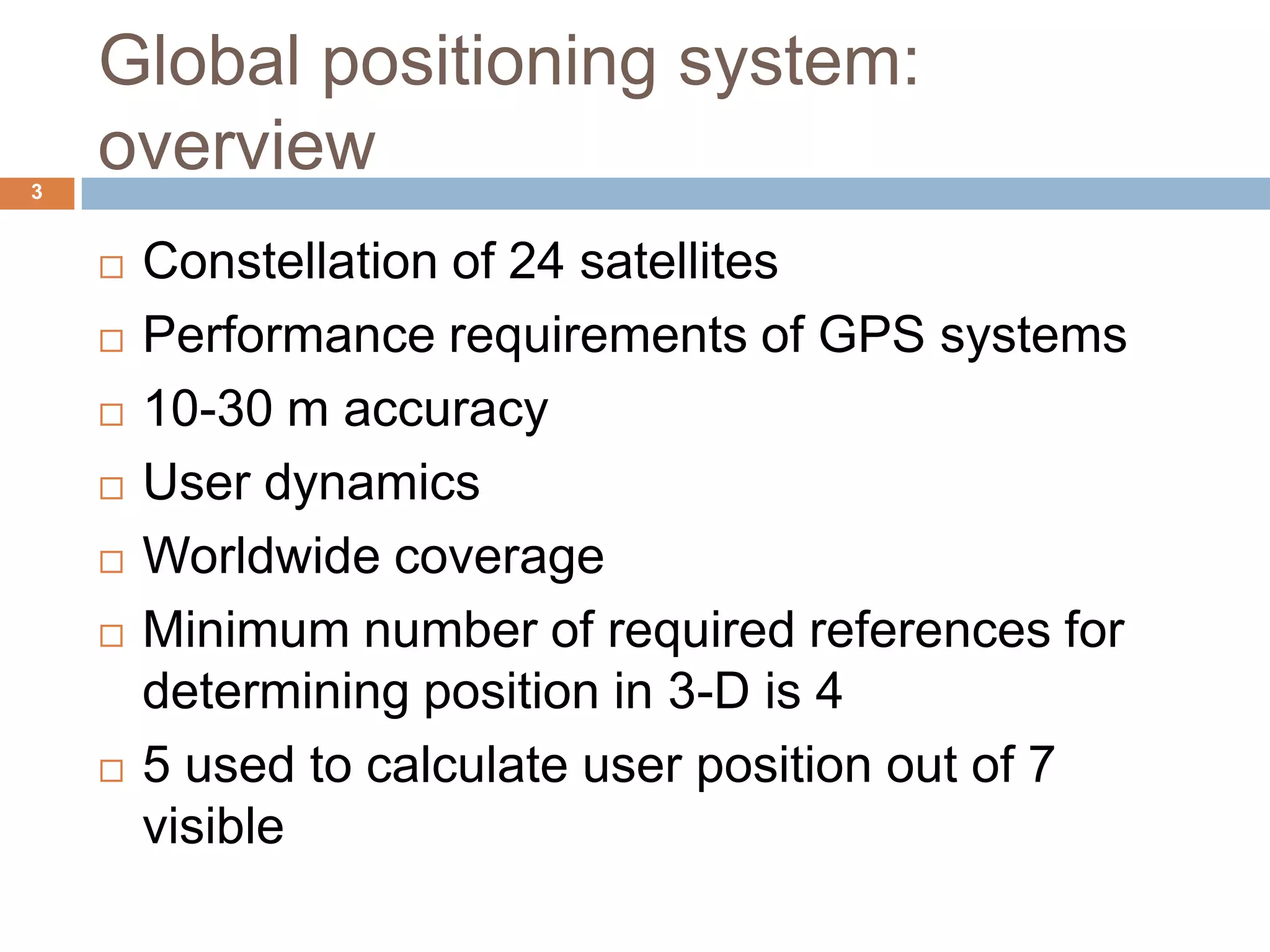
 Constellation of 24 satellites
 Performance requirements of GPS systems
 10-30 m accuracy
 User dynamics
 Worldwide coverage
 Minimum number of required references for
determining position in 3-D is 4
 5 used to calculate user position out of 7
visible
3
Global positioning system:
overview
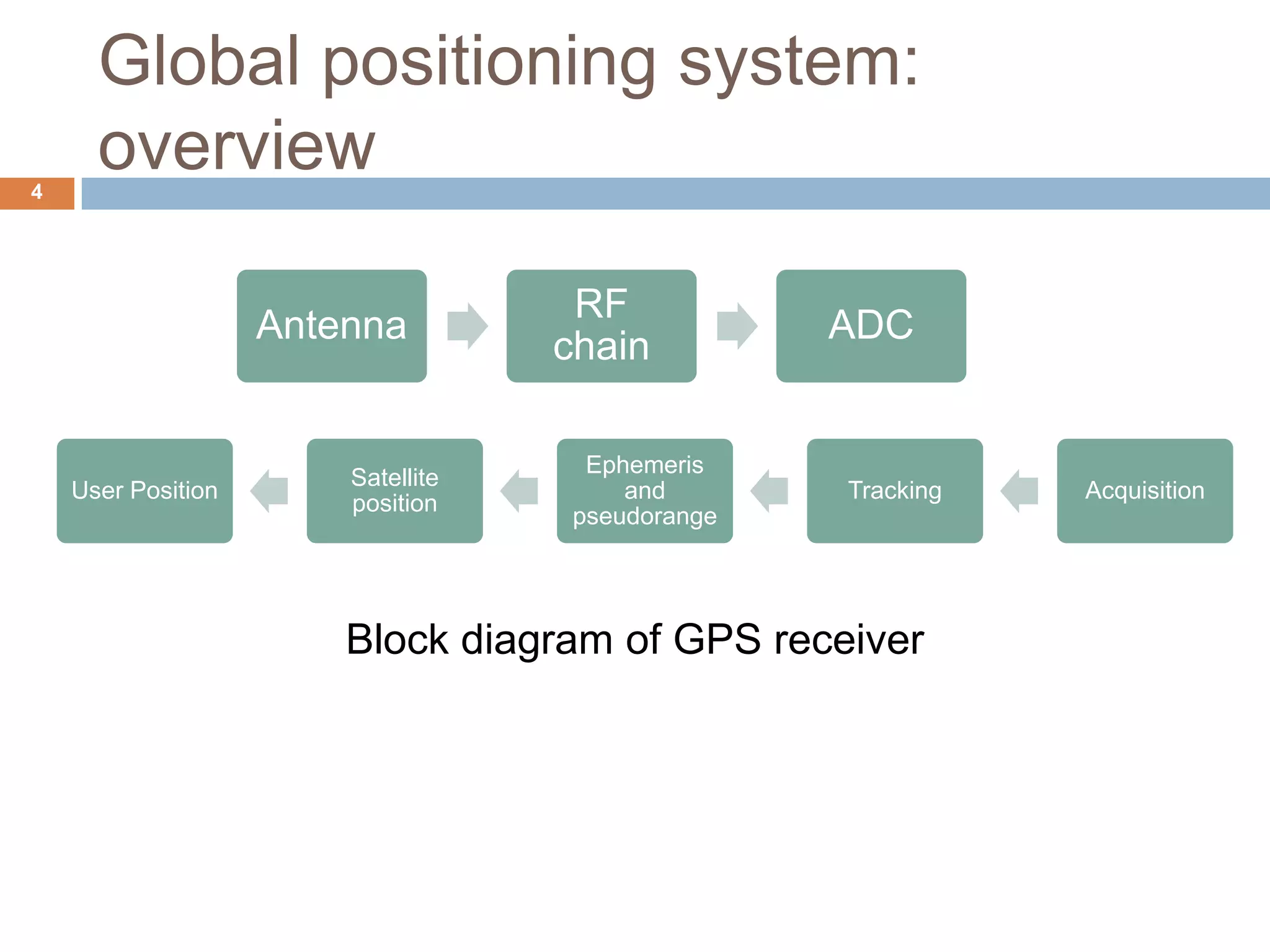
Antenna
RF
chain
ADC
AcquisitionTracking
Ephemeris
and
pseudorange
Satellite
position
User Position
Block diagram of GPS receiver
4
Signal structure of GPS
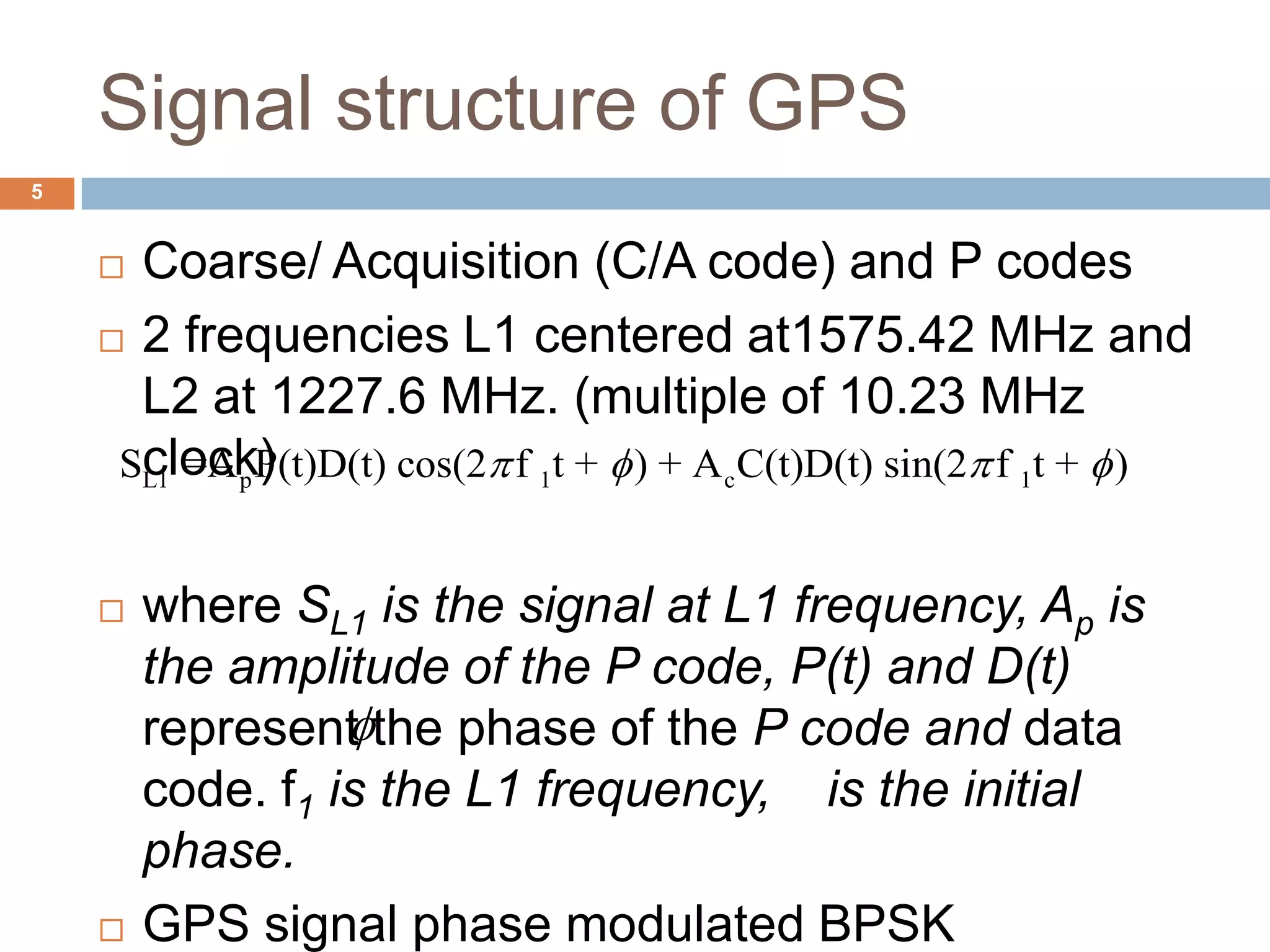
 Coarse/ Acquisition (C/A code) and P codes
 2 frequencies L1 centered at1575.42 MHz and
L2 at 1227.6 MHz. (multiple of 10.23 MHz
clock)
 where SL1 is the signal at L1 frequency, Ap is
the amplitude of the P code, P(t) and D(t)
represent the phase of the P code and data
code. f1 is the L1 frequency, is the initial
phase.
 GPS signal phase modulated BPSK
L1 p 1 c 1S =A P(t)D(t) cos(2 f t + ) + A C(t)D(t) sin(2 f t + )   

5
Signal structure of GPS
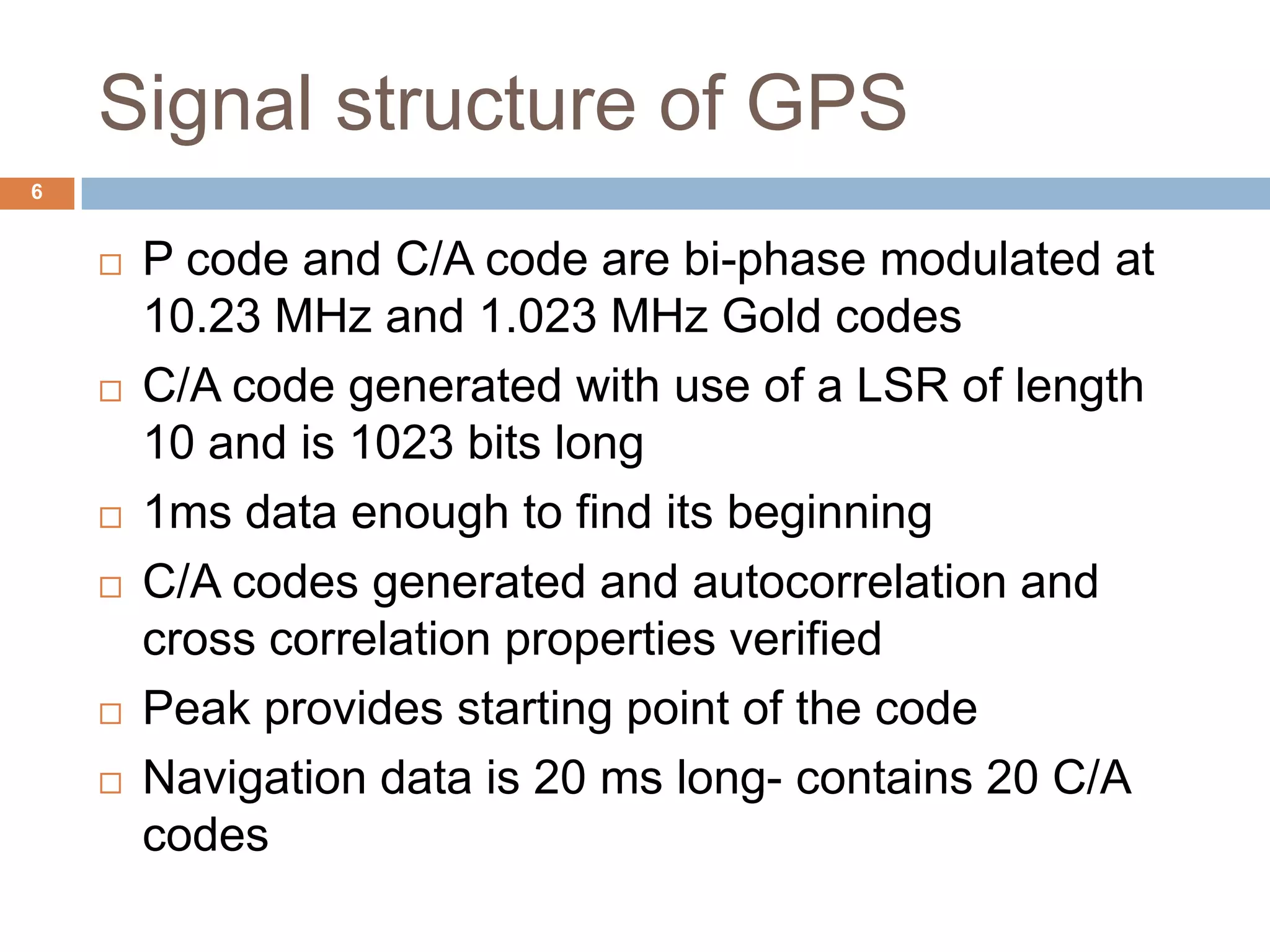
 P code and C/A code are bi-phase modulated at
10.23 MHz and 1.023 MHz Gold codes
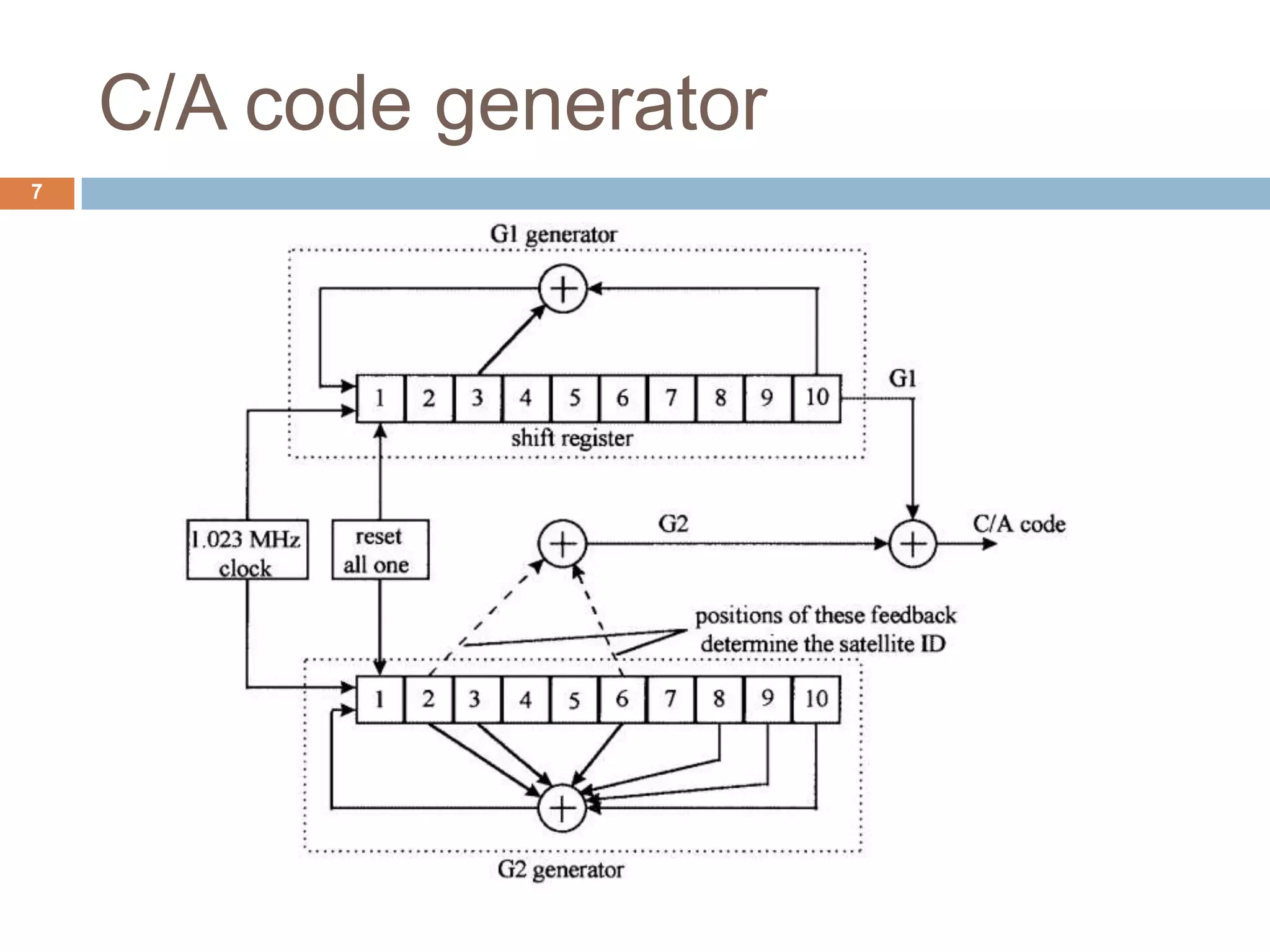
 C/A code generated with use of a LSR of length
10 and is 1023 bits long
 1ms data enough to find its beginning
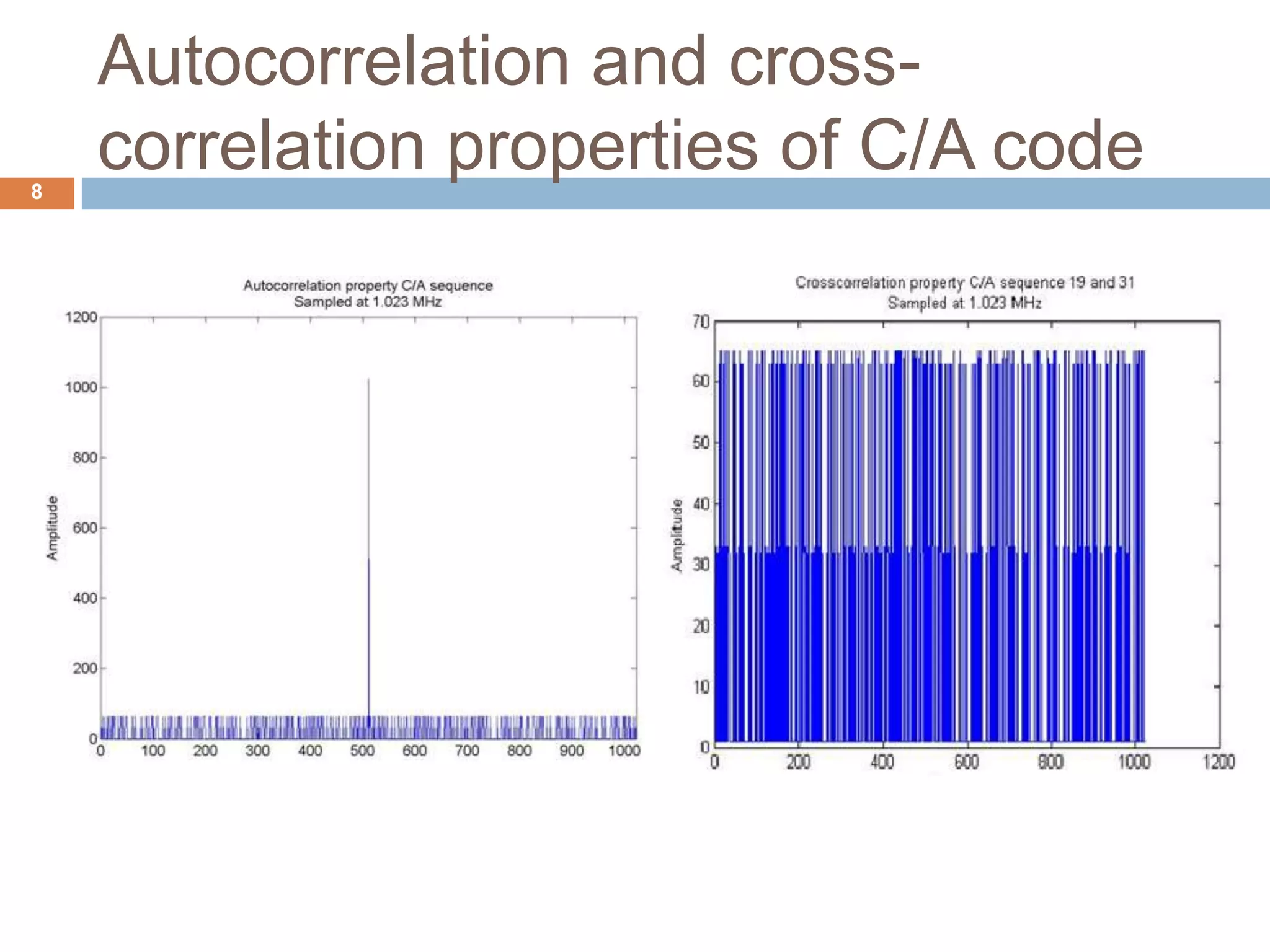
 C/A codes generated and autocorrelation and
cross correlation properties verified
 Peak provides starting point of the code
 Navigation data is 20 ms long- contains 20 C/A
codes
6
C/A code generator
7
Autocorrelation and cross-
correlation properties of C/A code8
Acquisition
 Search for frequency over is +/- 10 kHz which
is maximum Doppler range
 2-D search for carrier frequency and starting
point of C/A code
 IF is at 21.25 MHz, sampling frequency is 5
MHz. So, center of the signal is at 1.25 MHz.
 Maximum data record used for acquisition is
10 ms since data is 20 ms long
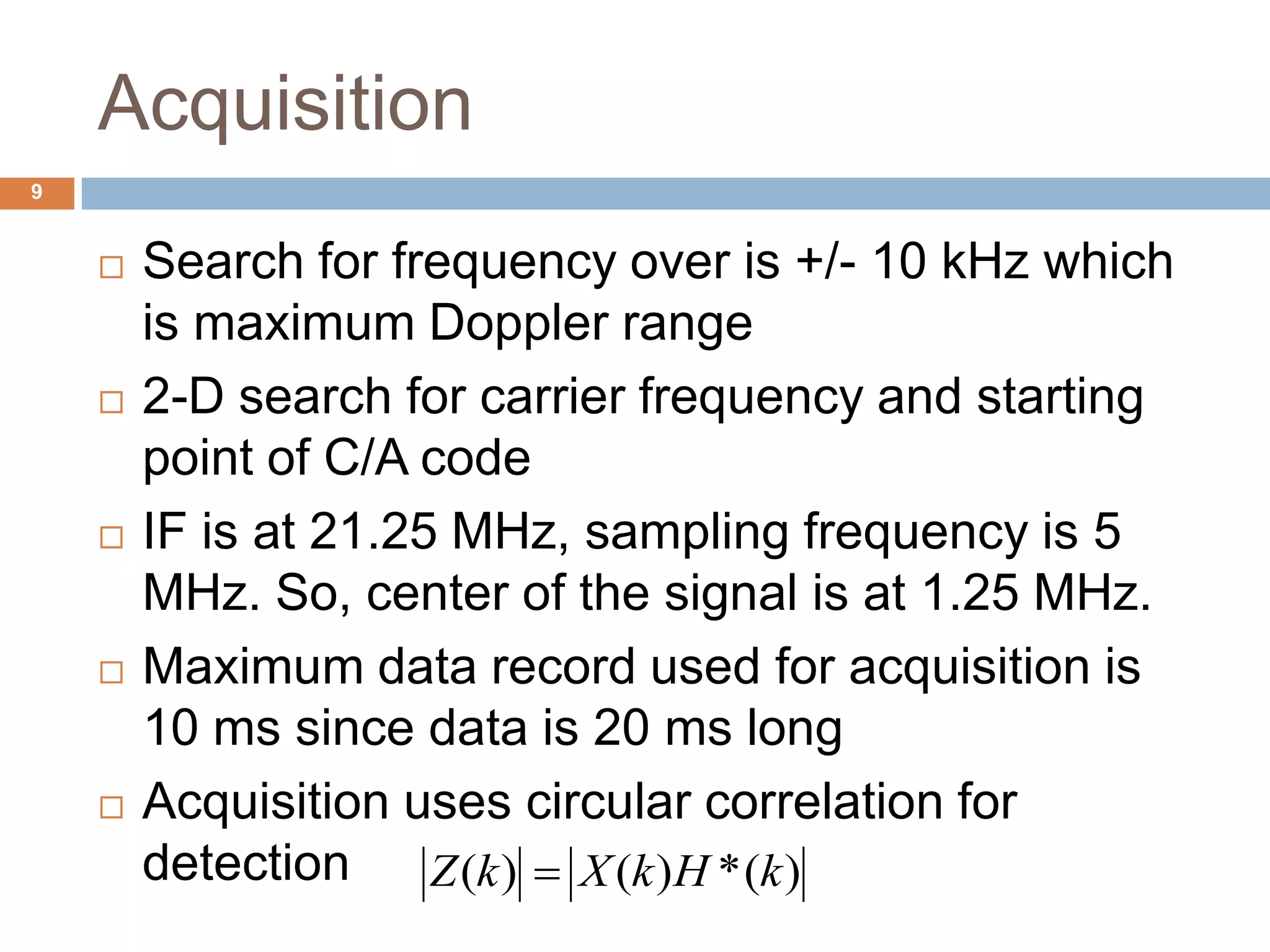
 Acquisition uses circular correlation for
detection ( ) ( ) *( )Z k X k H k
9
Tracking loop
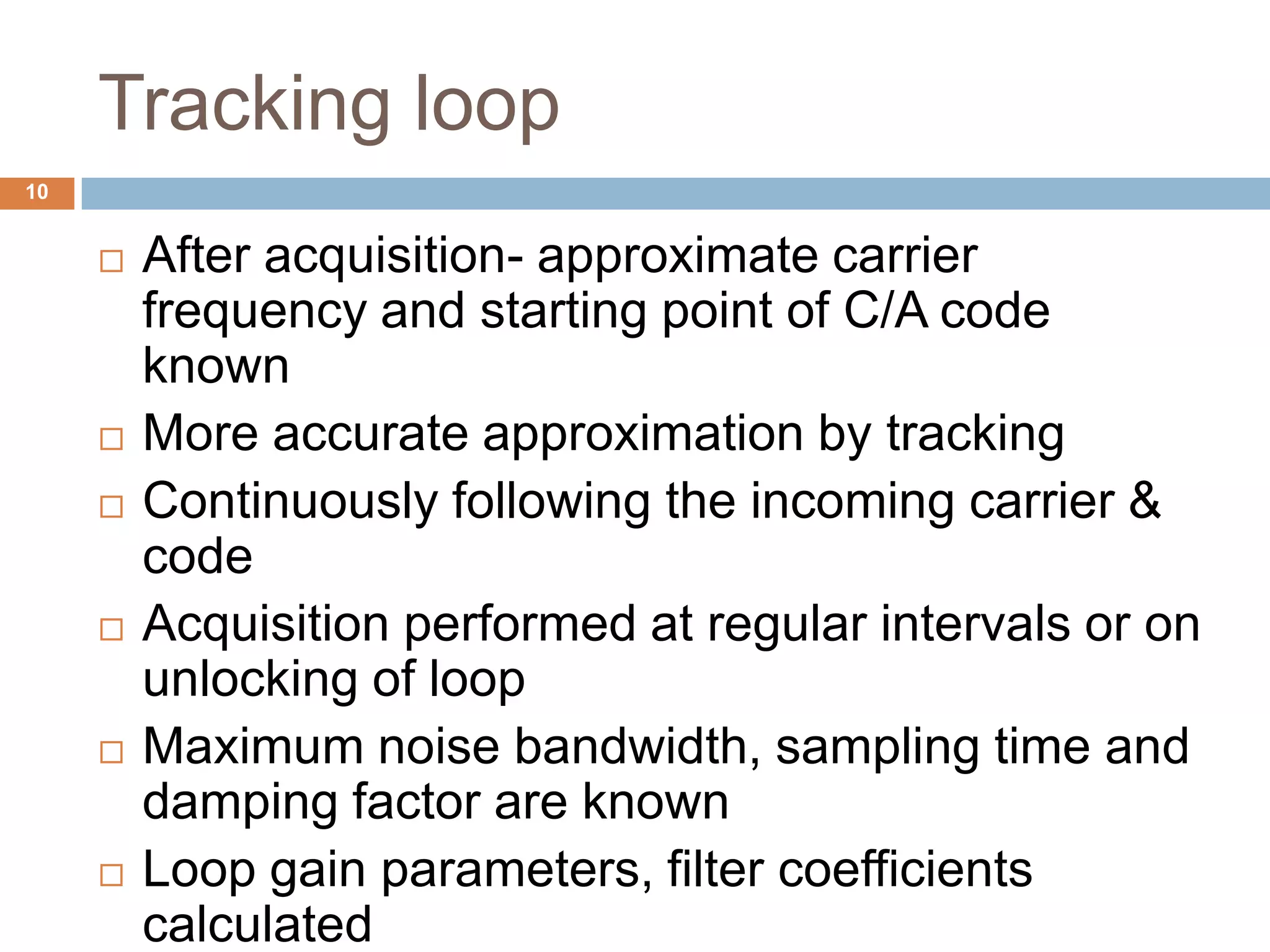
 After acquisition- approximate carrier
frequency and starting point of C/A code
known
 More accurate approximation by tracking
 Continuously following the incoming carrier &
code
 Acquisition performed at regular intervals or on
unlocking of loop
 Maximum noise bandwidth, sampling time and
damping factor are known
 Loop gain parameters, filter coefficients
calculated
10
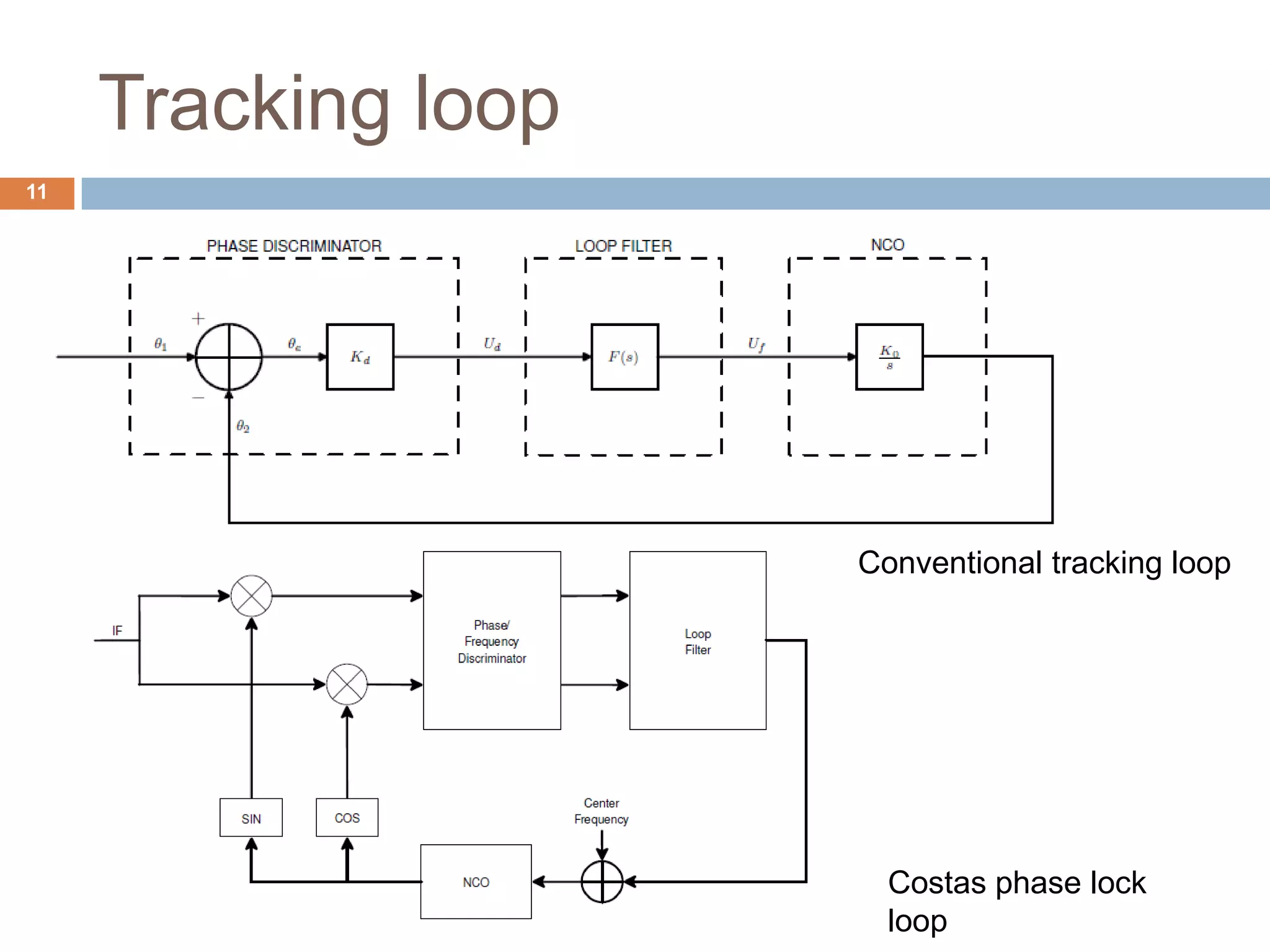
Tracking loop
Costas phase lock
loop
Conventional tracking loop
11
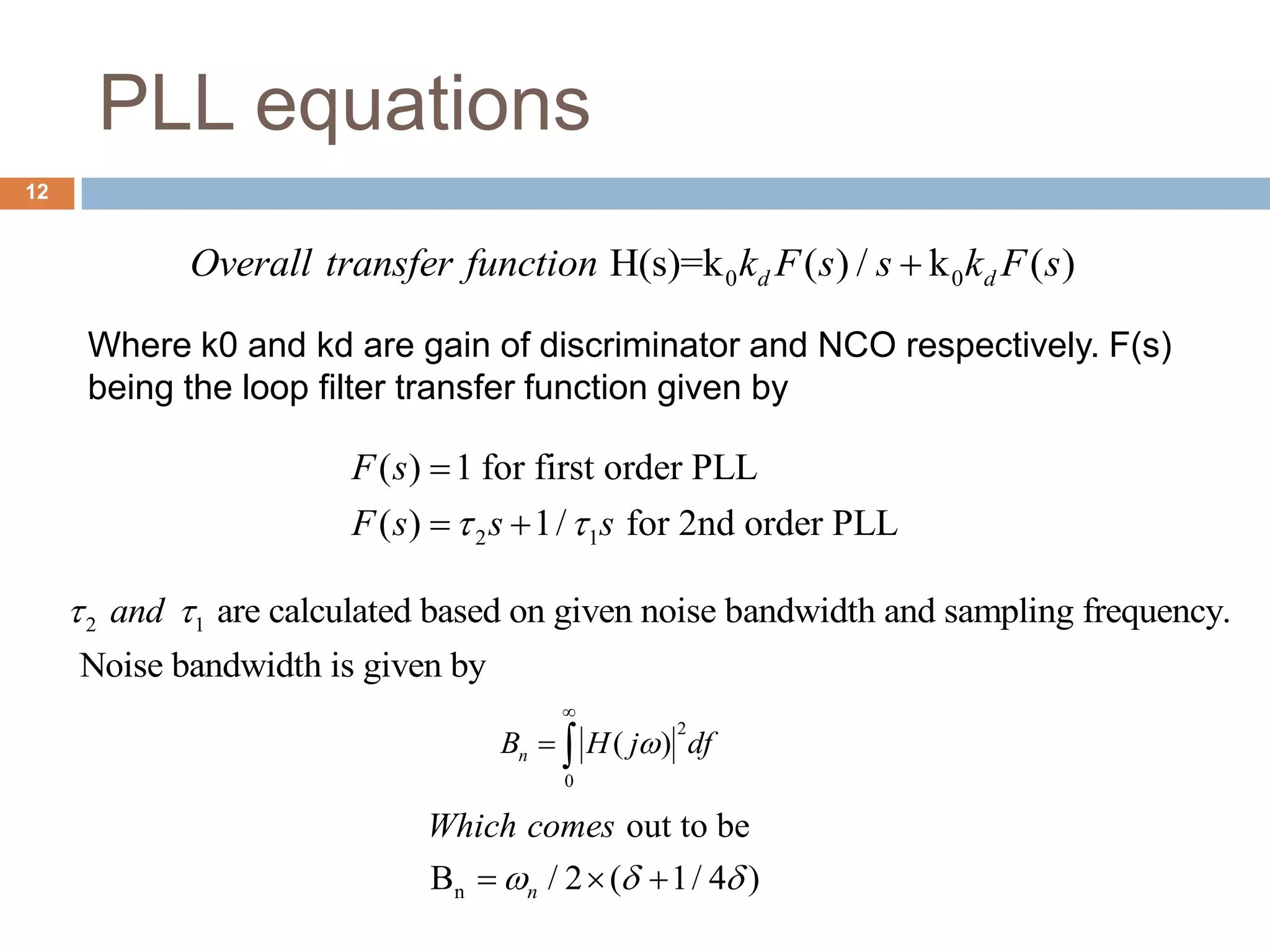
PLL equations
2
0
( )nB H j df

 
2 1
( ) 1 for first order PLL
( ) 1/ for 2nd order PLL
F s
F s s s 

 
0 0H(s)=k ( ) / k ( )d dOverall transfer function k F s s k F s
Where k0 and kd are gain of discriminator and NCO respectively. F(s)
being the loop filter transfer function given by
2 1 are calculated based on given noise bandwidth and sampling frequency.
Noise bandwidth is given by
and 
n
out to be
B / 2 ( 1/ 4 )n
Which comes
    
12
Continuous to discrete domain
transforms
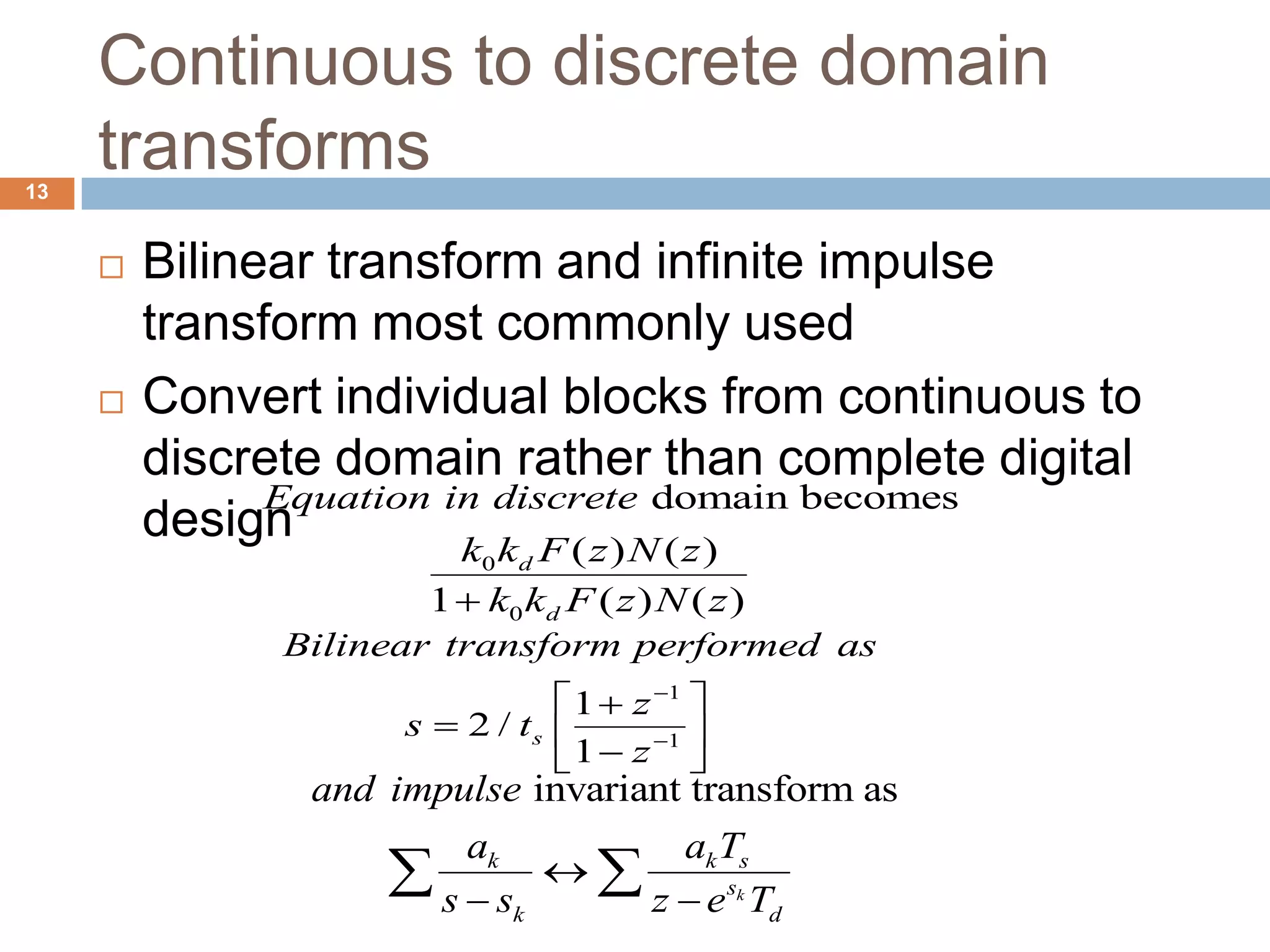
 Bilinear transform and infinite impulse
transform most commonly used
 Convert individual blocks from continuous to
discrete domain rather than complete digital
design
1
1
1
2 /
1
s
Bilinear transform performed as
z
s t
z


 
  
 
invariant transform as
k
k k s
s
k d
and impulse
a a T
s s z e T

 
 
13
0
0
domain becomes
( ) ( )
1 ( ) ( )
d
d
Equation in discrete
k k F z N z
k k F z N z
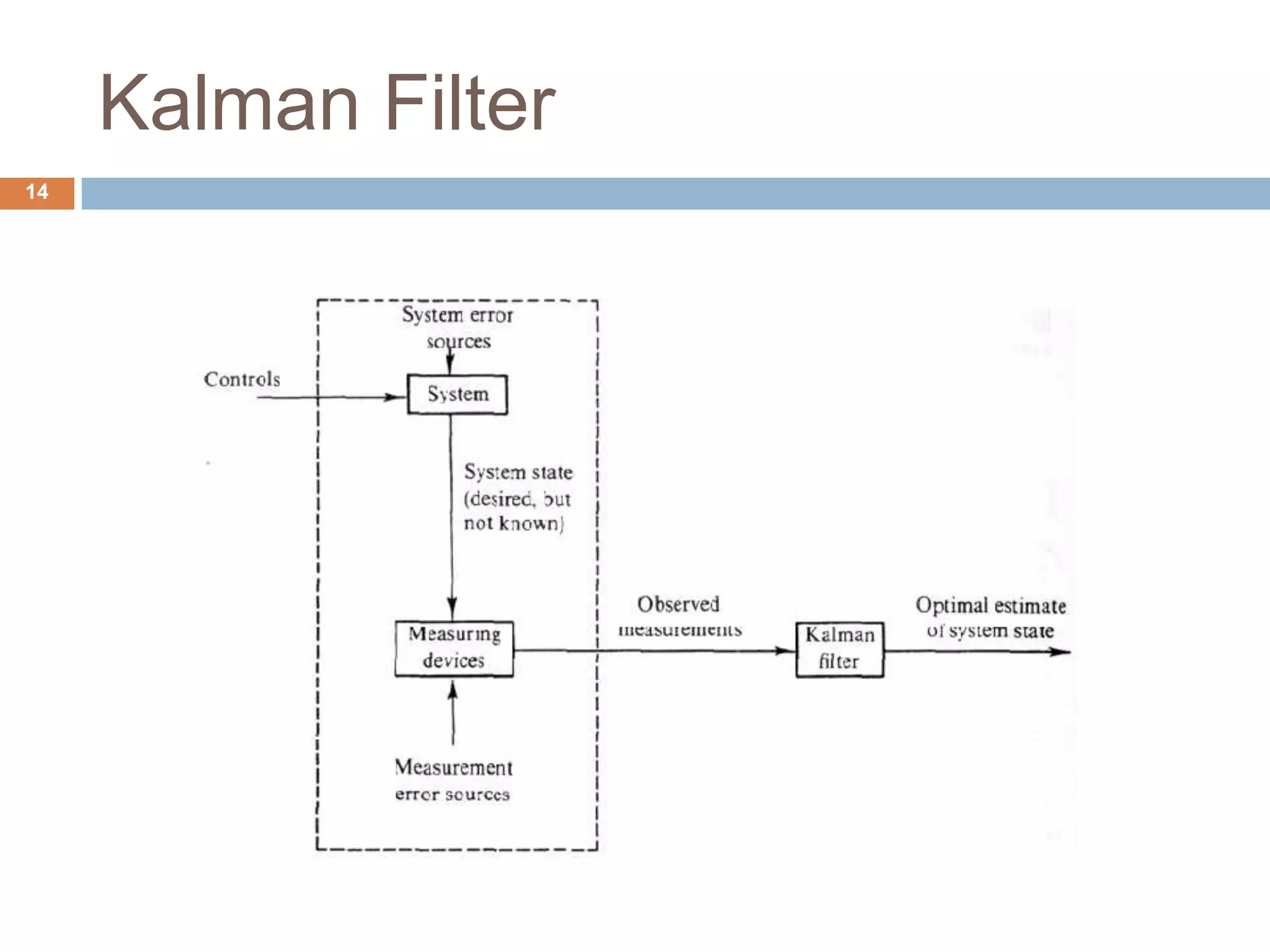
Kalman Filter
14
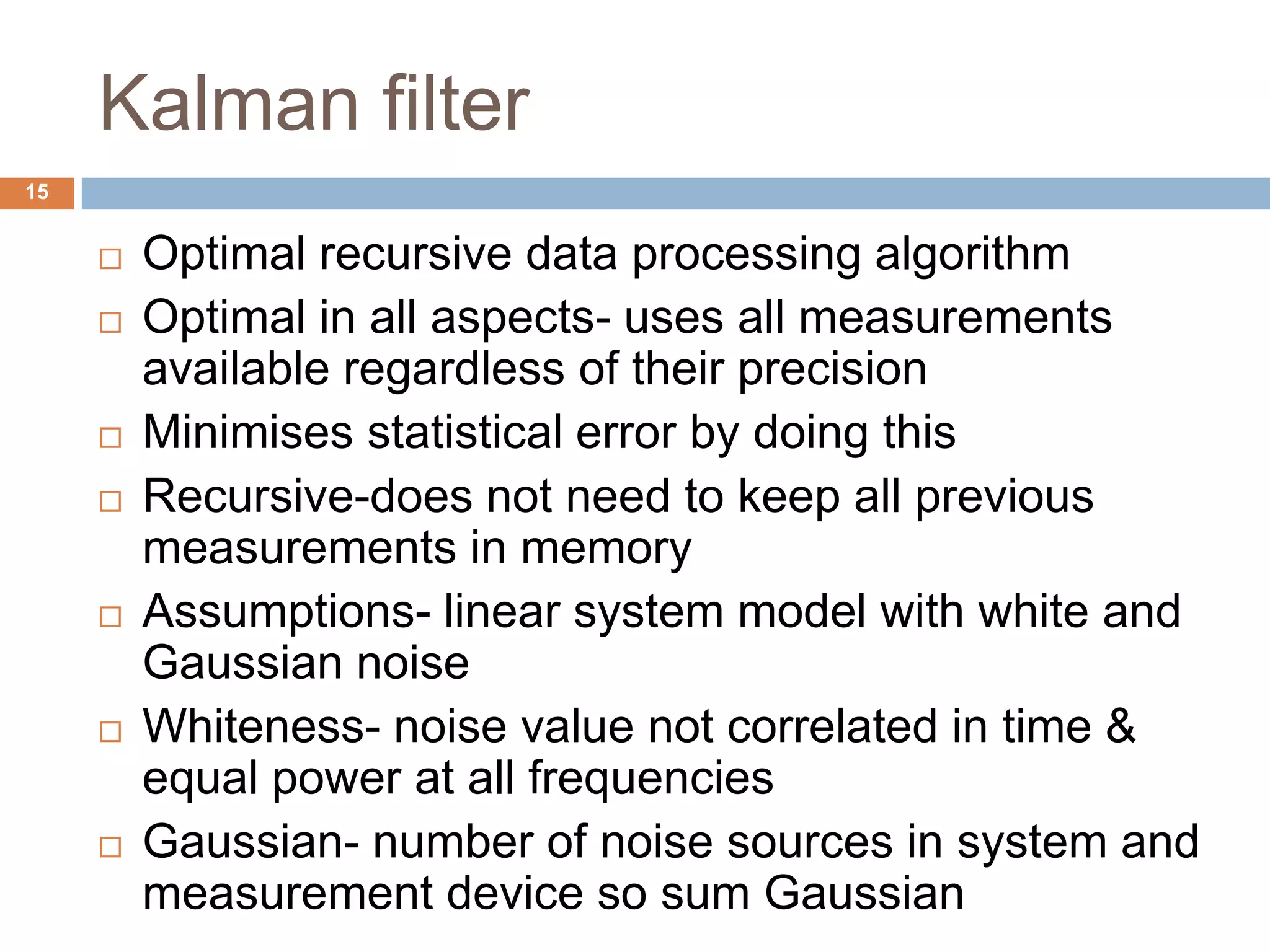
Kalman filter
 Optimal recursive data processing algorithm
 Optimal in all aspects- uses all measurements
available regardless of their precision
 Minimises statistical error by doing this
 Recursive-does not need to keep all previous
measurements in memory
 Assumptions- linear system model with white and
Gaussian noise
 Whiteness- noise value not correlated in time &
equal power at all frequencies
 Gaussian- number of noise sources in system and
measurement device so sum Gaussian
15
Review II16
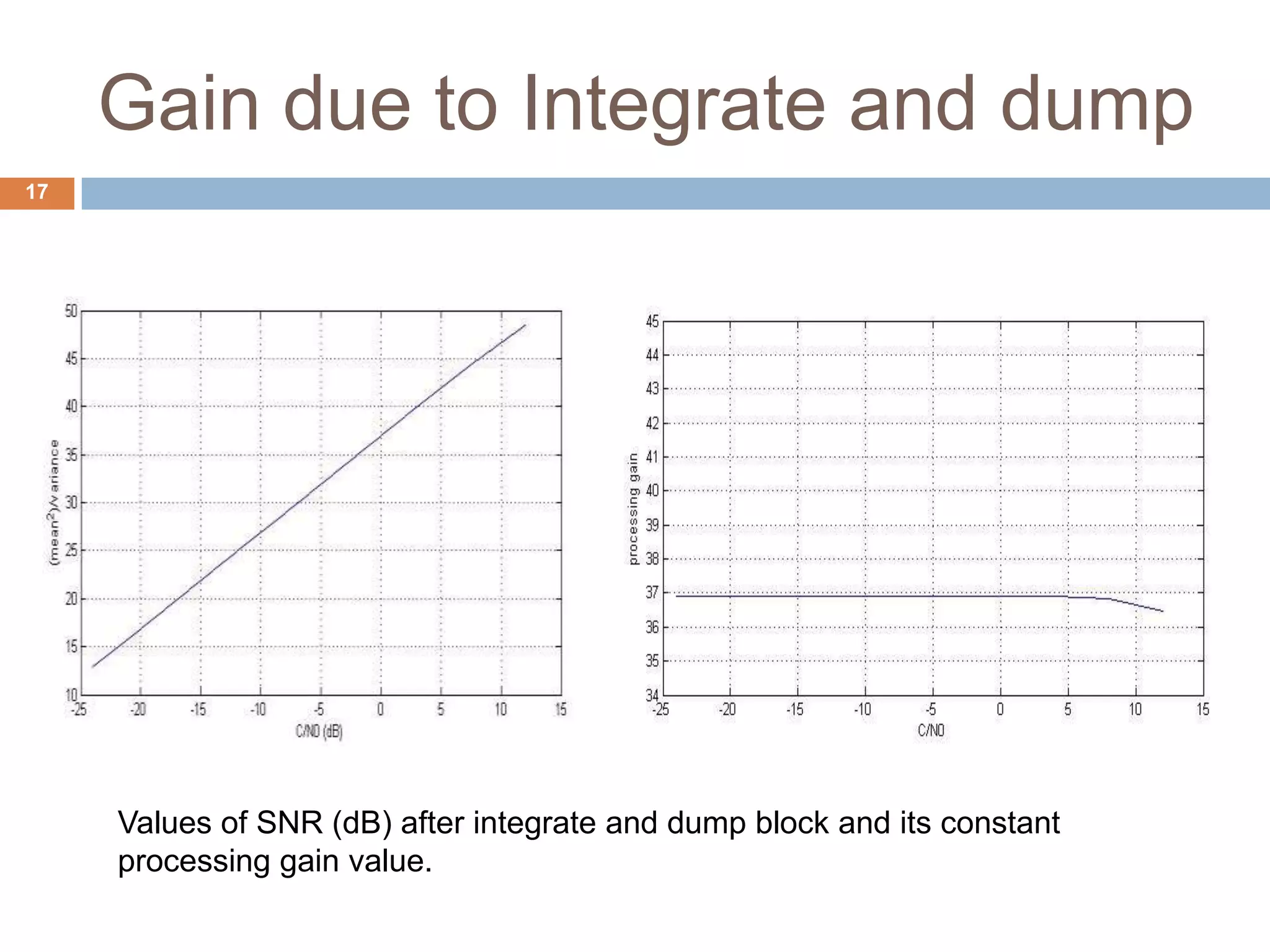
Gain due to Integrate and dump
17
Values of SNR (dB) after integrate and dump block and its constant
processing gain value.
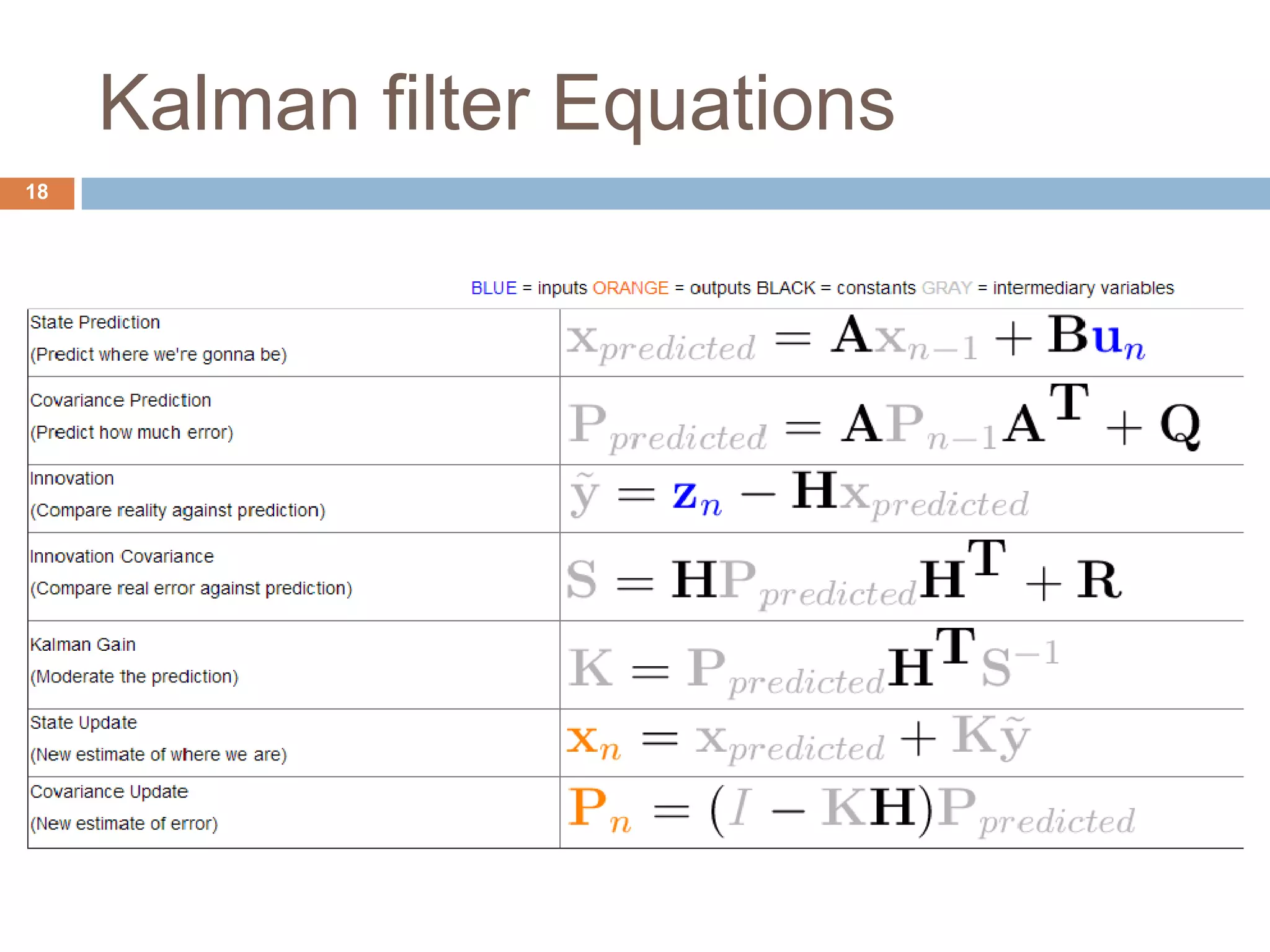
Kalman filter Equations
18
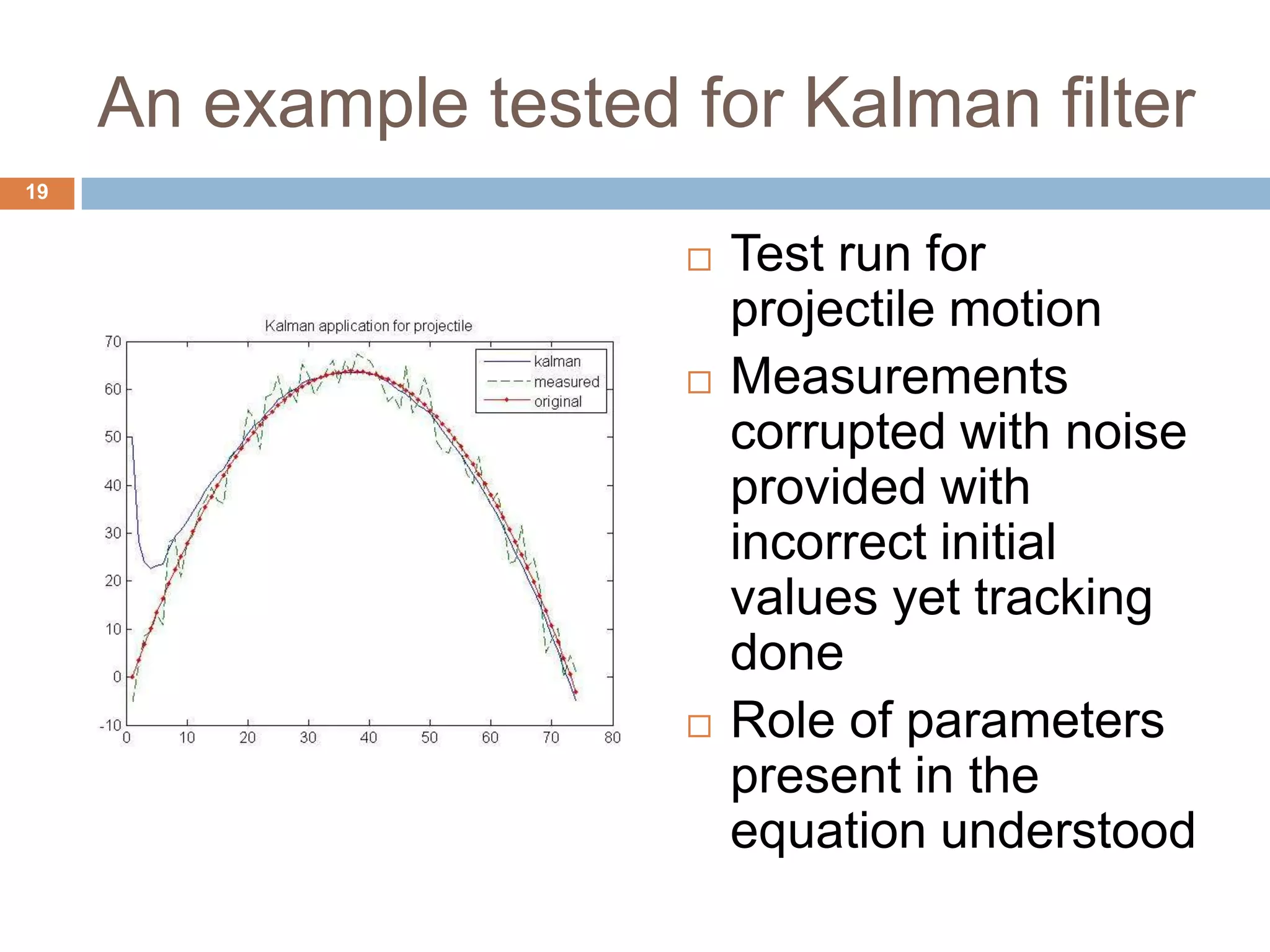
An example tested for Kalman filter
 Test run for
projectile motion
 Measurements
corrupted with noise
provided with
incorrect initial
values yet tracking
done
 Role of parameters
present in the
equation understood
19
Formation of filter equations for
PLL20
 Phase difference and frequency difference
were selected to be the parameters for state
equations
 Requirements: Design of FLL, error variance
in measurement of phase and frequency
 Deciding the control inputs for the state
equations
 Finding variance for different values of C/N0
which are 40 dB-Hz to 80 dB-Hz for GPS
signals
 Measurement matrix becomes [1 2*pi*T ;0 1]

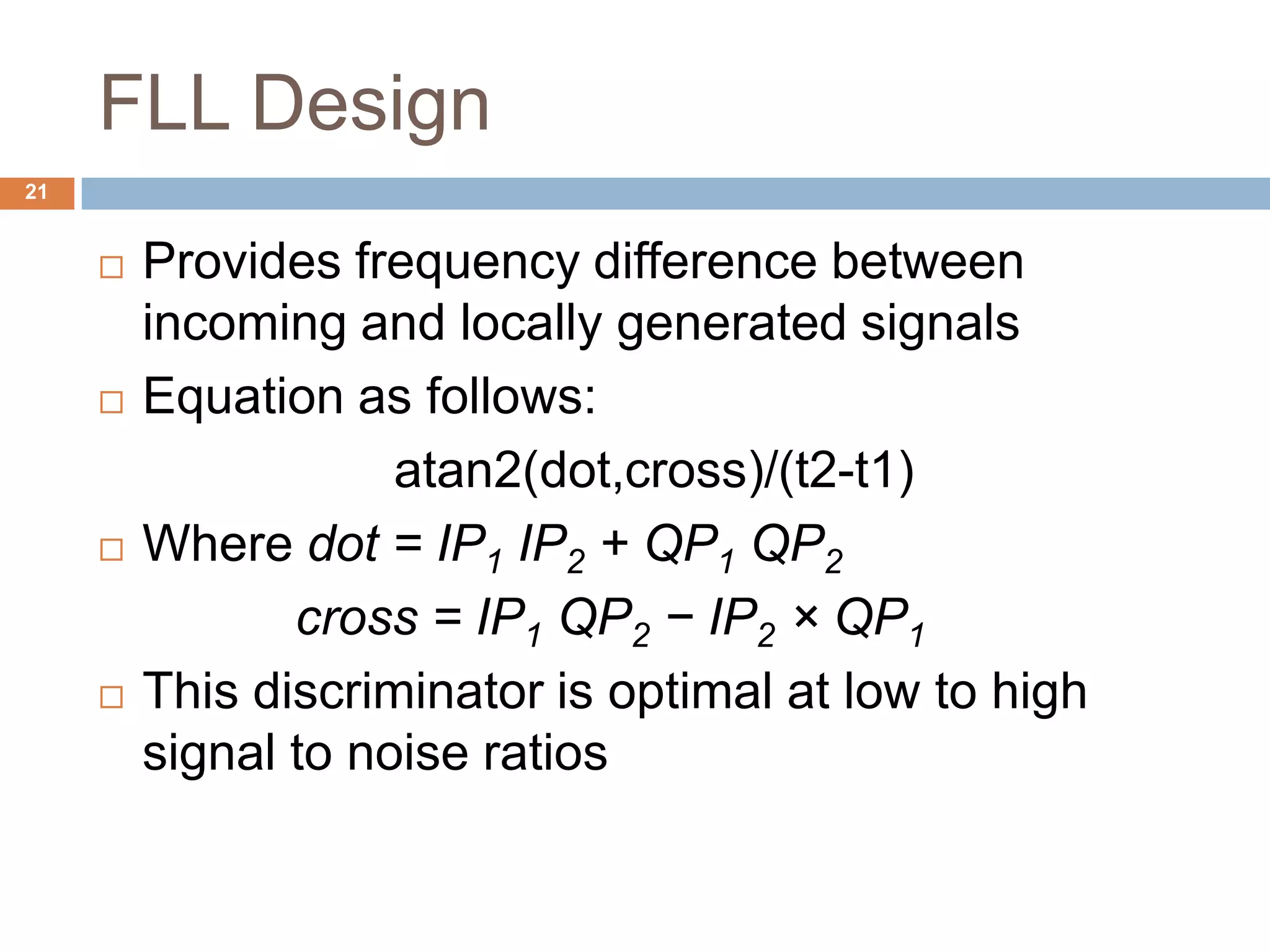
FLL Design
21
 Provides frequency difference between
incoming and locally generated signals
 Equation as follows:
atan2(dot,cross)/(t2-t1)
 Where dot = IP1 IP2 + QP1 QP2
cross = IP1 QP2 − IP2 × QP1
 This discriminator is optimal at low to high
signal to noise ratios
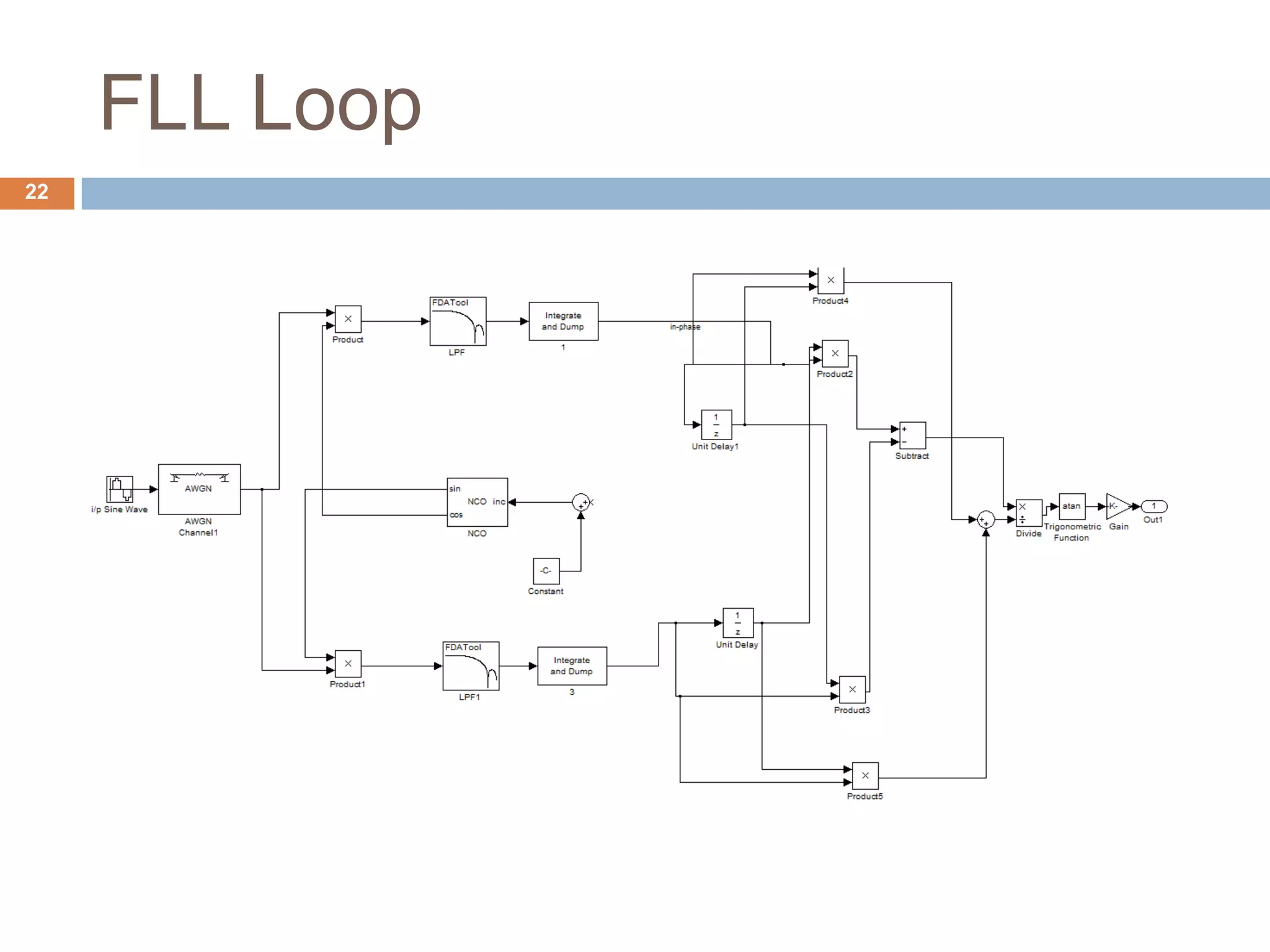
FLL Loop
22
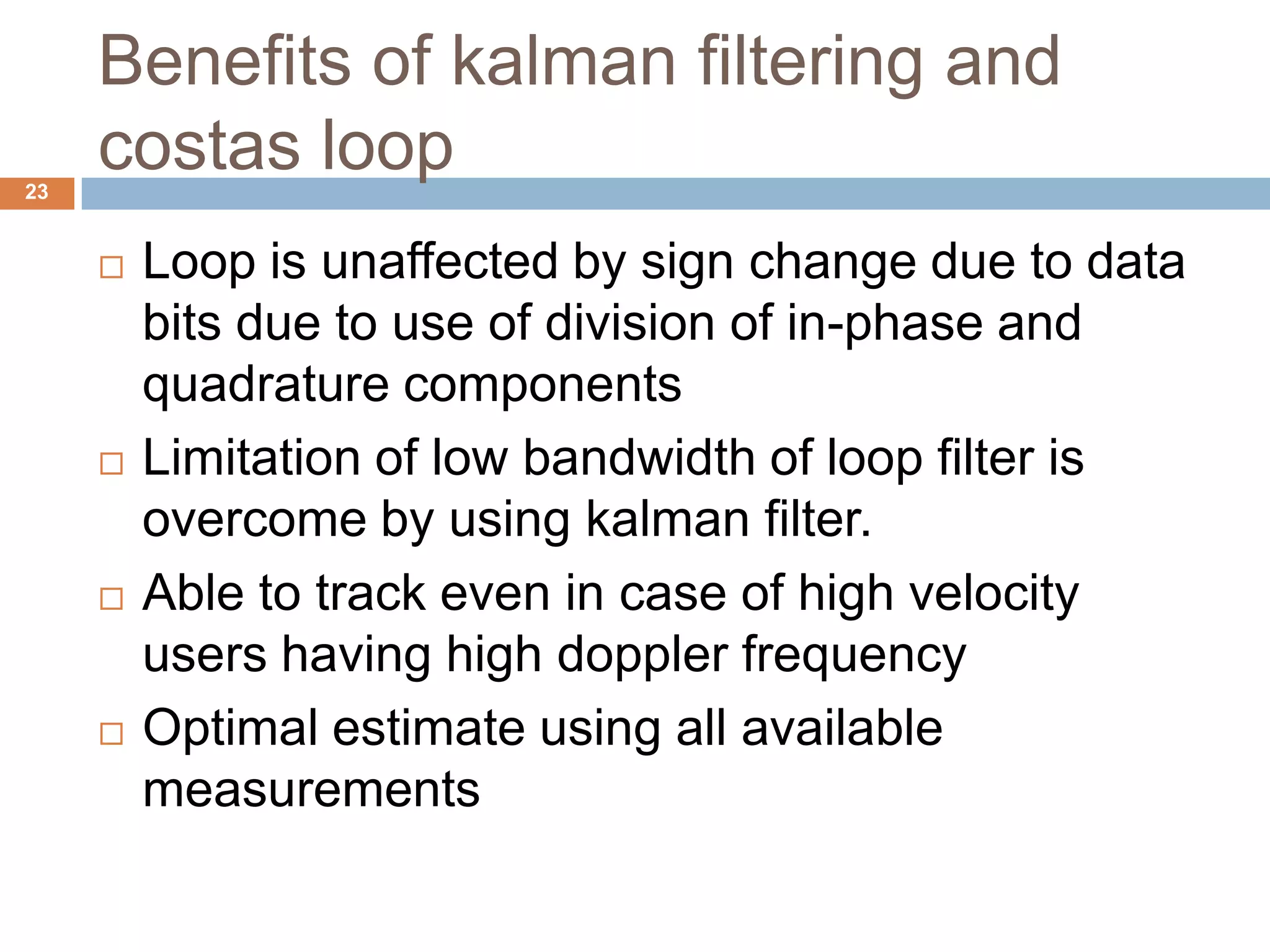
Benefits of kalman filtering and
costas loop23
 Loop is unaffected by sign change due to data
bits due to use of division of in-phase and
quadrature components
 Limitation of low bandwidth of loop filter is
overcome by using kalman filter.
 Able to track even in case of high velocity
users having high doppler frequency
 Optimal estimate using all available
measurements
Different Filter implementations
24
 Smoother-Based GPS Signal Tracking in a
Software Receiver, Mark L. Psiaki, Cornell
University
 Kalman Filter Based Tracking Algorithms For
Software GPS Receivers, Mathew
Lashley, Thesis, Auburn University
 Above two implemented and innovation of
change in input values done- desired output
values obtained
Challenges in design
25
 Non functioning of PLL due to divide by zero at
t=T as sine value dropped to zero
 Kalman filter not showing any output values
beyond first sample as first output came NaN
(not a number)
 Selection of values of error variance in
measurement (open loop or closed loop)
 State equation not producing desired output
 Very high variance in FLL output
Solutions to design challenges
26
 Addition of very small value (10e-6) to
Quadrature phase component to prevent
divide by zero error
 Debugging to find reason for non functioning
Kalman filter after first sample
 Source found to be initial values of FLL set as
zero causing NaN in output and the same loop
iterations again and again
 Initial values altered and output obtained
 Error variance measured for closed loops
Solutions to design challenges
27
 Process error variance and measurement error
variance measured setting up high values for
other
 State equation used input as frequency
difference output from FLL which failed to get
desired output
 So, difference of previous state of frequency
and FLL output taken
 FLL outputs averaged for decreasing variance
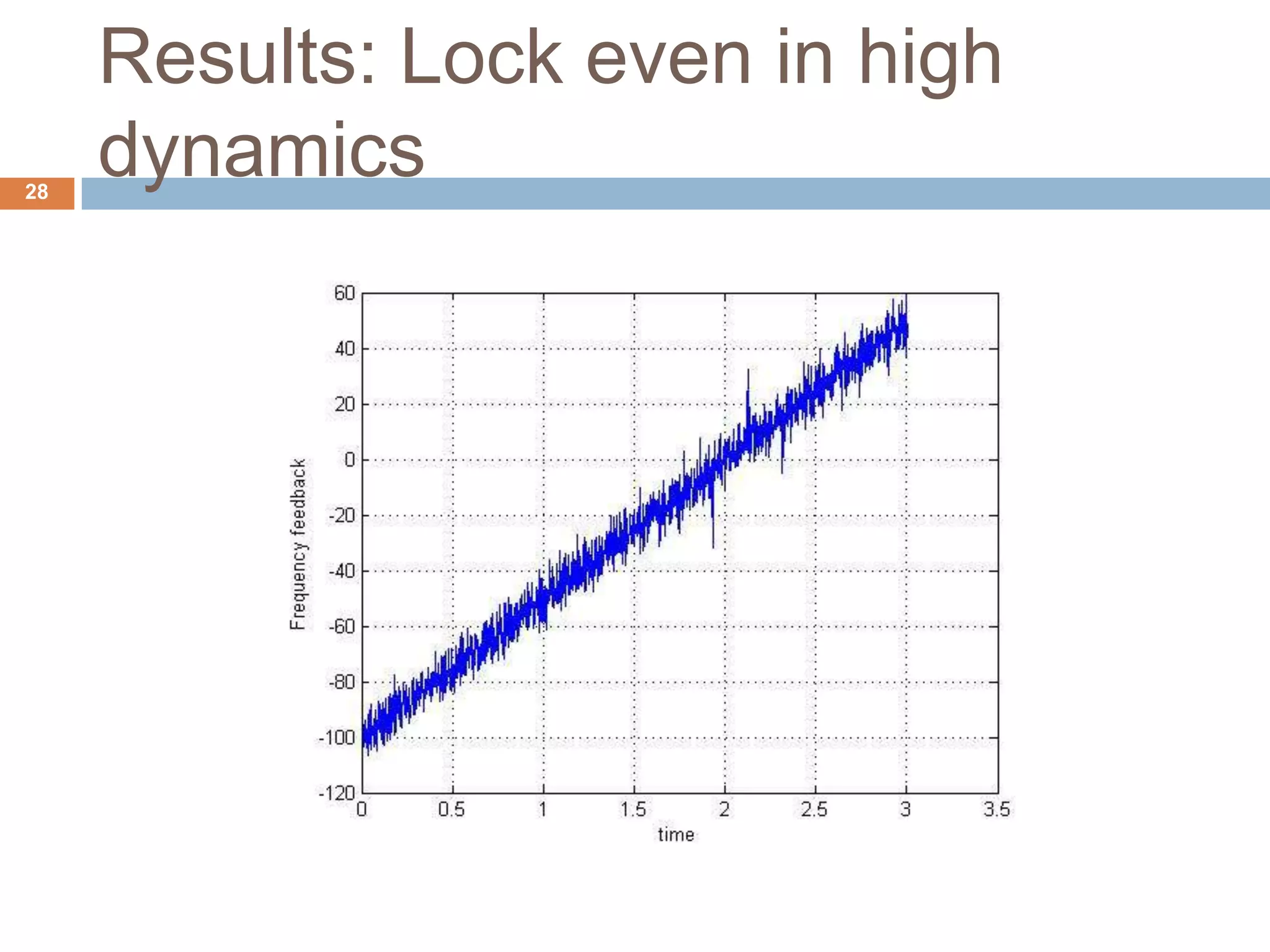
Results: Lock even in high
dynamics28
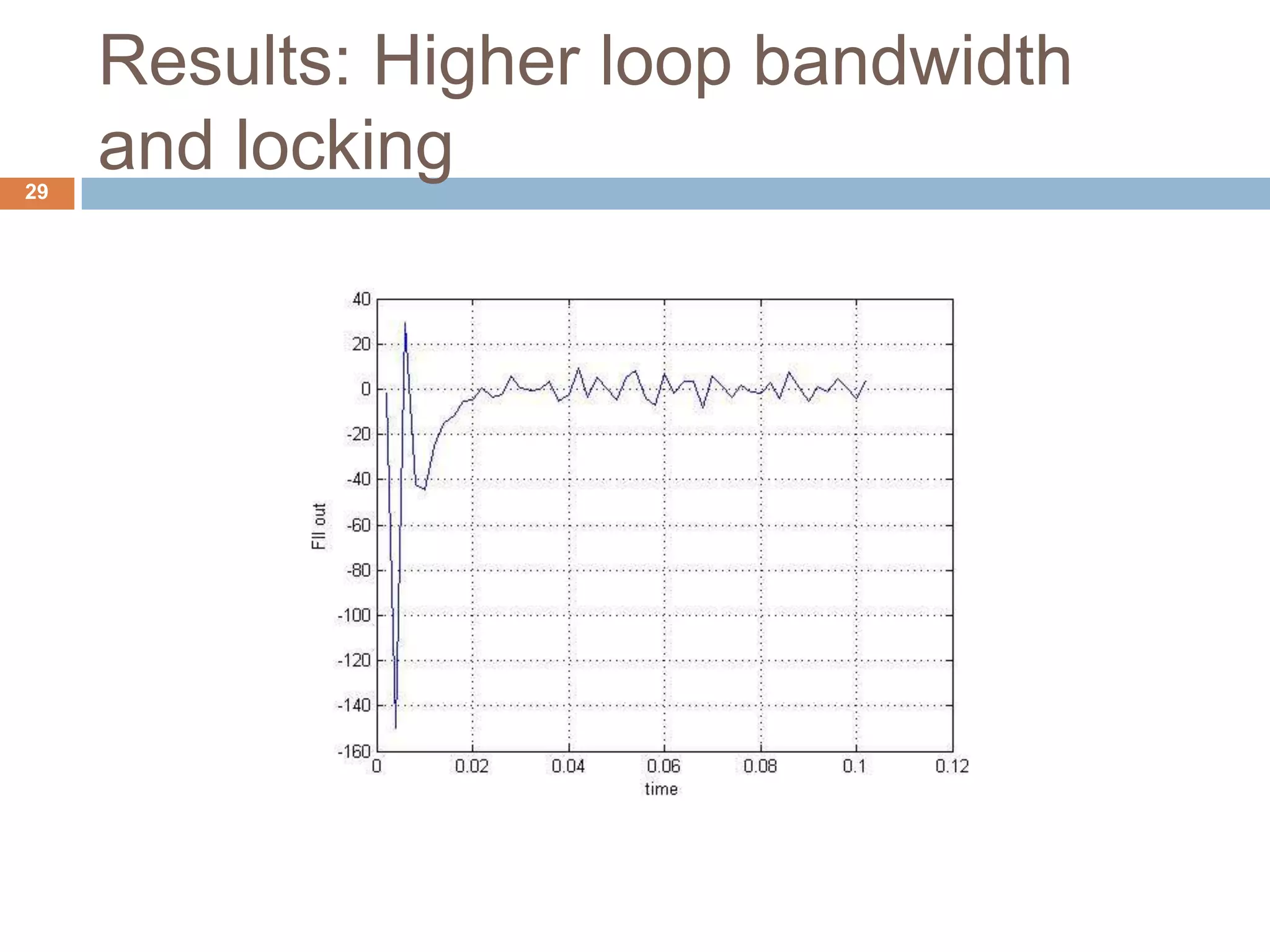
Results: Higher loop bandwidth
and locking29
Review III-Kalman filter based
GPS tracking
30
List of Simulations carried
out31
 PLL and FLL based on thesis by Matthew
Lashley
 PLL based on 2 papers by M L Psiaki - GPS
Signal Tracking in high dynamics and low C/N0
 One innovation in design of FLL using different
equations from those given in the papers
 Cascading of Kalman filter
 All simulations performed at 40 dB-Hz-at lower
value of SNR than the average 45 dB-Hz for
GPS signals
 Test for signal outage and whether or not signal
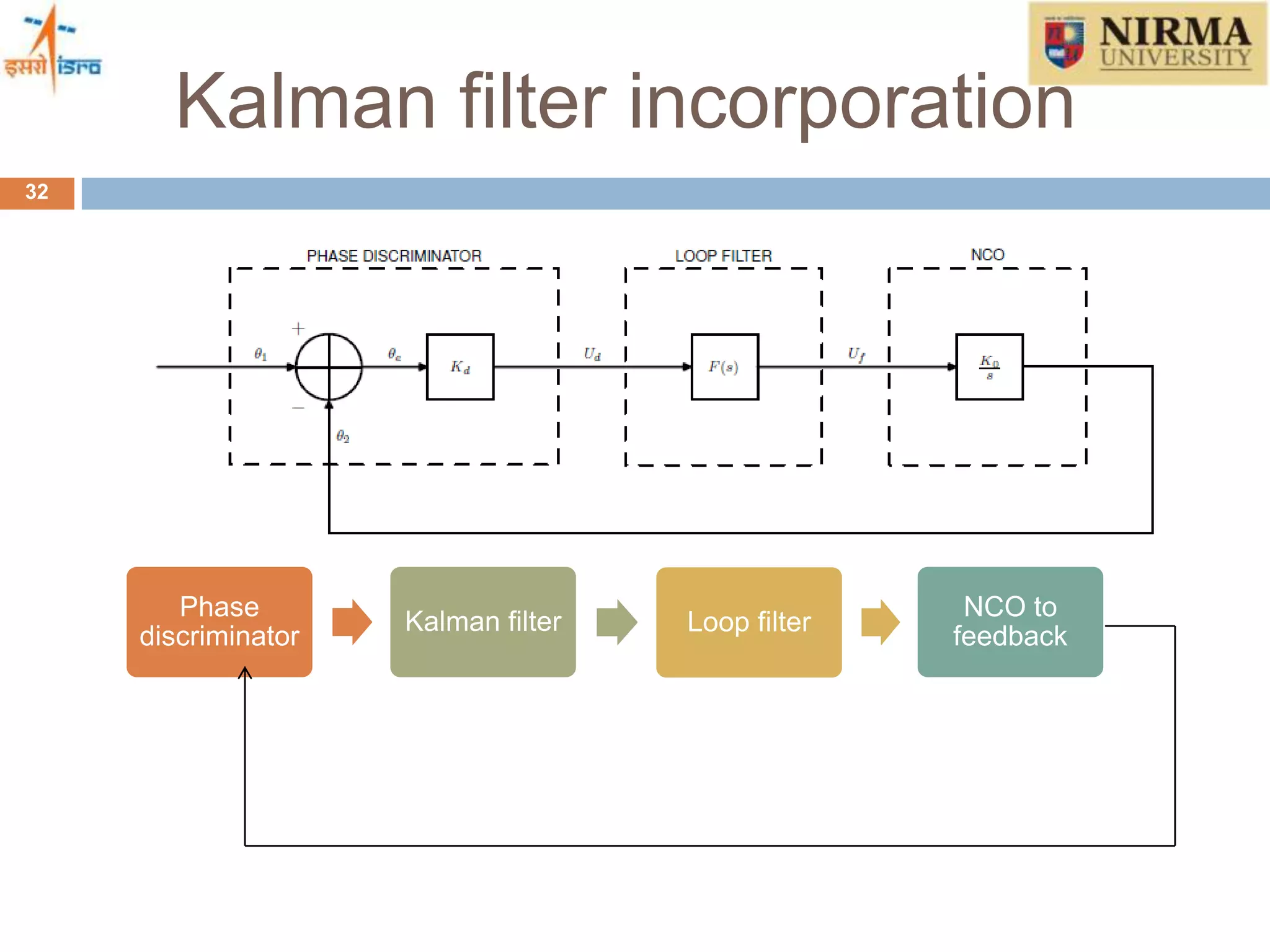
Kalman filter incorporation
32
Phase
discriminator
Kalman filter Loop filter
NCO to
feedback
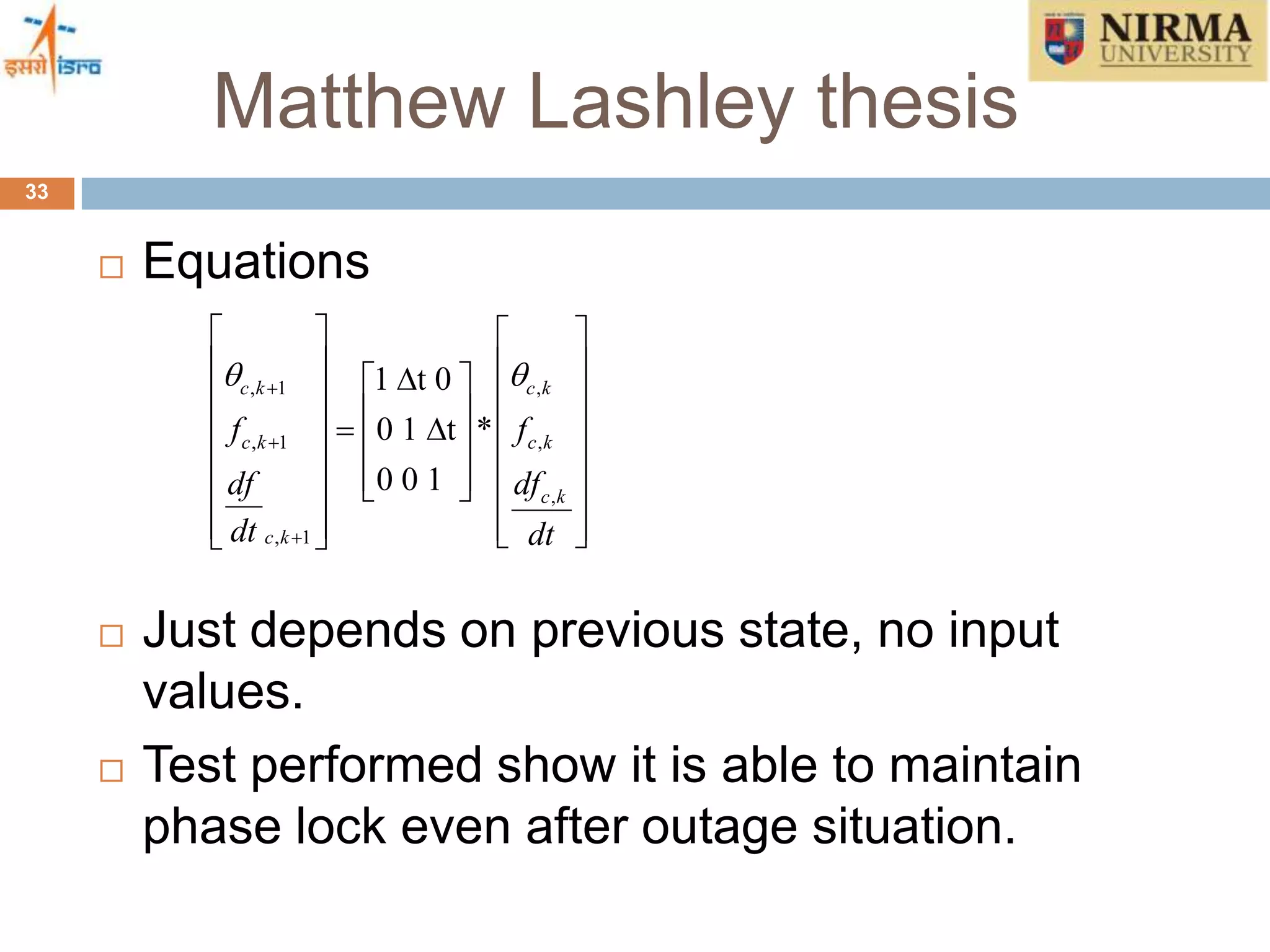
Matthew Lashley thesis
33
 Equations
 Just depends on previous state, no input
values.
 Test performed show it is able to maintain
phase lock even after outage situation.
, 1 ,
, 1 ,
,
, 1
1 t 0
0 1 t *
0 0 1
c k c k
c k c k
c k
c k
f f
df df
dt dt
 


   
                     
     
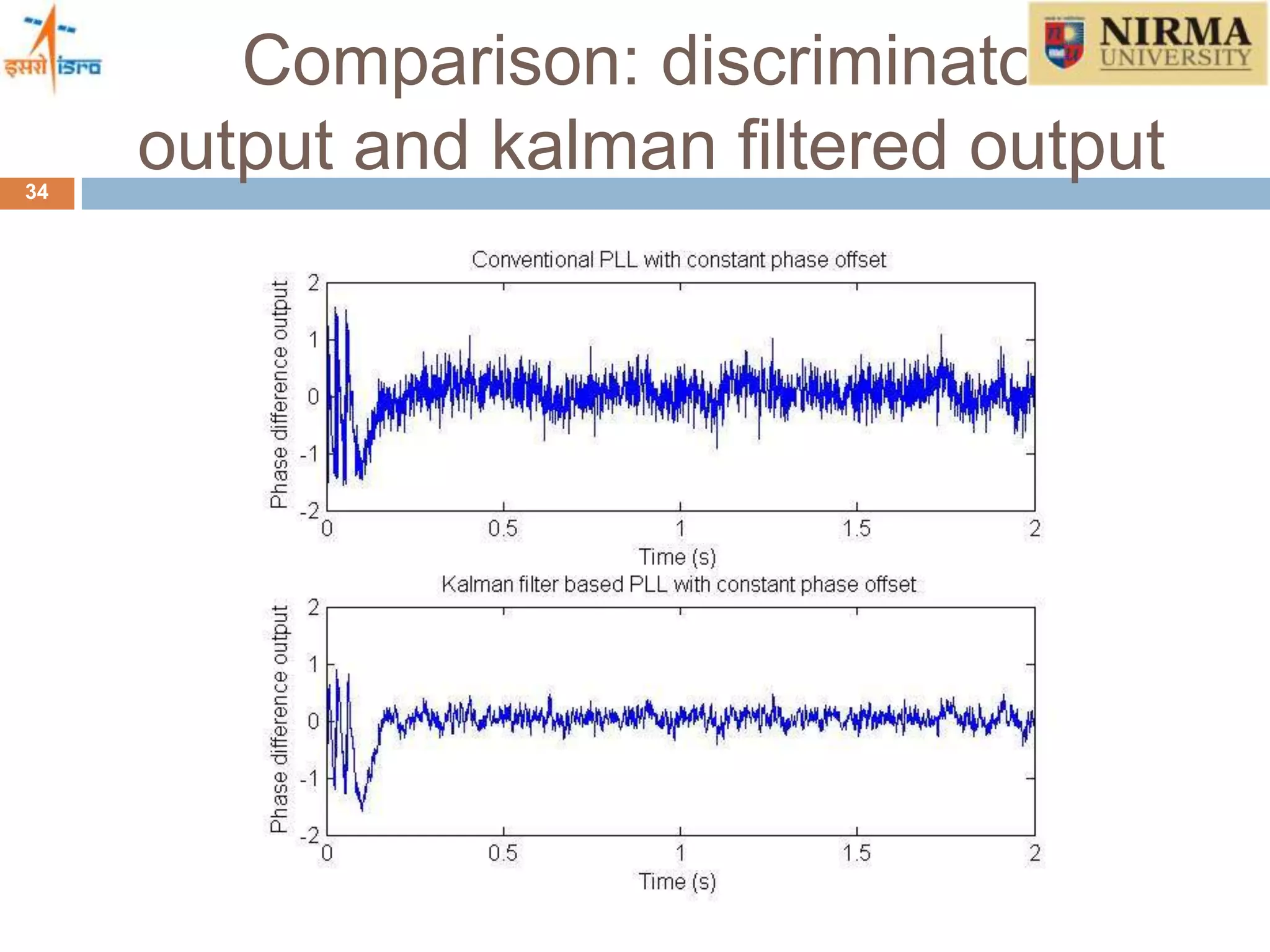
Comparison: discriminator
output and kalman filtered output34
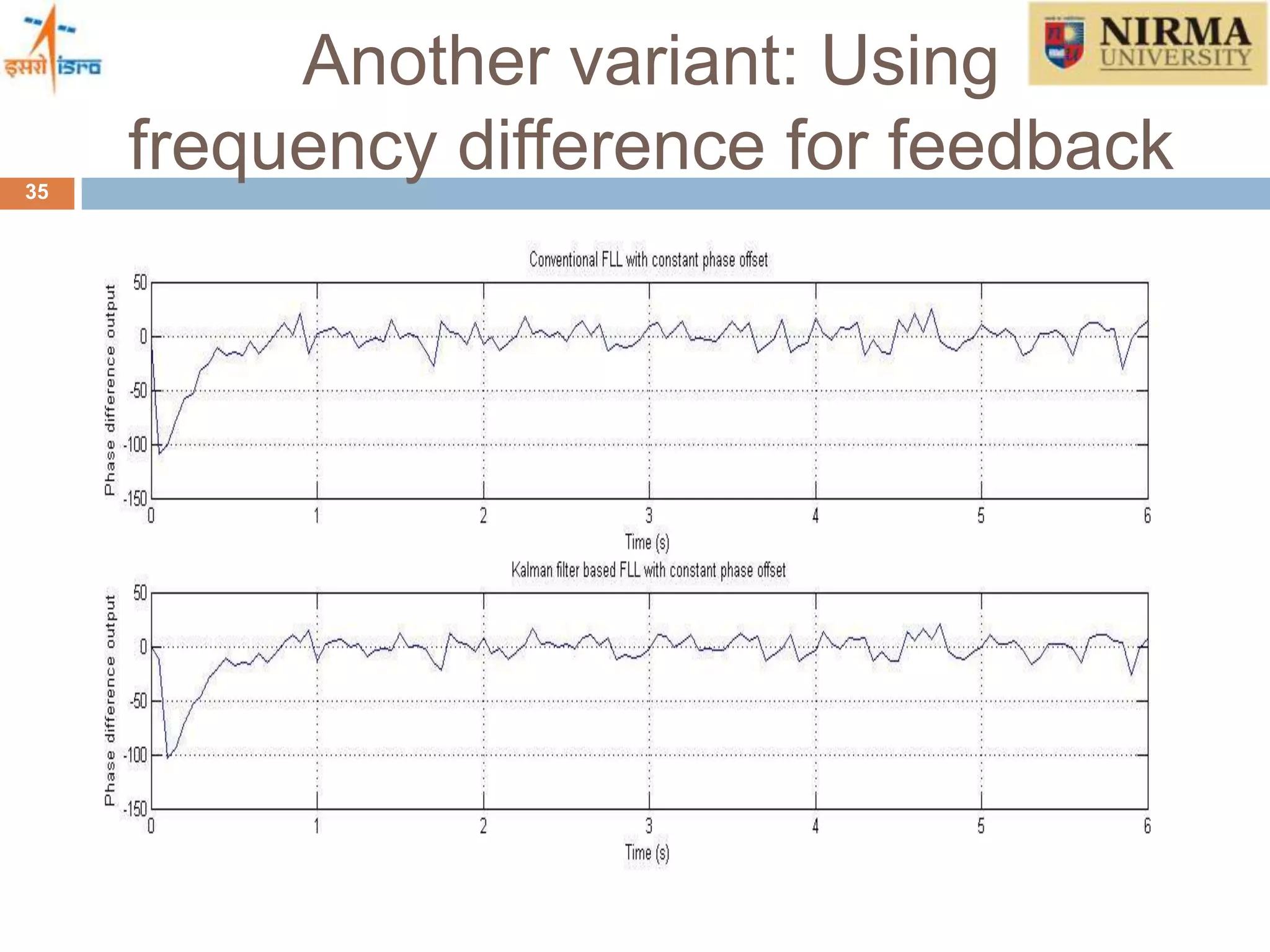
Another variant: Using
frequency difference for feedback35
PLL with 10 ms integration
time in outage36
 Increased integration time improves gain of the
integrate and dump block
 Upper limit is 10ms due to data bit transition
boundary
 Filter coefficients modified as sampling time
changed
 Initially it was taken as 1 ms, now increased to 10
ms which increases gain to 47 dB from 37 dB.
 Entire loop along with Kalman filter now works on
10 ms sampling time after integrate & dump
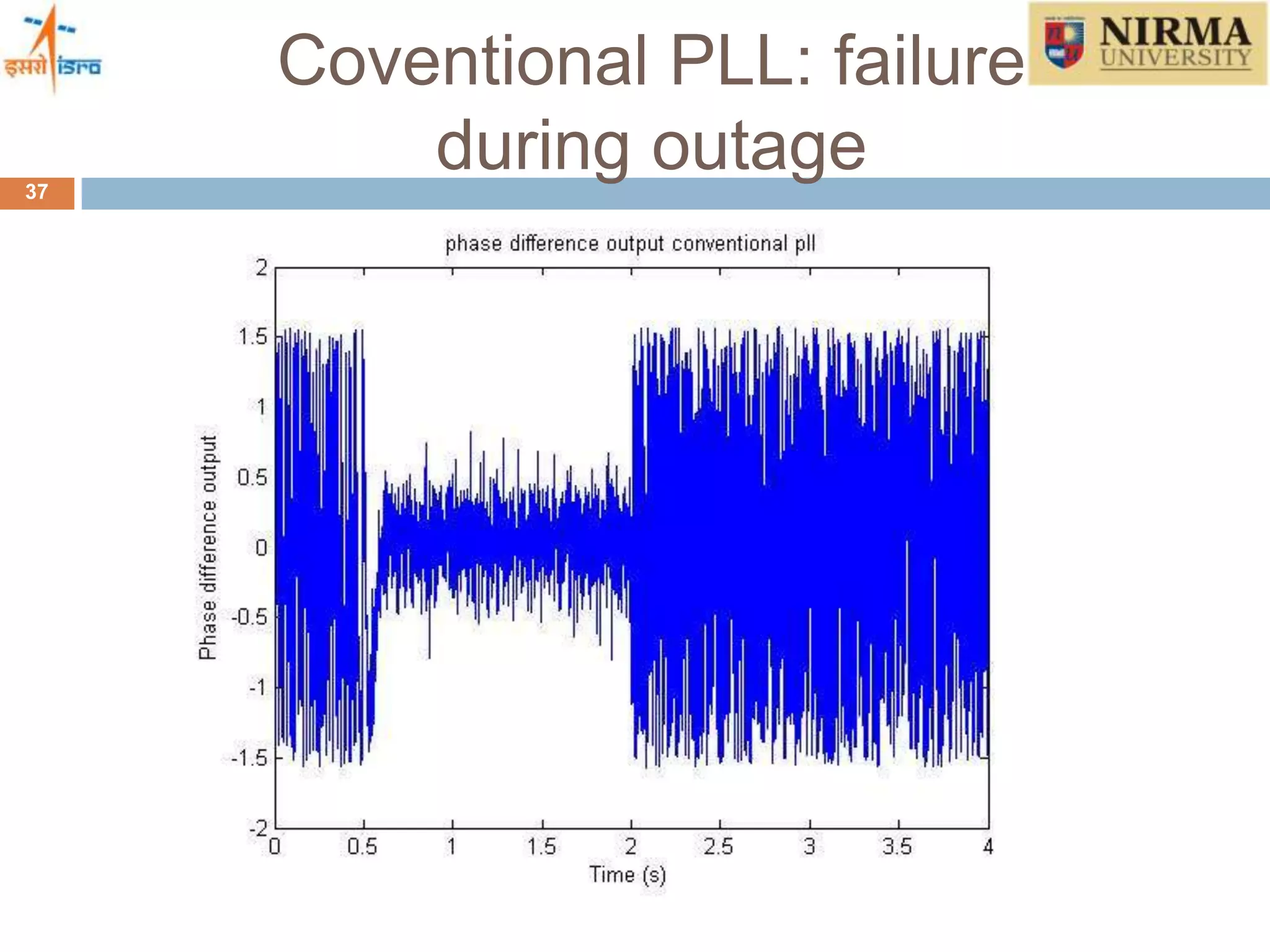
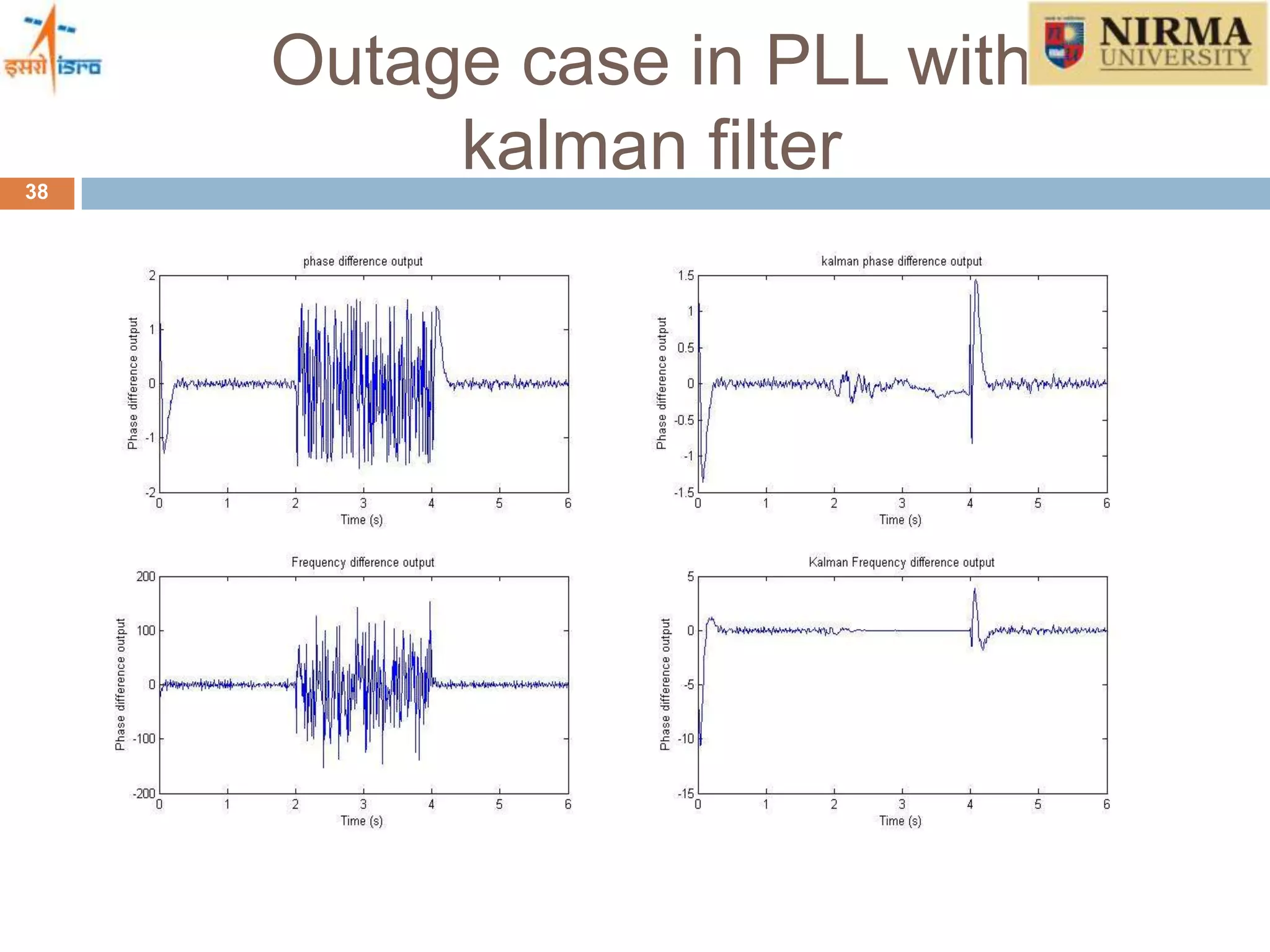
 Improvement in PLL performance even in outage
case as shown in results
Coventional PLL: failure
during outage37
Outage case in PLL with
kalman filter38
How this works
39
 Conventional PLL is not weighted and thus
due to fd being > fpullin it loses lock during
outage
 Kalman filter being weighted filter it effectively
neglects measurements during outage
 It predicts the present state values based on
the values just before signal outage occurs
and thus maintains phase lock
 Measurement error variance values increased
during outage to make it neglect
measurements
 Process error variance nearly zero
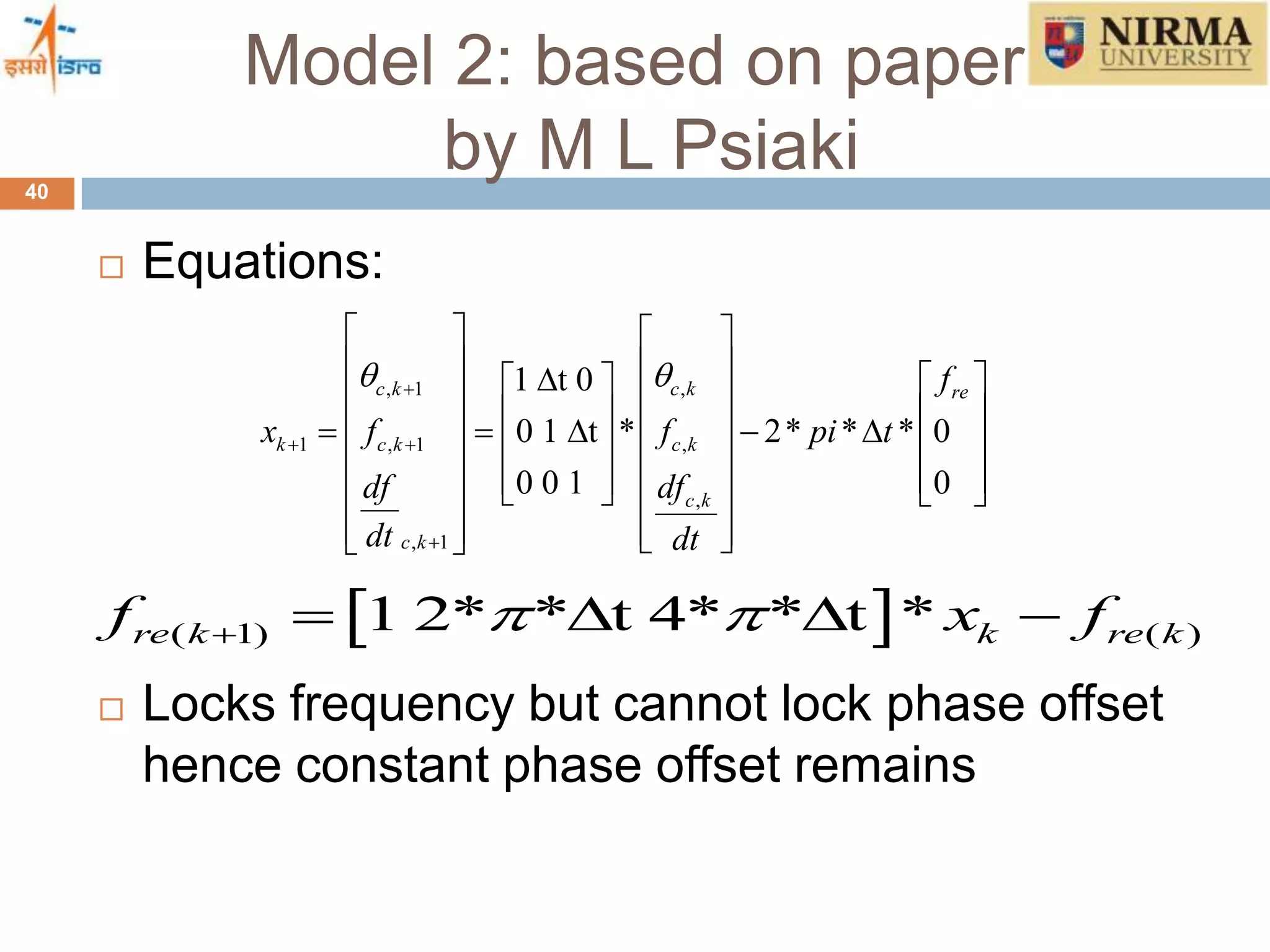
Model 2: based on papers
by M L Psiaki40
 Equations:
 Locks frequency but cannot lock phase offset
hence constant phase offset remains
, 1 ,
1 , 1 ,
,
, 1
1 t 0
0 1 t * 2* * * 0
0 0 1 0
c k c k re
k c k c k
c k
c k
f
x f f pi t
df df
dt dt
 
 

   
                                  
     
 ( 1) ( )1 2* * t 4* * t *re k k re kf x f     
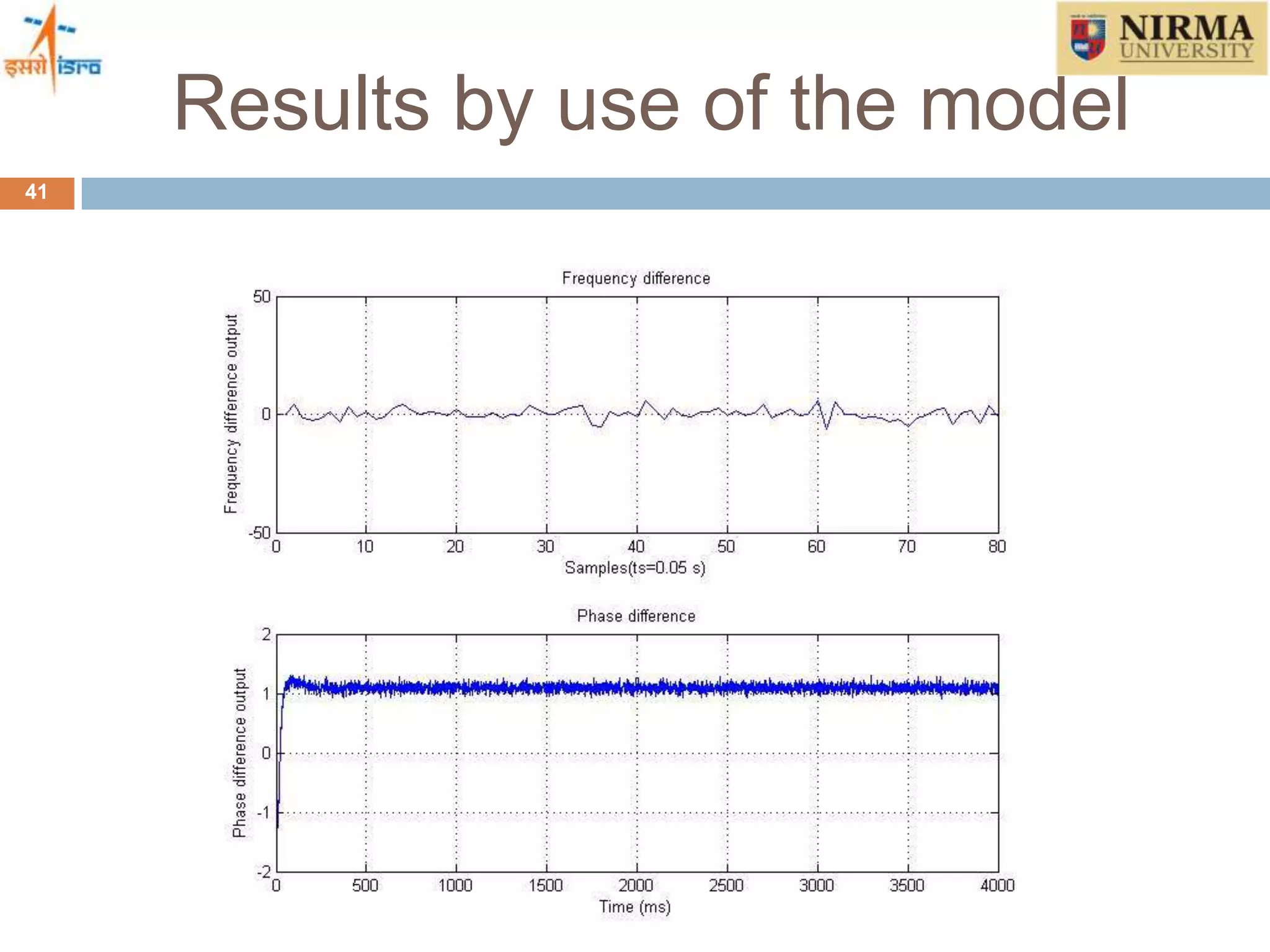
Results by use of the model
41
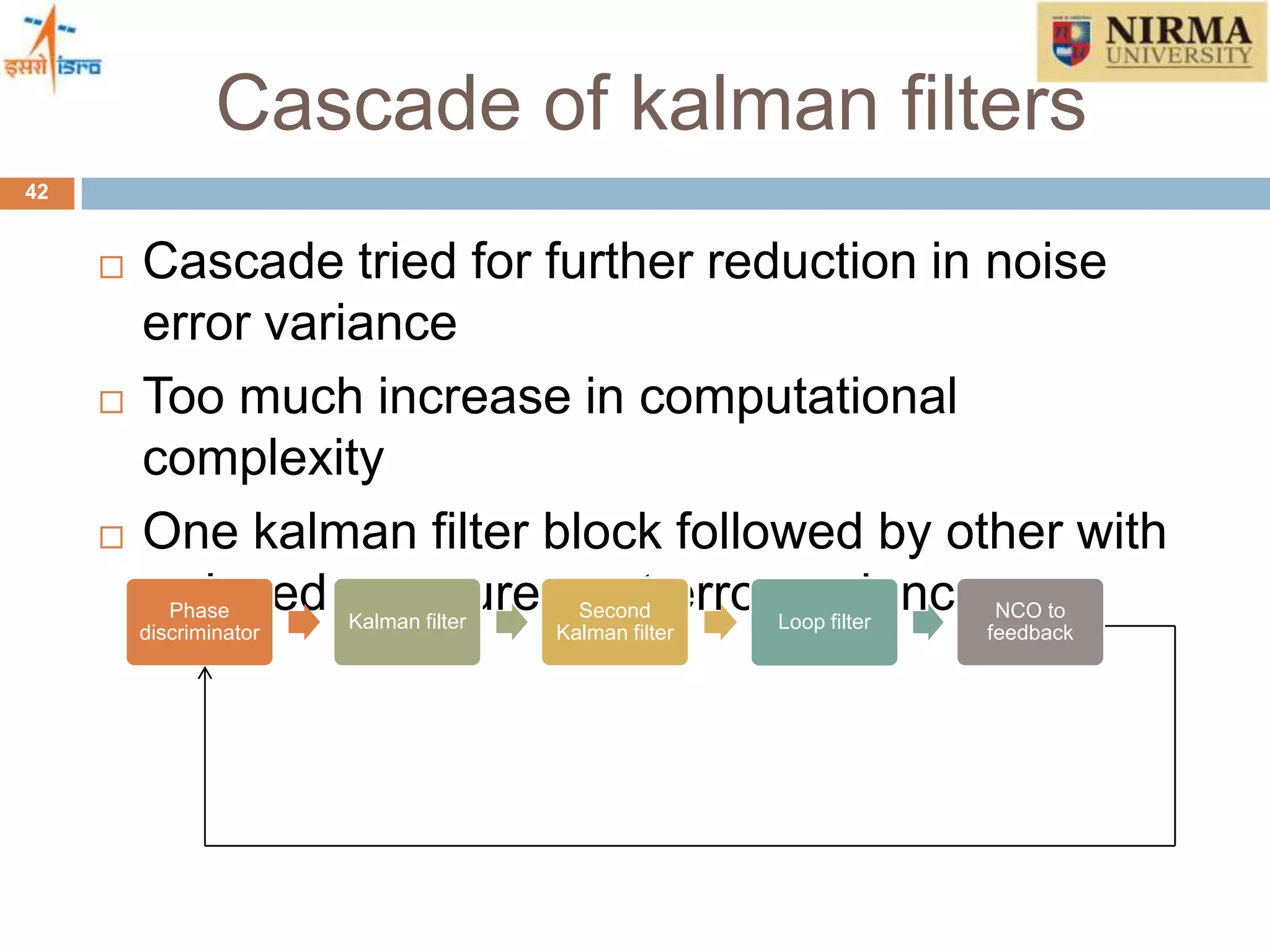
Cascade of kalman filters
42
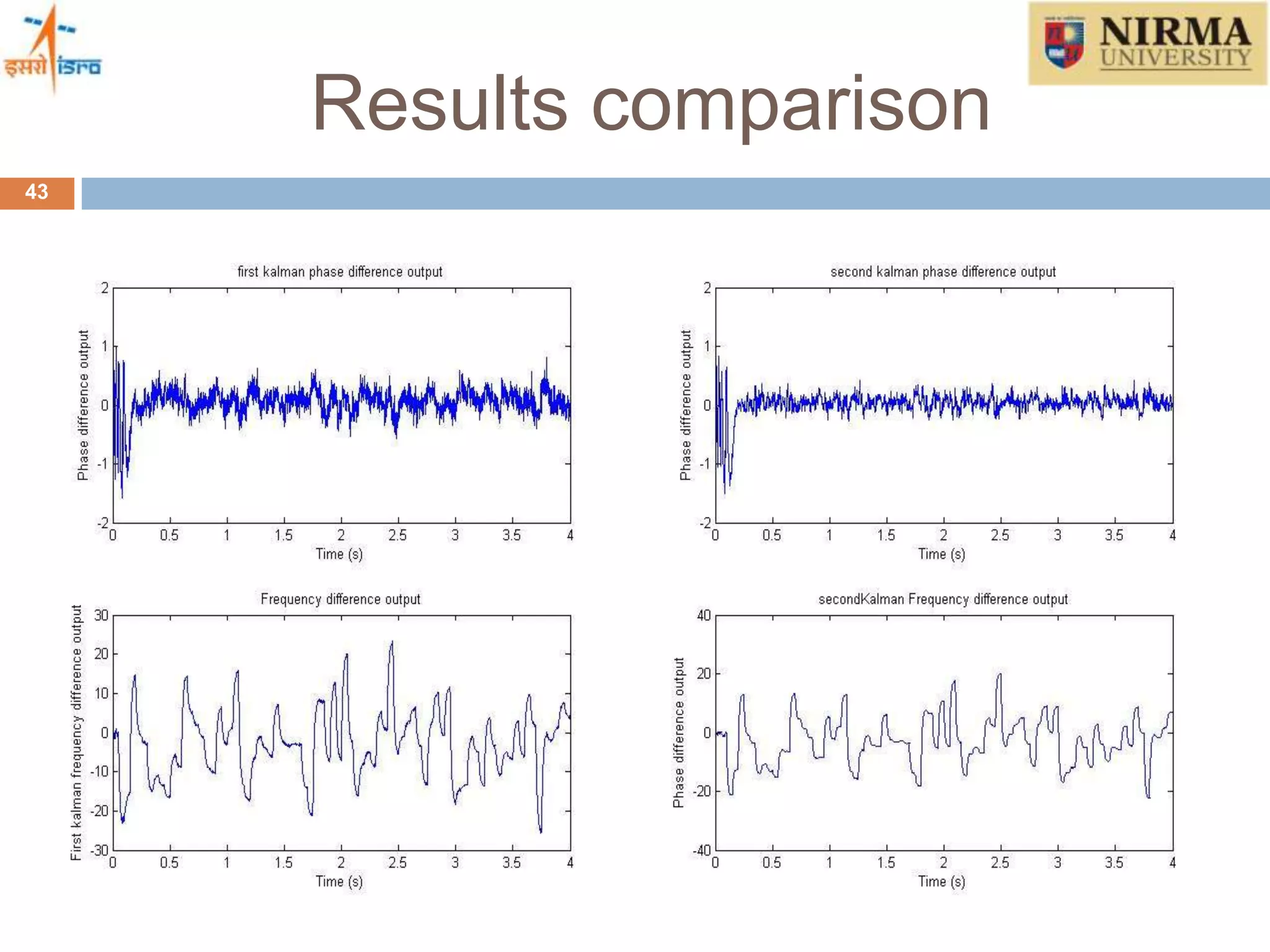
 Cascade tried for further reduction in noise
error variance
 Too much increase in computational
complexity
 One kalman filter block followed by other with
reduced measurement error variancePhase
discriminator
Kalman filter
Second
Kalman filter
Loop filter
NCO to
feedback
Results comparison
43
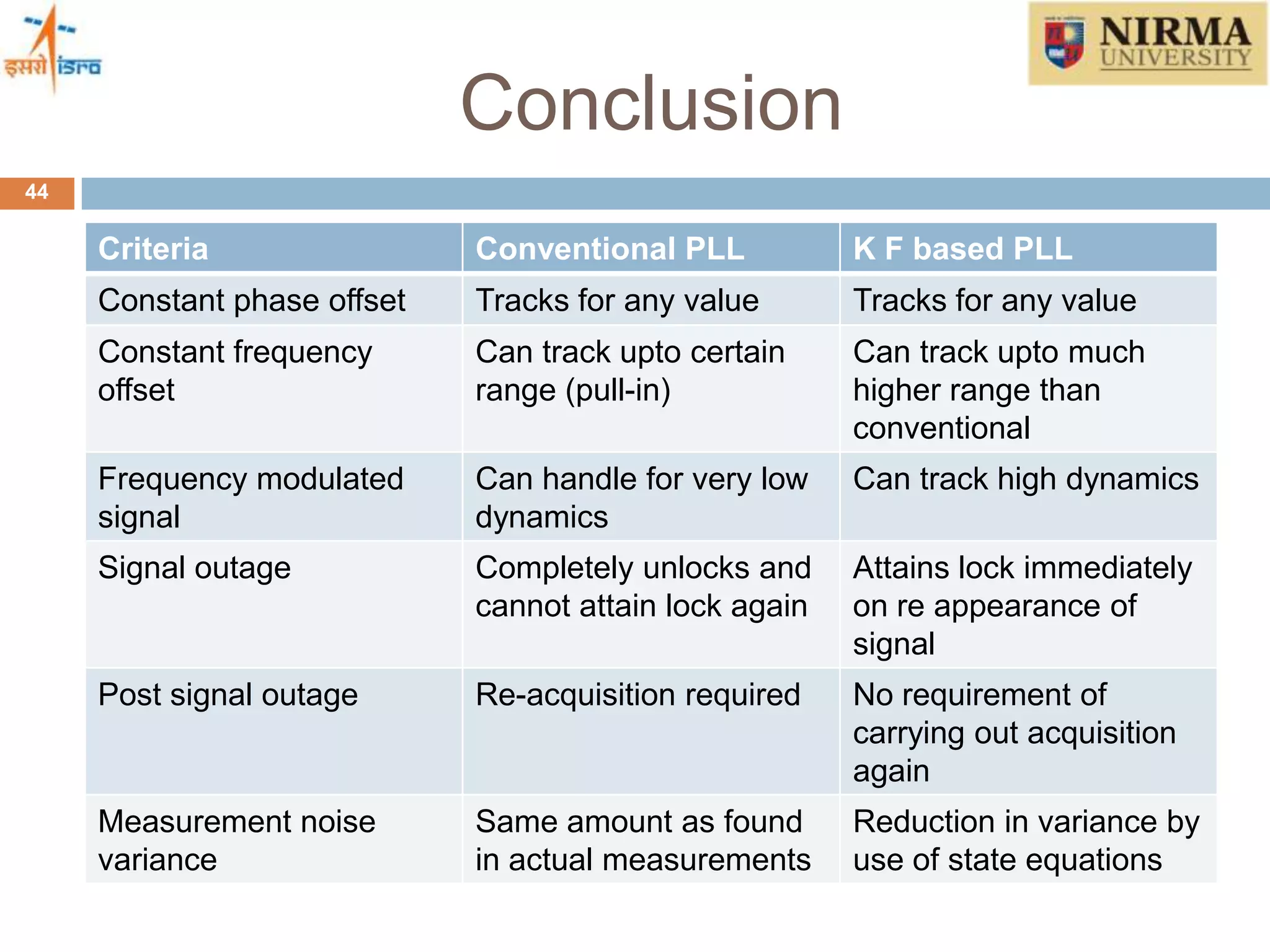
Conclusion
44
Criteria Conventional PLL K F based PLL
Constant phase offset Tracks for any value Tracks for any value
Constant frequency
offset
Can track upto certain
range (pull-in)
Can track upto much
higher range than
conventional
Frequency modulated
signal
Can handle for very low
dynamics
Can track high dynamics
Signal outage Completely unlocks and
cannot attain lock again
Attains lock immediately
on re appearance of
signal
Post signal outage Re-acquisition required No requirement of
carrying out acquisition
again
Measurement noise
variance
Same amount as found
in actual measurements
Reduction in variance by
use of state equations
References
45
 Fundamentals of Global Positioning System Receivers: A Software
Approach, James Bao-Yen Tsui, John Wiley & Sons, INC.
 Spilker, Jr., J. J. (1996a). Fundamentals of Signal Tracking Theory
 Parkinson, B.W. (1996). Introduction and Heritage of NAVSTAR, the Global
Positioning System, Volume 1, American Institute of Aeronautics and
Astronautics, Washington, DC.
 Improving Tracking Performance of PLL in High Dynamic
Applications, Department of Geomatics Engineering, by Ping Lian November
2004
 Thesis on Kalman Filter Based Tracking Algorithms For Software GPS
Receivers, Matthew Lashley
 Smoother-Based GPS Signal Tracking in a Software Receiver, Mark L.
Psiaki, Cornell University
 Extended Kalman Filter Methods for Tracking Weak GPS Signals Mark L. Psiaki
and Hee Jung, Cornell University, Ithaca, N.Y.
 Carrier tracking loop using adaptive two-stage kalman filter for high dynamics
situation K H Kim, G I Jee and J H Song, International Journal of
Thank You46
On a lighter note…

Kalman Filter Based GPS Receiver

  • 1.
    KALMAN FILTER BASEDGPS TRACKING Prepared by: Falak Shah (0BEC082) Semester VIII (EC), Nirma University Guided by: Mr. Ankesh Garg (DCTG-SAC/ISRO)
  • 2.
    Table of contents GPS overview  Signal structure of GPS  Acquisition  Tracking  Conventional tracking loop  Conversion from continuous to discrete domain  Kalman filter 2
  • 3.
    Global positioning system: overview Constellation of 24 satellites  Performance requirements of GPS systems  10-30 m accuracy  User dynamics  Worldwide coverage  Minimum number of required references for determining position in 3-D is 4  5 used to calculate user position out of 7 visible 3
  • 4.
  • 5.
    Signal structure ofGPS  Coarse/ Acquisition (C/A code) and P codes  2 frequencies L1 centered at1575.42 MHz and L2 at 1227.6 MHz. (multiple of 10.23 MHz clock)  where SL1 is the signal at L1 frequency, Ap is the amplitude of the P code, P(t) and D(t) represent the phase of the P code and data code. f1 is the L1 frequency, is the initial phase.  GPS signal phase modulated BPSK L1 p 1 c 1S =A P(t)D(t) cos(2 f t + ) + A C(t)D(t) sin(2 f t + )     5
  • 6.
    Signal structure ofGPS  P code and C/A code are bi-phase modulated at 10.23 MHz and 1.023 MHz Gold codes  C/A code generated with use of a LSR of length 10 and is 1023 bits long  1ms data enough to find its beginning  C/A codes generated and autocorrelation and cross correlation properties verified  Peak provides starting point of the code  Navigation data is 20 ms long- contains 20 C/A codes 6
  • 7.
  • 8.
  • 9.
    Acquisition  Search forfrequency over is +/- 10 kHz which is maximum Doppler range  2-D search for carrier frequency and starting point of C/A code  IF is at 21.25 MHz, sampling frequency is 5 MHz. So, center of the signal is at 1.25 MHz.  Maximum data record used for acquisition is 10 ms since data is 20 ms long  Acquisition uses circular correlation for detection ( ) ( ) *( )Z k X k H k 9
  • 10.
    Tracking loop  Afteracquisition- approximate carrier frequency and starting point of C/A code known  More accurate approximation by tracking  Continuously following the incoming carrier & code  Acquisition performed at regular intervals or on unlocking of loop  Maximum noise bandwidth, sampling time and damping factor are known  Loop gain parameters, filter coefficients calculated 10
  • 11.
    Tracking loop Costas phaselock loop Conventional tracking loop 11
  • 12.
    PLL equations 2 0 ( )nBH j df    2 1 ( ) 1 for first order PLL ( ) 1/ for 2nd order PLL F s F s s s     0 0H(s)=k ( ) / k ( )d dOverall transfer function k F s s k F s Where k0 and kd are gain of discriminator and NCO respectively. F(s) being the loop filter transfer function given by 2 1 are calculated based on given noise bandwidth and sampling frequency. Noise bandwidth is given by and  n out to be B / 2 ( 1/ 4 )n Which comes      12
  • 13.
    Continuous to discretedomain transforms  Bilinear transform and infinite impulse transform most commonly used  Convert individual blocks from continuous to discrete domain rather than complete digital design 1 1 1 2 / 1 s Bilinear transform performed as z s t z          invariant transform as k k k s s k d and impulse a a T s s z e T      13 0 0 domain becomes ( ) ( ) 1 ( ) ( ) d d Equation in discrete k k F z N z k k F z N z
  • 14.
  • 15.
    Kalman filter  Optimalrecursive data processing algorithm  Optimal in all aspects- uses all measurements available regardless of their precision  Minimises statistical error by doing this  Recursive-does not need to keep all previous measurements in memory  Assumptions- linear system model with white and Gaussian noise  Whiteness- noise value not correlated in time & equal power at all frequencies  Gaussian- number of noise sources in system and measurement device so sum Gaussian 15
  • 16.
  • 17.
    Gain due toIntegrate and dump 17 Values of SNR (dB) after integrate and dump block and its constant processing gain value.
  • 18.
  • 19.
    An example testedfor Kalman filter  Test run for projectile motion  Measurements corrupted with noise provided with incorrect initial values yet tracking done  Role of parameters present in the equation understood 19
  • 20.
    Formation of filterequations for PLL20  Phase difference and frequency difference were selected to be the parameters for state equations  Requirements: Design of FLL, error variance in measurement of phase and frequency  Deciding the control inputs for the state equations  Finding variance for different values of C/N0 which are 40 dB-Hz to 80 dB-Hz for GPS signals  Measurement matrix becomes [1 2*pi*T ;0 1] 
  • 21.
    FLL Design 21  Providesfrequency difference between incoming and locally generated signals  Equation as follows: atan2(dot,cross)/(t2-t1)  Where dot = IP1 IP2 + QP1 QP2 cross = IP1 QP2 − IP2 × QP1  This discriminator is optimal at low to high signal to noise ratios
  • 22.
  • 23.
    Benefits of kalmanfiltering and costas loop23  Loop is unaffected by sign change due to data bits due to use of division of in-phase and quadrature components  Limitation of low bandwidth of loop filter is overcome by using kalman filter.  Able to track even in case of high velocity users having high doppler frequency  Optimal estimate using all available measurements
  • 24.
    Different Filter implementations 24 Smoother-Based GPS Signal Tracking in a Software Receiver, Mark L. Psiaki, Cornell University  Kalman Filter Based Tracking Algorithms For Software GPS Receivers, Mathew Lashley, Thesis, Auburn University  Above two implemented and innovation of change in input values done- desired output values obtained
  • 25.
    Challenges in design 25 Non functioning of PLL due to divide by zero at t=T as sine value dropped to zero  Kalman filter not showing any output values beyond first sample as first output came NaN (not a number)  Selection of values of error variance in measurement (open loop or closed loop)  State equation not producing desired output  Very high variance in FLL output
  • 26.
    Solutions to designchallenges 26  Addition of very small value (10e-6) to Quadrature phase component to prevent divide by zero error  Debugging to find reason for non functioning Kalman filter after first sample  Source found to be initial values of FLL set as zero causing NaN in output and the same loop iterations again and again  Initial values altered and output obtained  Error variance measured for closed loops
  • 27.
    Solutions to designchallenges 27  Process error variance and measurement error variance measured setting up high values for other  State equation used input as frequency difference output from FLL which failed to get desired output  So, difference of previous state of frequency and FLL output taken  FLL outputs averaged for decreasing variance
  • 28.
    Results: Lock evenin high dynamics28
  • 29.
    Results: Higher loopbandwidth and locking29
  • 30.
    Review III-Kalman filterbased GPS tracking 30
  • 31.
    List of Simulationscarried out31  PLL and FLL based on thesis by Matthew Lashley  PLL based on 2 papers by M L Psiaki - GPS Signal Tracking in high dynamics and low C/N0  One innovation in design of FLL using different equations from those given in the papers  Cascading of Kalman filter  All simulations performed at 40 dB-Hz-at lower value of SNR than the average 45 dB-Hz for GPS signals  Test for signal outage and whether or not signal
  • 32.
  • 33.
    Matthew Lashley thesis 33 Equations  Just depends on previous state, no input values.  Test performed show it is able to maintain phase lock even after outage situation. , 1 , , 1 , , , 1 1 t 0 0 1 t * 0 0 1 c k c k c k c k c k c k f f df df dt dt                                    
  • 34.
    Comparison: discriminator output andkalman filtered output34
  • 35.
    Another variant: Using frequencydifference for feedback35
  • 36.
    PLL with 10ms integration time in outage36  Increased integration time improves gain of the integrate and dump block  Upper limit is 10ms due to data bit transition boundary  Filter coefficients modified as sampling time changed  Initially it was taken as 1 ms, now increased to 10 ms which increases gain to 47 dB from 37 dB.  Entire loop along with Kalman filter now works on 10 ms sampling time after integrate & dump  Improvement in PLL performance even in outage case as shown in results
  • 37.
  • 38.
    Outage case inPLL with kalman filter38
  • 39.
    How this works 39 Conventional PLL is not weighted and thus due to fd being > fpullin it loses lock during outage  Kalman filter being weighted filter it effectively neglects measurements during outage  It predicts the present state values based on the values just before signal outage occurs and thus maintains phase lock  Measurement error variance values increased during outage to make it neglect measurements  Process error variance nearly zero
  • 40.
    Model 2: basedon papers by M L Psiaki40  Equations:  Locks frequency but cannot lock phase offset hence constant phase offset remains , 1 , 1 , 1 , , , 1 1 t 0 0 1 t * 2* * * 0 0 0 1 0 c k c k re k c k c k c k c k f x f f pi t df df dt dt                                                    ( 1) ( )1 2* * t 4* * t *re k k re kf x f     
  • 41.
    Results by useof the model 41
  • 42.
    Cascade of kalmanfilters 42  Cascade tried for further reduction in noise error variance  Too much increase in computational complexity  One kalman filter block followed by other with reduced measurement error variancePhase discriminator Kalman filter Second Kalman filter Loop filter NCO to feedback
  • 43.
  • 44.
    Conclusion 44 Criteria Conventional PLLK F based PLL Constant phase offset Tracks for any value Tracks for any value Constant frequency offset Can track upto certain range (pull-in) Can track upto much higher range than conventional Frequency modulated signal Can handle for very low dynamics Can track high dynamics Signal outage Completely unlocks and cannot attain lock again Attains lock immediately on re appearance of signal Post signal outage Re-acquisition required No requirement of carrying out acquisition again Measurement noise variance Same amount as found in actual measurements Reduction in variance by use of state equations
  • 45.
    References 45  Fundamentals ofGlobal Positioning System Receivers: A Software Approach, James Bao-Yen Tsui, John Wiley & Sons, INC.  Spilker, Jr., J. J. (1996a). Fundamentals of Signal Tracking Theory  Parkinson, B.W. (1996). Introduction and Heritage of NAVSTAR, the Global Positioning System, Volume 1, American Institute of Aeronautics and Astronautics, Washington, DC.  Improving Tracking Performance of PLL in High Dynamic Applications, Department of Geomatics Engineering, by Ping Lian November 2004  Thesis on Kalman Filter Based Tracking Algorithms For Software GPS Receivers, Matthew Lashley  Smoother-Based GPS Signal Tracking in a Software Receiver, Mark L. Psiaki, Cornell University  Extended Kalman Filter Methods for Tracking Weak GPS Signals Mark L. Psiaki and Hee Jung, Cornell University, Ithaca, N.Y.  Carrier tracking loop using adaptive two-stage kalman filter for high dynamics situation K H Kim, G I Jee and J H Song, International Journal of
  • 46.
  • 47.
    On a lighternote…