COOPERATIVE RESEARCH CENTRE FOR CONTAMINATION ASSESSMENT
AND REMEDIATION OF THE ENVIRONMENT
Professor Ravi Naidu,
Managing Director & CEO, CRC CARE
Global Chair Innovation, Global Centre for Environmental
Remediation, University of Newcastle
2nd May 2018
Clean Soils: Humanity’s
next great challenge
Overview
• Introduction
• Chemical pollutants in soils
• Impacts
• Human
• Environment
• Risk implications
• Clean Earth: next great challenge
• Conclusion and Global Initiative
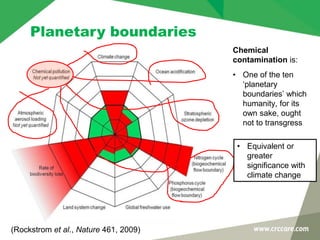
Planetary boundaries
Chemical
contamination is:
• One of the ten
‘planetary
boundaries’ which
humanity, for its
own sake, ought
not to transgress
(Rockstrom et al., Nature 461, 2009)
• Equivalent or
greater
significance with
climate change
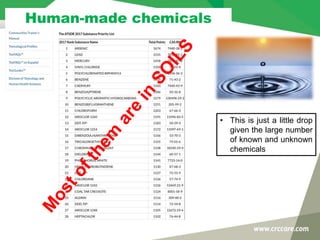
• This is just a little drop
given the large number
of known and unknown
chemicals
Human-made chemicals
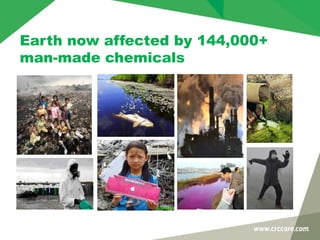
Earth now affected by 144,000+
man-made chemicals
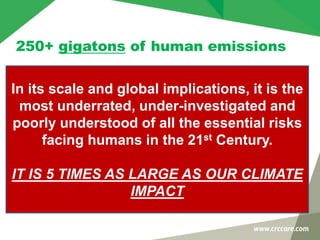
250+ gigatons of human emissions
• 30 million tons of industrial
chemicals and pesticides
• 150 mt of N and 11mt of P
• 400 mt of hazardous wastes
• 50 mt e-waste
• 15 bt of coal, oil and gas
• 50 bt of carbon dioxide
gas
• 72 bt materials and
metals
• >50 to 100 bt mining
wastes
• 75 bt of topsoil.
250+ gigatons of human emissions
In its scale and global implications, it is the
most underrated, under-investigated and
poorly understood of all the essential risks
facing humans in the 21st Century.
IT IS 5 TIMES AS LARGE AS OUR CLIMATE
IMPACT
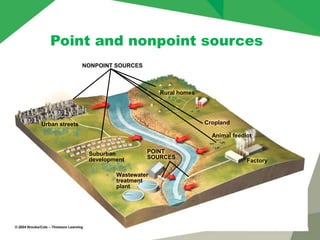
Point and nonpoint sources
NONPOINT SOURCES
Urban streets
Suburban
development
Wastewater
treatment
plant
Rural homes
Cropland
Factory
Animal feedlot
POINT
SOURCES
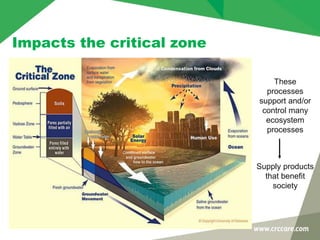
Impacts the critical zone
These
processes
support and/or
control many
ecosystem
processes
Supply products
that benefit
society
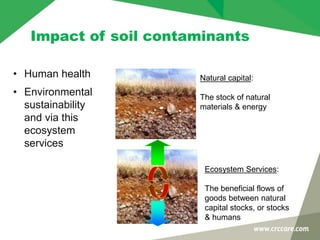
Impact of soil contaminants
• Human health
• Environmental
sustainability
and via this
ecosystem
services
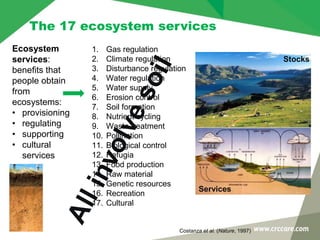
Natural capital:
The stock of natural
materials & energy
Ecosystem Services:
The beneficial flows of
goods between natural
capital stocks, or stocks
& humans
Costanza et al. (Nature, 1997)
1. Gas regulation
2. Climate regulation
3. Disturbance regulation
4. Water regulation
5. Water supply
6. Erosion control
7. Soil formation
8. Nutrient cycling
9. Waste treatment
10. Pollination
11. Biological control
12. Refugia
13. Food production
14. Raw material
15. Genetic resources
16. Recreation
17. Cultural
Services
Stocks
Ecosystem
services:
benefits that
people obtain
from
ecosystems:
• provisioning
• regulating
• supporting
• cultural
services
The 17 ecosystem services
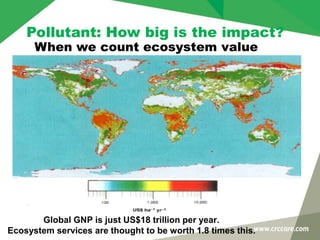
Global GNP is just US$18 trillion per year.
Ecosystem services are thought to be worth 1.8 times this.
Pollutant: How big is the impact?
When we count ecosystem value
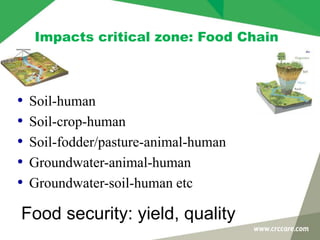
Impacts critical zone: Food Chain
• Soil-human
• Soil-crop-human
• Soil-fodder/pasture-animal-human
• Groundwater-animal-human
• Groundwater-soil-human etc
Food security: yield, quality
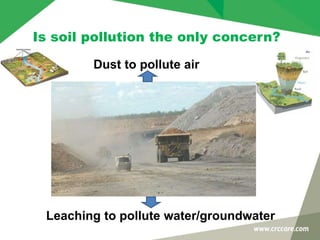
Is soil pollution the only concern?
Dust to pollute air
Leaching to pollute water/groundwater
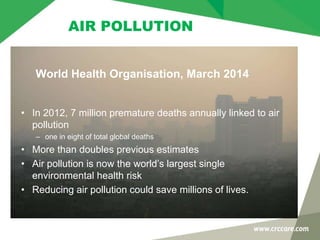
• In 2012, 7 million premature deaths annually linked to air
pollution
– one in eight of total global deaths
• More than doubles previous estimates
• Air pollution is now the world’s largest single
environmental health risk
• Reducing air pollution could save millions of lives.
World Health Organisation, March 2014
AIR POLLUTION
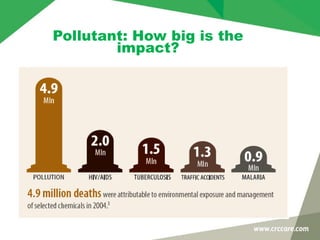
Pollutant: How big is the
impact?
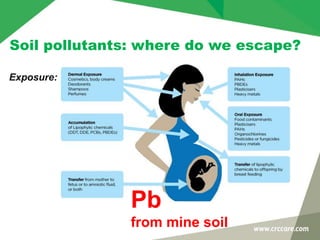
Soil pollutants: where do we escape?
Exposure:
Pb
from mine soil
HUMAN-MADE CHEMICALS
• Brain development conditions affect millions of children worldwide
– e.g. autism, Attention deficit hyperactivity disorder (ADHD),
dyslexia and other cognitive impairments
• Five industrial chemicals identified in 2006 as toxic to the developing
brain: lead, methylmercury, polychlorinated biphenyls, arsenic,
toluene
• Since 2006, six additional such chemicals documented
– manganese, fluoride, chlorpyrifos, dichlorodiphenyltrichloroethane,
tetrachloroethylene, and the polybrominated diphenyl ethers
– Even more remain undiscovered
Grandjean & Llandigran (2014) Neurobehavioural effects of developmental toxicity. The Lancet Neurology, 13(3): pp 330-338.
The Lancet, March 2014
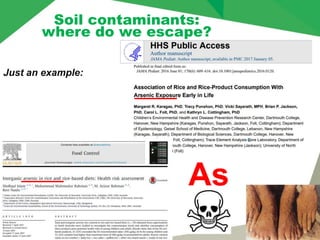
Soil contaminants:
where do we escape?
Just an example:
As
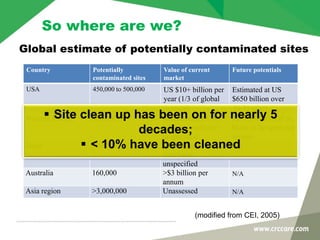
Country Potentially
contaminated sites
Value of current
market
Future potentials
USA 450,000 to 500,000 US $10+ billion per
year (1/3 of global
demand)
Estimated at US
$650 billion over
30-35 years
Western Europe 600,000+ An estimated € 50
billion, timeframe
unspecified
0.5-1.5% of GDP is
likely to be spent per
annum
Japan 500,000+ $1.2 billion+,
timeframe
unspecified
N/A
Australia 160,000 >$3 billion per
annum
N/A
Asia region >3,000,000 Unassessed N/A
(modified from CEI, 2005)
Global estimate of potentially contaminated sites
So where are we?
 Site clean up has been on for nearly 5
decades;
 < 10% have been cleaned
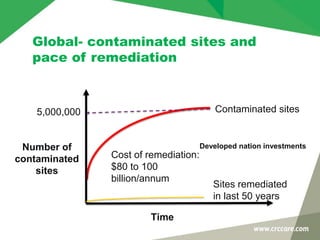
Global- contaminated sites and
pace of remediation
Time
5,000,000
Number of
contaminated
sites
Contaminated sites
Sites remediated
in last 50 years
Cost of remediation:
$80 to 100
billion/annum
Developed nation investments
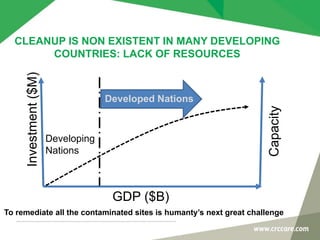
CLEANUP IS NON EXISTENT IN MANY DEVELOPING
COUNTRIES: LACK OF RESOURCES
Investment($M)
GDP ($B)
Capacity
Developing
Nations
Developed Nations
To remediate all the contaminated sites is humanty’s next great challenge
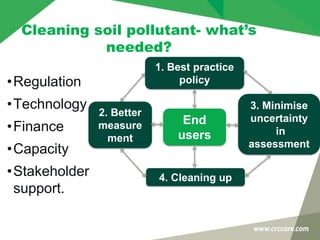
Cleaning soil pollutant- what’s
needed?
•Regulation
•Technology
•Finance
•Capacity
•Stakeholder
support.
1. Best practice
policy
2. Better
measure
ment
3. Minimise
uncertainty
in
assessment
4. Cleaning up
End
users
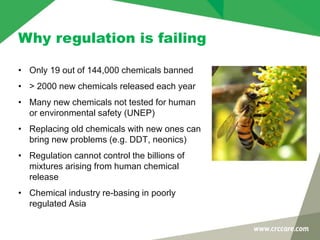
Why regulation is failing
• Only 19 out of 144,000 chemicals banned
• > 2000 new chemicals released each year
• Many new chemicals not tested for human
or environmental safety (UNEP)
• Replacing old chemicals with new ones can
bring new problems (e.g. DDT, neonics)
• Regulation cannot control the billions of
mixtures arising from human chemical
release
• Chemical industry re-basing in poorly
regulated Asia
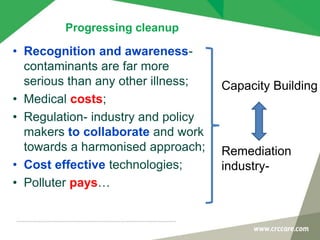
Progressing cleanup
• Recognition and awareness-
contaminants are far more
serious than any other illness;
• Medical costs;
• Regulation- industry and policy
makers to collaborate and work
towards a harmonised approach;
• Cost effective technologies;
• Polluter pays…
Capacity Building
Remediation
industry-
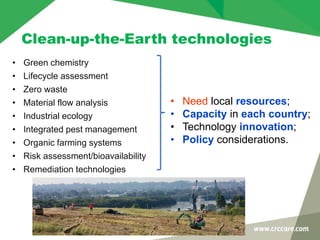
Clean-up-the-Earth technologies
• Green chemistry
• Lifecycle assessment
• Zero waste
• Material flow analysis
• Industrial ecology
• Integrated pest management
• Organic farming systems
• Risk assessment/bioavailability
• Remediation technologies
• Need local resources;
• Capacity in each country;
• Technology innovation;
• Policy considerations.
Concluding remarks
• More than 5 million potentially contaminated sites;
• Chemical pollutant in soil is not a single entity- Linked to water
and air
• The heath burden is higher than any other causalities
• The impact of chemical pollutants is five times as large as our
climate impact;
• Regulation could play a central role in managing;
– Introduction of new chemicals in the environment;
• Need for an accord like Paris Climate Change- for Soil pollutants
• Global initiative is needed..
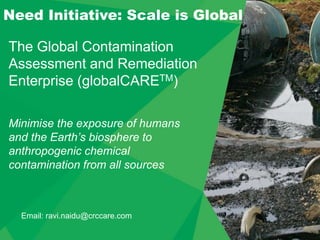
The Global Contamination
Assessment and Remediation
Enterprise (globalCARETM)
Need Initiative: Scale is Global
Minimise the exposure of humans
and the Earth’s biosphere to
anthropogenic chemical
contamination from all sources
Email: ravi.naidu@crccare.com
Acknowledgement
• Dr Bhabananda Biswas, UniSA
• Mr Adam Barclay, CRC CARE
• Mr Julian Cribb
• Dr Brent Clothier
• GCER and CRC CARE Team
Unlocking Future..
Global CleanUp Congress:
21st to 25th October,
Coimbatore, India
Global status of soil pollution

Global status of soil pollution

  • 2.
    COOPERATIVE RESEARCH CENTREFOR CONTAMINATION ASSESSMENT AND REMEDIATION OF THE ENVIRONMENT Professor Ravi Naidu, Managing Director & CEO, CRC CARE Global Chair Innovation, Global Centre for Environmental Remediation, University of Newcastle 2nd May 2018 Clean Soils: Humanity’s next great challenge
  • 4.
    Overview • Introduction • Chemicalpollutants in soils • Impacts • Human • Environment • Risk implications • Clean Earth: next great challenge • Conclusion and Global Initiative
  • 5.
    Planetary boundaries Chemical contamination is: •One of the ten ‘planetary boundaries’ which humanity, for its own sake, ought not to transgress (Rockstrom et al., Nature 461, 2009) • Equivalent or greater significance with climate change
  • 6.
    • This isjust a little drop given the large number of known and unknown chemicals Human-made chemicals
  • 7.
    Earth now affectedby 144,000+ man-made chemicals
  • 8.
    250+ gigatons ofhuman emissions • 30 million tons of industrial chemicals and pesticides • 150 mt of N and 11mt of P • 400 mt of hazardous wastes • 50 mt e-waste • 15 bt of coal, oil and gas • 50 bt of carbon dioxide gas • 72 bt materials and metals • >50 to 100 bt mining wastes • 75 bt of topsoil.
  • 9.
    250+ gigatons ofhuman emissions In its scale and global implications, it is the most underrated, under-investigated and poorly understood of all the essential risks facing humans in the 21st Century. IT IS 5 TIMES AS LARGE AS OUR CLIMATE IMPACT
  • 10.
    Point and nonpointsources NONPOINT SOURCES Urban streets Suburban development Wastewater treatment plant Rural homes Cropland Factory Animal feedlot POINT SOURCES
  • 11.
    Impacts the criticalzone These processes support and/or control many ecosystem processes Supply products that benefit society
  • 12.
    Impact of soilcontaminants • Human health • Environmental sustainability and via this ecosystem services Natural capital: The stock of natural materials & energy Ecosystem Services: The beneficial flows of goods between natural capital stocks, or stocks & humans
  • 13.
    Costanza et al.(Nature, 1997) 1. Gas regulation 2. Climate regulation 3. Disturbance regulation 4. Water regulation 5. Water supply 6. Erosion control 7. Soil formation 8. Nutrient cycling 9. Waste treatment 10. Pollination 11. Biological control 12. Refugia 13. Food production 14. Raw material 15. Genetic resources 16. Recreation 17. Cultural Services Stocks Ecosystem services: benefits that people obtain from ecosystems: • provisioning • regulating • supporting • cultural services The 17 ecosystem services
  • 14.
    Global GNP isjust US$18 trillion per year. Ecosystem services are thought to be worth 1.8 times this. Pollutant: How big is the impact? When we count ecosystem value
  • 15.
    Impacts critical zone:Food Chain • Soil-human • Soil-crop-human • Soil-fodder/pasture-animal-human • Groundwater-animal-human • Groundwater-soil-human etc Food security: yield, quality
  • 16.
    Is soil pollutionthe only concern? Dust to pollute air Leaching to pollute water/groundwater
  • 17.
    • In 2012,7 million premature deaths annually linked to air pollution – one in eight of total global deaths • More than doubles previous estimates • Air pollution is now the world’s largest single environmental health risk • Reducing air pollution could save millions of lives. World Health Organisation, March 2014 AIR POLLUTION
  • 18.
    Pollutant: How bigis the impact?
  • 19.
    Soil pollutants: wheredo we escape? Exposure: Pb from mine soil
  • 20.
    HUMAN-MADE CHEMICALS • Braindevelopment conditions affect millions of children worldwide – e.g. autism, Attention deficit hyperactivity disorder (ADHD), dyslexia and other cognitive impairments • Five industrial chemicals identified in 2006 as toxic to the developing brain: lead, methylmercury, polychlorinated biphenyls, arsenic, toluene • Since 2006, six additional such chemicals documented – manganese, fluoride, chlorpyrifos, dichlorodiphenyltrichloroethane, tetrachloroethylene, and the polybrominated diphenyl ethers – Even more remain undiscovered Grandjean & Llandigran (2014) Neurobehavioural effects of developmental toxicity. The Lancet Neurology, 13(3): pp 330-338. The Lancet, March 2014
  • 21.
    Soil contaminants: where dowe escape? Just an example: As
  • 22.
    Country Potentially contaminated sites Valueof current market Future potentials USA 450,000 to 500,000 US $10+ billion per year (1/3 of global demand) Estimated at US $650 billion over 30-35 years Western Europe 600,000+ An estimated € 50 billion, timeframe unspecified 0.5-1.5% of GDP is likely to be spent per annum Japan 500,000+ $1.2 billion+, timeframe unspecified N/A Australia 160,000 >$3 billion per annum N/A Asia region >3,000,000 Unassessed N/A (modified from CEI, 2005) Global estimate of potentially contaminated sites So where are we?  Site clean up has been on for nearly 5 decades;  < 10% have been cleaned
  • 24.
    Global- contaminated sitesand pace of remediation Time 5,000,000 Number of contaminated sites Contaminated sites Sites remediated in last 50 years Cost of remediation: $80 to 100 billion/annum Developed nation investments
  • 25.
    CLEANUP IS NONEXISTENT IN MANY DEVELOPING COUNTRIES: LACK OF RESOURCES Investment($M) GDP ($B) Capacity Developing Nations Developed Nations To remediate all the contaminated sites is humanty’s next great challenge
  • 26.
    Cleaning soil pollutant-what’s needed? •Regulation •Technology •Finance •Capacity •Stakeholder support. 1. Best practice policy 2. Better measure ment 3. Minimise uncertainty in assessment 4. Cleaning up End users
  • 27.
    Why regulation isfailing • Only 19 out of 144,000 chemicals banned • > 2000 new chemicals released each year • Many new chemicals not tested for human or environmental safety (UNEP) • Replacing old chemicals with new ones can bring new problems (e.g. DDT, neonics) • Regulation cannot control the billions of mixtures arising from human chemical release • Chemical industry re-basing in poorly regulated Asia
  • 28.
    Progressing cleanup • Recognitionand awareness- contaminants are far more serious than any other illness; • Medical costs; • Regulation- industry and policy makers to collaborate and work towards a harmonised approach; • Cost effective technologies; • Polluter pays… Capacity Building Remediation industry-
  • 29.
    Clean-up-the-Earth technologies • Greenchemistry • Lifecycle assessment • Zero waste • Material flow analysis • Industrial ecology • Integrated pest management • Organic farming systems • Risk assessment/bioavailability • Remediation technologies • Need local resources; • Capacity in each country; • Technology innovation; • Policy considerations.
  • 30.
    Concluding remarks • Morethan 5 million potentially contaminated sites; • Chemical pollutant in soil is not a single entity- Linked to water and air • The heath burden is higher than any other causalities • The impact of chemical pollutants is five times as large as our climate impact; • Regulation could play a central role in managing; – Introduction of new chemicals in the environment; • Need for an accord like Paris Climate Change- for Soil pollutants • Global initiative is needed..
  • 31.
    The Global Contamination Assessmentand Remediation Enterprise (globalCARETM) Need Initiative: Scale is Global Minimise the exposure of humans and the Earth’s biosphere to anthropogenic chemical contamination from all sources Email: ravi.naidu@crccare.com
  • 32.
    Acknowledgement • Dr BhabanandaBiswas, UniSA • Mr Adam Barclay, CRC CARE • Mr Julian Cribb • Dr Brent Clothier • GCER and CRC CARE Team
  • 33.
  • 34.
    Global CleanUp Congress: 21stto 25th October, Coimbatore, India