SOIL REMEDIATION
By : Ahmed shrshr
ID : 202412392050005
What is Soil Remediation?
Soil remediation refers to the process of removing contaminants from soil
or reducing their toxicity to acceptable levels.
It aims to restore the soil's natural functions and make it suitable for
various uses, such as agriculture, construction, or ecological restoration.
Importance of Soil Remediation
Soil is a vital natural resource that supports plant growth, provides
habitat for organisms, and plays a crucial role in the ecosystem.
Contaminated soil can pose risks to human health, wildlife, and the
environment, through direct contact, ingestion of contaminated
food, or groundwater contamination
Main Causes of Soil Pollution
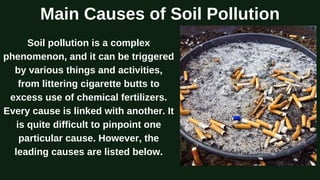
Soil pollution is a complex
phenomenon, and it can be triggered
by various things and activities,
from littering cigarette butts to
excess use of chemical fertilizers.
Every cause is linked with another. It
is quite difficult to pinpoint one
particular cause. However, the
leading causes are listed below.
1. INDUSTRIAL ACTIVITY
Industrial activity has been the biggest contributor to the problem in
the last century, especially since mining and manufacturing have
increased. Most industries are dependent on extracting minerals from the
earth.
Whether it is iron ore or coal, the by-products are contaminated and not
disposed off in a manner that can be considered safe. As a result,
industrial waste lingers on the soil surface for a long time, making it
unsuitable for use.
2. AGRICULTURAL ACTIVITIES
The utilization of chemicals has gone up
tremendously since technology has
provided us with modern pesticides and
fertilizers. They are full of chemicals not
produced in nature and cannot be broken
down. As a result, they seep into the ground
after mixing with water and slowly reduce
the soil fertility.
Other chemicals damage the composition
of the soil and make it more erodible by
water and air. Plants absorb many of these
pesticides, and when they decompose, they
cause soil pollution since they become a
part of the land.
FINALLY, A GROWING CONCERN IS HOW WE DISPOSE OF OUR WASTE. WHILE
INDUSTRIAL WASTE IS SURE TO CAUSE CONTAMINATION, THERE IS ANOTHER
WAY IN WHICH WE ARE ADDING TO THE POLLUTION. EVERY PERSON EXCRETES
A CERTAIN AMOUNT OF PERSONAL WASTE IN THE FORM OF URINE AND
FAECES.
WHILE MUCH OF IT MOVES INTO THE SEWER SYSTEM, A LARGE AMOUNT IS
DUMPED DIRECTLY INTO LANDFILLS IN THE FORM OF DIAPERS. EVEN THE
SEWER SYSTEM ENDS AT THE LANDFILL, WHERE THE BIOLOGICAL WASTE
POLLUTES THE SOIL AND WATER. THIS IS BECAUSE OUR BODIES ARE FULL OF
TOXINS AND CHEMICALS THAT ARE NOW SEEPING INTO THE LAND AND
CAUSING SOIL POLLUTION.
3. Waste Disposal
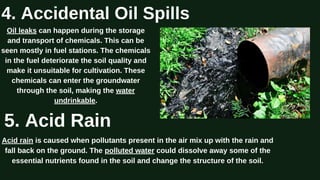
Oil leaks can happen during the storage
and transport of chemicals. This can be
seen mostly in fuel stations. The chemicals
in the fuel deteriorate the soil quality and
make it unsuitable for cultivation. These
chemicals can enter the groundwater
through the soil, making the water
undrinkable.
4. Accidental Oil Spills
5. Acid Rain
Acid rain is caused when pollutants present in the air mix up with the rain and
fall back on the ground. The polluted water could dissolve away some of the
essential nutrients found in the soil and change the structure of the soil.
TYPES OF SOIL CONTAMINANTS
Heavy Metals
Such as lead, mercury, cadmium, and arsenic, which can accumulate in the soil and be taken up
by plants, entering the food chain14.
They are often released from industrial activities and can cause serious health problems in
humans and animals.
https://link.springer.com/article/10.1007/s11356-022-22984-z
Organic Pollutants
Include petroleum hydrocarbons, polycyclic aromatic hydrocarbons (PAHs), pesticides, and
solvents4.
These pollutants can be persistent in the environment and may have mutagenic, carcinogenic, or
toxic effects.
Radioactive Substances
Result from nuclear accidents, mining activities, or improper disposal of radioactive waste.
They pose a significant threat to human health and the environment due to their long half-lives
and high toxicity.
PHYSICAL REMEDIATION TECHNIQUES
SOIL VAPOR EXTRACTION
INVOLVES THE REMOVAL OF VOLATILE ORGANIC COMPOUNDS (VOCS) FROM THE SOIL BY
INJECTING CLEAN AIR AND EXTRACTING THE VAPOR-PHASE CONTAMINANTS4.
IT IS EFFECTIVE FOR TREATING SOILS CONTAMINATED WITH GASOLINE, SOLVENTS, AND
OTHER VOLATILE ORGANIC POLLUTANTS.
THERMAL DESORPTION
USES HEAT TO VOLATILIZE CONTAMINANTS FROM THE SOIL, WHICH ARE THEN CAPTURED
AND TREATED.
THIS METHOD IS SUITABLE FOR REMOVING ORGANIC POLLUTANTS WITH HIGH BOILING
POINTS, SUCH AS PAHS AND PESTICIDES4.
SOLIDIFICATION/STABILIZATION
PHYSICALLY OR CHEMICALLY BINDS CONTAMINANTS IN THE SOIL TO REDUCE THEIR
MOBILITY AND BIOAVAILABILITY4.
COMMONLY USED FOR TREATING HEAVY METAL-CONTAMINATED SOILS TO PREVENT THEIR
LEACHING INTO GROUNDWATER.
Chemical Remediation Techniques
Chemical Oxidation
Involves the use of strong oxidizing agents, such as hydrogen peroxide or potassium
permanganate, to oxidize and degrade organic contaminants in the soil4.
It can be effective for treating a wide range of organic pollutants, including chlorinated
solvents and petroleum hydrocarbons.
Chemical Reduction
Reduces the toxicity of certain contaminants, such as heavy metals, by changing their
chemical state.
For example, zero-valent iron can be used to reduce hexavalent chromium to its less
toxic trivalent form.
Soil Washing
Uses water or chemical solutions to wash contaminants out of the soil matrix4.
It is particularly useful for treating soils contaminated with heavy metals or hydrophobic
organic pollutants.
Biological Remediation Techniques
Bioremediation
Utilizes microorganisms, such as bacteria and fungi, to degrade or transform
contaminants into less harmful substances4.
Microbes can break down organic pollutants through metabolic processes, converting
them into carbon dioxide, water, and other harmless byproducts.
Phytoremediation
Involves the use of plants to remove, degrade, or immobilize contaminants in the soil.
Certain plants can absorb heavy metals or organic pollutants from the soil and store
them in their tissues or metabolize them.
Mycoremediation
Employs fungi to remediate contaminated soil.
Fungi can produce enzymes that break down complex organic molecules, making
them more accessible for degradation by other microorganisms.
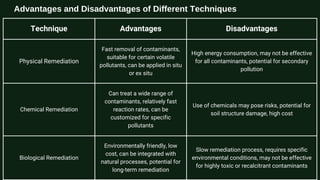
Technique Advantages Disadvantages
Physical Remediation
Fast removal of contaminants,
suitable for certain volatile
pollutants, can be applied in situ
or ex situ
High energy consumption, may not be effective
for all contaminants, potential for secondary
pollution
Chemical Remediation
Can treat a wide range of
contaminants, relatively fast
reaction rates, can be
customized for specific
pollutants
Use of chemicals may pose risks, potential for
soil structure damage, high cost
Biological Remediation
Environmentally friendly, low
cost, can be integrated with
natural processes, potential for
long-term remediation
Slow remediation process, requires specific
environmental conditions, may not be effective
for highly toxic or recalcitrant contaminants
Advantages and Disadvantages of Different Techniques
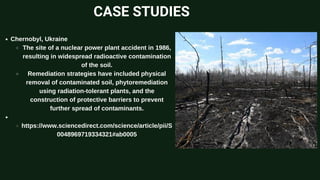
CASE STUDIES
Chernobyl, Ukraine
The site of a nuclear power plant accident in 1986,
resulting in widespread radioactive contamination
of the soil.
Remediation strategies have included physical
removal of contaminated soil, phytoremediation
using radiation-tolerant plants, and the
construction of protective barriers to prevent
further spread of contaminants.
https://www.sciencedirect.com/science/article/pii/S
0048969719334321#ab0005
Future Trends in Soil Remediation
The use of nanoparticles for soil remediation is emerging as a promising area
of research.
Nanoparticles can have unique physical and chemical properties that enhance the
efficiency of contaminant removal or degradation.
Nanotechnology
Biotechnological Innovations
Advances in genetic engineering and microbiology may lead to
the development of more efficient and specialized
microorganisms for bioremediation.
The discovery of new enzymes and metabolic pathways can
expand the range of contaminants that can be treated
biologically.
Integrated Remediation Approaches
Combining multiple remediation techniques in a single project
to achieve better results and overcome the limitations of
individual methods.
For example, using physical or chemical pretreatment
followed by biological remediation.
CONCLUSION
Soil remediation is essential for protecting human health, the environment, and the
sustainable use of land resources.
A variety of remediation techniques are available, each with its own advantages and
limitations, and the choice of technique depends on the specific characteristics of
the contaminated site and the contaminants present.
Continued research and innovation in soil remediation technologies are needed to
address the growing challenges of soil contamination and ensure the long-term
health of our planet.
WRITE YOUR TOPIC OR IDEA
Briefly elaborate on what
you want to discuss.
Briefly elaborate on what
you want to discuss.
Briefly elaborate on what
you want to discuss.
Briefly elaborate on what
you want to discuss.
ADD A MAIN
POINT
ADD A MAIN
POINT
ADD A MAIN
POINT
ADD A MAIN
POINT
Use this for a photo caption.
WRITE YOUR TOPIC OR IDEA
USE THIS FOR A PHOTO CAPTION.
ADD A SECTION HEADER
Item 1 Item 2 Item 3 Item 4 Item 5
0
20
40
60
80
100
120
140
WRITE YOUR
TOPIC OR IDEA
Briefly elaborate on what you want to discuss.
Item 1
20%
Item 2
20%
Item 3
20%
Item 4
20%
Item 5
20%
WRITE YOUR
TOPIC OR IDEA
Briefly elaborate on what you want to discuss.
Item 1 Item 2 Item 3 Item 4 Item 5
0
10
20
30
40
50
WRITE YOUR
TOPIC OR IDEA
Briefly elaborate on what you want to discuss.
Item 1 Item 2 Item 3 Item 4 Item 5
0
10
20
30
40
50
WRITE YOUR
TOPIC OR IDEA
Briefly elaborate on what you want to discuss.
WRITE YOUR TOPIC OR IDEA
5 OUT OF 6
2 OUT OF 6
Briefly elaborate on what you
want to discuss.
Briefly elaborate on what you
want to discuss.
Briefly elaborate on what you want to discuss.
ADD A MAIN
POINT
ADD A MAIN
POINT
ADD A MAIN
POINT
30% 60% 90%
WRITE YOUR TOPIC OR IDEA
"The future belongs to those
who believe in the beauty of
their dreams."
— ELEANOR ROOSEVELT
WRITE YOUR TOPIC OR IDEA
Write your topic or idea
Briefly elaborate on what you want to discuss.
FREE
RESOURCE
PAGE
Use these elements in
your Canva presentation.

Soil Remediation................. (1).pdf

  • 1.
    SOIL REMEDIATION By :Ahmed shrshr ID : 202412392050005
  • 2.
    What is SoilRemediation? Soil remediation refers to the process of removing contaminants from soil or reducing their toxicity to acceptable levels. It aims to restore the soil's natural functions and make it suitable for various uses, such as agriculture, construction, or ecological restoration.
  • 3.
    Importance of SoilRemediation Soil is a vital natural resource that supports plant growth, provides habitat for organisms, and plays a crucial role in the ecosystem. Contaminated soil can pose risks to human health, wildlife, and the environment, through direct contact, ingestion of contaminated food, or groundwater contamination
  • 4.
    Main Causes ofSoil Pollution Soil pollution is a complex phenomenon, and it can be triggered by various things and activities, from littering cigarette butts to excess use of chemical fertilizers. Every cause is linked with another. It is quite difficult to pinpoint one particular cause. However, the leading causes are listed below.
  • 5.
    1. INDUSTRIAL ACTIVITY Industrialactivity has been the biggest contributor to the problem in the last century, especially since mining and manufacturing have increased. Most industries are dependent on extracting minerals from the earth. Whether it is iron ore or coal, the by-products are contaminated and not disposed off in a manner that can be considered safe. As a result, industrial waste lingers on the soil surface for a long time, making it unsuitable for use.
  • 6.
    2. AGRICULTURAL ACTIVITIES Theutilization of chemicals has gone up tremendously since technology has provided us with modern pesticides and fertilizers. They are full of chemicals not produced in nature and cannot be broken down. As a result, they seep into the ground after mixing with water and slowly reduce the soil fertility. Other chemicals damage the composition of the soil and make it more erodible by water and air. Plants absorb many of these pesticides, and when they decompose, they cause soil pollution since they become a part of the land.
  • 7.
    FINALLY, A GROWINGCONCERN IS HOW WE DISPOSE OF OUR WASTE. WHILE INDUSTRIAL WASTE IS SURE TO CAUSE CONTAMINATION, THERE IS ANOTHER WAY IN WHICH WE ARE ADDING TO THE POLLUTION. EVERY PERSON EXCRETES A CERTAIN AMOUNT OF PERSONAL WASTE IN THE FORM OF URINE AND FAECES. WHILE MUCH OF IT MOVES INTO THE SEWER SYSTEM, A LARGE AMOUNT IS DUMPED DIRECTLY INTO LANDFILLS IN THE FORM OF DIAPERS. EVEN THE SEWER SYSTEM ENDS AT THE LANDFILL, WHERE THE BIOLOGICAL WASTE POLLUTES THE SOIL AND WATER. THIS IS BECAUSE OUR BODIES ARE FULL OF TOXINS AND CHEMICALS THAT ARE NOW SEEPING INTO THE LAND AND CAUSING SOIL POLLUTION. 3. Waste Disposal
  • 8.
    Oil leaks canhappen during the storage and transport of chemicals. This can be seen mostly in fuel stations. The chemicals in the fuel deteriorate the soil quality and make it unsuitable for cultivation. These chemicals can enter the groundwater through the soil, making the water undrinkable. 4. Accidental Oil Spills 5. Acid Rain Acid rain is caused when pollutants present in the air mix up with the rain and fall back on the ground. The polluted water could dissolve away some of the essential nutrients found in the soil and change the structure of the soil.
  • 9.
    TYPES OF SOILCONTAMINANTS Heavy Metals Such as lead, mercury, cadmium, and arsenic, which can accumulate in the soil and be taken up by plants, entering the food chain14. They are often released from industrial activities and can cause serious health problems in humans and animals. https://link.springer.com/article/10.1007/s11356-022-22984-z Organic Pollutants Include petroleum hydrocarbons, polycyclic aromatic hydrocarbons (PAHs), pesticides, and solvents4. These pollutants can be persistent in the environment and may have mutagenic, carcinogenic, or toxic effects. Radioactive Substances Result from nuclear accidents, mining activities, or improper disposal of radioactive waste. They pose a significant threat to human health and the environment due to their long half-lives and high toxicity.
  • 10.
    PHYSICAL REMEDIATION TECHNIQUES SOILVAPOR EXTRACTION INVOLVES THE REMOVAL OF VOLATILE ORGANIC COMPOUNDS (VOCS) FROM THE SOIL BY INJECTING CLEAN AIR AND EXTRACTING THE VAPOR-PHASE CONTAMINANTS4. IT IS EFFECTIVE FOR TREATING SOILS CONTAMINATED WITH GASOLINE, SOLVENTS, AND OTHER VOLATILE ORGANIC POLLUTANTS. THERMAL DESORPTION USES HEAT TO VOLATILIZE CONTAMINANTS FROM THE SOIL, WHICH ARE THEN CAPTURED AND TREATED. THIS METHOD IS SUITABLE FOR REMOVING ORGANIC POLLUTANTS WITH HIGH BOILING POINTS, SUCH AS PAHS AND PESTICIDES4. SOLIDIFICATION/STABILIZATION PHYSICALLY OR CHEMICALLY BINDS CONTAMINANTS IN THE SOIL TO REDUCE THEIR MOBILITY AND BIOAVAILABILITY4. COMMONLY USED FOR TREATING HEAVY METAL-CONTAMINATED SOILS TO PREVENT THEIR LEACHING INTO GROUNDWATER.
  • 11.
    Chemical Remediation Techniques ChemicalOxidation Involves the use of strong oxidizing agents, such as hydrogen peroxide or potassium permanganate, to oxidize and degrade organic contaminants in the soil4. It can be effective for treating a wide range of organic pollutants, including chlorinated solvents and petroleum hydrocarbons. Chemical Reduction Reduces the toxicity of certain contaminants, such as heavy metals, by changing their chemical state. For example, zero-valent iron can be used to reduce hexavalent chromium to its less toxic trivalent form. Soil Washing Uses water or chemical solutions to wash contaminants out of the soil matrix4. It is particularly useful for treating soils contaminated with heavy metals or hydrophobic organic pollutants.
  • 12.
    Biological Remediation Techniques Bioremediation Utilizesmicroorganisms, such as bacteria and fungi, to degrade or transform contaminants into less harmful substances4. Microbes can break down organic pollutants through metabolic processes, converting them into carbon dioxide, water, and other harmless byproducts. Phytoremediation Involves the use of plants to remove, degrade, or immobilize contaminants in the soil. Certain plants can absorb heavy metals or organic pollutants from the soil and store them in their tissues or metabolize them. Mycoremediation Employs fungi to remediate contaminated soil. Fungi can produce enzymes that break down complex organic molecules, making them more accessible for degradation by other microorganisms.
  • 13.
    Technique Advantages Disadvantages PhysicalRemediation Fast removal of contaminants, suitable for certain volatile pollutants, can be applied in situ or ex situ High energy consumption, may not be effective for all contaminants, potential for secondary pollution Chemical Remediation Can treat a wide range of contaminants, relatively fast reaction rates, can be customized for specific pollutants Use of chemicals may pose risks, potential for soil structure damage, high cost Biological Remediation Environmentally friendly, low cost, can be integrated with natural processes, potential for long-term remediation Slow remediation process, requires specific environmental conditions, may not be effective for highly toxic or recalcitrant contaminants Advantages and Disadvantages of Different Techniques
  • 14.
    CASE STUDIES Chernobyl, Ukraine Thesite of a nuclear power plant accident in 1986, resulting in widespread radioactive contamination of the soil. Remediation strategies have included physical removal of contaminated soil, phytoremediation using radiation-tolerant plants, and the construction of protective barriers to prevent further spread of contaminants. https://www.sciencedirect.com/science/article/pii/S 0048969719334321#ab0005
  • 15.
    Future Trends inSoil Remediation The use of nanoparticles for soil remediation is emerging as a promising area of research. Nanoparticles can have unique physical and chemical properties that enhance the efficiency of contaminant removal or degradation. Nanotechnology
  • 16.
    Biotechnological Innovations Advances ingenetic engineering and microbiology may lead to the development of more efficient and specialized microorganisms for bioremediation. The discovery of new enzymes and metabolic pathways can expand the range of contaminants that can be treated biologically.
  • 17.
    Integrated Remediation Approaches Combiningmultiple remediation techniques in a single project to achieve better results and overcome the limitations of individual methods. For example, using physical or chemical pretreatment followed by biological remediation.
  • 18.
    CONCLUSION Soil remediation isessential for protecting human health, the environment, and the sustainable use of land resources. A variety of remediation techniques are available, each with its own advantages and limitations, and the choice of technique depends on the specific characteristics of the contaminated site and the contaminants present. Continued research and innovation in soil remediation technologies are needed to address the growing challenges of soil contamination and ensure the long-term health of our planet.
  • 19.
    WRITE YOUR TOPICOR IDEA Briefly elaborate on what you want to discuss. Briefly elaborate on what you want to discuss. Briefly elaborate on what you want to discuss. Briefly elaborate on what you want to discuss. ADD A MAIN POINT ADD A MAIN POINT ADD A MAIN POINT ADD A MAIN POINT
  • 20.
    Use this fora photo caption.
  • 21.
    Use this fora photo caption.
  • 22.
    Use this fora photo caption.
  • 23.
    WRITE YOUR TOPICOR IDEA USE THIS FOR A PHOTO CAPTION.
  • 24.
  • 25.
    Item 1 Item2 Item 3 Item 4 Item 5 0 20 40 60 80 100 120 140 WRITE YOUR TOPIC OR IDEA Briefly elaborate on what you want to discuss.
  • 26.
    Item 1 20% Item 2 20% Item3 20% Item 4 20% Item 5 20% WRITE YOUR TOPIC OR IDEA Briefly elaborate on what you want to discuss.
  • 27.
    Item 1 Item2 Item 3 Item 4 Item 5 0 10 20 30 40 50 WRITE YOUR TOPIC OR IDEA Briefly elaborate on what you want to discuss.
  • 28.
    Item 1 Item2 Item 3 Item 4 Item 5 0 10 20 30 40 50 WRITE YOUR TOPIC OR IDEA Briefly elaborate on what you want to discuss.
  • 29.
    WRITE YOUR TOPICOR IDEA 5 OUT OF 6 2 OUT OF 6 Briefly elaborate on what you want to discuss. Briefly elaborate on what you want to discuss.
  • 30.
    Briefly elaborate onwhat you want to discuss. ADD A MAIN POINT ADD A MAIN POINT ADD A MAIN POINT 30% 60% 90% WRITE YOUR TOPIC OR IDEA
  • 31.
    "The future belongsto those who believe in the beauty of their dreams." — ELEANOR ROOSEVELT
  • 32.
  • 33.
    Write your topicor idea Briefly elaborate on what you want to discuss.
  • 34.
    FREE RESOURCE PAGE Use these elementsin your Canva presentation.