Soil pollution impacts,
treatment and control
By:
Rania Ahmed Sayed Ahmed
Mohamed Mohsen Awad
Under supervision of:
Prof. Elsayed Shalaby
1
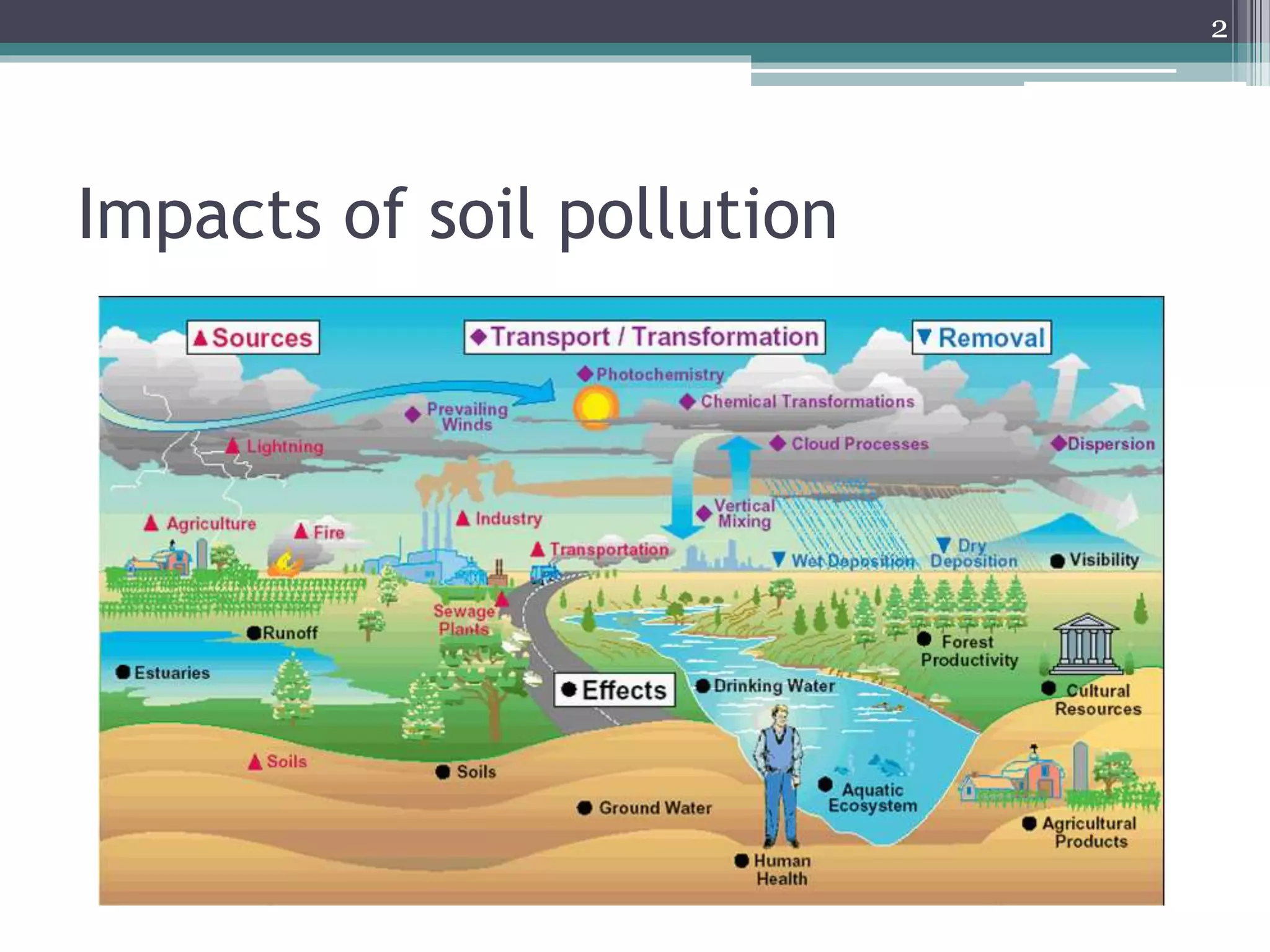
Impacts of soil pollution
2
Effects of soil pollution on:
1. Abiotic ecosystem components
 Groundwater
 Air quality
 Soil fertility
2. Human health and biotic
ecosystem components
 Human health
 Plants
3
The results of a questionnaire compiled recently by the Joint Research
Centre in 27 European countries.
4
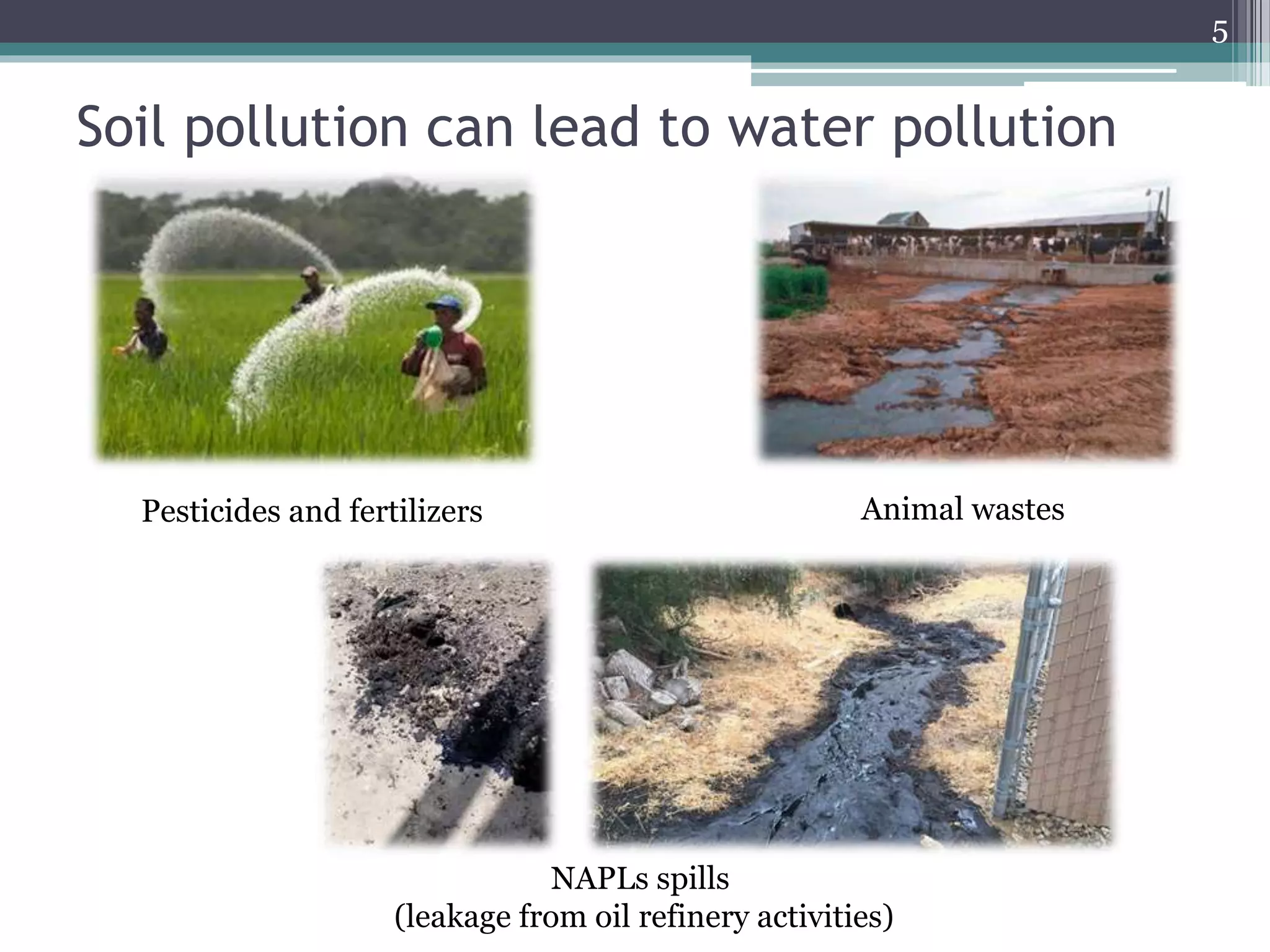
Soil pollution can lead to water pollution
5
Pesticides and fertilizers Animal wastes
NAPLs spills
(leakage from oil refinery activities)
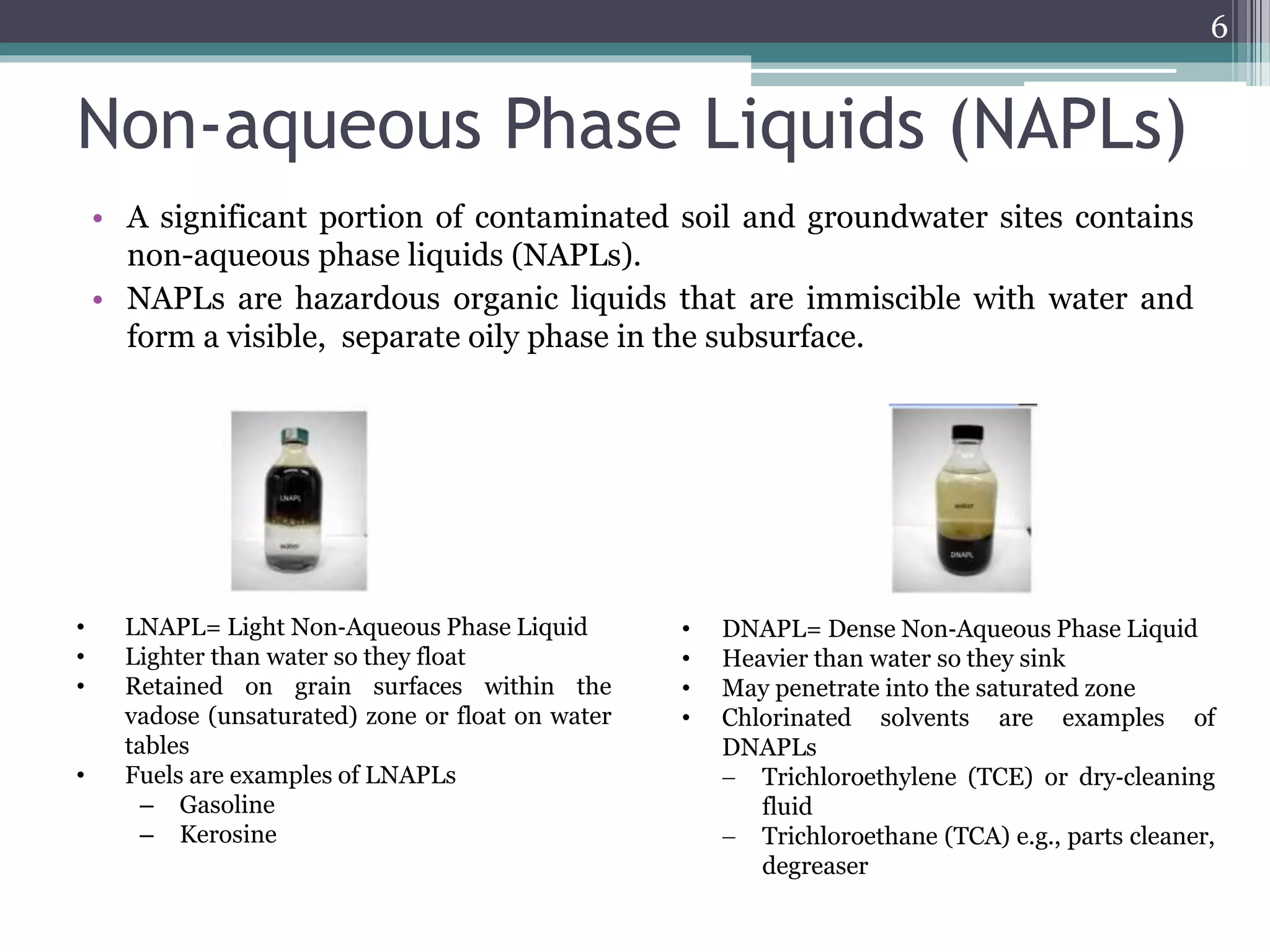
Non-aqueous Phase Liquids (NAPLs)
• A significant portion of contaminated soil and groundwater sites contains
non-aqueous phase liquids (NAPLs).
• NAPLs are hazardous organic liquids that are immiscible with water and
form a visible, separate oily phase in the subsurface.
• LNAPL= Light Non‐Aqueous Phase Liquid
• Lighter than water so they float
• Retained on grain surfaces within the
vadose (unsaturated) zone or float on water
tables
• Fuels are examples of LNAPLs
– Gasoline
– Kerosine
• DNAPL= Dense Non‐Aqueous Phase Liquid
• Heavier than water so they sink
• May penetrate into the saturated zone
• Chlorinated solvents are examples of
DNAPLs
 Trichloroethylene (TCE) or dry‐cleaning
fluid
 Trichloroethane (TCA) e.g., parts cleaner,
degreaser
6
Effect of soil pollution on air quality
8
Some PAH particles can readily evaporate into the air from soil or surface waters.
Silicosis is a lung disease caused by breathing in (inhaling) silica dust. Silica
dust forms during mining and quarrying.
9
• Manure emits
ammonia.
• Methane gas
emission due to
organic matter
decomposition.
The decomposition of organic materials in
soil can release sulfur dioxide and other
sulfur compounds, causing acid rain.
Effect of soil pollution on human health
10
Generally, people can be exposed to contaminants in soil through
ingestion (eating or drinking), dermal exposure (skin contact) or
inhalation (breathing).
Heavy metals
Environmental pollution by heavy metals is of major health
concerns all over the world even if it is at low
concentrations due to their long-term cumulative health
effects.
Intake of heavy metal through food materials:
• Impairs the function of other metal ions
• Decreases the immunology of body
• Retardation of growth
• Poor mental development
11
Pesticides
Major categories of pesticides and their persistence in the soil:
• Chlorinated hydrocarbons - DDT, heptachlor, etc—2-15 years
• Organophosphates - Malathion, methyl parathion—1-2 weeks
• Carbamates - Carbaryl, maneb, aldicarb—days to weeks
• Pyrethroids - Pemethrin, decamethrin—days to weeks
12
Some of the chronic and acute toxicological effects of
pesticides are:
• Chronic liver damage
• Endocrine disorders
• Reproductive disorders
• Immune-suppression
• Various cancer
• Parkinson’s and Alzheimer’s diseases
PAHs
• Human exposure to PAHs has been associated with an
increased risk of developing cancer in the variety of
organs (such as lung, bladder, stomach, skin, larynx,
scrotum, breast, oesophageal, prostate, kidney and
pancreas).
• Furthermore, they are known to suppress the immune
system and are suspected of being endocrine disrupters.
13
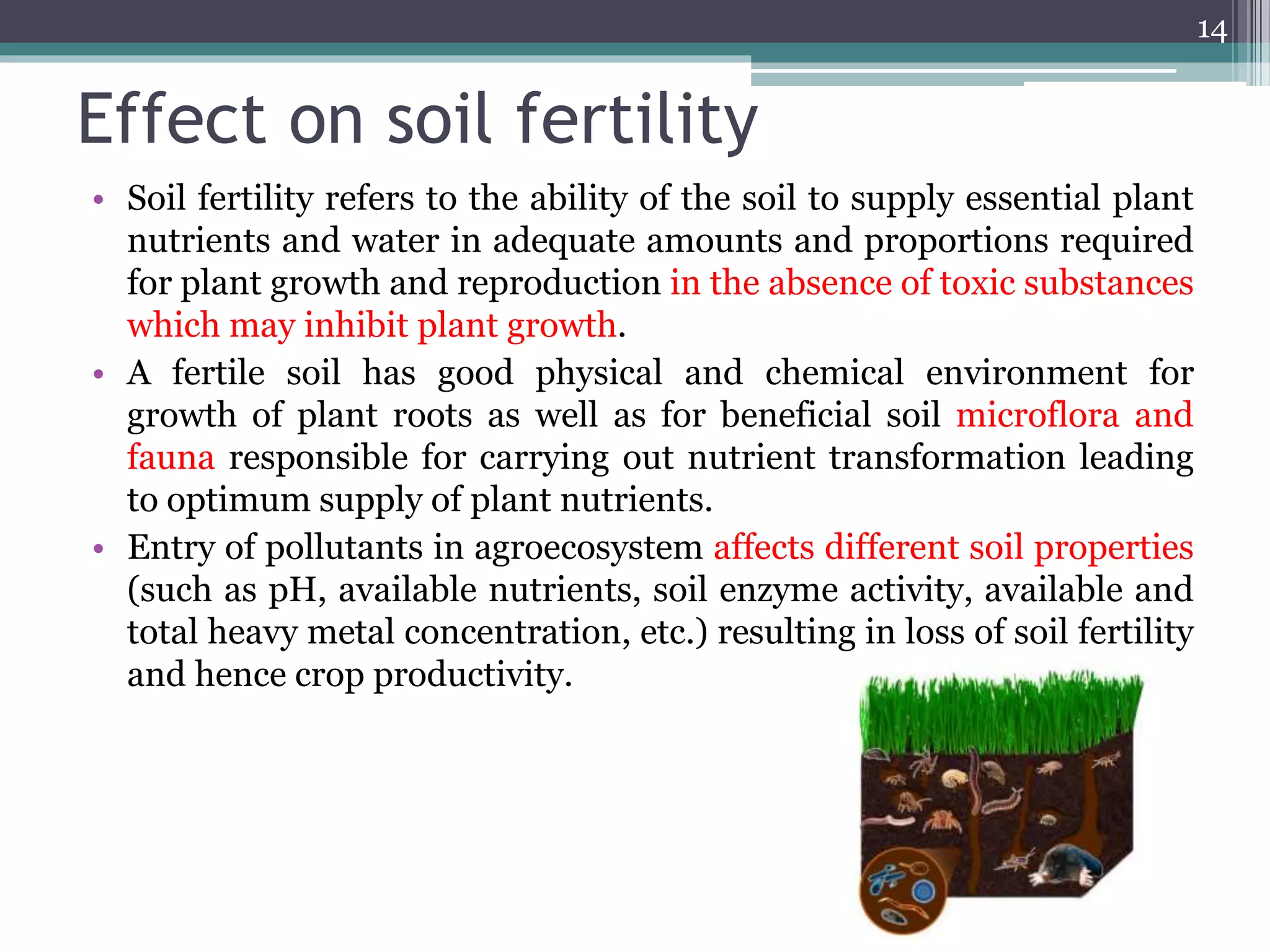
Effect on soil fertility
• Soil fertility refers to the ability of the soil to supply essential plant
nutrients and water in adequate amounts and proportions required
for plant growth and reproduction in the absence of toxic substances
which may inhibit plant growth.
• A fertile soil has good physical and chemical environment for
growth of plant roots as well as for beneficial soil microflora and
fauna responsible for carrying out nutrient transformation leading
to optimum supply of plant nutrients.
• Entry of pollutants in agroecosystem affects different soil properties
(such as pH, available nutrients, soil enzyme activity, available and
total heavy metal concentration, etc.) resulting in loss of soil fertility
and hence crop productivity.
14
Phytotoxicity of Heavy Metals
• Significant part of the metal loaded effluents, generated particularly
from small scale industries in developing and under-developed
countries are released untreated into land and water bodies.
• Also, some of the metals are impurities/constituents of extensively
used agrochemicals like fertilizers (e.g. Cd in phosphatic fertilizer),
pesticides (e.g., Zn, Cu, Sn, Hg, organic pollutants) etc. and
contaminate the rhizosphere when these are used in intensive
agriculture.
• Some impacts of heavy metals toxicity in plants include:
 Growth reduction (As, Cd, Cr, Pb, Ni, Hg, Cu)
 Chlorosis (Cd, Ni, Hg, Cu)
 Necrosis (As, Cd, Ni)
15
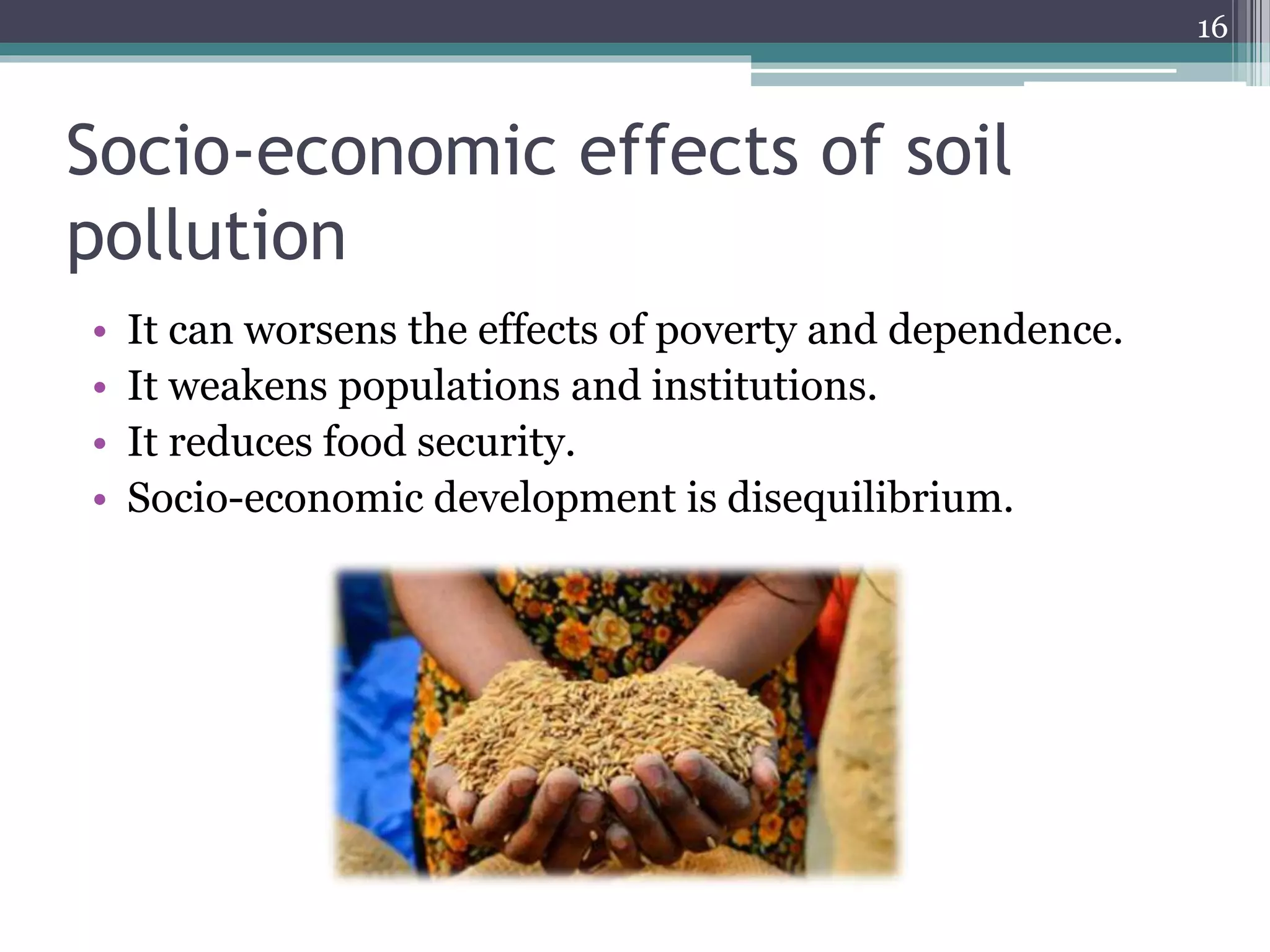
Socio-economic effects of soil
pollution
• It can worsens the effects of poverty and dependence.
• It weakens populations and institutions.
• It reduces food security.
• Socio-economic development is disequilibrium.
16
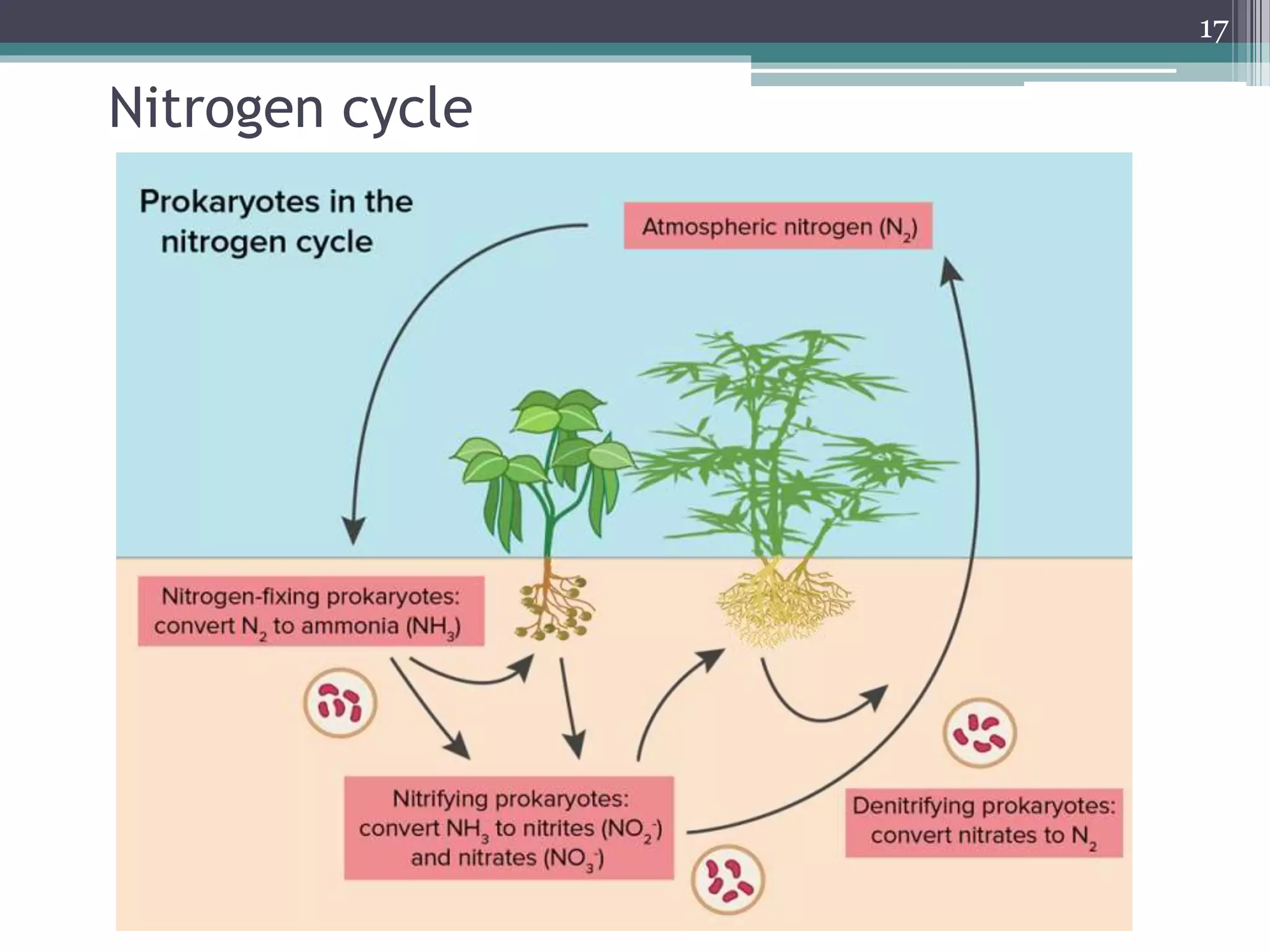
Nitrogen cycle
17
Eutrophication
• We humans may not be able to fix
nitrogen biologically, but we
certainly do industrially!
(Fertilizers)
• Increase in nutrient levels
1. Algal blooms: block sunlight from
photosynthetic marine plants
under the water surface.
2. Decay of algae by MOs: use up all
the oxygen in the water, leaving
none for other marine life, and
producing free toxic compounds ,
such as ammonia and hydrogen
sulphide (H2S).
18
NO toxicity
19
Formation of N‐nitroso compounds from NO3
−, NO2
−, NO, and their effects on human health.
• NO3
− is applied in increasing
amounts in the fertilizers for
agricultural production.
• They accumulate in the soil.
• They can reach groundwater.
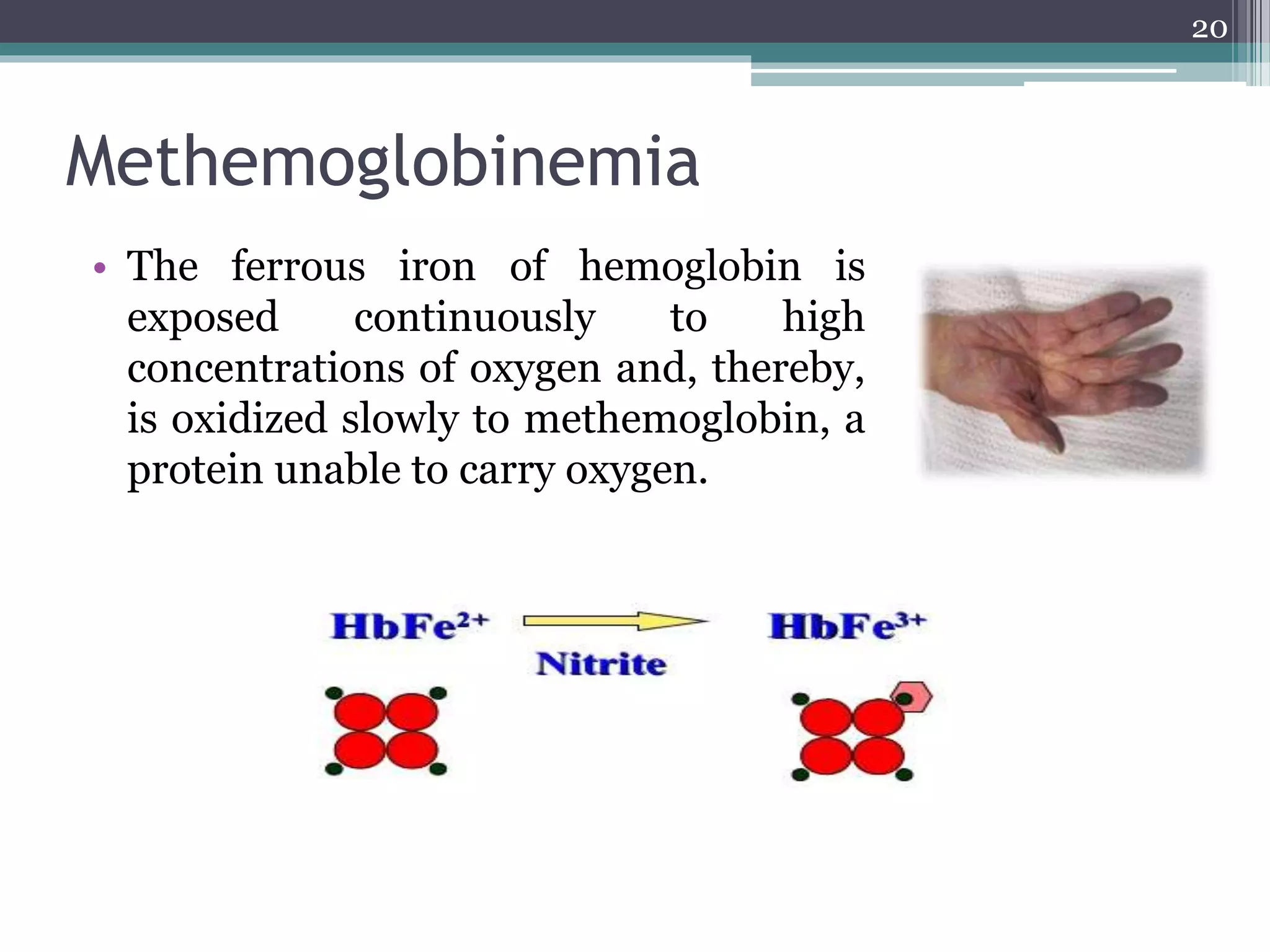
Methemoglobinemia
• The ferrous iron of hemoglobin is
exposed continuously to high
concentrations of oxygen and, thereby,
is oxidized slowly to methemoglobin, a
protein unable to carry oxygen.
20
Impacts of radioactive pollution on soil
Effects of radioactive pollutants:
• Radiation affects the soil and soil
fertility.
• The radioactive leaching or dumped
into the soil is more complicated,
because they remain in soil for
thousands of years.
• Radioactive pollution in soil can
lead to mutations, malformations,
carcinogenicity, and abortion for
animals as well as humans.
21
22
Remediation technologies
• According to the scale of pollution, the risk level and the
financial and time constraints on the remediation project,
treatment of the soil may take place immediately in place (in
situ) or the soil may be transported to special facilities where
remediation may be carried out in special reactors or vessels,
that are specially designed for this purpose (in tank method).
• An example of this process is the washing of heavily polluted
soils in special tanks.
• The polluted soil may also be transported and spread on a
surface prepared to prevent the spread of contamination in
lateral and vertical directions.
• Beds prepared in this way form the so-called prepared beds
upon which the remediation process will take place. This
method is especially suitable for soils contaminated by oil
products.
23
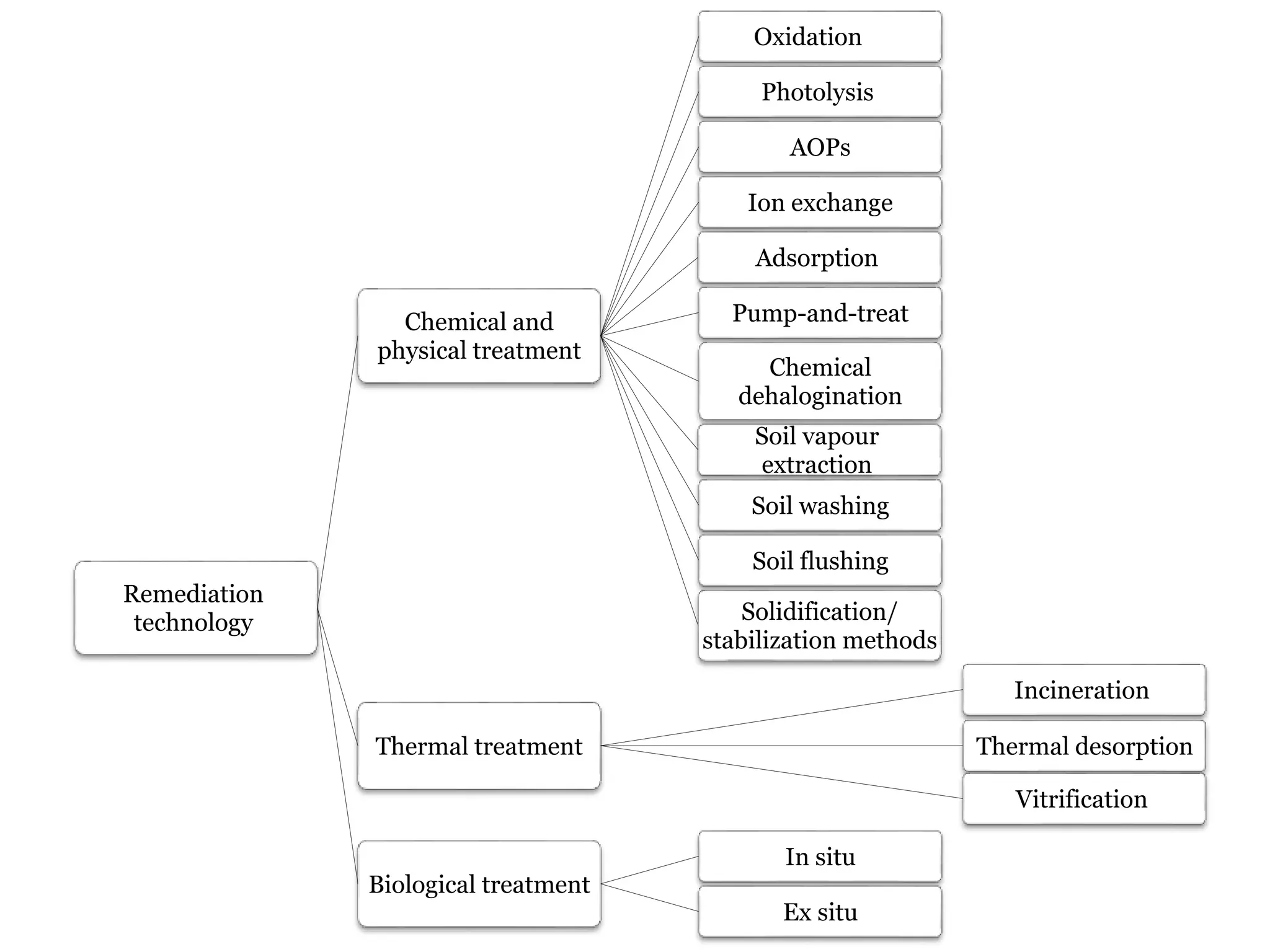
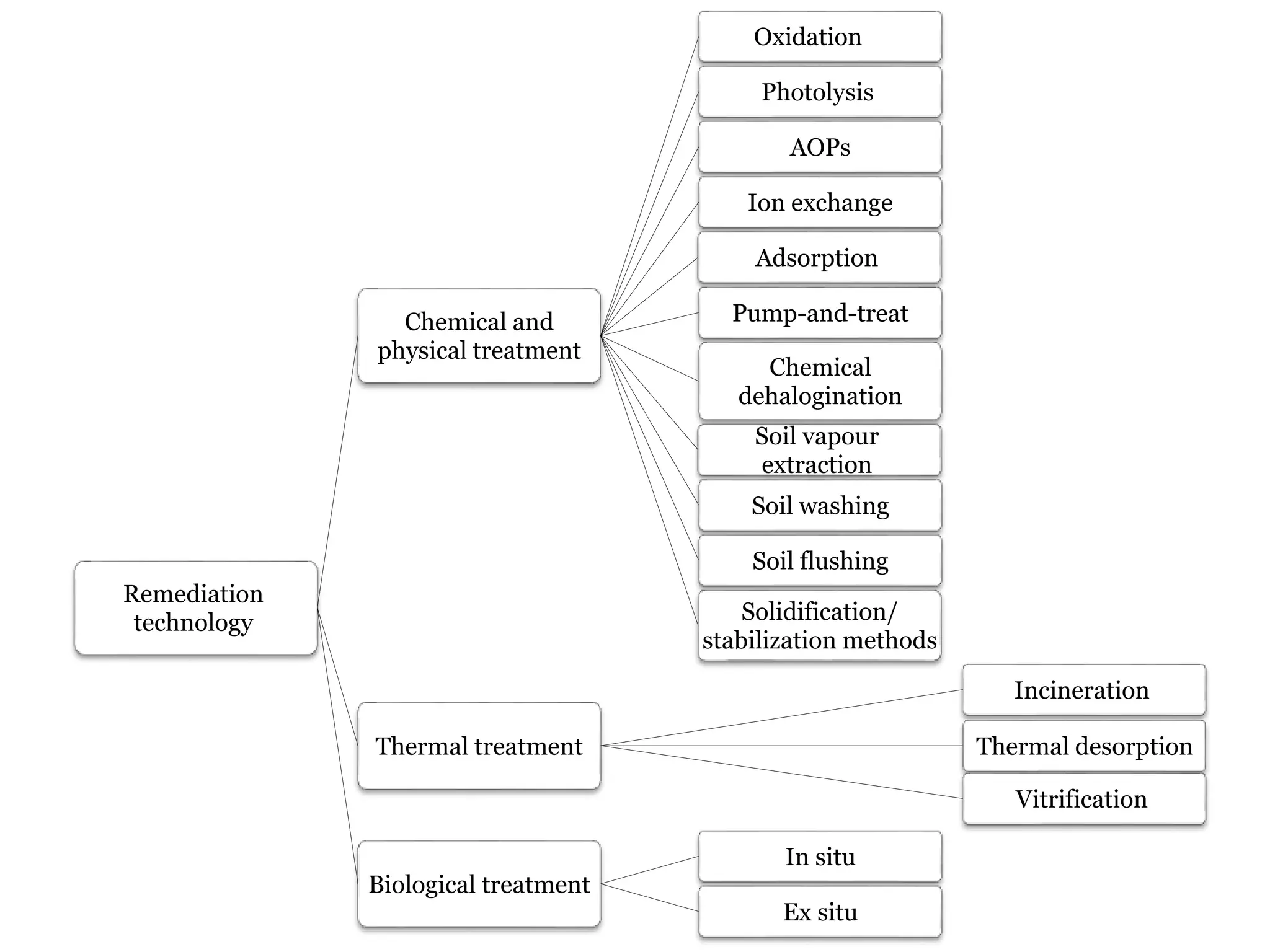
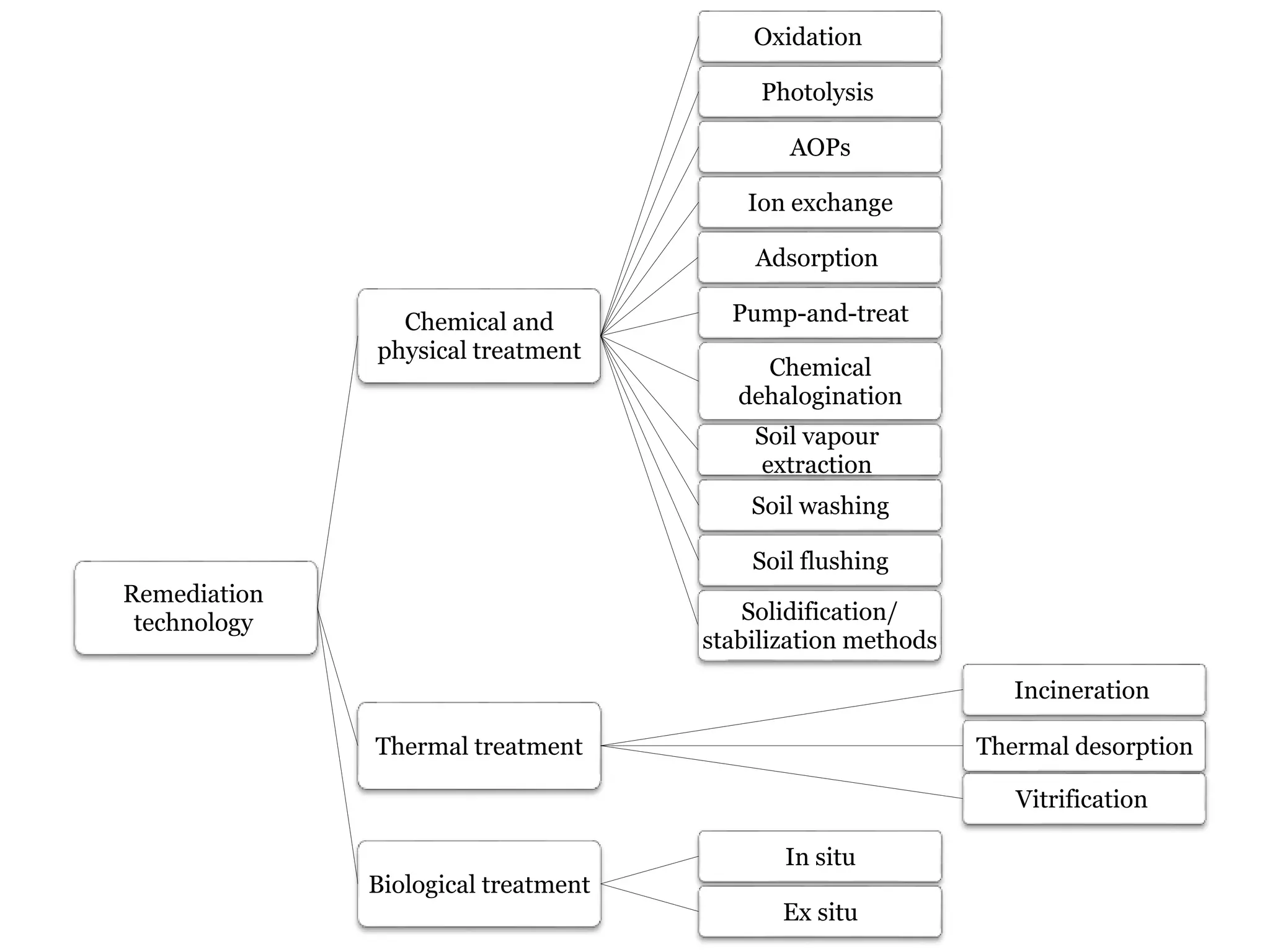
Remediation
technology
Chemical and
physical treatment
Oxidation
Photolysis
AOPs
Ion exchange
Adsorption
Pump-and-treat
Chemical
dehalogination
Soil vapour
extraction
Soil washing
Soil flushing
Solidification/
stabilization methods
Thermal treatment
Incineration
Thermal desorption
Vitrification
Biological treatment
In situ
Ex situ
24
Chemical and physical remedial
techniques
• The aim of all chemical and physical methods of
remediation is to change the chemical
environment in a way that the transport of toxic
substances to other elements of the soil system is
prevented.
• Examples here can be given by transport to
plants; to ground water; or to soil organisms.
• Such preventive measures may include
decreasing mobility or change of chemical
constitution.
25
1. Oxidation
• Oxidation is a common highly effective remediation
technology for soils contaminated by toxic organic chemicals
and cyanides.
• Oxidising agents used in this technology include a wide range
of substances among which the most common are hydrogen
peroxide, ozone and potassium permanganate.
• All three methods are according to EPA of high treatment
efficiency, reaching over 90% at short times in many cases.
• For example efficiency reaches >90% for unsaturated
aliphatic compounds such as trichlorethylene (TCE) as well as
for aromatic compounds such as Benzene.
• Oxidation technology has been successfully used for in situ
remedy at source areas as well as for flume treatment. It is
mostly used for benzene, ethylbenzene, toluene and xylene
(BTEX) as well as for PAH's, phenols and alkenes.
26
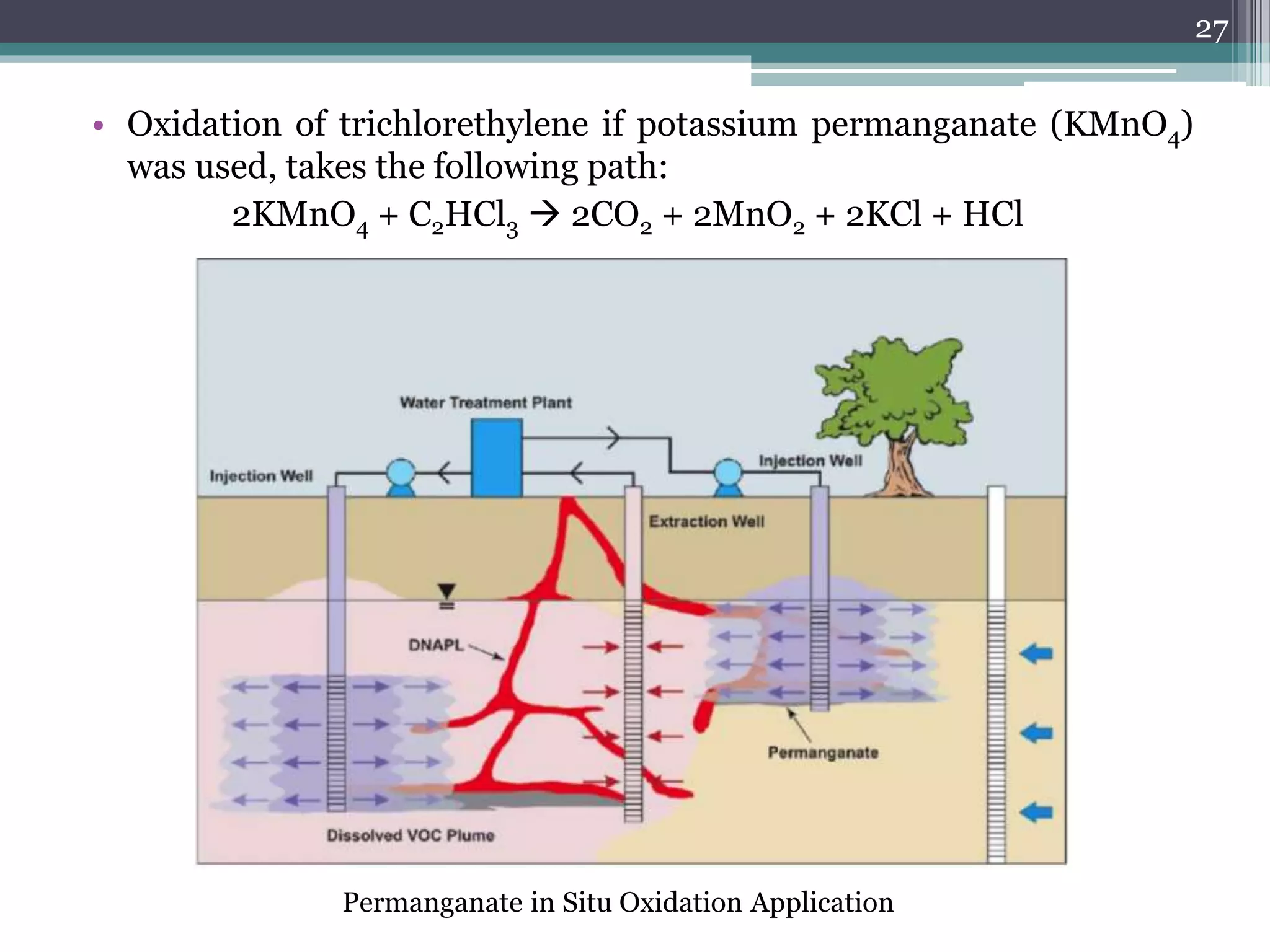
• Oxidation of trichlorethylene if potassium permanganate (KMnO4)
was used, takes the following path:
2KMnO4 + C2HCl3  2CO2 + 2MnO2 + 2KCl + HCl
Permanganate in Situ Oxidation Application
27
Ozone destruction of toxic contaminants takes place in the following
manner:
O3 + H2O + C2HCl3  2CO2 + 3HCl
General conceptual model of in-situ ozonation in the saturated zone with
soil vacuum extraction to capture volatile emissions and O3(g)
28
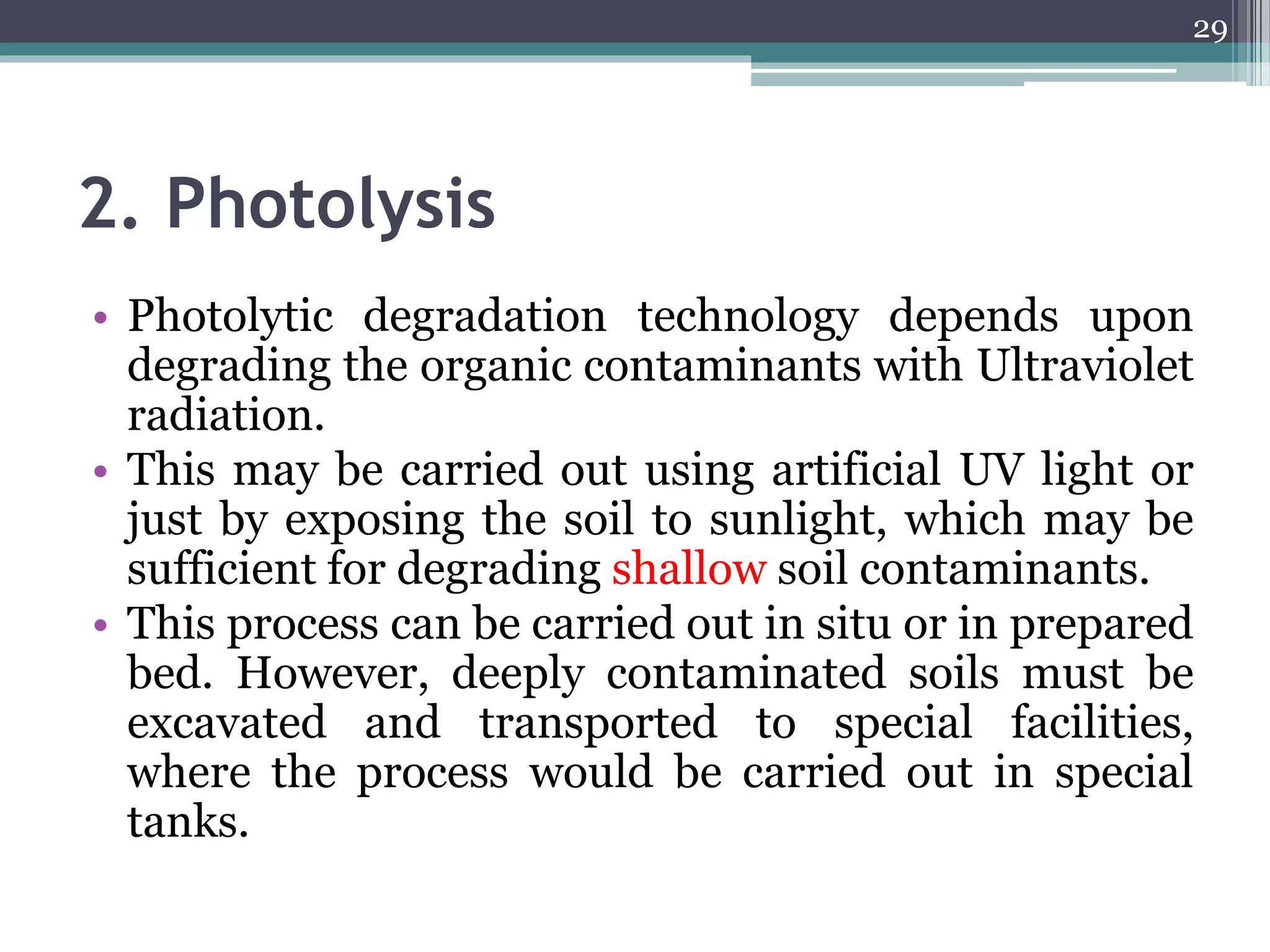
2. Photolysis
• Photolytic degradation technology depends upon
degrading the organic contaminants with Ultraviolet
radiation.
• This may be carried out using artificial UV light or
just by exposing the soil to sunlight, which may be
sufficient for degrading shallow soil contaminants.
• This process can be carried out in situ or in prepared
bed. However, deeply contaminated soils must be
excavated and transported to special facilities,
where the process would be carried out in special
tanks.
29
3. Advanced Oxidation Processes
(AOPs)
• AOPs are based on the generation of in situ
hydroxyl radicals (O˙H) in very mild, near
ambient pressure and temperature experimental
conditions(by irradiation). These radicals are
strong enough oxidants that are able to degrade a
great variety of bio-recalcitrant organic
compounds.
• Peroxide based/ ozone
• Fenton (Fe2+ & peroxide)
• Metal based nanoparticles (ZnO or/and TiO2)
(MO/doped N) + EM radiations (UV, Laser,
Ultrasound, and sunlight)
30
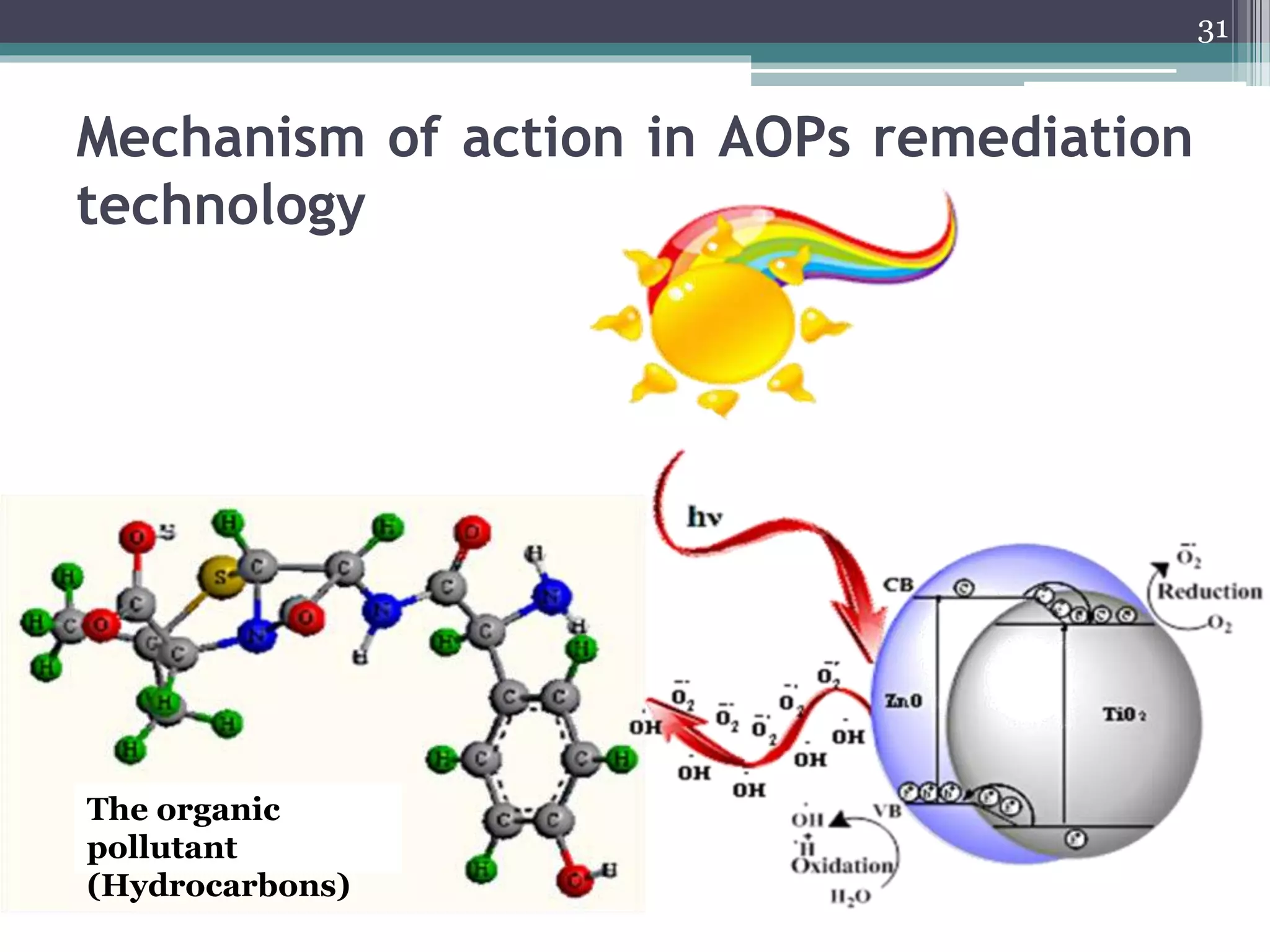
Mechanism of action in AOPs remediation
technology
The organic
pollutant
(Hydrocarbons)
31
4. Ion exchange
• Soil components with high CEC values are capable of
binding positively charged organic chemicals and metals
in a way that makes them chemically immobile and thus
reduce the risk imposed by them on the soil environment.
• Addition of soil conditioners such as synthetic resins
zeolites or clays may help increasing the CEC
characteristics of the soil and thus enhance the binding of
positively charged contaminants on the negative
functional groups of the soil matter.
32
5. Adsorption
• Adsorption is the most widely used, fastest,
inexpensive technology for the treatment of
groundwater, chemical spills, and for removing a
series of toxic chemicals such as BTEX,
ethylbenzene, xylene, trichloroethene,
tetrachloroethene, dichloroethane, PCBs,
pesticides, herbicides, explosives, and anions
like perchlorate and heavy metals.
33
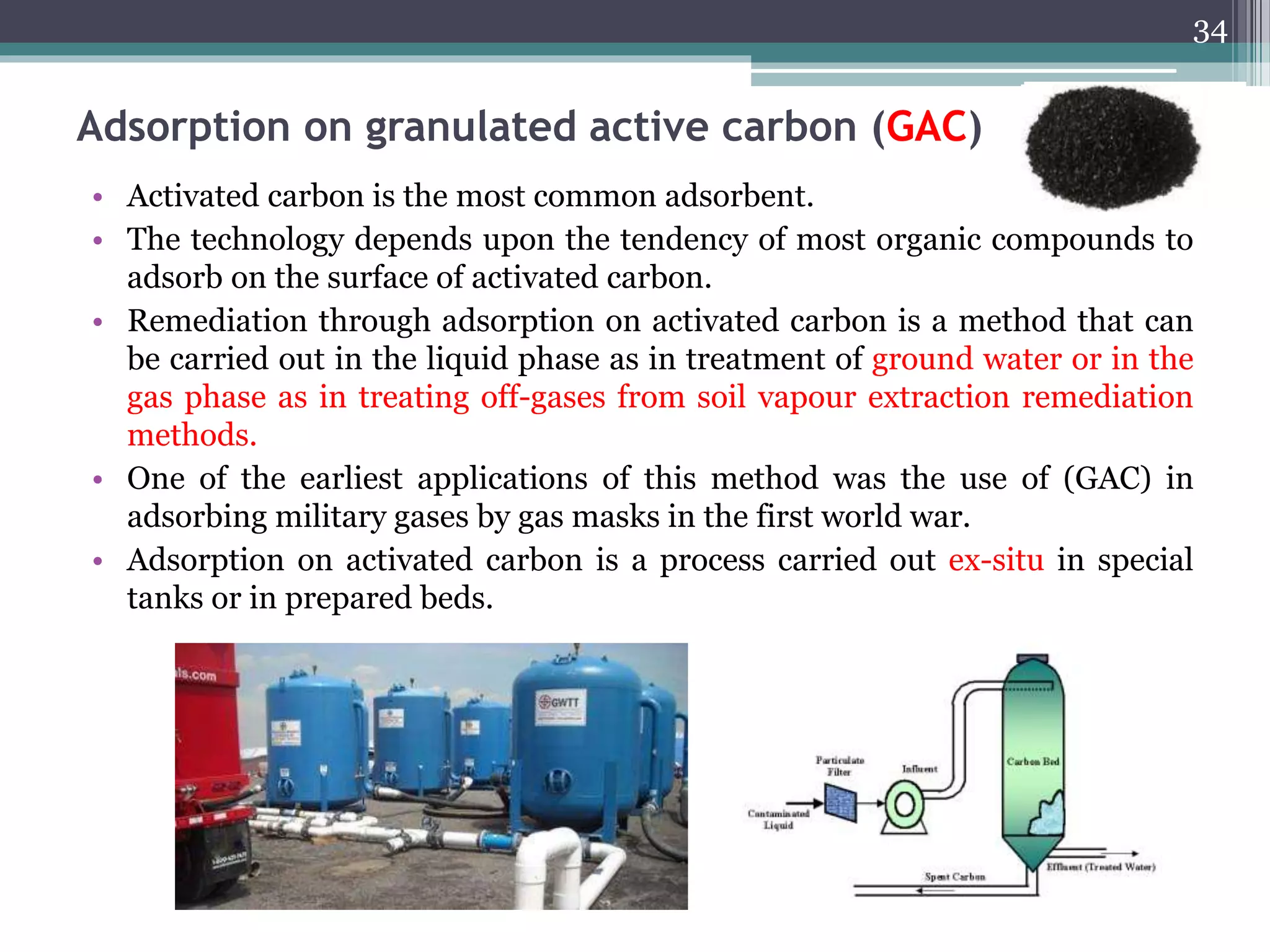
Adsorption on granulated active carbon (GAC)
• Activated carbon is the most common adsorbent.
• The technology depends upon the tendency of most organic compounds to
adsorb on the surface of activated carbon.
• Remediation through adsorption on activated carbon is a method that can
be carried out in the liquid phase as in treatment of ground water or in the
gas phase as in treating off-gases from soil vapour extraction remediation
methods.
• One of the earliest applications of this method was the use of (GAC) in
adsorbing military gases by gas masks in the first world war.
• Adsorption on activated carbon is a process carried out ex-situ in special
tanks or in prepared beds.
34
6. Pump-and-Treat
• In pump-and-treat, the
groundwater is pumped and
then treated using granular
activated charcoal.
• Generally, the pump-and-treat
approach requires 50–100 years
to reach remedial goals, and in
most cases the goals are never
achieved.
• Moreover, disposal of
contaminants that become
bound to activated carbon after
treatment becomes a problem.
• Because of these drawbacks, surfactant-enhanced remediation,
metallic iron technology, permeable reactive barriers, etc., have
emerged as alternatives to traditional pump-and treat-systems.
35
7. Chemical dehalogenation
• This treatment technology is used to dehalogenate (remove halogens)
halogenated compounds.
• During chemical dehalogenation, contaminated soils and reagents are
mixed, and heated in a treatment vessel.
• Reagents could be either sodium bicarbonate (base-catalyzed
decomposition process—BCD) or polyethylene glycol (alkaline polyethylene
glycol or glycolate technology—APEG).
• Dehalogenation was successful in removing PCBs, PCDD/Fs and pesticides
from soil.
• An example of this may be given by the change of trichlorethylene into
ethene.
36
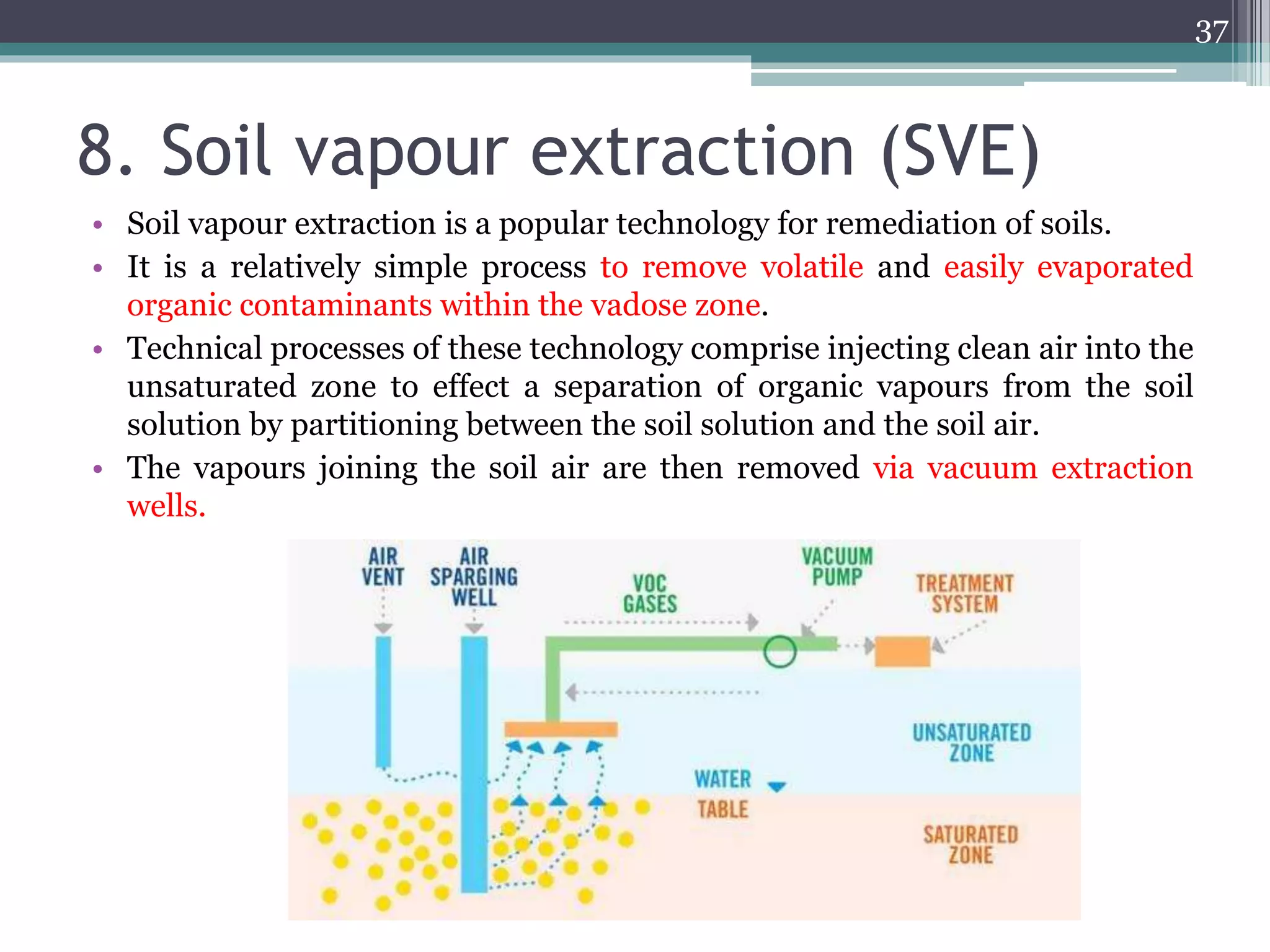
8. Soil vapour extraction (SVE)
• Soil vapour extraction is a popular technology for remediation of soils.
• It is a relatively simple process to remove volatile and easily evaporated
organic contaminants within the vadose zone.
• Technical processes of these technology comprise injecting clean air into the
unsaturated zone to effect a separation of organic vapours from the soil
solution by partitioning between the soil solution and the soil air.
• The vapours joining the soil air are then removed via vacuum extraction
wells.
37
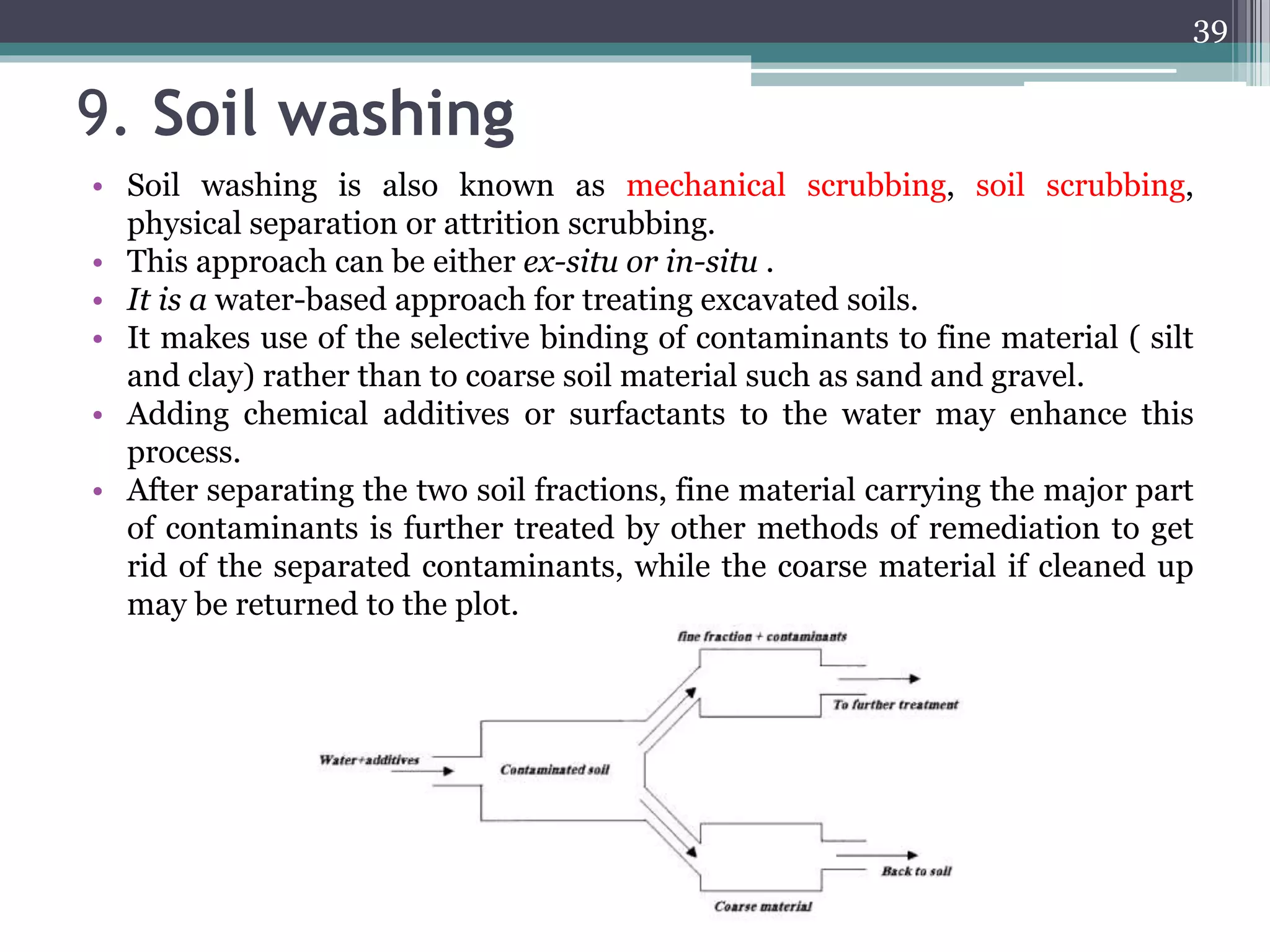
9. Soil washing
• Soil washing is also known as mechanical scrubbing, soil scrubbing,
physical separation or attrition scrubbing.
• This approach can be either ex-situ or in-situ .
• It is a water-based approach for treating excavated soils.
• It makes use of the selective binding of contaminants to fine material ( silt
and clay) rather than to coarse soil material such as sand and gravel.
• Adding chemical additives or surfactants to the water may enhance this
process.
• After separating the two soil fractions, fine material carrying the major part
of contaminants is further treated by other methods of remediation to get
rid of the separated contaminants, while the coarse material if cleaned up
may be returned to the plot.
39
10. Soil flushing
• Soil flushing is a remediation method used for in situ treatment of inorganic
and organic contaminants.
• Known sometimes as the cosolvent flushing method, this technique
depends upon injecting a solvent mixture such as water and alcohol or
surfactants into the vadose or saturated zone.
• The leachate i.e. the solvent with leached contaminants is drawn from
recovery wells to be treated above ground or be disposed of.
Diagrammatic illustration of soil flushing techniques
41
11. Solidification / stabilisation methods
• This is a group of technologies aiming at immobilising or stabilising
contaminants in the soil and preventing them from entering the
environment either by enclosing them into a solid mass or
converting them to the least soluble , mobile or toxic form.
• Used for soils contaminated with heavy metals, radionuclides,
organic compounds.
43
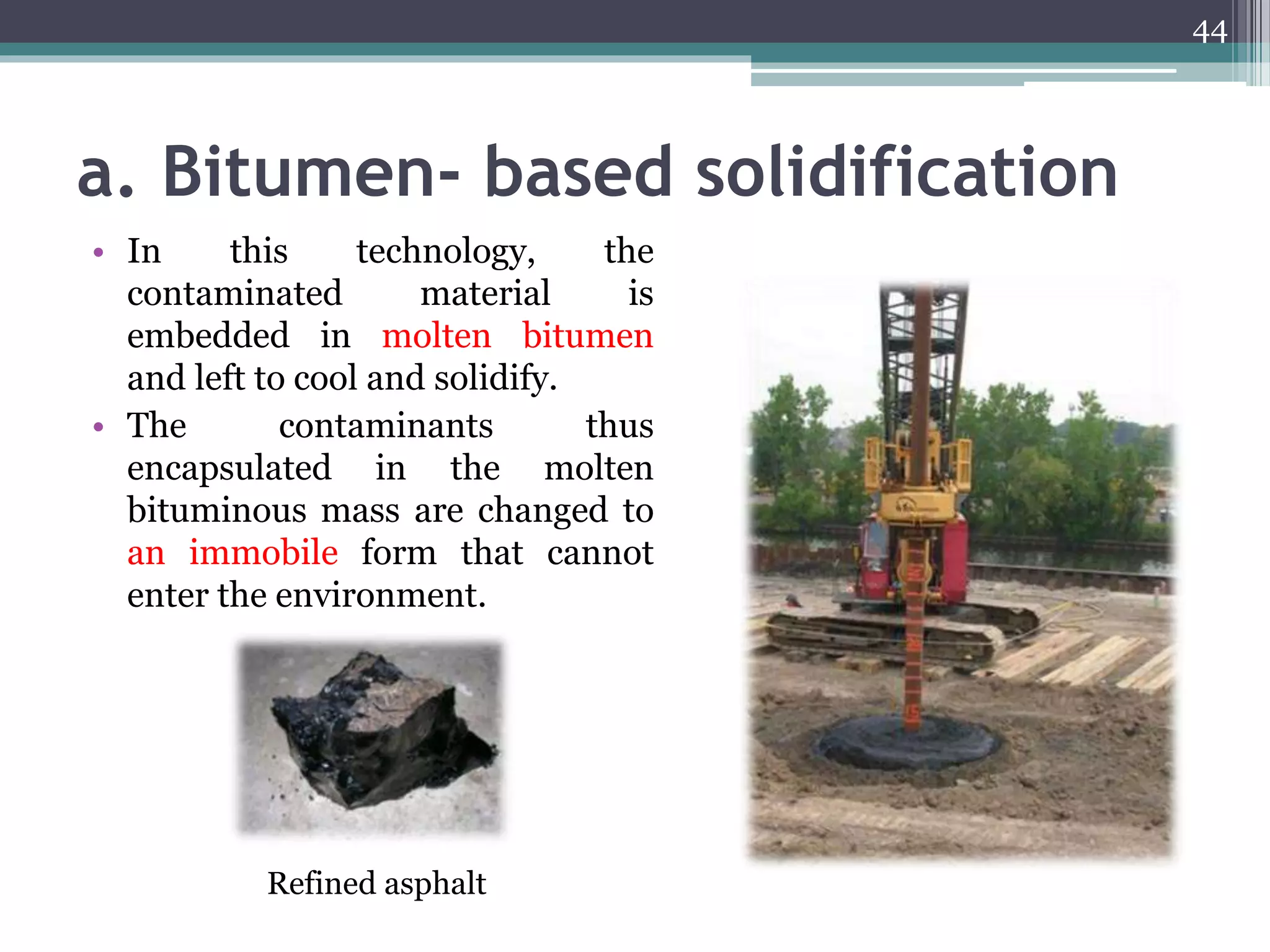
a. Bitumen- based solidification
• In this technology, the
contaminated material is
embedded in molten bitumen
and left to cool and solidify.
• The contaminants thus
encapsulated in the molten
bituminous mass are changed to
an immobile form that cannot
enter the environment.
Refined asphalt
44
b. Encapsulation in thermoplastic
materials
• Thermoplastic materials (e.g. Modified sulphur cement)
are molten and mixed with the contaminated material in
special tanks and vigorously mixed to form a
homogenous slurry fluid.
• After cooling the resulting solid may safely be disposed
of.
45
c. Polyethylene extrusion
• The contaminated soil is mixed with
polyethylene binders, heated and then left to
cool.
• The resulting solid may be disposed of or used in
other ways.
46
d. Pozzolan / Portland cement
• Pozzolanic-based materials ( e.g. fly ash, kiln
dust, pumice) are mixed with the contaminated
matter in presence of water and alkali additives.
• At this environment, heavy metals may
precipitate out of the slurry.
• The rest mass solidifies enclosing the remaining
organic contaminants.
47
Remediation
technology
Chemical and
physical treatment
Oxidation
Photolysis
AOPs
Ion exchange
Adsorption
Pump-and-treat
Chemical
dehalogination
Soil vapour
extraction
Soil washing
Soil flushing
Solidification/
stabilization methods
Thermal treatment
Incineration
Thermal desorption
Vitrification
Biological treatment
In situ
Ex situ
48
Thermal treatment
49
Thermal treatment
• Volatilisation and destruction of contaminants
by thermal treatment is a very effective
technique .
• It is achieved by heating the contaminated soil in
kilns to temperatures between 400 and 700°C,
followed by further treatment of the kiln off gas
at higher temperatures( 800- 1200°C) to secure
total oxidation of the organic volatile matter.
50
1. Incineration
• In this technology, contaminants are combusted at high temperatures
(970°C - 1200°C) .
• It is particularly effective for halogenated and other refractory organic
pollutants.
• Properly operated incinerators may be of very high destruction and removal
efficiency (DRE) reaching to as much as 99.9 %, which is normally required
for PCB' s and dioxins.
Ex situ incineration includes the excavation of contaminated soils, which are
incinerated under oxygen-rich conditions. Off-gases are collected for reuse or disposal.
51
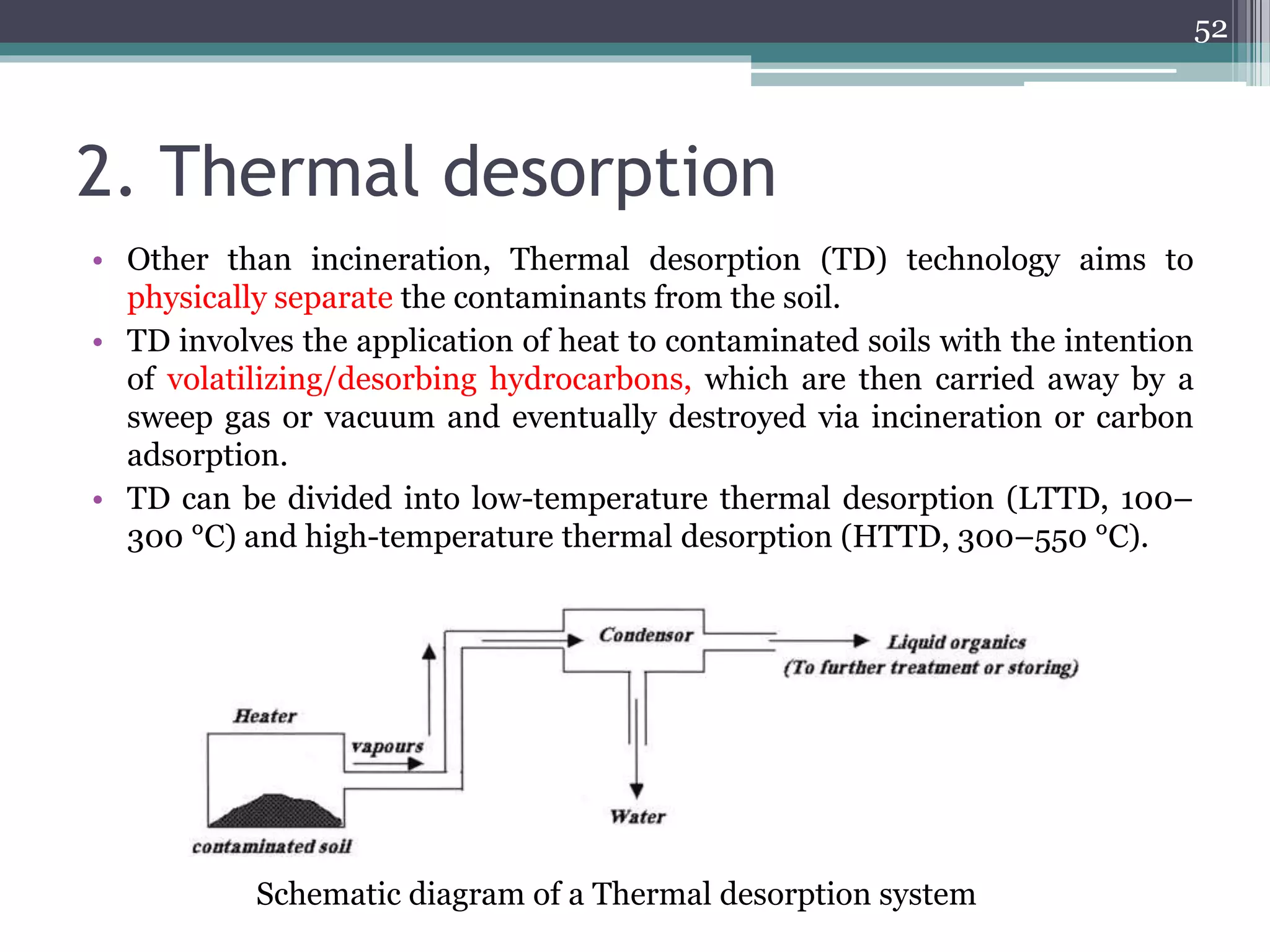
2. Thermal desorption
• Other than incineration, Thermal desorption (TD) technology aims to
physically separate the contaminants from the soil.
• TD involves the application of heat to contaminated soils with the intention
of volatilizing/desorbing hydrocarbons, which are then carried away by a
sweep gas or vacuum and eventually destroyed via incineration or carbon
adsorption.
• TD can be divided into low-temperature thermal desorption (LTTD, 100–
300 °C) and high-temperature thermal desorption (HTTD, 300–550 °C).
Schematic diagram of a Thermal desorption system
52
3. Vitrification
• In this process the contaminated soil is encapsulated into a monolithic mass
of glass.
• Vitrification may be carried out in situ or ex situ.
• Introducing graphite electrodes into the soil and heating it electrically by
powerful generators to temperatures between 1600-1800 °c perform in situ
Vitrification.
• At these temperatures the soil melts and forms a glass block on cooling.
• Organic contaminants are pyrolysed and reduced to gases during the
melting process, while heavy metals remain enclosed in the stabilised glass
mass.
• This method has also been successfully used in treating soils contaminated
by radioactive materials.
• Vitrification may also be done in special appliances where contaminated
soil would be molten in presence of borosilicate and soda lime to form a
solid glass block.
53
In situ vitrification
54
Remediation
technology
Chemical and
physical treatment
Oxidation
Photolysis
AOPs
Ion exchange
Adsorption
Pump-and-treat
Chemical
dehalogination
Soil vapour
extraction
Soil washing
Soil flushing
Solidification/
stabilization methods
Thermal treatment
Incineration
Thermal desorption
Vitrification
Biological treatment
In situ
Ex situ
55
III Biological remediation
56
Biological remediation
57
• Vegetation (Phytoremediation)
• Several plant species have the
ability to bioaccumulate heavy
metals found in the soil.
• Some tree species can sequester,
destroy, and/or evapotranspire
various organic compounds.
• Naturally occurring micro-
organisms in the soil
• Many microorganisms can
transform hazardous
chemicals to substances that
may be less hazardous.
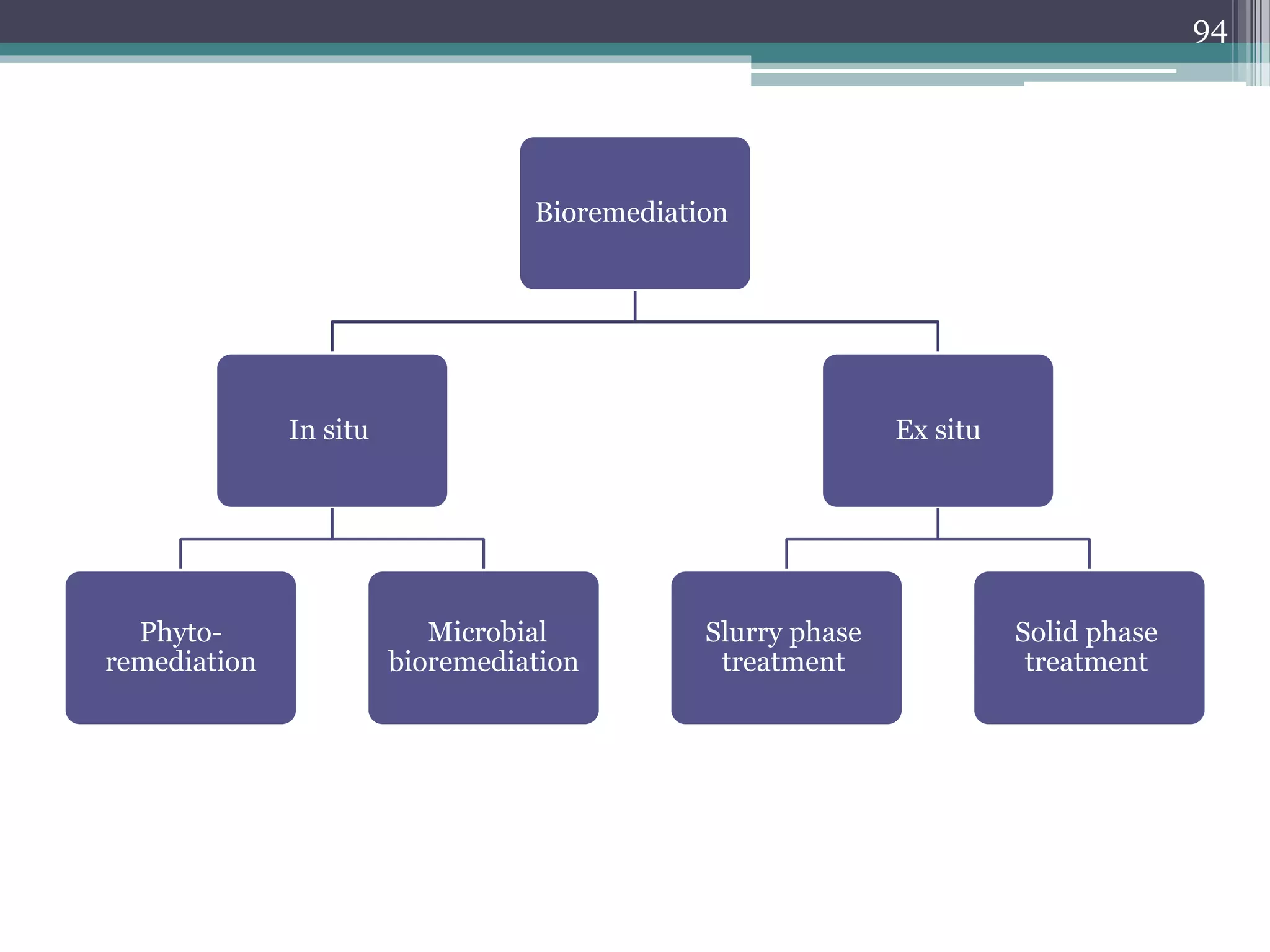
Capable of degrading toxic materials, while carrying out
their daily biological activities.
Bioremediation
In situ
Phyto-
remediation
Microbial
bioremediation
Ex situ
Slurry phase
treatment
Solid phase
treatment
58
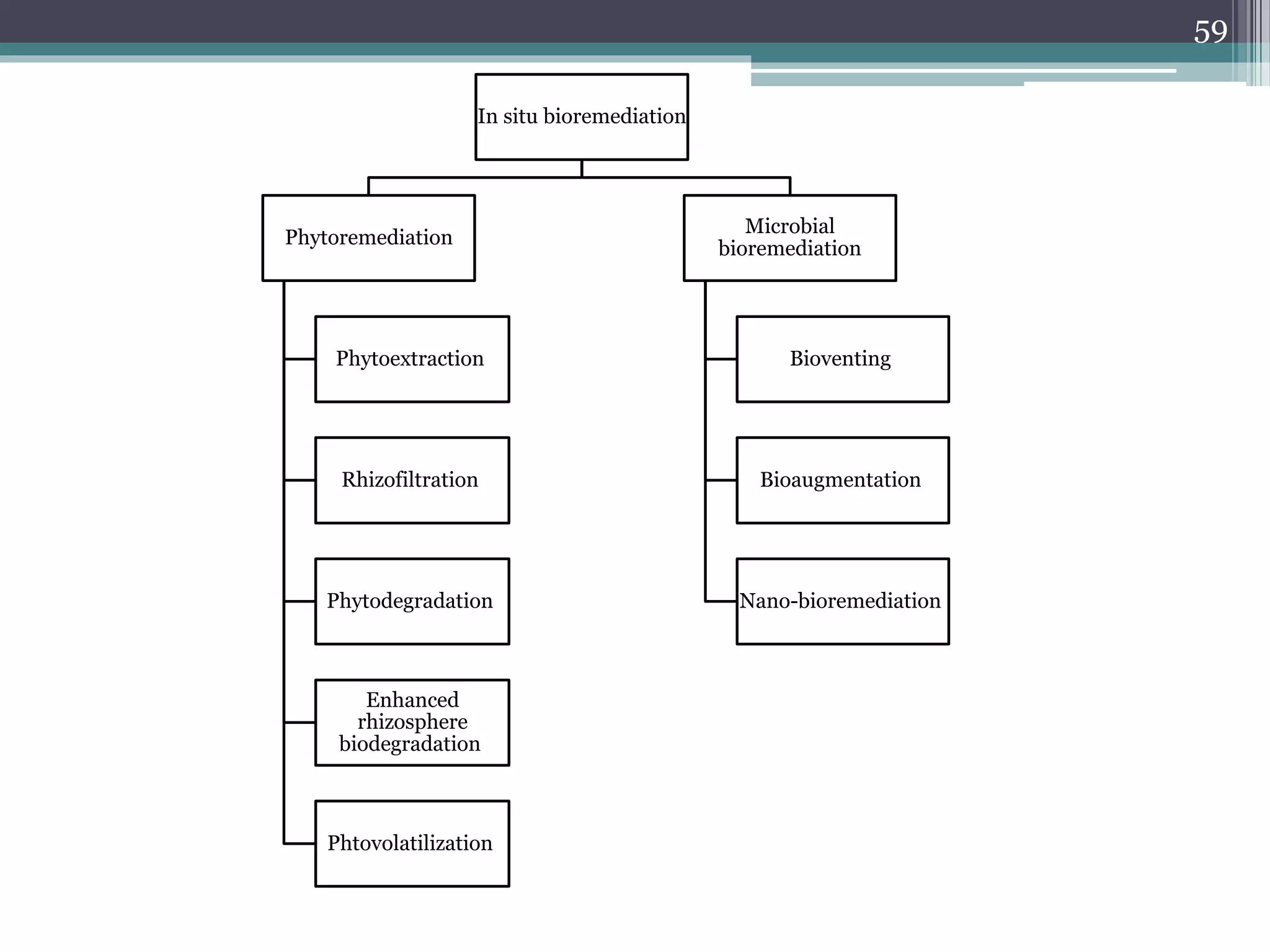
In situ bioremediation
Microbial
bioremediation
Bioventing
Bioaugmentation
Nano-bioremediation
Phytoremediation
Phytoextraction
Rhizofiltration
Phytodegradation
Enhanced
rhizosphere
biodegradation
Phtovolatilization
59
Phytoremediation
60
1. Phytoextraction
62
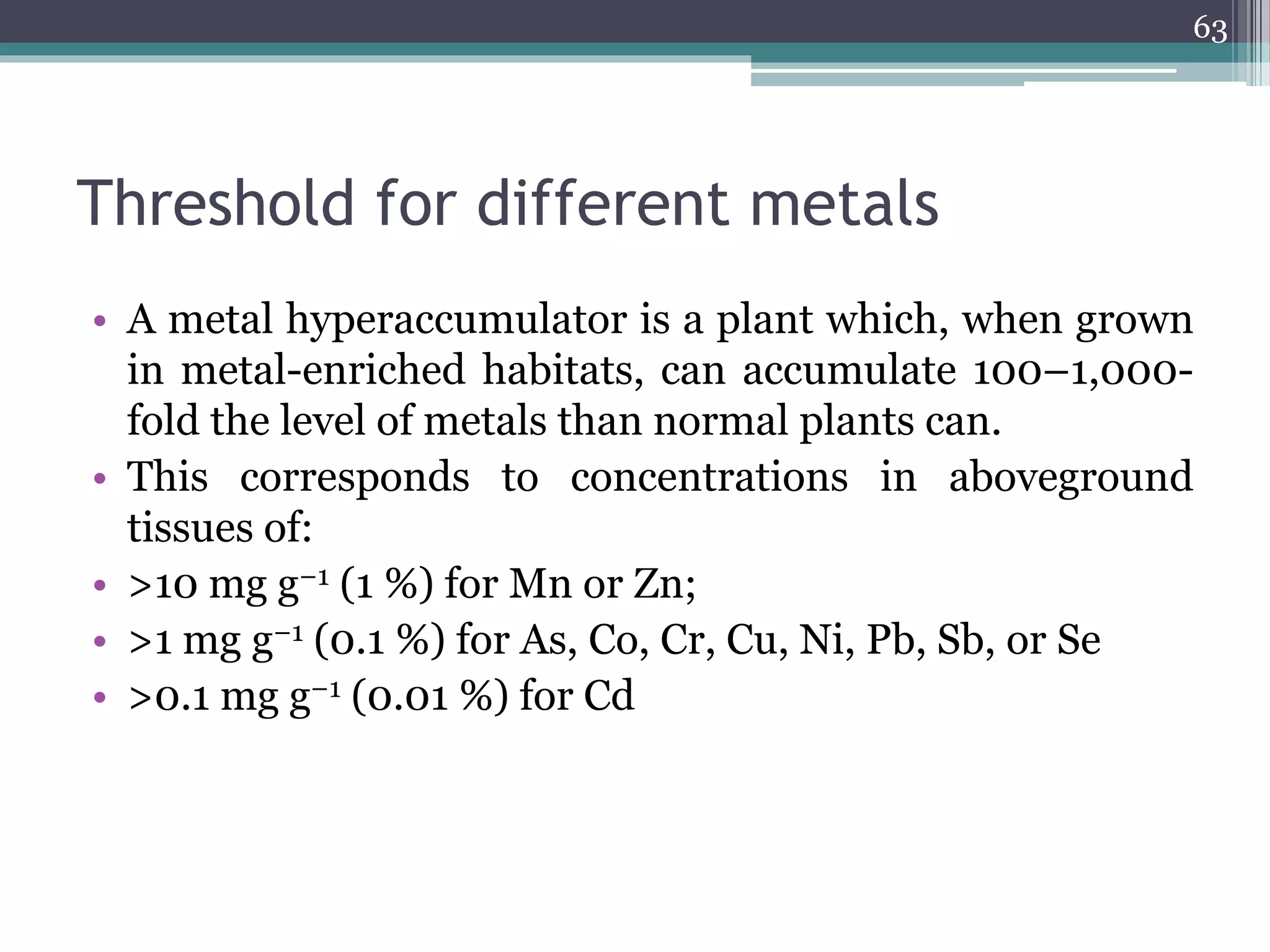
Threshold for different metals
• A metal hyperaccumulator is a plant which, when grown
in metal-enriched habitats, can accumulate 100–1,000-
fold the level of metals than normal plants can.
• This corresponds to concentrations in aboveground
tissues of:
• >10 mg g−1 (1 %) for Mn or Zn;
• >1 mg g−1 (0.1 %) for As, Co, Cr, Cu, Ni, Pb, Sb, or Se
• >0.1 mg g−1 (0.01 %) for Cd
63
Use of hyperaccumulators
64
Thlaspi caerulescens Brassica juncea
For example, B. juncea, although with only one-third the
concentration of Zn in its tissues compared with T. caerulescens (a
known hyperaccumulator of Zn), is considered to be more effective
at removing Zn from soils.
This advantage is primarily due to the fact that B. juncea produces
ten times more biomass than T. caerulescens .
Mechanism of phytoextration
• Generally, only a small fraction of the total content is readily
available (bioavailable), as most of the metals are commonly found
as insoluble compounds or are strongly bound to the soil matrix.
65
Bioavailability
of metals
Secretion of
phytosiderophores
to chelate and
solubilize metals
Acidification of the
rhizosphere due to
proton pumps and
exudation of
organic acids
2. Rhizofilteration
• Rhizofilteration is a process through which a well developed root system
is used as a filter for metals.
• This process takes place more readily in water than in soil and that is
why it is mainly used to extract metals or radioactive matter from water.
• Other than in the phytoextraction process, here only the roots, where
the metal accumulation has taken place, are harvested and disposed of.
66
• In rhizofiltration, the
contaminants are adsorbed or
absorbed, i.e., plant roots
precipitate and concentrate toxic
metals from polluted effluents.
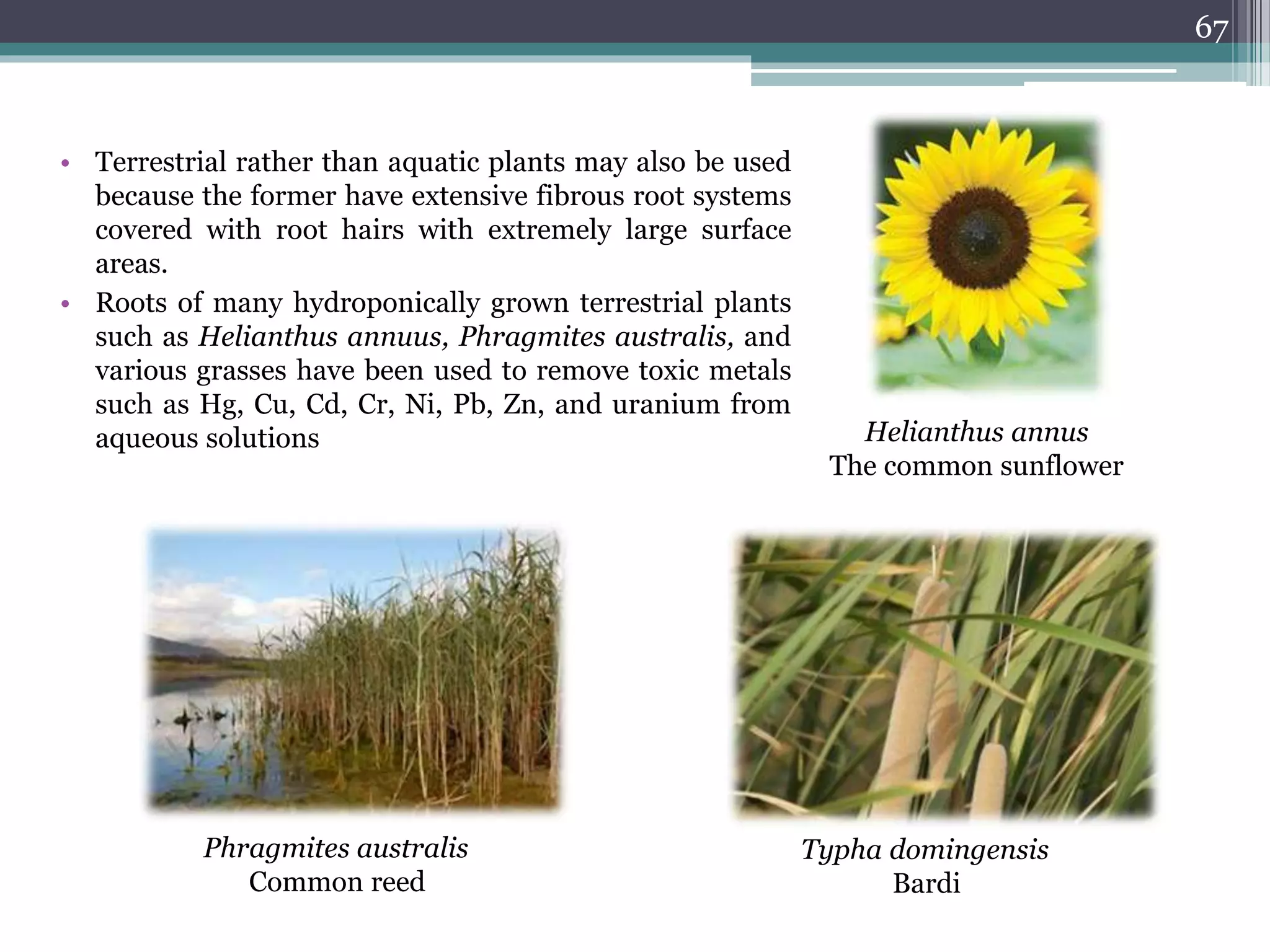
• Terrestrial rather than aquatic plants may also be used
because the former have extensive fibrous root systems
covered with root hairs with extremely large surface
areas.
• Roots of many hydroponically grown terrestrial plants
such as Helianthus annuus, Phragmites australis, and
various grasses have been used to remove toxic metals
such as Hg, Cu, Cd, Cr, Ni, Pb, Zn, and uranium from
aqueous solutions
67
Phragmites australis
Common reed
Typha domingensis
Bardi
Helianthus annus
The common sunflower
3. Phytodegradation
• Phytodegradation utilises plants to
uptake / degrade organic
contaminants in soils.
• Internal process: through
metabolic processes.
• External process: enzymes break
down contaminants.
• Examples: chlorinated solvents
and herbicides.
68
4. Enhanced rhizosphere biodegradation
• Rhizodegradation refers to the
breakdown of contaminants within the
plant root zone, or rhizosphere.
• Rhizodegradation is believed to be
carried out by bacteria or other
microorganisms whose numbers
typically flourish in the rhizosphere.
• Microorganisms (yeast, fungi or
bacteria) consume and digest organic
substances for nutrition and energy.
69
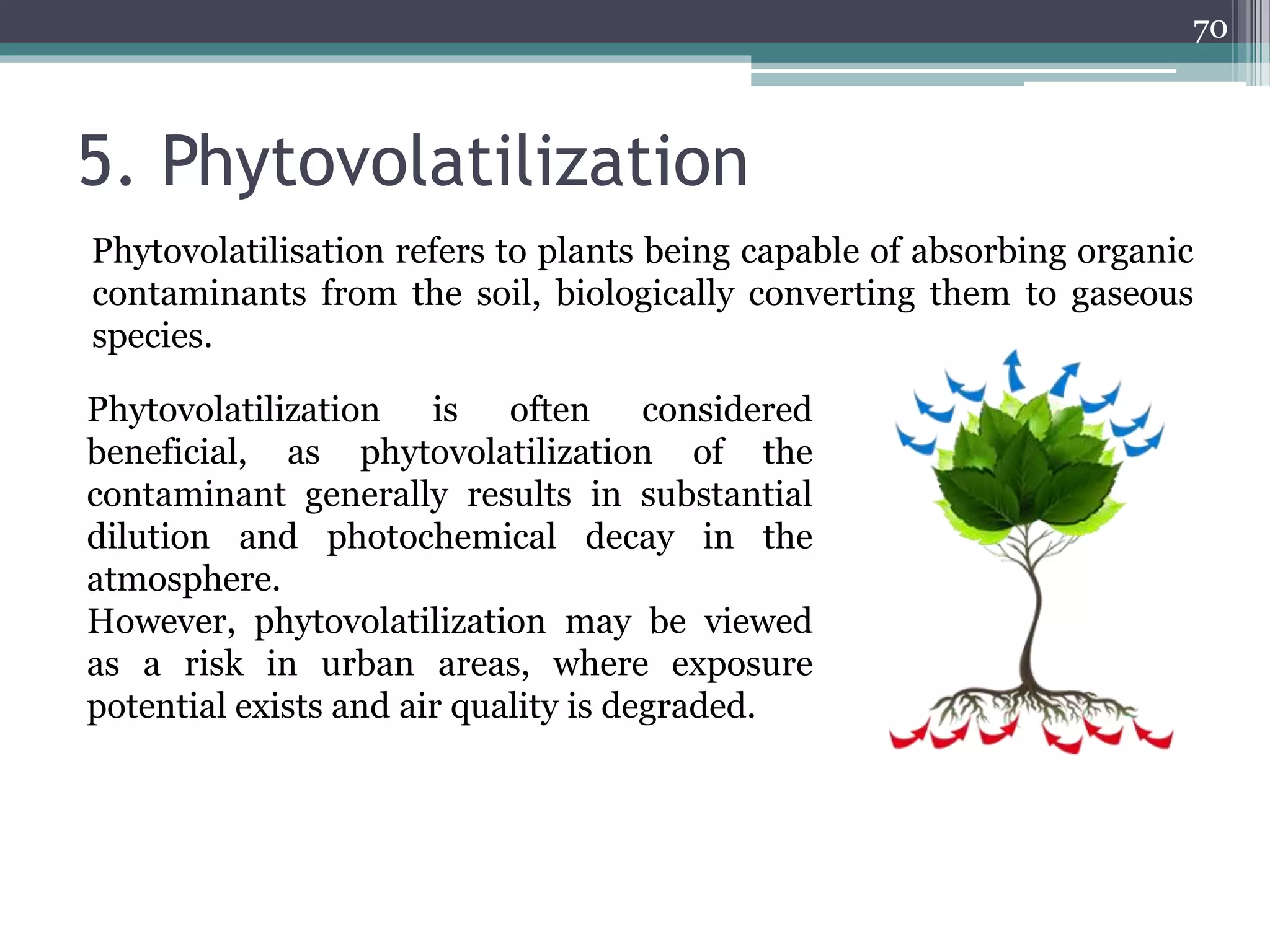
5. Phytovolatilization
Phytovolatilisation refers to plants being capable of absorbing organic
contaminants from the soil, biologically converting them to gaseous
species.
70
Phytovolatilization is often considered
beneficial, as phytovolatilization of the
contaminant generally results in substantial
dilution and photochemical decay in the
atmosphere.
However, phytovolatilization may be viewed
as a risk in urban areas, where exposure
potential exists and air quality is degraded.
Phytovolatilization of heavy metals
• This technique can also be used for some heavy metals like Hg and
Se because these metals can form volatile chemical species through
reduction and methylation reactions.
• Biological volatilization has the advantage of removing Se from a
contaminated site in relatively nontoxic forms, such as
dimethylselenide (DMSe).
• Nevertheless, phytovolatilization of Hg may cause secondary
contamination of the environment with Hg0.
• For this reason, another alternative to promote a higher efficiency of
phytoextraction could be the use of genetic engineering to integrate
genes from other organisms in plants so that they could accumulate
Hg without releasing Hg0 into the atmosphere.
71
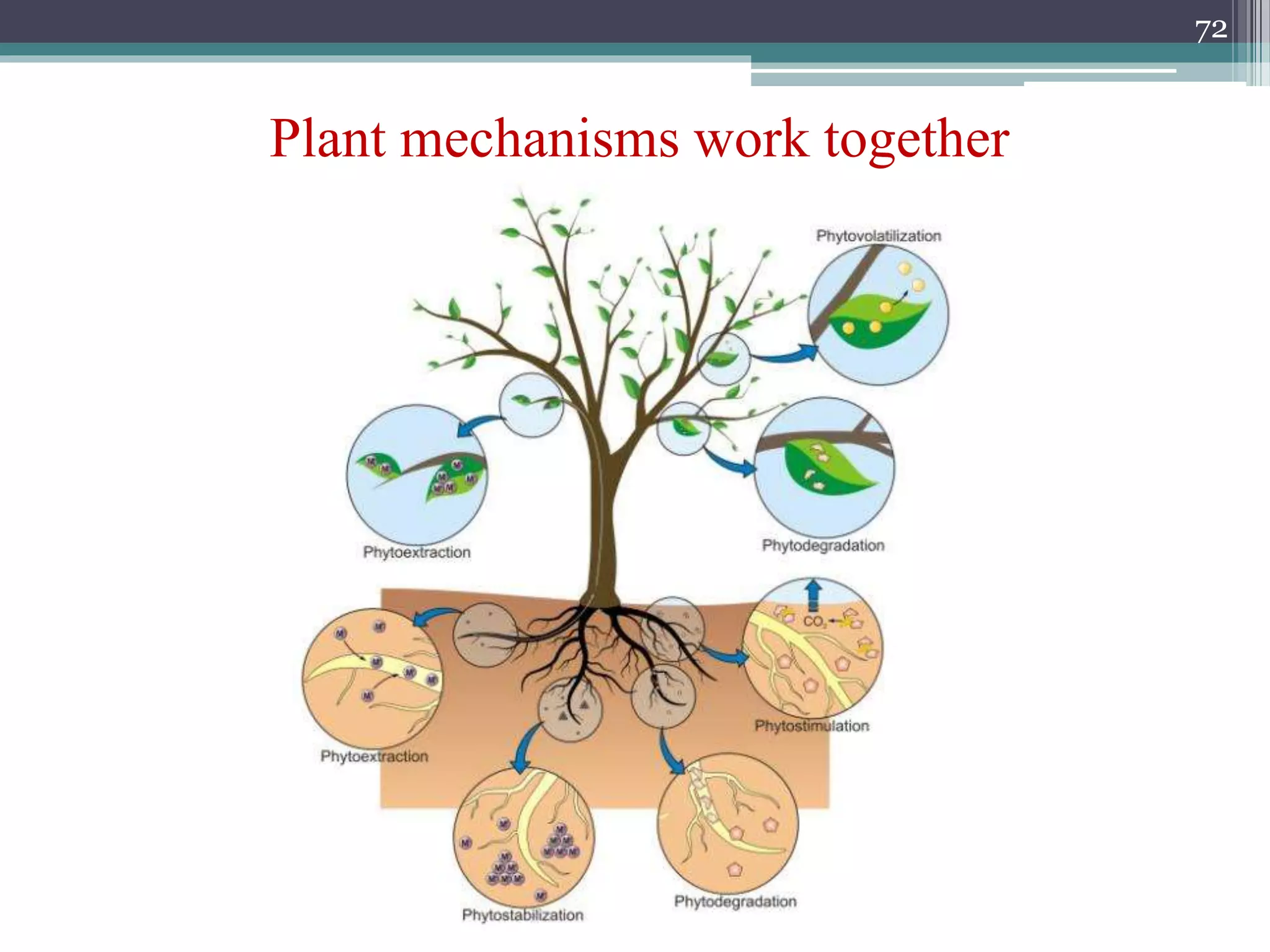
Plant mechanisms work together
72
Advantages of phytoremediation
• It can be applied to more multiple and mixed
contaminants and media.
• It is less costly and if properly managed is both
environmentally friendly and aesthetically
pleasing to the public.
73
Limitations of phytoremediation
• A longer time period is likely to be required for
phytoremediation, as this technology is dependent on
plant growth rates for establishment of an extensive root
system or significant aboveground biomass.
• Phytoremediation is most effective only at sites with
shallow contamination in the soils and/or sites with
shallow water table.
74
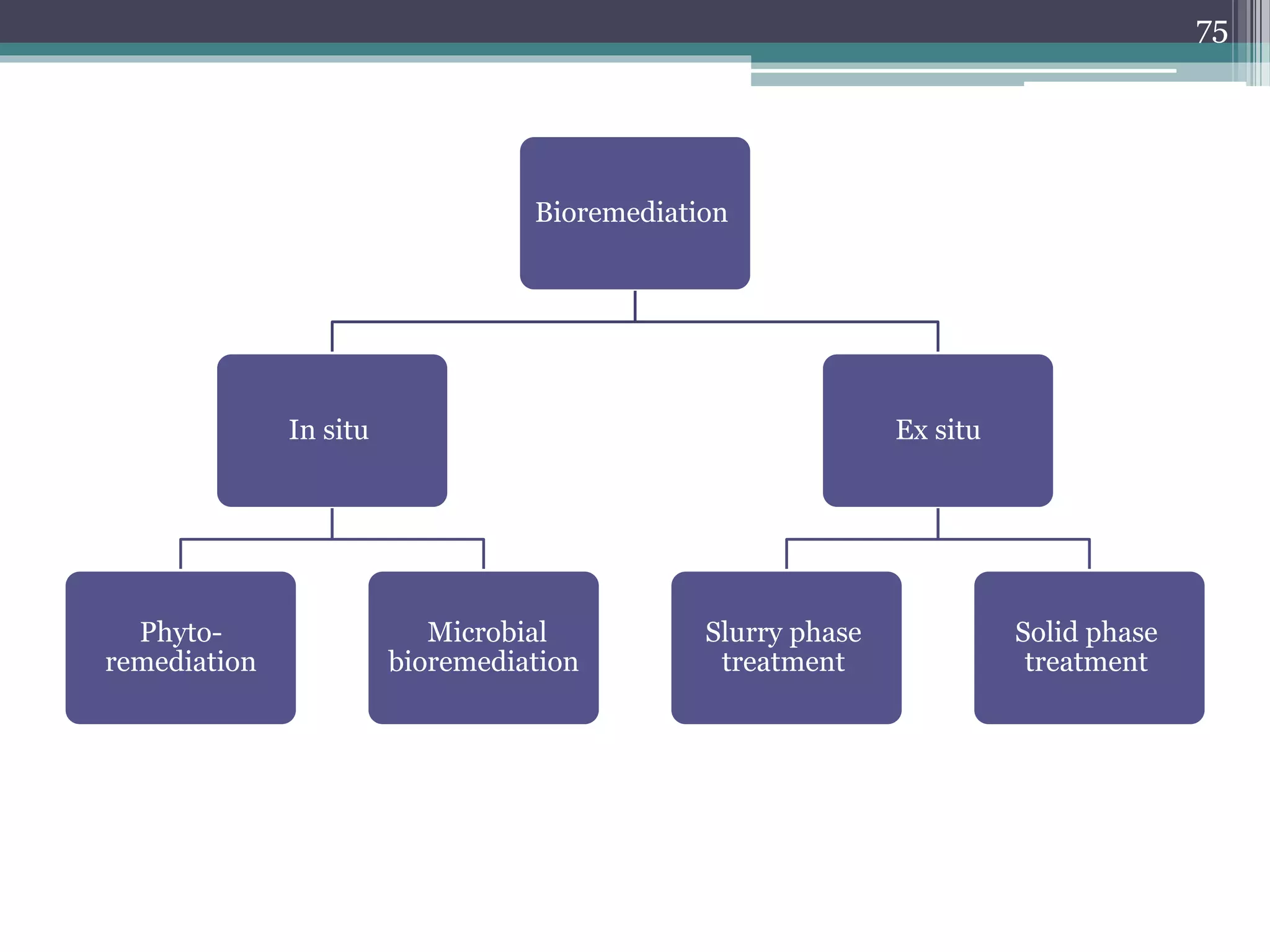
Bioremediation
In situ
Phyto-
remediation
Microbial
bioremediation
Ex situ
Slurry phase
treatment
Solid phase
treatment
75
Microbial bioremediation
76
Microorganisms
77
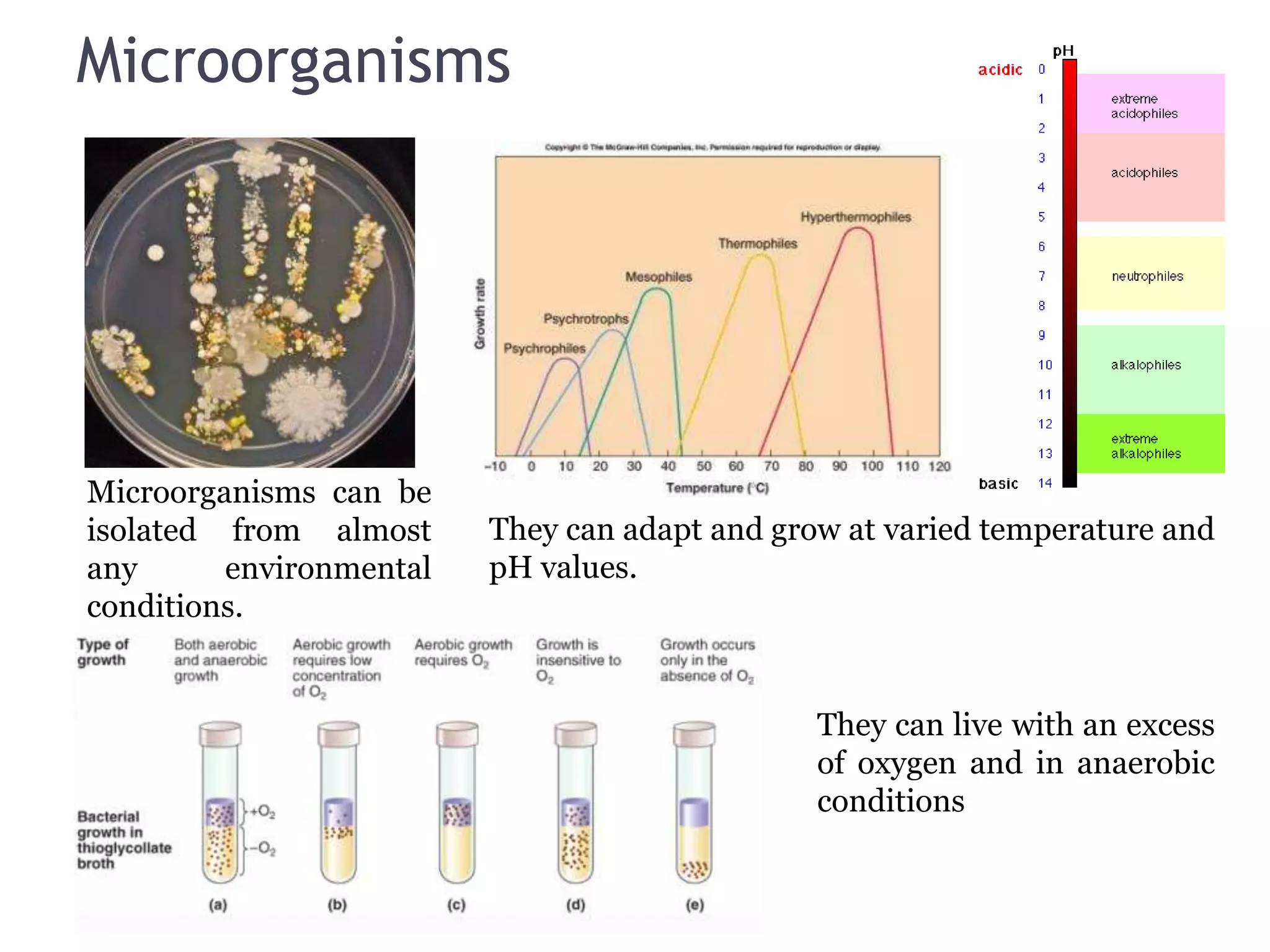
Microorganisms can be
isolated from almost
any environmental
conditions.
They can adapt and grow at varied temperature and
pH values.
They can live with an excess
of oxygen and in anaerobic
conditions
Microbial bioremediation
78
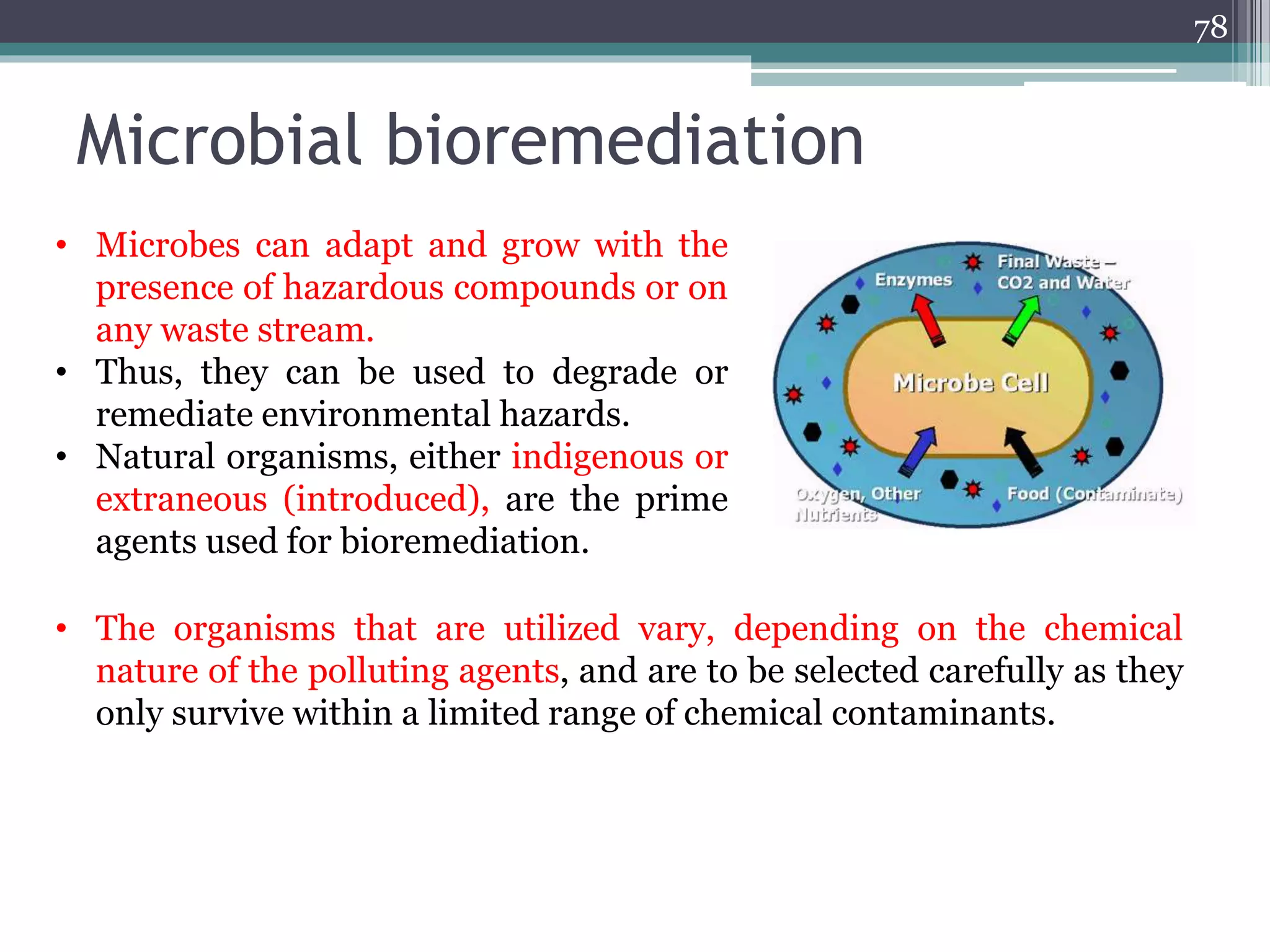
• Microbes can adapt and grow with the
presence of hazardous compounds or on
any waste stream.
• Thus, they can be used to degrade or
remediate environmental hazards.
• Natural organisms, either indigenous or
extraneous (introduced), are the prime
agents used for bioremediation.
• The organisms that are utilized vary, depending on the chemical
nature of the polluting agents, and are to be selected carefully as they
only survive within a limited range of chemical contaminants.
Microorganisms Having Biodegradation Potential for Xenobiotics
79
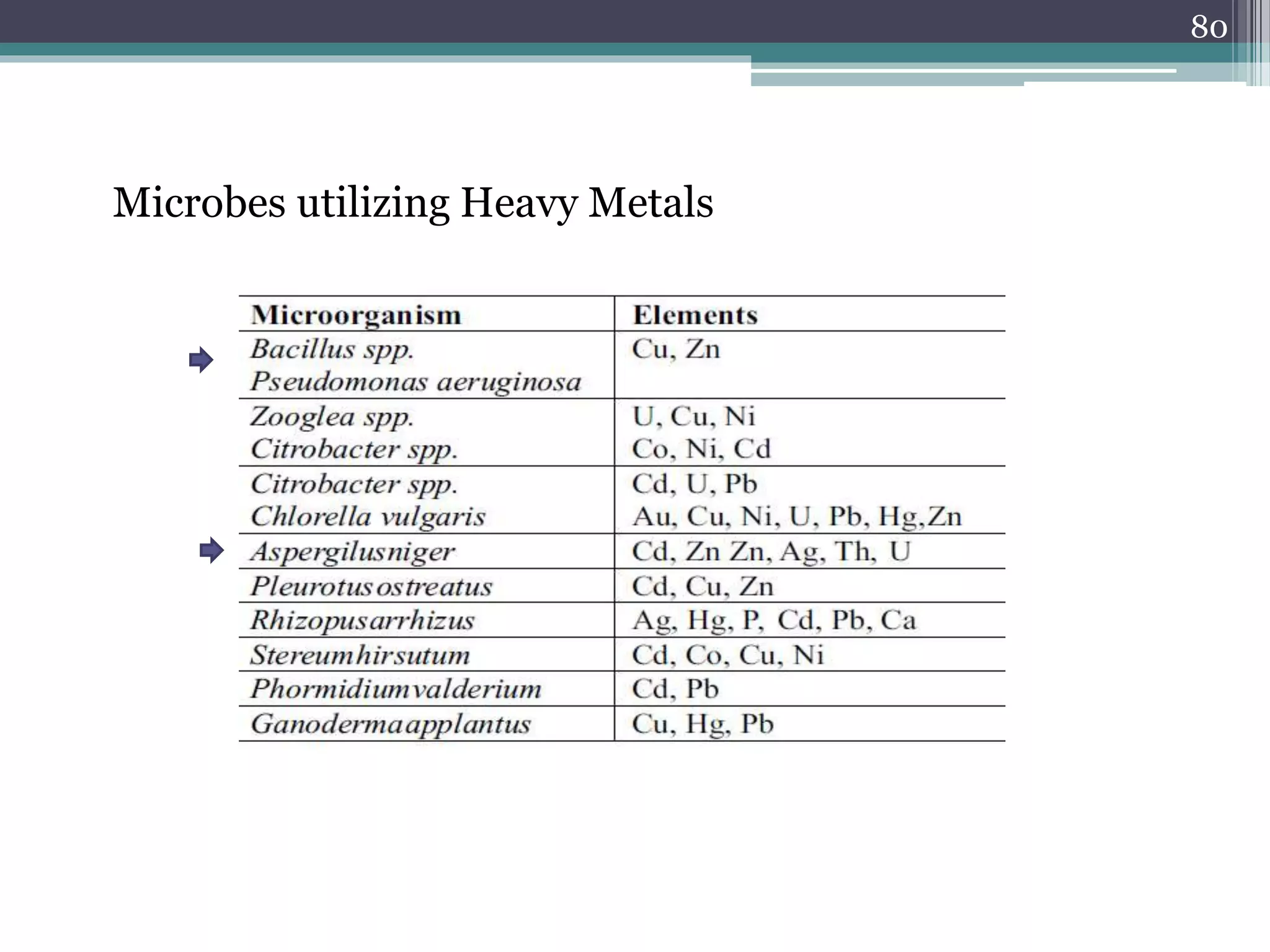
Microbes utilizing Heavy Metals
80
Mycoremediation
81
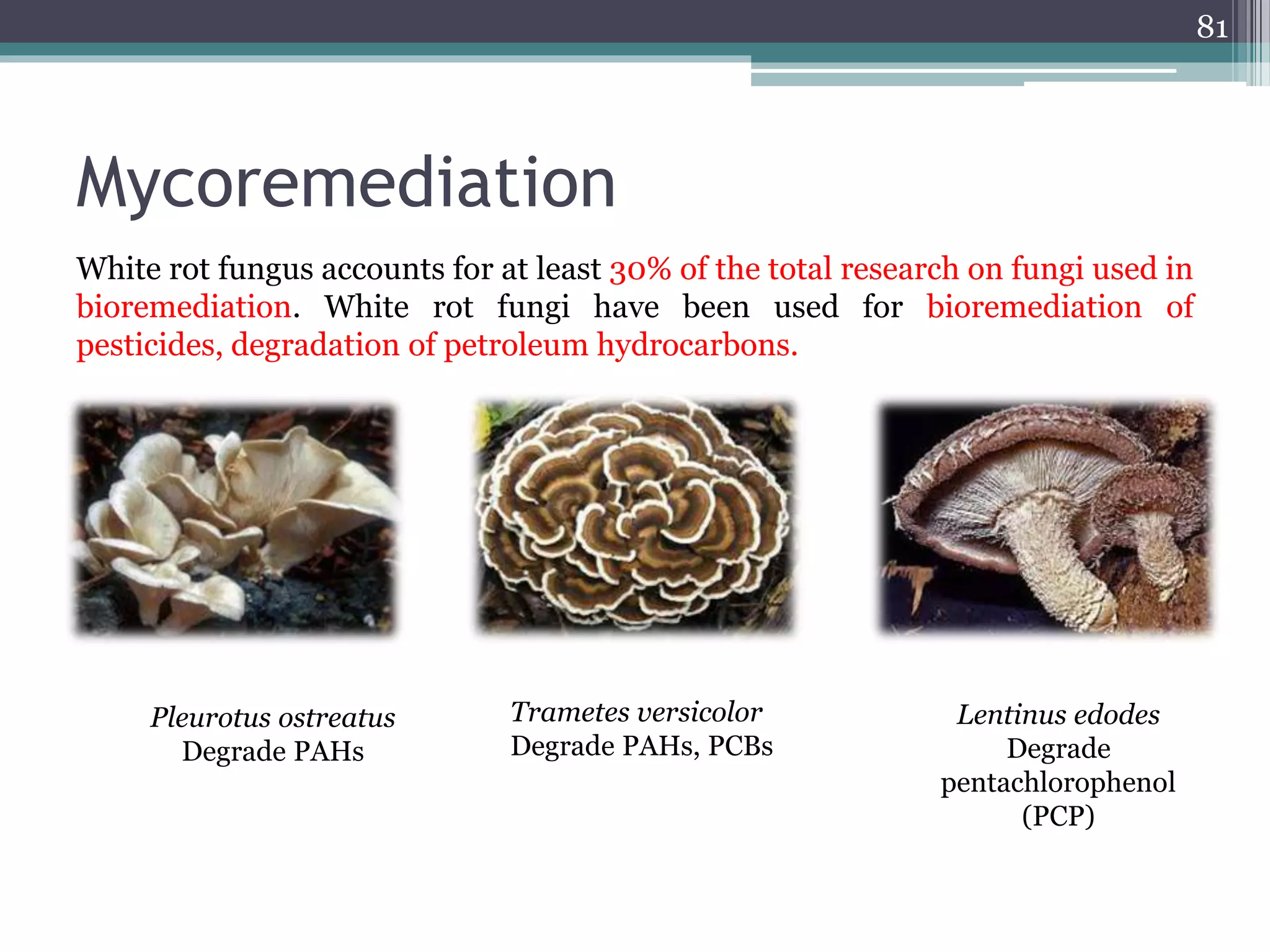
White rot fungus accounts for at least 30% of the total research on fungi used in
bioremediation. White rot fungi have been used for bioremediation of
pesticides, degradation of petroleum hydrocarbons.
Pleurotus ostreatus
Degrade PAHs
Trametes versicolor
Degrade PAHs, PCBs
Lentinus edodes
Degrade
pentachlorophenol
(PCP)
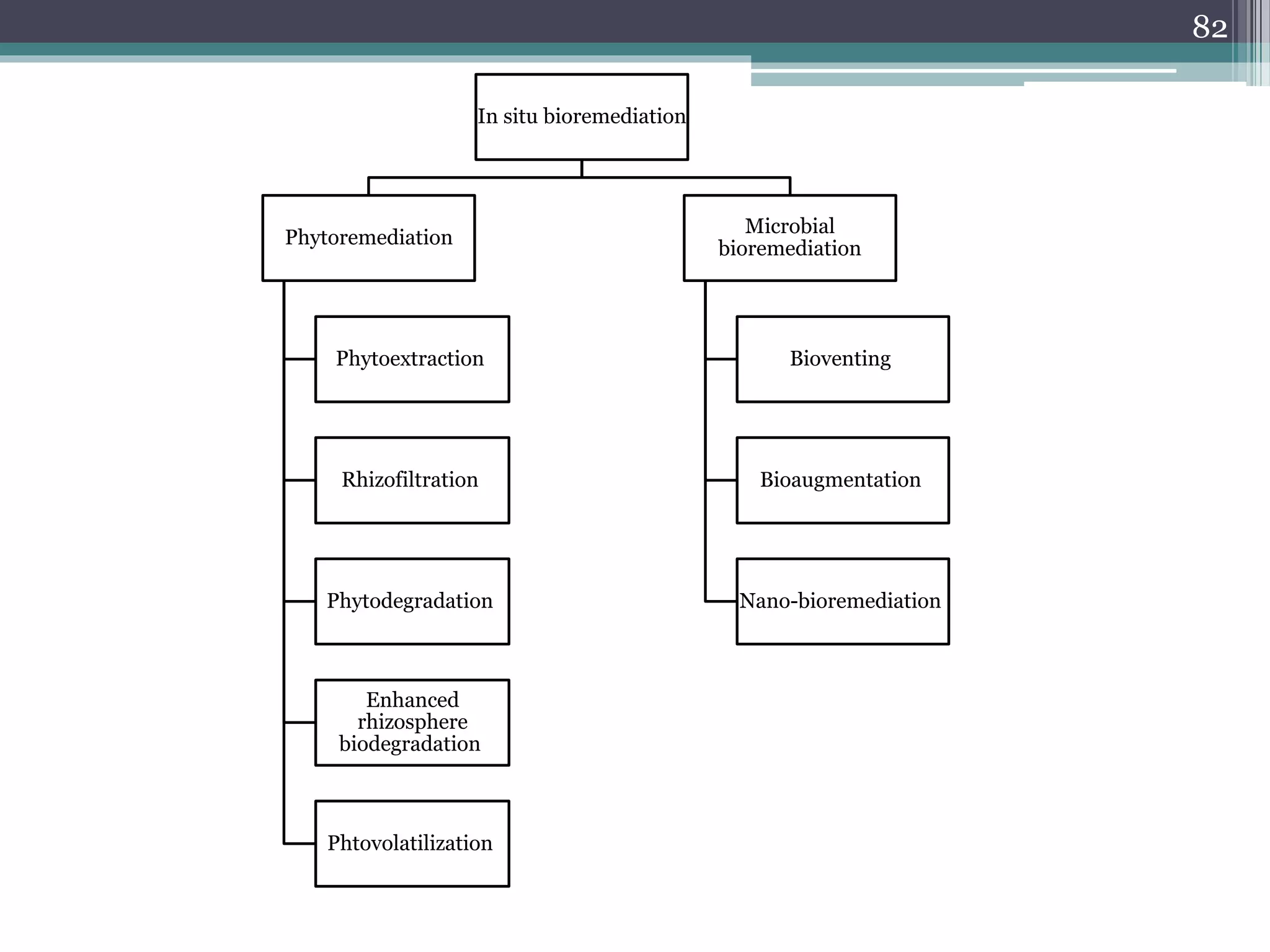
In situ bioremediation
Microbial
bioremediation
Bioventing
Bioaugmentation
Nano-bioremediation
Phytoremediation
Phytoextraction
Rhizofiltration
Phytodegradation
Enhanced
rhizosphere
biodegradation
Phtovolatilization
82
1. Bioventing
• In situ treatment and involves supplying a gas and nutrients through wells into the
subsurface to stimulate the indigenous bacteria.
• The gas can be used to keep the subsurface aerobic or anaerobic to enable
degradation to occur.
• It works for simple hydrocarbons and can be used where the contamination is deep
under the surface.
83
Schematic diagram of a typical bioventing
system
Aerobic bioventing
• Treating aerobically degradable contaminants, such as fuels.
• Using the supplied oxygen, the microbes oxidize the contaminants
to gain energy and carbon for growth.
• Oxygen is typically introduced by air injection wells that push air
into the subsurface.
84
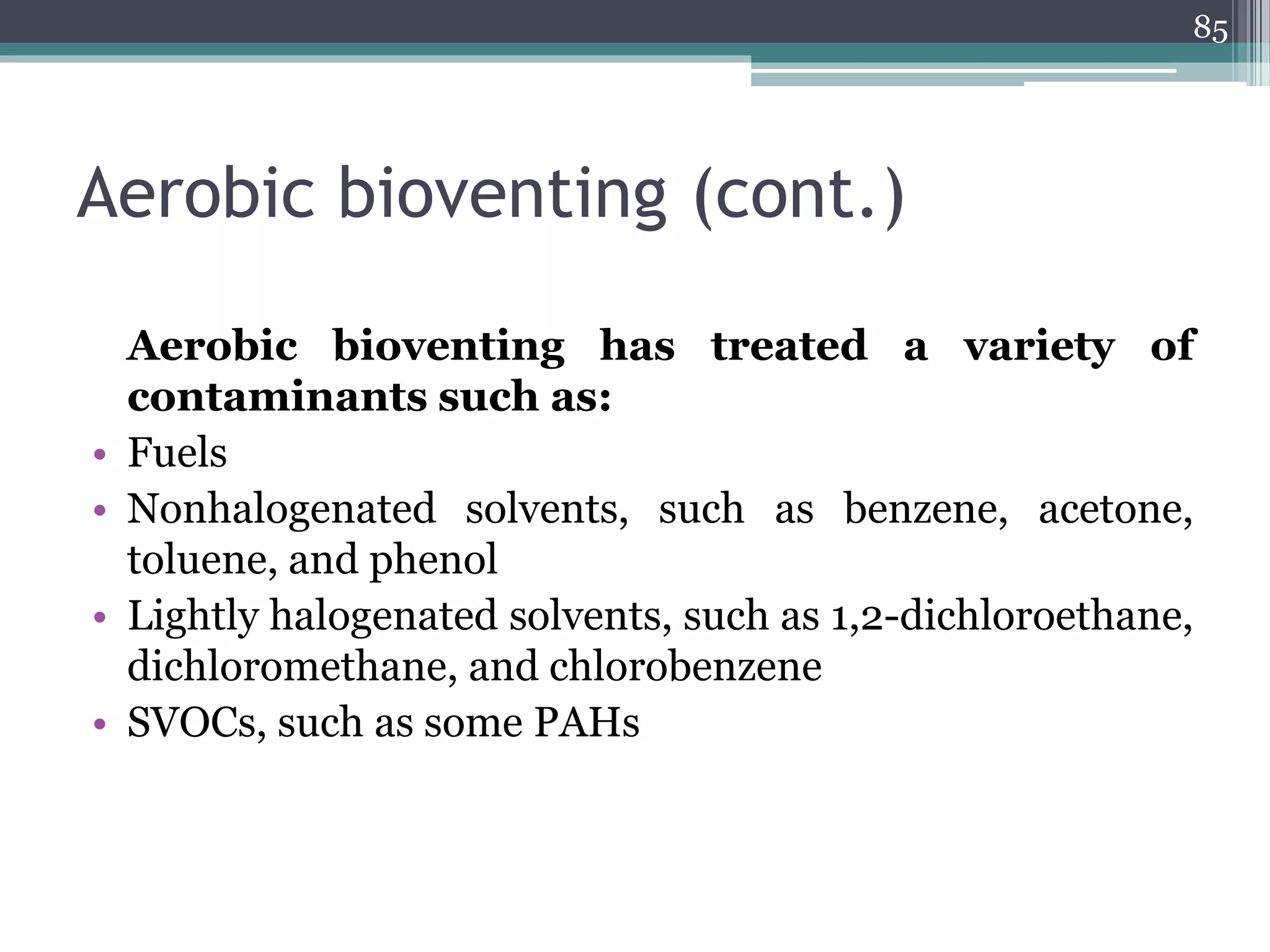
Aerobic bioventing (cont.)
Aerobic bioventing has treated a variety of
contaminants such as:
• Fuels
• Nonhalogenated solvents, such as benzene, acetone,
toluene, and phenol
• Lightly halogenated solvents, such as 1,2-dichloroethane,
dichloromethane, and chlorobenzene
• SVOCs, such as some PAHs
85
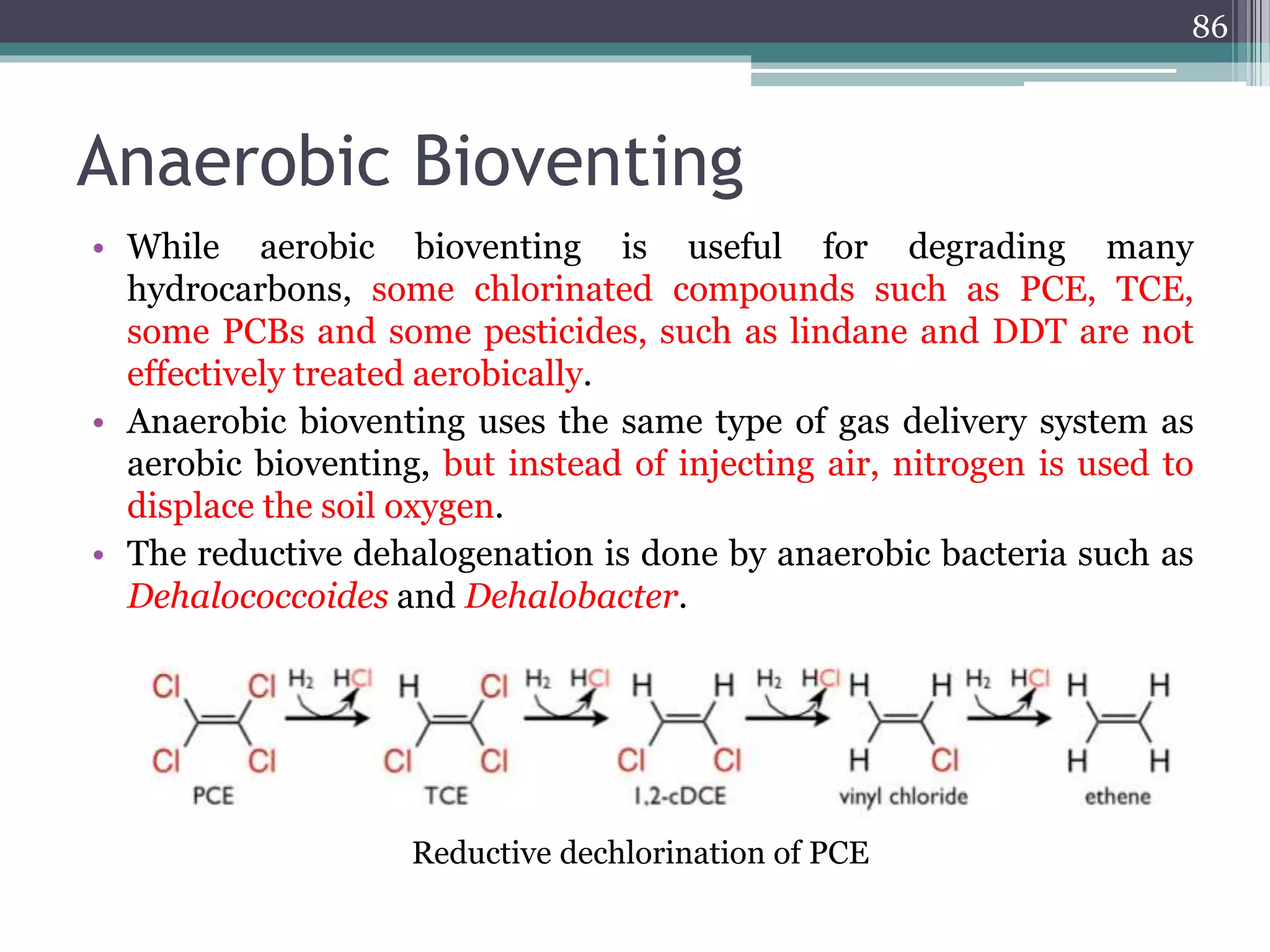
Anaerobic Bioventing
• While aerobic bioventing is useful for degrading many
hydrocarbons, some chlorinated compounds such as PCE, TCE,
some PCBs and some pesticides, such as lindane and DDT are not
effectively treated aerobically.
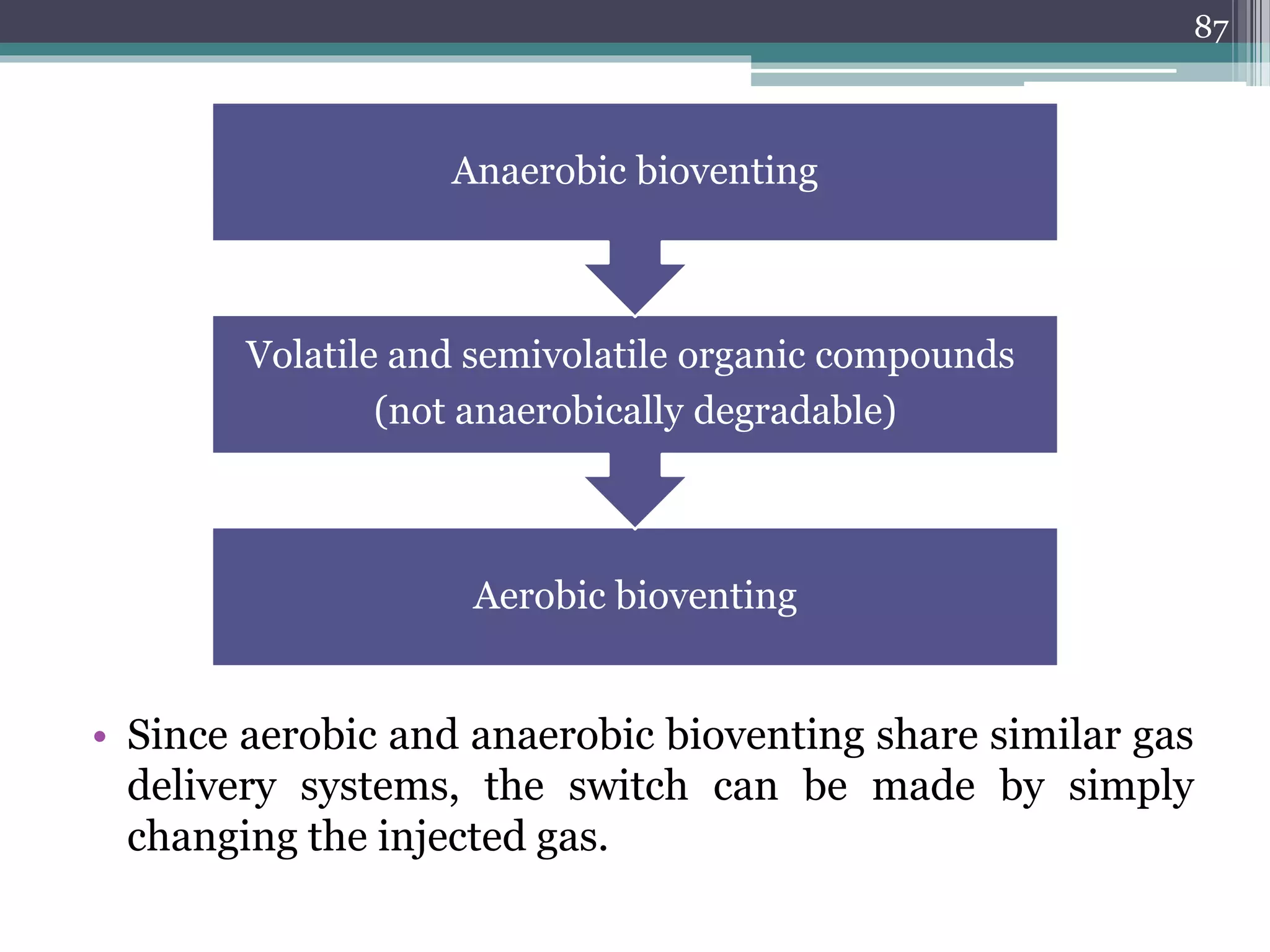
• Anaerobic bioventing uses the same type of gas delivery system as
aerobic bioventing, but instead of injecting air, nitrogen is used to
displace the soil oxygen.
• The reductive dehalogenation is done by anaerobic bacteria such as
Dehalococcoides and Dehalobacter.
86
Reductive dechlorination of PCE
• Since aerobic and anaerobic bioventing share similar gas
delivery systems, the switch can be made by simply
changing the injected gas.
87
Aerobic bioventing
Volatile and semivolatile organic compounds
(not anaerobically degradable)
Anaerobic bioventing
2. Bioaugmentation
• Bioaugmentation is the way to enhance biodegradative capacity of
the contaminated sites by inoculation of bacteria with desired
catalytic capabilities.
• The basic principle of this intervention is to enhance genetic
diversity leading to a wider repertoire of biodegradative reactions.
• Bioaugmentation is the remediation process involving wild-type or
genetically modified microorganisms for treatment of sites
contaminated with hazardous organic chemicals.
88
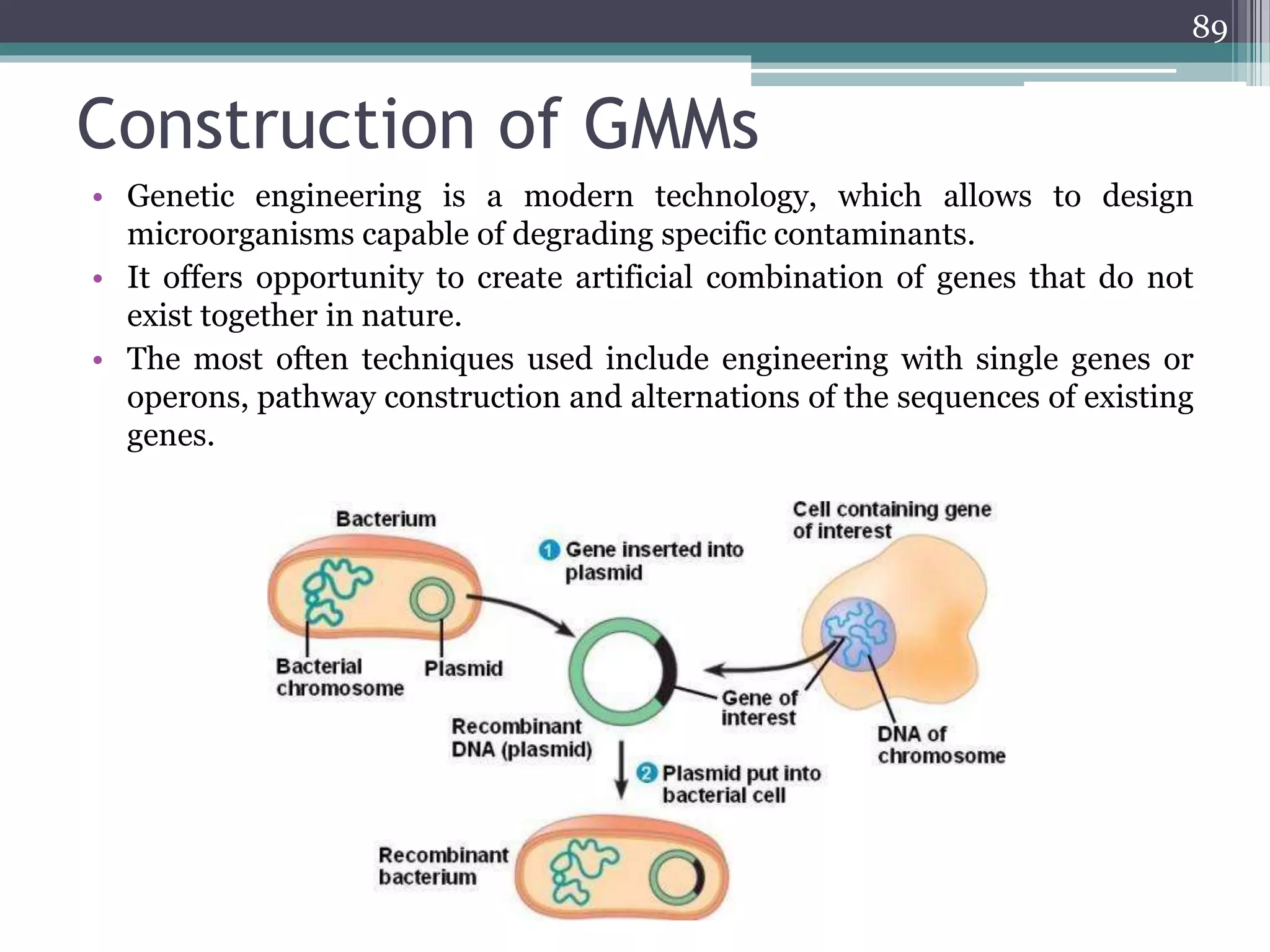
Construction of GMMs
• Genetic engineering is a modern technology, which allows to design
microorganisms capable of degrading specific contaminants.
• It offers opportunity to create artificial combination of genes that do not
exist together in nature.
• The most often techniques used include engineering with single genes or
operons, pathway construction and alternations of the sequences of existing
genes.
89
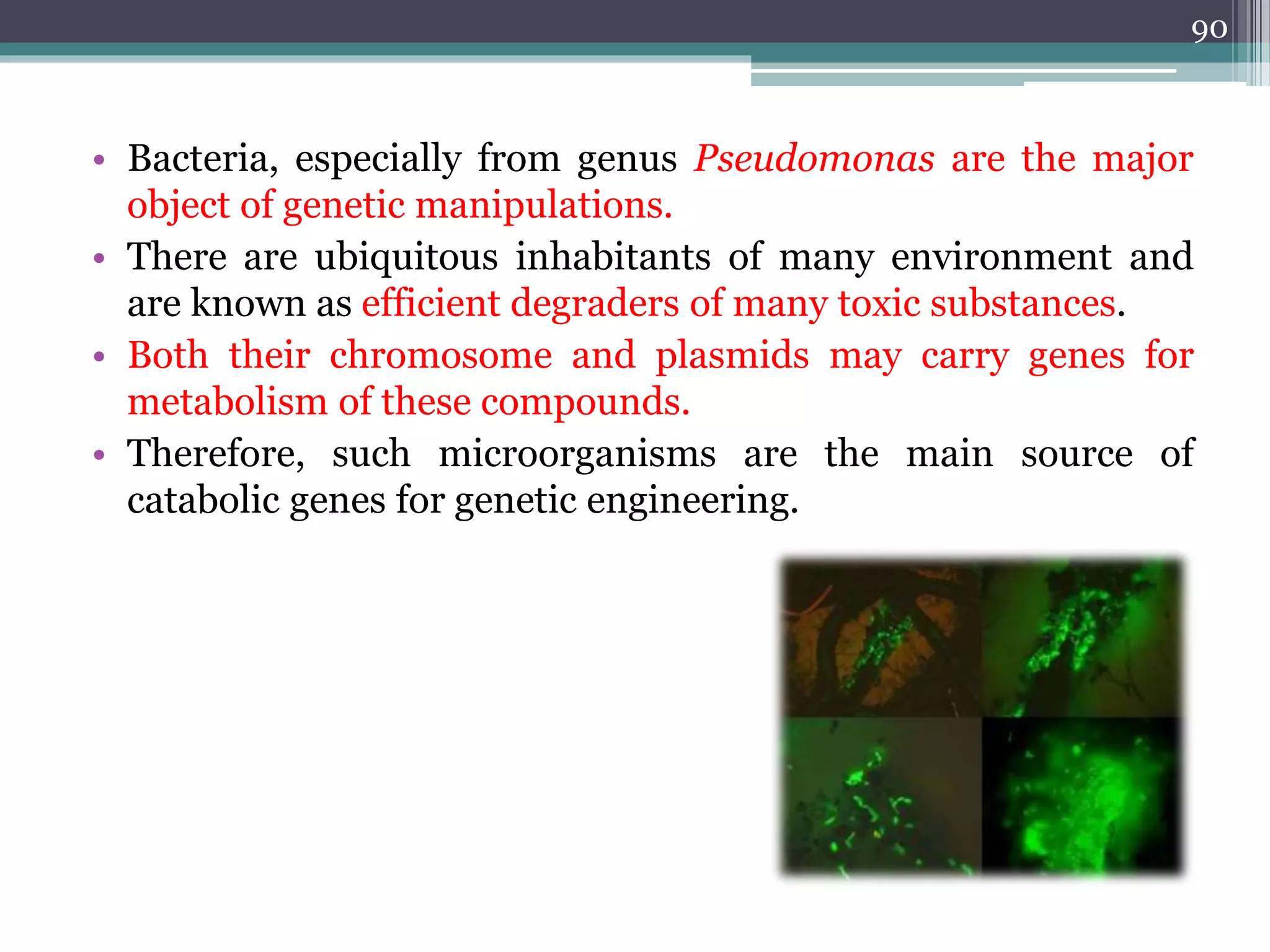
• Bacteria, especially from genus Pseudomonas are the major
object of genetic manipulations.
• There are ubiquitous inhabitants of many environment and
are known as efficient degraders of many toxic substances.
• Both their chromosome and plasmids may carry genes for
metabolism of these compounds.
• Therefore, such microorganisms are the main source of
catabolic genes for genetic engineering.
90
GMMs degrading organic compounds
91
3. Nanobioremediation
• The possibility of using physicochemical technology (fast, but expensive) to
treat the high concentrations initially followed by biological technology
(cheap, but relatively slow), is presented as a viable practical and
sustainable alternative to in-situ application.
• This remediation method is known as Nanobioremediation, and the
scientists are currently evaluating the potential of this technology for its
effectiveness and sustainability for residual clays contaminated with
chlorinated organic contaminants.
92
Concept of nanobioremediation: Initial injection of nZVI to reduce the source zone concentrations and then
initiate biormediation of residual source contamination (if any) and any produced byproducts.
Bioremediation
In situ
Phyto-
remediation
Microbial
bioremediation
Ex situ
Slurry phase
treatment
Solid phase
treatment
94
b) Ex situ biological remediation
• Ex situ bio remedial methods involve excavation
of soil and treat it at a different site.
• These methods are normally faster than the in
situ methods.
• They are applicable for a wider range of
contaminants, yet they are more expensive.
95
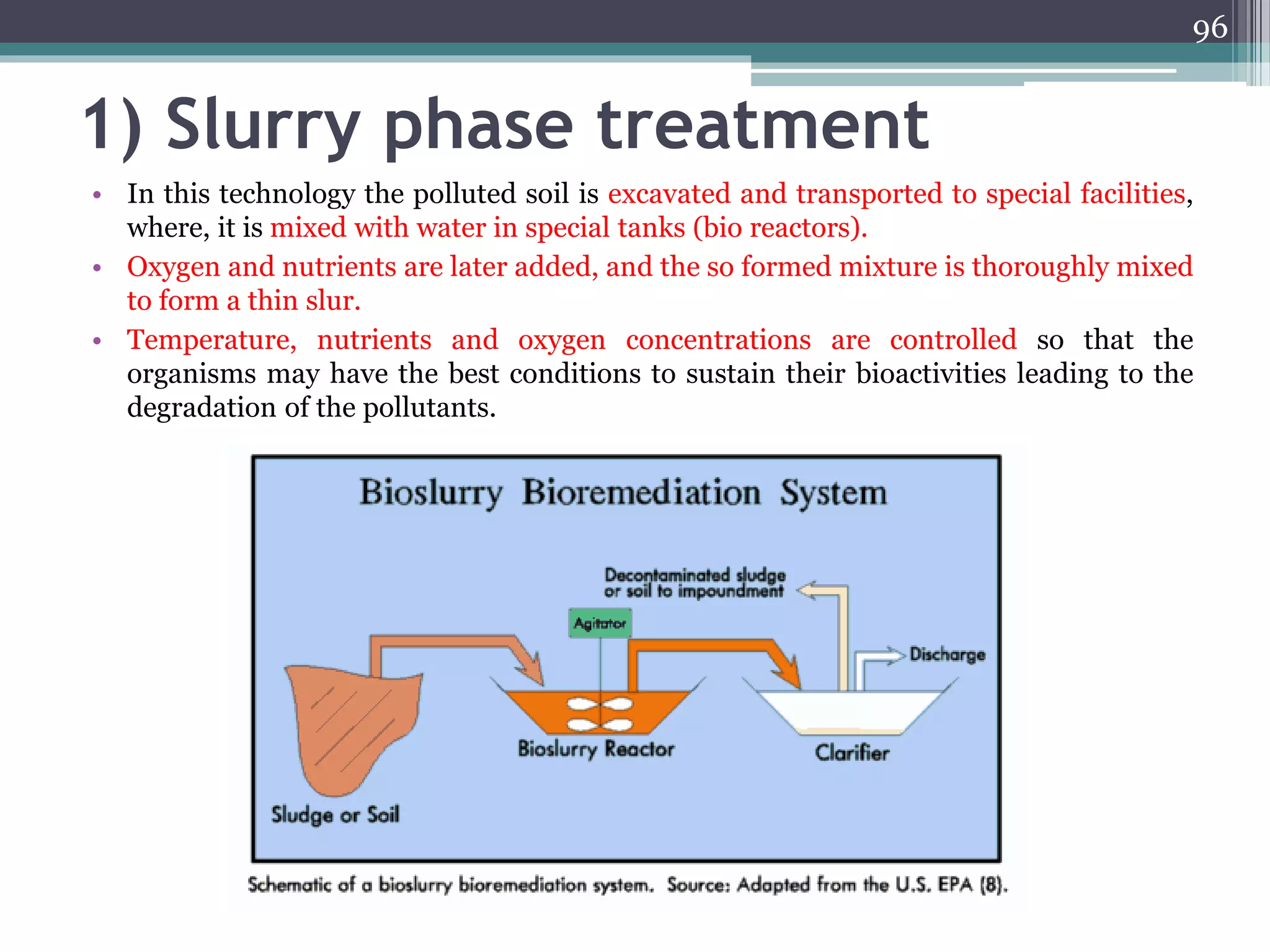
1) Slurry phase treatment
• In this technology the polluted soil is excavated and transported to special facilities,
where, it is mixed with water in special tanks (bio reactors).
• Oxygen and nutrients are later added, and the so formed mixture is thoroughly mixed
to form a thin slur.
• Temperature, nutrients and oxygen concentrations are controlled so that the
organisms may have the best conditions to sustain their bioactivities leading to the
degradation of the pollutants.
96
2) Solid phase treatment
• Here the polluted soil is treated above the
ground in prepared beds.
• Despite the benefit of being less expensive than
the slurry bed treatment, it is not so effective
and needs more time and space to prepare the
beds.
• Three main techniques are commonly used to
carry out this remediation method - land
farming, soil biopiles and composting.
97
a) Land farming
• The soil is excavated and spread on a pad with a built in system for
collecting any possible leachates seepage.
• The so-formed bed is regularly mixed and turned over in order to
facilitate aeration and enhance biological activity in the bed.
• Nutrients are added if required, since lack of nutrients and oxygen
may lead to retardation of the bio degradation processes.
98
b. Composting
• Composting is the technique that involves combining contaminated
soil with nonhazardous organic amendments such as manure or
agricultural waste.
• This supports the development of rich microbial population
characterized at higher temperature for growth.
• Composting takes place between 40 and 50 °C and the thermophilic
microorganisms are active at this temperature.
• Proper conditions of oxygen, moisture, and temperature are
maintained.
• Frequent mixing is carried out for aeration and surface irrigation is
done for maintaining moisture level.
99
• Microorganisms degrade organic matter to CO2, water, and humic acid as
end products.
• Degradation is brought about by a consortium of aerobic organisms,
predominantly bacteria, fungi, and actinomycetes.
• They break down complex organics to smaller molecules which are used
as carbon and energy sources.
• Compost is either dark brown or black and is not soluble in water.
• Composting has been successfully applied to soils and bio-solids
contaminated with petroleum hydrocarbons, e.g., fuels, oils, grease,
solvents, chlorophenols, pesticides, herbicides, and nitro-aromatic
explosives.
100
c) Soil biopiles
• The excavated soil is heaped in piles of several meters height.
• To enhance degradation activities by the microorganisms, air is blown
through the pile.
• If required, nutrients are also added.
• Due to emissions from the piles, the whole process is sometimes carried
out in inclusions that control any volatile contaminants.
101
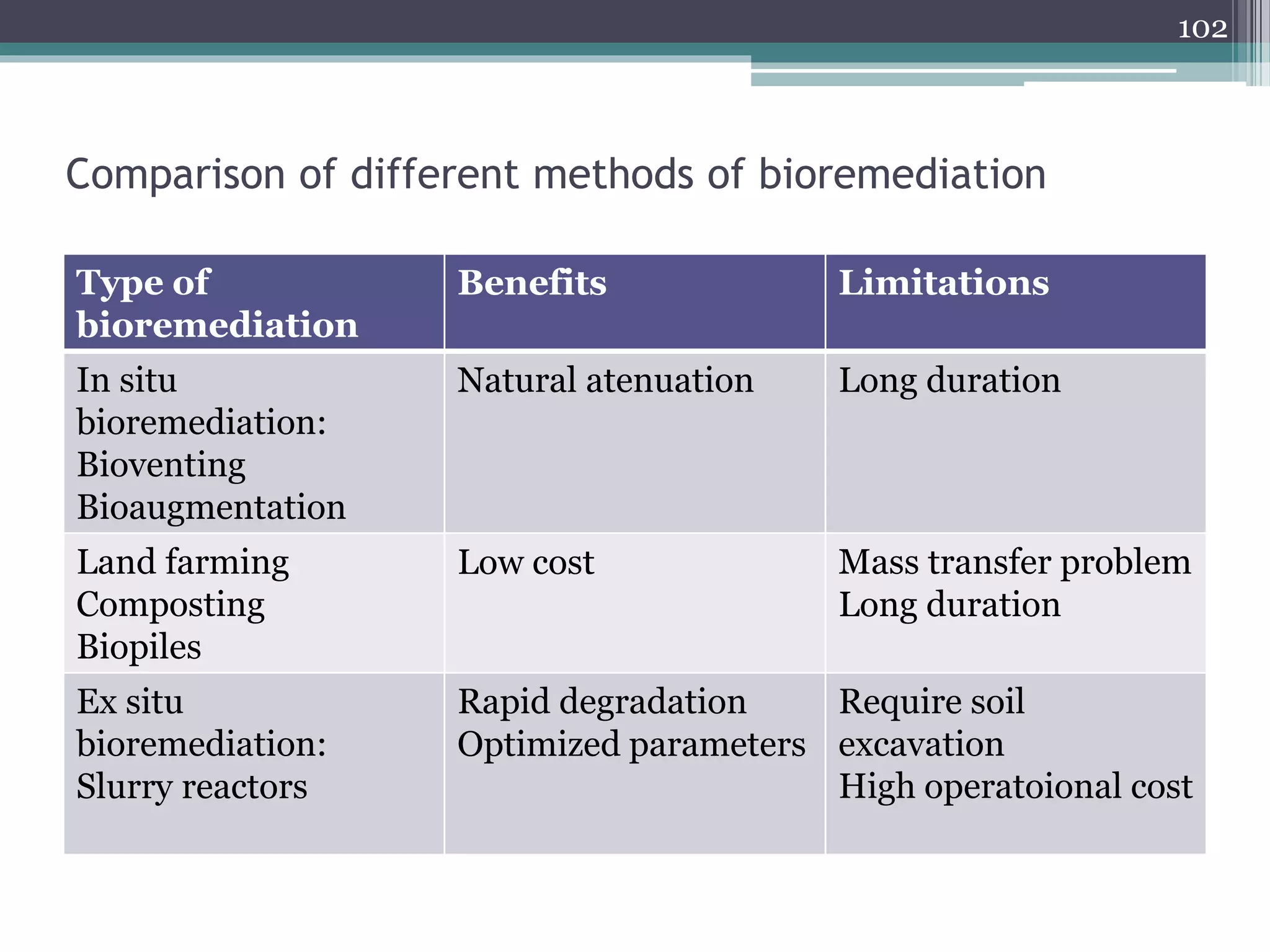
Comparison of different methods of bioremediation
LimitationsBenefitsType of
bioremediation
Long durationNatural atenuationIn situ
bioremediation:
Bioventing
Bioaugmentation
Mass transfer problem
Long duration
Low costLand farming
Composting
Biopiles
Require soil
excavation
High operatoional cost
Rapid degradation
Optimized parameters
Ex situ
bioremediation:
Slurry reactors
102
Soil pollution control
103
104
Soil Pollution Control
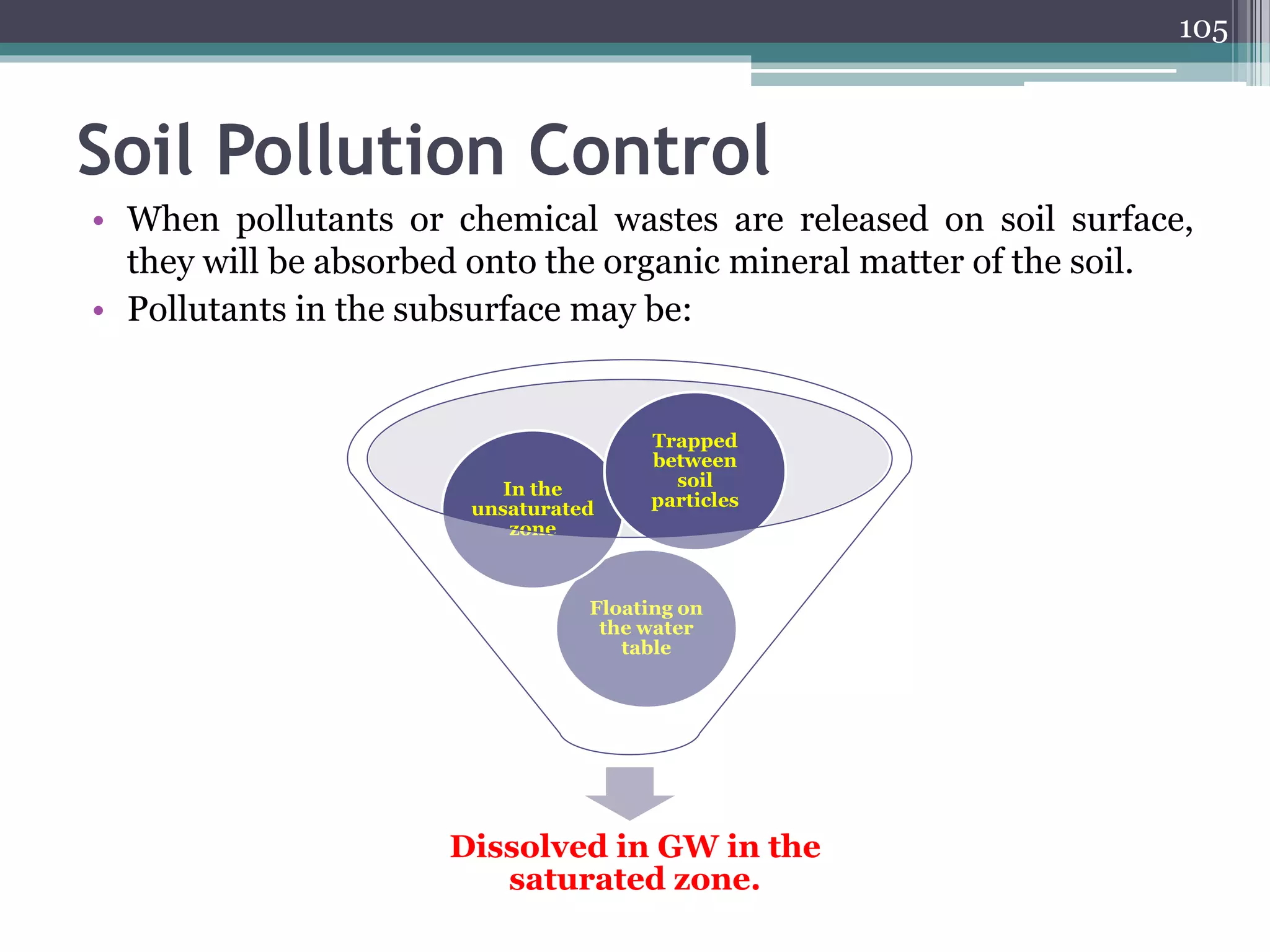
• When pollutants or chemical wastes are released on soil surface,
they will be absorbed onto the organic mineral matter of the soil.
• Pollutants in the subsurface may be:
Dissolved in GW in the
saturated zone.
Floating on
the water
table
In the
unsaturated
zone
Trapped
between
soil
particles
105
Objectives of Control measures for soil pollution
1. Mitigation and prevent soil pollution.
106
5.Evade the accidental events from the
proposed activities (facilities)~ (Nuclear
power plant – Oil refineries firms).
4. Avoid the recurrence of the treated soil.
3. Eradicate the cross contaminations.
2. Exclude the potential source of soil pollution.
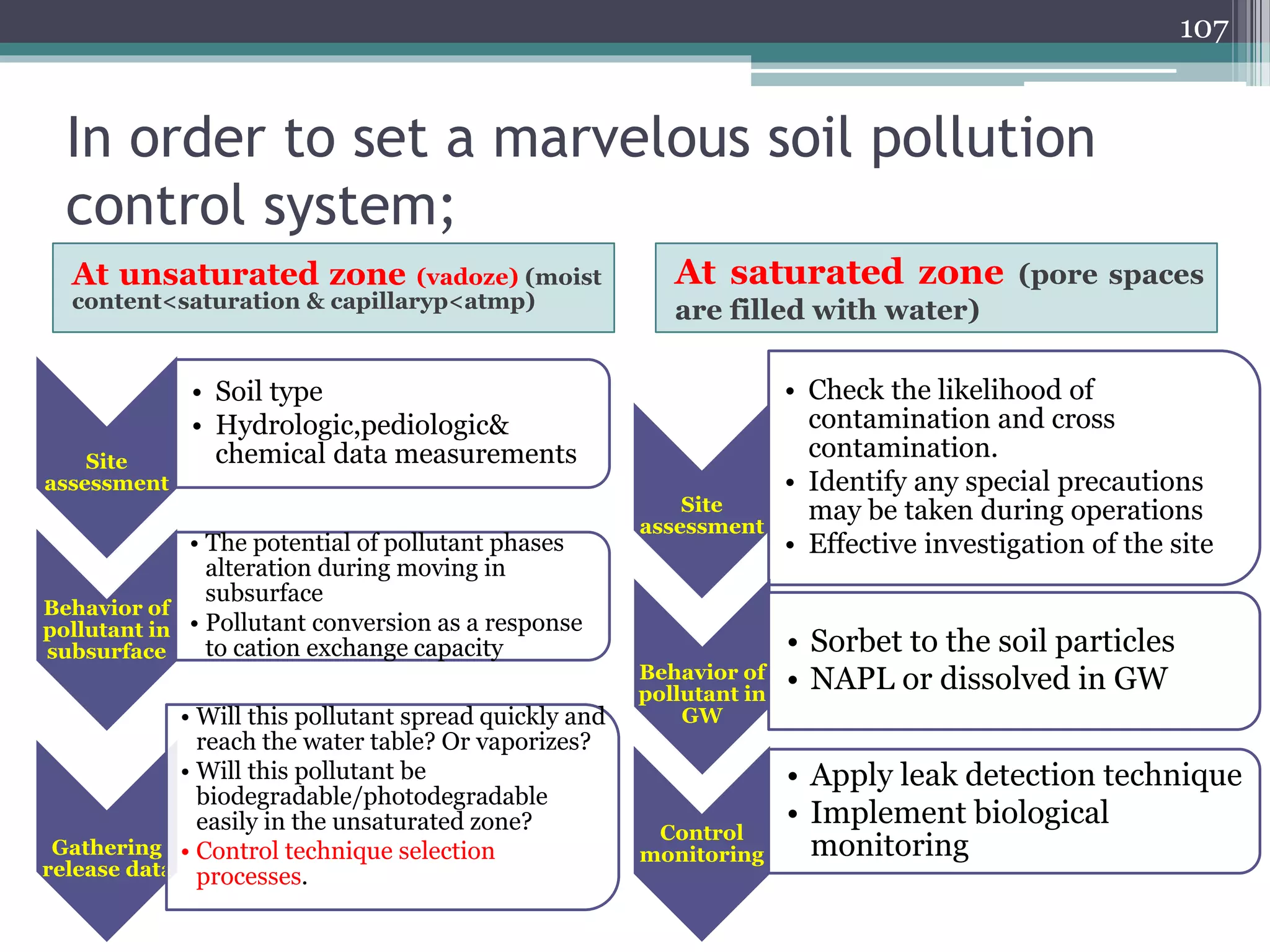
In order to set a marvelous soil pollution
control system;
At unsaturated zone (vadoze) (moist
content<saturation & capillaryp<atmp)
Site
assessment
• Soil type
• Hydrologic,pediologic&
chemical data measurements
Behavior of
pollutant in
subsurface
• The potential of pollutant phases
alteration during moving in
subsurface
• Pollutant conversion as a response
to cation exchange capacity
Gathering
release data
• Will this pollutant spread quickly and
reach the water table? Or vaporizes?
• Will this pollutant be
biodegradable/photodegradable
easily in the unsaturated zone?
• Control technique selection
processes.
At saturated zone (pore spaces
are filled with water)
Site
assessment
• Check the likelihood of
contamination and cross
contamination.
• Identify any special precautions
may be taken during operations
• Effective investigation of the site
Behavior of
pollutant in
GW
• Sorbet to the soil particles
• NAPL or dissolved in GW
Control
monitoring
• Apply leak detection technique
• Implement biological
monitoring
107
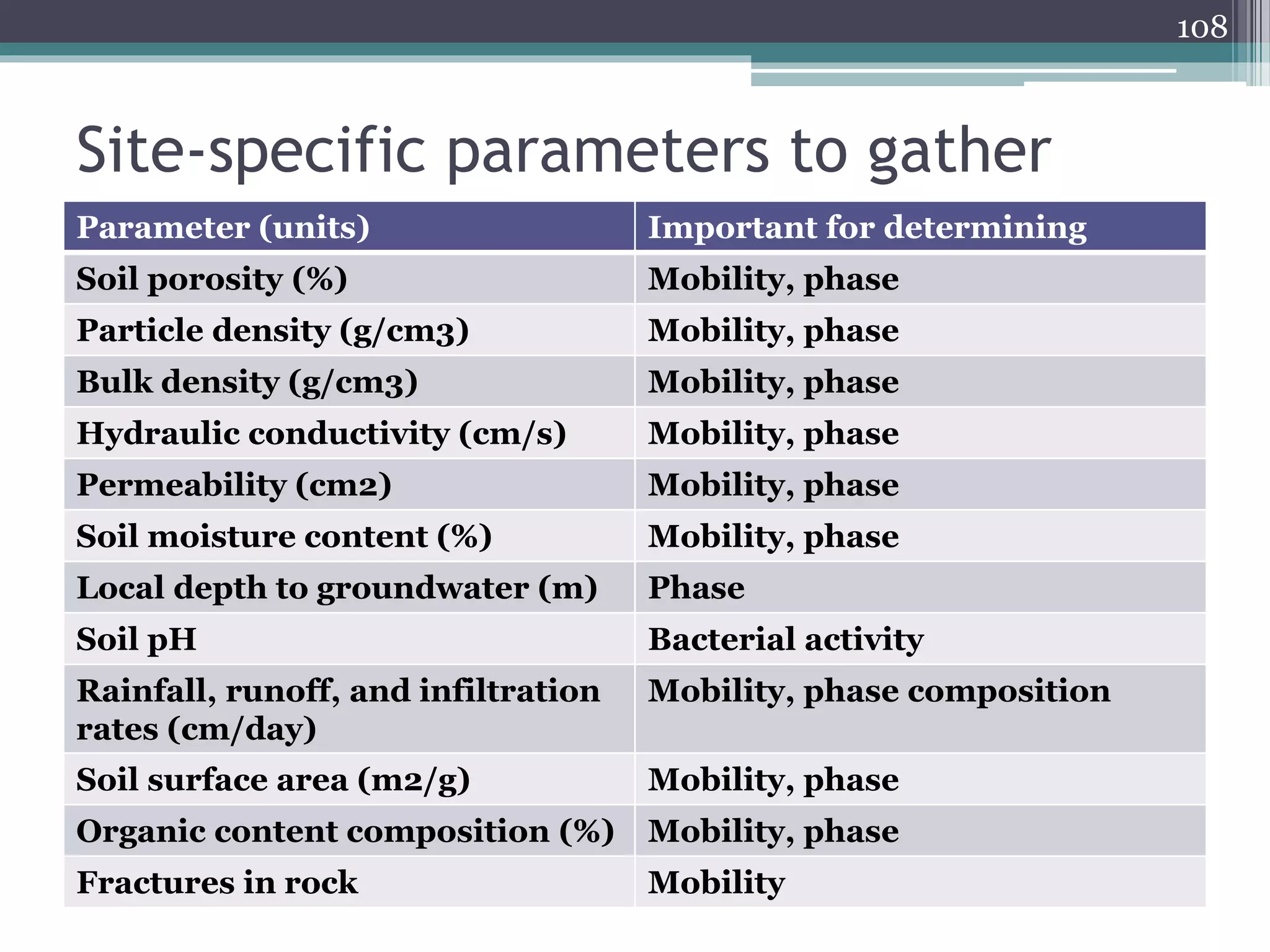
Site-specific parameters to gather
Parameter (units) Important for determining
Soil porosity (%) Mobility, phase
Particle density (g/cm3) Mobility, phase
Bulk density (g/cm3) Mobility, phase
Hydraulic conductivity (cm/s) Mobility, phase
Permeability (cm2) Mobility, phase
Soil moisture content (%) Mobility, phase
Local depth to groundwater (m) Phase
Soil pH Bacterial activity
Rainfall, runoff, and infiltration
rates (cm/day)
Mobility, phase composition
Soil surface area (m2/g) Mobility, phase
Organic content composition (%) Mobility, phase
Fractures in rock Mobility
108
Gathering contaminant specific informations
Factors Units Mobility increase
Liquid viscosity
cPoise /
mpas
Low (<2)
Medium (2–
20)
High (>20)
Liquid density g/cm3 Low (<1) Medium (1, 2) High (>2)
Air-filled
porosity (The
total porosity
minus fraction
filled with water
equals the air-
filled porosity)
% volume Low (<10)
Medium (10–
30)
High (>30)
How will be the partitioning in the subsurface?
What are phases it will likely to reside in ?
Does it likely to move away from the site ( potentiality of cross
contaminations) or whether it is prefer to degrade overtime?
109
110
The problem we face with the presence of LNAPLs
NAPLs may be retained on the soil surface spreading in the vadose,
if leached in a great volume, they might infiltrate the soil to reach
GW table, and hence a dramatic contamination of phreatic zone
occurs (if NAPL have high viscosity and denser than water in pore
space)
111
To characterize pollutants dispersion in the
soil, we should set ground water monitoring
wells
1- To evaluate the impacts on the volume (deep meter
follow up) = assessment of soil infiltration problems
2- To estimate ground water quality
112
Two methods for control migration of
subsurface contaminants
Trench excavations Pumping well installation
• As NAPLs reach the trench, it can be
intercepted, removed and disposed
of , thereby control the migration
beyond the trench.(use soil isolators)
• Increase drawing local GW &
contaminants to the well.
113
To control soil cross contaminations
(pollution of unsaturated zone)
Backfill
placement
Hydraulic
barriers
Diaphragm
walls
114
Spills control
• Intentional spillage due to vessel wash down should be
inhibited.
Accidental spills must be confined.
Leaking underground
tank with petroleum
plume due to an
accident in oil refinery
facility
115
Soil pollution control in ERC
The Egyptian Refining Company (ERC) is building a state-of-the-
art greenfield second- stage oil refinery in the industrial area of
Mostorod inside Greater Cairo Area, which will produce over 4
million tons of refined products, including 2.3 million tons of
EURO V diesel, the cleanest fuel of its type in the world.
Environmental air, soil and water are the major issues in most
countries, especially in areas of high population, and the sources
of it and their adverse effects on our wellbeing are varied. So
environmental control to the green zone is very important,
especially during construction phase of the ERC Hydro-Cracking
Complex Project at Mostorod, which is an important issue for GS
E&C Company due to the significant environmental importance
of the green zone, Moreover, as a stage in comparing actual
results of it during the construction phase with the national and
international guidelines IFC.
116
OBJECTIVESThe overall objectives of this control programs are to:
• Assess/confirm compliance of the air quality, noise levels,
water quality with relevant national guidelines;
• Assess/confirm compliance of the in surrounding
environment with relevant national guidelines;
• Mitigation for the pollution load for the nearby area.
• Identify any non-compliance issues, if any; and prevent the
proposed cross contaminations.
• Provide general conclusions based on analysis results.
117
The project site is located at Mostorod, Cairo Governorate, Egypt. The site is in the North-
East of Greater Cairo, approximately 40 km from the city center (The Ismailia Canal flows
in the North-South direction close to the Project Area.
118
Area 1,2&3 enclosed with the proposed isolating fence
The locations of the monitoring wells will be selected in Areas No. 1 and No. 3 by GS E&C.
The well locations will be selected to satisfy the up-gradient and down-gradient monitoring
requirements, and to Identify the expected impacts of the construction works at the project site.
119
METHOD STATEMENT
Well’s Excavation
• wells will be installed in the top of the major
sand aquifer to define the hydrogeological
setting and control groundwater parameters &
soil cross contaminations
• Thus, two boreholes, 10 to 12 inch in diameter,
will be drilled using manual drilling technique.
The 10 to 12 inch diameter boreholes will house
50 mm internal diameter UPVC well pipes as
shown in the following Figure.
120
121
The borehole installation, shown in the previous
Figure, can be summarized as follows:
- Drilling to penetrate the sand layer of the upper
aquifer.
- Installing the uPVC screen and pipe.
- Backfilling with filter material and bentonite
pellets as shown.
- Backfilling the top portion of the hole with
bentonite cement mixture.
- Fixing the steel cover of the monitoring well.
122
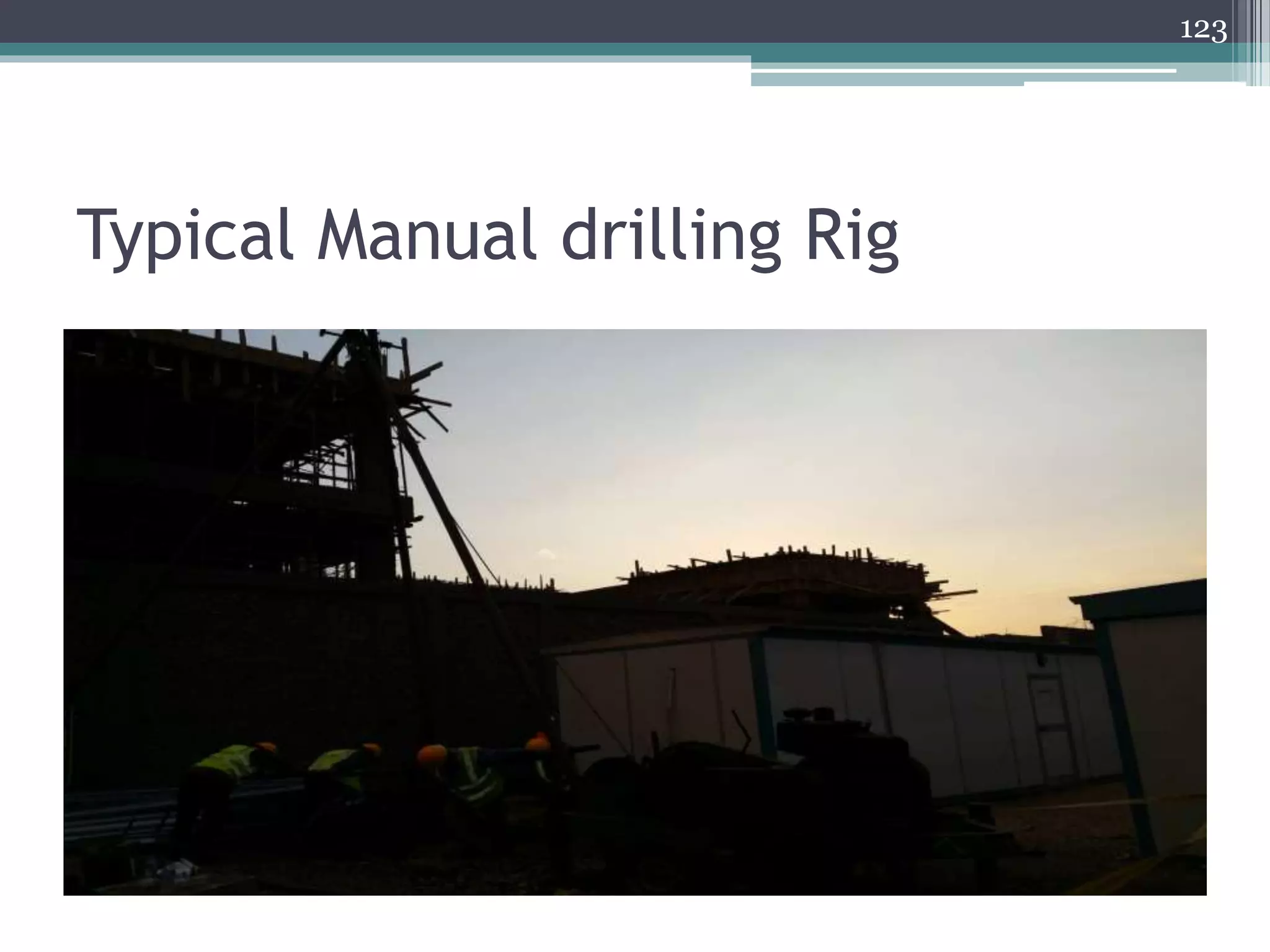
Typical Manual drilling Rig
123
International Standards
Groundwater Standards
Parameter Units WHO drinking water standard
NH3 mg/l N/A
Sodium (Na) mg/l N/A
Cyanide ( CN) mg/l 0.07
Nitrite (NO2) mg/l 0.2
Nitrate (NO3) mg/l N/A
Phosphate (PO4) mg/l N/A
Arsenic (As) mg/l 0.01
Cadmium (Cd) mg/l N/A
Chromium (Cr) mg/l 0.5
Copper (Cu) mg/l 0.2
Iron (Fe) mg/l N/A
Lead (Pb) mg/l 0.01
Manganese (Mn) mg/l N/A
Nickel (Ni) mg/l 0.07
Zinc (Zn) mg/l N/A
Mercury (Hg) mg/l 0.006
Phenol mg/l N/A
Naphthalene mg/l N/A
Acenaphthylene mg/l N/A
Acenaphthene mg/l N/A
Flourene mg/l N/A
Phenanthrene mg/l N/A
Anthracene mg/l N/A
Flouranthene mg/l N/A
Pyrene mg/l N/A
Benzo(a) anthracene mg/l N/A
Chrysene mg/l N/A
Benzo(b) flouranthene mg/l N/A
Benzo(k) flouranthene µg/l N/A
Benzo(a) pyrene µg/l 0.7
Indeno(1,2,3-c-d) pyrene µg/l N/A
Dibenzo(a,h) anthracene µg/l N/A
Benzo(g,h,i) perylene µg/l N/A
Cis 1, 2, Dichloroethane µg/l 0.05
Trans 1, 2, Dicholroethane µg/l 0.05
Trichloroethane µg/l 0.02
Pentachloroethane µg/l 0.04
Benzene µg/l N/A
Toluene µg/l 0.7
Ethyl Benzene µg/l N/A
o-Xylene µg/l N/A
m-Xylene µg/l N/A
p-Xylene µg/l N/A
MTBE µg/l N/A
124
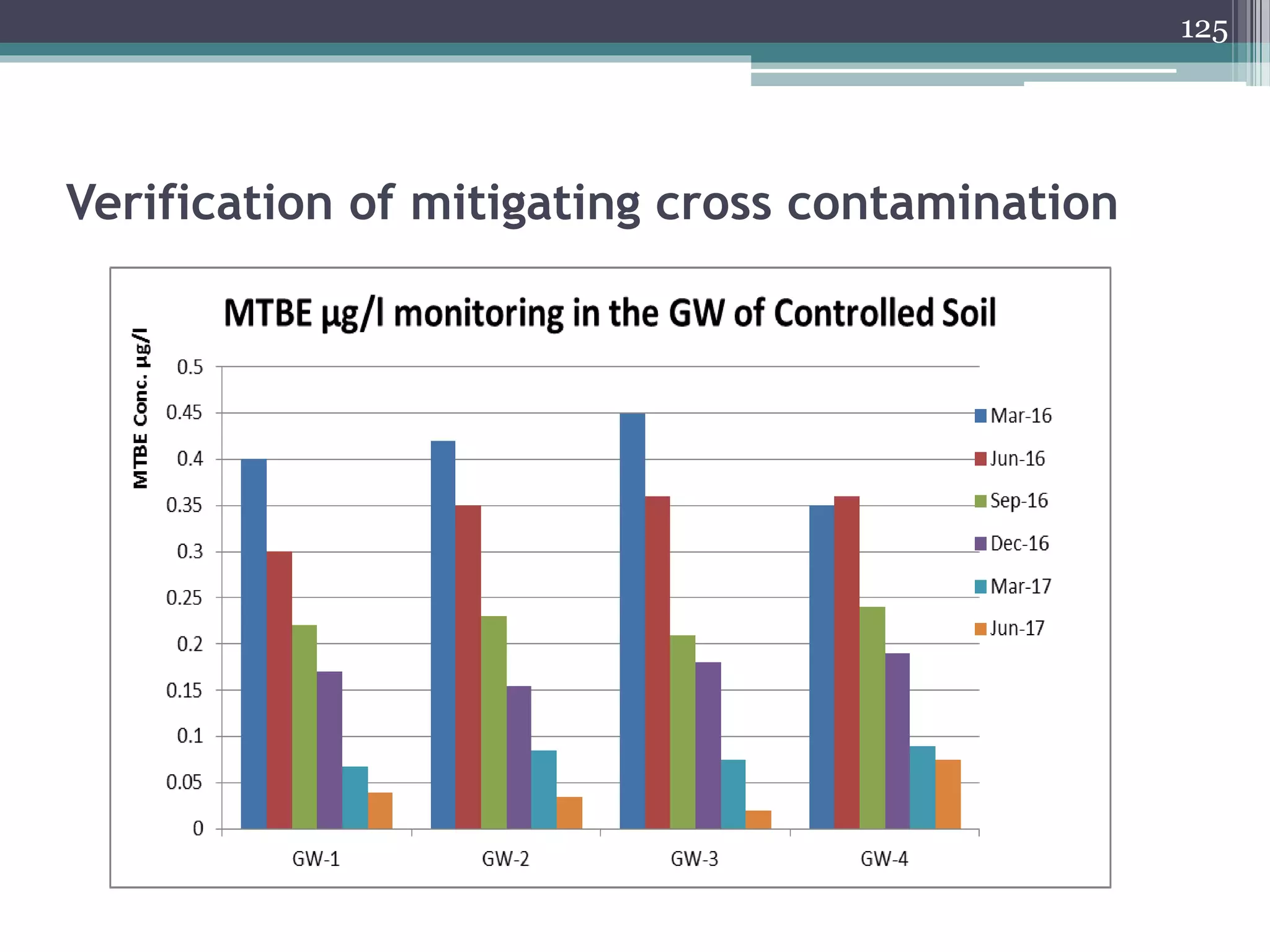
Verification of mitigating cross contamination
125
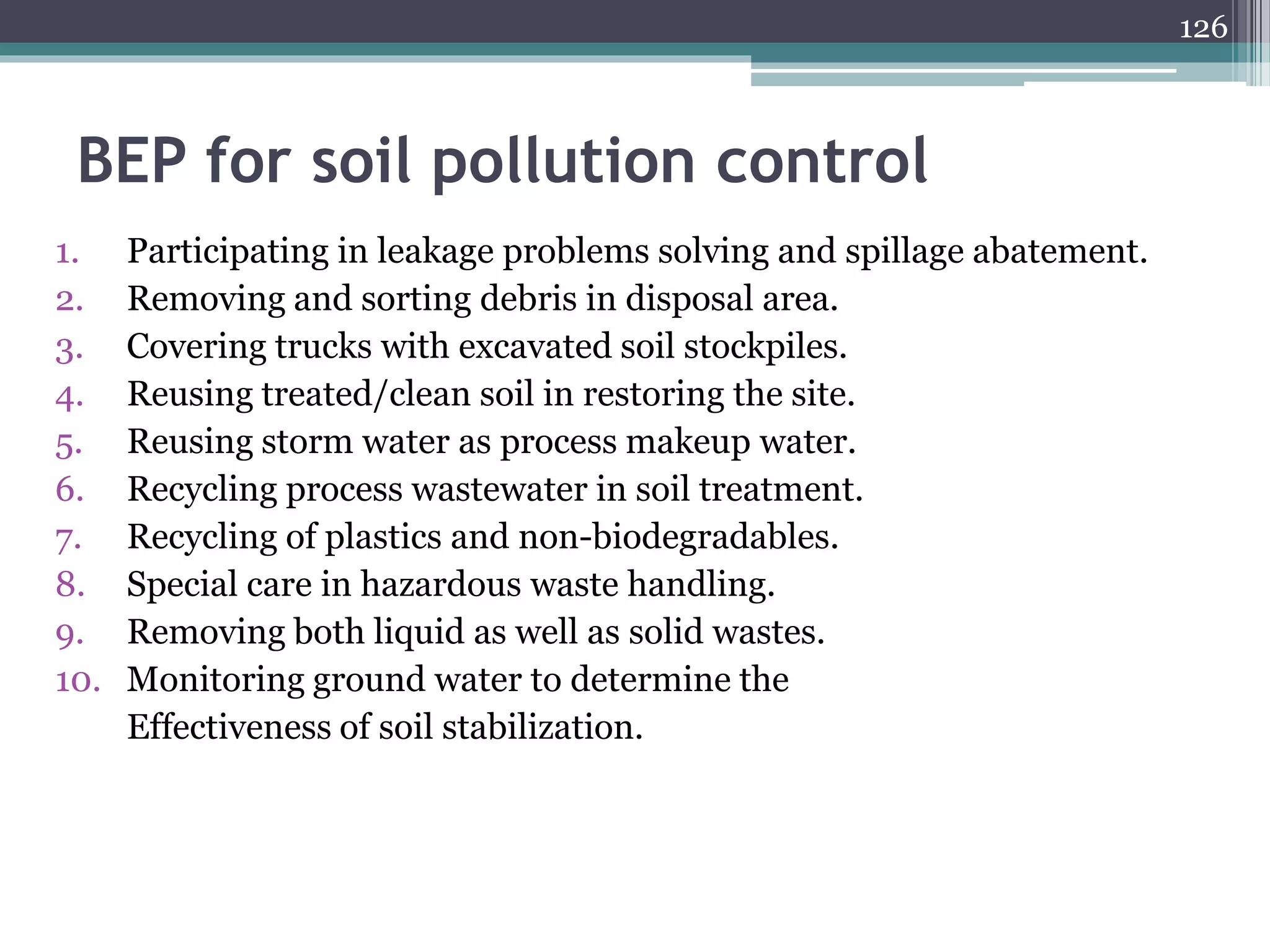
BEP for soil pollution control
1. Participating in leakage problems solving and spillage abatement.
2. Removing and sorting debris in disposal area.
3. Covering trucks with excavated soil stockpiles.
4. Reusing treated/clean soil in restoring the site.
5. Reusing storm water as process makeup water.
6. Recycling process wastewater in soil treatment.
7. Recycling of plastics and non-biodegradables.
8. Special care in hazardous waste handling.
9. Removing both liquid as well as solid wastes.
10. Monitoring ground water to determine the
Effectiveness of soil stabilization.
126
11. Installing an air quality monitoring system (in situ
excavation).
12. Eradicate
illegal fly “midnight”
dumping/ disposal
of the wastes .
127
Please accept our regards!
128

Soil pollution impacts, treatment and control

  • 1.
    Soil pollution impacts, treatmentand control By: Rania Ahmed Sayed Ahmed Mohamed Mohsen Awad Under supervision of: Prof. Elsayed Shalaby 1
  • 2.
    Impacts of soilpollution 2
  • 3.
    Effects of soilpollution on: 1. Abiotic ecosystem components  Groundwater  Air quality  Soil fertility 2. Human health and biotic ecosystem components  Human health  Plants 3
  • 4.
    The results ofa questionnaire compiled recently by the Joint Research Centre in 27 European countries. 4
  • 5.
    Soil pollution canlead to water pollution 5 Pesticides and fertilizers Animal wastes NAPLs spills (leakage from oil refinery activities)
  • 6.
    Non-aqueous Phase Liquids(NAPLs) • A significant portion of contaminated soil and groundwater sites contains non-aqueous phase liquids (NAPLs). • NAPLs are hazardous organic liquids that are immiscible with water and form a visible, separate oily phase in the subsurface. • LNAPL= Light Non‐Aqueous Phase Liquid • Lighter than water so they float • Retained on grain surfaces within the vadose (unsaturated) zone or float on water tables • Fuels are examples of LNAPLs – Gasoline – Kerosine • DNAPL= Dense Non‐Aqueous Phase Liquid • Heavier than water so they sink • May penetrate into the saturated zone • Chlorinated solvents are examples of DNAPLs  Trichloroethylene (TCE) or dry‐cleaning fluid  Trichloroethane (TCA) e.g., parts cleaner, degreaser 6
  • 7.
    Effect of soilpollution on air quality 8 Some PAH particles can readily evaporate into the air from soil or surface waters. Silicosis is a lung disease caused by breathing in (inhaling) silica dust. Silica dust forms during mining and quarrying.
  • 8.
    9 • Manure emits ammonia. •Methane gas emission due to organic matter decomposition. The decomposition of organic materials in soil can release sulfur dioxide and other sulfur compounds, causing acid rain.
  • 9.
    Effect of soilpollution on human health 10 Generally, people can be exposed to contaminants in soil through ingestion (eating or drinking), dermal exposure (skin contact) or inhalation (breathing).
  • 10.
    Heavy metals Environmental pollutionby heavy metals is of major health concerns all over the world even if it is at low concentrations due to their long-term cumulative health effects. Intake of heavy metal through food materials: • Impairs the function of other metal ions • Decreases the immunology of body • Retardation of growth • Poor mental development 11
  • 11.
    Pesticides Major categories ofpesticides and their persistence in the soil: • Chlorinated hydrocarbons - DDT, heptachlor, etc—2-15 years • Organophosphates - Malathion, methyl parathion—1-2 weeks • Carbamates - Carbaryl, maneb, aldicarb—days to weeks • Pyrethroids - Pemethrin, decamethrin—days to weeks 12 Some of the chronic and acute toxicological effects of pesticides are: • Chronic liver damage • Endocrine disorders • Reproductive disorders • Immune-suppression • Various cancer • Parkinson’s and Alzheimer’s diseases
  • 12.
    PAHs • Human exposureto PAHs has been associated with an increased risk of developing cancer in the variety of organs (such as lung, bladder, stomach, skin, larynx, scrotum, breast, oesophageal, prostate, kidney and pancreas). • Furthermore, they are known to suppress the immune system and are suspected of being endocrine disrupters. 13
  • 13.
    Effect on soilfertility • Soil fertility refers to the ability of the soil to supply essential plant nutrients and water in adequate amounts and proportions required for plant growth and reproduction in the absence of toxic substances which may inhibit plant growth. • A fertile soil has good physical and chemical environment for growth of plant roots as well as for beneficial soil microflora and fauna responsible for carrying out nutrient transformation leading to optimum supply of plant nutrients. • Entry of pollutants in agroecosystem affects different soil properties (such as pH, available nutrients, soil enzyme activity, available and total heavy metal concentration, etc.) resulting in loss of soil fertility and hence crop productivity. 14
  • 14.
    Phytotoxicity of HeavyMetals • Significant part of the metal loaded effluents, generated particularly from small scale industries in developing and under-developed countries are released untreated into land and water bodies. • Also, some of the metals are impurities/constituents of extensively used agrochemicals like fertilizers (e.g. Cd in phosphatic fertilizer), pesticides (e.g., Zn, Cu, Sn, Hg, organic pollutants) etc. and contaminate the rhizosphere when these are used in intensive agriculture. • Some impacts of heavy metals toxicity in plants include:  Growth reduction (As, Cd, Cr, Pb, Ni, Hg, Cu)  Chlorosis (Cd, Ni, Hg, Cu)  Necrosis (As, Cd, Ni) 15
  • 15.
    Socio-economic effects ofsoil pollution • It can worsens the effects of poverty and dependence. • It weakens populations and institutions. • It reduces food security. • Socio-economic development is disequilibrium. 16
  • 16.
  • 17.
    Eutrophication • We humansmay not be able to fix nitrogen biologically, but we certainly do industrially! (Fertilizers) • Increase in nutrient levels 1. Algal blooms: block sunlight from photosynthetic marine plants under the water surface. 2. Decay of algae by MOs: use up all the oxygen in the water, leaving none for other marine life, and producing free toxic compounds , such as ammonia and hydrogen sulphide (H2S). 18
  • 18.
    NO toxicity 19 Formation ofN‐nitroso compounds from NO3 −, NO2 −, NO, and their effects on human health. • NO3 − is applied in increasing amounts in the fertilizers for agricultural production. • They accumulate in the soil. • They can reach groundwater.
  • 19.
    Methemoglobinemia • The ferrousiron of hemoglobin is exposed continuously to high concentrations of oxygen and, thereby, is oxidized slowly to methemoglobin, a protein unable to carry oxygen. 20
  • 20.
    Impacts of radioactivepollution on soil Effects of radioactive pollutants: • Radiation affects the soil and soil fertility. • The radioactive leaching or dumped into the soil is more complicated, because they remain in soil for thousands of years. • Radioactive pollution in soil can lead to mutations, malformations, carcinogenicity, and abortion for animals as well as humans. 21
  • 21.
  • 22.
    Remediation technologies • Accordingto the scale of pollution, the risk level and the financial and time constraints on the remediation project, treatment of the soil may take place immediately in place (in situ) or the soil may be transported to special facilities where remediation may be carried out in special reactors or vessels, that are specially designed for this purpose (in tank method). • An example of this process is the washing of heavily polluted soils in special tanks. • The polluted soil may also be transported and spread on a surface prepared to prevent the spread of contamination in lateral and vertical directions. • Beds prepared in this way form the so-called prepared beds upon which the remediation process will take place. This method is especially suitable for soils contaminated by oil products. 23
  • 23.
    Remediation technology Chemical and physical treatment Oxidation Photolysis AOPs Ionexchange Adsorption Pump-and-treat Chemical dehalogination Soil vapour extraction Soil washing Soil flushing Solidification/ stabilization methods Thermal treatment Incineration Thermal desorption Vitrification Biological treatment In situ Ex situ 24
  • 24.
    Chemical and physicalremedial techniques • The aim of all chemical and physical methods of remediation is to change the chemical environment in a way that the transport of toxic substances to other elements of the soil system is prevented. • Examples here can be given by transport to plants; to ground water; or to soil organisms. • Such preventive measures may include decreasing mobility or change of chemical constitution. 25
  • 25.
    1. Oxidation • Oxidationis a common highly effective remediation technology for soils contaminated by toxic organic chemicals and cyanides. • Oxidising agents used in this technology include a wide range of substances among which the most common are hydrogen peroxide, ozone and potassium permanganate. • All three methods are according to EPA of high treatment efficiency, reaching over 90% at short times in many cases. • For example efficiency reaches >90% for unsaturated aliphatic compounds such as trichlorethylene (TCE) as well as for aromatic compounds such as Benzene. • Oxidation technology has been successfully used for in situ remedy at source areas as well as for flume treatment. It is mostly used for benzene, ethylbenzene, toluene and xylene (BTEX) as well as for PAH's, phenols and alkenes. 26
  • 26.
    • Oxidation oftrichlorethylene if potassium permanganate (KMnO4) was used, takes the following path: 2KMnO4 + C2HCl3  2CO2 + 2MnO2 + 2KCl + HCl Permanganate in Situ Oxidation Application 27
  • 27.
    Ozone destruction oftoxic contaminants takes place in the following manner: O3 + H2O + C2HCl3  2CO2 + 3HCl General conceptual model of in-situ ozonation in the saturated zone with soil vacuum extraction to capture volatile emissions and O3(g) 28
  • 28.
    2. Photolysis • Photolyticdegradation technology depends upon degrading the organic contaminants with Ultraviolet radiation. • This may be carried out using artificial UV light or just by exposing the soil to sunlight, which may be sufficient for degrading shallow soil contaminants. • This process can be carried out in situ or in prepared bed. However, deeply contaminated soils must be excavated and transported to special facilities, where the process would be carried out in special tanks. 29
  • 29.
    3. Advanced OxidationProcesses (AOPs) • AOPs are based on the generation of in situ hydroxyl radicals (O˙H) in very mild, near ambient pressure and temperature experimental conditions(by irradiation). These radicals are strong enough oxidants that are able to degrade a great variety of bio-recalcitrant organic compounds. • Peroxide based/ ozone • Fenton (Fe2+ & peroxide) • Metal based nanoparticles (ZnO or/and TiO2) (MO/doped N) + EM radiations (UV, Laser, Ultrasound, and sunlight) 30
  • 30.
    Mechanism of actionin AOPs remediation technology The organic pollutant (Hydrocarbons) 31
  • 31.
    4. Ion exchange •Soil components with high CEC values are capable of binding positively charged organic chemicals and metals in a way that makes them chemically immobile and thus reduce the risk imposed by them on the soil environment. • Addition of soil conditioners such as synthetic resins zeolites or clays may help increasing the CEC characteristics of the soil and thus enhance the binding of positively charged contaminants on the negative functional groups of the soil matter. 32
  • 32.
    5. Adsorption • Adsorptionis the most widely used, fastest, inexpensive technology for the treatment of groundwater, chemical spills, and for removing a series of toxic chemicals such as BTEX, ethylbenzene, xylene, trichloroethene, tetrachloroethene, dichloroethane, PCBs, pesticides, herbicides, explosives, and anions like perchlorate and heavy metals. 33
  • 33.
    Adsorption on granulatedactive carbon (GAC) • Activated carbon is the most common adsorbent. • The technology depends upon the tendency of most organic compounds to adsorb on the surface of activated carbon. • Remediation through adsorption on activated carbon is a method that can be carried out in the liquid phase as in treatment of ground water or in the gas phase as in treating off-gases from soil vapour extraction remediation methods. • One of the earliest applications of this method was the use of (GAC) in adsorbing military gases by gas masks in the first world war. • Adsorption on activated carbon is a process carried out ex-situ in special tanks or in prepared beds. 34
  • 34.
    6. Pump-and-Treat • Inpump-and-treat, the groundwater is pumped and then treated using granular activated charcoal. • Generally, the pump-and-treat approach requires 50–100 years to reach remedial goals, and in most cases the goals are never achieved. • Moreover, disposal of contaminants that become bound to activated carbon after treatment becomes a problem. • Because of these drawbacks, surfactant-enhanced remediation, metallic iron technology, permeable reactive barriers, etc., have emerged as alternatives to traditional pump-and treat-systems. 35
  • 35.
    7. Chemical dehalogenation •This treatment technology is used to dehalogenate (remove halogens) halogenated compounds. • During chemical dehalogenation, contaminated soils and reagents are mixed, and heated in a treatment vessel. • Reagents could be either sodium bicarbonate (base-catalyzed decomposition process—BCD) or polyethylene glycol (alkaline polyethylene glycol or glycolate technology—APEG). • Dehalogenation was successful in removing PCBs, PCDD/Fs and pesticides from soil. • An example of this may be given by the change of trichlorethylene into ethene. 36
  • 36.
    8. Soil vapourextraction (SVE) • Soil vapour extraction is a popular technology for remediation of soils. • It is a relatively simple process to remove volatile and easily evaporated organic contaminants within the vadose zone. • Technical processes of these technology comprise injecting clean air into the unsaturated zone to effect a separation of organic vapours from the soil solution by partitioning between the soil solution and the soil air. • The vapours joining the soil air are then removed via vacuum extraction wells. 37
  • 37.
    9. Soil washing •Soil washing is also known as mechanical scrubbing, soil scrubbing, physical separation or attrition scrubbing. • This approach can be either ex-situ or in-situ . • It is a water-based approach for treating excavated soils. • It makes use of the selective binding of contaminants to fine material ( silt and clay) rather than to coarse soil material such as sand and gravel. • Adding chemical additives or surfactants to the water may enhance this process. • After separating the two soil fractions, fine material carrying the major part of contaminants is further treated by other methods of remediation to get rid of the separated contaminants, while the coarse material if cleaned up may be returned to the plot. 39
  • 38.
    10. Soil flushing •Soil flushing is a remediation method used for in situ treatment of inorganic and organic contaminants. • Known sometimes as the cosolvent flushing method, this technique depends upon injecting a solvent mixture such as water and alcohol or surfactants into the vadose or saturated zone. • The leachate i.e. the solvent with leached contaminants is drawn from recovery wells to be treated above ground or be disposed of. Diagrammatic illustration of soil flushing techniques 41
  • 39.
    11. Solidification /stabilisation methods • This is a group of technologies aiming at immobilising or stabilising contaminants in the soil and preventing them from entering the environment either by enclosing them into a solid mass or converting them to the least soluble , mobile or toxic form. • Used for soils contaminated with heavy metals, radionuclides, organic compounds. 43
  • 40.
    a. Bitumen- basedsolidification • In this technology, the contaminated material is embedded in molten bitumen and left to cool and solidify. • The contaminants thus encapsulated in the molten bituminous mass are changed to an immobile form that cannot enter the environment. Refined asphalt 44
  • 41.
    b. Encapsulation inthermoplastic materials • Thermoplastic materials (e.g. Modified sulphur cement) are molten and mixed with the contaminated material in special tanks and vigorously mixed to form a homogenous slurry fluid. • After cooling the resulting solid may safely be disposed of. 45
  • 42.
    c. Polyethylene extrusion •The contaminated soil is mixed with polyethylene binders, heated and then left to cool. • The resulting solid may be disposed of or used in other ways. 46
  • 43.
    d. Pozzolan /Portland cement • Pozzolanic-based materials ( e.g. fly ash, kiln dust, pumice) are mixed with the contaminated matter in presence of water and alkali additives. • At this environment, heavy metals may precipitate out of the slurry. • The rest mass solidifies enclosing the remaining organic contaminants. 47
  • 44.
    Remediation technology Chemical and physical treatment Oxidation Photolysis AOPs Ionexchange Adsorption Pump-and-treat Chemical dehalogination Soil vapour extraction Soil washing Soil flushing Solidification/ stabilization methods Thermal treatment Incineration Thermal desorption Vitrification Biological treatment In situ Ex situ 48
  • 45.
  • 46.
    Thermal treatment • Volatilisationand destruction of contaminants by thermal treatment is a very effective technique . • It is achieved by heating the contaminated soil in kilns to temperatures between 400 and 700°C, followed by further treatment of the kiln off gas at higher temperatures( 800- 1200°C) to secure total oxidation of the organic volatile matter. 50
  • 47.
    1. Incineration • Inthis technology, contaminants are combusted at high temperatures (970°C - 1200°C) . • It is particularly effective for halogenated and other refractory organic pollutants. • Properly operated incinerators may be of very high destruction and removal efficiency (DRE) reaching to as much as 99.9 %, which is normally required for PCB' s and dioxins. Ex situ incineration includes the excavation of contaminated soils, which are incinerated under oxygen-rich conditions. Off-gases are collected for reuse or disposal. 51
  • 48.
    2. Thermal desorption •Other than incineration, Thermal desorption (TD) technology aims to physically separate the contaminants from the soil. • TD involves the application of heat to contaminated soils with the intention of volatilizing/desorbing hydrocarbons, which are then carried away by a sweep gas or vacuum and eventually destroyed via incineration or carbon adsorption. • TD can be divided into low-temperature thermal desorption (LTTD, 100– 300 °C) and high-temperature thermal desorption (HTTD, 300–550 °C). Schematic diagram of a Thermal desorption system 52
  • 49.
    3. Vitrification • Inthis process the contaminated soil is encapsulated into a monolithic mass of glass. • Vitrification may be carried out in situ or ex situ. • Introducing graphite electrodes into the soil and heating it electrically by powerful generators to temperatures between 1600-1800 °c perform in situ Vitrification. • At these temperatures the soil melts and forms a glass block on cooling. • Organic contaminants are pyrolysed and reduced to gases during the melting process, while heavy metals remain enclosed in the stabilised glass mass. • This method has also been successfully used in treating soils contaminated by radioactive materials. • Vitrification may also be done in special appliances where contaminated soil would be molten in presence of borosilicate and soda lime to form a solid glass block. 53
  • 50.
  • 51.
    Remediation technology Chemical and physical treatment Oxidation Photolysis AOPs Ionexchange Adsorption Pump-and-treat Chemical dehalogination Soil vapour extraction Soil washing Soil flushing Solidification/ stabilization methods Thermal treatment Incineration Thermal desorption Vitrification Biological treatment In situ Ex situ 55
  • 52.
  • 53.
    Biological remediation 57 • Vegetation(Phytoremediation) • Several plant species have the ability to bioaccumulate heavy metals found in the soil. • Some tree species can sequester, destroy, and/or evapotranspire various organic compounds. • Naturally occurring micro- organisms in the soil • Many microorganisms can transform hazardous chemicals to substances that may be less hazardous. Capable of degrading toxic materials, while carrying out their daily biological activities.
  • 54.
  • 55.
  • 56.
  • 57.
  • 58.
    Threshold for differentmetals • A metal hyperaccumulator is a plant which, when grown in metal-enriched habitats, can accumulate 100–1,000- fold the level of metals than normal plants can. • This corresponds to concentrations in aboveground tissues of: • >10 mg g−1 (1 %) for Mn or Zn; • >1 mg g−1 (0.1 %) for As, Co, Cr, Cu, Ni, Pb, Sb, or Se • >0.1 mg g−1 (0.01 %) for Cd 63
  • 59.
    Use of hyperaccumulators 64 Thlaspicaerulescens Brassica juncea For example, B. juncea, although with only one-third the concentration of Zn in its tissues compared with T. caerulescens (a known hyperaccumulator of Zn), is considered to be more effective at removing Zn from soils. This advantage is primarily due to the fact that B. juncea produces ten times more biomass than T. caerulescens .
  • 60.
    Mechanism of phytoextration •Generally, only a small fraction of the total content is readily available (bioavailable), as most of the metals are commonly found as insoluble compounds or are strongly bound to the soil matrix. 65 Bioavailability of metals Secretion of phytosiderophores to chelate and solubilize metals Acidification of the rhizosphere due to proton pumps and exudation of organic acids
  • 61.
    2. Rhizofilteration • Rhizofilterationis a process through which a well developed root system is used as a filter for metals. • This process takes place more readily in water than in soil and that is why it is mainly used to extract metals or radioactive matter from water. • Other than in the phytoextraction process, here only the roots, where the metal accumulation has taken place, are harvested and disposed of. 66 • In rhizofiltration, the contaminants are adsorbed or absorbed, i.e., plant roots precipitate and concentrate toxic metals from polluted effluents.
  • 62.
    • Terrestrial ratherthan aquatic plants may also be used because the former have extensive fibrous root systems covered with root hairs with extremely large surface areas. • Roots of many hydroponically grown terrestrial plants such as Helianthus annuus, Phragmites australis, and various grasses have been used to remove toxic metals such as Hg, Cu, Cd, Cr, Ni, Pb, Zn, and uranium from aqueous solutions 67 Phragmites australis Common reed Typha domingensis Bardi Helianthus annus The common sunflower
  • 63.
    3. Phytodegradation • Phytodegradationutilises plants to uptake / degrade organic contaminants in soils. • Internal process: through metabolic processes. • External process: enzymes break down contaminants. • Examples: chlorinated solvents and herbicides. 68
  • 64.
    4. Enhanced rhizospherebiodegradation • Rhizodegradation refers to the breakdown of contaminants within the plant root zone, or rhizosphere. • Rhizodegradation is believed to be carried out by bacteria or other microorganisms whose numbers typically flourish in the rhizosphere. • Microorganisms (yeast, fungi or bacteria) consume and digest organic substances for nutrition and energy. 69
  • 65.
    5. Phytovolatilization Phytovolatilisation refersto plants being capable of absorbing organic contaminants from the soil, biologically converting them to gaseous species. 70 Phytovolatilization is often considered beneficial, as phytovolatilization of the contaminant generally results in substantial dilution and photochemical decay in the atmosphere. However, phytovolatilization may be viewed as a risk in urban areas, where exposure potential exists and air quality is degraded.
  • 66.
    Phytovolatilization of heavymetals • This technique can also be used for some heavy metals like Hg and Se because these metals can form volatile chemical species through reduction and methylation reactions. • Biological volatilization has the advantage of removing Se from a contaminated site in relatively nontoxic forms, such as dimethylselenide (DMSe). • Nevertheless, phytovolatilization of Hg may cause secondary contamination of the environment with Hg0. • For this reason, another alternative to promote a higher efficiency of phytoextraction could be the use of genetic engineering to integrate genes from other organisms in plants so that they could accumulate Hg without releasing Hg0 into the atmosphere. 71
  • 67.
  • 68.
    Advantages of phytoremediation •It can be applied to more multiple and mixed contaminants and media. • It is less costly and if properly managed is both environmentally friendly and aesthetically pleasing to the public. 73
  • 69.
    Limitations of phytoremediation •A longer time period is likely to be required for phytoremediation, as this technology is dependent on plant growth rates for establishment of an extensive root system or significant aboveground biomass. • Phytoremediation is most effective only at sites with shallow contamination in the soils and/or sites with shallow water table. 74
  • 70.
  • 71.
  • 72.
    Microorganisms 77 Microorganisms can be isolatedfrom almost any environmental conditions. They can adapt and grow at varied temperature and pH values. They can live with an excess of oxygen and in anaerobic conditions
  • 73.
    Microbial bioremediation 78 • Microbescan adapt and grow with the presence of hazardous compounds or on any waste stream. • Thus, they can be used to degrade or remediate environmental hazards. • Natural organisms, either indigenous or extraneous (introduced), are the prime agents used for bioremediation. • The organisms that are utilized vary, depending on the chemical nature of the polluting agents, and are to be selected carefully as they only survive within a limited range of chemical contaminants.
  • 74.
    Microorganisms Having BiodegradationPotential for Xenobiotics 79
  • 75.
  • 76.
    Mycoremediation 81 White rot fungusaccounts for at least 30% of the total research on fungi used in bioremediation. White rot fungi have been used for bioremediation of pesticides, degradation of petroleum hydrocarbons. Pleurotus ostreatus Degrade PAHs Trametes versicolor Degrade PAHs, PCBs Lentinus edodes Degrade pentachlorophenol (PCP)
  • 77.
  • 78.
    1. Bioventing • Insitu treatment and involves supplying a gas and nutrients through wells into the subsurface to stimulate the indigenous bacteria. • The gas can be used to keep the subsurface aerobic or anaerobic to enable degradation to occur. • It works for simple hydrocarbons and can be used where the contamination is deep under the surface. 83 Schematic diagram of a typical bioventing system
  • 79.
    Aerobic bioventing • Treatingaerobically degradable contaminants, such as fuels. • Using the supplied oxygen, the microbes oxidize the contaminants to gain energy and carbon for growth. • Oxygen is typically introduced by air injection wells that push air into the subsurface. 84
  • 80.
    Aerobic bioventing (cont.) Aerobicbioventing has treated a variety of contaminants such as: • Fuels • Nonhalogenated solvents, such as benzene, acetone, toluene, and phenol • Lightly halogenated solvents, such as 1,2-dichloroethane, dichloromethane, and chlorobenzene • SVOCs, such as some PAHs 85
  • 81.
    Anaerobic Bioventing • Whileaerobic bioventing is useful for degrading many hydrocarbons, some chlorinated compounds such as PCE, TCE, some PCBs and some pesticides, such as lindane and DDT are not effectively treated aerobically. • Anaerobic bioventing uses the same type of gas delivery system as aerobic bioventing, but instead of injecting air, nitrogen is used to displace the soil oxygen. • The reductive dehalogenation is done by anaerobic bacteria such as Dehalococcoides and Dehalobacter. 86 Reductive dechlorination of PCE
  • 82.
    • Since aerobicand anaerobic bioventing share similar gas delivery systems, the switch can be made by simply changing the injected gas. 87 Aerobic bioventing Volatile and semivolatile organic compounds (not anaerobically degradable) Anaerobic bioventing
  • 83.
    2. Bioaugmentation • Bioaugmentationis the way to enhance biodegradative capacity of the contaminated sites by inoculation of bacteria with desired catalytic capabilities. • The basic principle of this intervention is to enhance genetic diversity leading to a wider repertoire of biodegradative reactions. • Bioaugmentation is the remediation process involving wild-type or genetically modified microorganisms for treatment of sites contaminated with hazardous organic chemicals. 88
  • 84.
    Construction of GMMs •Genetic engineering is a modern technology, which allows to design microorganisms capable of degrading specific contaminants. • It offers opportunity to create artificial combination of genes that do not exist together in nature. • The most often techniques used include engineering with single genes or operons, pathway construction and alternations of the sequences of existing genes. 89
  • 85.
    • Bacteria, especiallyfrom genus Pseudomonas are the major object of genetic manipulations. • There are ubiquitous inhabitants of many environment and are known as efficient degraders of many toxic substances. • Both their chromosome and plasmids may carry genes for metabolism of these compounds. • Therefore, such microorganisms are the main source of catabolic genes for genetic engineering. 90
  • 86.
  • 87.
    3. Nanobioremediation • Thepossibility of using physicochemical technology (fast, but expensive) to treat the high concentrations initially followed by biological technology (cheap, but relatively slow), is presented as a viable practical and sustainable alternative to in-situ application. • This remediation method is known as Nanobioremediation, and the scientists are currently evaluating the potential of this technology for its effectiveness and sustainability for residual clays contaminated with chlorinated organic contaminants. 92 Concept of nanobioremediation: Initial injection of nZVI to reduce the source zone concentrations and then initiate biormediation of residual source contamination (if any) and any produced byproducts.
  • 88.
  • 89.
    b) Ex situbiological remediation • Ex situ bio remedial methods involve excavation of soil and treat it at a different site. • These methods are normally faster than the in situ methods. • They are applicable for a wider range of contaminants, yet they are more expensive. 95
  • 90.
    1) Slurry phasetreatment • In this technology the polluted soil is excavated and transported to special facilities, where, it is mixed with water in special tanks (bio reactors). • Oxygen and nutrients are later added, and the so formed mixture is thoroughly mixed to form a thin slur. • Temperature, nutrients and oxygen concentrations are controlled so that the organisms may have the best conditions to sustain their bioactivities leading to the degradation of the pollutants. 96
  • 91.
    2) Solid phasetreatment • Here the polluted soil is treated above the ground in prepared beds. • Despite the benefit of being less expensive than the slurry bed treatment, it is not so effective and needs more time and space to prepare the beds. • Three main techniques are commonly used to carry out this remediation method - land farming, soil biopiles and composting. 97
  • 92.
    a) Land farming •The soil is excavated and spread on a pad with a built in system for collecting any possible leachates seepage. • The so-formed bed is regularly mixed and turned over in order to facilitate aeration and enhance biological activity in the bed. • Nutrients are added if required, since lack of nutrients and oxygen may lead to retardation of the bio degradation processes. 98
  • 93.
    b. Composting • Compostingis the technique that involves combining contaminated soil with nonhazardous organic amendments such as manure or agricultural waste. • This supports the development of rich microbial population characterized at higher temperature for growth. • Composting takes place between 40 and 50 °C and the thermophilic microorganisms are active at this temperature. • Proper conditions of oxygen, moisture, and temperature are maintained. • Frequent mixing is carried out for aeration and surface irrigation is done for maintaining moisture level. 99
  • 94.
    • Microorganisms degradeorganic matter to CO2, water, and humic acid as end products. • Degradation is brought about by a consortium of aerobic organisms, predominantly bacteria, fungi, and actinomycetes. • They break down complex organics to smaller molecules which are used as carbon and energy sources. • Compost is either dark brown or black and is not soluble in water. • Composting has been successfully applied to soils and bio-solids contaminated with petroleum hydrocarbons, e.g., fuels, oils, grease, solvents, chlorophenols, pesticides, herbicides, and nitro-aromatic explosives. 100
  • 95.
    c) Soil biopiles •The excavated soil is heaped in piles of several meters height. • To enhance degradation activities by the microorganisms, air is blown through the pile. • If required, nutrients are also added. • Due to emissions from the piles, the whole process is sometimes carried out in inclusions that control any volatile contaminants. 101
  • 96.
    Comparison of differentmethods of bioremediation LimitationsBenefitsType of bioremediation Long durationNatural atenuationIn situ bioremediation: Bioventing Bioaugmentation Mass transfer problem Long duration Low costLand farming Composting Biopiles Require soil excavation High operatoional cost Rapid degradation Optimized parameters Ex situ bioremediation: Slurry reactors 102
  • 97.
  • 98.
  • 99.
    Soil Pollution Control •When pollutants or chemical wastes are released on soil surface, they will be absorbed onto the organic mineral matter of the soil. • Pollutants in the subsurface may be: Dissolved in GW in the saturated zone. Floating on the water table In the unsaturated zone Trapped between soil particles 105
  • 100.
    Objectives of Controlmeasures for soil pollution 1. Mitigation and prevent soil pollution. 106 5.Evade the accidental events from the proposed activities (facilities)~ (Nuclear power plant – Oil refineries firms). 4. Avoid the recurrence of the treated soil. 3. Eradicate the cross contaminations. 2. Exclude the potential source of soil pollution.
  • 101.
    In order toset a marvelous soil pollution control system; At unsaturated zone (vadoze) (moist content<saturation & capillaryp<atmp) Site assessment • Soil type • Hydrologic,pediologic& chemical data measurements Behavior of pollutant in subsurface • The potential of pollutant phases alteration during moving in subsurface • Pollutant conversion as a response to cation exchange capacity Gathering release data • Will this pollutant spread quickly and reach the water table? Or vaporizes? • Will this pollutant be biodegradable/photodegradable easily in the unsaturated zone? • Control technique selection processes. At saturated zone (pore spaces are filled with water) Site assessment • Check the likelihood of contamination and cross contamination. • Identify any special precautions may be taken during operations • Effective investigation of the site Behavior of pollutant in GW • Sorbet to the soil particles • NAPL or dissolved in GW Control monitoring • Apply leak detection technique • Implement biological monitoring 107
  • 102.
    Site-specific parameters togather Parameter (units) Important for determining Soil porosity (%) Mobility, phase Particle density (g/cm3) Mobility, phase Bulk density (g/cm3) Mobility, phase Hydraulic conductivity (cm/s) Mobility, phase Permeability (cm2) Mobility, phase Soil moisture content (%) Mobility, phase Local depth to groundwater (m) Phase Soil pH Bacterial activity Rainfall, runoff, and infiltration rates (cm/day) Mobility, phase composition Soil surface area (m2/g) Mobility, phase Organic content composition (%) Mobility, phase Fractures in rock Mobility 108
  • 103.
    Gathering contaminant specificinformations Factors Units Mobility increase Liquid viscosity cPoise / mpas Low (<2) Medium (2– 20) High (>20) Liquid density g/cm3 Low (<1) Medium (1, 2) High (>2) Air-filled porosity (The total porosity minus fraction filled with water equals the air- filled porosity) % volume Low (<10) Medium (10– 30) High (>30) How will be the partitioning in the subsurface? What are phases it will likely to reside in ? Does it likely to move away from the site ( potentiality of cross contaminations) or whether it is prefer to degrade overtime? 109
  • 104.
  • 105.
    The problem weface with the presence of LNAPLs NAPLs may be retained on the soil surface spreading in the vadose, if leached in a great volume, they might infiltrate the soil to reach GW table, and hence a dramatic contamination of phreatic zone occurs (if NAPL have high viscosity and denser than water in pore space) 111
  • 106.
    To characterize pollutantsdispersion in the soil, we should set ground water monitoring wells 1- To evaluate the impacts on the volume (deep meter follow up) = assessment of soil infiltration problems 2- To estimate ground water quality 112
  • 107.
    Two methods forcontrol migration of subsurface contaminants Trench excavations Pumping well installation • As NAPLs reach the trench, it can be intercepted, removed and disposed of , thereby control the migration beyond the trench.(use soil isolators) • Increase drawing local GW & contaminants to the well. 113
  • 108.
    To control soilcross contaminations (pollution of unsaturated zone) Backfill placement Hydraulic barriers Diaphragm walls 114
  • 109.
    Spills control • Intentionalspillage due to vessel wash down should be inhibited. Accidental spills must be confined. Leaking underground tank with petroleum plume due to an accident in oil refinery facility 115
  • 110.
    Soil pollution controlin ERC The Egyptian Refining Company (ERC) is building a state-of-the- art greenfield second- stage oil refinery in the industrial area of Mostorod inside Greater Cairo Area, which will produce over 4 million tons of refined products, including 2.3 million tons of EURO V diesel, the cleanest fuel of its type in the world. Environmental air, soil and water are the major issues in most countries, especially in areas of high population, and the sources of it and their adverse effects on our wellbeing are varied. So environmental control to the green zone is very important, especially during construction phase of the ERC Hydro-Cracking Complex Project at Mostorod, which is an important issue for GS E&C Company due to the significant environmental importance of the green zone, Moreover, as a stage in comparing actual results of it during the construction phase with the national and international guidelines IFC. 116
  • 111.
    OBJECTIVESThe overall objectivesof this control programs are to: • Assess/confirm compliance of the air quality, noise levels, water quality with relevant national guidelines; • Assess/confirm compliance of the in surrounding environment with relevant national guidelines; • Mitigation for the pollution load for the nearby area. • Identify any non-compliance issues, if any; and prevent the proposed cross contaminations. • Provide general conclusions based on analysis results. 117
  • 112.
    The project siteis located at Mostorod, Cairo Governorate, Egypt. The site is in the North- East of Greater Cairo, approximately 40 km from the city center (The Ismailia Canal flows in the North-South direction close to the Project Area. 118
  • 113.
    Area 1,2&3 enclosedwith the proposed isolating fence The locations of the monitoring wells will be selected in Areas No. 1 and No. 3 by GS E&C. The well locations will be selected to satisfy the up-gradient and down-gradient monitoring requirements, and to Identify the expected impacts of the construction works at the project site. 119
  • 114.
    METHOD STATEMENT Well’s Excavation •wells will be installed in the top of the major sand aquifer to define the hydrogeological setting and control groundwater parameters & soil cross contaminations • Thus, two boreholes, 10 to 12 inch in diameter, will be drilled using manual drilling technique. The 10 to 12 inch diameter boreholes will house 50 mm internal diameter UPVC well pipes as shown in the following Figure. 120
  • 115.
  • 116.
    The borehole installation,shown in the previous Figure, can be summarized as follows: - Drilling to penetrate the sand layer of the upper aquifer. - Installing the uPVC screen and pipe. - Backfilling with filter material and bentonite pellets as shown. - Backfilling the top portion of the hole with bentonite cement mixture. - Fixing the steel cover of the monitoring well. 122
  • 117.
  • 118.
    International Standards Groundwater Standards ParameterUnits WHO drinking water standard NH3 mg/l N/A Sodium (Na) mg/l N/A Cyanide ( CN) mg/l 0.07 Nitrite (NO2) mg/l 0.2 Nitrate (NO3) mg/l N/A Phosphate (PO4) mg/l N/A Arsenic (As) mg/l 0.01 Cadmium (Cd) mg/l N/A Chromium (Cr) mg/l 0.5 Copper (Cu) mg/l 0.2 Iron (Fe) mg/l N/A Lead (Pb) mg/l 0.01 Manganese (Mn) mg/l N/A Nickel (Ni) mg/l 0.07 Zinc (Zn) mg/l N/A Mercury (Hg) mg/l 0.006 Phenol mg/l N/A Naphthalene mg/l N/A Acenaphthylene mg/l N/A Acenaphthene mg/l N/A Flourene mg/l N/A Phenanthrene mg/l N/A Anthracene mg/l N/A Flouranthene mg/l N/A Pyrene mg/l N/A Benzo(a) anthracene mg/l N/A Chrysene mg/l N/A Benzo(b) flouranthene mg/l N/A Benzo(k) flouranthene µg/l N/A Benzo(a) pyrene µg/l 0.7 Indeno(1,2,3-c-d) pyrene µg/l N/A Dibenzo(a,h) anthracene µg/l N/A Benzo(g,h,i) perylene µg/l N/A Cis 1, 2, Dichloroethane µg/l 0.05 Trans 1, 2, Dicholroethane µg/l 0.05 Trichloroethane µg/l 0.02 Pentachloroethane µg/l 0.04 Benzene µg/l N/A Toluene µg/l 0.7 Ethyl Benzene µg/l N/A o-Xylene µg/l N/A m-Xylene µg/l N/A p-Xylene µg/l N/A MTBE µg/l N/A 124
  • 119.
    Verification of mitigatingcross contamination 125
  • 120.
    BEP for soilpollution control 1. Participating in leakage problems solving and spillage abatement. 2. Removing and sorting debris in disposal area. 3. Covering trucks with excavated soil stockpiles. 4. Reusing treated/clean soil in restoring the site. 5. Reusing storm water as process makeup water. 6. Recycling process wastewater in soil treatment. 7. Recycling of plastics and non-biodegradables. 8. Special care in hazardous waste handling. 9. Removing both liquid as well as solid wastes. 10. Monitoring ground water to determine the Effectiveness of soil stabilization. 126
  • 121.
    11. Installing anair quality monitoring system (in situ excavation). 12. Eradicate illegal fly “midnight” dumping/ disposal of the wastes . 127
  • 122.
    Please accept ourregards! 128

Editor's Notes

  • #6 Manure, and wastewater containing manure, can severely harm river and stream ecosystems. Manure contains ammonia which is highly toxic to fish at low levels. Increased amounts of nutrients, such as nitrogen and phosphorus, from can cause eutophication.
  • #9 PAHs enter water through discharges from industrial and wastewater treatment plants.
  • #15 ممكن الملوث ياثر بطريقتين: 1. ياثر على ال fauna & flora المسئولين عن نقل نقل المغذيات للنبات 2. ياثر على خصائص التربة زي الpH
  • #20 NO3− is applied in increasing amounts in the fertilizers for agricultural production, and they accumulate in the soil. This accumulated NO3− moves toward the deeper parts of the ground especially with rainwater, and some of it reaches underground and some to surface waters. NO3− is easily converted into NO2− in mammals by the activity of enzymes in both bacteria and mammals. The NO2− then later can react with different molecules, such as amines, amides, and to form N‐nitroso compounds which can be carcinogenic
  • #21 Methemoglobin (English: methaemoglobin) (pronounced "met-hemoglobin") is a form of the oxygen-carrying metalloprotein hemoglobin, in which the iron in the heme group is in the Fe3+(ferric) state, not the Fe2+ (ferrous) of normal hemoglobin. 
  • #28 http://www.geoengineer.org/education/web-based-class-projects/geoenvironmental-engineering/soil-remediation-techniques-examination-of-in-situ-chemical-oxidation?showall=1&limitstart=
  • #33 http://www.zeo-core.com/about-zeolite
  • #58 Phytoremediation is a technology of soil remediation which has been gaining increasing popularity in the last decades (since 1991). Advantages of bioremediation: It is possible to completely breakdown organic contaminants into other nontoxic chemicals. Equipment requirements are minimal compared to other remediation technologies. Low cost of treatment per unit volume of soil or groundwater compared to other remediation technologies.
  • #59 However, the time required for complete remediation will depend upon whether the process is carried out in situ or in special facilities, where excavated soil material is transported. Ex situ technologies are normally faster and more effective than in situ processes.
  • #63 Metal translocation to shoots is a crucial physiological process as it is much simpler to harvest shoots than roots. It is also the most promising for commercial application.
  • #65 Two different approaches have been tested for phytoextraction of heavy metals: (1) the use of hyperaccumulators, which produce comparatively less aboveground biomass but accumulate target heavy metals to a greater extent and (2) the application of other plants, which accumulate target heavy metals to a lesser extent but produce more aboveground biomass so that overall accumulation is comparable to that of hyperaccumulators.
  • #67 The use of plant roots to absorb, concentrate, and precipitate heavy metals may provide a costeffective method to treat water with concentrations of heavy metals that are too low for efficient removal by conventional methods while too high to allow discharge to the environment.
  • #68 Typha domingensis = bardi = البوط الدمياطي
  • #70 Microorganisms may be so prevalent in the rhizosphere because the plant exudes sugars, amino acids, enzymes, and other compounds that can stimulate bacterial growth. The roots also provide additional surface area for microbes to grow on and a pathway for oxygen transfer from the environment.
  • #71 This technique is less useful for removal of heavy metals as these must (1) be taken up by plants through roots, (2) pass through the xylem to the leaves (3), be converted into volatile compounds, and (4) volatilize to the atmosphere.
  • #76 However, the time required for complete remediation will depend upon whether the process is carried out in situ or in special facilities, where excavated soil material is transported. Ex situ technologies are normally faster and more effective than in situ processes.
  • #79 Since numerous types of pollutants are to be encountered in a contaminated site, diverse types of microorganisms are likely to be required for effective mediation (Table 1 and 2).
  • #84 Bioventing employs low air flow rates and provides only the amount of oxygen necessary for the biodegradation while minimizing volatilization and release of contaminants to the atmosphere.
  • #88 Volatile and semivolatile organic compounds may be produced during anaerobic bioventing that are not anaerobically degradable. Volatile compounds may be aerobically degraded in the soil surrounding the treatment zone. Semivolatile compounds may be treated by following anaerobic bioventing with aerobic bioventing. Since aerobic and anaerobic bioventing share similar gas delivery systems, the switch can be made by simply changing the injected gas.
  • #90 Microorganisms act well only when the waste materials present allow them to produce nutrients and energy for the development of more cells. When these conditions are not favorable then their capacity to degrade is reduced. In such cases genetically engineered microorganisms have to be used, although stimulating indigenous microorganisms is preferred.
  • #95 However, the time required for complete remediation will depend upon whether the process is carried out in situ or in special facilities, where excavated soil material is transported. Ex situ technologies are normally faster and more effective than in situ processes.