Basic Laboratory Techniques
in Molecular Biology
Dr Esther Maina
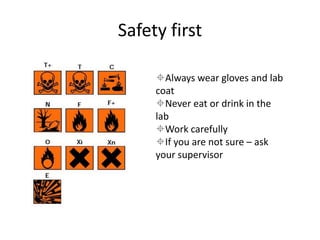
Safety first
Always wear gloves and lab
coat
Never eat or drink in the
lab
Work carefully
If you are not sure – ask
your supervisor
Literature
Current protocols in molecular biology
Molecular Cloning: A Laboratory Manual,
Third Edition by Sambrook
www.methods.info
Practical components will include:
- Isolation of genomic DNA
- Restriction of DNA
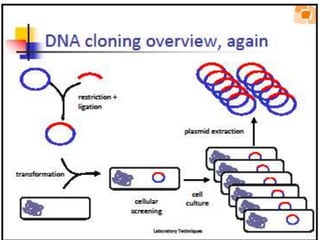
- Ligation into vectors- Plasmids (CLONING)
- Polymerase Chain Reaction (PCR)
-Automated DNA sequencing
what is DNA?
1. DNA is deoxyribonucleic acid, a complex string of
syllables found inside your body in tiny genes tightly
packaged in structures called chromosomes
2. The information in your DNA determines your unique
biological characteristics, such as eye color, height,
talents etc.
3. DNA replication is conserved in evolution
4. Molecular biology techniques utilize DNA, RNA, and
enzymes that interact with nucleic acids to understand
biology at a molecular level.
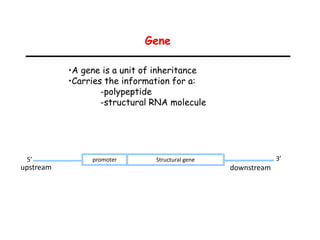
Gene
promoter Structural gene
flank flank
upstream downstream
5’ 3’
•A gene is a unit of inheritance
•Carries the information for a:
-polypeptide
-structural RNA molecule
Extraction of DNA
Take only DNA from the whole cell extract:
- break cell membrane
- precipitate proteins
Purify DNA from proteins bound, etc
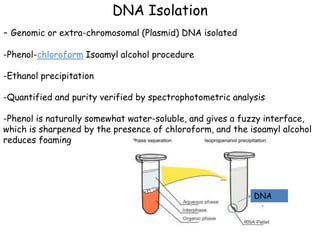
DNA Isolation
- Genomic or extra-chromosomal (Plasmid) DNA isolated
-Phenol-chloroform Isoamyl alcohol procedure
-Ethanol precipitation
-Quantified and purity verified by spectrophotometric analysis
-Phenol is naturally somewhat water-soluble, and gives a fuzzy interface,
which is sharpened by the presence of chloroform, and the isoamyl alcohol
reduces foaming
DNA
-DNA is precipitated by first ensuring that the
correct concentration of positive ions is present in
solution (too much will result in a lot of salt co-
precipitating with DNA, too little will result in
incomplete DNA recovery)
- 2.5 vols of 95% ethanol is added to the aq
solution in a fresh tube and incubated
-Solution is centrifuged and resulting pellet
washed with 70% ethanol and pellet allowed to dry
-Pellet is subsequently resuspended in either TE
buffer or de-ionised water
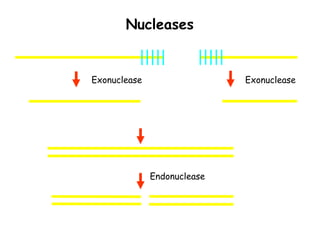
Nucleases
Endonuclease
5’ Exonuclease 3’ Exonuclease
Restriction enzymes
• Specific endonucleases
• Recognize specific short sequences of DNA and cleave
the DNA at or near the recognition sequence
• Recognition sequences: usually 4 or 6 bases but there are
some that are 5, 8, or longer
• Recognition sequences are palindromes
• Palindrome: sequence of DNA that is the same when one
strand is read from left to right or the other strand is
read from right to left– consists of adjacent inverted
repeats
Restriction enzymes (cont’d)
• Example of a palindrome:
GAATTC
CTTAAG
• Restriction enzymes are isolated from bacteria
• Derive names from the bacteria
• Genus- first letter capitalized
• Species- second and third letters (small case)
• Additional letters from “strains”
• Roman numeral designates different enzymes from the
same bacterial strain, in numerical order of discovery
• Example: EcoRI
– E Escherichia
– Co coli
– R R strain
– I first enzyme discovered from Escherichia coli R
Restriction enzymes play a very important role
-in the construction of recombinant DNA molecules,
as is done in gene cloning experiments
-Another application of restriction enzymes is to
map the locations of restriction sites in DNA
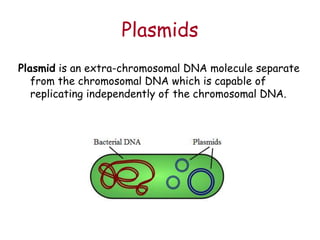
Plasmids
Plasmid is an extra-chromosomal DNA molecule separate
from the chromosomal DNA which is capable of
replicating independently of the chromosomal DNA.
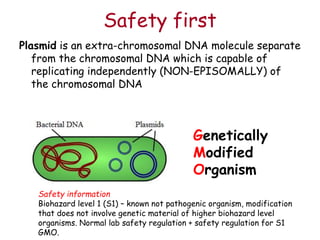
Safety first
Plasmid is an extra-chromosomal DNA molecule separate
from the chromosomal DNA which is capable of
replicating independently (NON-EPISOMALLY) of
the chromosomal DNA
Genetically
Modified
Organism
Safety information
Biohazard level 1 (S1) – known not pathogenic organism, modification
that does not involve genetic material of higher biohazard level
organisms. Normal lab safety regulation + safety regulation for S1
GMO.
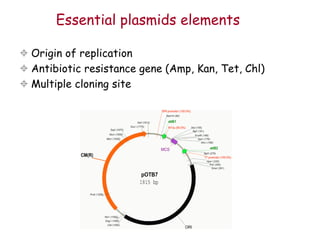
Essential plasmids elements
 Origin of replication
 Antibiotic resistance gene (Amp, Kan, Tet, Chl)
 Multiple cloning site
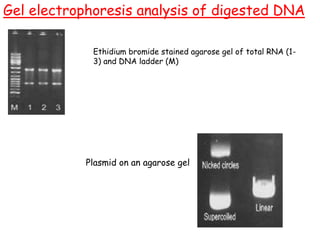
Gel electrophoresis analysis of digested DNA
Ethidium bromide stained agarose gel of total RNA (1-
3) and DNA ladder (M)
Plasmid on an agarose gel
The Polymerase Chain
Reaction (PCR)
What is the Polymerase Chain Reaction?
• It’s a means of selectively amplifying a particular
segment of DNA
• The segment may represent a small part of a large
and complex mixture of DNAs:
e.g. a specific exon of a human gene
• It can be thought of as a molecular photocopier ( it
mimicks nature by replicating DNA)
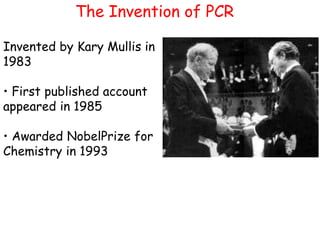
The Invention of PCR
Invented by Kary Mullis in
1983
• First published account
appeared in 1985
• Awarded NobelPrize for
Chemistry in 1993
What’s in the Reaction?
• Template DNA
• Reaction buffer (Tris, ammonium ions (and/or potassium ions), magnesium
ions, bovine serum albumin)
• Nucleotides (dNTPs)
• Primers
• DNA polymerase (usually Taq)
The Basics of PCR Cycling
30–35 cycles each comprising:
– denaturation (95°C),for 30 sec
– annealing (55–60°C), for 30 sec
– extension (72°C), time depends on product size
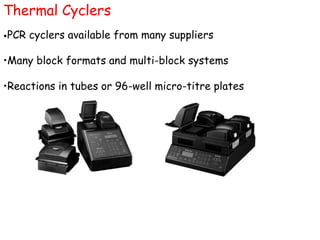
Thermal Cyclers
•PCR cyclers available from many suppliers
•Many block formats and multi-block systems
•Reactions in tubes or 96-well micro-titre plates
Has It Worked?
• Check a sample by gel electrophoresis
• Is the product the size that you expected?
• Is there more than one band?
• Is any band the correct size?
• May need to optimize the reaction conditions
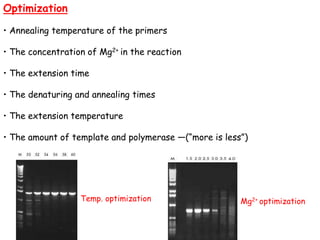
Optimization
• Annealing temperature of the primers
• The concentration of Mg2+ in the reaction
• The extension time
• The denaturing and annealing times
• The extension temperature
• The amount of template and polymerase —(“more is less”)
Temp. optimization Mg2+ optimization
-Do errors occur and does it matter?
. Yes, if you want to clone the amplified DNA — an individual molecule may
harbour several mutations.
• No, if you want to sequence the amplified
DNA or cut it with restriction enzymes.
• Use a proof-reading thermo-stable enzyme
rather than Taq.
- Can I PCR Amplify RNA? Not directly due to DNA
polymerase requiring a DNA template
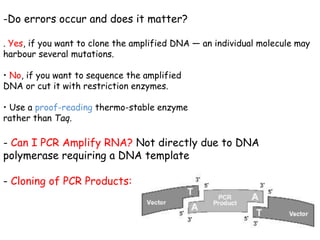
- Cloning of PCR Products:

basic molecular biology techniques.ppt

  • 1.
    Basic Laboratory Techniques inMolecular Biology Dr Esther Maina
  • 2.
    Safety first Always weargloves and lab coat Never eat or drink in the lab Work carefully If you are not sure – ask your supervisor
  • 3.
    Literature Current protocols inmolecular biology Molecular Cloning: A Laboratory Manual, Third Edition by Sambrook www.methods.info
  • 4.
    Practical components willinclude: - Isolation of genomic DNA - Restriction of DNA - Ligation into vectors- Plasmids (CLONING) - Polymerase Chain Reaction (PCR) -Automated DNA sequencing
  • 5.
    what is DNA? 1.DNA is deoxyribonucleic acid, a complex string of syllables found inside your body in tiny genes tightly packaged in structures called chromosomes 2. The information in your DNA determines your unique biological characteristics, such as eye color, height, talents etc. 3. DNA replication is conserved in evolution 4. Molecular biology techniques utilize DNA, RNA, and enzymes that interact with nucleic acids to understand biology at a molecular level.
  • 6.
    Gene promoter Structural gene flankflank upstream downstream 5’ 3’ •A gene is a unit of inheritance •Carries the information for a: -polypeptide -structural RNA molecule
  • 7.
    Extraction of DNA Takeonly DNA from the whole cell extract: - break cell membrane - precipitate proteins Purify DNA from proteins bound, etc
  • 8.
    DNA Isolation - Genomicor extra-chromosomal (Plasmid) DNA isolated -Phenol-chloroform Isoamyl alcohol procedure -Ethanol precipitation -Quantified and purity verified by spectrophotometric analysis -Phenol is naturally somewhat water-soluble, and gives a fuzzy interface, which is sharpened by the presence of chloroform, and the isoamyl alcohol reduces foaming DNA
  • 9.
    -DNA is precipitatedby first ensuring that the correct concentration of positive ions is present in solution (too much will result in a lot of salt co- precipitating with DNA, too little will result in incomplete DNA recovery) - 2.5 vols of 95% ethanol is added to the aq solution in a fresh tube and incubated -Solution is centrifuged and resulting pellet washed with 70% ethanol and pellet allowed to dry -Pellet is subsequently resuspended in either TE buffer or de-ionised water
  • 10.
  • 11.
    Restriction enzymes • Specificendonucleases • Recognize specific short sequences of DNA and cleave the DNA at or near the recognition sequence • Recognition sequences: usually 4 or 6 bases but there are some that are 5, 8, or longer • Recognition sequences are palindromes • Palindrome: sequence of DNA that is the same when one strand is read from left to right or the other strand is read from right to left– consists of adjacent inverted repeats
  • 12.
    Restriction enzymes (cont’d) •Example of a palindrome: GAATTC CTTAAG • Restriction enzymes are isolated from bacteria • Derive names from the bacteria • Genus- first letter capitalized • Species- second and third letters (small case) • Additional letters from “strains” • Roman numeral designates different enzymes from the same bacterial strain, in numerical order of discovery • Example: EcoRI – E Escherichia – Co coli – R R strain – I first enzyme discovered from Escherichia coli R
  • 13.
    Restriction enzymes playa very important role -in the construction of recombinant DNA molecules, as is done in gene cloning experiments -Another application of restriction enzymes is to map the locations of restriction sites in DNA
  • 14.
    Plasmids Plasmid is anextra-chromosomal DNA molecule separate from the chromosomal DNA which is capable of replicating independently of the chromosomal DNA.
  • 15.
    Safety first Plasmid isan extra-chromosomal DNA molecule separate from the chromosomal DNA which is capable of replicating independently (NON-EPISOMALLY) of the chromosomal DNA Genetically Modified Organism Safety information Biohazard level 1 (S1) – known not pathogenic organism, modification that does not involve genetic material of higher biohazard level organisms. Normal lab safety regulation + safety regulation for S1 GMO.
  • 16.
    Essential plasmids elements Origin of replication  Antibiotic resistance gene (Amp, Kan, Tet, Chl)  Multiple cloning site
  • 17.
    Gel electrophoresis analysisof digested DNA Ethidium bromide stained agarose gel of total RNA (1- 3) and DNA ladder (M) Plasmid on an agarose gel
  • 19.
    The Polymerase Chain Reaction(PCR) What is the Polymerase Chain Reaction? • It’s a means of selectively amplifying a particular segment of DNA • The segment may represent a small part of a large and complex mixture of DNAs: e.g. a specific exon of a human gene • It can be thought of as a molecular photocopier ( it mimicks nature by replicating DNA)
  • 20.
    The Invention ofPCR Invented by Kary Mullis in 1983 • First published account appeared in 1985 • Awarded NobelPrize for Chemistry in 1993
  • 21.
    What’s in theReaction? • Template DNA • Reaction buffer (Tris, ammonium ions (and/or potassium ions), magnesium ions, bovine serum albumin) • Nucleotides (dNTPs) • Primers • DNA polymerase (usually Taq) The Basics of PCR Cycling 30–35 cycles each comprising: – denaturation (95°C),for 30 sec – annealing (55–60°C), for 30 sec – extension (72°C), time depends on product size
  • 22.
    Thermal Cyclers •PCR cyclersavailable from many suppliers •Many block formats and multi-block systems •Reactions in tubes or 96-well micro-titre plates
  • 23.
    Has It Worked? •Check a sample by gel electrophoresis • Is the product the size that you expected? • Is there more than one band? • Is any band the correct size? • May need to optimize the reaction conditions
  • 24.
    Optimization • Annealing temperatureof the primers • The concentration of Mg2+ in the reaction • The extension time • The denaturing and annealing times • The extension temperature • The amount of template and polymerase —(“more is less”) Temp. optimization Mg2+ optimization
  • 25.
    -Do errors occurand does it matter? . Yes, if you want to clone the amplified DNA — an individual molecule may harbour several mutations. • No, if you want to sequence the amplified DNA or cut it with restriction enzymes. • Use a proof-reading thermo-stable enzyme rather than Taq. - Can I PCR Amplify RNA? Not directly due to DNA polymerase requiring a DNA template - Cloning of PCR Products: