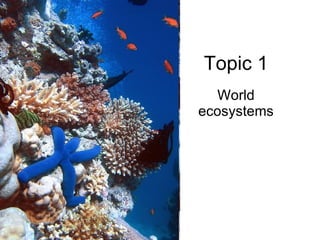
Topic 1 World ecosystems
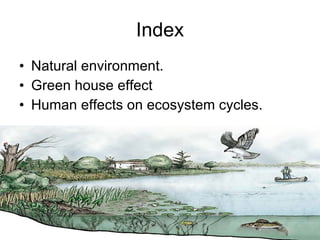
Index Natural environment. Green house effect Human effects on ecosystem cycles.
Natural environment An ecosystem is a community of trees, plants, animals and insects living in a particular environment. All living things are linked and depend on the land, water and air.
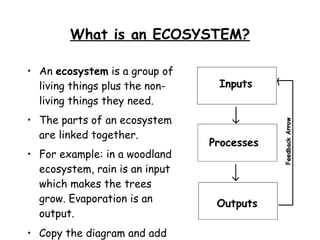
What is an ECOSYSTEM? An  ecosystem  is a group of living things plus the non-living things they need. The parts of an ecosystem are linked together. For example: in a woodland ecosystem, rain is an input which makes the trees grow. Evaporation is an output. Copy the diagram and add examples to each box.
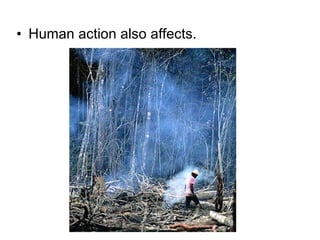
Human action also affects.
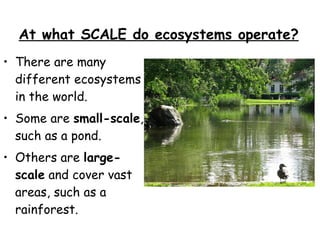
At what SCALE do ecosystems operate? There are many different ecosystems in the world. Some are  small-scale , such as a pond. Others are  large-scale  and cover vast areas, such as a rainforest.
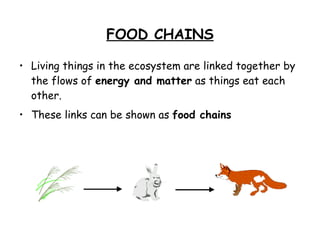
FOOD CHAINS Living things in the ecosystem are linked together by the flows of  energy and matter  as things eat each other. These links can be shown as  food chains
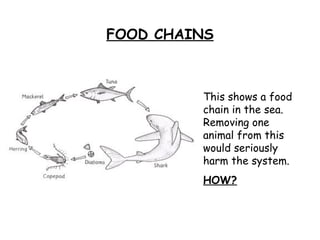
FOOD CHAINS This shows a food chain in the sea. Removing one animal from this would seriously harm the system.  HOW?
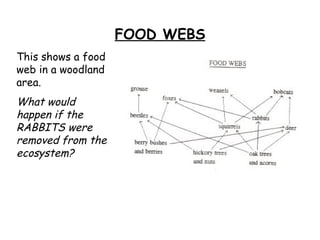
FOOD WEBS This shows a food web in a woodland area.  What would happen if the RABBITS were removed from the ecosystem?
Sections Abiotic Biotic
World ecosystems 8 types
Lets go to the rainforest and find out what its like, the types of vegetation & its soil 1.Tropical rainforest
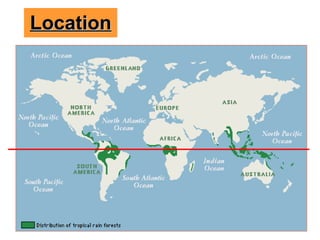
Location
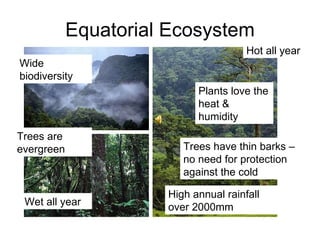
Equatorial Ecosystem Hot all year Wet all year High annual rainfall over 2000mm Wide biodiversity Plants love the heat & humidity Trees are evergreen Trees have thin barks – no need for protection against the cold
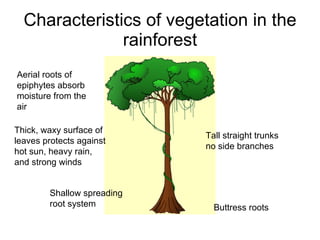
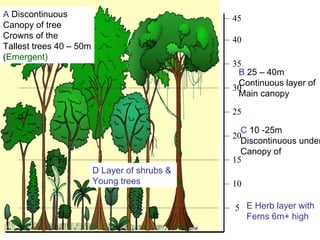
Characteristics of vegetation in the rainforest Tall straight trunks  no side branches  Aerial roots of  epiphytes absorb  moisture from the  air  Shallow spreading  root system  Buttress roots  Thick, waxy surface of  leaves protects against  hot sun, heavy rain,  and strong winds
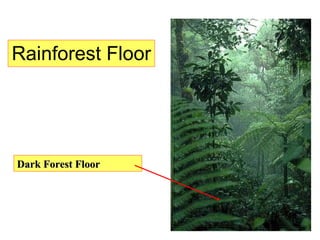
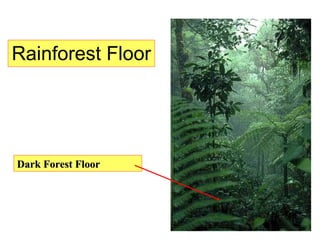
Rainforest Floor Dark Forest Floor
FACTS The Amazon Rainforest has been described as the "Lungs of our Planet" because it provides the essential environmental world service of continuously recycling carbon dioxide into oxygen. More than 20 percent of the world oxygen is produced in the Amazon Rainforest.  One and one-half acres of rainforest are lost every second with tragic consequences for both developing and industrial countries.
A  Discontinuous  Canopy of tree Crowns of the  Tallest trees 40 – 50m ( Emergent) B  25 – 40m  Continuous layer of  Main canopy C  10 -25m  Discontinuous under Canopy of D Layer of shrubs &  Young trees E Herb layer with  Ferns 6m+ high 5 10 15 20 25 30 35 40 45
Rainforest Floor Dark Forest Floor
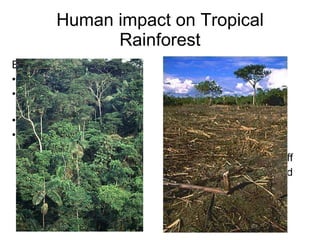
Human impact on Tropical Rainforest Before clearance Rain intercepted Organic matter decays quickly Nutrients released Nutrients taken up by the trees After Clearance All rain reaches the surface No trees left to supply nutrients Nutrients already in the soil are washed out Increased surface runoff Increased soil deposited into the rivers
Solutions?
Management Making a survey of the area’s resources before using them Selecting only a few trees per hectare Cutting down only fully grown trees Replanting those cut down Checking the work is done according to the plans
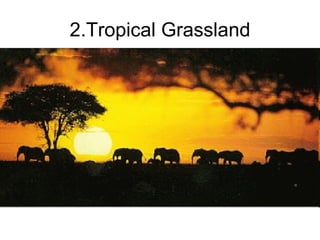
2.Tropical Grassland
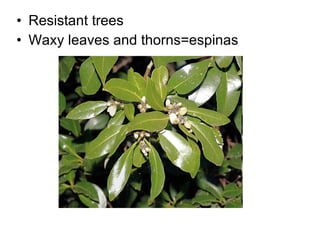
Resistant trees Waxy leaves and thorns=espinas
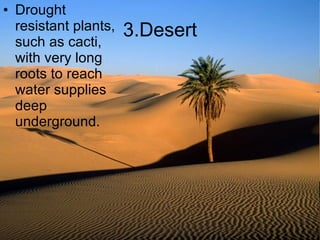
3.Desert Drought resistant plants, such as cacti, with very long roots to reach water supplies deep underground.
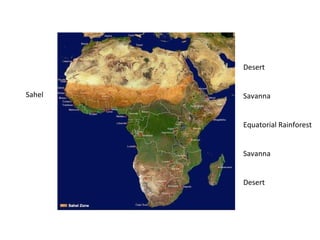
Desert Savanna Equatorial Rainforest Savanna Desert Sahel
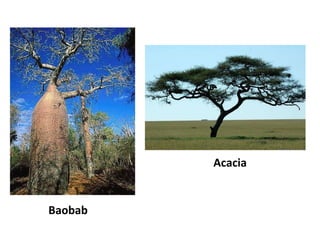
Baobab Acacia
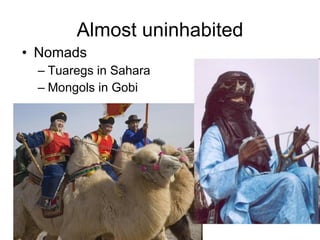
Almost uninhabited Nomads  Tuaregs in Sahara Mongols in Gobi
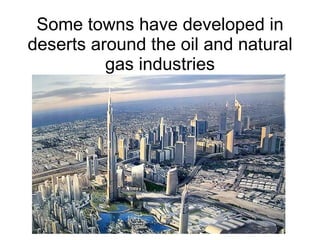
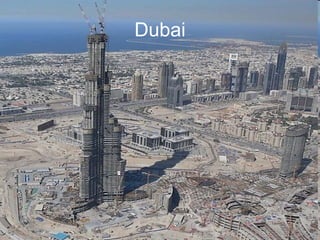
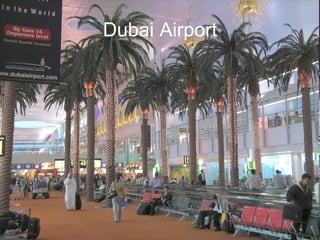
Some towns have developed in deserts around the oil and natural gas industries
Dubai
Dubai Airport
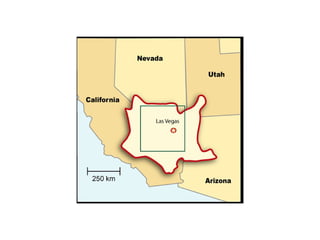
Las Vegas in Mojave Desert
 
 
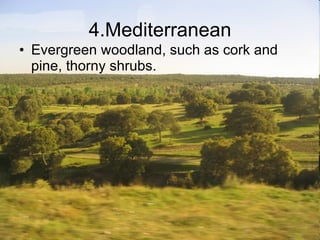
4.Mediterranean Evergreen woodland, such as cork and pine, thorny shrubs.
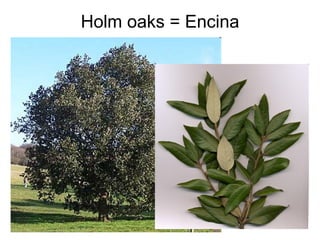
Holm oaks = Encina
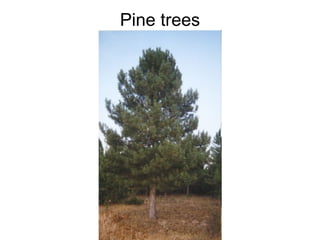
Pine trees
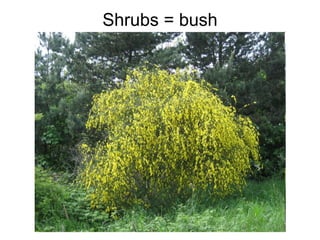
Shrubs = bush
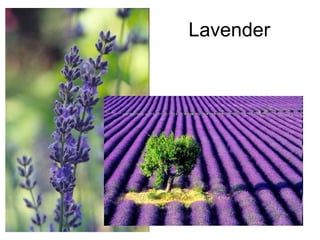
Lavender
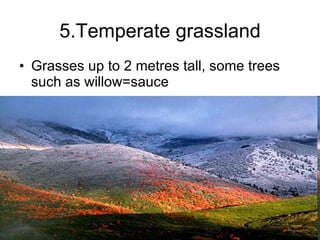
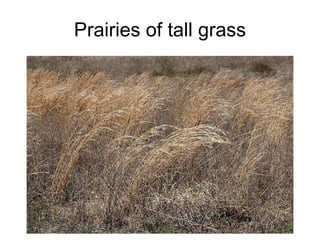
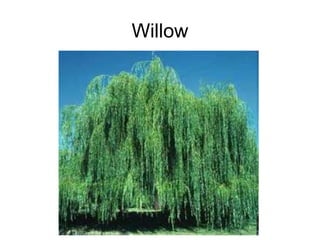
5.Temperate grassland Grasses up to 2 metres tall, some trees such as willow=sauce
Prairies of tall grass
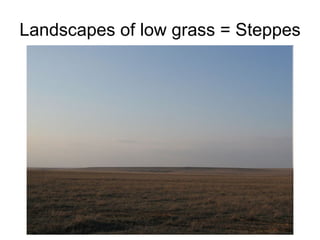
Landscapes of low grass = Steppes
Willow
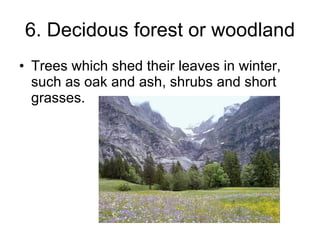
6. Decidous forest or woodland Trees which shed their leaves in winter, such as oak and ash, shrubs and short grasses.
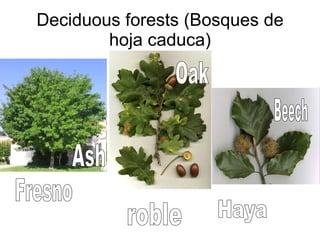
Deciduous forests (Bosques de hoja caduca) Ash Haya Oak roble Beech Fresno
7.Coniferous forest Dense evergreen trees, such as fir=abeto, pine.
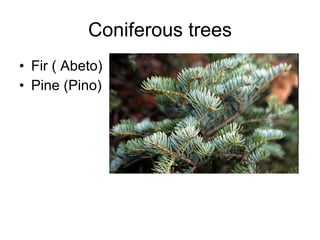
Coniferous trees Fir ( Abeto) Pine (Pino)
8.Tundra Short plans, such as moors, heather and lichen. Some stunted trees
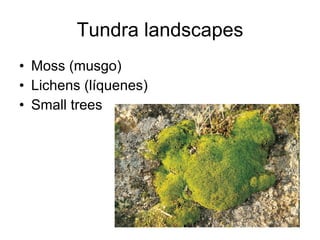
Tundra landscapes Moss (musgo) Lichens (líquenes) Small trees
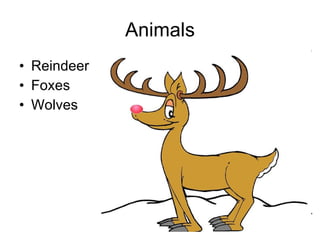
Animals Reindeer Foxes Wolves
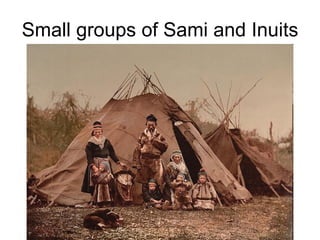
Small groups of Sami and Inuits
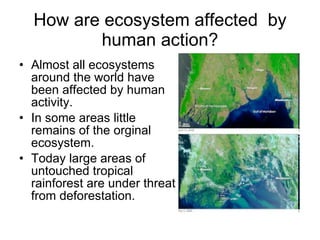
How are ecosystem affected  by human action? Almost all ecosystems around the world have been affected by human activity. In some areas little remains of the orginal ecosystem. Today large areas of untouched tropical rainforest are under threat from deforestation.
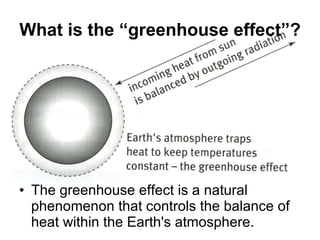
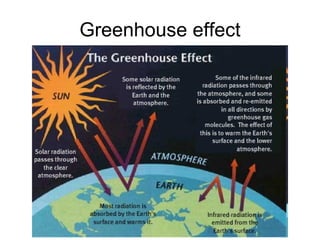
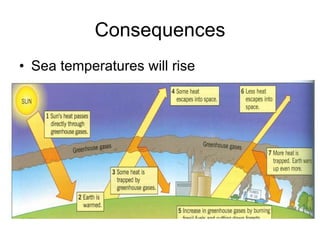
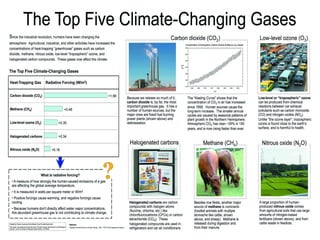
The greenhouse effect is a natural phenomenon that controls the balance of heat within the Earth's atmosphere.  What is the “greenhouse effect”?
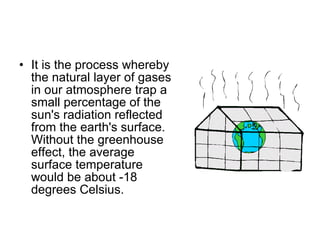
It is the process whereby the natural layer of gases in our atmosphere trap a small percentage of the sun's radiation reflected from the earth's surface. Without the greenhouse effect, the average surface temperature would be about -18 degrees Celsius.
Greenhouse effect
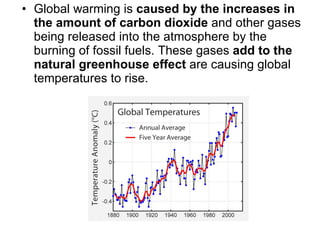
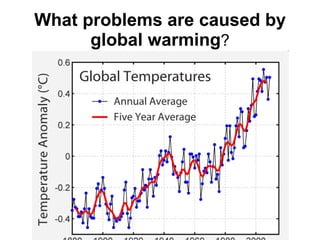
Global warming is  caused by the increases in the amount of carbon dioxide  and other gases being released into the atmosphere by the burning of fossil fuels. These gases  add to the natural greenhouse effect  are causing global temperatures to rise.
What problems are caused by global warming ?
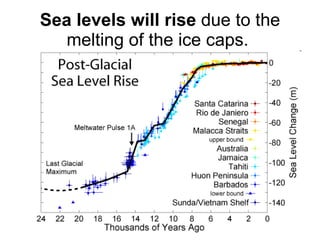
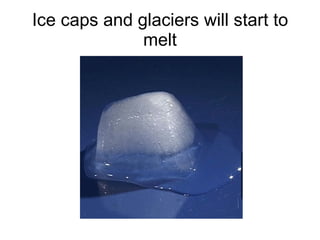
Sea levels will rise  due to the melting of the ice caps.
Consequences Sea temperatures will rise
Ice caps and glaciers will start to melt
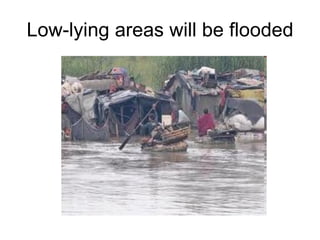
Low-lying areas will be flooded
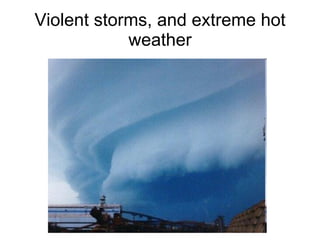
Violent storms, and extreme hot weather
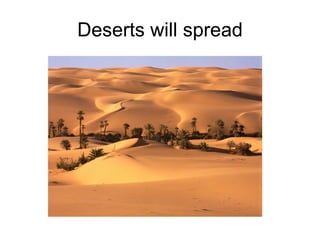
Deserts will spread
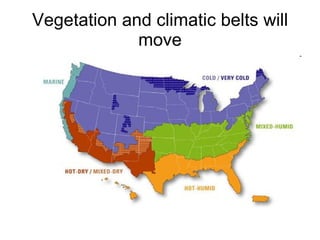
Vegetation and climatic belts will move
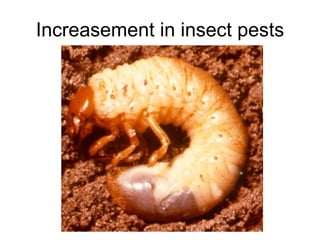
Increasement in insect pests
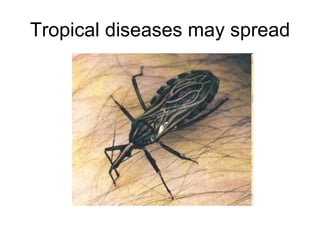
Tropical diseases may spread
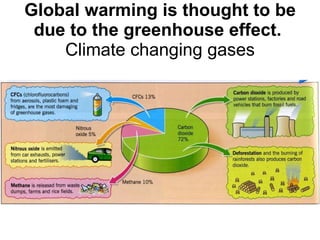
Global warming is thought to be due to the greenhouse effect.  Climate changing gases
 
Kyoto Protocol-1997 In 1997, the  Kyoto Protocol  brought agreement between countries that greenhouse gases should be reduced. So far, many European countries, including Britain, have admitted difficulty in achieving the target. http://www.youtube.com/watch?v=Jh02eZFRIh4&feature=related
Activity: the Kyoto Protocol http:// www.youtube.com/watch?v = oJAbATJCugs&feature = player_embedded#t =184   Watch it and answer the questions.
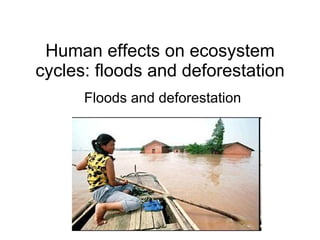
Human effects on ecosystem cycles: floods and deforestation Floods and deforestation
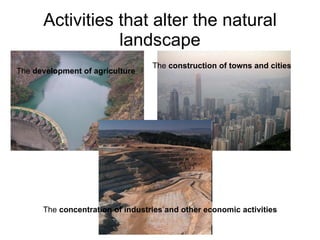
Activities that alter the natural landscape The  development of agriculture   The  construction of towns and cities   The  concentration of industries and other economic activities
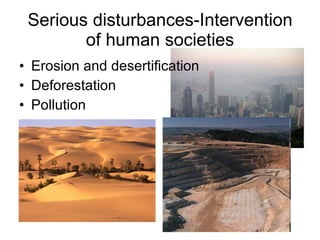
Serious disturbances-Intervention of human societies Erosion and desertification Deforestation Pollution
 
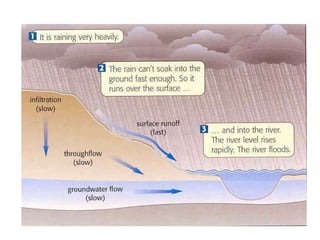
Why do some floods have disastrous consequences?
 
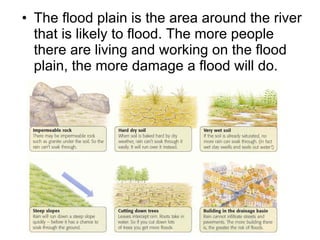
The flood plain is the area around the river that is likely to flood. The more people there are living and working on the flood plain, the more damage a flood will do.
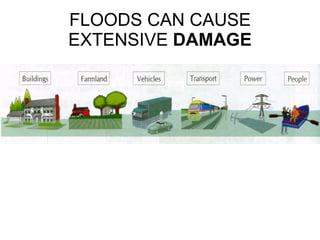
FLOODS CAN CAUSE EXTENSIVE  DAMAGE
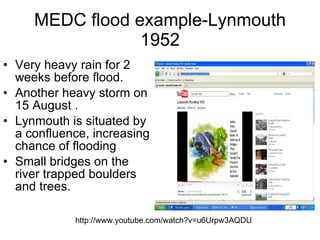
MEDC flood example-Lynmouth 1952 Very heavy rain for 2 weeks before flood. Another heavy storm on 15 August .  Lynmouth is situated by a confluence, increasing chance of flooding  Small bridges on the river trapped boulders and trees.  http://www.youtube.com/watch?v=u6Urpw3AQDU
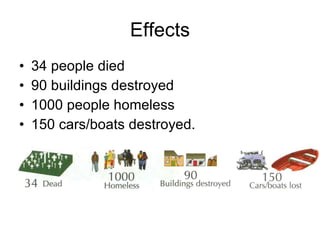
Effects 34 people died  90 buildings destroyed  1000 people homeless  150 cars/boats destroyed.
Floods - Bangladesh, 1998 (LEDC) 80% of Bangladesh on flood plain  Strong winds lead to storm. Rivers flood in summer due to monsoon rain.  Deforestation in Nepal . River Ganges used for irrigation upstream – less silt in downstream to build up the floodplain  Rising population –slope collapse  http://www.youtube.com/watch?v=1tMMcrl_foo
Effects 1040 people died  Over half the country flooded  23 million homeless  130 million cattle drowned  Crops ruined  Drinking water polluted  Communities destroyed
http://environment.nationalgeographic.com/environment/photos/floods-general/#/amazon-river_50_600x450.jpg
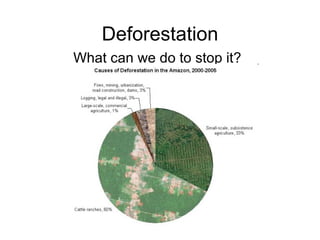
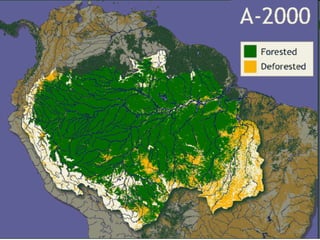
Deforestation What can we do to stop it?
 
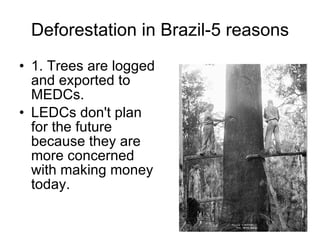
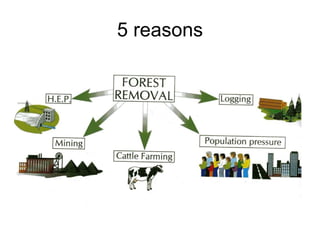
Deforestation in Brazil-5 reasons 1. Trees are logged and exported to MEDCs.  LEDCs don't plan for the future because they are more concerned with making money today.
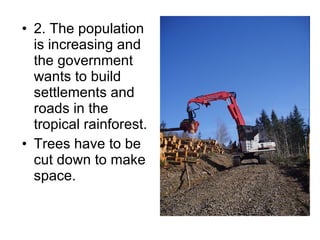
2.  The population is increasing and the government wants to build settlements and roads in the tropical rainforest.  Trees have to be cut down to make space.
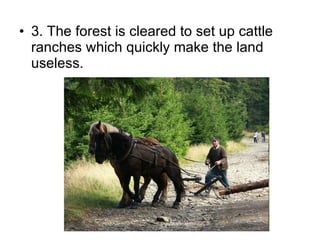
3. The forest is cleared to set up cattle ranches which quickly make the land useless.
4.  Mineral extraction helps Brazil pay foreign debts — In Brazil is the world's largest iron reserve.  Forest is removed to make way for roads and mines.
5.  Hydro-electric power (HEP) development has meant that large areas of land have been flooded.
5 reasons
http://www.historiasiglo20.org/MEC-BC/Ecosystems/quizmaker.html

Topic 1 world ecosystems

  • 1.
    Topic 1 Worldecosystems
  • 2.
    Index Natural environment.Green house effect Human effects on ecosystem cycles.
  • 3.
    Natural environment Anecosystem is a community of trees, plants, animals and insects living in a particular environment. All living things are linked and depend on the land, water and air.
  • 4.
    What is anECOSYSTEM? An ecosystem is a group of living things plus the non-living things they need. The parts of an ecosystem are linked together. For example: in a woodland ecosystem, rain is an input which makes the trees grow. Evaporation is an output. Copy the diagram and add examples to each box.
  • 5.
  • 6.
    At what SCALEdo ecosystems operate? There are many different ecosystems in the world. Some are small-scale , such as a pond. Others are large-scale and cover vast areas, such as a rainforest.
  • 7.
    FOOD CHAINS Livingthings in the ecosystem are linked together by the flows of energy and matter as things eat each other. These links can be shown as food chains
  • 8.
    FOOD CHAINS Thisshows a food chain in the sea. Removing one animal from this would seriously harm the system. HOW?
  • 9.
    FOOD WEBS Thisshows a food web in a woodland area. What would happen if the RABBITS were removed from the ecosystem?
  • 10.
  • 11.
  • 12.
    Lets go tothe rainforest and find out what its like, the types of vegetation & its soil 1.Tropical rainforest
  • 13.
  • 14.
    Equatorial Ecosystem Hotall year Wet all year High annual rainfall over 2000mm Wide biodiversity Plants love the heat & humidity Trees are evergreen Trees have thin barks – no need for protection against the cold
  • 15.
    Characteristics of vegetationin the rainforest Tall straight trunks no side branches Aerial roots of epiphytes absorb moisture from the air Shallow spreading root system Buttress roots Thick, waxy surface of leaves protects against hot sun, heavy rain, and strong winds
  • 16.
  • 17.
    FACTS The AmazonRainforest has been described as the "Lungs of our Planet" because it provides the essential environmental world service of continuously recycling carbon dioxide into oxygen. More than 20 percent of the world oxygen is produced in the Amazon Rainforest. One and one-half acres of rainforest are lost every second with tragic consequences for both developing and industrial countries.
  • 18.
    A Discontinuous Canopy of tree Crowns of the Tallest trees 40 – 50m ( Emergent) B 25 – 40m Continuous layer of Main canopy C 10 -25m Discontinuous under Canopy of D Layer of shrubs & Young trees E Herb layer with Ferns 6m+ high 5 10 15 20 25 30 35 40 45
  • 19.
  • 20.
    Human impact onTropical Rainforest Before clearance Rain intercepted Organic matter decays quickly Nutrients released Nutrients taken up by the trees After Clearance All rain reaches the surface No trees left to supply nutrients Nutrients already in the soil are washed out Increased surface runoff Increased soil deposited into the rivers
  • 21.
  • 22.
    Management Making asurvey of the area’s resources before using them Selecting only a few trees per hectare Cutting down only fully grown trees Replanting those cut down Checking the work is done according to the plans
  • 23.
  • 24.
    Resistant trees Waxyleaves and thorns=espinas
  • 25.
    3.Desert Drought resistantplants, such as cacti, with very long roots to reach water supplies deep underground.
  • 26.
    Desert Savanna EquatorialRainforest Savanna Desert Sahel
  • 27.
  • 28.
    Almost uninhabited Nomads Tuaregs in Sahara Mongols in Gobi
  • 29.
    Some towns havedeveloped in deserts around the oil and natural gas industries
  • 30.
  • 31.
  • 32.
    Las Vegas inMojave Desert
  • 33.
  • 34.
  • 35.
    4.Mediterranean Evergreen woodland,such as cork and pine, thorny shrubs.
  • 36.
  • 37.
  • 38.
  • 39.
  • 40.
    5.Temperate grassland Grassesup to 2 metres tall, some trees such as willow=sauce
  • 41.
  • 42.
    Landscapes of lowgrass = Steppes
  • 43.
  • 44.
    6. Decidous forestor woodland Trees which shed their leaves in winter, such as oak and ash, shrubs and short grasses.
  • 45.
    Deciduous forests (Bosquesde hoja caduca) Ash Haya Oak roble Beech Fresno
  • 46.
    7.Coniferous forest Denseevergreen trees, such as fir=abeto, pine.
  • 47.
    Coniferous trees Fir( Abeto) Pine (Pino)
  • 48.
    8.Tundra Short plans,such as moors, heather and lichen. Some stunted trees
  • 49.
    Tundra landscapes Moss(musgo) Lichens (líquenes) Small trees
  • 50.
  • 51.
    Small groups ofSami and Inuits
  • 52.
    How are ecosystemaffected by human action? Almost all ecosystems around the world have been affected by human activity. In some areas little remains of the orginal ecosystem. Today large areas of untouched tropical rainforest are under threat from deforestation.
  • 53.
    The greenhouse effectis a natural phenomenon that controls the balance of heat within the Earth's atmosphere. What is the “greenhouse effect”?
  • 54.
    It is theprocess whereby the natural layer of gases in our atmosphere trap a small percentage of the sun's radiation reflected from the earth's surface. Without the greenhouse effect, the average surface temperature would be about -18 degrees Celsius.
  • 55.
  • 56.
    Global warming is caused by the increases in the amount of carbon dioxide and other gases being released into the atmosphere by the burning of fossil fuels. These gases add to the natural greenhouse effect are causing global temperatures to rise.
  • 57.
    What problems arecaused by global warming ?
  • 58.
    Sea levels willrise due to the melting of the ice caps.
  • 59.
  • 60.
    Ice caps andglaciers will start to melt
  • 61.
  • 62.
    Violent storms, andextreme hot weather
  • 63.
  • 64.
    Vegetation and climaticbelts will move
  • 65.
  • 66.
  • 67.
    Global warming isthought to be due to the greenhouse effect. Climate changing gases
  • 68.
  • 69.
    Kyoto Protocol-1997 In1997, the Kyoto Protocol brought agreement between countries that greenhouse gases should be reduced. So far, many European countries, including Britain, have admitted difficulty in achieving the target. http://www.youtube.com/watch?v=Jh02eZFRIh4&feature=related
  • 70.
    Activity: the KyotoProtocol http:// www.youtube.com/watch?v = oJAbATJCugs&feature = player_embedded#t =184 Watch it and answer the questions.
  • 71.
    Human effects onecosystem cycles: floods and deforestation Floods and deforestation
  • 72.
    Activities that alterthe natural landscape The development of agriculture The construction of towns and cities The concentration of industries and other economic activities
  • 73.
    Serious disturbances-Intervention ofhuman societies Erosion and desertification Deforestation Pollution
  • 74.
  • 75.
    Why do somefloods have disastrous consequences?
  • 76.
  • 77.
    The flood plainis the area around the river that is likely to flood. The more people there are living and working on the flood plain, the more damage a flood will do.
  • 78.
    FLOODS CAN CAUSEEXTENSIVE DAMAGE
  • 79.
    MEDC flood example-Lynmouth1952 Very heavy rain for 2 weeks before flood. Another heavy storm on 15 August . Lynmouth is situated by a confluence, increasing chance of flooding Small bridges on the river trapped boulders and trees. http://www.youtube.com/watch?v=u6Urpw3AQDU
  • 80.
    Effects 34 peopledied 90 buildings destroyed 1000 people homeless 150 cars/boats destroyed.
  • 81.
    Floods - Bangladesh,1998 (LEDC) 80% of Bangladesh on flood plain Strong winds lead to storm. Rivers flood in summer due to monsoon rain. Deforestation in Nepal . River Ganges used for irrigation upstream – less silt in downstream to build up the floodplain Rising population –slope collapse http://www.youtube.com/watch?v=1tMMcrl_foo
  • 82.
    Effects 1040 peopledied Over half the country flooded 23 million homeless 130 million cattle drowned Crops ruined Drinking water polluted Communities destroyed
  • 83.
  • 84.
    Deforestation What canwe do to stop it?
  • 85.
  • 86.
    Deforestation in Brazil-5reasons 1. Trees are logged and exported to MEDCs. LEDCs don't plan for the future because they are more concerned with making money today.
  • 87.
    2. Thepopulation is increasing and the government wants to build settlements and roads in the tropical rainforest. Trees have to be cut down to make space.
  • 88.
    3. The forestis cleared to set up cattle ranches which quickly make the land useless.
  • 89.
    4. Mineralextraction helps Brazil pay foreign debts — In Brazil is the world's largest iron reserve. Forest is removed to make way for roads and mines.
  • 90.
    5. Hydro-electricpower (HEP) development has meant that large areas of land have been flooded.
  • 91.
  • 92.