The Ecological
Situations in Asia
E
C
O
S
Y
S
T
E
M
 A system formed by the
interaction of a community of
organisms with their physical
environment
 An area where physical,
chemical, biological traits
and forms of energy like air,
water, soil, and organisms are
interrelating with each other
 Includes the whole complex
of physical factors forming
what we call environment
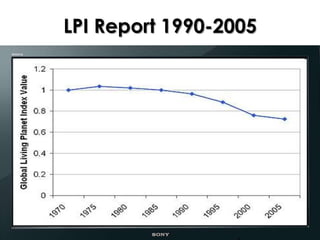
The Living Planet Index (LPI)
 Describes the health condition of the
planet’s ecosystems
 Sums up tracked populations of
vertebrate, terrestrial, marine, and
freshwater species, which include fish,
amphibians, reptiles, birds, and
mammals from all parts of the world
LPI Report 1990-2005
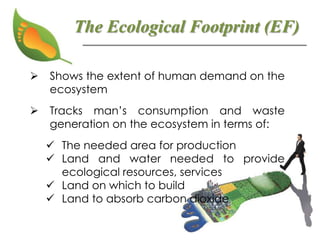
The Ecological Footprint (EF)
 Shows the extent of human demand on the
ecosystem
 Tracks man’s consumption and waste
generation on the ecosystem in terms of:
 The needed area for production
 Land and water needed to provide
ecological resources, services
 Land on which to build
 Land to absorb carbon dioxide
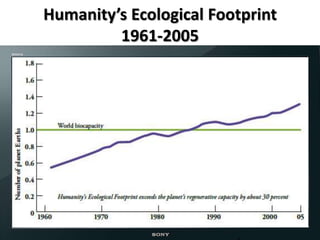
Humanity’s Ecological Footprint
1961-2005
 Agreed upon in response to the
United Nations conference on
Environment and Development
(UNCED) on the Earth Summit in
June 1992 at Rio de Janeiro
 Call for development to be
promoted in ways that are
sustainable and environmentally
sound
Sustainable Development
 Responsible development of the
environment to meet the needs of
the present generation without
compromising the ability of the
future generations to meet their
own needs
Sustainable Development
 Essence is defined by the Philippine
Agenda 21, Section 1.3
In the harmonious integration of a
sound and viable economy,
responsible governance, social
harmony, and ecological integrity
to insure that development is a life-
enhancing process.
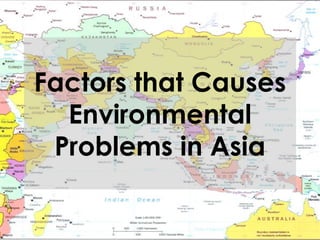
Factors that Causes
Environmental
Problems in Asia
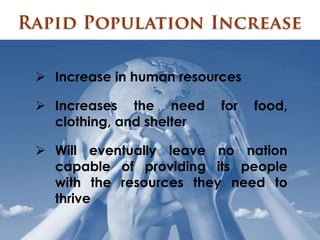
 Increase in human resources
 Increases the need for food,
clothing, and shelter
 Will eventually leave no nation
capable of providing its people
with the resources they need to
thrive
 Physical growth of urban areas
from being rural as result of
population immigration
 Effects include change in density
and administration services
 Urban population is fastest in East
Asia, South Asia, and Southeast
Asia.
 Urban areas with more than 10
million inhabitants
 Host strong interactions between
social, political, economic, and
ecological progress
 Asia has eleven of the world’s
ten megacities with six in the top
ten.
Metropolitan area, which is notably
warmer than its surrounding areas.
 The immediate change is seen in
the disposal of volume of waste
 Unfriendly environmental
technologies
 Travel distances
 New pollutants such as pesticides
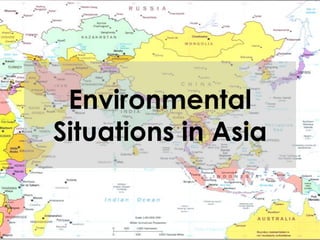
Environmental
Situations in Asia
The introduction of harmful
substances into the environment
that causes instability, disorder,
harm, or discomfort to the
ecosystem.
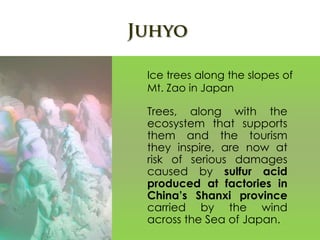
Trees, along with the
ecosystem that supports
them and the tourism
they inspire, are now at
risk of serious damages
caused by sulfur acid
produced at factories in
China’s Shanxi province
carried by the wind
across the Sea of Japan.
Ice trees along the slopes of
Mt. Zao in Japan
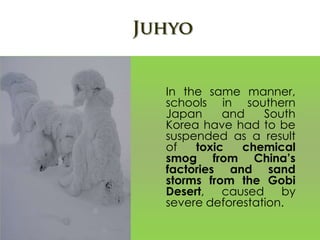
In the same manner,
schools in southern
Japan and South
Korea have had to be
suspended as a result
of toxic chemical
smog from China’s
factories and sand
storms from the Gobi
Desert, caused by
severe deforestation.
The release of a liquid
petroleum hydrocarbon into
the environment due to
human activity, and is a form
of pollution.
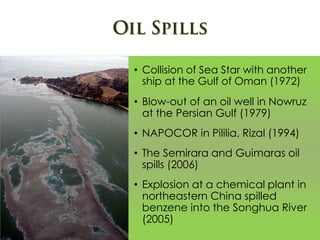
• Collision of Sea Star with another
ship at the Gulf of Oman (1972)
• Blow-out of an oil well in Nowruz
at the Persian Gulf (1979)
• NAPOCOR in Pililia, Rizal (1994)
• The Semirara and Guimaras oil
spills (2006)
• Explosion at a chemical plant in
northeastern China spilled
benzene into the Songhua River
(2005)
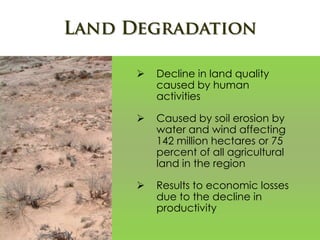
 Decline in land quality
caused by human
activities
 Caused by soil erosion by
water and wind affecting
142 million hectares or 75
percent of all agricultural
land in the region
 Results to economic losses
due to the decline in
productivity
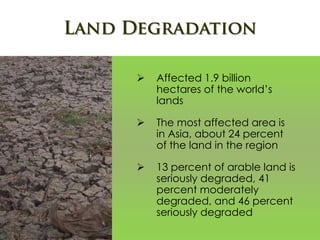
 Affected 1.9 billion
hectares of the world’s
lands
 The most affected area is
in Asia, about 24 percent
of the land in the region
 13 percent of arable land is
seriously degraded, 41
percent moderately
degraded, and 46 percent
seriously degraded
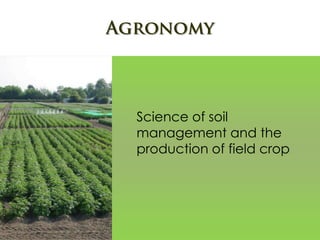
Science of soil
management and the
production of field crop
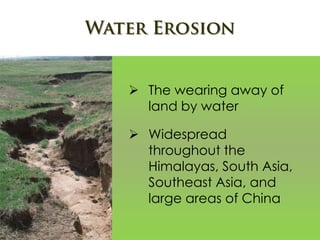
 The wearing away of
land by water
 Widespread
throughout the
Himalayas, South Asia,
Southeast Asia, and
large areas of China
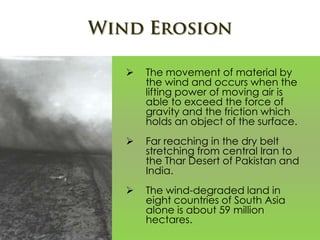
 The movement of material by
the wind and occurs when the
lifting power of moving air is
able to exceed the force of
gravity and the friction which
holds an object of the surface.
 Far reaching in the dry belt
stretching from central Iran to
the Thar Desert of Pakistan and
India.
 The wind-degraded land in
eight countries of South Asia
alone is about 59 million
hectares.
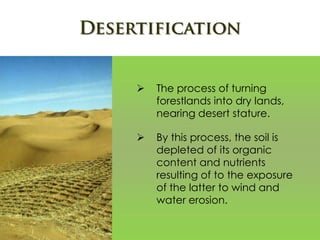
 The process of turning
forestlands into dry lands,
nearing desert stature.
 By this process, the soil is
depleted of its organic
content and nutrients
resulting of to the exposure
of the latter to wind and
water erosion.
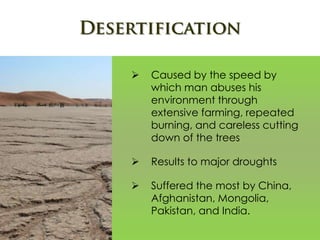
 Caused by the speed by
which man abuses his
environment through
extensive farming, repeated
burning, and careless cutting
down of the trees
 Results to major droughts
 Suffered the most by China,
Afghanistan, Mongolia,
Pakistan, and India.
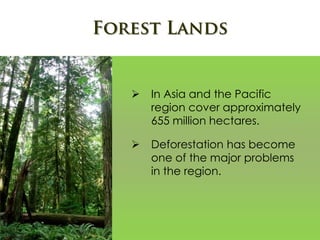
 In Asia and the Pacific
region cover approximately
655 million hectares.
 Deforestation has become
one of the major problems
in the region.
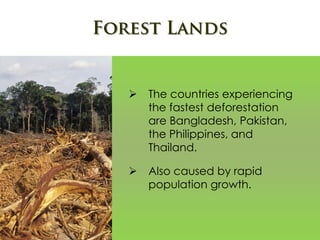
 The countries experiencing
the fastest deforestation
are Bangladesh, Pakistan,
the Philippines, and
Thailand.
 Also caused by rapid
population growth.
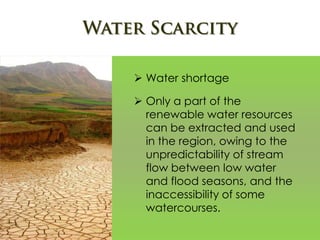
 Water shortage
 Only a part of the
renewable water resources
can be extracted and used
in the region, owing to the
unpredictability of stream
flow between low water
and flood seasons, and the
inaccessibility of some
watercourses.
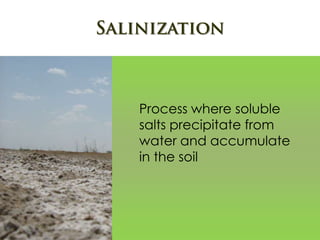
Process where soluble
salts precipitate from
water and accumulate
in the soil
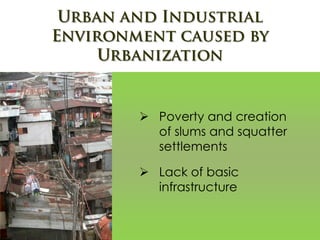
 Poverty and creation
of slums and squatter
settlements
 Lack of basic
infrastructure
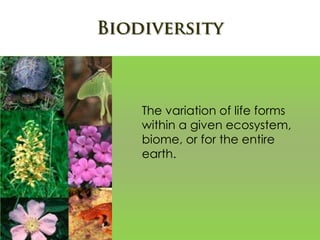
The variation of life forms
within a given ecosystem,
biome, or for the entire
earth.
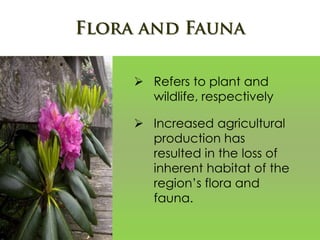
 Refers to plant and
wildlife, respectively
 Increased agricultural
production has
resulted in the loss of
inherent habitat of the
region’s flora and
fauna.
END

Ecological problems in Asia

  • 1.
  • 2.
    E C O S Y S T E M  A systemformed by the interaction of a community of organisms with their physical environment  An area where physical, chemical, biological traits and forms of energy like air, water, soil, and organisms are interrelating with each other  Includes the whole complex of physical factors forming what we call environment
  • 3.
    The Living PlanetIndex (LPI)  Describes the health condition of the planet’s ecosystems  Sums up tracked populations of vertebrate, terrestrial, marine, and freshwater species, which include fish, amphibians, reptiles, birds, and mammals from all parts of the world
  • 4.
  • 5.
    The Ecological Footprint(EF)  Shows the extent of human demand on the ecosystem  Tracks man’s consumption and waste generation on the ecosystem in terms of:  The needed area for production  Land and water needed to provide ecological resources, services  Land on which to build  Land to absorb carbon dioxide
  • 6.
  • 7.
     Agreed uponin response to the United Nations conference on Environment and Development (UNCED) on the Earth Summit in June 1992 at Rio de Janeiro  Call for development to be promoted in ways that are sustainable and environmentally sound
  • 8.
    Sustainable Development  Responsibledevelopment of the environment to meet the needs of the present generation without compromising the ability of the future generations to meet their own needs
  • 9.
    Sustainable Development  Essenceis defined by the Philippine Agenda 21, Section 1.3 In the harmonious integration of a sound and viable economy, responsible governance, social harmony, and ecological integrity to insure that development is a life- enhancing process.
  • 10.
  • 11.
     Increase inhuman resources  Increases the need for food, clothing, and shelter  Will eventually leave no nation capable of providing its people with the resources they need to thrive
  • 12.
     Physical growthof urban areas from being rural as result of population immigration  Effects include change in density and administration services  Urban population is fastest in East Asia, South Asia, and Southeast Asia.
  • 13.
     Urban areaswith more than 10 million inhabitants  Host strong interactions between social, political, economic, and ecological progress  Asia has eleven of the world’s ten megacities with six in the top ten.
  • 14.
    Metropolitan area, whichis notably warmer than its surrounding areas.
  • 15.
     The immediatechange is seen in the disposal of volume of waste  Unfriendly environmental technologies  Travel distances  New pollutants such as pesticides
  • 16.
  • 17.
    The introduction ofharmful substances into the environment that causes instability, disorder, harm, or discomfort to the ecosystem.
  • 18.
    Trees, along withthe ecosystem that supports them and the tourism they inspire, are now at risk of serious damages caused by sulfur acid produced at factories in China’s Shanxi province carried by the wind across the Sea of Japan. Ice trees along the slopes of Mt. Zao in Japan
  • 19.
    In the samemanner, schools in southern Japan and South Korea have had to be suspended as a result of toxic chemical smog from China’s factories and sand storms from the Gobi Desert, caused by severe deforestation.
  • 20.
    The release ofa liquid petroleum hydrocarbon into the environment due to human activity, and is a form of pollution.
  • 21.
    • Collision ofSea Star with another ship at the Gulf of Oman (1972) • Blow-out of an oil well in Nowruz at the Persian Gulf (1979) • NAPOCOR in Pililia, Rizal (1994) • The Semirara and Guimaras oil spills (2006) • Explosion at a chemical plant in northeastern China spilled benzene into the Songhua River (2005)
  • 22.
     Decline inland quality caused by human activities  Caused by soil erosion by water and wind affecting 142 million hectares or 75 percent of all agricultural land in the region  Results to economic losses due to the decline in productivity
  • 23.
     Affected 1.9billion hectares of the world’s lands  The most affected area is in Asia, about 24 percent of the land in the region  13 percent of arable land is seriously degraded, 41 percent moderately degraded, and 46 percent seriously degraded
  • 24.
    Science of soil managementand the production of field crop
  • 25.
     The wearingaway of land by water  Widespread throughout the Himalayas, South Asia, Southeast Asia, and large areas of China
  • 26.
     The movementof material by the wind and occurs when the lifting power of moving air is able to exceed the force of gravity and the friction which holds an object of the surface.  Far reaching in the dry belt stretching from central Iran to the Thar Desert of Pakistan and India.  The wind-degraded land in eight countries of South Asia alone is about 59 million hectares.
  • 27.
     The processof turning forestlands into dry lands, nearing desert stature.  By this process, the soil is depleted of its organic content and nutrients resulting of to the exposure of the latter to wind and water erosion.
  • 28.
     Caused bythe speed by which man abuses his environment through extensive farming, repeated burning, and careless cutting down of the trees  Results to major droughts  Suffered the most by China, Afghanistan, Mongolia, Pakistan, and India.
  • 29.
     In Asiaand the Pacific region cover approximately 655 million hectares.  Deforestation has become one of the major problems in the region.
  • 30.
     The countriesexperiencing the fastest deforestation are Bangladesh, Pakistan, the Philippines, and Thailand.  Also caused by rapid population growth.
  • 31.
     Water shortage Only a part of the renewable water resources can be extracted and used in the region, owing to the unpredictability of stream flow between low water and flood seasons, and the inaccessibility of some watercourses.
  • 32.
    Process where soluble saltsprecipitate from water and accumulate in the soil
  • 33.
     Poverty andcreation of slums and squatter settlements  Lack of basic infrastructure
  • 34.
    The variation oflife forms within a given ecosystem, biome, or for the entire earth.
  • 35.
     Refers toplant and wildlife, respectively  Increased agricultural production has resulted in the loss of inherent habitat of the region’s flora and fauna.
  • 36.