ENVIRONMENTAL PROBLEMS
WHAT DO YOU MEAN BY
ENVIRONMENTAL PROBLEMS?
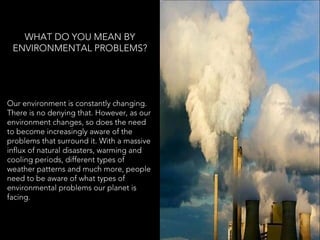
Our environment is constantly changing.
There is no denying that. However, as our
environment changes, so does the need
to become increasingly aware of the
problems that surround it. With a massive
influx of natural disasters, warming and
cooling periods, different types of
weather patterns and much more, people
need to be aware of what types of
environmental problems our planet is
facing.
15 MAJOR CURRENT
ENVIRONMENTAL PROBLEMS
1. Pollution
2. Global Warming
3. Overpopulation
4. Natural Resource Depletion
5. Waste Disposal
6. Climate Change
7. Loss of Biodiversity
8. Deforestation
9. Ocean Acidification
10. Ozone Layer Depletion
11. Acid Rain
12. Water Pollution
13. Urban Sprawl
14: Public Health Issues
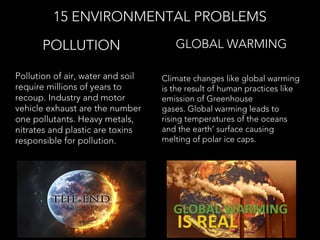
Pollution of air, water and soil
require millions of years to
recoup. Industry and motor
vehicle exhaust are the number
one pollutants. Heavy metals,
nitrates and plastic are toxins
responsible for pollution.
POLLUTION
15 ENVIRONMENTAL PROBLEMS
Climate changes like global warming
is the result of human practices like
emission of Greenhouse
gases. Global warming leads to
rising temperatures of the oceans
and the earth’ surface causing
melting of polar ice caps.
GLOBAL WARMING
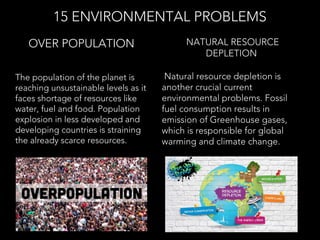
The population of the planet is
reaching unsustainable levels as it
faces shortage of resources like
water, fuel and food. Population
explosion in less developed and
developing countries is straining
the already scarce resources.
OVER POPULATION
15 ENVIRONMENTAL PROBLEMS
 Natural resource depletion is
another crucial current
environmental problems. Fossil
fuel consumption results in
emission of Greenhouse gases,
which is responsible for global
warming and climate change.
 NATURAL RESOURCE
DEPLETION
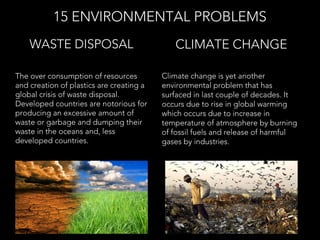
The over consumption of resources
and creation of plastics are creating a
global crisis of waste disposal.
Developed countries are notorious for
producing an excessive amount of
waste or garbage and dumping their
waste in the oceans and, less
developed countries.
WASTE DISPOSAL
15 ENVIRONMENTAL PROBLEMS
Climate change is yet another
environmental problem that has
surfaced in last couple of decades. It
occurs due to rise in global warming
which occurs due to increase in
temperature of atmosphere by burning
of fossil fuels and release of harmful
gases by industries.
CLIMATE CHANGE
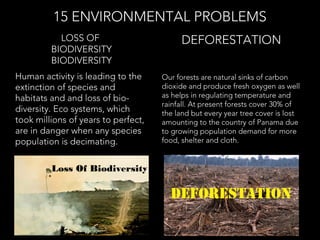
Human activity is leading to the
extinction of species and
habitats and and loss of bio-
diversity. Eco systems, which
took millions of years to perfect,
are in danger when any species
population is decimating.
LOSS OF
BIODIVERSITY
BIODIVERSITY
15 ENVIRONMENTAL PROBLEMS
Our forests are natural sinks of carbon
dioxide and produce fresh oxygen as well
as helps in regulating temperature and
rainfall. At present forests cover 30% of
the land but every year tree cover is lost
amounting to the country of Panama due
to growing population demand for more
food, shelter and cloth.
DEFORESTATION
Loss Of Biodiversity
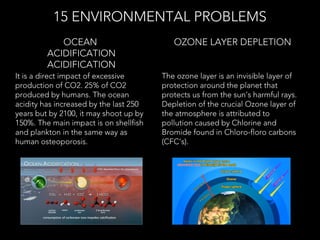
It is a direct impact of excessive
production of CO2. 25% of CO2
produced by humans. The ocean
acidity has increased by the last 250
years but by 2100, it may shoot up by
150%. The main impact is on shellfish
and plankton in the same way as
human osteoporosis.
OCEAN
ACIDIFICATION
ACIDIFICATION
15 ENVIRONMENTAL PROBLEMS
The ozone layer is an invisible layer of
protection around the planet that
protects us from the sun’s harmful rays.
Depletion of the crucial Ozone layer of
the atmosphere is attributed to
pollution caused by Chlorine and
Bromide found in Chloro-floro carbons
(CFC’s).
 OZONE LAYER DEPLETION
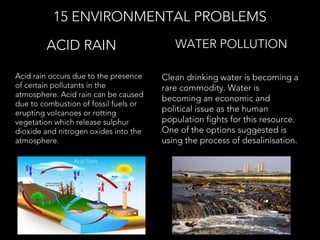
Acid rain occurs due to the presence
of certain pollutants in the
atmosphere. Acid rain can be caused
due to combustion of fossil fuels or
erupting volcanoes or rotting
vegetation which release sulphur
dioxide and nitrogen oxides into the
atmosphere. 
ACID RAIN
15 ENVIRONMENTAL PROBLEMS
Clean drinking water is becoming a
rare commodity. Water is
becoming an economic and
political issue as the human
population fights for this resource.
One of the options suggested is
using the process of desalinisation. 
WATER POLLUTION
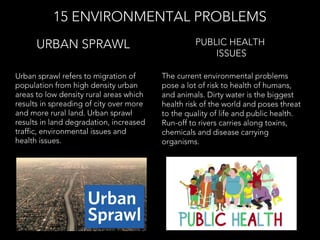
Urban sprawl refers to migration of
population from high density urban
areas to low density rural areas which
results in spreading of city over more
and more rural land. Urban sprawl
results in land degradation, increased
traffic, environmental issues and
health issues.
 URBAN SPRAWL
15 ENVIRONMENTAL PROBLEMS
The current environmental problems
pose a lot of risk to health of humans,
and animals. Dirty water is the biggest
health risk of the world and poses threat
to the quality of life and public health.
Run-off to rivers carries along toxins,
chemicals and disease carrying
organisms. 
PUBLIC HEALTH
ISSUES
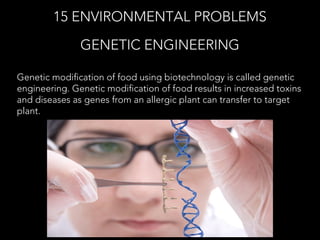
Genetic modification of food using biotechnology is called genetic
engineering. Genetic modification of food results in increased toxins
and diseases as genes from an allergic plant can transfer to target
plant.
GENETIC ENGINEERING
15 ENVIRONMENTAL PROBLEMS
Presented By
THANK YOU

Environmental Problems

  • 1.
  • 2.
    WHAT DO YOUMEAN BY ENVIRONMENTAL PROBLEMS? Our environment is constantly changing. There is no denying that. However, as our environment changes, so does the need to become increasingly aware of the problems that surround it. With a massive influx of natural disasters, warming and cooling periods, different types of weather patterns and much more, people need to be aware of what types of environmental problems our planet is facing.
  • 3.
    15 MAJOR CURRENT ENVIRONMENTALPROBLEMS 1. Pollution 2. Global Warming 3. Overpopulation 4. Natural Resource Depletion 5. Waste Disposal 6. Climate Change 7. Loss of Biodiversity 8. Deforestation 9. Ocean Acidification 10. Ozone Layer Depletion 11. Acid Rain 12. Water Pollution 13. Urban Sprawl 14: Public Health Issues
  • 4.
    Pollution of air,water and soil require millions of years to recoup. Industry and motor vehicle exhaust are the number one pollutants. Heavy metals, nitrates and plastic are toxins responsible for pollution. POLLUTION 15 ENVIRONMENTAL PROBLEMS Climate changes like global warming is the result of human practices like emission of Greenhouse gases. Global warming leads to rising temperatures of the oceans and the earth’ surface causing melting of polar ice caps. GLOBAL WARMING
  • 5.
    The population ofthe planet is reaching unsustainable levels as it faces shortage of resources like water, fuel and food. Population explosion in less developed and developing countries is straining the already scarce resources. OVER POPULATION 15 ENVIRONMENTAL PROBLEMS  Natural resource depletion is another crucial current environmental problems. Fossil fuel consumption results in emission of Greenhouse gases, which is responsible for global warming and climate change.  NATURAL RESOURCE DEPLETION
  • 6.
    The over consumptionof resources and creation of plastics are creating a global crisis of waste disposal. Developed countries are notorious for producing an excessive amount of waste or garbage and dumping their waste in the oceans and, less developed countries. WASTE DISPOSAL 15 ENVIRONMENTAL PROBLEMS Climate change is yet another environmental problem that has surfaced in last couple of decades. It occurs due to rise in global warming which occurs due to increase in temperature of atmosphere by burning of fossil fuels and release of harmful gases by industries. CLIMATE CHANGE
  • 7.
    Human activity isleading to the extinction of species and habitats and and loss of bio- diversity. Eco systems, which took millions of years to perfect, are in danger when any species population is decimating. LOSS OF BIODIVERSITY BIODIVERSITY 15 ENVIRONMENTAL PROBLEMS Our forests are natural sinks of carbon dioxide and produce fresh oxygen as well as helps in regulating temperature and rainfall. At present forests cover 30% of the land but every year tree cover is lost amounting to the country of Panama due to growing population demand for more food, shelter and cloth. DEFORESTATION Loss Of Biodiversity
  • 8.
    It is adirect impact of excessive production of CO2. 25% of CO2 produced by humans. The ocean acidity has increased by the last 250 years but by 2100, it may shoot up by 150%. The main impact is on shellfish and plankton in the same way as human osteoporosis. OCEAN ACIDIFICATION ACIDIFICATION 15 ENVIRONMENTAL PROBLEMS The ozone layer is an invisible layer of protection around the planet that protects us from the sun’s harmful rays. Depletion of the crucial Ozone layer of the atmosphere is attributed to pollution caused by Chlorine and Bromide found in Chloro-floro carbons (CFC’s).  OZONE LAYER DEPLETION
  • 9.
    Acid rain occursdue to the presence of certain pollutants in the atmosphere. Acid rain can be caused due to combustion of fossil fuels or erupting volcanoes or rotting vegetation which release sulphur dioxide and nitrogen oxides into the atmosphere.  ACID RAIN 15 ENVIRONMENTAL PROBLEMS Clean drinking water is becoming a rare commodity. Water is becoming an economic and political issue as the human population fights for this resource. One of the options suggested is using the process of desalinisation.  WATER POLLUTION
  • 10.
    Urban sprawl refersto migration of population from high density urban areas to low density rural areas which results in spreading of city over more and more rural land. Urban sprawl results in land degradation, increased traffic, environmental issues and health issues.  URBAN SPRAWL 15 ENVIRONMENTAL PROBLEMS The current environmental problems pose a lot of risk to health of humans, and animals. Dirty water is the biggest health risk of the world and poses threat to the quality of life and public health. Run-off to rivers carries along toxins, chemicals and disease carrying organisms.  PUBLIC HEALTH ISSUES
  • 11.
    Genetic modification offood using biotechnology is called genetic engineering. Genetic modification of food results in increased toxins and diseases as genes from an allergic plant can transfer to target plant. GENETIC ENGINEERING 15 ENVIRONMENTAL PROBLEMS
  • 12.