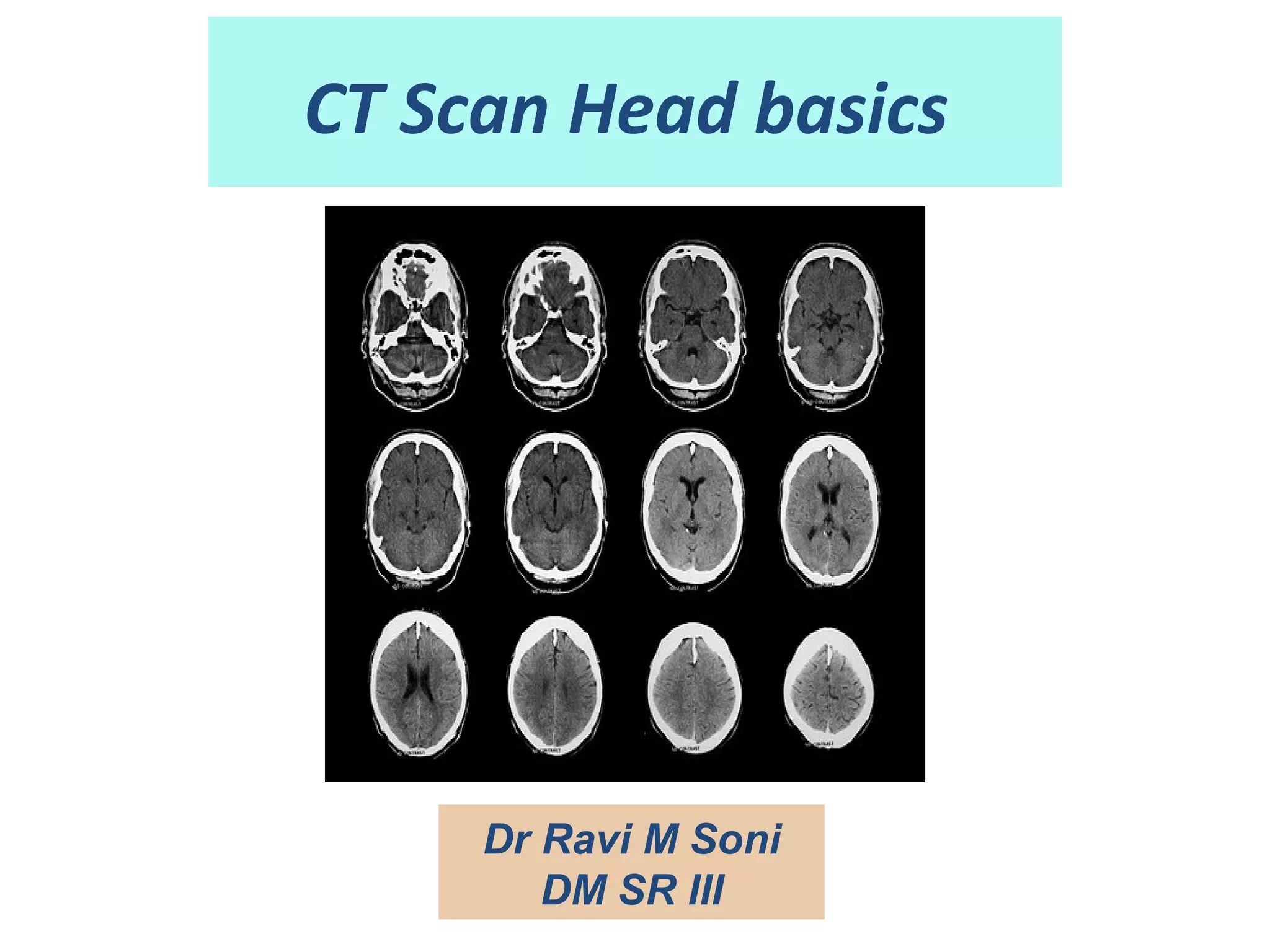
CT Scan Head basics
Dr Ravi M Soni
DM SR III
Contents:
•
BASIC PRINCIPLES OF CT SCAN
•
NORMAL NEUROANATOMY AS SEEN ON HEAD CT SCANS
•
ILLUSTRATIONS
•
BRIEF DESCRIPTION OF RELEVANT PATHOLOGIES
BASIC PRINCIPLES OF CT SCAN
HISTORY
•
Sir Godfrey hounsfield-1972
•
Nobel prize in 1979
•
Original scanners took approximately 6 minutes to
perform a rotation (one slice) and 20 minutes to
reconstruct. Despite many technological advances
since then, the principles remain the same.
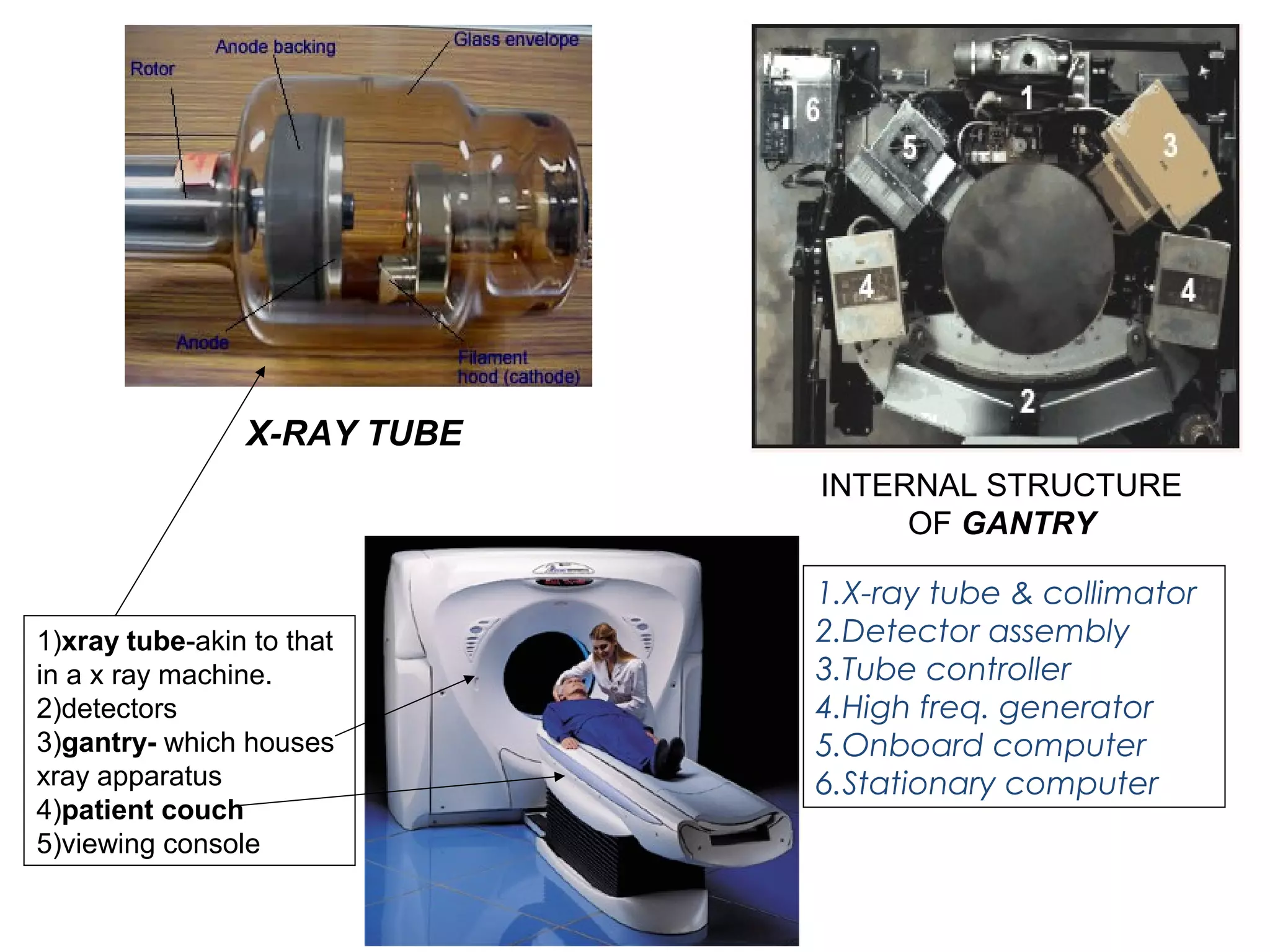
PARTS
1 ) Gantry- which houses X ray apparatus
2 ) X ray tube-akin to that in a X ray machine.
3 ) Detectors
4 ) Patient couch
5 ) Viewing console
X-RAY TUBE
1.X-ray tube & collimator
2.Detector assembly
3.Tube controller
4.High freq. generator
5.Onboard computer
6.Stationary computer
INTERNAL STRUCTURE
OF GANTRY
1)xray tube-akin to that
in a x ray machine.
2)detectors
3)gantry- which houses
xray apparatus
4)patient couch
5)viewing console
PRINCIPLE
1. Internal structure of an object can be
reconstructed from multiple projections of the
object.
2. Uses X rays applied in sequence of slices
across the organ
3. Images reconstructed from X ray
absorption data
4. X ray beam moves around the patient in a
circular path
5. CT scan provides a 3D display of the
intracranial anatomy built up from a vertical
series of transverse axial tomograms.
6. Each tomogram represents a horizontal
slice through the patient’s head.
Beam of light projected in two direction's,
detecting two different shadows
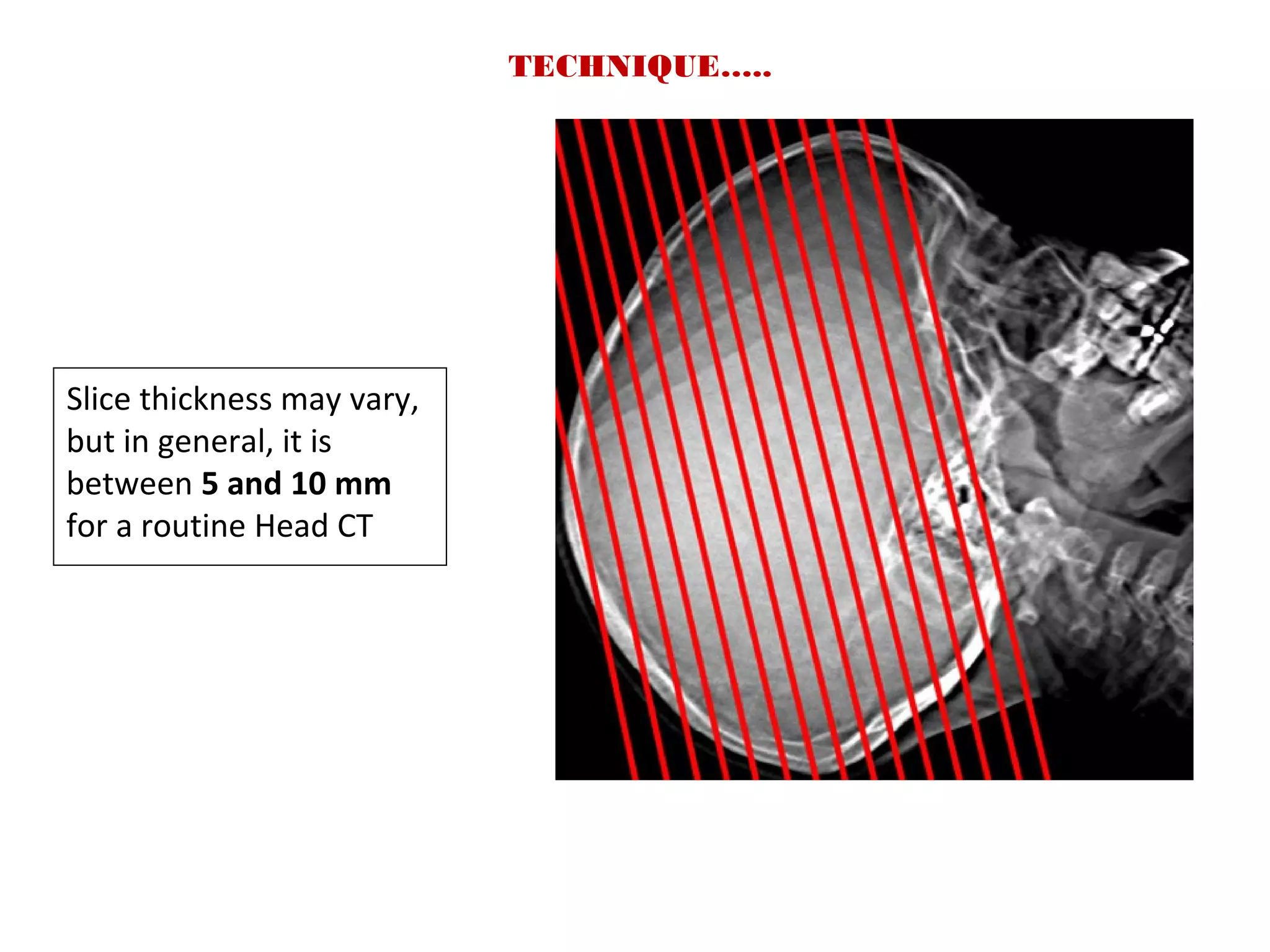
TECHNIQUE…..

Slice thickness may vary,
but in general, it is
between 5 and 10 mm
for a routine Head CT
9
Image Formation
Image
Attenuation
Receptor
Decoder
XRays
BASICS….
•
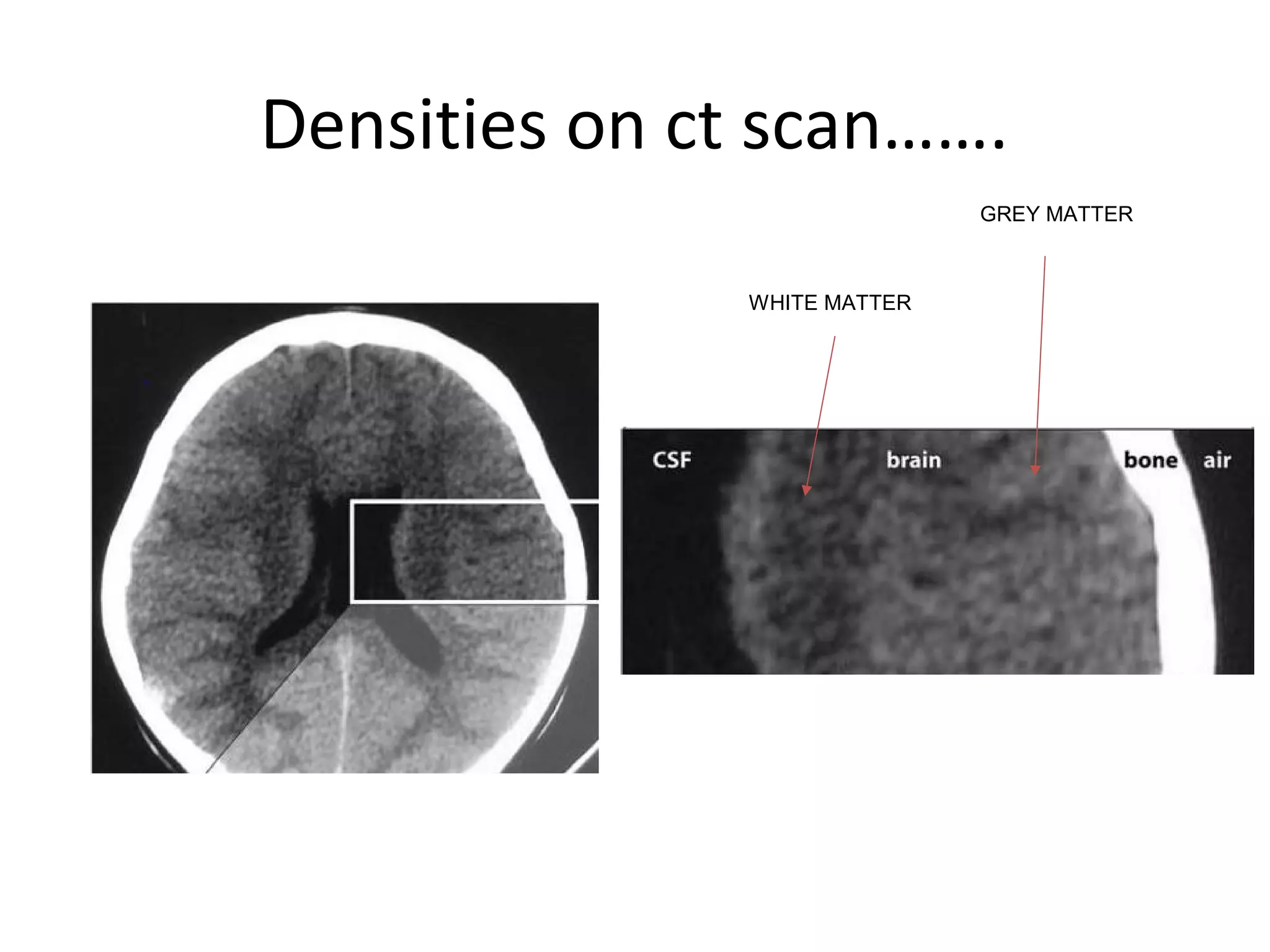
X-RAYS ARE ABSORBED TO DIFFERENT DEGREES BY DIFFERENT TISSUES
•
Always describe CT findings as densities-
isodense/hypodense/hyperdense.
•
Higher the density = whiter is the appearance
•
Lower the density = darker the appearance
•
Brain is the reference density
•
Anything of the density as brain= isodense*
•
Higher density than brain= hyperdense ( skull is the best example)
•
Anything darker (lower density) than brain= hypodense( CSF and air are
classical examples)
HOUNSFIELD UNITS
•
Hounsfield Unit (HU)- mean attenuation of x-rays by
different tissues.
•
Related to composition & nature of tissue
•
Represent the density of tissue
•
Also called as CT NUMBER
DESCRIPTION OF TISSUE APPROX. HU DENSITY
Air --- 1000 HYPODENSE
Fat ---70 HYPODENSE
Pure water 0 ISODENSE
CSF +8 ISODENSE
White matter +30 HYPERDENSE
Gray matter +45 HYPERDENSE
Blood +70 HYPERDENSE
Bone/calcification +1000 HYPERDENSE
Densities on ct scan…….
WHITE MATTER
GREY MATTER
Physiologic calcifications
•
Chorid plexus-rare before 10yrs
•
Basal ganglia-rare before 40ys
•
Pineal gland-common after 30 yr rare
before 10yr
•
Falx
•
Dentate nuclei
16
INDICATIONS
•
To diagnose neuro infections and their
complications
•
Stroke to distinguish infarct from hemorrhage
•
CT angio before thrombolysis
•
CT venogram for cerebral venous thrombosis(cvt)
•
Acute changes in mental status
•
Focal neurologic findings
•
Trauma
•
Suspected SAH
•
CNS tumors
NORMAL NEUROANATOMY AS SEEN ON HEAD CT
SCANS
18
BRAIN ANATOMY
19
20
21
Compartments
Supratentorial:
-Cerebrum
-Lateral and third vent.
Infratentorial
-Brain stem
-Cerebellum
-Fourth ventricle
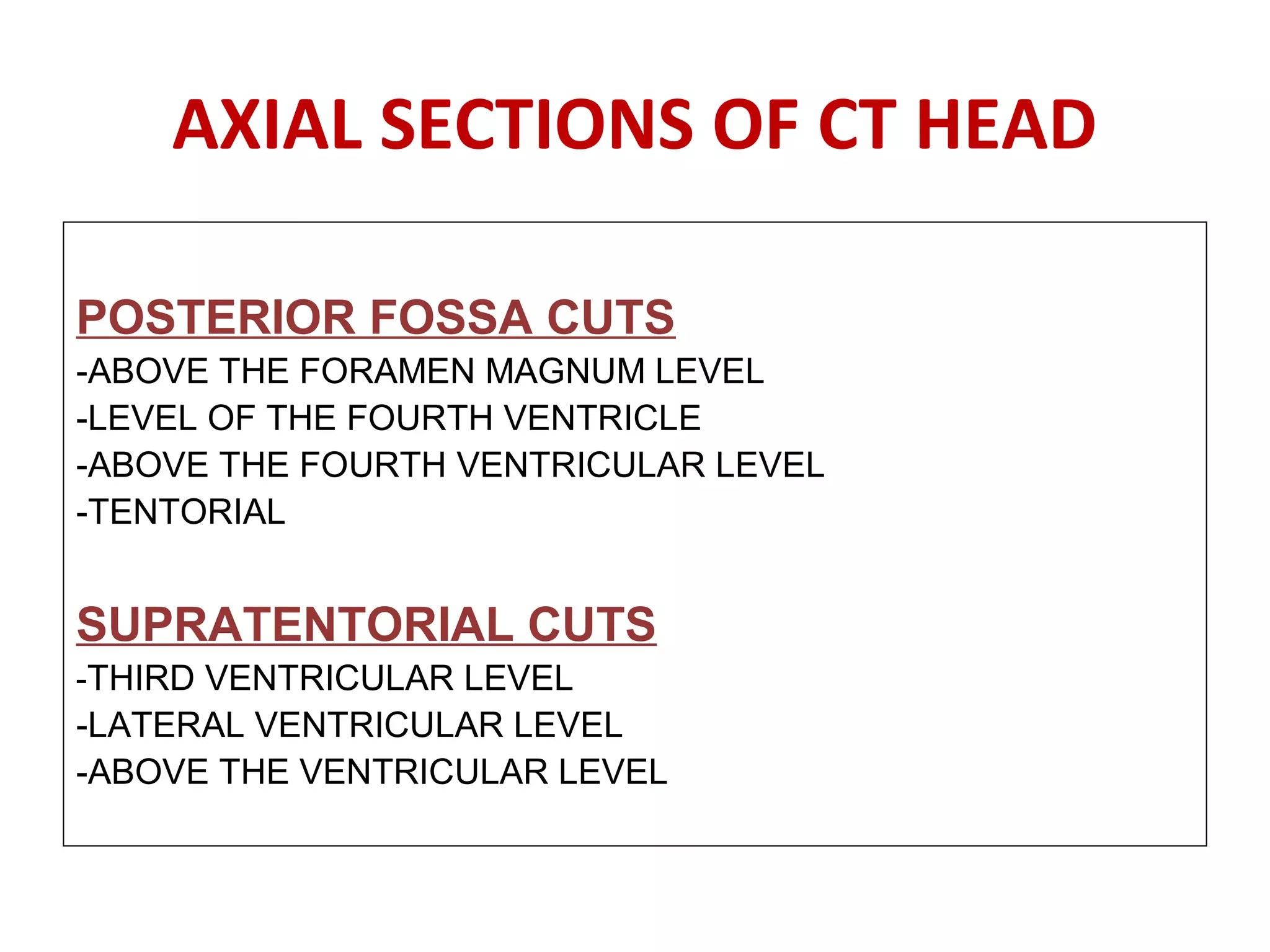
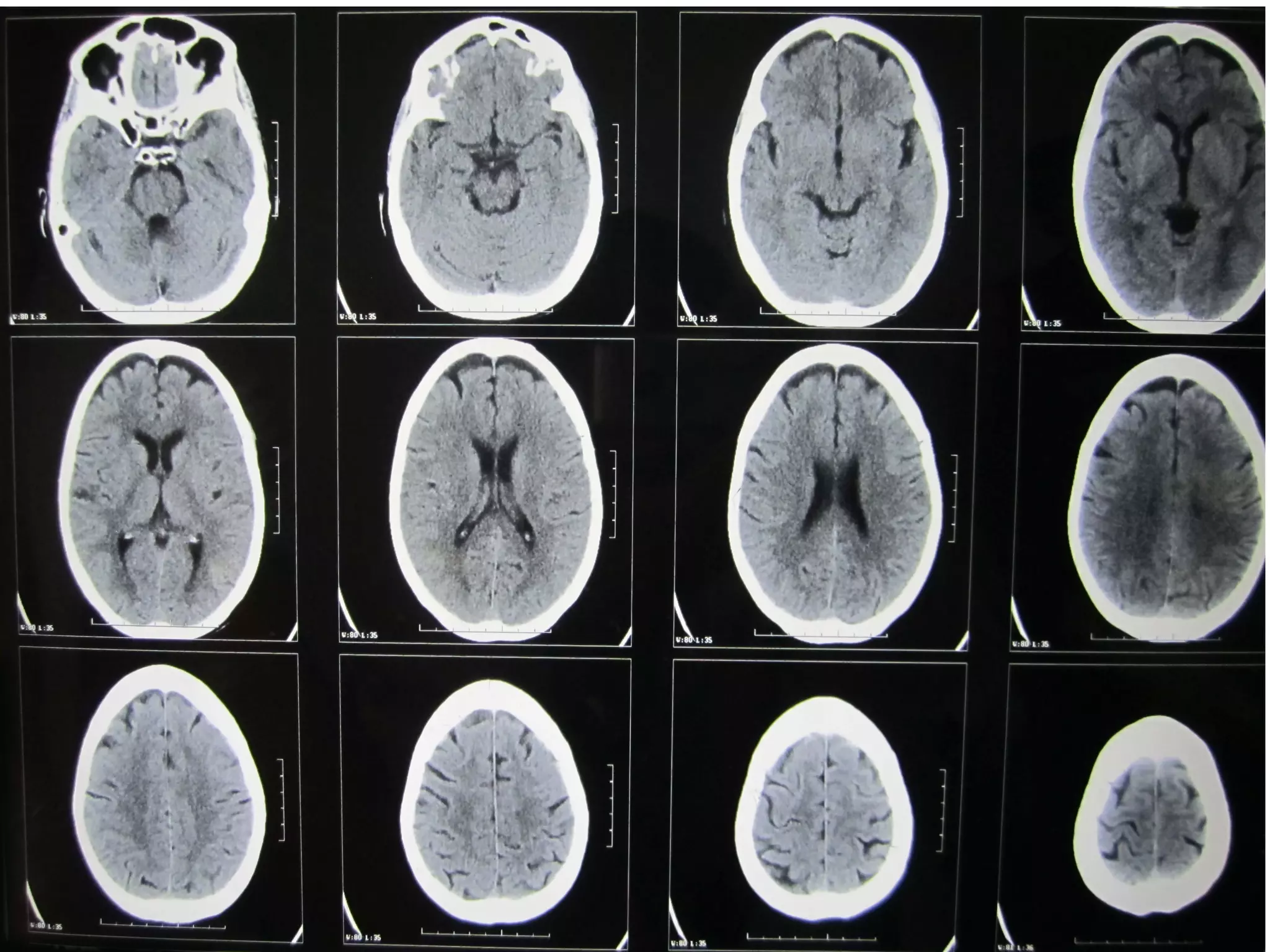
AXIAL SECTIONS OF CT HEAD
POSTERIOR FOSSA CUTS
-ABOVE THE FORAMEN MAGNUM LEVEL
-LEVEL OF THE FOURTH VENTRICLE
-ABOVE THE FOURTH VENTRICULAR LEVEL
-TENTORIAL
SUPRATENTORIAL CUTS
-THIRD VENTRICULAR LEVEL
-LATERAL VENTRICULAR LEVEL
-ABOVE THE VENTRICULAR LEVEL
Lateral View of Brain
NORMAL ANATOMY…….
A= ORBIT , B= SPHENOID SINUS , C= TEMPORAL LOBE, D=EXTERNAL AUDITORY CANAL
E= MASTOID AIR CELLS F= CEREBELLAR HEMISPHERES
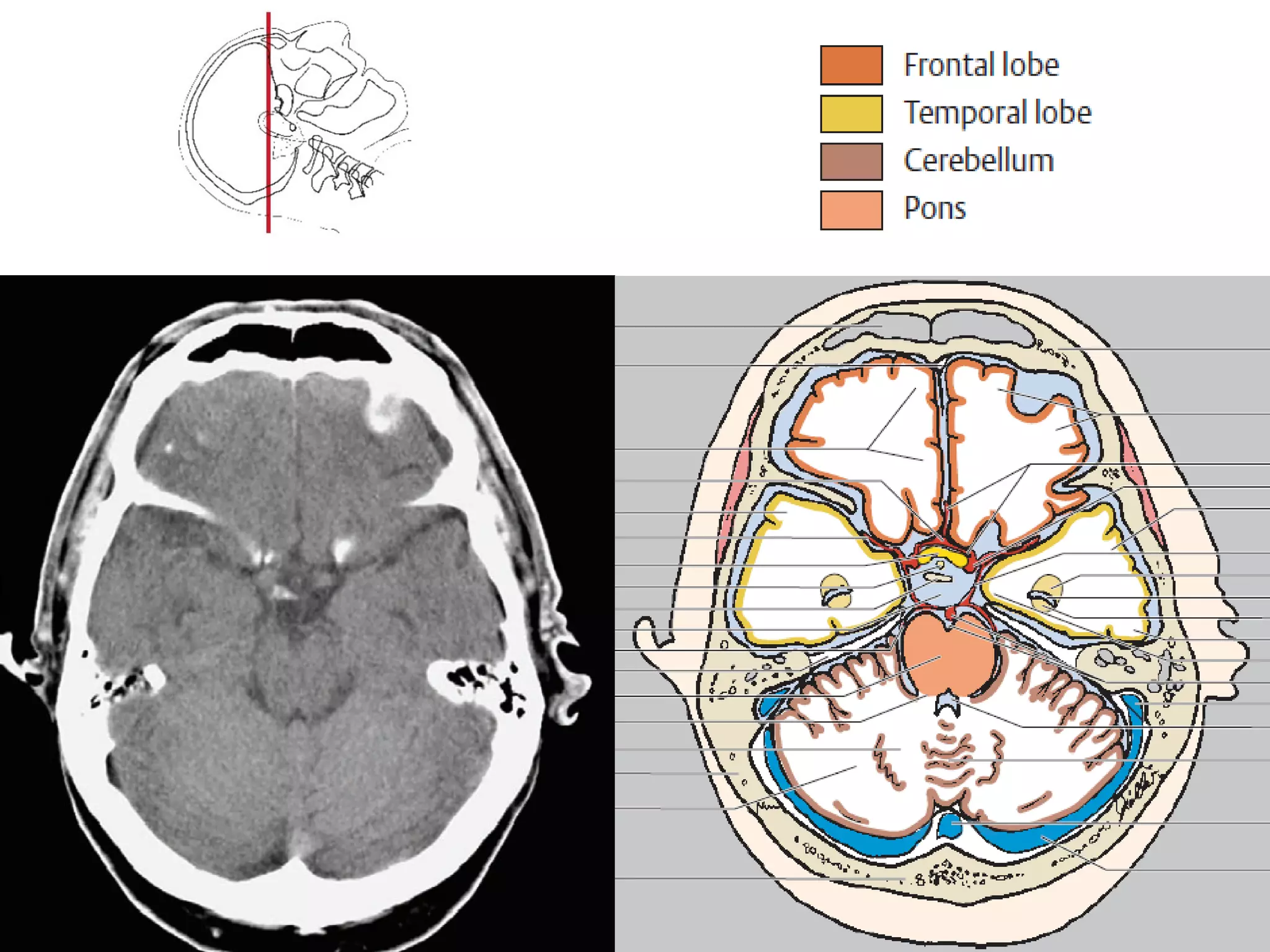
NORMAL ANATOMY…….
A=Frontal Lobe, B= Frontal Bone (Superior Surface of Orbital Part), C= Dorsum Sellae,
D=Basilar Artery E= Temporal Lobe F= Mastoid Air Cells G=Cerebellar Hemisphere
NORMAL ANATOMY…….
A=FRONTAL LOBE B= SYLVIAN FISSURE C=TEMPORAL LOBE
D=SUPRASELLAR CISTERN E=MIDBRAIN F=FOURTH VENTRICLE
G= CEREBELLAR HEMISPHERE
NORMAL ANATOMY……..
A=FALX CEREBRI B=FRONTAL LOBE C=ANTERIOR HORN LAT VENTRICLE
D=THIRD VENTRICLE E=QUADRIGEMINAL PLATE CISTERN F=CEREBELLUM
NORMAL ANATOMY……..
A=ANTERIOR HORN LAT VENTRICLE B=CAUDATE NUCLEUS C=ANT LIMB INT CAPSULE
D=GLOBUS PALLIDUS AND PUTAMEN E=POST LIMB INT CAPSULE F=THIRD VENTRICLE
G=QUADRIGEMINAL PLATE CISTERN H=CEREBELLAR VERMIS I=OCCIPITAL LOBE
NORMAL ANATOMY……..
A=GENU OF CORPUS CALLOSUM B=ANT HORN OF LATERAL VENTRICLE C=INT CAPSULE
D=THALAMUS E=PINEAL GLAND F=CHOROID PLEXUS G=STARAIGHT SINUS
NORMAL ANATOMY…….
A=FALX CEREBRI B=FRONTAL LOBE C=BODY OF LATERAL VENTRICLE
D=SPLENIUM OF CORPUS CALLOSUM E=PARIETAL LOBE F=OCCIPITAL LOBE
G=SUPERIOR SAGITTAL SINUS
NORMAL ANATOMY……..
A=FALX CEREBRI B=SULCUS C=GYRUS D=SUPERIOR SAGGITAL SINUS
1. Frontal bone
2. Superior frontal gyrus
3. Coronal suture
4. Precentral sulcus
5. Falx cerebri
6. Precentral gyrus
7. Parietal bone
8. Paracentral lobule
9. Central sulcus
10 . Postcentral gyrus
11 . Superior parietal lobule
12 . Precuneus
13 . Sagittal suture
14 . Superior saggital sinus
Frontal
bone
Falx cerebri
Central
sulcus
Parietal bone
Superior
saggital
sinus
1. Frontal bone
2. Superior saggital sinus
3. Superior frontal gyrus
4. Coronal suture
5. Falx cerebri
6. Middle frontal gyrus
7. Longitudinal cerebral fissure
8. Precentral sulcus
9. Precentral gyrus
10 . Central sulcus
11 . Cerebral white matter (centrum
semiovale)
12 . Postcentral gyrus
13 . Paracentral lobule
14 . Supramarginal gyrus
15 . Parietal bone
16 . Inferior parietal lobule
17 . Precuneus
18 . Parieto-occipital sulcus
19 . Occipital bone
40
CORPUS CALLOSUM
CORONA RADIATA
2 Frontal sinus
5 Falx cerebri
6 Caudate nucleus (head)
9 Corpus callosum (genu)
11 Lateral ventricle
12 Third ventricle
13 Central sulcus
14 Precentral gyrus
15 Fornix
16 Postcentral gyrus
17 Interventricular foramen
(foramen of Monro)
18 Lateral sulcus
19 Claustrum
20 insular Cistern
22 Insula
23 Thalamus
25 Pineal gland
31 Vermis of cerebellum
32 Lateral ventricle (trigone
with choroid plexus)
33 Straight sinus
34 Middle temporal gyrus
37 Superior sagittal sinus
38 Occipital gyri
2 Frontal sinus
3 Falx cerebri
7 Corpus callosum (genu)
13 External capsule
14 Putamen
15 Septum verum
(precommissural septum)
16 Cistern of lateral cerebral fossa
(insular cistern)
17 Hypothalamus
19 Third ventricle
20 Claustrum
21 Superior temporal gyrus
22 Extreme capsule
27 Hippocampus
28 Thalamus
30 Pineal gland (calcified)
31 Tentorium cerebelli
32 Quadrigeminal plate
33 Vermis of cerebellum
34 Quadrigeminal
and ambient cisterns
35 Straight sinus
37 Superior sagittal sinus
38 Lateral ventricle (trigone)
1 Frontal sinus
2 Frontal bone
3 Falx cerebri
4 Orbital gyri
5 Straight gyrus
6 Anterior cerebral artery
7 Anterior communicating artery
8 Internal carotid artery
9 Superior temporal gyrus
10Mi ddle temporal gyrus
11 Middle cerebral artery
12 Posterior communicating
artery
13 Optic chiasm
14 Amygdaloid body
15 Pituitary stalk
16 Lateral ventricle (temporal
horn)
17 Dorsum sellae
18 Hippocampus
19 Pentagon of basal cisterns
20Infe rior temporal gyrus
21 Posterior cerebral artery
22 Parahippocampal gyrus
23 Tentorium cerebelli
24 Basilar artery and basal sulcus
25 Pons
26 Sigmoid sinus
27 Cerebellar peduncle (middle)
28 Fourth ventricle
29 Dentate nucleus
30V ermis of cerebellum (superior
part)
31 Temporal bone
32 Confluence of the sinuses
33 Cerebellar hemisphere
34 Transverse sinus
35 Occipital bone
1 Frontal bone
2 Frontal sinus
3 Straight gyrus
4 Temporal muscle
5 Orbital gyri
6 Roof of orbit
7 Superior temporal gyrus
8 Optic nerve
9 Internal carotid artery
10Pi tuitary gland
11 Middle temporal gyrus
12 Dorsum sellae
13 Parahippocampal gyrus
14 Basilar artery
15 Lateral ventricle (temporal
horn)
16 Inferior temporal gyrus
17 Trigeminal nerve (V)
18 Trochlear nerve
19 Pontine cistern
20Mas toid antrum
21 Tentorium cerebelli
22 Fourth ventricle
23 Pons
24 Temporal bone
25 Cerebellar peduncle
26 Vermis of cerebellum
27 Sigmoid sinus
28 Cerebellar hemisphere
29 Dentate nucleus
30Occip ital sinus
31 Occipital bone
32 Semispinalis capitis muscle
1 Nasal bone
2 Eyeball
3 Medial rectus muscle
4 Nasal septum
5 Ethmoidal cells
6 Zygomatic bone
7 Pterygopalatine fossa
8 Inferior rectus muscle
9 Occipital bone (basilar part)
10T emporal muscle
11 Foramen ovale with
mandibular nerve
12 Sphenoidal sinus
13 Temporal bone (apex of the
petrous pyramid)
14 Zygomatic arch
15 Internal carotid artery
16 Masseter muscle
17 Jugular vein (bulb)
18 Lateral pterygoid muscle
(superior head)
19 External auditory meatus
20Auditor y tube
21 Medulla oblongata
22 Head of mandible
23 Mastoid process
24 Foramen lacerum
25 Sigmoid sinus
26 Vertebral arteries
27 Petro-occipital fissure
28 Flocculus
29 Cerebellar tonsil
30Dig astric muscle
31 Splenius capitis muscle
32 Cerebellar hemisphere (caudal lobe)
33 Rectus capitis posterior minor muscle
34 Cisterna magna (posterior cerebellomedullary
cistern)
35 Rectus capitis posterior major muscle
36 Occipital bone
37 Semispinalis capitis muscle
38 Trapezius muscle
Cerebellar
hemisphere
medulla
Cisterna
magna
eye ball
53
Pathology
•
Trauma: -EDH
-SDH
-SAH
-ICH
-IVH
-Contusion: salt and pepper
•
Tumours
•
Infection:-Abscess, Granulomas
•
Vascular :-Haemorrhagic and ischemic
•
Congenital:- Hydrocephalous, encephalocoel
•
Degenerative:- Atrophy and NPH
54
55
56
57
58
59
60
Extradural hematoma
Convex shape
Subdural hematoma
Cresent shape
Skull fracture
62SDH & ICH
63
ICH
Infarcts
Anterior cerebral artery infarct
Middle cerebral artery infarct
Posterior cerebral artery infarct
Hyper dense MCA sign
Internal cerebral artery infarct
ACA+MCA
hemorrhage
Intra parenchymal hemorrhage
in putamen Sub arachnoid hemorrhage
hyperdensities in sylvian fissure,basal cystern
Neuro infections
•
Bacterial meningitis
–
Radiological signs
•
Meningeal enhancement
•
Cerebral edema
•
Complications
–
Abscess stages
•
Sub dural abscess,
•
Epidural abscess
Bacterial meningitis
Indicatations for ct Head
before lumbar puncture-
to look for obstructive hydrocephalus-to prevent herniation
to conform meningeal involvement—by meningeal
enhancement
Meningitis complications suggested by seizures, altered
sensorium, focal deficits
Encephalitis- cerebral edema is seen
others
cerebral abscess
epidural/sub dural empyema
arteritis leading to infarct
hydrocephalus
seen well effaced
Gyri and sulci
Normal parenchyma
cerebral edema
hydrocephalus
•
Sub dural effusion
•
cerebral abscess
stages
Early cerebritis
early capsule, thin rim
Late capsular, thick rim
Multi loculated
Late cerebritis
d/d for multiple ring enhancing
lesions
Tuberculoma
Neurocysticerosis
CNS crptococcosis
Metastasis
Abscess (also cerebritis)
Glioblastoma, Granuloma
Infarct (esp. Basal ganglia)
Contusion (rare)
AIDS (Toxoplasmosis, etc.)
Lymphoma (common in AIDS )
Neurosarcoidosis
Demyelination (active)
Resolving hematoma, Radiation change (necrosis)
TUBERCULOMA
•
Non contrast ct normal or may show
complications
•
On contrast basal enhancing exudates,meningeal
anhancement, tubeculomas with ring
enhancement,ependimitis
Basal exudate enhancement
Tuberculomas with perilesional edema
Coalising tuberculomas
NEUROCYSTICERCOSIS
•
Stages
vesicular stage- live stage
only hypo dense lesion with out perilesional edema/ring
enhancement
colloidal stage- perilesional edema with ring enhancement
granular stage- scolex gets calcified resulting in central hyper density
nodular stage- entire lesion gets calcified nodular stage-
vesicular stage- colloidal stage- granular stage- nodular stage-
•
Tuberculous granuloma neurocysticercosis
>20 mm size <20mm
large perilesional edema usually small area
irregular margine regular margin
Coalising lesions noncoalising
These findings are not pathognomic,above signs can be seen viceversa
neurocysticercosis
TUBERCULOMAs
central dot sign
Stary sky
78
CT scan of the brain showing
early signs of a left middle
cerebral artery ischaemic CVE.
In this picture only loss of
definition of the gyri are seen
clearly (look at cortical surface
under red arrow and compare to
other side)
Acute Infarct
79
MCA infarction: on CT an area
of hypoattenuation appearing
within six hours is highly specific
for irreversible ischemic brain
damage
Acute Infarct
80
81
82
83
King George's Medical University UP, Lucknow
INDIA

CT Scan Head basics

  • 1.
    CT Scan Headbasics Dr Ravi M Soni DM SR III
  • 2.
    Contents: • BASIC PRINCIPLES OFCT SCAN • NORMAL NEUROANATOMY AS SEEN ON HEAD CT SCANS • ILLUSTRATIONS • BRIEF DESCRIPTION OF RELEVANT PATHOLOGIES
  • 3.
  • 4.
    HISTORY • Sir Godfrey hounsfield-1972 • Nobelprize in 1979 • Original scanners took approximately 6 minutes to perform a rotation (one slice) and 20 minutes to reconstruct. Despite many technological advances since then, the principles remain the same.
  • 5.
    PARTS 1 ) Gantry-which houses X ray apparatus 2 ) X ray tube-akin to that in a X ray machine. 3 ) Detectors 4 ) Patient couch 5 ) Viewing console
  • 6.
    X-RAY TUBE 1.X-ray tube& collimator 2.Detector assembly 3.Tube controller 4.High freq. generator 5.Onboard computer 6.Stationary computer INTERNAL STRUCTURE OF GANTRY 1)xray tube-akin to that in a x ray machine. 2)detectors 3)gantry- which houses xray apparatus 4)patient couch 5)viewing console
  • 7.
    PRINCIPLE 1. Internal structureof an object can be reconstructed from multiple projections of the object. 2. Uses X rays applied in sequence of slices across the organ 3. Images reconstructed from X ray absorption data 4. X ray beam moves around the patient in a circular path 5. CT scan provides a 3D display of the intracranial anatomy built up from a vertical series of transverse axial tomograms. 6. Each tomogram represents a horizontal slice through the patient’s head. Beam of light projected in two direction's, detecting two different shadows
  • 8.
    TECHNIQUE…..  Slice thickness mayvary, but in general, it is between 5 and 10 mm for a routine Head CT
  • 9.
  • 11.
    BASICS…. • X-RAYS ARE ABSORBEDTO DIFFERENT DEGREES BY DIFFERENT TISSUES • Always describe CT findings as densities- isodense/hypodense/hyperdense. • Higher the density = whiter is the appearance • Lower the density = darker the appearance • Brain is the reference density • Anything of the density as brain= isodense* • Higher density than brain= hyperdense ( skull is the best example) • Anything darker (lower density) than brain= hypodense( CSF and air are classical examples)
  • 12.
    HOUNSFIELD UNITS • Hounsfield Unit(HU)- mean attenuation of x-rays by different tissues. • Related to composition & nature of tissue • Represent the density of tissue • Also called as CT NUMBER
  • 13.
    DESCRIPTION OF TISSUEAPPROX. HU DENSITY Air --- 1000 HYPODENSE Fat ---70 HYPODENSE Pure water 0 ISODENSE CSF +8 ISODENSE White matter +30 HYPERDENSE Gray matter +45 HYPERDENSE Blood +70 HYPERDENSE Bone/calcification +1000 HYPERDENSE
  • 14.
    Densities on ctscan……. WHITE MATTER GREY MATTER
  • 15.
    Physiologic calcifications • Chorid plexus-rarebefore 10yrs • Basal ganglia-rare before 40ys • Pineal gland-common after 30 yr rare before 10yr • Falx • Dentate nuclei
  • 16.
    16 INDICATIONS • To diagnose neuroinfections and their complications • Stroke to distinguish infarct from hemorrhage • CT angio before thrombolysis • CT venogram for cerebral venous thrombosis(cvt) • Acute changes in mental status • Focal neurologic findings • Trauma • Suspected SAH • CNS tumors
  • 17.
    NORMAL NEUROANATOMY ASSEEN ON HEAD CT SCANS
  • 18.
  • 19.
  • 20.
  • 21.
    21 Compartments Supratentorial: -Cerebrum -Lateral and thirdvent. Infratentorial -Brain stem -Cerebellum -Fourth ventricle
  • 22.
    AXIAL SECTIONS OFCT HEAD POSTERIOR FOSSA CUTS -ABOVE THE FORAMEN MAGNUM LEVEL -LEVEL OF THE FOURTH VENTRICLE -ABOVE THE FOURTH VENTRICULAR LEVEL -TENTORIAL SUPRATENTORIAL CUTS -THIRD VENTRICULAR LEVEL -LATERAL VENTRICULAR LEVEL -ABOVE THE VENTRICULAR LEVEL
  • 23.
  • 24.
    NORMAL ANATOMY……. A= ORBIT, B= SPHENOID SINUS , C= TEMPORAL LOBE, D=EXTERNAL AUDITORY CANAL E= MASTOID AIR CELLS F= CEREBELLAR HEMISPHERES
  • 25.
    NORMAL ANATOMY……. A=Frontal Lobe,B= Frontal Bone (Superior Surface of Orbital Part), C= Dorsum Sellae, D=Basilar Artery E= Temporal Lobe F= Mastoid Air Cells G=Cerebellar Hemisphere
  • 26.
    NORMAL ANATOMY……. A=FRONTAL LOBEB= SYLVIAN FISSURE C=TEMPORAL LOBE D=SUPRASELLAR CISTERN E=MIDBRAIN F=FOURTH VENTRICLE G= CEREBELLAR HEMISPHERE
  • 27.
    NORMAL ANATOMY…….. A=FALX CEREBRIB=FRONTAL LOBE C=ANTERIOR HORN LAT VENTRICLE D=THIRD VENTRICLE E=QUADRIGEMINAL PLATE CISTERN F=CEREBELLUM
  • 28.
    NORMAL ANATOMY…….. A=ANTERIOR HORNLAT VENTRICLE B=CAUDATE NUCLEUS C=ANT LIMB INT CAPSULE D=GLOBUS PALLIDUS AND PUTAMEN E=POST LIMB INT CAPSULE F=THIRD VENTRICLE G=QUADRIGEMINAL PLATE CISTERN H=CEREBELLAR VERMIS I=OCCIPITAL LOBE
  • 29.
    NORMAL ANATOMY…….. A=GENU OFCORPUS CALLOSUM B=ANT HORN OF LATERAL VENTRICLE C=INT CAPSULE D=THALAMUS E=PINEAL GLAND F=CHOROID PLEXUS G=STARAIGHT SINUS
  • 30.
    NORMAL ANATOMY……. A=FALX CEREBRIB=FRONTAL LOBE C=BODY OF LATERAL VENTRICLE D=SPLENIUM OF CORPUS CALLOSUM E=PARIETAL LOBE F=OCCIPITAL LOBE G=SUPERIOR SAGITTAL SINUS
  • 31.
    NORMAL ANATOMY…….. A=FALX CEREBRIB=SULCUS C=GYRUS D=SUPERIOR SAGGITAL SINUS
  • 36.
    1. Frontal bone 2.Superior frontal gyrus 3. Coronal suture 4. Precentral sulcus 5. Falx cerebri 6. Precentral gyrus 7. Parietal bone 8. Paracentral lobule 9. Central sulcus 10 . Postcentral gyrus 11 . Superior parietal lobule 12 . Precuneus 13 . Sagittal suture 14 . Superior saggital sinus
  • 37.
  • 39.
    1. Frontal bone 2.Superior saggital sinus 3. Superior frontal gyrus 4. Coronal suture 5. Falx cerebri 6. Middle frontal gyrus 7. Longitudinal cerebral fissure 8. Precentral sulcus 9. Precentral gyrus 10 . Central sulcus 11 . Cerebral white matter (centrum semiovale) 12 . Postcentral gyrus 13 . Paracentral lobule 14 . Supramarginal gyrus 15 . Parietal bone 16 . Inferior parietal lobule 17 . Precuneus 18 . Parieto-occipital sulcus 19 . Occipital bone
  • 40.
  • 41.
  • 43.
    2 Frontal sinus 5Falx cerebri 6 Caudate nucleus (head) 9 Corpus callosum (genu) 11 Lateral ventricle 12 Third ventricle 13 Central sulcus 14 Precentral gyrus 15 Fornix 16 Postcentral gyrus 17 Interventricular foramen (foramen of Monro) 18 Lateral sulcus 19 Claustrum 20 insular Cistern 22 Insula 23 Thalamus 25 Pineal gland 31 Vermis of cerebellum 32 Lateral ventricle (trigone with choroid plexus) 33 Straight sinus 34 Middle temporal gyrus 37 Superior sagittal sinus 38 Occipital gyri
  • 45.
    2 Frontal sinus 3Falx cerebri 7 Corpus callosum (genu) 13 External capsule 14 Putamen 15 Septum verum (precommissural septum) 16 Cistern of lateral cerebral fossa (insular cistern) 17 Hypothalamus 19 Third ventricle 20 Claustrum 21 Superior temporal gyrus 22 Extreme capsule 27 Hippocampus 28 Thalamus 30 Pineal gland (calcified) 31 Tentorium cerebelli 32 Quadrigeminal plate 33 Vermis of cerebellum 34 Quadrigeminal and ambient cisterns 35 Straight sinus 37 Superior sagittal sinus 38 Lateral ventricle (trigone)
  • 47.
    1 Frontal sinus 2Frontal bone 3 Falx cerebri 4 Orbital gyri 5 Straight gyrus 6 Anterior cerebral artery 7 Anterior communicating artery 8 Internal carotid artery 9 Superior temporal gyrus 10Mi ddle temporal gyrus 11 Middle cerebral artery 12 Posterior communicating artery 13 Optic chiasm 14 Amygdaloid body 15 Pituitary stalk 16 Lateral ventricle (temporal horn) 17 Dorsum sellae 18 Hippocampus 19 Pentagon of basal cisterns 20Infe rior temporal gyrus 21 Posterior cerebral artery 22 Parahippocampal gyrus 23 Tentorium cerebelli 24 Basilar artery and basal sulcus 25 Pons 26 Sigmoid sinus 27 Cerebellar peduncle (middle) 28 Fourth ventricle 29 Dentate nucleus 30V ermis of cerebellum (superior part) 31 Temporal bone 32 Confluence of the sinuses 33 Cerebellar hemisphere 34 Transverse sinus 35 Occipital bone
  • 49.
    1 Frontal bone 2Frontal sinus 3 Straight gyrus 4 Temporal muscle 5 Orbital gyri 6 Roof of orbit 7 Superior temporal gyrus 8 Optic nerve 9 Internal carotid artery 10Pi tuitary gland 11 Middle temporal gyrus 12 Dorsum sellae 13 Parahippocampal gyrus 14 Basilar artery 15 Lateral ventricle (temporal horn) 16 Inferior temporal gyrus 17 Trigeminal nerve (V) 18 Trochlear nerve 19 Pontine cistern 20Mas toid antrum 21 Tentorium cerebelli 22 Fourth ventricle 23 Pons 24 Temporal bone 25 Cerebellar peduncle 26 Vermis of cerebellum 27 Sigmoid sinus 28 Cerebellar hemisphere 29 Dentate nucleus 30Occip ital sinus 31 Occipital bone 32 Semispinalis capitis muscle
  • 51.
    1 Nasal bone 2Eyeball 3 Medial rectus muscle 4 Nasal septum 5 Ethmoidal cells 6 Zygomatic bone 7 Pterygopalatine fossa 8 Inferior rectus muscle 9 Occipital bone (basilar part) 10T emporal muscle 11 Foramen ovale with mandibular nerve 12 Sphenoidal sinus 13 Temporal bone (apex of the petrous pyramid) 14 Zygomatic arch 15 Internal carotid artery 16 Masseter muscle 17 Jugular vein (bulb) 18 Lateral pterygoid muscle (superior head) 19 External auditory meatus 20Auditor y tube 21 Medulla oblongata 22 Head of mandible 23 Mastoid process 24 Foramen lacerum 25 Sigmoid sinus 26 Vertebral arteries 27 Petro-occipital fissure 28 Flocculus 29 Cerebellar tonsil 30Dig astric muscle 31 Splenius capitis muscle 32 Cerebellar hemisphere (caudal lobe) 33 Rectus capitis posterior minor muscle 34 Cisterna magna (posterior cerebellomedullary cistern) 35 Rectus capitis posterior major muscle 36 Occipital bone 37 Semispinalis capitis muscle 38 Trapezius muscle
  • 52.
  • 53.
    53 Pathology • Trauma: -EDH -SDH -SAH -ICH -IVH -Contusion: saltand pepper • Tumours • Infection:-Abscess, Granulomas • Vascular :-Haemorrhagic and ischemic • Congenital:- Hydrocephalous, encephalocoel • Degenerative:- Atrophy and NPH
  • 54.
  • 55.
  • 56.
  • 57.
  • 58.
  • 59.
  • 60.
  • 61.
    Extradural hematoma Convex shape Subduralhematoma Cresent shape Skull fracture
  • 62.
  • 63.
  • 64.
    Infarcts Anterior cerebral arteryinfarct Middle cerebral artery infarct Posterior cerebral artery infarct Hyper dense MCA sign Internal cerebral artery infarct ACA+MCA
  • 65.
    hemorrhage Intra parenchymal hemorrhage inputamen Sub arachnoid hemorrhage hyperdensities in sylvian fissure,basal cystern
  • 66.
    Neuro infections • Bacterial meningitis – Radiologicalsigns • Meningeal enhancement • Cerebral edema • Complications – Abscess stages • Sub dural abscess, • Epidural abscess
  • 67.
    Bacterial meningitis Indicatations forct Head before lumbar puncture- to look for obstructive hydrocephalus-to prevent herniation to conform meningeal involvement—by meningeal enhancement
  • 68.
    Meningitis complications suggestedby seizures, altered sensorium, focal deficits Encephalitis- cerebral edema is seen others cerebral abscess epidural/sub dural empyema arteritis leading to infarct hydrocephalus seen well effaced Gyri and sulci Normal parenchyma cerebral edema
  • 69.
  • 70.
  • 71.
    • cerebral abscess stages Early cerebritis earlycapsule, thin rim Late capsular, thick rim Multi loculated Late cerebritis
  • 72.
    d/d for multiplering enhancing lesions Tuberculoma Neurocysticerosis CNS crptococcosis Metastasis Abscess (also cerebritis) Glioblastoma, Granuloma Infarct (esp. Basal ganglia) Contusion (rare) AIDS (Toxoplasmosis, etc.) Lymphoma (common in AIDS ) Neurosarcoidosis Demyelination (active) Resolving hematoma, Radiation change (necrosis)
  • 73.
  • 74.
    • Non contrast ctnormal or may show complications • On contrast basal enhancing exudates,meningeal anhancement, tubeculomas with ring enhancement,ependimitis Basal exudate enhancement Tuberculomas with perilesional edema Coalising tuberculomas
  • 75.
  • 76.
    • Stages vesicular stage- livestage only hypo dense lesion with out perilesional edema/ring enhancement colloidal stage- perilesional edema with ring enhancement granular stage- scolex gets calcified resulting in central hyper density nodular stage- entire lesion gets calcified nodular stage- vesicular stage- colloidal stage- granular stage- nodular stage-
  • 77.
    • Tuberculous granuloma neurocysticercosis >20mm size <20mm large perilesional edema usually small area irregular margine regular margin Coalising lesions noncoalising These findings are not pathognomic,above signs can be seen viceversa neurocysticercosis TUBERCULOMAs central dot sign Stary sky
  • 78.
    78 CT scan ofthe brain showing early signs of a left middle cerebral artery ischaemic CVE. In this picture only loss of definition of the gyri are seen clearly (look at cortical surface under red arrow and compare to other side) Acute Infarct
  • 79.
    79 MCA infarction: onCT an area of hypoattenuation appearing within six hours is highly specific for irreversible ischemic brain damage Acute Infarct
  • 80.
  • 81.
  • 82.
  • 83.
  • 84.
    King George's MedicalUniversity UP, Lucknow INDIA