COMMUNITY ECOLOGYCOMMUNITY ECOLOGY
Department of Botany.
G.D. Rungta college of science & technology
SynopSiS-SynopSiS-
• Introduction
• Characteristics
• Size & Structure
• Characters Used In The
Study Of Community
• Classification
• Ecotone & Edge Effect
• Biological Spectrum
• INTRODUCTION
Environment is made up of abiotic & biotic components.
The biotic components are most important because these constisutes plants
animals & micro organisms & together known as BIOLOGICAL
COMMUNITIES of an eco system
• DEFINITION
• COMMUNITY IS AN ASSEMBLAGE OF ANIMAL & PLANT
SPECIES OCCURING TOGETHER IN A PARTICULAR AREA.
• A grassland, a desert, a forest are examples of
community
CHARACTERISTICS OF ACHARACTERISTICS OF A
COMMUNITYCOMMUNITY
•
The characteristics by which a community is designated are as
follows
• 1)Species Diversity
• A biotic community has producer, consumer &
decomposer. Within these species diversities, some
populations exert more influence than others in the
community because the share a higher % of energy
flow.
• 2)Growth & Structure
• Community is usually described in term of growth forms.
The growth form is the general appearance of plant.
These growth forms are directly influenced by
environmental factors.
• 3) Dominance
• In each community, one or a few species dominate either in
numbers or in physical characteristics or both over the other
species.
• The dominant species are called ECOLOGICAL DOMINANTS.
• 4) Successions
• Succession is very important in development of community.
Community develops as a result of directional change in it with
time.
• 5) Trophic levels
• There are 3 broad trophic levels in a community which are
Producers, Consumers & Decomposers. The food produced by
the green plants is consumed directly or indirectly by all kinds
of animals. So these are known as Consumers.
• The dead bodies & excreta of both producers & consumers are
decomposed by microbes into simple substances, these are
called the Decomposers of the community
SIZE & STRUCTURE OFSIZE & STRUCTURE OF
COMMUNITYCOMMUNITY
• SIZE
• Communities may be small, consisting a few
species populations in a small space, or
large, comprising several species
populations in a large area. Larger once
extend over areas of several thousands of
square kms, as forests, other such as
deserts etc.
• Very small sized communities are the groups
of microbes in such micro habitats as leaf
surface, fallen log, litter, soil etc.
STRUCTURESTRUCTURE
• Structurally, a community may be of 2 types i.e., OPEN
or CLOSED.
• Plants of open communities are distantly placed, where
as in closed communities plants are so closely placed &
intimately associated that there is no hope for invasion
of any new plant
COMMUNITY CHARACTERSCOMMUNITY CHARACTERS
• Analytical characters
Quantitative Qualitative
a) Frequency a) Physiognomy
b) Density b) Phenology
c) Abundance c) Stratification
d) Cover & basal area d) Abundance
e) Sociability
f) Vitality
g) Life form
Analytical charactersAnalytical characters
• Those characters which are
important for study, explanation &
analysis of a community are called
analytical characters.
• There are 2 types of analytical
characters
1)Quantitative
2) Qualitative
QuantitativeQuantitative
CharaCtersCharaCters
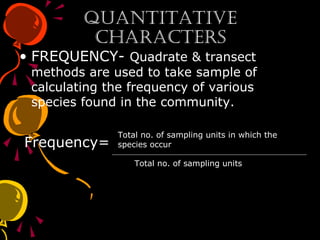
• FREQUENCY- Quadrate & transect
methods are used to take sample of
calculating the frequency of various
species found in the community.
Frequency=
Total no. of sampling units
Total no. of sampling units in which the
species occur
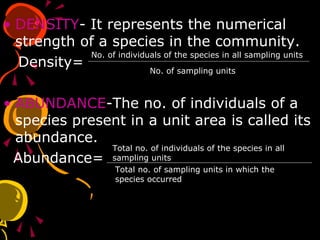
• DENSITY- It represents the numerical
strength of a species in the community.
Density=
• ABUNDANCE-The no. of individuals of a
species present in a unit area is called its
abundance.
Abundance=
No. of individuals of the species in all sampling units
No. of sampling units
Total no. of individuals of the species in all
sampling units
Total no. of sampling units in which the
species occurred
• COver & Basal areas
• COVER –It refers to the area of ground occupied
by the above ground parts of the plants such as
leaves, stems, & inflorescence as viewed from
above.
• BASAL AREAS– It refers to the ground
actually penetrated by the stems & is readily seen
when the leaves & stems are clipped at the ground
surface. It is one of the chief characteristics to
determine dominance
QualitativeQualitative
CharaCtersCharaCters
• Physiognomy- It denotes the external out line of the
community. Physiognomy is the form, structure external
appearance of the vegetation which develops due to
dominant plants of life forms. It is most useful method for
nomenclature & appearance of the community.
• Phenology- There are many important events in the
life history of a species like seed germination, leaf fall,
time of flowering, fruiting & seed dispersal. Phenolgy is
the calender of events in the life history of the plant.
These phenological events can be recorded
diagrammatically month wise & season wise & provide
valuable information such a diagram is called a
phenogram.
1)Germination 2) vegetative growth
3) Flowering 4) Fruiting
5) Seed maturation 6) Death
Phenogram with 6 events
• Stratification- the development of different species of plant
community of a given region takes place through the processes of
adaptation, competition & natural selection. This results in the
development of various strata or layers between the soil surface, this
vertical layering pattern is called Stratification
• Sunlight is the main cause behind the development of vertical
stratification.
• STRATIFICATION in FOREST COMMUNITY- A forest community shows
5 vertical strata:
1) Subterranean Strata- Basal portion, covered by litter & debris of plants
as well as animals.
2) Forest Floor- Second layer, abundance of litter. This region is the zone
of decomposition.
3) Stratum of Herbaceous Vegetation- Third layer, formed by
herbaceous plant like grasses, dicotyledonous annuals etc.
4) Stratum of Shrubs- Located below the crown layer & above the
herbaceous layer, represented by shrubby life form.
5) Stratum of Tree- Topmost layer, also called CROWN LAYER which
represents highest limit of plant community in given region.
• Abundance- The abundance of a species can not
be easily demonstrated quantitatively because living
organisms specially plants are not distributed uniformly
over the earths surface.
• On the basis of abundance, plants are grouped under 5
heads, they are
• Very rare
• Rare
• Common
• Frequent
• Very much frequent
• Sociability- It refers proximities of the plants.
Some plants of some species grow better when
thy are grown together & form dense populations
or communities where as some plants of some
species grown together become weak or
vanished. Sociability denotes the degree of
association-ship between species occurring in a
community.
• Vitality- It refers the condition of plant & its
capacity to complete the life cycle, i.e., normal
growth & reproduction.
• Life forms- The adaptation of the plant to
climate is called life form.
CLASSIFICATION OFCLASSIFICATION OF
COMMUNITYCOMMUNITY
• Physiognomic classification-
This classification totally depends on the general
appearance of the plants, is termed as
Physiognomic classification.
1) Phanerophytes- This plants may be trees,
shrubs or climbers. In these plants the growing
buds are not well protected & are located in
upright shoots much above the ground surface.
2) Chamaephytes- In these plants their buds are
situated close to the ground surface or upto max.
height of 25 cms. They commonly occur in high
altitude & latitudes
3)Hemicryptophytes- These plants are found on soil
surface & buds & shoots are protected by soil & dead
leaves.
Eg: most of the biennial & perennial herbs..
4) Cryptophytes- In these plants the buds are
usually buried in the soil or in bulbs & rhizomes
where food is stored to withstand long periods
of adverse climatic conditions.
5) Therophytes- These are annual plants that
produce flowers & seeds in the favourable
• haBitat classification-
Those Regions
where the habitat of plant community are
clearly indicated, the plants are classified &
named by using the characters of
physiography. On the basis of habitat, plants
are classified as follows:
• Sand dune community
• Pond community
• Lake community
• Stream community
• floRistic classification
• It requires detailed study of the individual
community & also involves many concepts
like frequence dominance’ constancy’
presence & fidality.
1) Zurich-Montpellier: In this classification
the followers first time used association as a unit
of community. An association, the fundamental
unit of synecology is a plant community of
definite floristic composition presenting a uniform
physiognomy & growing in habitat conditions
2) Scandinavian Classification – The
followers of this school considered sociation as the
unit of community. Sociation is the recurring plant
community with homogenous species composition,
in which some dominant species essentially occur
per annum
3) Russian system – COWLES termed society
as a unit of vegetation. He gave importance to
habitat & climax.
4) British system- In this system the
physiognomic classification & successional trends
where given importance. Hence this system is the
mixture of American & European system.
• Dynamic classification-
CLEMENTS modified
the floristic system. He called the climax vegetation
in a macro climatic region as “formation“
Vegetation with heighest development under the
existing climate. Each formation was divided into a
few associations which were considered units of
climax communities.
1) Plant formation- plant formation is a
great vegetational unit in a region
determined by several dominant species, as
for example: the forests which are
characterised by trees. Thus a plant
formation is a geographically widespread
climax vegetation unit growing in uniform
2) Association – Association is a regional
vegetation in the formation. It is 2 or more
subdivisions of climax formation & each being
marked by more than 1 dominant species that are
peculiar to it.
3)Plant society- The minor communities of
association & consociation dominated by one or
more species which are other than the dominants
of associations & consociations are called
societies.
Society is an example of dominance within
dominance. Developing societies are called socies
ECOTONE & EDGEECOTONE & EDGE
EFFECTEFFECT
• When 2 plants or animal communities merge,
either by inter mingling of species in the same
habitat or by juxta position of different
communities in the same region, the resultant
transitional state is called an Ecotone.
• In nature there is no strict boundary between
any 2 adjacent communities. Member of 1
community may enter the other community
atleast at its margin & vice versa. Thus an
intermediate zone is formed between the two
adjacent communities & thus ecotone or
marginal zone develops.
• An intermediate zone between a forest & a
grass land communities, aplace at which a
river meets the sea etc are eg. of ecotone
• DAUBENMIRE classified ecotone into 3
types
1) Abrupt transition zone- This type of
ecotone develops due to sudden change in
environmental conditions like types of soil,
soil drainage
2) Sharp transition zone- This type of
ecotone develops due to interaction &
competetion between the plants.
BiOlOGiCalBiOlOGiCal
SpECTrumSpECTrum
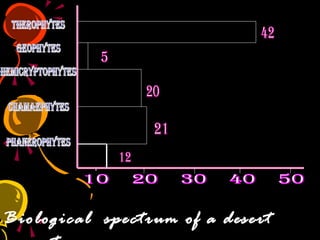
• The series of % of all the life forms of all plants in a
community is called biological spectrum.
• Biological spectrum indicates the climate of the area &
since plants are used in the analysis of the spectrum,
hence it is also known as phyto-climatic spectrum.
• Biological spectrum represents the distribution of
various life forms in percentile manner. 1 can prepare
biological spectrum of any area by obtaining the %
value of various plant groups.
Biological spectrum of a desert
Presented by-
Seema Verma
Date-
9th jan,2014

Community ecology...1

  • 1.
    COMMUNITY ECOLOGYCOMMUNITY ECOLOGY Departmentof Botany. G.D. Rungta college of science & technology
  • 2.
    SynopSiS-SynopSiS- • Introduction • Characteristics •Size & Structure • Characters Used In The Study Of Community • Classification • Ecotone & Edge Effect • Biological Spectrum
  • 3.
    • INTRODUCTION Environment ismade up of abiotic & biotic components. The biotic components are most important because these constisutes plants animals & micro organisms & together known as BIOLOGICAL COMMUNITIES of an eco system • DEFINITION • COMMUNITY IS AN ASSEMBLAGE OF ANIMAL & PLANT SPECIES OCCURING TOGETHER IN A PARTICULAR AREA. • A grassland, a desert, a forest are examples of community
  • 4.
    CHARACTERISTICS OF ACHARACTERISTICSOF A COMMUNITYCOMMUNITY • The characteristics by which a community is designated are as follows • 1)Species Diversity • A biotic community has producer, consumer & decomposer. Within these species diversities, some populations exert more influence than others in the community because the share a higher % of energy flow. • 2)Growth & Structure • Community is usually described in term of growth forms. The growth form is the general appearance of plant. These growth forms are directly influenced by environmental factors.
  • 5.
    • 3) Dominance •In each community, one or a few species dominate either in numbers or in physical characteristics or both over the other species. • The dominant species are called ECOLOGICAL DOMINANTS. • 4) Successions • Succession is very important in development of community. Community develops as a result of directional change in it with time. • 5) Trophic levels • There are 3 broad trophic levels in a community which are Producers, Consumers & Decomposers. The food produced by the green plants is consumed directly or indirectly by all kinds of animals. So these are known as Consumers. • The dead bodies & excreta of both producers & consumers are decomposed by microbes into simple substances, these are called the Decomposers of the community
  • 6.
    SIZE & STRUCTUREOFSIZE & STRUCTURE OF COMMUNITYCOMMUNITY • SIZE • Communities may be small, consisting a few species populations in a small space, or large, comprising several species populations in a large area. Larger once extend over areas of several thousands of square kms, as forests, other such as deserts etc. • Very small sized communities are the groups of microbes in such micro habitats as leaf surface, fallen log, litter, soil etc.
  • 7.
    STRUCTURESTRUCTURE • Structurally, acommunity may be of 2 types i.e., OPEN or CLOSED. • Plants of open communities are distantly placed, where as in closed communities plants are so closely placed & intimately associated that there is no hope for invasion of any new plant
  • 8.
    COMMUNITY CHARACTERSCOMMUNITY CHARACTERS •Analytical characters Quantitative Qualitative a) Frequency a) Physiognomy b) Density b) Phenology c) Abundance c) Stratification d) Cover & basal area d) Abundance e) Sociability f) Vitality g) Life form
  • 9.
    Analytical charactersAnalytical characters •Those characters which are important for study, explanation & analysis of a community are called analytical characters. • There are 2 types of analytical characters 1)Quantitative 2) Qualitative
  • 10.
    QuantitativeQuantitative CharaCtersCharaCters • FREQUENCY- Quadrate& transect methods are used to take sample of calculating the frequency of various species found in the community. Frequency= Total no. of sampling units Total no. of sampling units in which the species occur
  • 11.
    • DENSITY- Itrepresents the numerical strength of a species in the community. Density= • ABUNDANCE-The no. of individuals of a species present in a unit area is called its abundance. Abundance= No. of individuals of the species in all sampling units No. of sampling units Total no. of individuals of the species in all sampling units Total no. of sampling units in which the species occurred
  • 12.
    • COver &Basal areas • COVER –It refers to the area of ground occupied by the above ground parts of the plants such as leaves, stems, & inflorescence as viewed from above. • BASAL AREAS– It refers to the ground actually penetrated by the stems & is readily seen when the leaves & stems are clipped at the ground surface. It is one of the chief characteristics to determine dominance
  • 13.
    QualitativeQualitative CharaCtersCharaCters • Physiognomy- Itdenotes the external out line of the community. Physiognomy is the form, structure external appearance of the vegetation which develops due to dominant plants of life forms. It is most useful method for nomenclature & appearance of the community. • Phenology- There are many important events in the life history of a species like seed germination, leaf fall, time of flowering, fruiting & seed dispersal. Phenolgy is the calender of events in the life history of the plant. These phenological events can be recorded diagrammatically month wise & season wise & provide valuable information such a diagram is called a phenogram.
  • 14.
    1)Germination 2) vegetativegrowth 3) Flowering 4) Fruiting 5) Seed maturation 6) Death Phenogram with 6 events
  • 15.
    • Stratification- thedevelopment of different species of plant community of a given region takes place through the processes of adaptation, competition & natural selection. This results in the development of various strata or layers between the soil surface, this vertical layering pattern is called Stratification • Sunlight is the main cause behind the development of vertical stratification. • STRATIFICATION in FOREST COMMUNITY- A forest community shows 5 vertical strata: 1) Subterranean Strata- Basal portion, covered by litter & debris of plants as well as animals. 2) Forest Floor- Second layer, abundance of litter. This region is the zone of decomposition. 3) Stratum of Herbaceous Vegetation- Third layer, formed by herbaceous plant like grasses, dicotyledonous annuals etc. 4) Stratum of Shrubs- Located below the crown layer & above the herbaceous layer, represented by shrubby life form. 5) Stratum of Tree- Topmost layer, also called CROWN LAYER which represents highest limit of plant community in given region.
  • 16.
    • Abundance- Theabundance of a species can not be easily demonstrated quantitatively because living organisms specially plants are not distributed uniformly over the earths surface. • On the basis of abundance, plants are grouped under 5 heads, they are • Very rare • Rare • Common • Frequent • Very much frequent
  • 17.
    • Sociability- Itrefers proximities of the plants. Some plants of some species grow better when thy are grown together & form dense populations or communities where as some plants of some species grown together become weak or vanished. Sociability denotes the degree of association-ship between species occurring in a community. • Vitality- It refers the condition of plant & its capacity to complete the life cycle, i.e., normal growth & reproduction. • Life forms- The adaptation of the plant to climate is called life form.
  • 18.
    CLASSIFICATION OFCLASSIFICATION OF COMMUNITYCOMMUNITY •Physiognomic classification- This classification totally depends on the general appearance of the plants, is termed as Physiognomic classification. 1) Phanerophytes- This plants may be trees, shrubs or climbers. In these plants the growing buds are not well protected & are located in upright shoots much above the ground surface.
  • 19.
    2) Chamaephytes- Inthese plants their buds are situated close to the ground surface or upto max. height of 25 cms. They commonly occur in high altitude & latitudes 3)Hemicryptophytes- These plants are found on soil surface & buds & shoots are protected by soil & dead leaves. Eg: most of the biennial & perennial herbs.. 4) Cryptophytes- In these plants the buds are usually buried in the soil or in bulbs & rhizomes where food is stored to withstand long periods of adverse climatic conditions. 5) Therophytes- These are annual plants that produce flowers & seeds in the favourable
  • 20.
    • haBitat classification- ThoseRegions where the habitat of plant community are clearly indicated, the plants are classified & named by using the characters of physiography. On the basis of habitat, plants are classified as follows: • Sand dune community • Pond community • Lake community • Stream community
  • 21.
    • floRistic classification •It requires detailed study of the individual community & also involves many concepts like frequence dominance’ constancy’ presence & fidality. 1) Zurich-Montpellier: In this classification the followers first time used association as a unit of community. An association, the fundamental unit of synecology is a plant community of definite floristic composition presenting a uniform physiognomy & growing in habitat conditions
  • 22.
    2) Scandinavian Classification– The followers of this school considered sociation as the unit of community. Sociation is the recurring plant community with homogenous species composition, in which some dominant species essentially occur per annum 3) Russian system – COWLES termed society as a unit of vegetation. He gave importance to habitat & climax. 4) British system- In this system the physiognomic classification & successional trends where given importance. Hence this system is the mixture of American & European system.
  • 23.
    • Dynamic classification- CLEMENTSmodified the floristic system. He called the climax vegetation in a macro climatic region as “formation“ Vegetation with heighest development under the existing climate. Each formation was divided into a few associations which were considered units of climax communities. 1) Plant formation- plant formation is a great vegetational unit in a region determined by several dominant species, as for example: the forests which are characterised by trees. Thus a plant formation is a geographically widespread climax vegetation unit growing in uniform
  • 24.
    2) Association –Association is a regional vegetation in the formation. It is 2 or more subdivisions of climax formation & each being marked by more than 1 dominant species that are peculiar to it. 3)Plant society- The minor communities of association & consociation dominated by one or more species which are other than the dominants of associations & consociations are called societies. Society is an example of dominance within dominance. Developing societies are called socies
  • 25.
    ECOTONE & EDGEECOTONE& EDGE EFFECTEFFECT • When 2 plants or animal communities merge, either by inter mingling of species in the same habitat or by juxta position of different communities in the same region, the resultant transitional state is called an Ecotone. • In nature there is no strict boundary between any 2 adjacent communities. Member of 1 community may enter the other community atleast at its margin & vice versa. Thus an intermediate zone is formed between the two adjacent communities & thus ecotone or marginal zone develops.
  • 26.
    • An intermediatezone between a forest & a grass land communities, aplace at which a river meets the sea etc are eg. of ecotone • DAUBENMIRE classified ecotone into 3 types 1) Abrupt transition zone- This type of ecotone develops due to sudden change in environmental conditions like types of soil, soil drainage 2) Sharp transition zone- This type of ecotone develops due to interaction & competetion between the plants.
  • 27.
    BiOlOGiCalBiOlOGiCal SpECTrumSpECTrum • The seriesof % of all the life forms of all plants in a community is called biological spectrum. • Biological spectrum indicates the climate of the area & since plants are used in the analysis of the spectrum, hence it is also known as phyto-climatic spectrum. • Biological spectrum represents the distribution of various life forms in percentile manner. 1 can prepare biological spectrum of any area by obtaining the % value of various plant groups.
  • 28.
  • 29.