Summarize the key points discussed.
Direction:
Each member will take turns to answer the questions.
The assistant will summarize the key points discussed.
TIME FRAME: 10 minutes
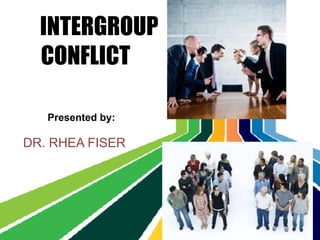
INTERGROUP CONFLICT
- isdisagreement and conflict that arises
between two or more groups within an
organization.
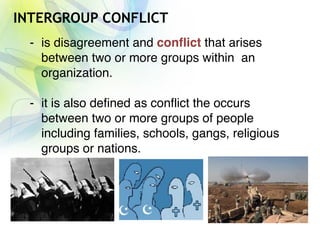
- it is also defined as conflict the occurs
between two or more groups of people
including families, schools, gangs, religious
groups or nations.
3.
INTERGROUP CONFLICTS happensWHEN…..
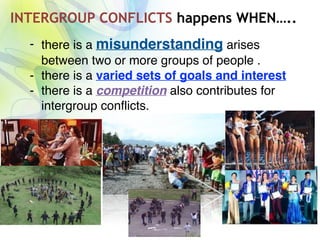
- there is a misunderstanding arises
between two or more groups of people .
- there is a varied sets of goals and interest
- there is a competition also contributes for
intergroup conflicts.
4.
CAUSES OF INTERGROUPCONFLICT
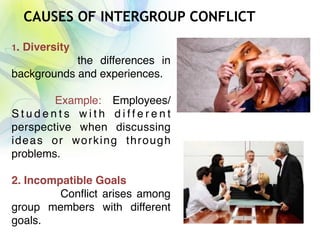
1. Diversity
the differences in
backgrounds and experiences.
Example: Employees/
S t u d e n t s w i t h d i f f e r e n t
perspective when discussing
ideas or working through
problems.
2. Incompatible Goals
Conflict arises among
group members with different
goals.
5.
CAUSES OF INTERGROUP
CONFLICT
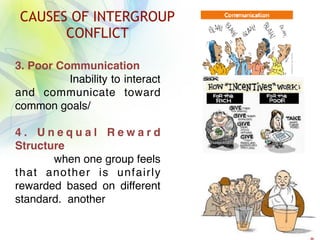
3.Poor Communication
Inability to interact
and communicate toward
common goals/
4 . U n e q u a l R e w a r d
Structure
when one group feels
that another is unfairly
rewarded based on different
standard. another
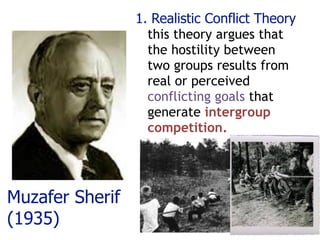
1. Realistic ConflictTheory
this theory argues that
the hostility between
two groups results from
real or perceived
conflicting goals that
generate intergroup
competition.
Muzafer Sherif
(1935)
8.
Realistic Group ConflictTheory
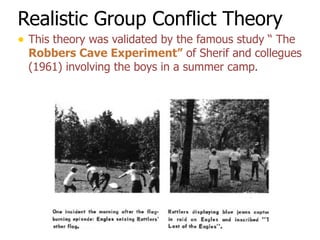
• This theory was validated by the famous study “ The
Robbers Cave Experiment” of Sherif and collegues
(1961) involving the boys in a summer camp.
9.
The Robbers
Cave Experiment
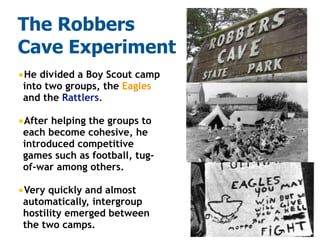
•Hedivided a Boy Scout camp
into two groups, the Eagles
and the Rattlers.
•After helping the groups to
each become cohesive, he
introduced competitive
games such as football, tug-
of-war among others.
•Very quickly and almost
automatically, intergroup
hostility emerged between
the two camps.
10.
What Sherif Did??
CrisisBrings the Groups
Together
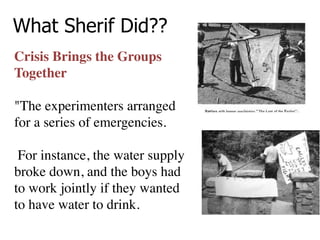
"The experimenters arranged
for a series of emergencies.
For instance, the water supply
broke down, and the boys had
to work jointly if they wanted
to have water to drink.
11.
The Outcome
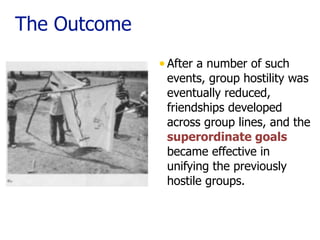
•After anumber of such
events, group hostility was
eventually reduced,
friendships developed
across group lines, and the
superordinate goals
became effective in
unifying the previously
hostile groups.
12.
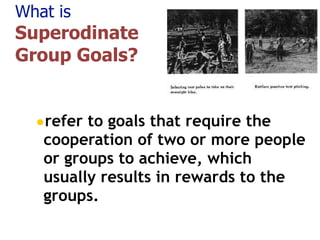
What is
Superodinate
Group Goals?
•referto goals that require the
cooperation of two or more people
or groups to achieve, which
usually results in rewards to the
groups.
13.
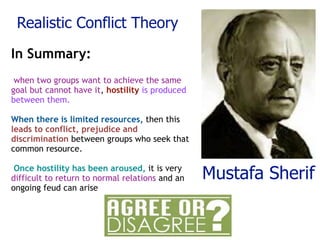
Realistic Conflict Theory
InSummary:
when two groups want to achieve the same
goal but cannot have it, hostility is produced
between them.
When there is limited resources, then this
leads to conflict, prejudice and
discrimination between groups who seek that
common resource.
Once hostility has been aroused, it is very
difficult to return to normal relations and an
ongoing feud can arise
Mustafa Sherif
14.
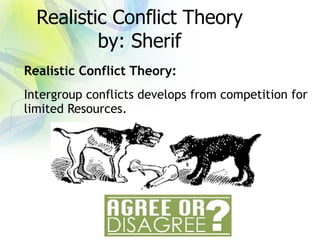
Realistic Conflict Theory
by:Sherif
Realistic Conflict Theory:
Intergroup conflicts develops from competition for
limited Resources.
15.
2. Social IdentityTheory
The way we define ourselves
in terms of our group
membership.
When we are belong to a
group, we are likely to derive
our sense of identity, at least
in part of the groups.
16.
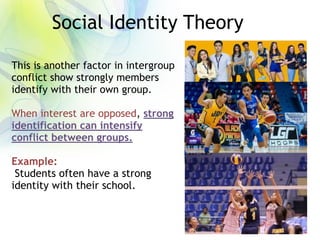
Social Identity Theory
Thisis another factor in intergroup
conflict show strongly members
identify with their own group.
When interest are opposed, strong
identification can intensify
conflict between groups.
Example:
Students often have a strong
identity with their school.
17.
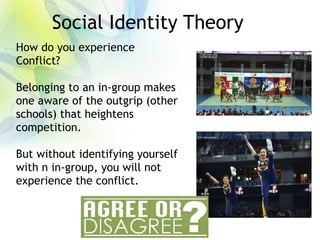
Social Identity Theory
Howdo you experience
Conflict?
Belonging to an in-group makes
one aware of the outgrip (other
schools) that heightens
competition.
But without identifying yourself
with n in-group, you will not
experience the conflict.
18.
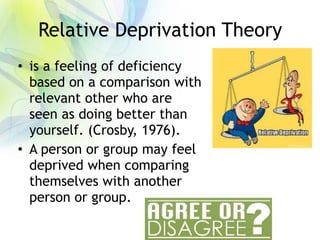
Relative Deprivation Theory
•is a feeling of deficiency
based on a comparison with
relevant other who are
seen as doing better than
yourself. (Crosby, 1976).
• A person or group may feel
deprived when comparing
themselves with another
person or group.
19.
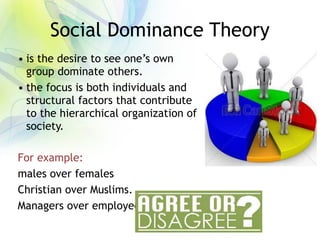
Social Dominance Theory
•is the desire to see one’s own
group dominate others.
• the focus is both individuals and
structural factors that contribute
to the hierarchical organization of
society.
For example:
males over females
Christian over Muslims.
Managers over employees
20.
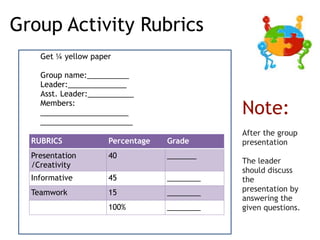
Group Activity Rubrics
RUBRICSPercentage Grade
Presentation
/Creativity
40 _______
Informative 45 ________
Teamwork 15 ________
100% ________
Get ¼ yellow paper
Group name:__________
Leader:______________
Asst. Leader:___________
Members:
_____________________
______________________
Note:
After the group
presentation
The leader
should discuss
the
presentation by
answering the
given questions.
21.
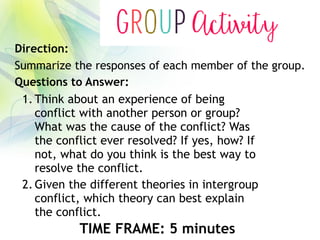
1. Think aboutan experience of being
conflict with another person or group?
What was the cause of the conflict? Was
the conflict ever resolved? If yes, how? If
not, what do you think is the best way to
resolve the conflict.
2. Given the different theories in intergroup
conflict, which theory can best explain
the conflict.
Direction:
Summarize the responses of each member of the group.
Questions to Answer:
TIME FRAME: 5 minutes
22.
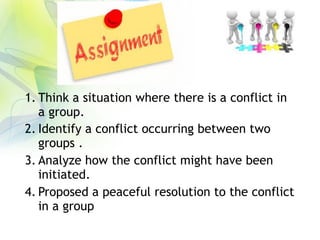
1. Think asituation where there is a conflict in
a group.
2. Identify a conflict occurring between two
groups .
3. Analyze how the conflict might have been
initiated.
4. Proposed a peaceful resolution to the conflict
in a group