UNDERSTANDING
CONFLICT
DR. ASLAM KHAN
CONFLICT……
CONFLICT ARISES WHENEVER INDIVIDUALS HAVE DIFFERENT VALUES,
OPINIONS, NEEDS, INTERESTS AND ARE UNABLE TO GET THE SOLUTION.
NATIONALIST/ANTI-NATIONALIST
RIGHT/LEFT IDEOLOGICAL
CAST AND RELIGION (IDENTITY)
RICH/POOR (ECONOMIC)
LINGUISTIC/ETHNIC (CULTURAL)
RACIAL (SOCIAL)
MEANING & DEFINITION…
The word “conflict” comes from the Latin word
conflictus, which means collision or clash.
• Defining conflict also depends on the nature of
conflict as something that takes place in society.
Conflict is commonly understood as:
• a form of opposition between parties;
• an absence of agreement between parties;
• a way to solve social contradictions;
• a natural process in human social interaction.
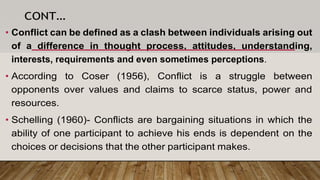
CONT…
• Conflict can be defined as a clash between individuals arising out
of a difference in thought process, attitudes, understanding,
interests, requirements and even sometimes perceptions.
• According to Coser (1956), Conflict is a struggle between
opponents over values and claims to scarce status, power and
resources.
• Schelling (1960)- Conflicts are bargaining situations in which the
ability of one participant to achieve his ends is dependent on the
choices or decisions that the other participant makes.
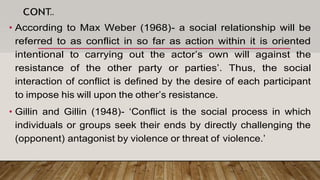
CONT..
• According to Max Weber (1968)- a social relationship will be
referred to as conflict in so far as action within it is oriented
intentional to carrying out the actor’s own will against the
resistance of the other party or parties’. Thus, the social
interaction of conflict is defined by the desire of each participant
to impose his will upon the other’s resistance.
• Gillin and Gillin (1948)- ‘Conflict is the social process in which
individuals or groups seek their ends by directly challenging the
(opponent) antagonist by violence or threat of violence.’
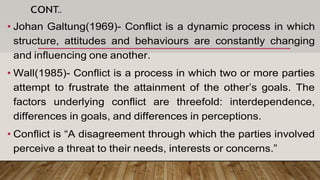
CONT..
• Johan Galtung(1969)- Conflict is a dynamic process in which
structure, attitudes and behaviours are constantly changing
and influencing one another.
• Wall(1985)- Conflict is a process in which two or more parties
attempt to frustrate the attainment of the other’s goals. The
factors underlying conflict are threefold: interdependence,
differences in goals, and differences in perceptions.
• Conflict is “A disagreement through which the parties involved
perceive a threat to their needs, interests or concerns.”
NATURE/CHARACTERISTICS OF CONFLICT
• The nature of the conflict is personal and direct. In conflict the incumbents or participants know
each other personally.
• Conflict is the result of deliberate and conscious efforts of individuals or the groups.
• Conflict is a universal process found in every society.
• It is basically an individual process. Its aim is not directly connected with the achievement of the
goal or an objective but is rather directed to dominate others or to eliminate the opponent.
• Conflict is of short duration, temporary and intermittent in character. But, once begun, the conflict
process is hard to stop. It tends to grow more and more bitter as it proceeds. Being temporary, it
gives way to some form of accommodation.
• Conflict is a process loaded with impulsiveness of human emotions and violent passions. It gains
force and then bursts open. Unlike fighting of animals, generally in human groups, the
spontaneous fighting is inhibited. It is often avoided through the process of accommodation and
assimilation.
• It may be latent or overt. In the latent form, it may exist in the form of tension, dissatisfaction,
contravention and rivalry. It becomes overt when an issue is declared and a hostile action is taken.
CONT…
• It is cumulative; each act of aggression usually promotes a more aggressive
rebuttal. Thus, termination of conflict is not easy.
• Groups previously in conflict may co-operate to achieve a goal considered
important enough for them to unite despite their differences.
• It may emerge as a result of opposing interests. It is layered in a history of
binary perceptions: exile/homeland, outsider/insider, us/them,
patriotic/unpatriotic.
• It has both disintegrative and integrative effects. It disrupts unity in a society
and is a disturbing way of setting issues. A certain account of internal
conflict, however, may serve indirectly to stimulate group interaction.
External conflict can have positive effects by unifying the group.
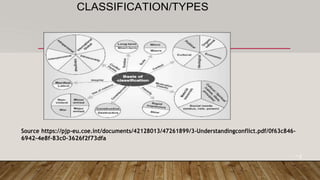
CLASSIFICATION/TYPES
Source https://pjp-eu.coe.int/documents/42128013/47261899/3-Understandingconflict.pdf/0f63c846-
6942-4e8f-83c0-3626f2f73dfa
TYPES:
Conflict types are:
1. Intrapersonal
2. interpersonal
3. intergroup,
4. intragroup/intersociety
5. International/global.
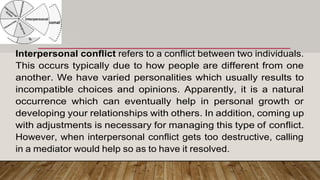
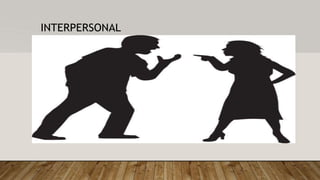
Interpersonal conflict refers to a conflict between two individuals.
This occurs typically due to how people are different from one
another. We have varied personalities which usually results to
incompatible choices and opinions. Apparently, it is a natural
occurrence which can eventually help in personal growth or
developing your relationships with others. In addition, coming up
with adjustments is necessary for managing this type of conflict.
However, when interpersonal conflict gets too destructive, calling
in a mediator would help so as to have it resolved.
INTERPERSONAL
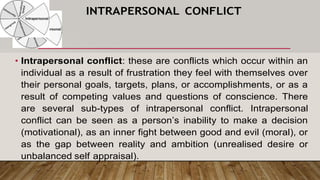
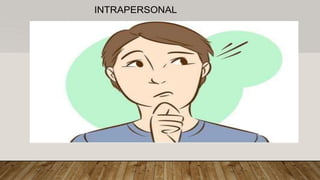
• Intrapersonal conflict: these are conflicts which occur within an
individual as a result of frustration they feel with themselves over
their personal goals, targets, plans, or accomplishments, or as a
result of competing values and questions of conscience. There
are several sub-types of intrapersonal conflict. Intrapersonal
conflict can be seen as a person’s inability to make a decision
(motivational), as an inner fight between good and evil (moral), or
as the gap between reality and ambition (unrealised desire or
unbalanced self appraisal).
INTRAPERSONAL CONFLICT
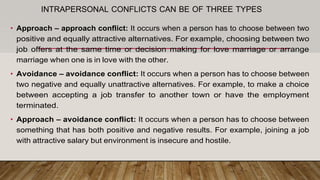
INTRAPERSONAL CONFLICTS CAN BE OF THREE TYPES
• Approach – approach conflict: It occurs when a person has to choose between two
positive and equally attractive alternatives. For example, choosing between two
job offers at the same time or decision making for love marriage or arrange
marriage when one is in love with the other.
• Avoidance – avoidance conflict: It occurs when a person has to choose between
two negative and equally unattractive alternatives. For example, to make a choice
between accepting a job transfer to another town or have the employment
terminated.
• Approach – avoidance conflict: It occurs when a person has to choose between
something that has both positive and negative results. For example, joining a job
with attractive salary but environment is insecure and hostile.
INTRAPERSONAL
INTRAGROUP/INTRASOCIETY CONFLICT
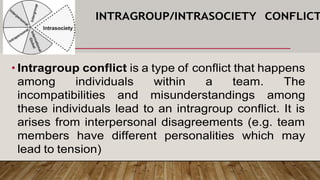
• Intragroup conflict is a type of conflict that happens
among individuals within a team. The
incompatibilities and misunderstandings among
these individuals lead to an intragroup conflict. It is
arises from interpersonal disagreements (e.g. team
members have different personalities which may
lead to tension)
INTRAGROUP
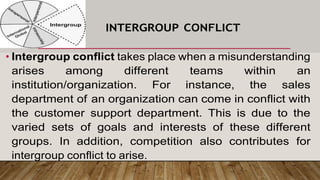
• Intergroup conflict takes place when a misunderstanding
arises among different teams within an
institution/organization. For instance, the sales
department of an organization can come in conflict with
the customer support department. This is due to the
varied sets of goals and interests of these different
groups. In addition, competition also contributes for
intergroup conflict to arise.
INTERGROUP CONFLICT
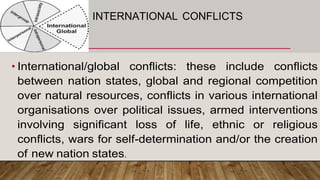
• International/global conflicts: these include conflicts
between nation states, global and regional competition
over natural resources, conflicts in various international
organisations over political issues, armed interventions
involving significant loss of life, ethnic or religious
conflicts, wars for self-determination and/or the creation
of new nation states.
INTERNATIONAL CONFLICTS
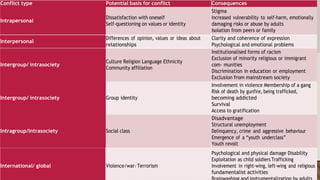
Conflict type Potential basis for conflict Consequences
Intrapersonal
Dissatisfaction with oneself
Self-questioning on values or identity
Stigma
Increased vulnerability to self-harm, emotionally
damaging risks or abuse by adults
Isolation from peers or family
Interpersonal
Differences of opinion, values or ideas about
relationships
Clarity and coherence of expression
Psychological and emotional problems
Intergroup/ intrasociety
Culture Religion Language Ethnicity
Community affiliation
Institutionalised forms of racism
Exclusion of minority religious or immigrant
com- munities
Discrimination in education or employment
Exclusion from mainstream society
Intergroup/ intrasociety Group identity
Involvement in violence Membership of a gang
Risk of death by gunfire, being trafficked,
becoming addicted
Survival
Access to gratification
Intragroup/Intrasociety Social class
Disadvantage
Structural unemployment
Delinquency, crime and aggressive behaviour
Emergence of a “youth underclass”
Youth revolt
International/ global Violence/war/ Terrorism
Psychological and physical damage Disability
Exploitation as child soldiers Trafficking
Involvement in right-wing, left-wing and religious
fundamentalist activities
THE CONFLICT TRIANGLE/ABC TRIANGLE BY GALTUNG
SOURCES/REFERENCES:
Galtung J., Peace by Peaceful Means: Peace and Conflict, Development and Civilization, Sage,
London, 1997, p. 72
Coser A. L., The Functions of Social Conflict (Free Press, New York, 1956).
Schelling, C. T., The Strategy of Conflict (Harvard University Press, Cambridge, 1960).
Quoted in Ramsbotham O., Woodhouse T. and Miall H., Contemporary Conflict Resolution: The
Prevention, Management and Transformation of Deadly Conflicts (Polity, Oxford, 2005, 2nd edition).
Wall A. J., Negotiation: Theory and Practice (Glenview, Scoff, Foresman, Illinois, 1985).
Folger J. P., Poole M. S. and Stutman R. K., Working Through Conflict: Strategies for Relationships,
Groups and Organizations (Harper Collins College Publishers, New York, 1993).
https://pjp-eu.coe.int/documents/42128013/47261899/3-Understandingconflict.pdf/0f63c846-
6942-4e8f-83c0-3626f2f73dfa
https://www.managementstudyguide.com/understanding-conflict.htm
https://www.slideshare.net/anuj0129/conflict-types-and-causesconflict-resolution/4
🙏🙏🙏🌷
THANK YOU

slides conflict word conflict management

  • 1.
  • 2.
    CONFLICT…… CONFLICT ARISES WHENEVERINDIVIDUALS HAVE DIFFERENT VALUES, OPINIONS, NEEDS, INTERESTS AND ARE UNABLE TO GET THE SOLUTION. NATIONALIST/ANTI-NATIONALIST RIGHT/LEFT IDEOLOGICAL CAST AND RELIGION (IDENTITY) RICH/POOR (ECONOMIC) LINGUISTIC/ETHNIC (CULTURAL) RACIAL (SOCIAL)
  • 3.
    MEANING & DEFINITION… Theword “conflict” comes from the Latin word conflictus, which means collision or clash. • Defining conflict also depends on the nature of conflict as something that takes place in society. Conflict is commonly understood as: • a form of opposition between parties; • an absence of agreement between parties; • a way to solve social contradictions; • a natural process in human social interaction.
  • 4.
    CONT… • Conflict canbe defined as a clash between individuals arising out of a difference in thought process, attitudes, understanding, interests, requirements and even sometimes perceptions. • According to Coser (1956), Conflict is a struggle between opponents over values and claims to scarce status, power and resources. • Schelling (1960)- Conflicts are bargaining situations in which the ability of one participant to achieve his ends is dependent on the choices or decisions that the other participant makes.
  • 5.
    CONT.. • According toMax Weber (1968)- a social relationship will be referred to as conflict in so far as action within it is oriented intentional to carrying out the actor’s own will against the resistance of the other party or parties’. Thus, the social interaction of conflict is defined by the desire of each participant to impose his will upon the other’s resistance. • Gillin and Gillin (1948)- ‘Conflict is the social process in which individuals or groups seek their ends by directly challenging the (opponent) antagonist by violence or threat of violence.’
  • 6.
    CONT.. • Johan Galtung(1969)-Conflict is a dynamic process in which structure, attitudes and behaviours are constantly changing and influencing one another. • Wall(1985)- Conflict is a process in which two or more parties attempt to frustrate the attainment of the other’s goals. The factors underlying conflict are threefold: interdependence, differences in goals, and differences in perceptions. • Conflict is “A disagreement through which the parties involved perceive a threat to their needs, interests or concerns.”
  • 7.
    NATURE/CHARACTERISTICS OF CONFLICT •The nature of the conflict is personal and direct. In conflict the incumbents or participants know each other personally. • Conflict is the result of deliberate and conscious efforts of individuals or the groups. • Conflict is a universal process found in every society. • It is basically an individual process. Its aim is not directly connected with the achievement of the goal or an objective but is rather directed to dominate others or to eliminate the opponent. • Conflict is of short duration, temporary and intermittent in character. But, once begun, the conflict process is hard to stop. It tends to grow more and more bitter as it proceeds. Being temporary, it gives way to some form of accommodation. • Conflict is a process loaded with impulsiveness of human emotions and violent passions. It gains force and then bursts open. Unlike fighting of animals, generally in human groups, the spontaneous fighting is inhibited. It is often avoided through the process of accommodation and assimilation. • It may be latent or overt. In the latent form, it may exist in the form of tension, dissatisfaction, contravention and rivalry. It becomes overt when an issue is declared and a hostile action is taken.
  • 8.
    CONT… • It iscumulative; each act of aggression usually promotes a more aggressive rebuttal. Thus, termination of conflict is not easy. • Groups previously in conflict may co-operate to achieve a goal considered important enough for them to unite despite their differences. • It may emerge as a result of opposing interests. It is layered in a history of binary perceptions: exile/homeland, outsider/insider, us/them, patriotic/unpatriotic. • It has both disintegrative and integrative effects. It disrupts unity in a society and is a disturbing way of setting issues. A certain account of internal conflict, however, may serve indirectly to stimulate group interaction. External conflict can have positive effects by unifying the group.
  • 9.
  • 10.
    TYPES: Conflict types are: 1.Intrapersonal 2. interpersonal 3. intergroup, 4. intragroup/intersociety 5. International/global.
  • 11.
    Interpersonal conflict refersto a conflict between two individuals. This occurs typically due to how people are different from one another. We have varied personalities which usually results to incompatible choices and opinions. Apparently, it is a natural occurrence which can eventually help in personal growth or developing your relationships with others. In addition, coming up with adjustments is necessary for managing this type of conflict. However, when interpersonal conflict gets too destructive, calling in a mediator would help so as to have it resolved.
  • 12.
  • 13.
    • Intrapersonal conflict:these are conflicts which occur within an individual as a result of frustration they feel with themselves over their personal goals, targets, plans, or accomplishments, or as a result of competing values and questions of conscience. There are several sub-types of intrapersonal conflict. Intrapersonal conflict can be seen as a person’s inability to make a decision (motivational), as an inner fight between good and evil (moral), or as the gap between reality and ambition (unrealised desire or unbalanced self appraisal). INTRAPERSONAL CONFLICT
  • 14.
    INTRAPERSONAL CONFLICTS CANBE OF THREE TYPES • Approach – approach conflict: It occurs when a person has to choose between two positive and equally attractive alternatives. For example, choosing between two job offers at the same time or decision making for love marriage or arrange marriage when one is in love with the other. • Avoidance – avoidance conflict: It occurs when a person has to choose between two negative and equally unattractive alternatives. For example, to make a choice between accepting a job transfer to another town or have the employment terminated. • Approach – avoidance conflict: It occurs when a person has to choose between something that has both positive and negative results. For example, joining a job with attractive salary but environment is insecure and hostile.
  • 15.
  • 16.
    INTRAGROUP/INTRASOCIETY CONFLICT • Intragroupconflict is a type of conflict that happens among individuals within a team. The incompatibilities and misunderstandings among these individuals lead to an intragroup conflict. It is arises from interpersonal disagreements (e.g. team members have different personalities which may lead to tension)
  • 17.
  • 18.
    • Intergroup conflicttakes place when a misunderstanding arises among different teams within an institution/organization. For instance, the sales department of an organization can come in conflict with the customer support department. This is due to the varied sets of goals and interests of these different groups. In addition, competition also contributes for intergroup conflict to arise. INTERGROUP CONFLICT
  • 20.
    • International/global conflicts:these include conflicts between nation states, global and regional competition over natural resources, conflicts in various international organisations over political issues, armed interventions involving significant loss of life, ethnic or religious conflicts, wars for self-determination and/or the creation of new nation states. INTERNATIONAL CONFLICTS
  • 22.
    Conflict type Potentialbasis for conflict Consequences Intrapersonal Dissatisfaction with oneself Self-questioning on values or identity Stigma Increased vulnerability to self-harm, emotionally damaging risks or abuse by adults Isolation from peers or family Interpersonal Differences of opinion, values or ideas about relationships Clarity and coherence of expression Psychological and emotional problems Intergroup/ intrasociety Culture Religion Language Ethnicity Community affiliation Institutionalised forms of racism Exclusion of minority religious or immigrant com- munities Discrimination in education or employment Exclusion from mainstream society Intergroup/ intrasociety Group identity Involvement in violence Membership of a gang Risk of death by gunfire, being trafficked, becoming addicted Survival Access to gratification Intragroup/Intrasociety Social class Disadvantage Structural unemployment Delinquency, crime and aggressive behaviour Emergence of a “youth underclass” Youth revolt International/ global Violence/war/ Terrorism Psychological and physical damage Disability Exploitation as child soldiers Trafficking Involvement in right-wing, left-wing and religious fundamentalist activities
  • 23.
    THE CONFLICT TRIANGLE/ABCTRIANGLE BY GALTUNG
  • 24.
    SOURCES/REFERENCES: Galtung J., Peaceby Peaceful Means: Peace and Conflict, Development and Civilization, Sage, London, 1997, p. 72 Coser A. L., The Functions of Social Conflict (Free Press, New York, 1956). Schelling, C. T., The Strategy of Conflict (Harvard University Press, Cambridge, 1960). Quoted in Ramsbotham O., Woodhouse T. and Miall H., Contemporary Conflict Resolution: The Prevention, Management and Transformation of Deadly Conflicts (Polity, Oxford, 2005, 2nd edition). Wall A. J., Negotiation: Theory and Practice (Glenview, Scoff, Foresman, Illinois, 1985). Folger J. P., Poole M. S. and Stutman R. K., Working Through Conflict: Strategies for Relationships, Groups and Organizations (Harper Collins College Publishers, New York, 1993). https://pjp-eu.coe.int/documents/42128013/47261899/3-Understandingconflict.pdf/0f63c846- 6942-4e8f-83c0-3626f2f73dfa https://www.managementstudyguide.com/understanding-conflict.htm https://www.slideshare.net/anuj0129/conflict-types-and-causesconflict-resolution/4
  • 25.