Visual field assessment in
glaucoma patients
Presenter Dr. Desta G.(R-2)
Moderator Dr. Abeba T. (associat.
Professor of ophthalmology, Glaucoma
sup.specialist,CHS,AAU)
Seminar outline
• Introduction
• Common visual field defects
• Glaucomatous visual defects
• Types of perimetry
Introduction
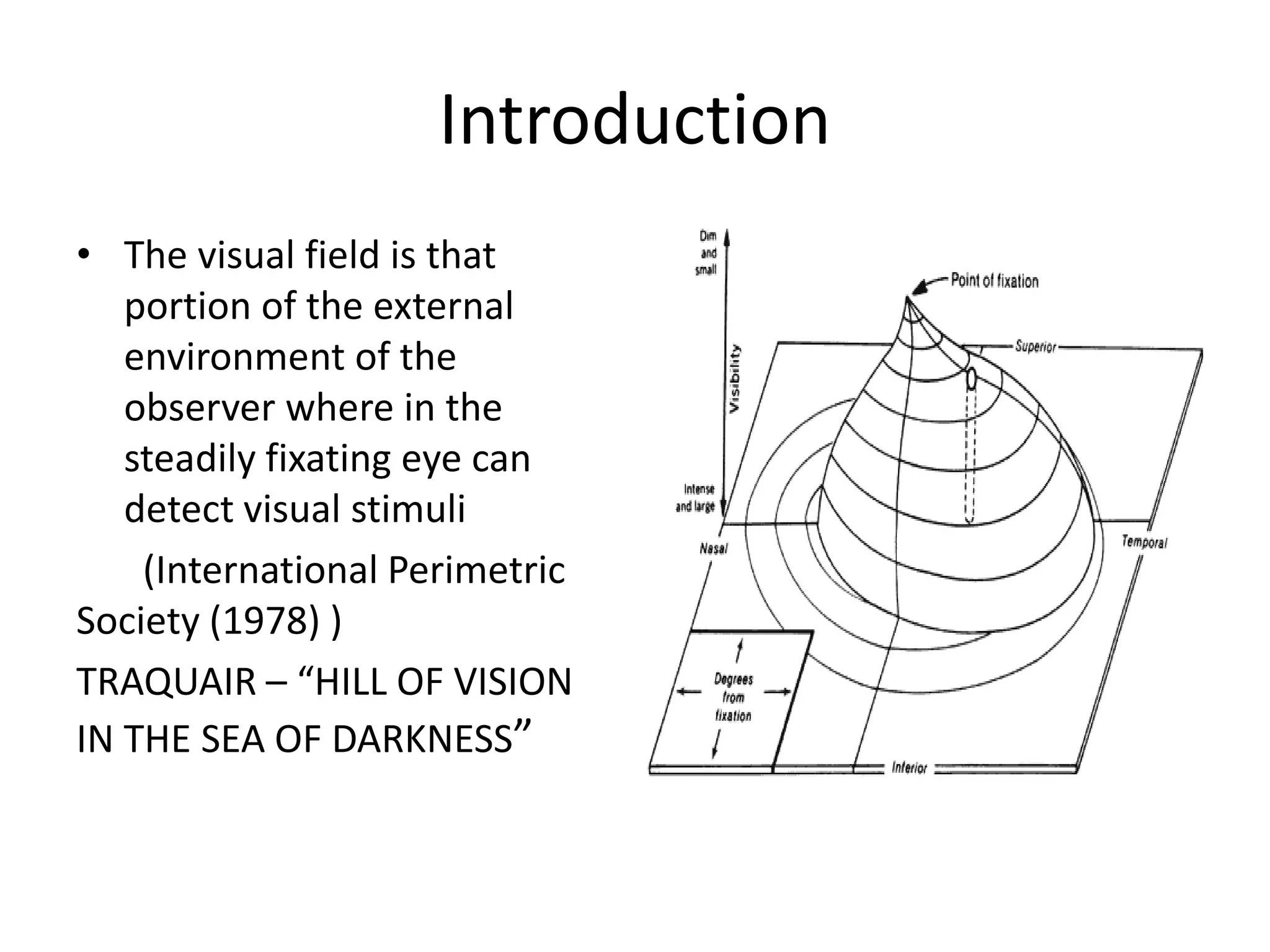
• The visual field is that
portion of the external
environment of the
observer where in the
steadily fixating eye can
detect visual stimuli
(International Perimetric
Society (1978) )
TRAQUAIR – “HILL OF VISION
IN THE SEA OF DARKNESS”
Boundaries
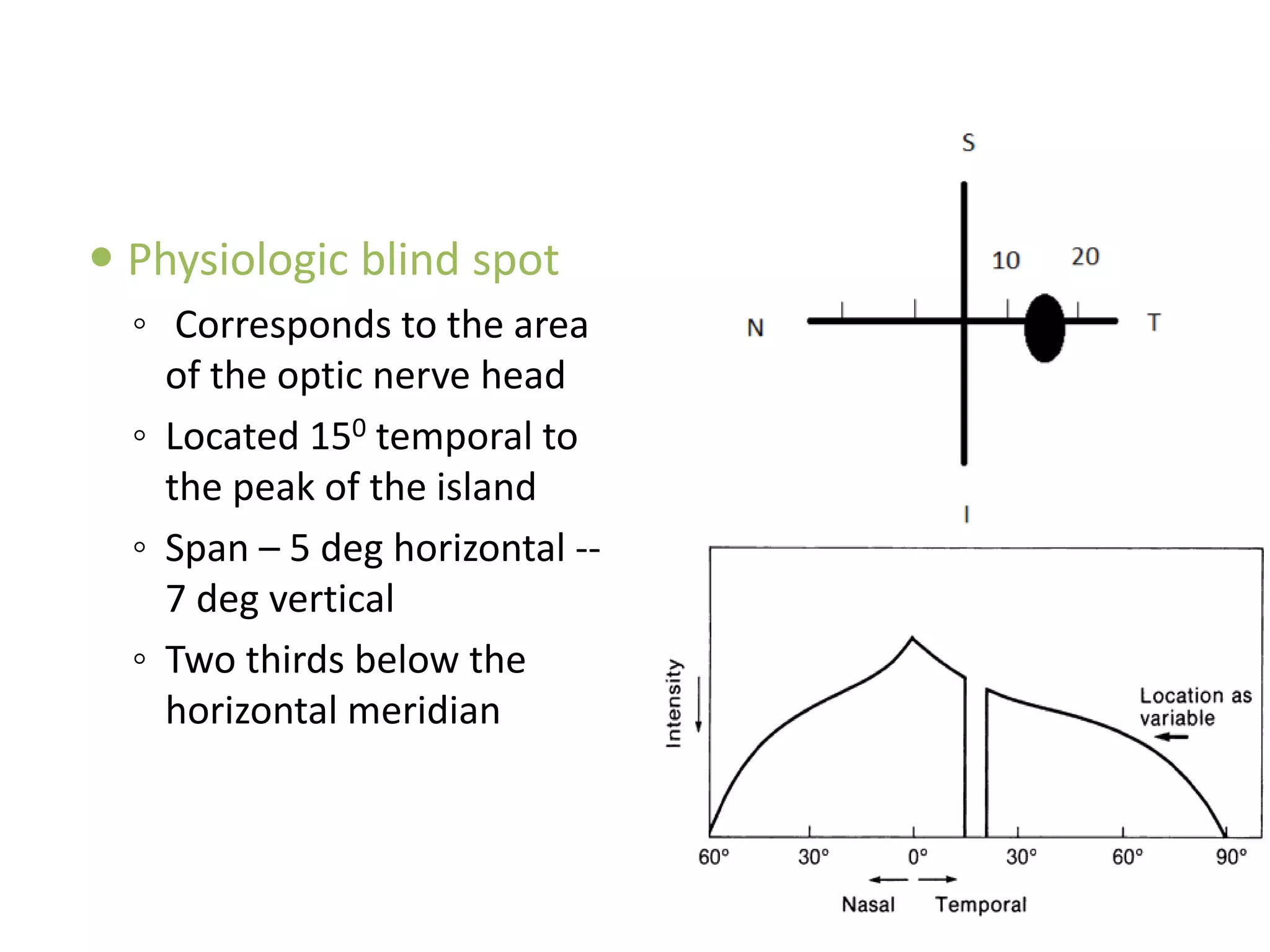
 Physiologic blind spot
◦ Corresponds to the area
of the optic nerve head
◦ Located 150 temporal to
the peak of the island
◦ Span – 5 deg horizontal --
7 deg vertical
◦ Two thirds below the
horizontal meridian
5
Color field
• Point at which passing from periphery to
centre, the colour first becomes evident
• Extent of field for objects of same size and
intensity white > yellow > blue > red > green
SCOTOMA : focal region of abnormally decreased sensitivity
surrounded by an area of normal sensitivity
ABSOLUTE vs RELATIVE
DEPRESSION : is an area of reduced sensitivity without a
surrounding area of normal sensitivity appears as denting of
isopters
• Homonymous is when the defects are in the
corresponding region of the visual field in both eyes.
• Hemianopia, there is a defect to the side of the midline in
both visual fields.
• Quadrantanopia there is visual field defect in one
quadrant
Congruousness describes the degree to which the field
defects match between the two eyes.
Generally, the more congruous the field defect the more
posterior along the visual pathway the lesion is located.
Isopter is a threshold line joining points of equal sensitivity on
a visual field chart
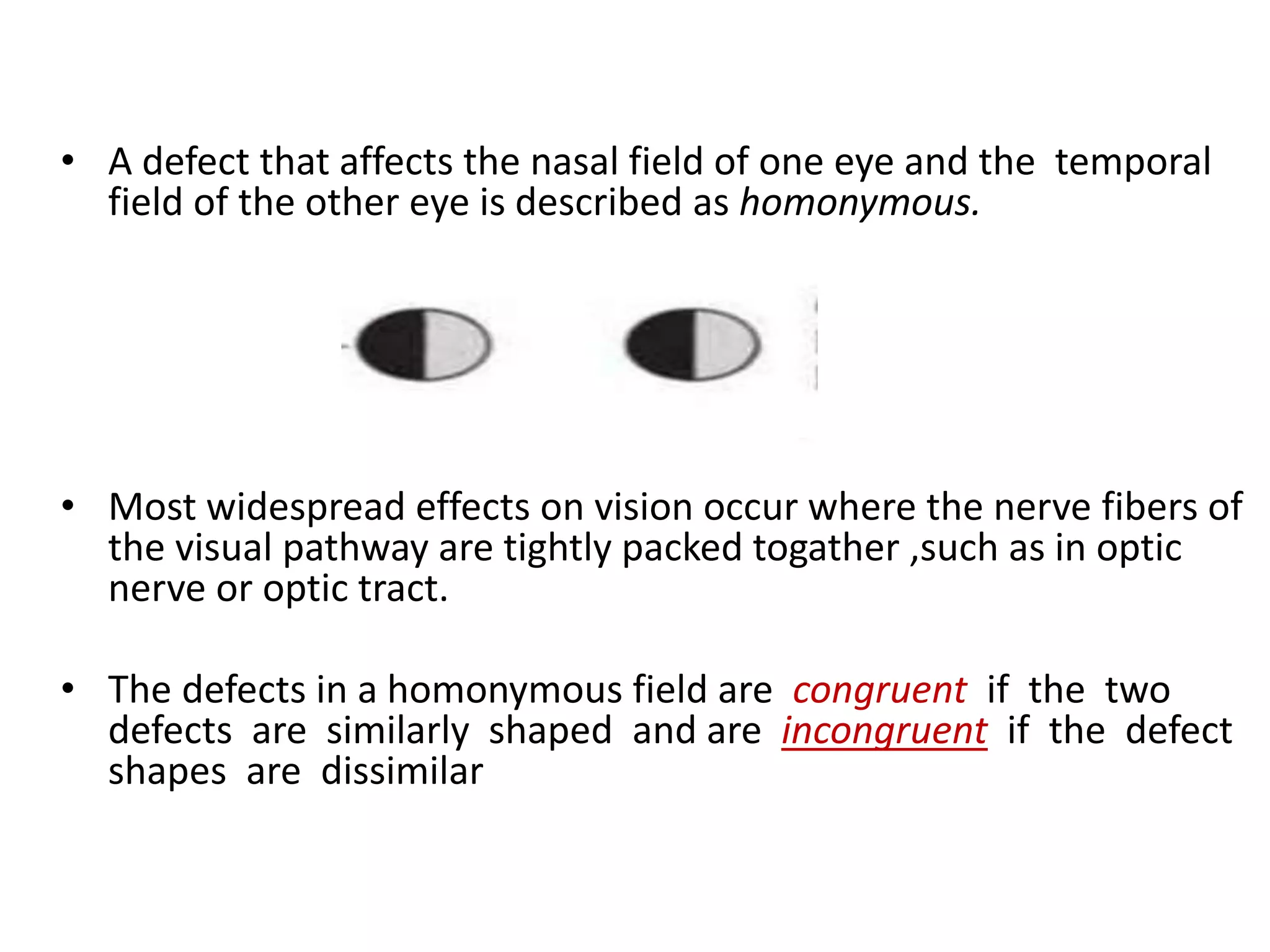
• A defect that affects the nasal field of one eye and the temporal
field of the other eye is described as homonymous.
• Most widespread effects on vision occur where the nerve fibers of
the visual pathway are tightly packed togather ,such as in optic
nerve or optic tract.
• The defects in a homonymous field are congruent if the two
defects are similarly shaped and are incongruent if the defect
shapes are dissimilar
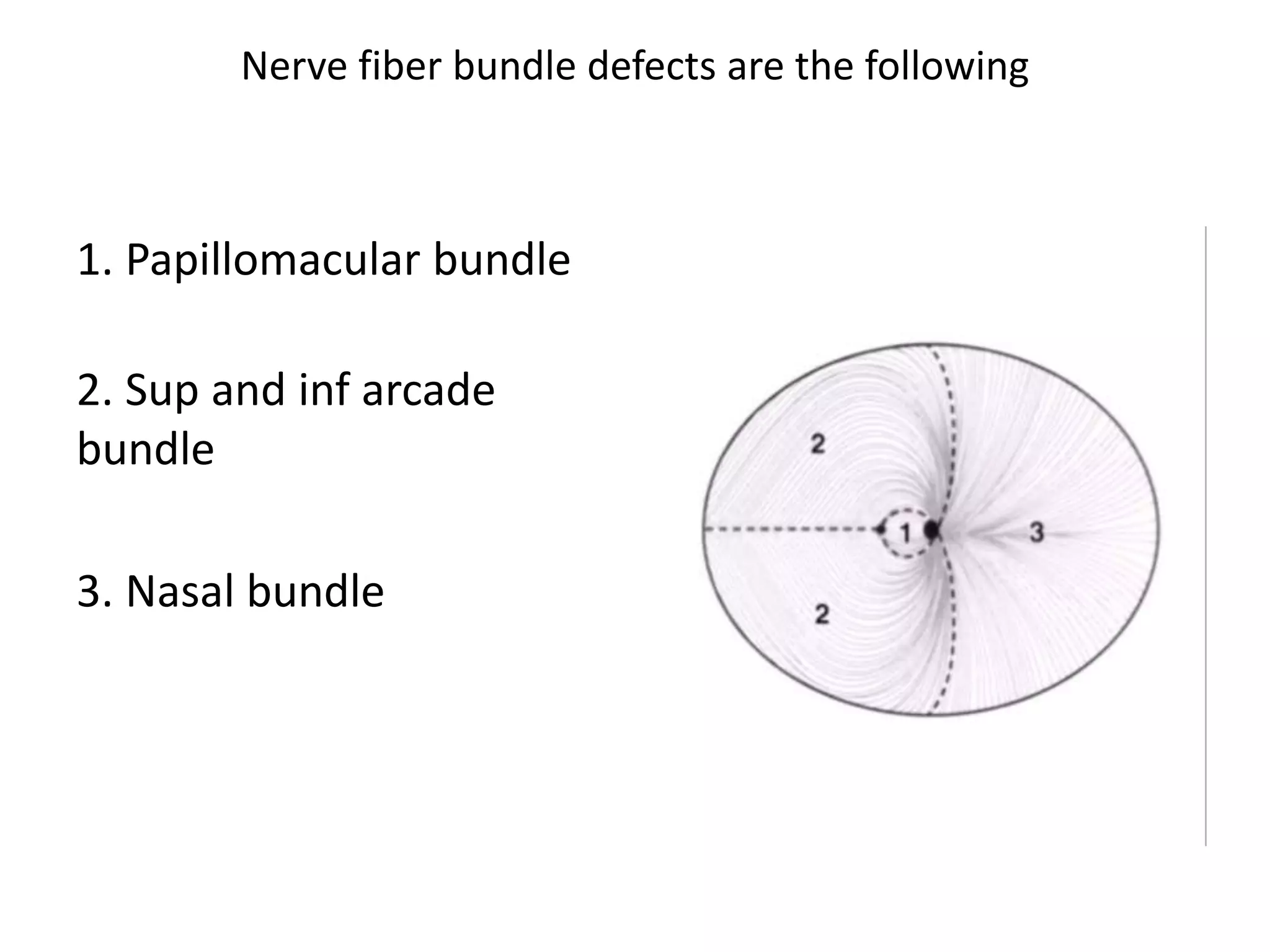
Nerve fiber bundle defects are the following
1. Papillomacular bundle
2. Sup and inf arcade
bundle
3. Nasal bundle
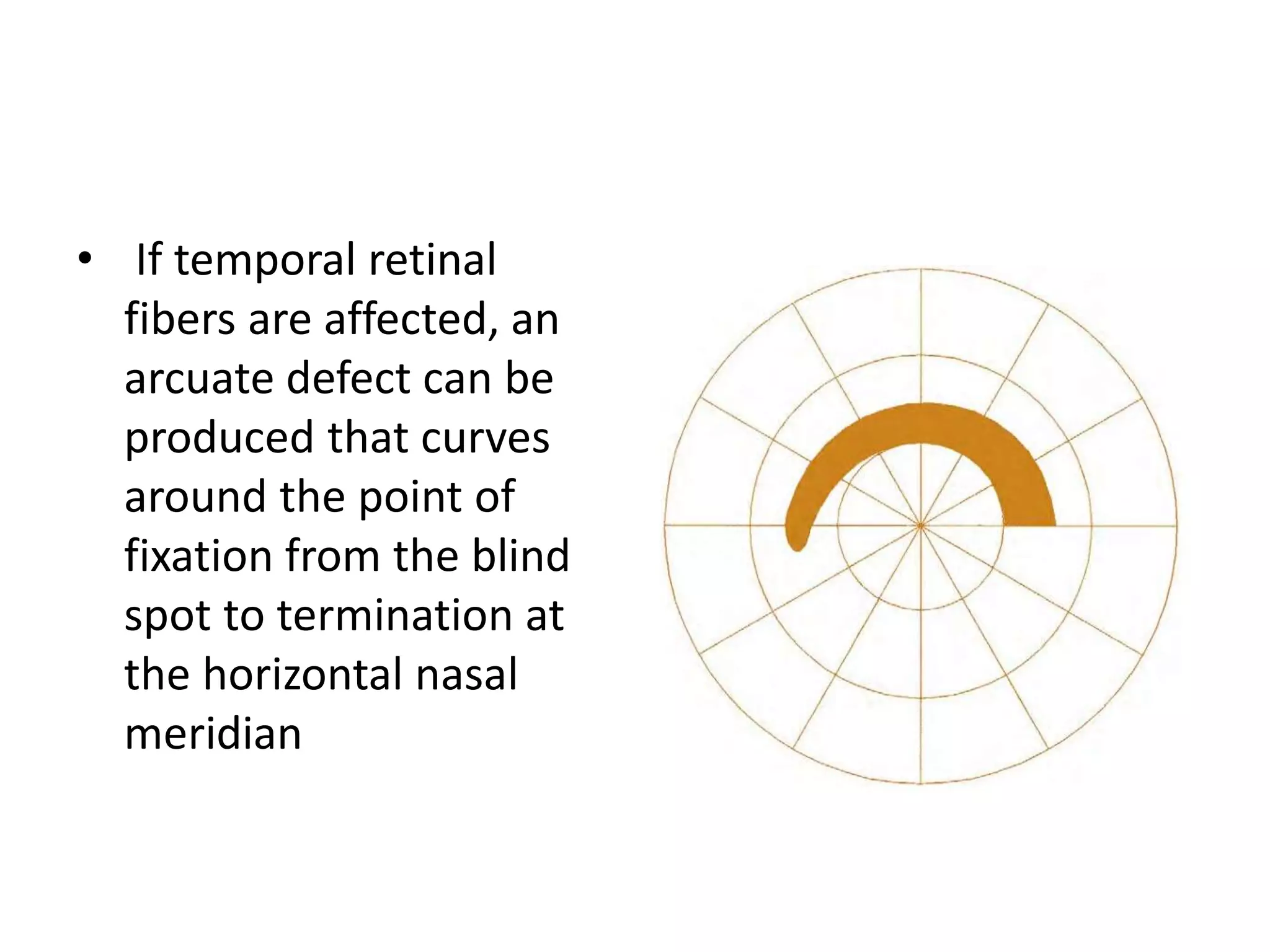
• If temporal retinal
fibers are affected, an
arcuate defect can be
produced that curves
around the point of
fixation from the blind
spot to termination at
the horizontal nasal
meridian
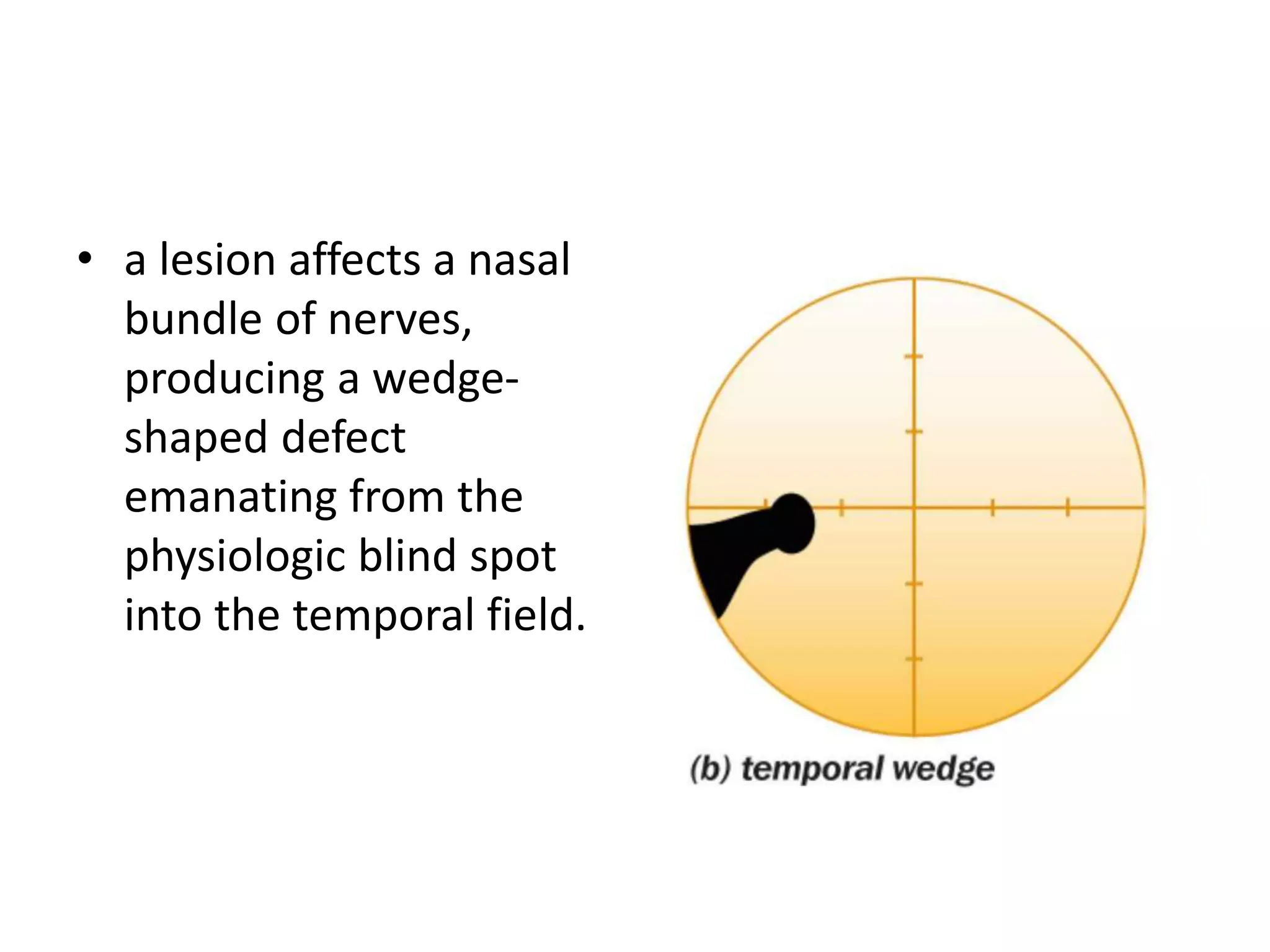
• a lesion affects a nasal
bundle of nerves,
producing a wedge-
shaped defect
emanating from the
physiologic blind spot
into the temporal field.
Injury to the optic nerve
• is accompanied by a visual field defect,
• a relative afferent pupillary defect, and
• atrophy of the affected nerve fibers, which eventually is
manifested at the disc.
• Complete section of one nerve produces total blindness of
that eye.
• The pupil will not react to light directly but do
consensually(affected side)
• The site of other eye is normal; the pupil react to light
directly but not consensually.
• The pupil on the injured side will constrict on
accommodation.
• If the optic nerve sectioned
close to its entrance to the
optic chiasm ,the inferior nasal
fibers from the opposite side
optic nerve that loop forward
within the optic nerve will also
be sectioned.
• In this case, in addition to
visual field loss of the same
eye, there is a superior
temporal defect in the field of
the opposite eye.
• This is known as anterior
junction defect.
 Optic chiasm
• Sagittal section of the optic chiasm will produce
bitemporal hemianopia.
• The pupil react normally to direct light reflex , the
consensual light reflex , and accomodation reflex.
• Lateral section of optic chiasm on one side
divides the fibers originating from the temporal
retina on that side produce nasal hemianopia.
• Lateral section on both sides divides the fibers
originating from both temporal retinae, produce
binasal hemianopia.
 Optic tract
• Division on one side will result in contralateral homonymous
hemianopia.
• The pupil react normally to the direct light reflex ,the
consensual light reflex and accommodation reflex.
LGN
• Distraction of LGN produces contralateral homonymous
hemianopia.
• The pupil react normally to the direct light reflex ,the
consensual light reflex and accomodation reflex.
• Lesions here eventually cause optic atrophy.
• Because of point-to-point localization in LGN, lesions here
produce moderately to completely congruent field defect.
• Pie on the sky vs pie on
the floor
• Where is the possible
area of lesion?
 Visual cortex
• Destruction of primary visual cortex produces contralateral
homonymous hemianopia.
• The pupils react normally to reflex stimulation.
• The macula is often spared if the posterior cerebral artery is
blocked by thrombosis because of anastomosis between
posterior and middle cerebral arteries at this site.
• Congruous field defects occur with lesions involving the
calcarine cortex
• More anterior involvement often produces incongruous field
defects,
suggesting that the corresponding fibers lie farther apart more
anteriorly in the visual pathways.
Glaucomatous VF loss
Early:
- Diffuse reduction / constriction of isopters
- Paracentral scotoma
- Bjerrum / arcuate
- Nasal steps
- Temporal wedge
Advanced:
- Double arcuate with
peripheral extension
- Central and temporal
island of vision
26
Early glaucomatous VF defect
• Paracentral scotomas
– early sign of localized glaucomatous damage
– Could be multiple along the course of the nerve
fiber bundle
27
Early glaucomatous VF loss…
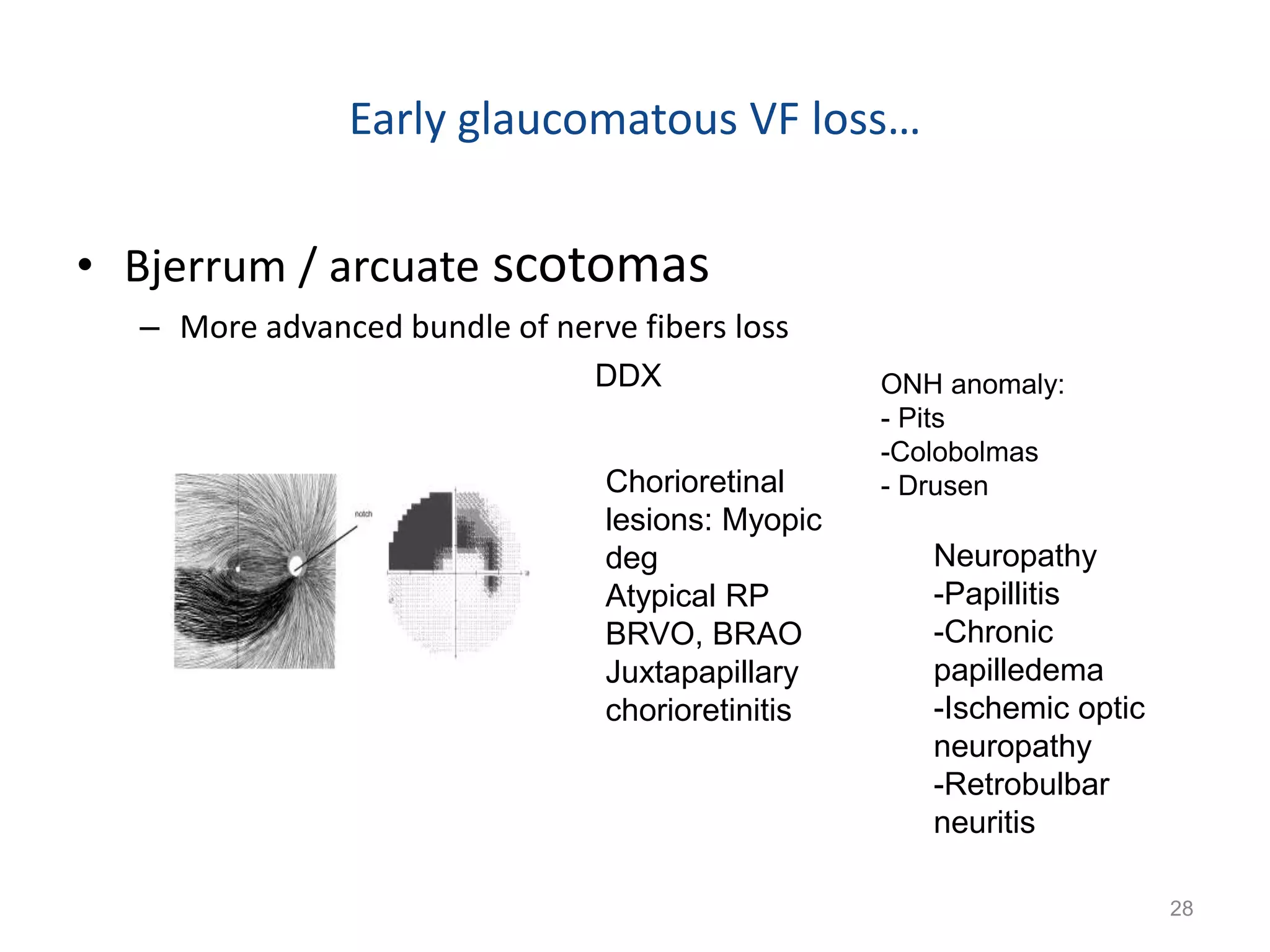
• Bjerrum / arcuate scotomas
– More advanced bundle of nerve fibers loss
28
Chorioretinal
lesions: Myopic
deg
Atypical RP
BRVO, BRAO
Juxtapapillary
chorioretinitis
ONH anomaly:
- Pits
-Colobolmas
- Drusen
Neuropathy
-Papillitis
-Chronic
papilledema
-Ischemic optic
neuropathy
-Retrobulbar
neuritis
DDX
Early glaucomatous VF loss
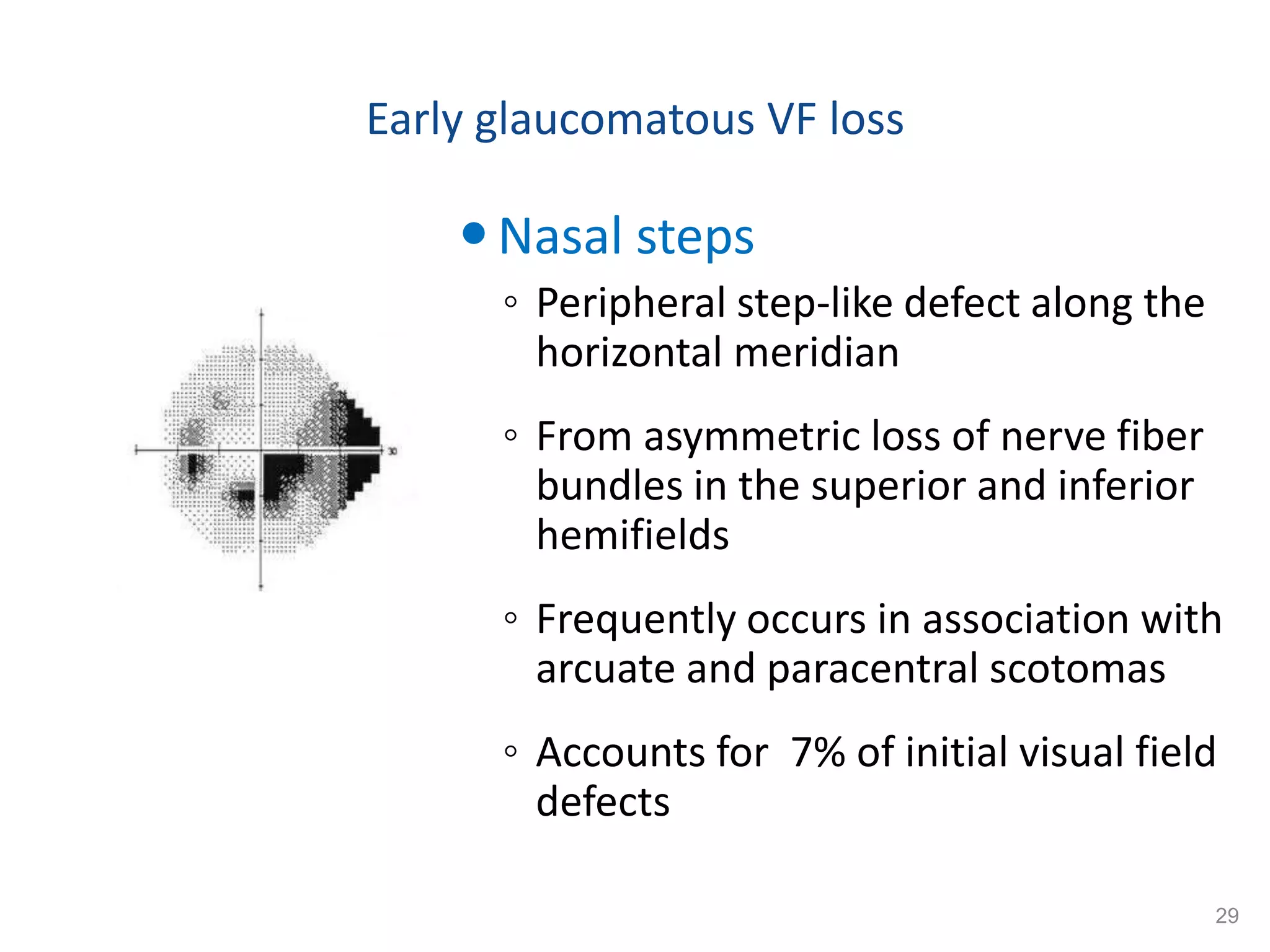
Nasal steps
◦ Peripheral step-like defect along the
horizontal meridian
◦ From asymmetric loss of nerve fiber
bundles in the superior and inferior
hemifields
◦ Frequently occurs in association with
arcuate and paracentral scotomas
◦ Accounts for 7% of initial visual field
defects
29
Early glaucomatous VF loss
• Temporal wedge defect
– Damage to nerve fibers on the
nasal side of the optic disc
– Less common
– Does not respect the
horizontal meridian
30
Early glaucomatous VF loss…
• Enlargement of blind spot
– Vertical elongation may occur with the development of a Siedel's scotoma, an early
arcute defect
– May also result from Peripapillary atrophy
Advanced glaucoma VF loss
1. Double arcuate defect
Superior and inferior arcuate fibers lost, leaving only papillomacular
32
Advanced…
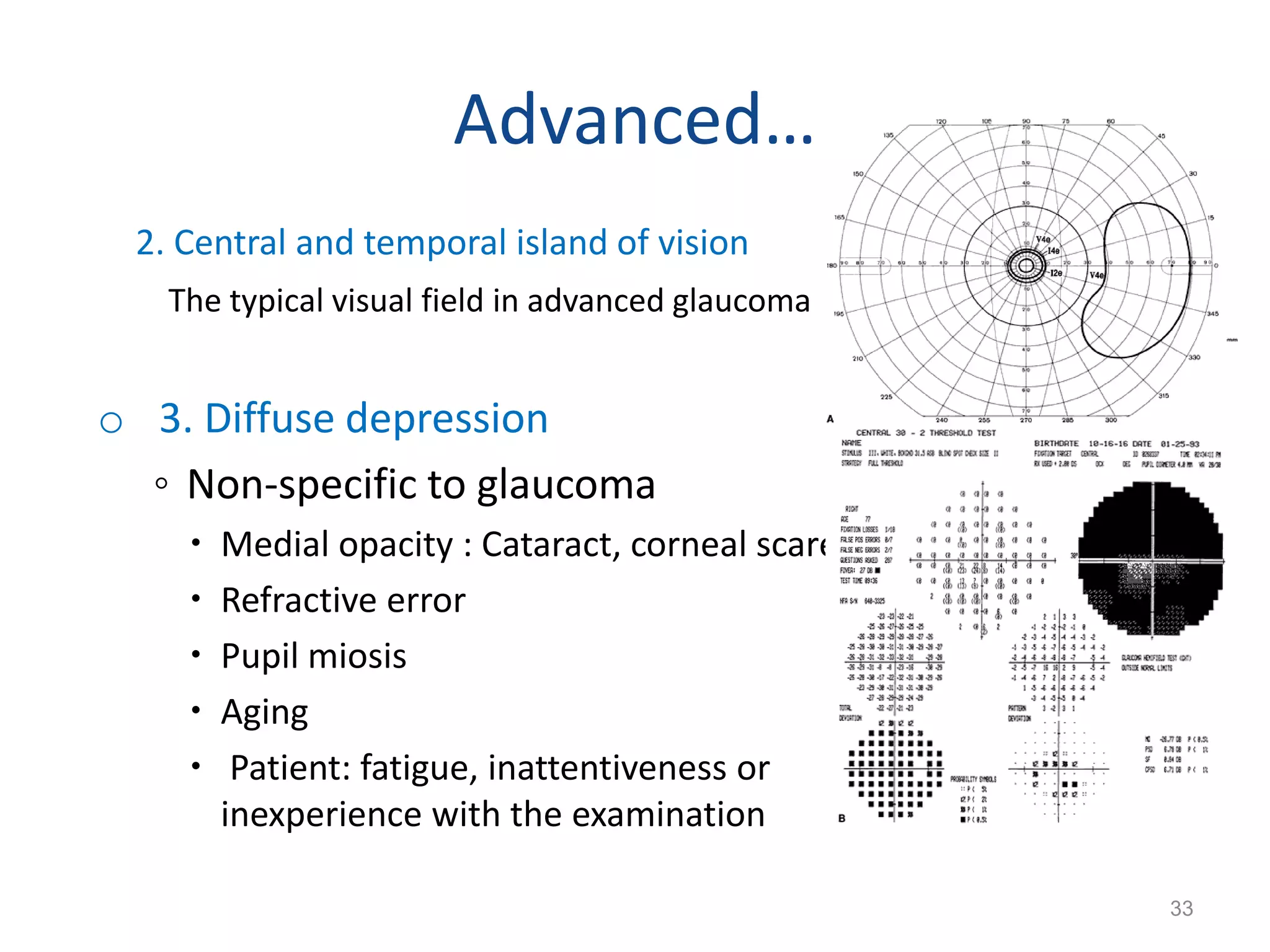
2. Central and temporal island of vision
The typical visual field in advanced glaucoma
o 3. Diffuse depression
◦ Non-specific to glaucoma
 Medial opacity : Cataract, corneal scare
 Refractive error
 Pupil miosis
 Aging
 Patient: fatigue, inattentiveness or
inexperience with the examination
33
What is perimetry ?
 Measurement of visual functions of the eye at topographically
defined loci in the visual field1
 Measures differential light sensitivity, or the ability of a
subject to distinguish a stimulus light from background
illumination2
Techniques of examination
• Confrontation
• Amsler grid
• Kinetic
• Static
Vf by confrontation
• Preliminary, quick and easy way
to measure visual field
Patients and examiner at same
level
• Compares the visual field of
eye of patient with opposite
eye of the examiner in a
plane perpendicular to line
of gaze
• Red pin is particularly useful
for neurological cases
• Kinetic Perimetry
Stimulus is moved from a non-seeing area of the visual field to
a seeing area along a set meridian
 Tangent screen, Glodmann perimeter
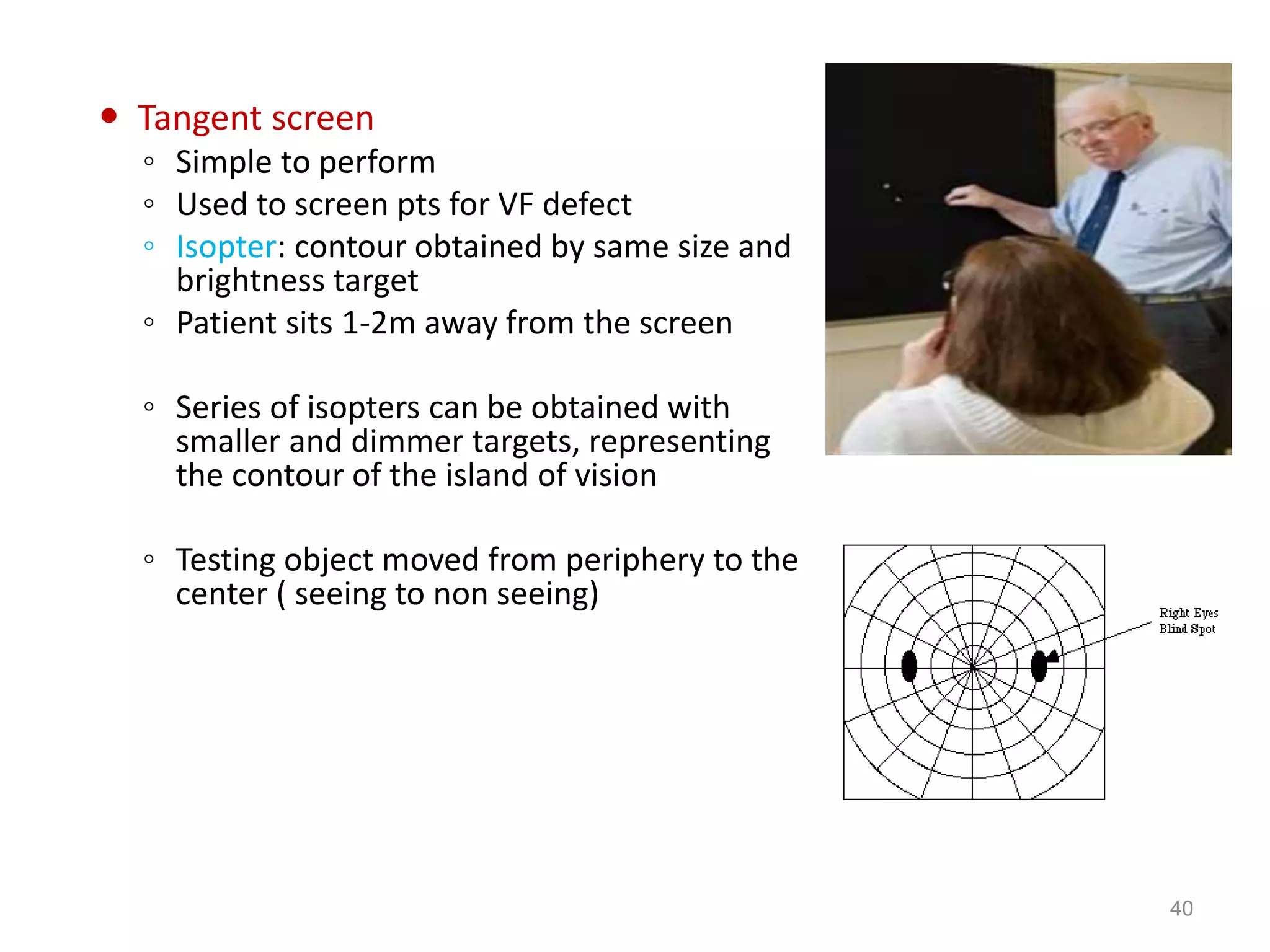
 Tangent screen
◦ Simple to perform
◦ Used to screen pts for VF defect
◦ Isopter: contour obtained by same size and
brightness target
◦ Patient sits 1-2m away from the screen
◦ Series of isopters can be obtained with
smaller and dimmer targets, representing
the contour of the island of vision
◦ Testing object moved from periphery to the
center ( seeing to non seeing)
40
Tangent…
 Used to identify, and localize scotomas in the island of
vision
◦ Deep/ absolute scotoma: area where largest and
brightest test object is not visible
◦ Relative/shallow scotoma: Defect obtained with small
or less bright testing object
◦ Drawbacks
 Non standardized lightening of the screen and brightness of
the test object
 Measures the central 30 degree only
41
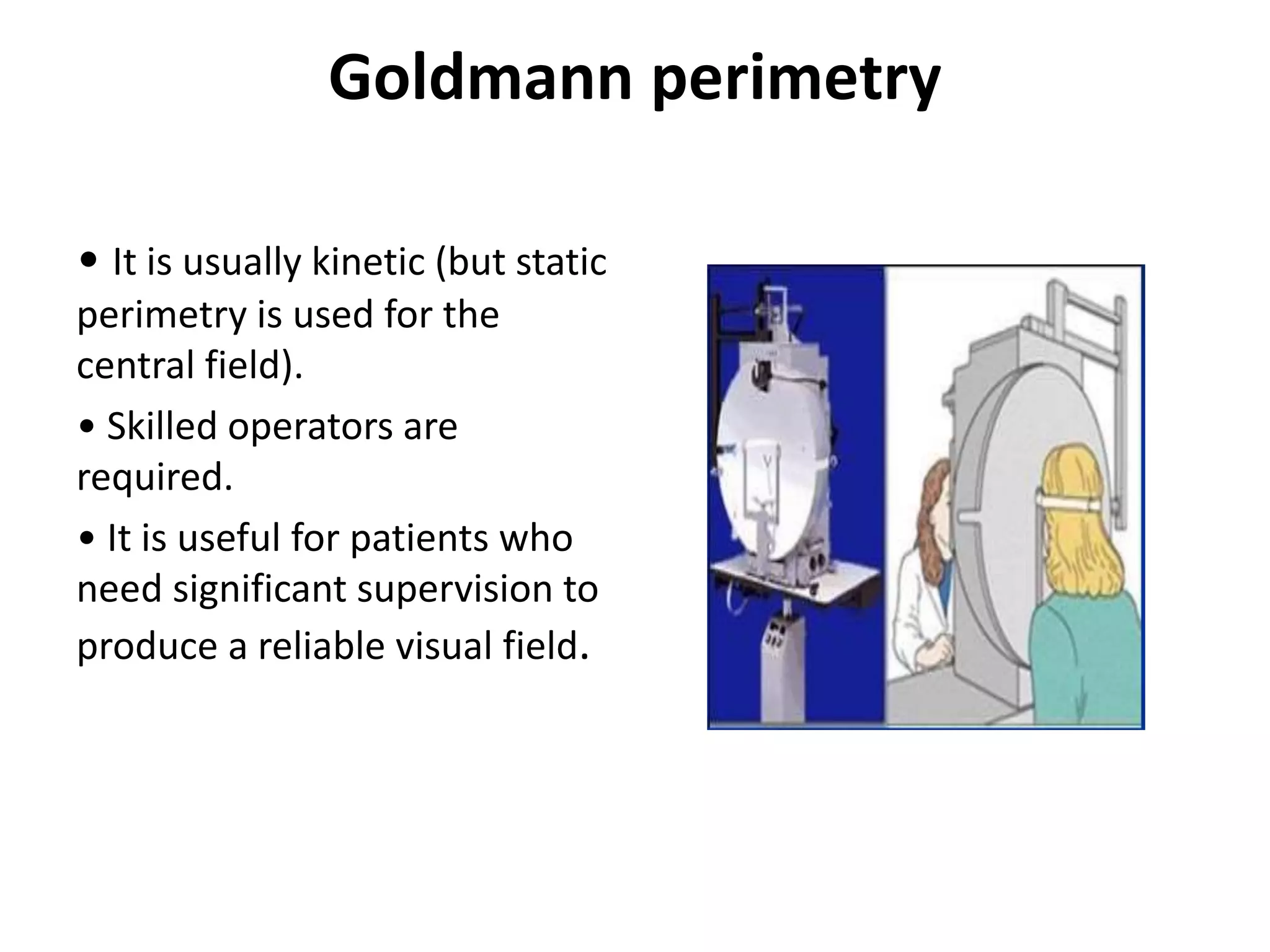
Goldmann perimetry
• It is usually kinetic (but static
perimetry is used for the
central field).
• Skilled operators are
required.
• It is useful for patients who
need significant supervision to
produce a reliable visual field.
• The target sizes are indicated by Roman
numerals (0–V),
• Representing the size of the target in square
millimeters, each successive number being
equivalent to a 4-fold increase in area.
Methods
• The machine should be calibrated at the start of each session.
• Distance and near add with wide aperture lenses are used
during testing(to prevent ring scotoma).
• Aphakic eyes should, where possible, be corrected with
contact lenses
• Seat patient with chin on the chin rest and forehead against
rest.
• Occlude the non test eye; ask patient to fix gaze on central
target and
• To press the buzzer whenever he/she sees the light stimulus.
• From the opposite side of the Goldmann, the examiner directs
the stimulus to map out the patient’s field of vision to
successive stimuli (isopters).
• The examiner should move the stimulus slowly and steadily
from unseen to seen,
• Inward for periphery and outward for mapping the blind
spot/central scotomas
• The examiner should monitor patient fixation via the viewing
telescope.
• The central 20° with an extension to the nasal 30° is
appropriate for picking up early glaucomatous scotomas
Interpretation
• The intensity of the light is represented by an Arabic numeral
(1–4),
• each successive number being 3.15 times brighter (0.5 log
unit steps).
• It is measured in apostilbs (asb).
• A lower-case letter indicates additional minor filters,
progressing from a, the darkest, to e, the brightest.
• Each progressive letter is an increase of 0.1 log unit.
Results
• Isopters are contours of visual
sensitivity. Common isopters
plotted are as follows
• I-4e (0.25 mm2, 1000 asb
stimulus).
• I-2e (0.25 mm2, 100 asb
stimulus).
• II-4e (1.0 mm2, 1000 asb
stimulus).
• IV-4e if smaller targets are not
seen (16 mm2, 1000 asb
stimulus).
Standard automated perimetry
• Automated static perimetry , also called standard automated
perimetry (SAP) is the Gold standard for glaucoma evaluation.
• Reasons
 It is more sensitive to early glaucoma changes
 Since it is computerized less variability among operators
 statistical programs can be used to do important tasks such as
 comparing the patients’ responses to a normal group of
subject responses,
 subtract out the effect of diffuse depression on the field as
occurs in cataract, and
 provide information on progression
Testing Algorithms in Standard Automated
Perimetry
1. Suprathreshold tests
• present a stimulus brighter than expected and determine
whether a subject can see it or not
• Uses in a community screening setting or
• when assessing neuron-ophthalmic, retinal disease, or visual
disability.
• but is not recommended for glaucoma diagnosis or follow-up
2. Full threshold testing
is a trial and error system whereby stimuli are shown and then
increased or decreased in intensity until an estimate is made of
the amount of light that can be seen approximately 50% of the
time.
4-2algorithm
Time consuming (15-20min)
3. The Swedish Interactive Threshold Algorithm
(SITA)
There are two SITA programs to choose from, SITA Standard
(preferred) and SITA Fast.
• Decrease time by 50% than FTS
Program selection includes the central 30°, 24°, 10°, or full field.
Humphrey perimetry
• Sensitive and reproducible
• Fixation monitoring (by
tracking gaze and retesting the
blind spot).
Method of Humphrey visual field (HVF)
• The machine automatically calibrates itself on start-up.
Selection of programs includes the following:
 full threshold or
 Swedish interactive threshold algorithm [SITA] central 30–2,
24–2, 10–2).
 Suprathreshold testing (screening central 76 point, full-field
120 point,and Esterman).
 Colored stimuli can also be use.
What to look for…
• Reliability indices (Table 2.2).
• Absolute retinal thresholds.
• Comparison to age-matched controls.
• Overall performance indices (global indices).
Unreliable VF
• Fixation losses ≥ 20%,
• False positive error ≥ 33%,
• False negative error ≥ 33%
Humphery data display
1. Reliability indices
2. Thresholds grid
(Numerical)
3. Graphic grayscale
4. Total and pattern
deviation plots with
their probability
maps
5. Global indices
65
Steps to interpreting a HVF
1. Check patient name and age
If a younger age is entered, some graphs on the field can look
much worse. Many of the calculations are based on the age
group of the patient
2. Check the field parameters
 Was this a 30-2 or a 10-2?
 Was the correct prescription used?
 Was the pupil size very small? (Makes the field look worse.)
 What was the stimulus size used?
66
Steps to interpreting a HVF
3. Check reliability
 How many fixation losses, false positives and false negatives are
present?
 Is the SF high?
4. Examine the all numeric data charts as well as the corresponding
graphs and compare them to previous HVFs
 Are new defects emerging?
 Are the focal defects found on the pattern deviation graph the
same over time?
 Is the mean deviation getting worse?
 Are there focal defects on the pattern deviation not seen on the
total deviation?
68
Probability values (p)
• These values indicate the significance of the defect <5%, <2%,
<1%, and <0.5%.
• The lower the p value, the greater its clinical significance and
the less the likelihood of the defect having occurred by
chance.
Almost always localized
Respect horizontal meridian
Begin nasal to the blind spot
Almost always detectable within the central 30°
CHARACTERISTICS OF GLAUCOMATOUS VISUAL FIELD DEFECTS
VISUAL FIELD SEVERITY GRADING SYSTEM FOR THE
HUMPHREY VISUAL FIELD ANAYLZER (STAGES 0–5)
• Stage 0 doesn’t meet any criteria from stage1
• Stage 1: Early Defect
• Mean deviation (MD) ≤ –6.00 dB and at least one of
the following:
A, On pattern deviation plot, there exists a cluster of 3 or
more points in an expected location of the visual field
depressed below the 5% level, at least 1 of which is
depressed below the 1% level
B, Corrected pattern standard deviation/pattern standard
deviation significant at P < 0.05
C, Glaucoma hemifield test “outside normal limits”
• Stage 2: Moderate Defect
MD of –6.01 to –12.00 dB and at least one of the following:
• A On pattern deviation plot, greater than or equal to 25% but
fewer than 50% of points depressed below the 5% level, and
greater than or equal to 15% but fewer than 25% of points
depressed below 1% level
• B At least 1 point within central 5° with sensitivity of < 15 dB
but no point within central 5° with sensitivity of < 0 dB
• C Only 1 hemifield containing a point with sensitivity < 15 dB
within 5° of fixation
Stage 3: Advanced Defect
MD of –12.01 dB to –20.00 dB and at least one of the
following:
A .On pattern deviation plot, greater than or equal to 50%
but fewer than 75% of points depressed below the 5% level
and greater than or equal to 25% but fewer than 50% of
points depressed below 1% level
B .Any point within central 5° with sensitivity of < 0 dB
C. Both hemifields containing a point(s) with sensitivity < 15
dB within 5° of fixation
• Stage 4: Severe Defect
MD of –20.00 dB and at least one of the following:
A. On pattern deviation plot, greater than or equal to 75% of
points depressed below the 5% level and greater than or equal
to 50% of points depressed below 1% level
B. At least 50% of points within central 5° with sensitivity of < 0
dB
C. Both hemifields containing greater than 50% of points with
sensitivity < 15 dB within 5° of fixation
• Stage 5: End-Stage Disease
 Unable to perform Humphrey visual fields in
“worst eye” due to central scotoma or
 “worst eye” visual acuity of 20/200 or worse
due to primary open-angle glaucoma. “Best
eye” may be any stage
References
• Yanoff & Duker: Ophthalmology, 3rd ed.
• Duanes foundation of clinical ophthalmology 2007ed
• BCSC neurophthalmolohy and glaucoma
• Dr. Ababa teaching lecture 2013
• Online sources
Visual field

Visual field

  • 1.
    Visual field assessmentin glaucoma patients Presenter Dr. Desta G.(R-2) Moderator Dr. Abeba T. (associat. Professor of ophthalmology, Glaucoma sup.specialist,CHS,AAU)
  • 2.
    Seminar outline • Introduction •Common visual field defects • Glaucomatous visual defects • Types of perimetry
  • 3.
    Introduction • The visualfield is that portion of the external environment of the observer where in the steadily fixating eye can detect visual stimuli (International Perimetric Society (1978) ) TRAQUAIR – “HILL OF VISION IN THE SEA OF DARKNESS”
  • 4.
  • 5.
     Physiologic blindspot ◦ Corresponds to the area of the optic nerve head ◦ Located 150 temporal to the peak of the island ◦ Span – 5 deg horizontal -- 7 deg vertical ◦ Two thirds below the horizontal meridian 5
  • 6.
    Color field • Pointat which passing from periphery to centre, the colour first becomes evident • Extent of field for objects of same size and intensity white > yellow > blue > red > green
  • 8.
    SCOTOMA : focalregion of abnormally decreased sensitivity surrounded by an area of normal sensitivity ABSOLUTE vs RELATIVE DEPRESSION : is an area of reduced sensitivity without a surrounding area of normal sensitivity appears as denting of isopters
  • 9.
    • Homonymous iswhen the defects are in the corresponding region of the visual field in both eyes. • Hemianopia, there is a defect to the side of the midline in both visual fields. • Quadrantanopia there is visual field defect in one quadrant
  • 10.
    Congruousness describes thedegree to which the field defects match between the two eyes. Generally, the more congruous the field defect the more posterior along the visual pathway the lesion is located. Isopter is a threshold line joining points of equal sensitivity on a visual field chart
  • 11.
    • A defectthat affects the nasal field of one eye and the temporal field of the other eye is described as homonymous. • Most widespread effects on vision occur where the nerve fibers of the visual pathway are tightly packed togather ,such as in optic nerve or optic tract. • The defects in a homonymous field are congruent if the two defects are similarly shaped and are incongruent if the defect shapes are dissimilar
  • 12.
    Nerve fiber bundledefects are the following 1. Papillomacular bundle 2. Sup and inf arcade bundle 3. Nasal bundle
  • 13.
    • If temporalretinal fibers are affected, an arcuate defect can be produced that curves around the point of fixation from the blind spot to termination at the horizontal nasal meridian
  • 14.
    • a lesionaffects a nasal bundle of nerves, producing a wedge- shaped defect emanating from the physiologic blind spot into the temporal field.
  • 16.
    Injury to theoptic nerve • is accompanied by a visual field defect, • a relative afferent pupillary defect, and • atrophy of the affected nerve fibers, which eventually is manifested at the disc.
  • 17.
    • Complete sectionof one nerve produces total blindness of that eye. • The pupil will not react to light directly but do consensually(affected side) • The site of other eye is normal; the pupil react to light directly but not consensually. • The pupil on the injured side will constrict on accommodation.
  • 18.
    • If theoptic nerve sectioned close to its entrance to the optic chiasm ,the inferior nasal fibers from the opposite side optic nerve that loop forward within the optic nerve will also be sectioned. • In this case, in addition to visual field loss of the same eye, there is a superior temporal defect in the field of the opposite eye. • This is known as anterior junction defect.
  • 19.
     Optic chiasm •Sagittal section of the optic chiasm will produce bitemporal hemianopia. • The pupil react normally to direct light reflex , the consensual light reflex , and accomodation reflex. • Lateral section of optic chiasm on one side divides the fibers originating from the temporal retina on that side produce nasal hemianopia. • Lateral section on both sides divides the fibers originating from both temporal retinae, produce binasal hemianopia.
  • 21.
     Optic tract •Division on one side will result in contralateral homonymous hemianopia. • The pupil react normally to the direct light reflex ,the consensual light reflex and accommodation reflex.
  • 22.
    LGN • Distraction ofLGN produces contralateral homonymous hemianopia. • The pupil react normally to the direct light reflex ,the consensual light reflex and accomodation reflex. • Lesions here eventually cause optic atrophy. • Because of point-to-point localization in LGN, lesions here produce moderately to completely congruent field defect.
  • 23.
    • Pie onthe sky vs pie on the floor • Where is the possible area of lesion?
  • 24.
     Visual cortex •Destruction of primary visual cortex produces contralateral homonymous hemianopia. • The pupils react normally to reflex stimulation. • The macula is often spared if the posterior cerebral artery is blocked by thrombosis because of anastomosis between posterior and middle cerebral arteries at this site.
  • 25.
    • Congruous fielddefects occur with lesions involving the calcarine cortex • More anterior involvement often produces incongruous field defects, suggesting that the corresponding fibers lie farther apart more anteriorly in the visual pathways.
  • 26.
    Glaucomatous VF loss Early: -Diffuse reduction / constriction of isopters - Paracentral scotoma - Bjerrum / arcuate - Nasal steps - Temporal wedge Advanced: - Double arcuate with peripheral extension - Central and temporal island of vision 26
  • 27.
    Early glaucomatous VFdefect • Paracentral scotomas – early sign of localized glaucomatous damage – Could be multiple along the course of the nerve fiber bundle 27
  • 28.
    Early glaucomatous VFloss… • Bjerrum / arcuate scotomas – More advanced bundle of nerve fibers loss 28 Chorioretinal lesions: Myopic deg Atypical RP BRVO, BRAO Juxtapapillary chorioretinitis ONH anomaly: - Pits -Colobolmas - Drusen Neuropathy -Papillitis -Chronic papilledema -Ischemic optic neuropathy -Retrobulbar neuritis DDX
  • 29.
    Early glaucomatous VFloss Nasal steps ◦ Peripheral step-like defect along the horizontal meridian ◦ From asymmetric loss of nerve fiber bundles in the superior and inferior hemifields ◦ Frequently occurs in association with arcuate and paracentral scotomas ◦ Accounts for 7% of initial visual field defects 29
  • 30.
    Early glaucomatous VFloss • Temporal wedge defect – Damage to nerve fibers on the nasal side of the optic disc – Less common – Does not respect the horizontal meridian 30
  • 31.
    Early glaucomatous VFloss… • Enlargement of blind spot – Vertical elongation may occur with the development of a Siedel's scotoma, an early arcute defect – May also result from Peripapillary atrophy
  • 32.
    Advanced glaucoma VFloss 1. Double arcuate defect Superior and inferior arcuate fibers lost, leaving only papillomacular 32
  • 33.
    Advanced… 2. Central andtemporal island of vision The typical visual field in advanced glaucoma o 3. Diffuse depression ◦ Non-specific to glaucoma  Medial opacity : Cataract, corneal scare  Refractive error  Pupil miosis  Aging  Patient: fatigue, inattentiveness or inexperience with the examination 33
  • 34.
    What is perimetry?  Measurement of visual functions of the eye at topographically defined loci in the visual field1  Measures differential light sensitivity, or the ability of a subject to distinguish a stimulus light from background illumination2
  • 35.
    Techniques of examination •Confrontation • Amsler grid • Kinetic • Static
  • 36.
    Vf by confrontation •Preliminary, quick and easy way to measure visual field Patients and examiner at same level • Compares the visual field of eye of patient with opposite eye of the examiner in a plane perpendicular to line of gaze • Red pin is particularly useful for neurological cases
  • 38.
    • Kinetic Perimetry Stimulusis moved from a non-seeing area of the visual field to a seeing area along a set meridian  Tangent screen, Glodmann perimeter
  • 40.
     Tangent screen ◦Simple to perform ◦ Used to screen pts for VF defect ◦ Isopter: contour obtained by same size and brightness target ◦ Patient sits 1-2m away from the screen ◦ Series of isopters can be obtained with smaller and dimmer targets, representing the contour of the island of vision ◦ Testing object moved from periphery to the center ( seeing to non seeing) 40
  • 41.
    Tangent…  Used toidentify, and localize scotomas in the island of vision ◦ Deep/ absolute scotoma: area where largest and brightest test object is not visible ◦ Relative/shallow scotoma: Defect obtained with small or less bright testing object ◦ Drawbacks  Non standardized lightening of the screen and brightness of the test object  Measures the central 30 degree only 41
  • 42.
    Goldmann perimetry • Itis usually kinetic (but static perimetry is used for the central field). • Skilled operators are required. • It is useful for patients who need significant supervision to produce a reliable visual field.
  • 43.
    • The targetsizes are indicated by Roman numerals (0–V), • Representing the size of the target in square millimeters, each successive number being equivalent to a 4-fold increase in area.
  • 45.
    Methods • The machineshould be calibrated at the start of each session. • Distance and near add with wide aperture lenses are used during testing(to prevent ring scotoma). • Aphakic eyes should, where possible, be corrected with contact lenses
  • 46.
    • Seat patientwith chin on the chin rest and forehead against rest. • Occlude the non test eye; ask patient to fix gaze on central target and • To press the buzzer whenever he/she sees the light stimulus.
  • 47.
    • From theopposite side of the Goldmann, the examiner directs the stimulus to map out the patient’s field of vision to successive stimuli (isopters).
  • 48.
    • The examinershould move the stimulus slowly and steadily from unseen to seen, • Inward for periphery and outward for mapping the blind spot/central scotomas
  • 49.
    • The examinershould monitor patient fixation via the viewing telescope. • The central 20° with an extension to the nasal 30° is appropriate for picking up early glaucomatous scotomas
  • 50.
    Interpretation • The intensityof the light is represented by an Arabic numeral (1–4), • each successive number being 3.15 times brighter (0.5 log unit steps). • It is measured in apostilbs (asb).
  • 51.
    • A lower-caseletter indicates additional minor filters, progressing from a, the darkest, to e, the brightest. • Each progressive letter is an increase of 0.1 log unit.
  • 52.
    Results • Isopters arecontours of visual sensitivity. Common isopters plotted are as follows • I-4e (0.25 mm2, 1000 asb stimulus). • I-2e (0.25 mm2, 100 asb stimulus). • II-4e (1.0 mm2, 1000 asb stimulus). • IV-4e if smaller targets are not seen (16 mm2, 1000 asb stimulus).
  • 53.
    Standard automated perimetry •Automated static perimetry , also called standard automated perimetry (SAP) is the Gold standard for glaucoma evaluation. • Reasons  It is more sensitive to early glaucoma changes  Since it is computerized less variability among operators  statistical programs can be used to do important tasks such as  comparing the patients’ responses to a normal group of subject responses,  subtract out the effect of diffuse depression on the field as occurs in cataract, and  provide information on progression
  • 54.
    Testing Algorithms inStandard Automated Perimetry 1. Suprathreshold tests • present a stimulus brighter than expected and determine whether a subject can see it or not • Uses in a community screening setting or • when assessing neuron-ophthalmic, retinal disease, or visual disability. • but is not recommended for glaucoma diagnosis or follow-up
  • 55.
    2. Full thresholdtesting is a trial and error system whereby stimuli are shown and then increased or decreased in intensity until an estimate is made of the amount of light that can be seen approximately 50% of the time. 4-2algorithm Time consuming (15-20min)
  • 56.
    3. The SwedishInteractive Threshold Algorithm (SITA) There are two SITA programs to choose from, SITA Standard (preferred) and SITA Fast. • Decrease time by 50% than FTS Program selection includes the central 30°, 24°, 10°, or full field.
  • 58.
    Humphrey perimetry • Sensitiveand reproducible • Fixation monitoring (by tracking gaze and retesting the blind spot).
  • 59.
    Method of Humphreyvisual field (HVF) • The machine automatically calibrates itself on start-up. Selection of programs includes the following:  full threshold or  Swedish interactive threshold algorithm [SITA] central 30–2, 24–2, 10–2).  Suprathreshold testing (screening central 76 point, full-field 120 point,and Esterman).  Colored stimuli can also be use.
  • 60.
    What to lookfor… • Reliability indices (Table 2.2). • Absolute retinal thresholds. • Comparison to age-matched controls. • Overall performance indices (global indices).
  • 62.
    Unreliable VF • Fixationlosses ≥ 20%, • False positive error ≥ 33%, • False negative error ≥ 33%
  • 65.
    Humphery data display 1.Reliability indices 2. Thresholds grid (Numerical) 3. Graphic grayscale 4. Total and pattern deviation plots with their probability maps 5. Global indices 65
  • 66.
    Steps to interpretinga HVF 1. Check patient name and age If a younger age is entered, some graphs on the field can look much worse. Many of the calculations are based on the age group of the patient 2. Check the field parameters  Was this a 30-2 or a 10-2?  Was the correct prescription used?  Was the pupil size very small? (Makes the field look worse.)  What was the stimulus size used? 66
  • 67.
    Steps to interpretinga HVF 3. Check reliability  How many fixation losses, false positives and false negatives are present?  Is the SF high? 4. Examine the all numeric data charts as well as the corresponding graphs and compare them to previous HVFs  Are new defects emerging?  Are the focal defects found on the pattern deviation graph the same over time?  Is the mean deviation getting worse?  Are there focal defects on the pattern deviation not seen on the total deviation?
  • 68.
  • 69.
    Probability values (p) •These values indicate the significance of the defect <5%, <2%, <1%, and <0.5%. • The lower the p value, the greater its clinical significance and the less the likelihood of the defect having occurred by chance.
  • 70.
    Almost always localized Respecthorizontal meridian Begin nasal to the blind spot Almost always detectable within the central 30° CHARACTERISTICS OF GLAUCOMATOUS VISUAL FIELD DEFECTS
  • 71.
    VISUAL FIELD SEVERITYGRADING SYSTEM FOR THE HUMPHREY VISUAL FIELD ANAYLZER (STAGES 0–5) • Stage 0 doesn’t meet any criteria from stage1 • Stage 1: Early Defect • Mean deviation (MD) ≤ –6.00 dB and at least one of the following: A, On pattern deviation plot, there exists a cluster of 3 or more points in an expected location of the visual field depressed below the 5% level, at least 1 of which is depressed below the 1% level B, Corrected pattern standard deviation/pattern standard deviation significant at P < 0.05 C, Glaucoma hemifield test “outside normal limits”
  • 72.
    • Stage 2:Moderate Defect MD of –6.01 to –12.00 dB and at least one of the following: • A On pattern deviation plot, greater than or equal to 25% but fewer than 50% of points depressed below the 5% level, and greater than or equal to 15% but fewer than 25% of points depressed below 1% level • B At least 1 point within central 5° with sensitivity of < 15 dB but no point within central 5° with sensitivity of < 0 dB • C Only 1 hemifield containing a point with sensitivity < 15 dB within 5° of fixation
  • 73.
    Stage 3: AdvancedDefect MD of –12.01 dB to –20.00 dB and at least one of the following: A .On pattern deviation plot, greater than or equal to 50% but fewer than 75% of points depressed below the 5% level and greater than or equal to 25% but fewer than 50% of points depressed below 1% level B .Any point within central 5° with sensitivity of < 0 dB C. Both hemifields containing a point(s) with sensitivity < 15 dB within 5° of fixation
  • 74.
    • Stage 4:Severe Defect MD of –20.00 dB and at least one of the following: A. On pattern deviation plot, greater than or equal to 75% of points depressed below the 5% level and greater than or equal to 50% of points depressed below 1% level B. At least 50% of points within central 5° with sensitivity of < 0 dB C. Both hemifields containing greater than 50% of points with sensitivity < 15 dB within 5° of fixation
  • 75.
    • Stage 5:End-Stage Disease  Unable to perform Humphrey visual fields in “worst eye” due to central scotoma or  “worst eye” visual acuity of 20/200 or worse due to primary open-angle glaucoma. “Best eye” may be any stage
  • 76.
    References • Yanoff &Duker: Ophthalmology, 3rd ed. • Duanes foundation of clinical ophthalmology 2007ed • BCSC neurophthalmolohy and glaucoma • Dr. Ababa teaching lecture 2013 • Online sources