Immunochromatography
Guide
www.creative-diagnostics.com
Introduction
 Immunochromatography assay (ICA), namely lateral flow test, is a
simple device intended to detect the presence or absence of the
target analyte.
 The concept of immune-chromatography is a combination of
chromatography and immunochemical reactions.
www.creative-diagnostics.com
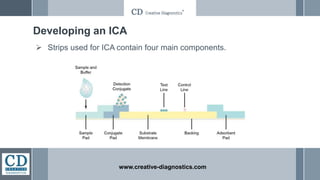
Developing an ICA
 Strips used for ICA contain four main components.
www.creative-diagnostics.com
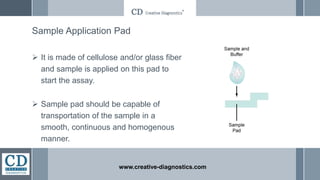
Sample Application Pad
 It is made of cellulose and/or glass fiber
and sample is applied on this pad to
start the assay.
 Sample pad should be capable of
transportation of the sample in a
smooth, continuous and homogenous
manner.
www.creative-diagnostics.com
Conjugate Pad
 It is the place where labeled
biorecognition molecules (labeled
antibodies, usually nano colloid gold
particle) are dispensed.
 Poor preparation of labeled conjugate
can adversely affect sensitivity of the
assay.
www.creative-diagnostics.com
Substrate (Nitrocellulose) Membrane
 It is highly critical in determining
sensitivity of ICA. Test and control lines
are drawn over this piece of membrane.
 Proper dispensing of bioreagents, drying
and blocking play a role in improving
sensitivity of the assay.
www.creative-diagnostics.com
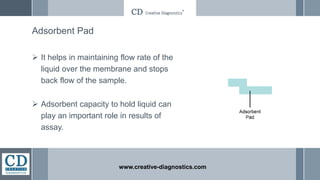
Adsorbent Pad
 It helps in maintaining flow rate of the
liquid over the membrane and stops
back flow of the sample.
 Adsorbent capacity to hold liquid can
play an important role in results of
assay.
www.creative-diagnostics.com
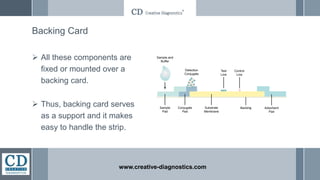
Backing Card
 All these components are
fixed or mounted over a
backing card.
 Thus, backing card serves
as a support and it makes
easy to handle the strip.
www.creative-diagnostics.com
1 2 3 4 5 6
Major Steps in ICA
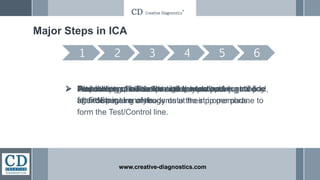
 Preparation of labeled antibody and capture antibody
against target analyte.
www.creative-diagnostics.com
 Immobilizing the labeled antibody onto conjugate pad,
and the capture antibody onto the strip membrane to
form the Test/Control line.
 Assembling of all components onto a backing card
after dispensing of reagents at their proper pads.
 Add samples and buffer onto sample pad. Wait the sample flow through the test and control line
for 5-10min.
 Read the result when the color reveals.
ICA Format
 Lateral flow assay basically combines a number of
variants such as formats, biorecognition molecules,
labels, detection systems and applications.
 There are three types of ICAs based on detection
format.
www.creative-diagnostics.com
Sandwich Assay
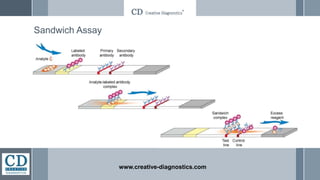
 In this assay format, label coated antibody is
immobilized at conjugate pad.
 A capture antibody against target analyte is immobilized
over test line.
 A secondary antibody against labeled antibody is
immobilized at control zone.
www.creative-diagnostics.com
Sandwich Assay
www.creative-diagnostics.com
Competitive Assay
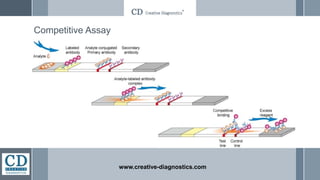
 Such format suits best for low molecular weight
compounds which cannot bind two antibodies
simultaneously.
 Absence of color at test line is an indication for the
presence of analyte while appearance of color both at
test and control lines indicates a negative result.
www.creative-diagnostics.com
Competitive Assay
www.creative-diagnostics.com
Multiplex Detection Assay
 Multiplex detection format is used for detection of more than one
target species and assay is performed over the strip containing test
lines equal to number of target species to be analyzed.
 Multiplex detection format is very useful in clinical diagnosis where
multiple analytes which are inter-dependent in deciding about the
stage of a disease are to be detected.
www.creative-diagnostics.com
Advantages and Limitations
 Lateral flow immunoassays represent a well-established and
very appropriate technology when applied to a wide variety of
point-of-care (POC) or field use applications.
www.creative-diagnostics.com
Advantages
• Relative ease of manufacture
• Stable - shelf-lives of 12-24 months often without refrigeration
• Ease of use
• Can handle small volumes of multiple sample types
• Can be integrated with onboard electronics, reader systems, and information
systems
• Relatively low cost and short timeline for development and approval
• Market presence and acceptance
Limitations
• Miniaturization of sample volume requirements below microliter level
• Multiplexing: simultaneous analysis of multiple markers difficult
• Integration with onboard electronics and built-in QC functions challenging
• Sensitivity issues in some systems
• Test-to-test reproducibility challenging - limits applications in quantitative systems
www.creative-diagnostics.com
Thanks
For more info about immunochromatography
services or rapid test kits,
Please visit: www.creative-diagnostics.com
www.creative-diagnostics.com

Immunochromatography guide

  • 1.
  • 2.
    Introduction  Immunochromatography assay(ICA), namely lateral flow test, is a simple device intended to detect the presence or absence of the target analyte.  The concept of immune-chromatography is a combination of chromatography and immunochemical reactions. www.creative-diagnostics.com
  • 3.
    Developing an ICA Strips used for ICA contain four main components. www.creative-diagnostics.com
  • 4.
    Sample Application Pad It is made of cellulose and/or glass fiber and sample is applied on this pad to start the assay.  Sample pad should be capable of transportation of the sample in a smooth, continuous and homogenous manner. www.creative-diagnostics.com
  • 5.
    Conjugate Pad  Itis the place where labeled biorecognition molecules (labeled antibodies, usually nano colloid gold particle) are dispensed.  Poor preparation of labeled conjugate can adversely affect sensitivity of the assay. www.creative-diagnostics.com
  • 6.
    Substrate (Nitrocellulose) Membrane It is highly critical in determining sensitivity of ICA. Test and control lines are drawn over this piece of membrane.  Proper dispensing of bioreagents, drying and blocking play a role in improving sensitivity of the assay. www.creative-diagnostics.com
  • 7.
    Adsorbent Pad  Ithelps in maintaining flow rate of the liquid over the membrane and stops back flow of the sample.  Adsorbent capacity to hold liquid can play an important role in results of assay. www.creative-diagnostics.com
  • 8.
    Backing Card  Allthese components are fixed or mounted over a backing card.  Thus, backing card serves as a support and it makes easy to handle the strip. www.creative-diagnostics.com
  • 9.
    1 2 34 5 6 Major Steps in ICA  Preparation of labeled antibody and capture antibody against target analyte. www.creative-diagnostics.com  Immobilizing the labeled antibody onto conjugate pad, and the capture antibody onto the strip membrane to form the Test/Control line.  Assembling of all components onto a backing card after dispensing of reagents at their proper pads.  Add samples and buffer onto sample pad. Wait the sample flow through the test and control line for 5-10min.  Read the result when the color reveals.
  • 10.
    ICA Format  Lateralflow assay basically combines a number of variants such as formats, biorecognition molecules, labels, detection systems and applications.  There are three types of ICAs based on detection format. www.creative-diagnostics.com
  • 11.
    Sandwich Assay  Inthis assay format, label coated antibody is immobilized at conjugate pad.  A capture antibody against target analyte is immobilized over test line.  A secondary antibody against labeled antibody is immobilized at control zone. www.creative-diagnostics.com
  • 12.
  • 13.
    Competitive Assay  Suchformat suits best for low molecular weight compounds which cannot bind two antibodies simultaneously.  Absence of color at test line is an indication for the presence of analyte while appearance of color both at test and control lines indicates a negative result. www.creative-diagnostics.com
  • 14.
  • 15.
    Multiplex Detection Assay Multiplex detection format is used for detection of more than one target species and assay is performed over the strip containing test lines equal to number of target species to be analyzed.  Multiplex detection format is very useful in clinical diagnosis where multiple analytes which are inter-dependent in deciding about the stage of a disease are to be detected. www.creative-diagnostics.com
  • 16.
    Advantages and Limitations Lateral flow immunoassays represent a well-established and very appropriate technology when applied to a wide variety of point-of-care (POC) or field use applications. www.creative-diagnostics.com
  • 17.
    Advantages • Relative easeof manufacture • Stable - shelf-lives of 12-24 months often without refrigeration • Ease of use • Can handle small volumes of multiple sample types • Can be integrated with onboard electronics, reader systems, and information systems • Relatively low cost and short timeline for development and approval • Market presence and acceptance Limitations • Miniaturization of sample volume requirements below microliter level • Multiplexing: simultaneous analysis of multiple markers difficult • Integration with onboard electronics and built-in QC functions challenging • Sensitivity issues in some systems • Test-to-test reproducibility challenging - limits applications in quantitative systems www.creative-diagnostics.com
  • 18.
  • 19.
    Thanks For more infoabout immunochromatography services or rapid test kits, Please visit: www.creative-diagnostics.com www.creative-diagnostics.com