theoretical basis and optimization of
immunoassay
BY
AKANKSH DAS
1ST M PHARM
PHARMACOLOGY
1
INTRODUCTION TO IMMUNOASSAY
 Immunoassays are bioanalytical methods in which the quantitation of the analyte
depends on the reaction of an antigen (analyte) and an antibody.
 Immunoassays have been widely used in many important areas of
pharmaceutical analysis such as diagnosis of diseases, therapeutic drug
monitoring, clinical pharmacokinetic and bioequivalence studies in drug
discovery and pharmaceutical industries.
 The importance and widespread of immunoassay methods in pharmaceutical
analysis are attributed to their inherent specificity,high sensitivity for the analysis
of wide range of analytes in biological samples.
2
Principle
 These methods are based on a competitive binding reaction between a fixed amount
of labelled form of an analyte and a variable amount of unlabelled sample analyte for a
limited amount of binding sites on a highly specific anti-analyte antibody.
 When these immunoanalytical reagents are mixed and incubated, the analyte is bound
to the antibody forming an immune complex.
 This complex is separated from the unbound reagent fraction by physical or chemical
separation technique.
 Analysis is achieved by measuring the label activity (e.g. radiation, fluorescence, or
enzyme) in either of the bound or free fraction. A standard curve, which represents the
measured signal as a function of the concentration of the unlabelled analyte in the
sample is constructed.
3
Immunoassay methods have been widely used in many important areas of
pharmaceutical analysis such as :
 Diagnosis of diseases
 Therapeutic drug monitoring
 Clinical pharmacokinetic
 Bioequivalence studies in drug discovery and pharmaceutical industries
 The detection system in immunoassays depends on readily detectable labels (e.g.
radioisotopes or enzymes) coupled to one of the immunoanalytical reagents (i.e.
analyte or antibody).
 The use of these labels in immunoassays results in assay methods with extremely
high sensitivity and low limits of detection
4
BASICMETHODOLOGY INVOLVEDIN PHARMACEUTICAL
ANALYSIS
 Immunoassay methods that have been applied in pharmaceutical
analysis, based on whether the separation step is or is not required,
can be classified into heterogeneous or homogeneous assay.
 These methods can be performed in either competitive or non-
competitive designs.
 The choice from these designs is based on nature of the analyte,
labeling chemistry available and the analytical parameter required
from the assay (e.g. sensitivity, dynamic range, and precision).
5
 TYPES
 Competitive immunoassay
 Non-Competitive immunoassay
 Homogenous immunoassay
 Heterogenous immunoassay
6
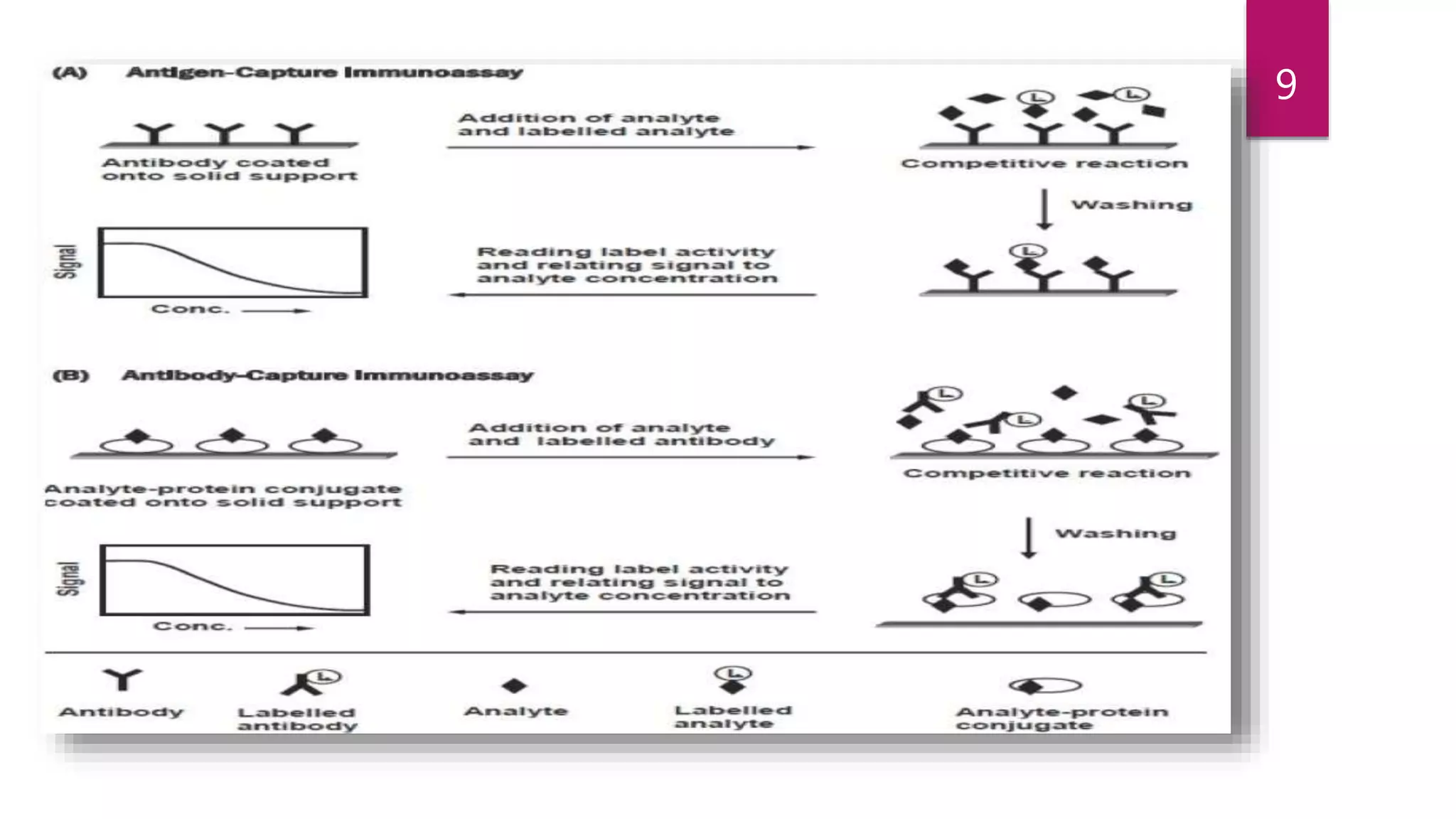
 Competitive immunoassay :
 Competitive design of immunoassays can be carried out in an antigen-capture or
antibody-capture format, depending on whether the solid phase is coated with
antibody or antigen (analyte), respectively.
 In the antigen-capture format,The competition reaction occurs between the
analyte (in sample) and a labelled analyte for the binding to a limited amount of
anti-analyte antibody coated onto a solid support.
 After equilibration and separation, the label activity on the solid phase is
measured, and the measured signal is inversely correlated to the concentrations of
analyte in the sample.
7
 In antibody-capture format the analyte (or its protein conjugate) is coated
onto a solid support.
 The competition occurs between the analyte (in sample) and the immobilized
analyte for the binding to a limited amount of labelled anti-analyte antibody.
 After equilibration and separation, the activity of the label bound to the solid
support is measured, and the signal is inversely correlated to the
concentration of the analyte.
8
9
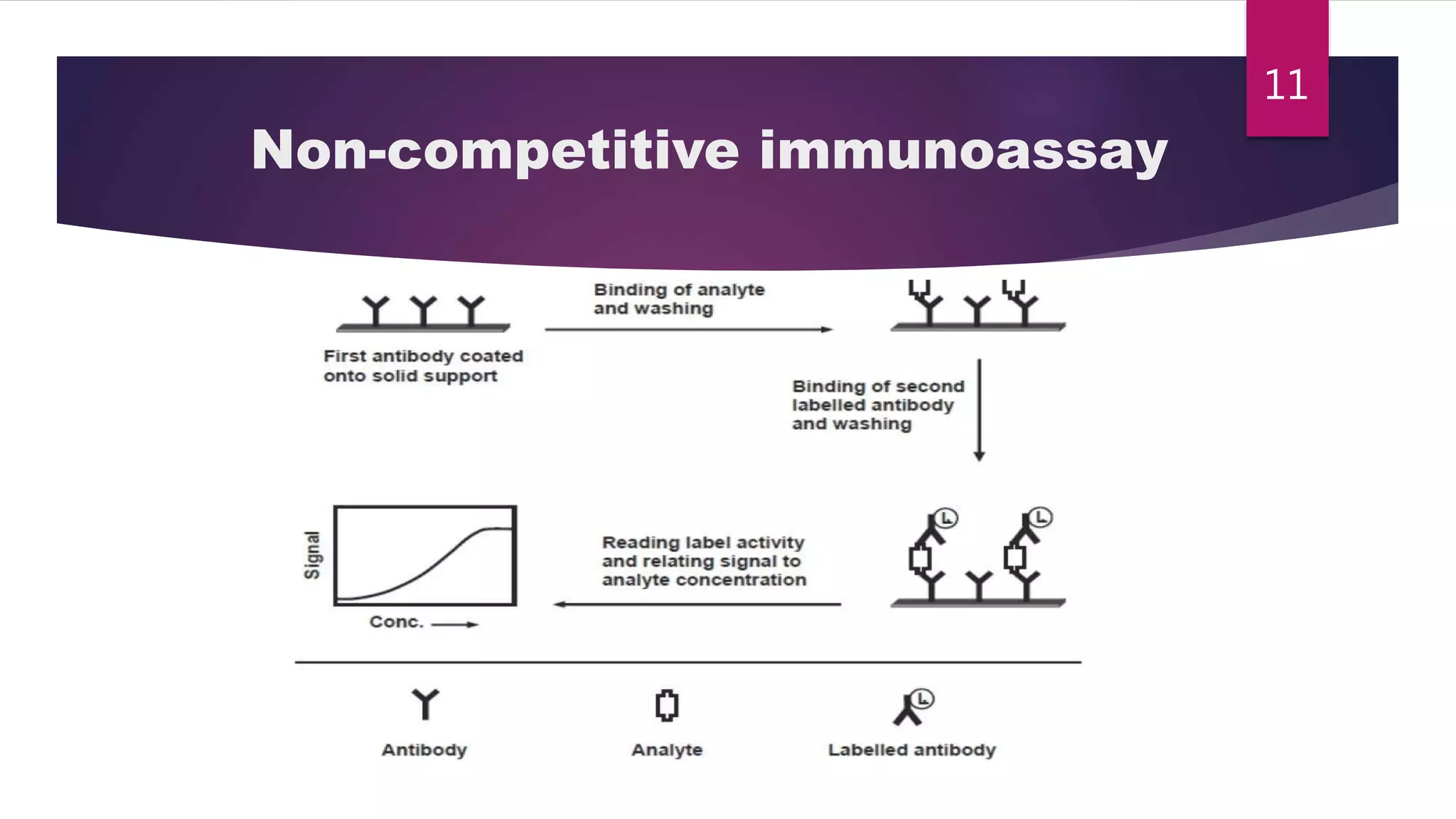
 Non-competitive immunoassay(“two-site” or “sandwich” assay)
 The non-competitive design is used for large analytes possessing more than one
recognition epitopes on the molecule. It requires two antibodies that bind to non-
overlapping epitopes on the analyte molecules.
 One of the two antibodies is bound to the solid phase, and the second one is
labelled and used for detection.
 The sample analyte is allowed to bind to an immobilized antibody. After washing,
the solid support (contains the formed analyte-antibody complex) is incubated
with an excess of the second labelled antibody, which binds to the remaining
epitope on the analyte molecule.
 After washing, the activity of the label bound to the solid support is measured
10
Non-competitive immunoassay
11
Homogeneous AND Heterogeneous IMMUNOASSAY
METHODS
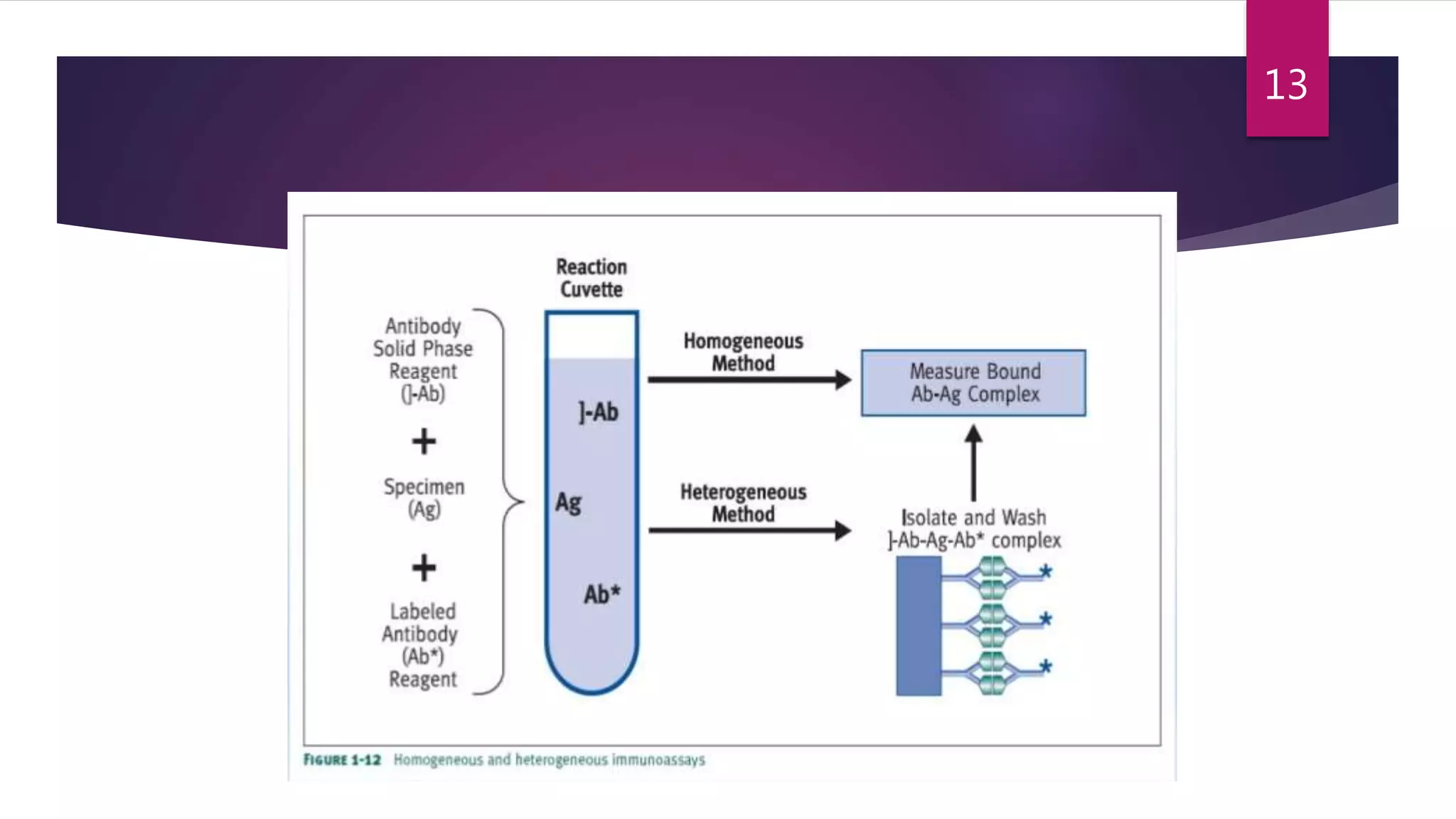
 Immunoassay that require separation of bound Ab-Ag* complex area referred as
heterogeneous immunoassay.
 Those that do not require separation are referred as homogeneous immunoassay.
 Homogeneous immunoassay
 Homogeneous are generally applied to the measurement of small analytes such as
therapeutic drugs.
 Since homogeneous methods do not require separation of the bound Ab-Ag*
from the free Ag*, they are generally much easier and faster to perform.
12
13
14
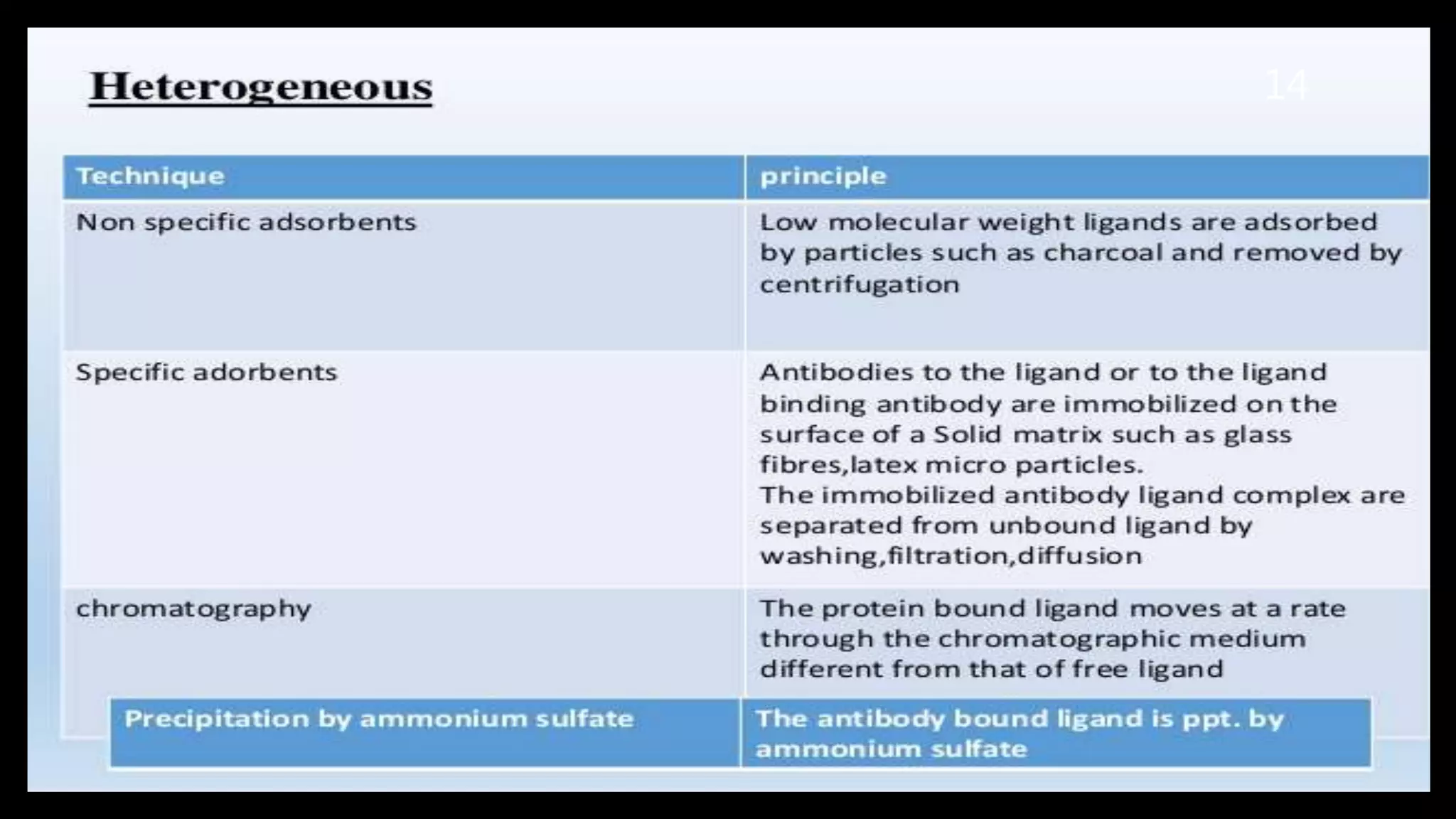
 Heterogeneous immunoassay :
 It measures both small and large molecule.
 Heterogeneous immunoassay such as the popular ELISA (Enzyme Linked
Immuno Sorbent Assay)can be used both qualitatively and quantitatively
to measure antigen antibody binding.
 Depending upon what variation you use it will detect
antigen(hormones,enzymes,microbial enzymes) or antibody ( anti-HIV in
the screening test for HIV infection) in body fluids.
15
enzyme-linked immunosorbent assay ( ELISA)
 ELISA is a commonly used analytical biochemistry assay.
 The assay uses a solid-phase enzyme immunoassay (EIA) to detect the presence
of a ligand (commonly a protein) in a liquid sample using antibodies directed
against the protein to be measured.
 ELISA has been used as a diagnostic tool in medicine, plant pathology,
and biotechnology, as well as a quality control check in various industries.
 In the most simple form of an ELISA, antigens from the sample are attached to a
surface. Then, a matching antibody is applied over the surface so it can bind to the
antigen.
 This antibody is linked to an enzyme, and in the final step, a substance containing
the enzyme's substrate is added. The subsequent reaction produces a detectable
signal, most commonly a color change.
16
 ELISA tests are broken into several types of tests based on how the analytes and
antibodies are bonded and used.The major types are described here.
 Direct ELISA
 Indirect ELISA
 Sandwich ELISA
17
Steps to Optimize Immunoassay Performance
 Minimize background and promote higher specific signal : There are a variety
of methods to promote a strong signal while minimizing nonspecific binding and
background noise.
 Use an efficient plate coating buffer to provide a stabilized coating of the
antibody or antigen on the microtiter plate.
 use a blocking buffer to block assay wells. This blocking of unoccupied space in
the plate wells prevents nonspecific binding of sample and assay components and
reduces the overall background signal.
 Using the proper sample diluents will dilute the samples to read within the
functional range, minimize sample matrix effects, block nonspecific conjugate
binding.
18
 Improve precision
 It is necessary to reduce plate to plate variability when preparing immunoassays.
Protein stabilizing buffers allow plates to be prepared in batches to be used over
time, which increases consistency and provides increased plate to plate precision
over extensive storage periods.
 Increase assay reproducibility
 To increase the reproducibility of any custom ELISA or immunoassay, it is
important to source reagents from a consistent and reliable supplier.
 Stabilize protein conjugates
 stabilizing conjugates enables you to store conjugated proteins and antibodies
future use, prepare batches of diluted, ready-to-use conjugate aliquots, and
reconstitute lyophilized conjugates while preserving native protein configuration
and activity.
19
 Increase shelf-life
 Using dependable stabilizing and blocking buffers to stabilize proteins allow you
to store your prepared microtiter plates.
 Depending on the type of protein, properly prepared plates can be stored under
proper conditions for several months or even years if prepared using reliable
reagents.
20
THANK YOU
21

Theoretical basis and optimization of immunoassay

  • 1.
    theoretical basis andoptimization of immunoassay BY AKANKSH DAS 1ST M PHARM PHARMACOLOGY 1
  • 2.
    INTRODUCTION TO IMMUNOASSAY Immunoassays are bioanalytical methods in which the quantitation of the analyte depends on the reaction of an antigen (analyte) and an antibody.  Immunoassays have been widely used in many important areas of pharmaceutical analysis such as diagnosis of diseases, therapeutic drug monitoring, clinical pharmacokinetic and bioequivalence studies in drug discovery and pharmaceutical industries.  The importance and widespread of immunoassay methods in pharmaceutical analysis are attributed to their inherent specificity,high sensitivity for the analysis of wide range of analytes in biological samples. 2
  • 3.
    Principle  These methodsare based on a competitive binding reaction between a fixed amount of labelled form of an analyte and a variable amount of unlabelled sample analyte for a limited amount of binding sites on a highly specific anti-analyte antibody.  When these immunoanalytical reagents are mixed and incubated, the analyte is bound to the antibody forming an immune complex.  This complex is separated from the unbound reagent fraction by physical or chemical separation technique.  Analysis is achieved by measuring the label activity (e.g. radiation, fluorescence, or enzyme) in either of the bound or free fraction. A standard curve, which represents the measured signal as a function of the concentration of the unlabelled analyte in the sample is constructed. 3
  • 4.
    Immunoassay methods havebeen widely used in many important areas of pharmaceutical analysis such as :  Diagnosis of diseases  Therapeutic drug monitoring  Clinical pharmacokinetic  Bioequivalence studies in drug discovery and pharmaceutical industries  The detection system in immunoassays depends on readily detectable labels (e.g. radioisotopes or enzymes) coupled to one of the immunoanalytical reagents (i.e. analyte or antibody).  The use of these labels in immunoassays results in assay methods with extremely high sensitivity and low limits of detection 4
  • 5.
    BASICMETHODOLOGY INVOLVEDIN PHARMACEUTICAL ANALYSIS Immunoassay methods that have been applied in pharmaceutical analysis, based on whether the separation step is or is not required, can be classified into heterogeneous or homogeneous assay.  These methods can be performed in either competitive or non- competitive designs.  The choice from these designs is based on nature of the analyte, labeling chemistry available and the analytical parameter required from the assay (e.g. sensitivity, dynamic range, and precision). 5
  • 6.
     TYPES  Competitiveimmunoassay  Non-Competitive immunoassay  Homogenous immunoassay  Heterogenous immunoassay 6
  • 7.
     Competitive immunoassay:  Competitive design of immunoassays can be carried out in an antigen-capture or antibody-capture format, depending on whether the solid phase is coated with antibody or antigen (analyte), respectively.  In the antigen-capture format,The competition reaction occurs between the analyte (in sample) and a labelled analyte for the binding to a limited amount of anti-analyte antibody coated onto a solid support.  After equilibration and separation, the label activity on the solid phase is measured, and the measured signal is inversely correlated to the concentrations of analyte in the sample. 7
  • 8.
     In antibody-captureformat the analyte (or its protein conjugate) is coated onto a solid support.  The competition occurs between the analyte (in sample) and the immobilized analyte for the binding to a limited amount of labelled anti-analyte antibody.  After equilibration and separation, the activity of the label bound to the solid support is measured, and the signal is inversely correlated to the concentration of the analyte. 8
  • 9.
  • 10.
     Non-competitive immunoassay(“two-site”or “sandwich” assay)  The non-competitive design is used for large analytes possessing more than one recognition epitopes on the molecule. It requires two antibodies that bind to non- overlapping epitopes on the analyte molecules.  One of the two antibodies is bound to the solid phase, and the second one is labelled and used for detection.  The sample analyte is allowed to bind to an immobilized antibody. After washing, the solid support (contains the formed analyte-antibody complex) is incubated with an excess of the second labelled antibody, which binds to the remaining epitope on the analyte molecule.  After washing, the activity of the label bound to the solid support is measured 10
  • 11.
  • 12.
    Homogeneous AND HeterogeneousIMMUNOASSAY METHODS  Immunoassay that require separation of bound Ab-Ag* complex area referred as heterogeneous immunoassay.  Those that do not require separation are referred as homogeneous immunoassay.  Homogeneous immunoassay  Homogeneous are generally applied to the measurement of small analytes such as therapeutic drugs.  Since homogeneous methods do not require separation of the bound Ab-Ag* from the free Ag*, they are generally much easier and faster to perform. 12
  • 13.
  • 14.
  • 15.
     Heterogeneous immunoassay:  It measures both small and large molecule.  Heterogeneous immunoassay such as the popular ELISA (Enzyme Linked Immuno Sorbent Assay)can be used both qualitatively and quantitatively to measure antigen antibody binding.  Depending upon what variation you use it will detect antigen(hormones,enzymes,microbial enzymes) or antibody ( anti-HIV in the screening test for HIV infection) in body fluids. 15
  • 16.
    enzyme-linked immunosorbent assay( ELISA)  ELISA is a commonly used analytical biochemistry assay.  The assay uses a solid-phase enzyme immunoassay (EIA) to detect the presence of a ligand (commonly a protein) in a liquid sample using antibodies directed against the protein to be measured.  ELISA has been used as a diagnostic tool in medicine, plant pathology, and biotechnology, as well as a quality control check in various industries.  In the most simple form of an ELISA, antigens from the sample are attached to a surface. Then, a matching antibody is applied over the surface so it can bind to the antigen.  This antibody is linked to an enzyme, and in the final step, a substance containing the enzyme's substrate is added. The subsequent reaction produces a detectable signal, most commonly a color change. 16
  • 17.
     ELISA testsare broken into several types of tests based on how the analytes and antibodies are bonded and used.The major types are described here.  Direct ELISA  Indirect ELISA  Sandwich ELISA 17
  • 18.
    Steps to OptimizeImmunoassay Performance  Minimize background and promote higher specific signal : There are a variety of methods to promote a strong signal while minimizing nonspecific binding and background noise.  Use an efficient plate coating buffer to provide a stabilized coating of the antibody or antigen on the microtiter plate.  use a blocking buffer to block assay wells. This blocking of unoccupied space in the plate wells prevents nonspecific binding of sample and assay components and reduces the overall background signal.  Using the proper sample diluents will dilute the samples to read within the functional range, minimize sample matrix effects, block nonspecific conjugate binding. 18
  • 19.
     Improve precision It is necessary to reduce plate to plate variability when preparing immunoassays. Protein stabilizing buffers allow plates to be prepared in batches to be used over time, which increases consistency and provides increased plate to plate precision over extensive storage periods.  Increase assay reproducibility  To increase the reproducibility of any custom ELISA or immunoassay, it is important to source reagents from a consistent and reliable supplier.  Stabilize protein conjugates  stabilizing conjugates enables you to store conjugated proteins and antibodies future use, prepare batches of diluted, ready-to-use conjugate aliquots, and reconstitute lyophilized conjugates while preserving native protein configuration and activity. 19
  • 20.
     Increase shelf-life Using dependable stabilizing and blocking buffers to stabilize proteins allow you to store your prepared microtiter plates.  Depending on the type of protein, properly prepared plates can be stored under proper conditions for several months or even years if prepared using reliable reagents. 20
  • 21.